


Community hub
Recent from talks
Contribute something
Nothing was collected or created yet.
Sebsi
View on Wikipedia
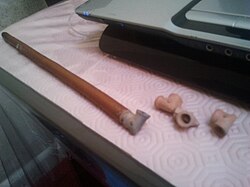
A sebsi or sibsi (Berber: ⵙⴱⵙⵉ) is a traditional Moroccan cannabis pipe with a narrow clay bowl called a skuff (or shkaff), with a fine metal screen. To this a hardwood stem is attached, which may be up to 46 cm (18 in) long.
The sebsi has traditionally been used to smoke kief, which in Morocco refers to the best parts of the cannabis finely chopped and mixed with tobacco or other herbs.[1] The sebsi provides a small, low-temperature serving of herb (usually about 25 mg), compared with larger traditional smoking devices like the chillum of India and Jamaica.[2]
References
[edit]
- ^ "Moroccan hashish journey". Cannabis Culture. 2003-05-21. Retrieved 2020-07-19.
- ^ 2006 World Drug Report: Analysis. United Nations Publications. 1 January 2006. pp. 2120–. ISBN 978-92-1-148214-0.
 | This Cannabis-related article is a stub. You can help Wikipedia by adding missing information. |
 | This Morocco-related article is a stub. You can help Wikipedia by adding missing information. |
Sebsi
View on GrokipediaEtymology and Terminology
Origin of the Name
The term "sebsi" originates from Moroccan Arabic سبسي (sabsi), a masculine noun referring to a traditional cannabis pipe, with the plural form سباسى (sbāsa).[3] This Arabic form is derived from Ottoman Turkish *صاپسی (sapsı), itself a compound of صاپ (sap, meaning a pipe or tube) and the suffix ـسی (-sı), reflecting historical linguistic exchanges in the Ottoman Empire's influence across North Africa.[3] The pronunciation in Moroccan Arabic is /səb.si/, emphasizing its integration into local dialects.[3] In Berber languages spoken in Morocco, the word appears as ⵙⴱⵙⵉ (sebsi), denoting a small pipe or smoking device, likely borrowed from Arabic due to the region's multilingual history where Berber communities adopted Arabic terms for everyday objects. This adaptation underscores the shared cultural lexicon in North Africa, where Berber speakers in the Rif and Atlas regions use it to describe the instrument associated with kif smoking. By the early 20th century, "sebsi" had become a standard reference in ethnographic works on Moroccan society, reflecting its entrenched place in regional terminology.[4]Variations and Regional Terms
The term "sebsi" exhibits several spelling variations in transliterations from Moroccan Arabic (Darija), including sebsi, sibsi, sabsi, and sebse, reflecting differences in phonetic rendering across linguistic contexts.[5] In Darija, it is typically pronounced as /səb.si/, with a short central vowel and emphasis on the initial syllable, while Berber influences introduce subtle dialectical shifts, such as a more guttural articulation in Rif-speaking communities. The Berber script form ⵙⴱⵙⵉ underscores its indigenous North African origins.[6] Regional terminology varies by dialect and locale within Morocco. In the Rif region of northern Morocco, where kif cultivation is prominent, the narrow clay bowl component is known as "skuff" (or shkaff) in local Berber-influenced speech.[7] This term highlights the pipe's modular design in everyday parlance among Rifians. The sebsi appears in Western literature depicting Moroccan life, notably in Paul Bowles' 1952 novel Let It Come Down, where it is portrayed as a long wooden pipe integral to social scenes in Tangier.[8] Similarly, Bowles' travel writings, such as Their Heads Are Green and Their Hands Are Blue (1963), reference the sebsi in descriptions of Rif mountain customs.[9] In Moroccan oral traditions and folklore, it is often simply called the "pipe du kif," emphasizing its association with the cannabis-tobacco mixture rather than the object itself.[10] To avoid confusion, the sebsi differs from the midwakh, a compact Arabian pipe used for smoking dokha tobacco in the Gulf region, and the chicha (or shisha), a water-cooled pipe prevalent across the broader Middle East and North Africa for communal tobacco sessions.[11]Design and Construction
Key Components
The sebsi pipe consists of a long, narrow wooden stem, typically measuring 20–45 cm in length, which serves to cool the smoke during inhalation and allows for controlled, measured draws.[7] This shaft is crafted from woods such as those derived from Jasminum fruticans L., Nerium oleander L., or Viburnum tinus L., enabling efficient smoke passage while maintaining portability.[7] At one end of the stem is the bowl, known as the chkaf (or variations like skuff or shkaff), a small clay chamber with a diameter of approximately 1–2 cm and a volume of about 1.0 cm³.[7][12] This compact design facilitates the precise packing of small quantities of material, typically yielding 2–3 inhalations per load, which supports controlled consumption.[7][12] Within the bowl sits a fine metal screen, commonly made of brass or steel mesh and often added to prevent ash and debris from being inhaled while regulating the burn rate for a smoother draw.[13] The opposite end features a simple mouthpiece, typically a carved wooden or reed tip shaped for comfort during extended use, contributing to the pipe's ergonomic functionality.[14] Overall, the sebsi is engineered for compactness and portability, optimized for one-handed operation and easy transport in traditional Moroccan settings.Materials and Manufacturing
The traditional sebsi pipe is crafted from locally sourced natural materials selected for their heat resistance, durability, and ability to impart minimal flavor to the smoke. The stem, which forms the long, slender body of the pipe, is primarily made from hardwoods such as almond, walnut, apricot, or olive wood, valued for their density and structural integrity during repeated use.[14] In some cases, lighter reed-like woods harvested from riverbanks are employed for more affordable variants. These woods ensure the pipe remains lightweight yet robust, typically measuring 20-45 cm in length.[14][7] The bowl, referred to as the skuff, is traditionally fashioned from red clay, often gathered from northern Moroccan soils.[13] This clay is molded by hand into the narrow, conical shape characteristic of the sebsi, allowing for precise loading of small amounts of material. Variations include bowls made from bone, stone, or other materials. The fine metal screen that fits within the bowl is a mesh that filters ash while permitting airflow.[13] Manufacturing remains a labor-intensive, artisanal process rooted in generational knowledge, with stems hand-carved using simple knives or small lathes to hollow out the wood and shape its ergonomic form.[14] Clay bowls are formed manually and fired in kilns to achieve hardness without cracking, a technique that hardens the material at elevated temperatures while preserving its porosity for even burning. Assembly occurs without modern adhesives, relying instead on tight friction fits between the wooden stem and the bowl or metal components, ensuring the pipe can be easily disassembled for cleaning. Ouezzane, a town in northern Morocco, serves as a renowned hub for sebsi production, where family-operated workshops in the medina continue to refine these methods through apprenticeship traditions passed down over generations.[15] These artisans produce pipes tailored to local preferences, emphasizing functionality and subtle decorative engravings.History
Introduction to Morocco
The introduction of cannabis to Morocco is believed to have occurred during the Arab invasions between the 7th and 15th centuries, coinciding with the initial cultivation practices in the northern Rif region, where the plant adapted to the local mountainous terrain.[16] This period marked the gradual integration of cannabis, known locally as kif, into North African agricultural and cultural landscapes, likely brought by Arab conquerors or traders from the east.[17] Although early textual references to its use in the Maghreb appear later, around the 10th century via pilgrimages or conquests, the Rif's isolation facilitated its establishment among indigenous communities before broader dissemination.[17] The sebsi has been part of Moroccan smoking traditions for several centuries, with documented use of similar pipes for kif appearing by the 18th-19th centuries. Tobacco was introduced to the region around the late 16th century, and these early variants were simple clay-bowled instruments, adapted for inhaling mixtures of herbs and emerging kif preparations, predating the more standardized designs associated with cannabis-specific use.[18] The term "sebsi" itself stems from Berber linguistic roots, underscoring its indigenous adaptation (detailed in Etymology and Terminology). By the 18th-19th centuries, pipes like the sebsi were used in Rif Berber communities for smoking mixtures of tobacco and kif, building on earlier herbal and tobacco practices introduced in the region.[18] Origins were firmly tied to the Rif Mountains, the heartland of Berber (Amazigh) tribes such as the Ketama, where cultivation and pipe use remained localized for self-consumption until the 18th century.[17] By this time, trade and migration had spread the practice to urban centers like Fez, integrating sebsi smoking into medina life among artisans and merchants, though it retained its rural Berber essence.[2]Historical Evolution
The sebsi, a traditional Moroccan pipe for smoking kif—a mixture of cannabis resin or pollen and tobacco—gained prominence in the 19th century as a cultural artifact among rural farmers and communities in the Rif, where it was used in social contexts. European colonial observers documented its widespread adoption during this period, noting its role in daily life across Morocco's agrarian communities. This popularization coincided with the expansion of cannabis cultivation in the Rif region, encouraged by Spanish colonial influences to maintain social stability among local populations.[19][20] During the French Protectorate from 1912 to 1956, authorities imposed restrictions on cannabis, culminating in a 1932 ban on cultivation and trade to align with international opium conventions and curb perceived social vices. Despite these suppression efforts, sebsi use persisted underground, particularly in the Rif Mountains, during colonial suppression, including the period of the Rif War (1921–1926). The pipe's simple design allowed discreet consumption in remote areas, sustaining kif traditions even as French policies aimed to eradicate the practice through enforcement and crop substitution programs.[21] Following Morocco's independence in 1956, the new government reinforced the cannabis ban as part of modernization efforts, yet the sebsi became embedded in national cultural identity, evoking Berber heritage and rural resilience. The 1960s and 1970s saw a surge in artisanal sebsi production, driven by international tourism and the hippie counterculture's fascination with Moroccan kif, which elevated the pipe as a symbol of exotic authenticity in global markets.[19][22] In the 20th century, practical adaptations enhanced the sebsi's functionality, including the incorporation of fine metal screens in the clay bowl (skuff) to filter residues and optimize burning, a feature that became standard amid fluctuating kif availability during colonial shortages. By the 1980s, intensified domestic enforcement and international pressure led to temporary declines in open use and production, though clandestine networks maintained the tradition. The sebsi's revival accelerated with the 2021 passage of Law 13-21, legalizing cannabis for medical and industrial purposes. As of 2025, implementation of the law has included approvals for 67 cannabis-based products, spurring renewed interest in traditional tools like the sebsi within regulated cultural and therapeutic contexts.[19][2][23]Usage and Cultural Significance
Traditional Practices
The preparation of kif for smoking in a sebsi begins with mixing finely chopped cannabis flowers or resin with tobacco, typically in a 2:1 ratio of cannabis to tobacco, which is then dried and crushed to a powder-like consistency.[7][24] This mixture, known as kif, is packed into the small bowl, or skuff, of the sebsi pipe, a narrow wooden instrument traditionally 20-40 cm long.[7][24] Lighting the sebsi involves the initial user filling the skuff and igniting the kif, often using a match to start the burn before passing it along. The smoking technique emphasizes short, frequent draws of 2-4 puffs per turn to ensure an even burn and maximize the psychotropic effects, with the pipe emptied of ashes by skilled blowing before repacking.[7] This process is communal, with the sebsi passed in small groups where participants share turns, fostering social interaction around tables in cafes or homes.[24] In daily routines among Rif farmers and locals, sebsi smoking serves as a relaxing ritual after labor-intensive work, integrated as a habitual practice to unwind and demonstrate the quality of one's kif supply. These sessions typically involve multiple rounds of sharing the pipe, creating extended communal gatherings that promote relaxation and conversation. Within Sufi brotherhoods, sebsi smoking forms part of dhikr ceremonies, where kif enhances spiritual focus and induces ecstatic states of remembrance of God.[19] Such rituals integrate the pipe's use to deepen meditative insight during these mystical practices.[19] Social gatherings featuring sebsi smoking often pair the pipe with mint tea and traditional music, creating a multisensory experience that complements the relaxation and communal bonding.[19]Social and Symbolic Roles
The sebsi holds profound symbolic value in Moroccan culture, particularly among the Berber communities of the Rif region, where it embodies local identity, autonomy, and historical resistance against external prohibitions on cannabis use. Tied to the Rif's long-standing cannabis cultivation traditions dating back several centuries, the sebsi and kif smoking represent a form of cultural defiance, as evidenced by the 1958 uprising in the Rif against government bans, which highlighted kif's role in communal solidarity and regional heritage.[4] Socially, the sebsi facilitates bonding in male-dominated gatherings, serving as a centerpiece in evening rituals among artisans, merchants, and friends in cafes, medinas, or homes, where it accompanies tea or coffee to foster conversation and hospitality. This practice, rooted in centuries-old norms, promotes communal knowledge-sharing and reinforces social ties without historical stigma, though its use has evolved from pipes to joints among younger groups since the 1960s.[25] Use is primarily associated with men, reflecting gender disparities in cannabis consumption in Morocco, where surveys indicate higher prevalence among males.[26] The sebsi's role reflects broader societal dynamics, with the 2021 legalization of medical and industrial cannabis potentially influencing cultural perceptions of traditional practices as of 2025. In literature and media, the sebsi recurs as a motif of leisure and subtle rebellion, notably in Paul Bowles's works depicting Moroccan life, such as scenes of intimate kif sessions in Tangier that evoke exoticism and cultural immersion. Featured in 20th-century narratives and journalistic accounts, like Simon Martelli's 2013 report on thriving Rif kif culture, it underscores themes of tradition amid modernization.[27][4]Modern Context
Production and Availability
The production of sebsi pipes remains a vital artisanal craft in Morocco's Rif region, particularly in workshops located in Ouezzane and Chefchaouen, where skilled craftsmen fashion these traditional smoking instruments from local woods.[15][4] Sebsi pipes are traded through local souks in the Rif and increasingly via online platforms such as Etsy, with typical prices ranging from 5 to 20 USD per pipe depending on materials and craftsmanship. Export occurs primarily as cultural artifacts, reaching international buyers interested in Moroccan heritage items.[28][14] Tourism significantly influences sebsi availability, with pipes commonly sold as souvenirs in Chefchaouen and Ouezzane medinas, attracting visitors to the blue city and green medina for authentic Rif artifacts.[29]Legal Status
In Morocco, Law No. 13-21, promulgated in July 2021, legalized the cultivation, production, and export of cannabis exclusively for medical, pharmaceutical, and industrial purposes, while explicitly prohibiting recreational use and consumption.[30][31] As a traditional pipe associated with smoking kif—a mixture of cannabis and tobacco—sebsi falls under prohibitions on drug paraphernalia linked to illicit recreational activities, with possession typically resulting in fines ranging from 500 to 5,000 Moroccan dirhams (approximately USD 50 to 500) or imprisonment up to one year, depending on the circumstances and quantity involved.[32][33] Enforcement of these regulations has seen targeted implementation in the Rif region, where cannabis cultivation has historically been prevalent. Since 2023, pilot programs under the National Agency for the Regulation of Cannabis Activities (ANRAC) have authorized licensed cultivation for non-recreational purposes, with over 5,000 farmers participating by 2025 (reaching 5,493 as of October 2025), up from 430 in 2023; however, public smoking or personal use remains strictly illegal, with authorities conducting raids to curb unlicensed activities.[34][35][36] Globally, sebsi is classified as drug paraphernalia in most countries due to its association with cannabis, a Schedule I controlled substance under frameworks like the United Nations Single Convention on Narcotic Drugs. In the United States, federal law prohibits the sale, distribution, or possession of such items intended for illegal drug use, with penalties including fines and up to three years' imprisonment for trafficking paraphernalia. Exceptions exist in jurisdictions with legalized recreational cannabis, such as Canada, where pipes like sebsi are legally available for purchase and use following the 2018 Cannabis Act, provided they comply with provincial sales restrictions.[37][38] In 2025, UNESCO's Mondiacult conference spotlighted cannabis in global cultural policy for the first time, marking 100 years since its international prohibition, though no formal exemptions for traditional tools like sebsi were granted.[39] By 2025, expansions in Morocco's industrial hemp sector—encompassing low-THC cannabis varieties for fiber and other non-psychoactive applications—have bolstered the legal framework under Law 13-21, indirectly supporting artisanal communities by integrating traditional crafts into regulated supply chains and reducing stigma around cannabis-related heritage items.[40][41]References
- https://en.wiktionary.org/wiki/%D8%B3%D8%A8%D8%B3%D9%8A
- https://en.wiktionary.org/wiki/sebsi