Recent from talks
Nothing was collected or created yet.
Selection algorithm
View on WikipediaIn computer science, a selection algorithm is an algorithm for finding the th smallest value in a collection of ordered values, such as numbers. The value that it finds is called the th order statistic. Selection includes as special cases the problems of finding the minimum, median, and maximum element in the collection. Selection algorithms include quickselect, and the median of medians algorithm. When applied to a collection of values, these algorithms take linear time, as expressed using big O notation. For data that is already structured, faster algorithms may be possible; as an extreme case, selection in an already-sorted array takes time .
Problem statement
[edit]An algorithm for the selection problem takes as input a collection of values, and a number . It outputs the th smallest of these values, or, in some versions of the problem, a collection of the smallest values. For this to be well-defined, it should be possible to sort the values into an order from smallest to largest; for instance, they may be integers, floating-point numbers, or some other kind of object with a numeric key. However, they are not assumed to have been already sorted. Often, selection algorithms are restricted to a comparison-based model of computation, as in comparison sort algorithms, where the algorithm has access to a comparison operation that can determine the relative ordering of any two values, but may not perform any other kind of arithmetic operations on these values.[1]
To simplify the problem, some works on this problem assume that the values are all distinct from each other,[2] or that some consistent tie-breaking method has been used to assign an ordering to pairs of items with the same value as each other. Another variation in the problem definition concerns the numbering of the ordered values: is the smallest value obtained by setting , as in zero-based numbering of arrays, or is it obtained by setting , following the usual English-language conventions for the smallest, second-smallest, etc.? This article follows the conventions used by Cormen et al., according to which all values are distinct and the minimum value is obtained from .[2]
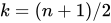
With these conventions, the maximum value, among a collection of values, is obtained by setting . When is an odd number, the median of the collection is obtained by setting . When is even, there are two choices for the median, obtained by rounding this choice of down or up, respectively: the lower median with and the upper median with .[2]
Algorithms
[edit]Sorting and heapselect
[edit]As a baseline algorithm, selection of the th smallest value in a collection of values can be performed by the following two steps:
- Sort the collection
- If the output of the sorting algorithm is an array, retrieve its th element; otherwise, scan the sorted sequence to find the th element.
The time for this method is dominated by the sorting step, which requires time using a comparison sort.[2][3] Even when integer sorting algorithms may be used, these are generally slower than the linear time that may be achieved using specialized selection algorithms. Nevertheless, the simplicity of this approach makes it attractive, especially when a highly-optimized sorting routine is provided as part of a runtime library, but a selection algorithm is not. For inputs of moderate size, sorting can be faster than non-random selection algorithms, because of the smaller constant factors in its running time.[4] This method also produces a sorted version of the collection, which may be useful for other later computations, and in particular for selection with other choices of .[3]
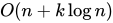
For a sorting algorithm that generates one item at a time, such as selection sort, the scan can be done in tandem with the sort, and the sort can be terminated once the th element has been found. One possible design of a consolation bracket in a single-elimination tournament, in which the teams who lost to the eventual winner play another mini-tournament to determine second place, can be seen as an instance of this method.[5] Applying this optimization to heapsort produces the heapselect algorithm, which can select the th smallest value in time .[6] This is fast when is small relative to , but degenerates to for larger values of , such as the choice used for median finding.
Pivoting
[edit]Many methods for selection are based on choosing a special "pivot" element from the input, and using comparisons with this element to divide the remaining input values into two subsets: the set of elements less than the pivot, and the set of elements greater than the pivot. The algorithm can then determine where the th smallest value is to be found, based on a comparison of with the sizes of these sets. In particular, if , the th smallest value is in , and can be found recursively by applying the same selection algorithm to . If , then the th smallest value is the pivot, and it can be returned immediately. In the remaining case, the th smallest value is in , and more specifically it is the element in position of . It can be found by applying a selection algorithm recursively, seeking the value in this position in .[7]
As with the related pivoting-based quicksort algorithm, the partition of the input into and may be done by making new collections for these sets, or by a method that partitions a given list or array data type in-place. Details vary depending on how the input collection is represented.[8] The time to compare the pivot against all the other values is .[7] However, pivoting methods differ in how they choose the pivot, which affects how big the subproblems in each recursive call will be. The efficiency of these methods depends greatly on the choice of the pivot. If the pivot is chosen badly, the running time of this method can be as slow as .[4]
- If the pivot were exactly at the median of the input, then each recursive call would have at most half as many values as the previous call, and the total times would add in a geometric series to . However, finding the median is itself a selection problem, on the entire original input. Trying to find it by a recursive call to a selection algorithm would lead to an infinite recursion, because the problem size would not decrease in each call.[7]
- Quickselect chooses the pivot uniformly at random from the input values. It can be described as a prune and search algorithm,[9] a variant of quicksort, with the same pivoting strategy, but where quicksort makes two recursive calls to sort the two subcollections and , quickselect only makes one of these two calls. Its expected time is .[2][7][9] For any constant , the probability that its number of comparisons exceeds is superexponentially small in .[10]
- The Floyd–Rivest algorithm, a variation of quickselect, chooses a pivot by randomly sampling a subset of data values, for some sample size , and then recursively selecting two elements somewhat above and below position of the sample to use as pivots. With this choice, it is likely that is sandwiched between the two pivots, so that after pivoting only a small number of data values between the pivots are left for a recursive call. This method can achieve an expected number of comparisons that is .[11] In their original work, Floyd and Rivest claimed that the term could be made as small as by a recursive sampling scheme, but the correctness of their analysis has been questioned.[12][13] Instead, more rigorous analysis has shown that a version of their algorithm achieves for this term.[14] Although the usual analysis of both quickselect and the Floyd–Rivest algorithm assumes the use of a true random number generator, a version of the Floyd–Rivest algorithm using a pseudorandom number generator seeded with only logarithmically many true random bits has been proven to run in linear time with high probability.[15]

- The median of medians method partitions the input into sets of five elements, and uses some other non-recursive method to find the median of each of these sets in constant time per set. It then recursively calls itself to find the median of these medians. Using the resulting median of medians as the pivot produces a partition with . Thus, a problem on elements is reduced to two recursive problems on elements (to find the pivot) and at most elements (after the pivot is used). The total size of these two recursive subproblems is at most , allowing the total time to be analyzed as a geometric series adding to . Unlike quickselect, this algorithm is deterministic, not randomized.[2][4][5] It was the first linear-time deterministic selection algorithm known,[5] and is commonly taught in undergraduate algorithms classes as an example of a divide and conquer that does not divide into two equal subproblems.[2][4][9][16] However, the high constant factors in its time bound make it slower than quickselect in practice,[3][9] and slower even than sorting for inputs of moderate size.[4]
- Hybrid algorithms such as introselect can be used to achieve the practical performance of quickselect with a fallback to medians of medians guaranteeing worst-case time.[17]
Factories
[edit]The deterministic selection algorithms with the smallest known numbers of comparisons, for values of that are far from or , are based on the concept of factories, introduced in 1976 by Arnold Schönhage, Mike Paterson, and Nick Pippenger.[18] These are methods that build partial orders of certain specified types, on small subsets of input values, by using comparisons to combine smaller partial orders. As a very simple example, one type of factory can take as input a sequence of single-element partial orders, compare pairs of elements from these orders, and produce as output a sequence of two-element totally ordered sets. The elements used as the inputs to this factory could either be input values that have not been compared with anything yet, or "waste" values produced by other factories. The goal of a factory-based algorithm is to combine together different factories, with the outputs of some factories going to the inputs of others, in order to eventually obtain a partial order in which one element (the th smallest) is larger than some other elements and smaller than another others. A careful design of these factories leads to an algorithm that, when applied to median-finding, uses at most comparisons. For other values of , the number of comparisons is smaller.[19]
Parallel algorithms
[edit]Parallel algorithms for selection have been studied since 1975, when Leslie Valiant introduced the parallel comparison tree model for analyzing these algorithms, and proved that in this model selection using a linear number of comparisons requires parallel steps, even for selecting the minimum or maximum.[20] Researchers later found parallel algorithms for selection in steps, matching this bound.[21][22] In a randomized parallel comparison tree model it is possible to perform selection in a bounded number of steps and a linear number of comparisons.[23] On the more realistic parallel RAM model of computing, with exclusive read exclusive write memory access, selection can be performed in time with processors, which is optimal both in time and in the number of processors.[24] With concurrent memory access, slightly faster parallel time is possible in general,[25] and the term in the time bound can be replaced by .[26]
Sublinear data structures
[edit]When data is already organized into a data structure, it may be possible to perform selection in an amount of time that is sublinear in the number of values. As a simple case of this, for data already sorted into an array, selecting the th element may be performed by a single array lookup, in constant time.[27] For values organized into a two-dimensional array of size , with sorted rows and columns, selection may be performed in time , or faster when is small relative to the array dimensions.[27][28] For a collection of one-dimensional sorted arrays, with items less than the selected item in the th array, the time is .[28]
Selection from data in a binary heap takes time . This is independent of the size of the heap, and faster than the time bound that would be obtained from best-first search.[28][29] This same method can be applied more generally to data organized as any kind of heap-ordered tree (a tree in which each node stores one value in which the parent of each non-root node has a smaller value than its child). This method of performing selection in a heap has been applied to problems of listing multiple solutions to combinatorial optimization problems, such as finding the k shortest paths in a weighted graph, by defining a state space of solutions in the form of an implicitly defined heap-ordered tree, and then applying this selection algorithm to this tree.[30] In the other direction, linear time selection algorithms have been used as a subroutine in a priority queue data structure related to the heap, improving the time for extracting its th item from to ; here is the iterated logarithm.[31]
For a collection of data values undergoing dynamic insertions and deletions, the order statistic tree augments a self-balancing binary search tree structure with a constant amount of additional information per tree node, allowing insertions, deletions, and selection queries that ask for the th element in the current set to all be performed in time per operation.[2] Going beyond the comparison model of computation, faster times per operation are possible for values that are small integers, on which binary arithmetic operations are allowed.[32] It is not possible for a streaming algorithm with memory sublinear in both and to solve selection queries exactly for dynamic data, but the count–min sketch can be used to solve selection queries approximately, by finding a value whose position in the ordering of the elements (if it were added to them) would be within steps of , for a sketch whose size is within logarithmic factors of .[33]
Lower bounds
[edit]The running time of the selection algorithms described above is necessary, because a selection algorithm that can handle inputs in an arbitrary order must take that much time to look at all of its inputs. If any one of its input values is not compared, that one value could be the one that should have been selected, and the algorithm can be made to produce an incorrect answer.[28] Beyond this simple argument, there has been a significant amount of research on the exact number of comparisons needed for selection, both in the randomized and deterministic cases.
Selecting the minimum of values requires comparisons, because the values that are not selected must each have been determined to be non-minimal, by being the largest in some comparison, and no two of these values can be largest in the same comparison. The same argument applies symmetrically to selecting the maximum.[14]
The next simplest case is selecting the second-smallest. After several incorrect attempts, the first tight lower bound on this case was published in 1964 by Soviet mathematician Sergey Kislitsyn. It can be shown by observing that selecting the second-smallest also requires distinguishing the smallest value from the rest, and by considering the number of comparisons involving the smallest value that an algorithm for this problem makes. Each of the items that were compared to the smallest value is a candidate for second-smallest, and of these values must be found larger than another value in a second comparison in order to rule them out as second-smallest. With values being the larger in at least one comparison, and values being the larger in at least two comparisons, there are a total of at least comparisons. An adversary argument, in which the outcome of each comparison is chosen in order to maximize (subject to consistency with at least one possible ordering) rather than by the numerical values of the given items, shows that it is possible to force to be at least . Therefore, the worst-case number of comparisons needed to select the second smallest is , the same number that would be obtained by holding a single-elimination tournament with a run-off tournament among the values that lost to the smallest value. However, the expected number of comparisons of a randomized selection algorithm can be better than this bound; for instance, selecting the second-smallest of six elements requires seven comparisons in the worst case, but may be done by a randomized algorithm with an expected number of 6.5 comparisons.[14]
More generally, selecting the th element out of requires at least comparisons, in the average case, matching the number of comparisons of the Floyd–Rivest algorithm up to its term. The argument is made directly for deterministic algorithms, with a number of comparisons that is averaged over all possible permutations of the input values.[1] By Yao's principle, it also applies to the expected number of comparisons for a randomized algorithm on its worst-case input.[34]
For deterministic algorithms, it has been shown that selecting the th element requires comparisons, where is the binary entropy function.[35] The special case of median-finding has a slightly larger lower bound on the number of comparisons, at least , for .[36]
Exact numbers of comparisons
[edit]
Knuth supplies the following triangle of numbers summarizing pairs of and for which the exact number of comparisons needed by an optimal selection algorithm is known. The th row of the triangle (starting with in the top row) gives the numbers of comparisons for inputs of values, and the th number within each row gives the number of comparisons needed to select the th smallest value from an input of that size. The rows are symmetric because selecting the th smallest requires exactly the same number of comparisons, in the worst case, as selecting the th largest.[14]
Most, but not all, of the entries on the left half of each row can be found using the formula This describes the number of comparisons made by a method of Abdollah Hadian and Milton Sobel, related to heapselect, that finds the smallest value using a single-elimination tournament and then repeatedly uses a smaller tournament among the values eliminated by the eventual tournament winners to find the next successive values until reaching the th smallest.[14][37] Some of the larger entries were proven to be optimal using a computer search.[14][38]
Language support
[edit]Very few languages have built-in support for general selection, although many provide facilities for finding the smallest or largest element of a list. Notable exceptions are the standard libraries of C++ and Rust. The Standard Template Library of C++ provides a templated nth_element method with a guarantee of expected linear time.[3] Rust's standard library provides multiple variants of the select_nth_unstable member function for the slice data type. These variants all have guaranteed linear running time for all inputs.[39]
Python's standard library includes heapq.nsmallest and heapq.nlargest functions for returning the smallest or largest elements from a collection, in sorted order. The implementation maintains a binary heap, limited to holding elements, and initialized to the first elements in the collection. Then, each subsequent item of the collection may replace the largest or smallest element in the heap if it is smaller or larger than this element. The algorithm's memory usage is superior to heapselect (the former only holds elements in memory at a time while the latter requires manipulating the entire dataset into memory). Running time depends on data ordering. The best case is for already sorted data. The worst-case is for reverse sorted data. In average cases, there are likely to be few heap updates and most input elements are processed with only a single comparison. For example, extracting the 100 largest or smallest values out of 10,000,000 random inputs makes 10,009,401 comparisons on average.[40]
Since 2017, Matlab has included maxk() and mink() functions, which return the maximal (minimal) values in a vector as well as their indices. The Matlab documentation does not specify which algorithm these functions use or what their running time is.[41]
History
[edit]Quickselect was presented without analysis by Tony Hoare in 1965,[42] and first analyzed in a 1971 technical report by Donald Knuth.[11] The first known linear time deterministic selection algorithm is the median of medians method, published in 1973 by Manuel Blum, Robert W. Floyd, Vaughan Pratt, Ron Rivest, and Robert Tarjan.[5] They trace the formulation of the selection problem to work of Charles L. Dodgson (better known as Lewis Carroll) who in 1883 pointed out that the usual design of single-elimination sports tournaments does not guarantee that the second-best player wins second place,[5][43] and to work of Hugo Steinhaus circa 1930, who followed up this same line of thought by asking for a tournament design that can make this guarantee, with a minimum number of games played (that is, comparisons).[5]
See also
[edit]- Geometric median § Computation, algorithms for higher-dimensional generalizations of medians
- Median filter, application of median-finding algorithms in image processing
References
[edit]- ^ a b Cunto, Walter; Munro, J. Ian (1989). "Average case selection". Journal of the ACM. 36 (2): 270–279. doi:10.1145/62044.62047. MR 1072421. S2CID 10947879.
- ^ a b c d e f g h Cormen, Thomas H.; Leiserson, Charles E.; Rivest, Ronald L.; Stein, Clifford (2009) [1990]. "Chapter 9: Medians and order statistics". Introduction to Algorithms (3rd ed.). MIT Press and McGraw-Hill. pp. 213–227. ISBN 0-262-03384-4.; "Section 14.1: Dynamic order statistics", pp. 339–345
- ^ a b c d Skiena, Steven S. (2020). "17.3: Median and selection". The Algorithm Design Manual. Texts in Computer Science (Third ed.). Springer. pp. 514–516. doi:10.1007/978-3-030-54256-6. ISBN 978-3-030-54255-9. MR 4241430. S2CID 22382667.
- ^ a b c d e Erickson, Jeff (June 2019). "1.8: Linear-time selection". Algorithms. pp. 35–39.
- ^ a b c d e f Blum, Manuel; Floyd, Robert W.; Pratt, Vaughan; Rivest, Ronald L.; Tarjan, Robert E. (1973). "Time bounds for selection" (PDF). Journal of Computer and System Sciences. 7 (4): 448–461. doi:10.1016/S0022-0000(73)80033-9. MR 0329916.
- ^ Brodal, Gerth Stølting (2013). "A survey on priority queues". In Brodnik, Andrej; López-Ortiz, Alejandro; Raman, Venkatesh; Viola, Alfredo (eds.). Space-Efficient Data Structures, Streams, and Algorithms – Papers in Honor of J. Ian Munro on the Occasion of His 66th Birthday. Lecture Notes in Computer Science. Vol. 8066. Springer. pp. 150–163. doi:10.1007/978-3-642-40273-9_11. ISBN 978-3-642-40272-2.
- ^ a b c d Kleinberg, Jon; Tardos, Éva (2006). "13.5 Randomized divide and conquer: median-finding and quicksort". Algorithm Design. Addison-Wesley. pp. 727–734. ISBN 9780321295354.
- ^ For instance, Cormen et al. use an in-place array partition, while Kleinberg and Tardos describe the input as a set and use a method that partitions it into two new sets.
- ^ a b c d Goodrich, Michael T.; Tamassia, Roberto (2015). "9.2: Selection". Algorithm Design and Applications. Wiley. pp. 270–275. ISBN 978-1-118-33591-8.
- ^ Devroye, Luc (1984). "Exponential bounds for the running time of a selection algorithm" (PDF). Journal of Computer and System Sciences. 29 (1): 1–7. doi:10.1016/0022-0000(84)90009-6. MR 0761047. Devroye, Luc (2001). "On the probabilistic worst-case time of 'find'" (PDF). Algorithmica. 31 (3): 291–303. doi:10.1007/s00453-001-0046-2. MR 1855252. S2CID 674040.
- ^ a b Floyd, Robert W.; Rivest, Ronald L. (March 1975). "Expected time bounds for selection". Communications of the ACM. 18 (3): 165–172. doi:10.1145/360680.360691. S2CID 3064709. See also "Algorithm 489: the algorithm SELECT—for finding the th smallest of elements", p. 173, doi:10.1145/360680.360694.
- ^ Brown, Theodore (September 1976). "Remark on Algorithm 489". ACM Transactions on Mathematical Software. 2 (3): 301–304. doi:10.1145/355694.355704. S2CID 13985011.
- ^ Postmus, J. T.; Rinnooy Kan, A. H. G.; Timmer, G. T. (1983). "An efficient dynamic selection method". Communications of the ACM. 26 (11): 878–881. doi:10.1145/182.358440. MR 0784120. S2CID 3211474.
- ^ a b c d e f Knuth, Donald E. (1998). "Section 5.3.3: Minimum-comparison selection". The Art of Computer Programming, Volume 3: Sorting and Searching (2nd ed.). Addison-Wesley. pp. 207–219. ISBN 0-201-89685-0.
- ^ Karloff, Howard J.; Raghavan, Prabhakar (1993). "Randomized algorithms and pseudorandom numbers". Journal of the ACM. 40 (3): 454–476. doi:10.1145/174130.174132. MR 1370358. S2CID 17956460.
- ^ Gurwitz, Chaya (1992). "On teaching median-finding algorithms". IEEE Transactions on Education. 35 (3): 230–232. Bibcode:1992ITEdu..35..230G. doi:10.1109/13.144650.
- ^ Musser, David R. (August 1997). "Introspective sorting and selection algorithms". Software: Practice and Experience. 27 (8). Wiley: 983–993. doi:10.1002/(sici)1097-024x(199708)27:8<983::aid-spe117>3.0.co;2-#.
- ^ Schönhage, A.; Paterson, M.; Pippenger, N. (1976). "Finding the median". Journal of Computer and System Sciences. 13 (2): 184–199. doi:10.1016/S0022-0000(76)80029-3. MR 0428794. S2CID 29867292.
- ^ Dor, Dorit; Zwick, Uri (1999). "Selecting the median". SIAM Journal on Computing. 28 (5): 1722–1758. doi:10.1137/S0097539795288611. MR 1694164. S2CID 2633282.
- ^ Valiant, Leslie G. (1975). "Parallelism in comparison problems". SIAM Journal on Computing. 4 (3): 348–355. doi:10.1137/0204030. MR 0378467.
- ^ Ajtai, Miklós; Komlós, János; Steiger, W. L.; Szemerédi, Endre (1989). "Optimal parallel selection has complexity ". Journal of Computer and System Sciences. 38 (1): 125–133. doi:10.1016/0022-0000(89)90035-4. MR 0990052.
- ^ Azar, Yossi; Pippenger, Nicholas (1990). "Parallel selection". Discrete Applied Mathematics. 27 (1–2): 49–58. doi:10.1016/0166-218X(90)90128-Y. MR 1055590.
- ^ Reischuk, Rüdiger (1985). "Probabilistic parallel algorithms for sorting and selection". SIAM Journal on Computing. 14 (2): 396–409. doi:10.1137/0214030. MR 0784745.
- ^ Han, Yijie (2007). "Optimal parallel selection". ACM Transactions on Algorithms. 3 (4): A38:1–A38:11. doi:10.1145/1290672.1290675. MR 2364962. S2CID 9645870.
- ^ Chaudhuri, Shiva; Hagerup, Torben; Raman, Rajeev (1993). "Approximate and exact deterministic parallel selection". In Borzyszkowski, Andrzej M.; Sokolowski, Stefan (eds.). Mathematical Foundations of Computer Science 1993, 18th International Symposium, MFCS'93, Gdansk, Poland, August 30 – September 3, 1993, Proceedings. Lecture Notes in Computer Science. Vol. 711. Springer. pp. 352–361. doi:10.1007/3-540-57182-5_27. hdl:11858/00-001M-0000-0014-B748-C. ISBN 978-3-540-57182-7.
- ^ Dietz, Paul F.; Raman, Rajeev (1999). "Small-rank selection in parallel, with applications to heap construction". Journal of Algorithms. 30 (1): 33–51. doi:10.1006/jagm.1998.0971. MR 1661179.
- ^ a b Frederickson, Greg N.; Johnson, Donald B. (1984). "Generalized selection and ranking: sorted matrices". SIAM Journal on Computing. 13 (1): 14–30. doi:10.1137/0213002. MR 0731024.
- ^ a b c d Kaplan, Haim; Kozma, László; Zamir, Or; Zwick, Uri (2019). "Selection from heaps, row-sorted matrices, and using soft heaps". In Fineman, Jeremy T.; Mitzenmacher, Michael (eds.). 2nd Symposium on Simplicity in Algorithms, SOSA 2019, January 8–9, 2019, San Diego, CA, USA. OASIcs. Vol. 69. Schloss Dagstuhl – Leibniz-Zentrum für Informatik. pp. 5:1–5:21. arXiv:1802.07041. doi:10.4230/OASIcs.SOSA.2019.5.
- ^ Frederickson, Greg N. (1993). "An optimal algorithm for selection in a min-heap". Information and Computation. 104 (2): 197–214. doi:10.1006/inco.1993.1030. MR 1221889.
- ^ Eppstein, David (1999). "Finding the shortest paths". SIAM Journal on Computing. 28 (2): 652–673. doi:10.1137/S0097539795290477. MR 1634364.
- ^ Babenko, Maxim; Kolesnichenko, Ignat; Smirnov, Ivan (2019). "Cascade heap: towards time-optimal extractions". Theory of Computing Systems. 63 (4): 637–646. doi:10.1007/s00224-018-9866-1. MR 3942251. S2CID 253740380.
- ^ Pătraşcu, Mihai; Thorup, Mikkel (2014). "Dynamic integer sets with optimal rank, select, and predecessor search". 55th IEEE Annual Symposium on Foundations of Computer Science, FOCS 2014, Philadelphia, PA, USA, October 18–21, 2014. IEEE Computer Society. pp. 166–175. arXiv:1408.3045. doi:10.1109/FOCS.2014.26. ISBN 978-1-4799-6517-5.
- ^ Cormode, Graham; Muthukrishnan, S. (2005). "An improved data stream summary: the count-min sketch and its applications". Journal of Algorithms. 55 (1): 58–75. doi:10.1016/j.jalgor.2003.12.001. MR 2132028.
- ^ Chan, Timothy M. (2010). "Comparison-based time-space lower bounds for selection". ACM Transactions on Algorithms. 6 (2): A26:1–A26:16. doi:10.1145/1721837.1721842. MR 2675693. S2CID 11742607.
- ^ Bent, Samuel W.; John, John W. (1985). "Finding the median requires comparisons". In Sedgewick, Robert (ed.). Proceedings of the 17th Annual ACM Symposium on Theory of Computing, May 6–8, 1985, Providence, Rhode Island, USA. Association for Computing Machinery. pp. 213–216. doi:10.1145/22145.22169. ISBN 0-89791-151-2.
- ^ Dor, Dorit; Zwick, Uri (2001). "Median selection requires comparisons". SIAM Journal on Discrete Mathematics. 14 (3): 312–325. doi:10.1137/S0895480199353895. MR 1857348.
- ^ Hadian, Abdollah; Sobel, Milton (May 1969). Selecting the -th largest using binary errorless comparisons (Report). School of Statistics Technical Reports. Vol. 121. University of Minnesota. hdl:11299/199105.
- ^ Gasarch, William; Kelly, Wayne; Pugh, William (July 1996). "Finding the th largest of for small ". ACM SIGACT News. 27 (2): 88–96. doi:10.1145/235767.235772. S2CID 3133332.
- ^ "Primitive Type slice". The Rust Standard Library. Retrieved 2025-10-12.
- ^ "heapq package source code". Python library. Retrieved 2023-08-06.; see also the linked comparison of algorithm performance on best-case data.
- ^ "mink: Find k smallest elements of array". Matlab R2023a documentation. Mathworks. Retrieved 2023-03-30.
- ^ Hoare, C. A. R. (July 1961). "Algorithm 65: Find". Communications of the ACM. 4 (7): 321–322. doi:10.1145/366622.366647.
- ^ Dodgson, Charles L. (1883). Lawn Tennis Tournaments: The True Method of Assigning Prizes with a Proof of the Fallacy of the Present Method. London: Macmillan and Co. See also Wilson, Robin; Moktefi, Amirouche, eds. (2019). "Lawn tennis tournaments". The Mathematical World of Charles L. Dodgson (Lewis Carroll). Oxford University Press. p. 129. ISBN 9780192549013.
Selection algorithm
View on GrokipediaProblem Definition
Formal Statement
The k-selection problem is defined as follows: given an unordered array of elements drawn from a totally ordered set (such as the real numbers) and an integer with , compute the -th smallest element in .[4] This element is the one that would occupy the -th position in the non-decreasing sorted version of , without requiring the full sorting of the array.[5] In order statistics, the -th smallest element is denoted , where the subscript indicates its rank in the ordered sample. The input array may contain duplicate elements, in which case accounts for multiplicities by considering the stable positions in a non-decreasing order.[5] Edge cases include , which yields the minimum element , and , which yields the maximum element .[4] The objective of selection algorithms is to solve this problem in linear time, , either on average or in the worst case, improving upon the time bound of general-purpose sorting algorithms. A baseline solution sorts the entire array and returns the element at index (assuming 1-based indexing post-sorting). Pseudocode for this approach is:SELECT-SORT(A, k)
SORT(A) // sorts A in non-decreasing order, O(n log n) time
return A[k]
SELECT-SORT(A, k)
SORT(A) // sorts A in non-decreasing order, O(n log n) time
return A[k]
Applications and Variants
Selection algorithms are employed in robust statistics to compute the median, which serves as a central tendency measure highly resistant to outliers and thus preferable over the mean in noisy datasets. In machine learning, they enable the extraction of order statistics essential for quantile regression, allowing models to predict conditional quantiles and capture varying data relationships across the distribution spectrum. Database query optimization leverages selection for TOP-K operations, where the algorithm identifies the k highest-scoring tuples from vast relations, reducing computational overhead compared to exhaustive sorting. Several variants adapt the core selection problem to specialized constraints. Partial selection focuses on retrieving the top-k elements without imposing a full order on the remaining data, proving efficient for ranking tasks where complete sorting is unnecessary.[6] Weighted selection extends this by incorporating element weights, as in the weighted median, which identifies the point minimizing the sum of weighted absolute deviations and applies to problems like optimal facility location on a line.[7] In streaming environments, selection maintains approximate k-th order statistics over unbounded data flows or fixed-size sliding windows, supporting real-time monitoring with bounded memory through sketches or priority queues.[8] These algorithms integrate into broader divide-and-conquer frameworks, often preconditioning subsequent steps for enhanced performance. A prominent example is their role in quicksort, where selecting a median pivot via a linear-time algorithm ensures balanced partitions, yielding worst-case O(n log n) time and mitigating degeneration on adversarial inputs.Core Algorithms
Sorting-Based Selection
The sorting-based selection algorithm offers a simple baseline for identifying the k-th smallest element in an unsorted array of n elements by fully sorting the array and then accessing the element at position k (using 1-based indexing). This method relies on any standard comparison-based sorting algorithm, such as mergesort or heapsort, to arrange the elements in non-decreasing order before selection.[9] The time complexity of this approach is dominated by the sorting step, resulting in O(n log n) in the worst case, followed by O(1) time to retrieve the k-th element. Space complexity varies by the chosen sorting algorithm: in-place methods like heapsort use O(1) auxiliary space, while mergesort requires O(n) additional space for temporary arrays. This full-sorting strategy guarantees correctness and handles duplicates naturally, as the sorted order preserves all elements.[10] A partial sorting variant improves efficiency when k is much smaller than n by sorting only the k smallest elements, avoiding work on the rest of the array. One common implementation modifies the selection sort algorithm to perform just k iterations, each finding and placing the next smallest element in the prefix. This yields a worst-case time complexity of O(nk) and O(1) space, making it preferable to full sorting for small k.[11] The advantages of sorting-based selection include its straightforward implementation and reliability, particularly in educational contexts or when the array must be sorted anyway for other purposes. It remains stable if a stable sorting algorithm is used, maintaining the relative order of equal elements. However, its drawbacks are significant for large n or frequent queries, as the quadratic or superlinear time can become prohibitive compared to more specialized selection methods.[12] Heap-based refinements, such as maintaining a priority queue of size k, can further optimize partial selection in practice.[13]Example Pseudocode (Insertion Sort-Based Partial Selection)
While selection sort is a direct fit for partial ordering, an insertion sort variant can build a sorted prefix by incrementally inserting elements into the first k positions. However, for clarity, the following pseudocode uses the more efficient selection sort modification for partial selection, as it aligns with the sorting-based paradigm (adaptable to insertion by shifting elements in the prefix during each insertion).procedure PartialSelection(A, n, k) // A is 1-based array, returns k-th smallest
for i = 1 to k do
min_idx = i
for j = i+1 to n do
if A[j] < A[min_idx] then
min_idx = j
end if
end for
swap A[i] and A[min_idx]
end for
return A[k]
procedure PartialSelection(A, n, k) // A is 1-based array, returns k-th smallest
for i = 1 to k do
min_idx = i
for j = i+1 to n do
if A[j] < A[min_idx] then
min_idx = j
end if
end for
swap A[i] and A[min_idx]
end for
return A[k]
Heap Selection
Heap selection, also known as the Heapselect algorithm, is a deterministic approach to the selection problem that leverages binary heaps to efficiently identify the k-th smallest or largest element in an unsorted array of n elements. Unlike full sorting methods, it focuses on maintaining a partial heap of size k to track candidate elements, making it particularly effective when k is significantly smaller than n. The algorithm builds on the properties of priority queues implemented via heaps, where insertions and extractions maintain the heap order in logarithmic time relative to the heap size. This method was inspired by early heap construction techniques, such as those in Floyd's 1964 treesort algorithm, which demonstrated efficient bottom-up heap building for ordered structures.[14] To find the k-th smallest element, the algorithm constructs a max-heap from the first k elements of the array, ensuring the root holds the largest value among them; this initial heapify operation takes O(k) time. For each subsequent element in the array, if it is smaller than the current root, it replaces the root, and the heap is re-heapified to restore the max-heap property, which requires O(log k) time per adjustment. Elements larger than the root are discarded, as they cannot be among the k smallest. After processing all elements, the root of the max-heap contains the k-th smallest element. For the k-th largest, a min-heap is used analogously, replacing elements smaller than the root. This process ensures the heap always holds the k smallest (or largest) elements encountered, with no recursion or partitioning involved. The time complexity of Heapselect is O(n log k) in both the average and worst cases, dominated by the (n - k) potential heapify operations after the initial build. Building the initial heap is linear in k, and since log k is small when k << n, the overall cost is sub-quadratic and often practical for moderate k. Space complexity is O(k) for the heap, excluding the input array. This makes Heapselect suitable for applications like finding top-k items in large datasets, where full linear-time selection might be overkill but sorting would be inefficient. Implementation typically employs a binary heap, represented as an array where for a node at index i, its parent is at floor((i-1)/2) and children at 2i+1 and 2i+2. The heapify operation sifts down the replaced root by swapping with the larger child until the heap order is satisfied, involving at most log k swaps and comparisons. Standard library implementations, such as Python's heapq module for nsmallest, use this approach internally, often with optimizations for small k to avoid full heap construction. Careful handling of equal elements ensures stability if needed, though the basic version assumes distinct values for simplicity. A variant of heap selection is the tournament method, which organizes elements into a binary tournament tree (analogous to a heap) to find the k-th largest element. It first builds the tree in O(n) time by pairwise comparisons, then traces paths from the root (maximum) to identify the k-th by examining O(k log n) additional comparisons along relevant branches. This achieves O(n + k log n) time, useful when k is large but still less than n. Another variant involves Cartesian trees, which combine heap ordering with the array's positional structure to support selection. A Cartesian tree is built in O(n) time, treating the array as an in-order traversal and min/max values as heap order; the k-th smallest can then be found by traversing the tree's structure or using its properties for partial order statistics. This approach extends to dynamic settings but remains O(n log k) for static selection in practice. Compared to sorting-based selection, which requires O(n log n) time to fully sort and select, Heapselect is more efficient for small k, as log k << log n, though it remains superlinear in n and less optimal than linear-time methods for median selection. It provides a reliable worst-case guarantee without randomization, at the cost of higher constants for heap operations versus simple scans.Quickselect and Randomized Pivoting
Quickselect, also known as Hoare's FIND algorithm, is a randomized selection algorithm designed to find the k-th smallest element in an unordered array of n distinct elements. It employs a divide-and-conquer strategy akin to quicksort, selecting a pivot and partitioning the array around it, but discards the subarray not containing the target order statistic after each step, recursing only into the relevant portion. This approach avoids fully sorting the array, focusing solely on isolating the desired element.[15] The core mechanism involves choosing a pivot uniformly at random from the current subarray to promote balanced partitions in expectation. The array is then rearranged such that elements smaller than the pivot precede it and larger elements follow, using a linear-time partitioning scheme. If the pivot's final position equals k (adjusted for the subarray), it is the sought element; otherwise, the algorithm recurses into the left subarray if k is smaller or the right if larger, effectively halving the search space on average. This randomization ensures that the pivot's rank is uniformly distributed, providing a probabilistic guarantee against degenerate cases.[15][16] The expected time complexity of quickselect is O(n), derived from the fact that each partitioning step takes O(n) time and the expected subproblem size decreases geometrically. Specifically, the probability that the pivot rank falls in the central half of the subarray (leading to a subproblem of size at most 3n/4) is 1/2, yielding a recurrence that solves to a linear bound, with the expected number of comparisons at most 4n. In the worst case, however, consistently poor pivot choices result in unbalanced partitions, yielding O(n²) time. This average-case efficiency stems from the uniform pivot distribution mitigating the risk of quadratic behavior, with the probability of a sequence of t bad pivots decaying exponentially as (1/2)^t.[16] A standard implementation uses the Lomuto partitioning scheme for simplicity and in-place operation. The following pseudocode illustrates the algorithm, assuming 0-based indexing and an arrayA of length n:
function quickselect(A, low, high, k):
if low >= high:
return A[low]
pivot_idx = random [integer](/page/Integer) in [low, high]
pivot_idx = lomuto_partition(A, low, high, pivot_idx)
if k == pivot_idx:
return A[pivot_idx]
else if k < pivot_idx:
return quickselect(A, low, pivot_idx - 1, k)
else:
return quickselect(A, pivot_idx + 1, high, k)
function lomuto_partition(A, low, high, pivot_idx):
pivot = A[pivot_idx]
swap A[pivot_idx] and A[high]
store_idx = low
for i from low to high - 1:
if A[i] < pivot:
swap A[store_idx] and A[i]
store_idx += 1
swap A[store_idx] and A[high]
return store_idx
function quickselect(A, low, high, k):
if low >= high:
return A[low]
pivot_idx = random [integer](/page/Integer) in [low, high]
pivot_idx = lomuto_partition(A, low, high, pivot_idx)
if k == pivot_idx:
return A[pivot_idx]
else if k < pivot_idx:
return quickselect(A, low, pivot_idx - 1, k)
else:
return quickselect(A, pivot_idx + 1, high, k)
function lomuto_partition(A, low, high, pivot_idx):
pivot = A[pivot_idx]
swap A[pivot_idx] and A[high]
store_idx = low
for i from low to high - 1:
if A[i] < pivot:
swap A[store_idx] and A[i]
store_idx += 1
swap A[store_idx] and A[high]
return store_idx
Deterministic Pivoting Algorithms
Deterministic pivoting algorithms for selection ensure worst-case linear time by selecting pivots that guarantee a balanced partition, avoiding the poor worst-case performance of naive quickselect. These methods structure the pivot choice recursively to bound the recursion depth and subproblem sizes, achieving O(n) time overall without relying on randomness. The seminal approach, known as the median-of-medians algorithm, divides the input into small groups to construct a pivot that is provably within the middle 30-70% of the elements, ensuring at least 30% of the array is discarded in each step.[3] The median-of-medians algorithm proceeds as follows:- Divide the n-element array into ⌈n/5⌉ groups of 5 elements each (with possibly one smaller group if n is not divisible by 5).
- For each group, sort it and select its median (the third element in the sorted group of 5), which can be done in constant time per group since the group size is fixed. This yields approximately n/5 medians.
- Recursively apply the median-of-medians algorithm to find the median x of these n/5 medians; this serves as the pivot.
- Partition the original array around x using a linear-time partitioning step, similar to quicksort, to determine the rank of x (the number of elements less than or equal to x).
- If the rank of x equals the desired k (for the k-th smallest element), return x. Otherwise, recurse on the subarray containing the k-th element: the left subarray if k is less than the rank, or the right if greater.[18]
Advanced Algorithms
Parallel Selection
Parallel selection algorithms adapt sequential selection techniques, such as pivoting, to parallel architectures like multi-core systems, GPUs, and distributed clusters, enabling faster computation of order statistics through concurrent operations on shared or distributed data. These methods target both shared-memory models, such as the Parallel Random Access Machine (PRAM), and practical environments like Graphics Processing Units (GPUs), where massive parallelism can significantly reduce execution time for large inputs. By distributing partitioning, sampling, and ranking tasks across processors, parallel selection achieves sublinear time per processor while maintaining overall efficiency. A key approach is parallel quickselect, which performs concurrent partitioning around a pivot using multiple threads or GPU warps, ensuring work-efficient implementations with linear total work and logarithmic parallel time. This involves parallel sampling to select pivots and balanced distribution of elements to processors for partitioning, minimizing recursion depth to avoid overhead. On GPUs, variants like SampleSelect extend this by using bucket-based partitioning with optimal splitters for load balancing, achieving average-case performance of (1 + ε)n operations and outperforming traditional quickselect by up to 2x on modern hardware like NVIDIA V100.[22] For deterministic guarantees without randomization, parallel adaptations of the median-of-medians algorithm operate in the PRAM model, recursively finding medians of small groups in parallel to select a good pivot that guarantees balanced partitions. These achieve O(log n) parallel time using O(n / log n) processors on the Exclusive-Read Exclusive-Write (EREW) PRAM, with O(n) total work, matching theoretical lower bounds. Han's optimal algorithm employs expander graphs to impose a partial order on elements, efficiently reducing the candidate set before partitioning and recursive selection. Earlier deterministic methods, such as those using selection networks inspired by AKS sorting, attain O(log n log* n) time on EREW PRAM with linear operations, providing robust performance for exact k-th element finding.[23][24] Sampling-based parallel methods, akin to AKS-style networks for selection, further optimize deterministic execution by parallel rank estimation and partial sorting in logarithmic depth, suitable for concurrent read models. In the PRAM EREW model, these algorithms collectively ensure O(n) work and polylogarithmic time, scaling efficiently with processor count while preserving comparison-based optimality. Applications span high-performance computing on GPUs for tasks like data analytics and scientific simulations, as well as big data frameworks such as Apache Spark, where parallel order statistics compute approximate quantiles distributively across clusters using sampling and merging. Challenges include load balancing during uneven partitioning, which can lead to idle processors, and synchronization overhead in shared-memory settings, addressed through asynchronous primitives and careful data distribution to minimize contention.[22][25]Sublinear-Time Selection Structures
Sublinear-time selection structures enable efficient order statistic queries by investing preprocessing time and space to reduce query complexity below linear time. In the preprocessing model, a data structure is built from an input array of elements in time, allowing subsequent selection queries—finding the -th smallest element—for any in time. This approach contrasts with one-pass linear-time algorithms by amortizing costs over multiple queries, making it suitable for repeated access patterns in databases and search engines. Order statistic trees, which augment balanced binary search trees with subtree sizes, provide an exact method for sublinear selection. By maintaining the size of each subtree, these structures support the operation to find the -th smallest element in the subtree rooted at node in time, after preprocessing to build the tree. Examples include red-black trees with size augmentation for balanced performance and treaps, which use random priorities to ensure expected height and support dynamic insertions/deletions while preserving selection guarantees. Splay trees offer amortized query times through self-adjustment, enhancing access frequencies for recently queried order statistics. Succinct data structures achieve sublinear selection with near-minimal space, particularly for implicit representations of arrays. Rank and select operations on bit vectors form the foundation: given a bit vector of length , counts the number of 1s up to position , and finds the position of the -th 1, both in time after preprocessing, using additional bits. These enable selection in compressed arrays, such as wavelet trees, where the -th element is located by navigating levels with rank/select queries in time, with the alphabet size, and total space bits.[26] In streaming settings, where data arrives incrementally, constant-space sketches support approximate selection with high probability. Reservoir sampling maintains a uniform random sample of fixed size from a stream of unknown length, enabling approximate order statistics like the median by sorting the reservoir in time per query, with space independent of stream size.[27] For frequency-based selection, the Count-Min sketch approximates item frequencies in a multiset stream using space for -approximation with probability , from which quantiles can be estimated via thresholding in sublinear query time.[28] Trade-offs between exact and approximate selection balance space, time, and accuracy. Exact structures like order statistic trees require bits and support precise queries but may not compress well, while succinct variants achieve extra space at the cost of constant factors in query time. Approximate sketches, such as those using reservoir sampling or Count-Min, trade exactness for sublinear space and single-pass processing, providing -approximate -th elements with failure probability , ideal for massive datasets where precision is secondary to scalability. Modern applications leverage these structures in compressed data and genomic sequencing, where sublinear queries accelerate analysis of terabyte-scale sequences. For instance, succinct rank/select enables efficient pattern matching in compressed genomes, reducing space by up to 50% while supporting selection for variant calling in time.[29] Recent 2020s advances in dynamic succinct structures extend preprocessing to handle updates in amortized polylogarithmic time, enabling real-time selection in evolving genomic databases without full rebuilds.[30]Theoretical Analysis
Lower Bounds on Comparisons
In the decision tree model of comparison-based algorithms, the worst-case number of comparisons required to perform exact k-selection—identifying the k-th smallest element in a set of n distinct elements—is at least . This information-theoretic lower bound arises because the algorithm must distinguish among the possible subsets of elements that could be the k smallest, with each comparison providing at most one bit of information to resolve the uncertainty in the input ordering.[31] For values of k that are linear in n, such as k ≈ n/2, this bound simplifies to Ω(n), as by Stirling's approximation, yielding .[31] A more refined general lower bound establishes that any comparison-based selection algorithm requires at least n - 1 comparisons in the worst case to find the k-th smallest element, regardless of k. This result, derived using adversary arguments that force the algorithm to eliminate at least one candidate element per comparison until only the correct k-th remains, holds for 1 ≤ k ≤ n. For the specific case of median selection (k = ⌈n/2⌉), adversarial techniques yield a stronger bound of more than (2 + 2^{-80})n comparisons in the worst case, by constructing an adversary that balances the weights of potential medians to maximize the decision tree depth.[32] Extensions of these bounds apply to partial selection problems, such as finding the second-smallest element, where at least n + ⌈log_2 n⌉ - 2 comparisons are required in the worst case, using arguments based on out-arborescences in the comparison graph to ensure all but one element is comparable to the minimum.[33] In restricted models that prohibit auxiliary structures like hashing, similar Ω(n) bounds persist for general k-selection, as the core comparison decisions cannot be shortcut without additional operations. These lower bounds also highlight the efficiency gap with sorting: while comparison-based sorting demands Ω(n log n) comparisons to resolve all n! possible orderings, selection resolves only the relative position of k elements against the rest, permitting linear-time algorithms in the unrestricted model.[31]Exact Comparison Counts
The minimal number of element comparisons required in the worst case to solve the selection problem for small input sizes has been determined through exhaustive enumeration of optimal decision trees. For selecting the minimum element (the 1st smallest, ), exactly comparisons are necessary and sufficient, as each comparison can at most eliminate one candidate from contention.[3] For selecting the median (approximately the -th smallest element), seminal work by Blum, Floyd, Pratt, Rivest, and Tarjan established a general lower bound of comparisons for , derived from information-theoretic arguments on the structure of comparison trees.[3] This bound is tight in certain models and highlights the median's computational hardness relative to the minimum. Optimal algorithms achieving or approaching this bound for small rely on carefully constructed comparison networks that minimize the maximum depth of the decision tree. Computational efforts have computed exact minima (the fewest worst-case comparisons to select the -th smallest of elements) via brute-force searches over possible comparison sequences. Early results, expanded in Knuth's analysis, provide precise values for medians up to moderate ; for example, 3 comparisons suffice for , but 6 are needed for . Kenneth Oksanen's exhaustive computer searches extended these to , confirming and refining optima for median selection. The table below summarizes known minimal comparisons for the median from these sources (values for reflect the tightest verified bounds).| Median rank () | Minimal comparisons | Source | |
|---|---|---|---|
| 3 | 2 | 3 | Oksanen (2005)[34] |
| 5 | 3 | 6 | Oksanen (2005)[34] |
| 7 | 4 | 10 | Oksanen (2005)[34] |
| 9 | 5 | 14 | Oksanen (2005)[34] |
| 11 | 6 | 18 | Oksanen (2005)[34] |
| 13 | 7 | 23 | Oksanen (2005)[34] |
| 15 | 8 | 27 | Dörrer et al. (2025)[35] |
Implementations
Library Support in Programming Languages
In C++, the standard library providesstd::nth_element in the <algorithm> header, which rearranges elements in a range such that the element at the nth position is correctly placed, with all preceding elements less than or equal to it and all following elements greater than or equal to it, achieving average linear time complexity O(n) while operating in-place and without preserving relative order (unstable).[36]
Java's standard library lacks a direct equivalent to linear-time selection like std::nth_element; instead, developers typically use Collections.sort or Arrays.sort for O(n log n) full sorting followed by indexing the desired position, or implement manual pivoting with Quickselect for efficiency, though external libraries such as Apache Commons may offer utilities for related array manipulations but not a built-in nth selection primitive.
Python's heapq module includes nlargest and nsmallest functions, which efficiently find the n largest or smallest elements using a heap-based approach with O(n log k) time complexity where k is the selection size, returning a new list (not in-place) and being unstable for ties; alternatively, sorted with slicing provides O(n log n) selection but also creates a copy.[37]
In JavaScript, the Array.prototype.sort method serves as the basis for selection by sorting the array in O(n log n) time (implementation-dependent but typically Timsort or similar) and then accessing the nth element via indexing, which mutates the original array in-place if not using non-mutating variants like toSorted (ES2023), and does not guarantee stability unless specified.
R's stats package offers the quantile function for computing sample quantiles, including the median and other order statistics, which uses a default type-7 interpolation method and computes quantiles via internal sorting in O(n log n) time, producing a vector of results without modifying the input and handling ties deterministically.[38]
Rust's standard library includes slice::select_nth_unstable (stabilized in version 1.49.0, 2020), which performs in-place partial sorting to place the nth smallest element correctly with average O(n time, unstable ordering, and no copying of the slice.[39]
Regarding efficiency, in-place operations like those in C++, Rust, Java, and JavaScript's sort avoid unnecessary memory allocation for large inputs, whereas Python's heapq and R's quantile often involve temporary structures or copies, trading space for simplicity; stability is generally not preserved in these implementations to prioritize speed, except where explicitly noted for specific use cases like quantile interpolation in R.[36][37][38]
Selection Algorithm Factories
Selection algorithm factories refer to creational design patterns that encapsulate the instantiation of selection procedures, allowing clients to obtain tailored implementations based on parameters such as the selection rank , determinism requirements, or support for parallelism. These factories typically leverage the factory method pattern, where a superclass provides an interface for object creation, deferring the concrete instantiation to subclasses, thereby promoting flexibility without coupling clients to specific algorithm details. This approach aligns with the principles outlined in seminal work on object-oriented design patterns, enabling the production of selection objects that can handle varying input characteristics efficiently.[40][41] In custom implementations, factories are frequently paired with the strategy pattern to facilitate runtime selection among alternative algorithms, such as quickselect for probabilistic performance or median-of-medians for deterministic linear-time guarantees. For example, in Java-based systems, developers can define a strategy interface for selection logic and use a factory to instantiate the appropriate strategy based on context, as demonstrated in case studies combining these patterns for extensible algorithm frameworks. Concrete strategies implement the core partitioning and recursion logic, while the factory ensures the correct variant is returned, often parameterized by input size or reliability needs. Such designs are common in open-source software where modularity supports experimentation with algorithm variants.[42] A typical use case arises in dynamic software environments, such as data processing pipelines or simulation tools, where the optimal selection algorithm varies with dataset scale or computational constraints—for instance, favoring parallel variants on multi-core systems for large-scale selections or deterministic ones for verifiable results in critical applications. This parameter-driven creation avoids hardcoded choices, adapting to runtime conditions like array length or hardware availability. A basic implementation sketch in Java illustrates the pattern:public interface Selector {
int select(int k, [List](/page/List)<Integer> data);
}
public class QuickSelect implements Selector {
@Override
public int select(int k, [List](/page/List)<Integer> data) {
// Quickselect implementation with randomized pivot
return quickSelect(data, 0, data.size() - 1, k);
}
// ... (partitioning logic)
}
public class MedianOfMediansSelect implements Selector {
@Override
public int select(int k, [List](/page/List)<Integer> data) {
// Median-of-medians implementation for worst-case O(n)
// ... (grouping and recursion logic)
return 0; // Placeholder
}
}
public abstract class SelectorFactory {
public abstract Selector createSelector();
// Concrete factories
public static class QuickSelectFactory extends SelectorFactory {
@Override
public Selector createSelector() {
return new [QuickSelect](/page/Quickselect)();
}
}
public static class MedianOfMediansFactory extends SelectorFactory {
@Override
public Selector createSelector() {
return new MedianOfMediansSelect();
}
}
}
public interface Selector {
int select(int k, [List](/page/List)<Integer> data);
}
public class QuickSelect implements Selector {
@Override
public int select(int k, [List](/page/List)<Integer> data) {
// Quickselect implementation with randomized pivot
return quickSelect(data, 0, data.size() - 1, k);
}
// ... (partitioning logic)
}
public class MedianOfMediansSelect implements Selector {
@Override
public int select(int k, [List](/page/List)<Integer> data) {
// Median-of-medians implementation for worst-case O(n)
// ... (grouping and recursion logic)
return 0; // Placeholder
}
}
public abstract class SelectorFactory {
public abstract Selector createSelector();
// Concrete factories
public static class QuickSelectFactory extends SelectorFactory {
@Override
public Selector createSelector() {
return new [QuickSelect](/page/Quickselect)();
}
}
public static class MedianOfMediansFactory extends SelectorFactory {
@Override
public Selector createSelector() {
return new MedianOfMediansSelect();
}
}
}
Selector selector = new QuickSelectFactory().createSelector(); int result = selector.select(k, data);, parameterizing the choice via factory subclasses or configuration.
The primary advantages of this factory approach include enhanced modularity, which isolates algorithm creation from usage, and ease of testing multiple variants by swapping factories without altering core code. This promotes maintainability in extensible systems, such as numerical libraries or algorithmic toolkits, where new selection strategies can be added post-deployment.[41][40]