Hubbry Logo
search
logo
Shadoof
Shadoof
current hub
2193596

Shadoof

logo
Community Hub0 Subscribers
Read side by side
from Wikipedia
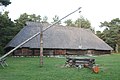
Well pole in central Anatolia, Turkey

A shadoof or shaduf,[1] well pole, well sweep, sweep,[2] swape,[3] or simply a lift[4] is a tool that is used to lift water from a well or another water source onto land or into another waterway or basin. It is highly efficient, and has been known since 3000 BCE.[citation needed]

The mechanism of a shadoof comprises a long counterbalanced pole on a pivot, with a bucket attached to the end of it. It is generally used in a crop irrigation system using basins, dikes, ditches, walls, canals, and similar waterways.[5]

History

[edit]
Multi-level shadoofs
Multi-level shadoof system in Egypt

One theory states that the shadoof was invented in prehistoric times in Mesopotamia as early as the time of Sargon of Akkad (around 24th and 23rd centuries BCE). The earliest evidence of this technology is a cylindrical seal with a depiction of a shadoof dating back to about 2200 BCE. Then, it is believed that the Minoans adopted this technology; evidence suggests the use of shadoofs as early as around 2100–1600 BCE. The shadoof appeared in Upper Egypt sometime after 2000 BC, most likely during the 18th Dynasty.[6] Around the same time, the shadoof reached China.

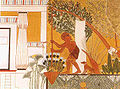
Some historians believe the Egyptians were the original inventors of the shadoof. The theory states that the shadoof originated along the Nile, using tomb drawings illustrating shadoofs at Thebes dating from 1250 BCE as evidence.[7]

An alternative origin theory states that shadoof originated from India around the same time as in Mesopotamia. This theory owes to the fact that the shadoof was well spread in India; however, there is little to no other evidence that makes this theory any stronger.[6]

It is still used in many areas of Africa and Asia and is very common in rural areas of India and Pakistan, such as the Bhojpuri belt of the Ganges plain. In Europe, they remain common in countries like Ukraine, Belarus, Poland and Germany. In the Great Hungarian Plain they are considered a symbol of the region.[citation needed]

Design, construction, and efficiency

[edit]

The shadoof is easy to construct and is highly efficient in use.[4] It consists of an upright frame on which is suspended a long pole or branch, at a distance of about one-fifth of its length from one end.[4] At the long end of this pole hangs a bucket, skin bag, or bitumen-coated reed basket. The bucket can be made in many different styles, sometimes having an uneven base or a part at the top of the skin that can be untied. This allows the water to be immediately distributed rather than manually emptied. The short end carries a weight made of clay, stone, or a similar material, which serves as the counterpoise of a lever. The bucket can be lowered by the operator using their own weight to push it down; the counterweight then raises the full bucket without effort.[4][8]

The implementations vary from region to region. The frame can consist of a single pole or a pair, and the buckets can be attached in multiple different ways, from being tied to a rope to being attached to a thinner stick.[6]

With an almost effortless swinging and lifting motion, the waterproof vessel can be used to scoop up and carry water from a body of water (typically, a river or pond) onto land or to another body of water. At the end of each movement, the water is emptied out into runnels that convey the water along irrigation ditches in the required direction.[8] The device is capable of lowering the force levels required of operators to the extent that the performance tends to be limited by the energy processing capacity of the operator and not necessarily muscle fatigue.

The shadoof has a lifting range of 1 to 6 meters. A study of efficiency in various sites in Chad has shown that one man can lift 39 to 130 liters per minute over heights of 1.8 to 6.2 m, resulting in water-lifting power levels of 26.7 to 60.1 W. Its efficiency has been calculated at 60%.[7][9]

A study done in Nigeria also indirectly assessed energy usage through heart rate, serving as the physiological metric. Through this approach, it was discovered that making suitable adjustments to the shadoof decreased energy consumption from approximately 109 to 71 watts (equivalent to 6.56 to 4.27 kilojoules per minute). This reduction enables a farmer to engage in prolonged work without necessitating frequent rest breaks.[9]

Social effects

[edit]

Across numerous cultures, shadoofs have symbolized collective effort.[9] In ancient Egypt and Mesopotamia, for instance, the multi-tiered shadoof systems allowed the movement of water to higher levels through teamwork.[10] Together with other irrigation technologies, shadoofs not only helped establish reliable methods of agriculture for growing civilizations but also influenced cultural elements.[11]

Well pole in Baidivka, Ukraine (1950)

The accessibility and utilization of shadoofs have been linked to class. During the Egyptian Middle Empire and the New Kingdom, pleasure gardens featuring shadoof irrigation became a hallmark of luxury residences and consequently a status symbol.[12] Although not directly, shadoofs contributed to creating a class system, a barrier for some. At the same time, shadoofs have remained essential for those with limited resources to support their livelihoods on large-scale farms around the Nile. Even in the present day, many communities worldwide lack access to more sophisticated water technologies, making shadoofs an indicator of socio-economic standing and a certain measure of societal development. The technology's reliability, despite its antiquity, often gets overlooked.[9]

The geographic spread of shadoofs is impressive. In regions where irrigation is imperative, such as Egypt, India, and parts of sub-Saharan Africa, shadoofs have played a crucial role in enabling agriculture to thrive in water-scarce areas. Shadoofs have empowered marginalized communities by providing them with the means to secure their sustenance, breaking the barrier of food insecurity even in the modern age.[7][9]

Gender roles have also undergone a transformation, with women frequently assuming shadoof operation.[13] The ease of use of the shadoof empowered women to play a more active role in farming. It is fair to acknowledge that shadoofs contributed to normalizing women's increased independence and participation in less physically demanding, and therefore more “socially acceptable”, aspects of food production.[13]

The ease of use of the shadoof is perhaps its most important feature. Studies have shown that it is impressively efficient, given the simplicity of its design. Still, it is essential to recognize that shadoofs, while easing the physical demands of water retrieval, require manual labor, posing a barrier for individuals with certain physical disabilities.[7]

Names

[edit]
  • Shadoof or shaduf comes from the Arabic word شادوف, šādūf.
  • It is also called a lift,[4] well pole, well sweep, or simply a sweep in the US.[2] A less common English translation is swape.[3]
  • Picotah (or picota) is a Portuguese loan word.
  • It is also called a jiégāo (桔槹) in Chinese.
  • The Tamil name is thulla (துலா), while the Telugu name is ethaamu (ఏతాము) or ethamu (ఏతము).
  • It was also known by the Ancient Greek name kēlōn (κήλων) or kēlōneion (κηλώνειον); this term (קילון) is also borrowed in Mishnaic Hebrew.
  • In Ukrainian, it is called krynychnyi zhuravel (криничний журавель, "well crane") for its shape; it is also known as zvid (звід).
  • In Hungarian, it is known as gémeskút (literally, "heron wells").
  • In Croatian, it is known as đeram (from Turkish, germe).
[edit]

In heraldry

[edit]

The use of shadoofs in certain areas influenced heraldry.[11] Below are some examples of heraldic elements of various subdivisions.

References

[edit]
[edit]
Revisions and contributorsEdit on WikipediaRead on Wikipedia
from Grokipedia
The shadoof, also spelled shaduf, is a simple hand-operated lever mechanism designed to lift water from sources such as rivers, wells, or canals for irrigation purposes, featuring a long wooden pole pivoted on a horizontal crossbar supported by upright posts, with a bucket suspended from one end and a counterweight—often a clay pot filled with stones or earth—from the other to facilitate manual operation by a single person.[1] Originating in ancient Mesopotamia and first evidenced in Upper Egypt after 2000 BC during the 18th Dynasty, the device marked a significant advancement in water management by allowing elevation of water to higher fields beyond the reach of simpler methods like direct scooping, thereby expanding cultivable land in the Nile Valley and similar arid environments without reliance on draft animals or complex machinery.[1] Its mechanical advantage, derived from the lever principle, enabled laborers to raise approximately 2.5 to 3 cubic meters of water per hour, sustaining agriculture in regions dependent on seasonal flooding like the Nile, and the shadoof's enduring design persists in rudimentary form across parts of Africa, the Middle East, and Asia where modern pumps are unavailable or unaffordable.[2]

Historical Development

Origins and Invention

The shadoof, a counterweighted lever for elevating water, emerged around 3000 BC in Mesopotamia, where arid conditions and dependence on the Tigris and Euphrates rivers necessitated tools to transport water from channels to elevated fields beyond natural inundation levels.[1] This innovation addressed the causal imperative of sustaining agriculture in a region prone to variable precipitation and flooding, enabling surplus production to underpin early urban societies without reliance on animal or mechanical power beyond human leverage.[1] Constructed from local timber for the pole, fibrous ropes, and improvised counterweights like clay-filled jars or stones, the device exemplified adaptation of basic torque mechanics to environmental constraints, predating widespread bronze use.[1] In ancient Egypt, the shadoof appeared by circa 2000 BC, integrated into Nile Valley farming to hoist water above flood plains for perennial cropping in higher terrains.[3] Tomb reliefs from this era, such as those in Middle Kingdom sites, illustrate operators maneuvering the apparatus to irrigate distant plots, reflecting its role in amplifying human labor efficiency amid seasonal water scarcity.[4] The adoption capitalized on the same lever-based advantage, tailored to Egypt's linear riverine ecology, where extending cultivation reduced famine risks tied to Nile variability.[5]

Spread Across Civilizations

The shaduf diffused from its early attestations in Mesopotamia around 3000 BC and Egypt after 2000 BC to adjacent regions of the ancient Near East, including Persia by circa 1200 BC, where it supplemented qanat underground channels for elevating water in arid landscapes.[1] Archaeological depictions, such as seals from Mesopotamian sites, and textual records underscore this westward and eastward propagation along trade corridors linking riverine civilizations.[1] In the Mediterranean basin, comparable lever-based water-lifting tools emerged during the Minoan period (circa 2100–1600 BC) and persisted as the kilonion through Classical and Hellenistic Greece, likely via maritime exchanges with Near Eastern cultures.[1] Roman agronomists later incorporated these Hellenistic variants, describing well sweeps in treatises on estate management that emphasized manual irrigation for elevated fields.[6] Eastward transmission reached China, where the jiégāo (also termed diaogan) appeared during the Shang Dynasty around 1600 BC, achieving broad utilization by the Western Zhou Dynasty (11th century–771 BC) as documented in early agricultural texts.[1] In India, while origins remain contested with possible independent development, Vedic and subsequent texts reference similar devices by circa 350 BC, reflecting integration into monsoon-dependent farming through overland cultural contacts.[1] This proliferation owed to the shaduf's inherent portability and construction from ubiquitous timber and counterweights, bypassing needs for specialized infrastructure and enabling adoption in labor-abundant, pre-industrial societies without centralized technological monopolies.[1] Migration of agrarians and merchants along proto-trade networks further disseminated the principle, yielding localized adaptations suited to diverse hydraulic regimes.[1]

Archaeological Evidence

Archaeological evidence for the shadoof primarily consists of visual representations in ancient art, as its construction from perishable materials such as wood, rope, and leather counterweights has left few physical traces. The earliest documented depiction appears on a Mesopotamian cylindrical seal dating to circa 2200 BCE, illustrating the device's use for water lifting.[1] In ancient Egypt, shadoofs are shown in tomb wall paintings from the New Kingdom period, including those in the 18th Dynasty (circa 1570–1292 BCE), where scenes portray laborers operating the mechanism to irrigate fields along the Nile. A notable example is the painting from the tomb of Ipuy, a royal scribe under Ramesses II, located at Thebes and dated to approximately 1250 BCE, which captures the shadoof in a garden irrigation context. These artistic records provide direct empirical confirmation of the tool's employment in agricultural practices, distinct from textual inferences.[1] Later Mesopotamian evidence includes reliefs from the Assyrian period, around the 8th century BCE, depicting similar lever-based water-lifting operations. Physical remnants, such as potential fulcrum supports or post sockets associated with irrigation infrastructure, remain elusive due to environmental degradation, though canal systems at sites like those in Sumer highlight the context for such devices. No verified skeletal analyses post-2000 specifically link laborer remains to shadoof use via biomechanical markers, underscoring the reliance on iconographic sources for causal reconstruction of its adoption.[1]

Technical Design and Mechanics

Core Components and Construction

The shadoof comprises a long wooden pole balanced over a fulcrum, with a bucket attached via rope to the longer end and a counterweight secured to the shorter end.[6][7] An upright frame supports the fulcrum, typically formed by two vertical posts connected by a horizontal crosspiece upon which the pole pivots.[7] Materials are sourced locally and include wood for the pole and frame, rope for suspending the bucket, and heavy rock or equivalent mass for the counterweight to balance loads of up to approximately 60 liters of water.[7] The bucket itself is a simple pail, often fashioned from available containers suited to holding water without specialized fabrication.[6] Construction demands minimal tools, such as cutting implements for shaping wood, allowing assembly by individuals or small groups using lashings or joints rather than metal fasteners.[7] Variations in design scale the pole and frame proportions to achieve lift heights from 1 to 4 meters, adapting to well or stream depths while maintaining mechanical advantage through the lever principle.[7] This simplicity, combined with non-durable yet replaceable components, supports sustained use in abrasive, sandy environments like those along the Nile, where the tool's basic form has persisted due to ease of repair and low maintenance needs.[6][7]

Operational Mechanism

The shadoof functions as a first-class lever, with a fulcrum positioned between the counterweight on the short arm and the water bucket suspended from the long arm via a rope. The mechanical advantage derives from the principle of torque equilibrium, where the operator's downward force applied at the greater distance from the fulcrum on the long arm produces a torque sufficient to counterbalance the load torque from the water-filled bucket, offset by the counterweight's opposing torque on the short arm. This ratio of arm lengths typically yields a force multiplication factor of 2 to 5, reducing the input force required relative to direct lifting.[8][1] In operation, the counterweight—commonly a heavy clay or stone-filled container—holds the empty bucket elevated above the water source. The operator pulls downward on the rope attached to the distal end of the long arm, pivoting the pole to lower the bucket into the water for filling. After the bucket is loaded, the operator maneuvers it horizontally to the discharge basin and partially releases tension, enabling the counterweight's descent to pivot the long arm upward and elevate the bucket for pouring. This cyclic process exploits gravitational assistance in the pulling phase and the counterweight's potential energy for the return lift, distributing physical effort across the operator's body rather than requiring sustained upward exertion against the full load.[1] The design's human-centric mechanics alleviate fatigue by aligning the pulling motion with natural body leverage, engaging the arms, back, and legs sequentially. Verifiable historical assessments confirm a proficient operator can thereby raise approximately 2,500 liters of water per day.[1]

Efficiency and Limitations

The shaduf exhibits mechanical efficiency of approximately 60%, with input power consumption typically ranging from 71 to 109 watts, reducible through optimal counterweight adjustments that halve the manual effort compared to direct bucket hauling without leverage.[9][10] Output power averages 40 watts, enabling water delivery rates of 60.9 liters per minute at lifts of about 2.92 meters, representing high productivity for human-powered devices in shallow irrigation contexts.[10] Despite these metrics, the shaduf is constrained to depths of 1 to 6 meters, as the lever arm's mechanics become impractical beyond this range, necessitating alternatives like animal-driven wheels for deeper sources.[11] Its operation demands continuous manual labor, limiting scalability for extensive fields where sustained high-volume lifting exceeds individual endurance, with daily outputs capping at around 2.5 cubic meters per operator.[1] Components such as ropes and pivots are prone to wear without regular maintenance, reducing reliability in arid or high-use environments.[12] In comparative hydraulic assessments, the shaduf outperforms pot or bucket methods in volume per cycle due to leverage-enabled larger loads, but underperforms animal-powered noria wheels for depths exceeding 3 meters or demands beyond small plots, where the latter achieve greater energy efficiency per unit water lifted.[13][1]

Applications and Uses

Role in Ancient Irrigation

The shadoof enabled the extension of basin irrigation in ancient Egypt by lifting water from the Nile River to higher fields, allowing cultivation beyond the natural floodplains and facilitating multi-crop cycles outside the annual inundation period. Adopted in Upper Egypt after approximately 2000 BC, during the late Middle Kingdom or early New Kingdom, this device supported the irrigation of dry-zone crops such as vegetables and emmer wheat, correlating with archaeological records of increased agricultural intensification and settlement expansion in the Nile Valley from the 18th Dynasty onward (ca. 1550–1295 BC).[14][1][15] In integration with canal and basin networks, the shadoof raised water for controlled field flooding, enhancing soil fertility through repeated watering and sediment deposition, which verifiable yield increases—estimated at up to double the flood-dependent output in some models—underpinned population growth and economic surplus in pharaonic society. Empirical evidence from settlement patterns and textual records, such as administrative papyri detailing water management, links shadoof use to productivity gains without which the labor-intensive pyramid-building eras post-2000 BC would have faced greater resource constraints.[14][1] Similarly in Mesopotamia, where the shadoof appeared by around 3000 BC, it complemented riverine irrigation from the Tigris and Euphrates, permitting water elevation to elevated fields and basins amid variable flood regimes, thereby stabilizing grain production and enabling urban centers' sustenance as evidenced by cuneiform tablets recording irrigation labor from the third millennium BC. This causal role in yield reliability, rather than dependency, is supported by correlations between water-lifting technologies and expanded arable land in Sumerian and Akkadian periods, fostering agricultural surpluses that drove early state formation.[1]

Modern and Regional Adaptations

The shadoof persists in manual operation for irrigation in rural Egypt, where farmers lift water from the Nile River or canals to fields, particularly in areas with limited access to mechanized equipment.[14] Its use continues in regions of India and other parts of Asia, such as Pakistan's rural Ganges plain, for small-scale farming where electricity is unreliable or absent, allowing cost-effective water elevation without fuel dependency.[14] In parts of sub-Saharan Africa, similar manual devices endure for lifting water 1 to 6 meters from wells or streams to irrigate modest plots, favored in power-scarce locales over diesel pumps due to minimal operational costs.[11] While the core wooden lever and counterweight design remains largely unaltered, minor regional modifications include substituting bamboo or lightweight metals for the pole in humid Asian environments to enhance durability against wear, though these changes do not fundamentally alter the human-powered mechanics.[1] Motorized variants are rare and typically involve attaching small engines to the sweep arm, but adoption is limited by maintenance challenges and higher upfront costs in low-income settings. Performance analyses from the 2010s indicate the shadoof achieves water discharge rates of approximately 0.5 to 1 cubic meter per hour per operator, sufficient for irrigating small vegetable or crop plots of under 0.5 hectares, with human effort as the primary input. Comparisons with fuel-powered pumps reveal the shadoof's lower productivity—yielding 10-20% less water volume and supporting reduced crop outputs—but its zero-emission profile from manual labor contrasts with the carbon and pollution burdens of diesel alternatives, rendering it viable for eco-conscious or fuel-unavailable contexts.[16] This persistence underscores the device's economic rationale in unelectrified rural economies, where initial investment under $50 per unit and no ongoing energy expenses outweigh efficiency deficits for subsistence farming.[11]

Cultural and Symbolic Aspects

Terminology and Names

The term "shadoof" entered English from Egyptian Arabic šādūf, denoting a counterbalanced pole for lifting water, with the Oxford English Dictionary recording its first use in 1836 by orientalist Edward William Lane.[17] An alternative transliteration, "shaduf," appears in dictionaries such as Merriam-Webster, reflecting phonetic variations in Arabic-to-English adaptation.[18] In regions outside the Middle East, analogous devices bear distinct local names tied to indigenous languages and independent inventions, underscoring the absence of a singular global term; for instance, ancient Sumerian records refer to it as zirigum, predating Arabic nomenclature.[1] In South Asia, the device is termed denkli or paecottah (also spelled picotta), terms derived from regional vernaculars and documented in historical accounts of Indian irrigation practices.[1] East Asian variants include the Chinese jiégāo (also diaogan), associated with early lever-based water-lifting systems in texts from the Warring States period onward, evidencing parallel technological evolution without evident diffusion from Mesopotamian or Egyptian sources prior to extensive trade routes.[1] European and American English equivalents, such as "well sweep" or "swape," emerged later in agricultural contexts, often describing similar counterpoise mechanisms in wells rather than riverine irrigation.[19] These disparate terminologies align with archaeological and textual evidence of convergent invention across isolated civilizations, as no shared etymological root links pre-contact usages in Sumer, the Indus Valley, and ancient China.[1]

Representations in Art and Heraldry

Depictions of the shadoof appear in ancient Egyptian tomb paintings from the New Kingdom period, illustrating its role in irrigation. A specific example is preserved in the Tomb of Ipuy (TT217) at Deir el-Medina, dating to the reign of Ramesses II (ca. 1279–1213 B.C.), where a scene shows a gardener employing a shaduf to water pomegranate plants. These artworks, often found in Theban necropolis tombs, emphasize the device's operational aspects through detailed figures manipulating the lever and counterweight.[20] Earlier evidence exists from Mesopotamia, with the shadoof represented on a cylinder seal from the late Akkadian period, circa 2200 B.C.[21] This glyptic art form captures the lever mechanism in a compact scene, predating Egyptian tomb illustrations and suggesting origins in the region.[1] In heraldry, motifs resembling the shadoof, typically as well sweeps, occur infrequently in local European coats of arms, particularly in rural areas of Germany and Czechia where such tools were traditionally employed for water lifting. Examples include the arms of Holice in Czechia and Börnsen in Germany, featuring the device to evoke agricultural heritage. These instances lack broader symbolic adoption across heraldic traditions.

Broader Impacts

Agricultural and Economic Effects

The adoption of the shadoof in ancient Egypt around 1500 BCE enabled farmers to lift water to higher elevations, extending irrigation to lands beyond the Nile's flood basin and increasing cultivable area by facilitating controlled water distribution to elevated fields.[1] This capability supported higher crop yields through supplemental irrigation outside the annual flood cycle, allowing for additional harvests of staples like emmer wheat and barley, which generated agricultural surpluses sufficient to buffer against variable Nile floods and sustain non-farming populations.[1] Such productivity gains correlated with economic expansions during the New Kingdom (c. 1550–1070 BCE), including population growth in the Nile Valley and trade networks exporting grain to regions like the Levant and Nubia.[22] Economically, the shadoof's construction from locally available wood, rope, and counterweights—requiring minimal capital—empowered individual smallholders or family units to manage irrigation independently, circumventing the need for large-scale communal labor or state-directed canal maintenance that characterized basin systems.[23] This accessibility reduced dependency on elite-controlled water resources, promoting decentralized agricultural operations and contributing to broader Bronze Age socioeconomic resilience in riverine societies by enabling surplus-oriented farming without heavy external inputs.[1] Verifiable archaeological evidence from settlement patterns in Upper Egypt links shadoof use to intensified local production, which underpinned trade in commodities and early urbanization hubs like Thebes.[24] Despite these advantages, the device's reliance on manual operation imposed labor constraints, with a single operator typically lifting 10–20 liters per cycle at rates of 20–30 cycles per hour, limiting its scalability for vast estates without multiple units or shifts.[23] Compared to pre-shadoof methods like manual bucketing, it alleviated physical strain by leveraging leverage and counterweight principles, distributing effort more evenly and reducing injury risk from repetitive heavy lifting.[23] Empirically, this fostered individual resourcefulness over exploitative alternatives such as corvée-mobilized basin digging, which demanded coordinated group labor under centralized authority, though the shadoof's daily demands still tied operators to fields during dry periods, constraining mobility.[24]

Technological Comparisons and Legacy

The shadoof provided a mechanical advantage over manual bucket carrying, enabling one operator to lift water from depths of 1 to 6 meters with reduced physical strain by distributing effort across leverage and counterweight. Performance evaluations report efficiencies around 60%, with typical outputs of 60.9 liters per minute at 40 watts of human power input, far exceeding the intermittent and laborious yields of hand-portage methods that lacked such amplification. [1] However, it yielded lower volumes than later devices like the noria water wheels, which harnessed animal or hydraulic power to deliver 50,000 to 200,000 liters per hour for sustained, large-scale irrigation, though norias demanded greater setup complexity and were limited in lift height to roughly half their diameter.[25] [15] In the lineage of water-lifting technologies, the shadoof's counterbalanced lever preceded and informed intermittent human-powered pumps, contrasting with continuous-flow innovations like the Archimedean screw, which prioritized steady elevation over variable-height adaptability but shared roots in ancient hydraulic needs. Empirical assessments of operator technique highlight the lever's intrinsic efficiency for unmechanized contexts, minimizing peak exertion through balanced pivoting without reliance on gears or animal traction.[15] The shadoof's principles endure in low-infrastructure settings, where studies confirm its niche superiority for micro-scale tasks—lifting up to 2.5 cubic meters daily per unit—over bulkier successors, avoiding obsolescence in areas prioritizing durability and minimal input over mechanized volume. This continuity reflects causal advantages of simple mechanics in resource-scarce environments, sustaining agricultural viability without ideological imperatives for wholesale replacement.[1]
User Avatar
No comments yet.