Hubbry Logo
Sheriff ArenaSheriff ArenaMain
Open search
Sheriff Arena
Community hub
Sheriff Arena
logo
8 pages, 0 posts
0 subscribers
Be the first to start a discussion here.
Sheriff Arena
Sheriff Arena
from Wikipedia

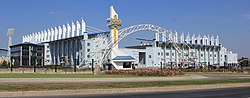
Sheriff Arena (Russian: Главная арена спорткомплекса «Шериф»; Romanian: Arena principală a complexului sportiv „Sheriff”) is home to Sheriff Tiraspol, a football team based in Tiraspol, capital of Transnistria, a breakaway region of Moldova. It is owned by the local Sheriff corporation. It has a capacity of 12,746.[1]

Key Information

The stadium occupies more than 40 hectares and consists of the main field plus five other fields, training fields, a covered indoor arena for winter use as well as a soccer school for children and on-site residences for the players of Sheriff Tiraspol.

In June 2022, UEFA ordered that no European games would be permitted to be played in Transnistria, as a direct consequence of the 2022 Russian invasion of Ukraine.[2] Sheriff played all of their home fixtures in the 2022–23 UEFA Europa League and 2022–23 UEFA Europa Conference League at Zimbru Stadium in Chișinău.

See also

[edit]

References

[edit]
[edit]
Revisions and contributorsEdit on WikipediaRead on Wikipedia
from Grokipedia
Sheriff Arena is a football stadium located in Tiraspol, the capital of Transnistria, a breakaway region of Moldova. Constructed between August 2000 and May 2002, it officially opened in July 2002 with a seating capacity of 12,746 spectators on a grass surface measuring 106 by 69 meters. Serving as the primary home ground for FC Sheriff Tiraspol, the arena has hosted numerous domestic Moldovan league matches and European competitions, including notable UEFA Champions League qualifiers. It forms the centerpiece of the expansive Sheriff Sports Complex, which encompasses additional training fields, a smaller arena, and other athletic facilities spanning over 40 hectares, developed by the Sheriff conglomerate that dominates the region's economy. The venue underwent renovations in 2011 to meet UEFA standards, enabling participation in higher-profile continental fixtures, such as the club's historic 2021 upset victory over Real Madrid in the Champions League group stage.

History

Construction and Early Development

The construction of the Sheriff Sports Complex, encompassing the main arena in , commenced on August 1, 2000, at the western outskirts of the city, under the initiative of the conglomerate to establish a comprehensive training and competition base for its sports investments, particularly FC Sheriff Tiraspol. This development was driven by the club's formation in 1997 and its rapid ascent in Moldovan football, including securing the league title in the 2000-01 season, necessitating modern facilities amid the geopolitical isolation of Transnistria, which limited access to infrastructure elsewhere in Moldova. The project progressed to completion by May , with the main officially opening in , featuring an all-seated configuration and an initial capacity of approximately 12,746 spectators. Key initial features included a grass pitch measuring 106 by 69 meters, equipped with an effective drainage , automatic irrigation, and undersoil heating to maintain playable conditions year-round. From its inception, the arena served primarily as the home ground for FC Sheriff Tiraspol, enabling the club to consolidate its dominance in domestic competitions by providing a professional venue tailored to European standards, despite the region's limited international recognition. The facility's design emphasized functionality for football, with the broader complex incorporating auxiliary fields to support the club's training regimen and youth development programs.

Expansion and Modernization

In the years following its 2002 opening, the Sheriff Stadium saw targeted upgrades to enhance safety, comfort, and compliance with international standards, including the conversion to an all-seater configuration with a capacity of 12,746 by the mid-2000s, incorporating VIP boxes and expanded media facilities to accommodate broadcast requirements. These modifications prioritized spectator safety amid growing attendance for FC Sheriff Tiraspol's domestic and European fixtures, while adding protective canopies over all stands and improved access passages. By , significant pitch renovations were completed, featuring a new turf surface, upgraded drainage, , and under-soil systems to playability in varying conditions and meet technical criteria for higher-category events. Concurrently, the facility achieved Category 3 —initially formalized for the adjacent small arena on June 27, , following attestation by delegates—which extended to the main to host group-stage European competitions through enhancements like standardized floodlighting and . These adaptations supported the club's rising profile in tournaments, with auxiliary measures such as backup artificial turf options for training and matches introduced in the 2010s to mitigate weather disruptions. Further modernization in the mid-2010s integrated the stadium into a broader exceeding 40 hectares, including the of new full-sized fields in 2015 to the club's operations and overall resilience, alongside enhancements like perimeter and aligned with venue protocols. This expansion emphasized for year-round use, with eight pitches (four grass with and four ) facilitating professional and developmental activities without compromising the main arena's focus on elite competitions.

Recent Developments

In the wake of FC Sheriff Tiraspol's 1–0 victory over Real Madrid on September 28, 2021, in the group stage at Sheriff Arena, the venue hosted subsequent high-attendance European matches, including a fixture drawing over 13,000 spectators on October 27, 2022. This period marked increased for the stadium, though specific infrastructure upgrades like enhanced digital scoreboards were not publicly documented in official reports. The Russian invasion of Ukraine in February 2022 prompted UEFA to prohibit European club competition matches in Transnistria from June 2022 onward, citing security risks stemming from the region's unrecognized status and proximity to the conflict zone. Consequently, FC Sheriff relocated home European legs to neutral venues, a policy persisting into 2025, as evidenced by the mandated venue change for their July 2025 UEFA Conference League qualifier against FC Utrecht. Domestic operations at the arena remained unaffected, with the facility supporting FC Sheriff's ongoing league play amid Transnistria's broader economic strains from disrupted Russian gas supplies and trade blockades. By , FC continued to leverage the for its dominant position in the Moldovan Super Liga, leading the 2025–26 standings after securing the prior season's cup and maintaining a historical tally exceeding national titles. Discussions on compliance have centered less on infrastructure—which meets category standards for international eligibility when location permits—and more on geopolitical barriers, with no announced plans for major adaptations amid sustained regional tensions.

Design and Facilities

Main Stadium Specifications

The Sheriff Arena, also known as Bolshaya Sportivnaya Arena, features a main pitch measuring 105 by 68 meters, covered with natural grass equipped with an undersoil heating system to maintain playable conditions during colder months. The stadium provides seating for 12,746 spectators, all under a covered roof structure ensuring protection from weather elements. Architecturally, the venue adopts a modern utilitarian design incorporating the red-and-blue of , constructed in on a portion of the 52-hectare site in western . Key infrastructure includes four 50-meter-high towers capable of illumination levels adjustable to , , 1,, or 1, lux, supporting evening matches and broadcasts. An electronic scoreboard, described as a large colorful video screen, is installed for displaying game information and replays. The facility complies with and standards for international competitions, including appropriate player tunnels and overall enabling eligibility for European club . Situated in , the capital of the breakaway Pridnestrovian Moldavian Republic (PMR) in —a disputed between and its administration—the stadium primarily serves the approximately 500,000 residents of the PMR, with access limited by the area's geopolitical isolation.

Auxiliary Fields and Indoor Arena

The Sheriff sports complex features eight full-sized training fields measuring 105 by 68 meters each, designed to support professional, youth, and reserve team activities. Four fields utilize natural grass with automated watering systems, while three employ high-quality artificial "Field Turf" surfaces suitable for winter conditions, and one combines sandy and grassy zones for varied training needs. All fields are equipped with Swiss "Motomatic" drainage, 400 lux floodlighting from tall masts, and protective enclosures up to seven meters high behind goals, enabling year-round use for FC Sheriff Tiraspol's squads and visiting teams. A covered indoor arena, heated and operational since late 2004, complements the outdoor fields by providing facilities for winter football training and off-season matches on a 105 by 68-meter pitch with fourth-generation "Field Turf" artificial turf and integrated drainage. This venue seats 3,570 spectators and includes adjustable lighting (up to 1,600 lux), an advanced acoustic system, a 40-square-meter scoreboard, and capabilities for live television broadcasting, facilitating professional-level sessions even in adverse weather. The indoor arena extends beyond football to accommodate multi-sport events, featuring an adjacent hall with 860 seats for indoor disciplines such as , , and , thereby enhancing the complex's versatility for simultaneous and smaller competitions. Integrated amenities like an on-site hotel with gyms, rooms, , and small pool further support extended training camps, underscoring the auxiliary infrastructure's role in sustaining athletic development year-round.

Infrastructure and Amenities

The Sheriff Arena is located on the western outskirts of Tiraspol, spanning 52 hectares within the broader sports complex, which necessitates transportation for visitors from the city center. Paid is available on-site to accommodate arriving . Visitor amenities include a dedicated fan shop offering club merchandise such as T-shirts, caps, and sports suits, alongside concessions featuring a operational during match days. protocols involve steward-conducted searches and ticket checks at entry points, contributing to a controlled and secure environment integrated with local oversight. Owing to the arena's position in the unrecognized of , international spectators face logistical challenges, including mandatory border crossings where a migration card must be obtained upon entry using a valid or ID; no visa is required, but compliance with these procedures is essential for access.

Usage and Events

Association Football

Sheriff Arena has served as the primary home venue for FC Sheriff Tiraspol in association football since its opening in 2002, hosting all domestic league and cup matches for the club. The stadium's facilities have supported FC Sheriff's sustained dominance in the Moldovan Super Liga, with the club securing 20 league titles between 1997 and 2024. Its consistent use for home fixtures has enabled a strong home record, contributing to the team's overall success in national competitions. In European competitions, the arena has accommodated FC Sheriff's qualifiers and group stage encounters, notably during the 2021–22 UEFA Champions League campaign where it hosted matches against high-profile opponents. A key fixture was the 24 November 2021 group stage game versus Real Madrid, which ended in a 0–3 defeat for Sheriff despite the competitive atmosphere. The venue's infrastructure meets UEFA standards, facilitating participation in continental tournaments. Attendance for league games typically averages between 1,000 and 3,000 spectators, reflecting the local fanbase in Transnistria, though figures rise significantly for derbies against rivals such as Zimbru Chișinău, occasionally approaching 8,000. The artificial turf pitch, upgraded in 2015 and again in 2023, provides reliable playing conditions, with teams like Manchester United reporting no major concerns prior to fixtures. This setup has aided FC Sheriff's home performances across various competitions.

Other Sports and Non-Sporting Events

The covered and auxiliary facilities of the complex host tournaments in (), , , and , with capacity for over 200 participants including accommodations and meals. The indoor hall is equipped for competitions in , , , and , supporting regional and potentially international in these disciplines. An Olympic-size indoor swimming pool enables training and competitions in swimming, diving, water polo, and synchronized swimming, exemplified by the SC “Sheriff” swimming pool team's participation in the Moldavian Swimming Cup in November–December 2021. These venues serve as a training hub for regional teams across multiple sports amid Transnistria's economic constraints and limited infrastructure, though non-football international events are rare due to logistical and geopolitical barriers. Non-sporting uses, such as public gatherings or corporate events tied to the Sheriff Group, occur occasionally but remain secondary to athletic programming, with no major concerts or festivals documented at the complex.

Ownership and Influence

Sheriff Group Background

The Sheriff Group, formally known as Sheriff Ltd., was founded on June 24, 1993, in Tiraspol, Transnistria, by Viktor Gushan and Ilya Kazmaly, both former Soviet security service officers. Initially established as a small trading firm amid the post-Soviet economic transition, the company capitalized on privatization opportunities by acquiring former state assets, expanding into fuel distribution, retail chains, supermarkets, and construction within its first decade. By the 2000s, it had further diversified into telecommunications, oil-related operations, hotels, and manufacturing, establishing itself as a multifaceted conglomerate operating primarily within Transnistria. In 1997, the group launched its sports division by acquiring and rebranding the local club Tiras Tiraspol as , marking its entry into professional association football as a means to build regional sporting infrastructure. The emerged as a central corporate asset in this initiative, designed to elevate the club's facilities and operations through private investment. The group now employs approximately 4,300 individuals directly and extends influence across key economic sectors in the Pridnestrovian Moldavian Republic (PMR), functioning as one of the region's dominant private enterprises with substantial market control in retail, , and services. serves as the primary executive, overseeing operations while adopting a notably presence.

Economic and Political Role in Transnistria

The Sheriff Group dominates Transnistria's economy, controlling an estimated 60 percent of its activities across sectors including trade, fuel distribution, telecommunications, and retail. This dominance stems from early post-Soviet privatization in the 1990s, when the company acquired state assets amid economic collapse and Moldova's blockade, enabling self-sustained growth in an internationally isolated entity. The group's revenue model has relied on control over customs operations and duty exemptions on imports like alcohol and cigarettes, generating funds for infrastructure such as the Sheriff Arena, constructed as a private initiative to address deficiencies in public facilities. These exemptions, in place until Moldova imposed duties in January 2024, underscored the group's role in bridging gaps left by limited state capacity and external sanctions. Economically, Sheriff provides employment to thousands in Transnistria, forming one of the region's major workforce segments alongside state employees and pensioners, thus stabilizing livelihoods in a context of chronic underdevelopment. The company's operations, including supermarkets and media outlets, support daily commerce and information flow, fostering economic resilience and a sense of local self-reliance in the pro-Russian Pridnestrovian Moldavian Republic despite reliance on Russian gas subsidies and Ukrainian transit routes. Investments like the arena exemplify private capital filling voids from Soviet-era decay and Moldovan disengagement, promoting infrastructure development without external aid dependencies. Politically, the group exerts influence through verifiable sponsorships and affiliations, notably funding the (Renewal) party, which secured a parliamentary in and has backed presidents aligned with its interests. Historical ties trace to the Smirnov presidency (1991–2011), during which Sheriff's founders, former security service members, benefited from privatization policies and maintained proximity to . Current head Viktor Gușan holds substantial sway, with the company's media and telecom assets amplifying pro-separatist narratives and electoral leverage, as seen in financing President Krasnoselsky's 2016 campaign. This interplay sustains Transnistria's de facto governance model, where reinforces political stability amid ongoing reintegration disputes with .

Controversies and Criticisms

Allegations of Corruption and Monopoly Power

The Sheriff Group, owner of Sheriff Arena, has faced allegations of employing mafia-like tactics to consolidate economic dominance in Transnistria, including coerced business acquisitions and undue judicial influence to protect its interests. A 2022 analysis by the Polish Institute of International Affairs described Sheriff's control as a "mafia-like system" that has progressively captured regional institutions since 2016, enabling it to safeguard assets through non-transparent means amid limited external oversight. Critics, including reports from European security firms, contend that such methods facilitated Sheriff's expansion into key sectors, often sidelining competitors via regulatory pressure or selective enforcement under Pridnestrovian Moldavian Republic (PMR) authorities. Sheriff's monopoly extends to fuel distribution, retail trade, telecommunications, and media, where it reportedly controls a disproportionate share of profitable activities, contributing approximately one-third of Transnistria's budget while limiting market entry for rivals. This dominance, per observers like France 24, stems from founders Viktor Gushan and Ilya Kazmaly's ex-KGB backgrounds, allowing leverage over local governance to maintain exclusivity in imports and services. Detractors argue that assets like FC Sheriff Tiraspol and its arena serve as public relations tools to mask opacity, with the club's sporting success—such as a home record of 5 wins, 1 draw, and 1 loss in recent Super Liga matches—contrasting with scant transparency in group finances. Defenders of emphasize operations conducted legally under PMR statutes, with no recorded convictions for in international or Moldovan courts, attributing its preeminence to efficient service provision in a conflict-prone, economically isolated enclave. While Western-leaning analyses, such as those from , highlight entrenched risks in Transnistria's de facto governance, empirical outcomes like Sheriff's role in sustaining and media access amid regional disruptions suggest causal efficacy over outright criminality, though verification remains hampered by the area's non-recognition. No peer-reviewed studies or EU-specific indictments from the 2010s directly substantiate takeover coercion claims against Sheriff, underscoring reliance on anecdotal and institutional critiques prone to geopolitical bias against PMR entities.

Ties to Regional Politics and Separatism

The Sheriff Arena, constructed by the Sheriff Group and opened on April 10, 2002, emerged in the economic and political vacuum following the 1992 Transnistria War, which solidified the Pridnestrovian Moldavian Republic's (PMR) de facto separation from Moldova amid Russian military support and unresolved status. This private initiative exemplified how post-Soviet entrepreneurial networks, rather than ideological fervor alone, sustained separatist viability by investing in infrastructure that the isolated PMR regime could not fund through formal channels, thereby reinforcing autonomy through economic self-provisioning over reliance on Chisinau. FC Sheriff Tiraspol's participation in European competitions, particularly its 2021-2022 UEFA Champions League campaign—culminating in a 2-1 victory over Real Madrid on September 28, 2021—served as a rare international showcase for Transnistria's capabilities, elevating local morale in a region enduring sanctions and diplomatic isolation. Such achievements, hosted at the arena, countered Moldovan reintegration arguments by demonstrating the PMR's functional institutions and private-sector prowess, fostering a narrative of resilience tied to economic pragmatism in a post-Soviet enclave dependent on contraband trade and Russian subsidies. The Sheriff Group's symbiotic relationship with PMR authorities, including alleged preferential arrangements in licensing and , has drawn for entrenching a quasi-monopolistic that bolsters separatist without external . Public budgets in Transnistria reflect limited state in Sheriff-linked projects like the arena, suggesting reciprocal benefits where private capital underwrites regime stability in exchange for operational leeway, a dynamic rooted in the 1990s economic collapse that favored opaque conglomerates over formal state-building. Critics, including reports from organizations monitoring the region, argue this alignment facilitates circumvention of international financial norms, such as anti-money laundering protocols, by leveraging Transnistria's non-recognized status for unchecked capital flows that indirectly sustain separation. Proponents counter that such private-regime ties exemplify causal self-reliance in a geopolitically stranded territory, where dependence on Moldova would exacerbate poverty without addressing underlying post-war disruptions like disrupted supply chains and frozen conflicts. This interplay underscores how economic actors like Sheriff prioritize survival mechanics over normative compliance, informing the PMR's persistent resistance to unification.

Sports and Community Impact Debates

The Sheriff Arena and associated sports complex have boosted youth engagement in football and other disciplines, with the FC Sheriff academy training around 400 young male athletes as part of broader philanthropic activities aimed at professional development. The facility hosts tournaments accommodating over 200 participants in sports including indoor soccer, basketball, and volleyball, providing structured opportunities in a region with limited alternatives. Proponents, including complex operators, contend this fosters physical fitness and skill-building among youth, potentially instilling discipline amid Transnistria's geopolitical instability. Economically, match attendance at the 12,746-capacity venue generates spillover effects for local vendors and services during events, contributing to short-term activity in Tiraspol's constrained market. However, detractors highlight the opportunity costs of the arena's construction and —estimated in broader complex investments—arguing they prioritize elite sports over essential public needs like roads and utilities in an economy reliant on limited industries. Transnistria's socioeconomic vulnerabilities, including heavy dependence on external energy and trade disruptions, amplify these concerns, as sports spending occurs against a backdrop of regional hardship akin to Moldova's 24.5% national rate in 2021. Access debates center on perceptions of exclusivity, with some viewing the complex as benefiting primarily those aligned with sponsoring entities, potentially sidelining broader community input in . While participant involvement metrics suggest positive local cohesion through team sports, no independent surveys quantify long-term unity or behavioral outcomes, leaving claims of societal benefits anecdotal amid critiques of uneven distribution. Overall, the arena's role underscores tensions between targeted sports investment and equitable development in Transnistria's isolated context.

References

Add your contribution
Related Hubs
User Avatar
No comments yet.