


Community hub
0 subscribers8 pages, 0 posts
Recent from talks
All channels
Be the first to start a discussion here.
Be the first to start a discussion here.
Be the first to start a discussion here.
Be the first to start a discussion here.
Contribute something
Welcome to the community hub built to collect knowledge and have discussions related to Shlach.
Nothing was collected or created yet.
Shlach
View on Wikipediafrom Wikipedia
Not found
Shlach
View on Grokipediafrom Grokipedia
Shelach, also transliterated as Shelach Lecha and meaning "Send for yourself," is the thirty-seventh weekly Torah portion (parashah) in the annual Jewish cycle of Torah reading and the fourth in the Book of Numbers, spanning Numbers 13:1–15:41.[1][2] It narrates the pivotal biblical episode in which God commands Moses to dispatch twelve tribal leaders as spies to scout the Promised Land of Canaan, their return with reports of its fertility contrasted by warnings of formidable inhabitants, and the resulting crisis of faith among the Israelites.[3][1]
The portion opens with divine instructions for the reconnaissance mission, specifying that one prince from each tribe— including notable figures like Shammua from Reuben, Shaphat from Simeon, and Caleb from Judah—should explore the land's terrain, settlements, and produce, beginning from the southern Negev region and ascending to the hill country.[2] After forty days, the spies return bearing an immense cluster of grapes, along with pomegranates and figs, affirming the land's exceptional bounty as "flowing with milk and honey," yet ten of them deliver a demoralizing account of giant Anakim inhabitants, fortified cities, and an unconquerable terrain, likening the Israelites to grasshoppers in comparison.[1][3] Only Caleb and Joshua, the spies from Judah and Ephraim respectively, counter with optimism, tearing their clothes in protest and urging the people to proceed, confident in God's promise and power to grant victory.[2]
This report sparks a night of communal weeping and rebellion, with the Israelite congregation lamenting their exodus from Egypt and plotting to appoint a new leader to return to bondage, prompting Moses, Aaron, Joshua, and Caleb to plead for faith in divine protection.[3] In response to the widespread lack of trust, God expresses intent to annihilate the nation with plague and create a new one from Moses, but Moses intercedes by invoking God's attributes of mercy and forgiveness as proclaimed at Sinai, leading to a moderated decree: the adult generation that left Egypt—except for the faithful Caleb and Joshua—must wander the wilderness for forty years until they perish, one year for each day of spying, while their children inherit the land.[1][2] Defiantly, some Israelites then launch an unauthorized assault on Canaan but are routed by the Amalekites and Canaanites, underscoring the consequences of disregarding God's command.[3]
The latter section of Shelach shifts to legislative matters in preparation for eventual settlement, detailing sacrificial offerings for unintentional sins by individuals, communities, or strangers, including grain, wine, and oil accompaniments, as well as the separation of challah dough as a portion for priests.[2] It recounts the incident of a man caught gathering wood on the Sabbath, whose execution by stoning serves as a stern enforcement of the day of rest, and concludes with the enduring mitzvah of tzitzit—fringes on garment corners with a blue thread—to remind the Israelites of all divine commandments and prevent straying after personal desires.[1][3] This parashah is traditionally read in late spring or early summer, with its haftarah from Joshua 2:1–24 paralleling the spy theme through Rahab's aid to Joshua's scouts in Jericho.[2]
These aliyot form the basis of the Shabbat reading in the annual cycle, with variations in the triennial cycle addressed separately.[13]
Overview
Synopsis
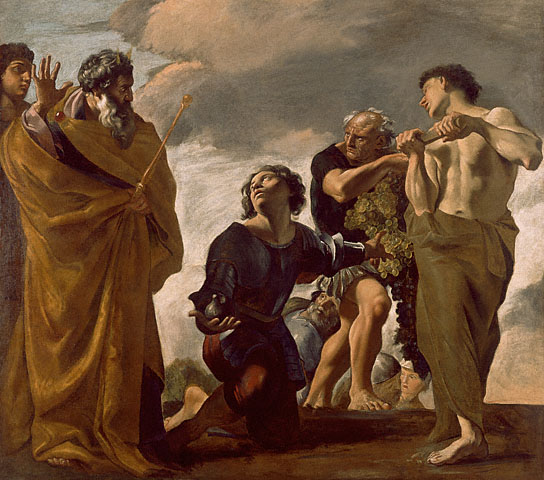
Parashat Shlach recounts the pivotal events following the Israelites' encampment at the edge of the Promised Land, beginning with God's directive to Moses to dispatch twelve scouts, one from each tribe except Levi, to explore Canaan and assess its suitability for conquest. These leaders, including Shammua from Reuben, Shaphat from Simeon, Caleb from Judah, Igal from Issachar, Joshua (formerly Hoshea) from Ephraim, Palti from Benjamin, Gaddiel from Zebulun, Gaddi from Manasseh, Ammiel from Dan, Sethur from Asher, Nahbi from Naphtali, and Geuel from Gad, were instructed to observe the land's topography, soil fertility, inhabitants' strength, and city fortifications, while bringing back samples of its produce.[4] The spies embarked on a forty-day reconnaissance from the Wilderness of Zin to Rehob, traversing the Negev and the hill country, and reaching as far as the entrance to Hamath. In the Valley of Eshcol, they discovered abundant fruit, cutting down a single cluster of grapes so heavy it required two men to carry it on a pole, along with pomegranates and figs, which symbolized the land's extraordinary bounty. Upon returning to Kadesh in the Wilderness of Paran, the spies presented their findings to Moses, Aaron, and the entire congregation, confirming the land flowed with milk and honey but warning of its formidable inhabitants—giants known as the Anakim, descendants of the Nephilim—who dwelled in heavily fortified cities, instilling fear that the Israelites appeared like grasshoppers in comparison. While Caleb urged immediate conquest, declaring the land could be taken with God's help, the majority spread panic, leading the people to weep and rebel against Moses and Aaron, lamenting their exodus from Egypt and proposing to appoint a new leader to return there.[4] In response to the uproar, Joshua and Caleb tore their clothes and implored the assembly to trust in God's protection, but the congregation threatened to stone them. God expressed anger at the lack of faith, intending to disinherit the people and start anew with Moses' line, yet Moses interceded, appealing to divine mercy and recalling God's attributes of forgiveness as proclaimed at Sinai. God relented from immediate destruction but decreed that all in the census aged twenty and older, except the faithful Caleb and Joshua, would wander forty years in the wilderness—one year for each day of scouting—until that generation perished without entering Canaan; their children would inherit the land instead. The ten dissenting spies died in a plague, while the people, regretting their defiance, attempted a premature ascent into the hill country but were routed by the Amalekites and Canaanites without divine or Mosaic support.[5] The parashah concludes with divine laws given through Moses to regulate offerings and observances in the Land of Canaan. For burnt offerings and sacrifices—whether voluntary, vowed, or festival-related—accompanying meal offerings of fine flour mixed with oil and libations of wine are mandated, scaled by animal size: a quarter hin of wine and a tenth of an ephah of flour and oil for a lamb; a third hin and two-tenths for a ram; a half hin and three-tenths for a bullock. These requirements apply equally to native Israelites and resident strangers, emphasizing uniformity in worship. Additionally, upon eating bread from the new land, a portion of the first dough must be separated as a challah offering to God. Provisions for atonement address unintentional sins: the entire congregation offers a bullock as a burnt offering with its meal and libation, plus a he-goat as a sin offering; an individual does likewise with a she-goat. However, deliberate, high-handed sins admit no atonement, resulting in being cut off from the people. Finally, the commandment to attach tzitzit—fringes with a blue cord— to garment corners serves as a perpetual reminder to observe all divine statutes and avoid straying after personal desires.[6]Significance
Parashat Shlach centers on the theme of lacking faith, exemplified by the spies' negative report that instills fear among the Israelites, leading to divine decree of a forty-year delay in entering the Promised Land. This narrative underscores the consequences of doubt in God's promises, mirroring motifs of rebellion and testing in the Book of Exodus, such as the golden calf incident where impatience and disbelief provoke divine wrath. The parashah illustrates how collective unbelief transforms potential triumph into prolonged exile in the wilderness, emphasizing faith as essential for covenantal fulfillment. As the 37th weekly Torah portion, Shlach is typically read in late spring or early summer, around the 25th of Sivan, shortly after Shavuot, which commemorates the revelation at Sinai. This timing juxtaposes the parashah's depiction of doubt and rebellion against the earlier themes of divine revelation and acceptance of the Torah, prompting reflections on how initial faith can erode into skepticism without sustained trust. The proximity to Shavuot highlights Shlach's role in the annual cycle as a cautionary bridge between celebration of covenant and the perils of faltering commitment.[7] Historically, Shlach has shaped Jewish ethics through the concept of dibbat ha'aretz ("slander of the land"), derived from the spies' pessimistic report that demoralized the people and is viewed as a form of destructive speech prohibited in Jewish moral teachings. This idea influences broader ethical discussions on avoiding negative speech that undermines communal morale or divine missions. In modern contexts, the parashah informs Zionist narratives, portraying the spies' fear as a metaphor for overcoming historical pessimism to reclaim and explore the Land of Israel, with responses like songs and writings reframing the story as a call to bold settlement.[8][9] The spy incident is commemorated on Tisha B'Av, the fast day marking national tragedies, as rabbinic tradition holds that the people's weeping over the spies' report on the ninth of Av initiated a chain of calamities, including the Temples' destructions on the same date. This association frames Shlach's events as the origin of Tisha B'Av observances, where reflections on the sin of the spies serve as a template for mourning lost opportunities due to faithlessness and division.[10][11]Textual Division
Weekly Portion Readings
In the traditional annual cycle of Torah readings observed in most synagogues, Parashat Shlach is divided into seven aliyot, or sections, each recited by a different congregant who receives the honor of an aliyah to the Torah. This custom, rooted in Talmudic practice, involves calling seven individuals on Shabbat to read portions of the parashah aloud, with the final aliyah often designated as the maftir, which may include additional verses for the haftarah reading.[12][13] The specific divisions and key content for each aliyah are as follows:| Aliyah | Verse Range (Numbers) | Key Content |
|---|---|---|
| First | 13:1–20 | God commands Moses to send one leader from each tribe to scout the Land of Canaan, providing detailed instructions on what to observe, including the land's fertility, inhabitants, and fortifications.[13] |
| Second | 13:21–14:7 | The spies journey through the land for forty days, returning with samples of its produce; they report its abundance but incite fear by describing the inhabitants as giants, prompting initial rebellion among the people, while Caleb urges confidence.[13] |
| Third | 14:8–25 | Joshua and Caleb encourage the Israelites to trust in God's promise, but the congregation weeps and plots to return to Egypt; God expresses anger at the lack of faith, and Moses intercedes on their behalf, leading to a decree of partial forgiveness.[13] |
| Fourth | 14:26–15:7 | God announces that the current generation will wander the wilderness for forty years as punishment, sparing only Caleb and Joshua; the people mourn and launch an unauthorized assault on Canaan but are defeated; laws prescribing grain and drink offerings to accompany animal sacrifices in the future Land are introduced.[13] |
| Fifth | 15:8–16 | Detailed regulations for offerings by leaders or the community are outlined, including libations of wine; these laws apply equally to native Israelites and resident strangers, underscoring universal observance.[13] |
| Sixth | 15:17–26 | The commandment to separate a portion (challah) from dough as a gift to the priests is introduced upon entering the Land; provisions for communal atonement through sin offerings for unintentional transgressions are also specified.[13] |
| Seventh | 15:27–41 | Rules for individual unintentional sins are detailed, contrasted with the stricter consequences for deliberate violations; the narrative includes the stoning of a Sabbath violator, followed by the mitzvah of attaching tzitzit (fringes) to garments as a reminder of all commandments.[13] |
Triennial Cycle Readings
The triennial cycle of Torah readings divides Parashat Shlach (Numbers 13:1–15:41) into three segments read over successive years, a practice with roots in ancient Jewish traditions that covers the entire Torah in three years rather than one. This approach, employed in many Conservative and Reform synagogues, results in approximately 119 verses distributed across the years for more extended study per Shabbat, contrasting with the annual cycle's complete reading of the parashah divided into seven shorter aliyot.[14][15] In Year 1, the reading covers Numbers 13:1–14:7, detailing the divine command to send spies, their dispatch and exploration of Canaan, return with produce, pessimistic report, and initial rebellion up to Caleb's encouragement.[14] In Year 2, Numbers 14:8–15:7 is read, encompassing Joshua and Caleb's full encouragement, the people's outcry, God's response and Moses' intercession, the forty-year wandering decree, the failed assault on the land, and laws for meal and drink offerings.[14] In Year 3, the portion includes Numbers 15:8–15:41, addressing detailed regulations for offerings by individuals, leaders, and communities, provisions for unintentional sins, the incident of the Sabbath wood-gatherer, and the commandment of tzitzit fringes on garments.[14]Narrative and Legal Content
The Mission of the Spies
In the biblical narrative of Numbers chapter 13, God instructs Moses to send scouts from the Israelite encampment in the Wilderness of Paran to explore the Land of Canaan, which God promises to give to the children of Israel.[16] The command specifies selecting one leader from each of the twelve tribes, excluding the tribe of Levi, with each representative being a chieftain among his people.[16] Moses complies, dispatching these men at God's directive, and they are described as distinguished heads of the Israelite tribes.[16] The selected scouts are explicitly named by tribe: Shammua son of Zakkur from Reuben; Shaphat son of Hori from Simeon; Caleb son of Jephunneh from Judah; Igal son of Joseph from Issachar; Hoshea son of Nun (later renamed Joshua by Moses) from Ephraim; Palti son of Raphu from Benjamin; Gaddiel son of Sodi from Zebulun; Gaddi son of Susi from Manasseh; Ammiel son of Gemalli from Dan; Sethur son of Michael from Asher; Nahbi son of Vophsi from Naphtali; and Geuel son of Machi from Gad.[16] These individuals, all prominent leaders, undertake the reconnaissance mission as representatives of their ancestral houses.[16] Moses provides the spies with specific directives for their survey, urging them to ascend southward through the Negev and climb the mountains to assess the land's character.[16] They are to observe the land's quality—whether fertile or barren—the nature of its inhabitants (strong or weak, numerous or few), the type of settlements (open camps or fortified cities), and the soil's productivity, including the presence of trees.[16] Additionally, they are encouraged to bring back samples of the land's fruit, coinciding with the early grape-ripening season, to demonstrate its fertility.[16] The spies' journey begins in the Wilderness of Zin and extends northward to Rehob near the entrance of Hamath, passing through the southern regions and reaching Hebron.[16] In Hebron, they encounter the Anakim, descendants of giants noted for their imposing stature, in a city said to predate Zoan in Egypt by seven years.[16] Further exploration leads them to the Valley of Eshkol, where they discover exceptionally large clusters of grapes, which they carry back on a pole between two men, along with samples of pomegranates and figs; this site is subsequently named Eshkol after the cluster (eshkol in Hebrew).[16] The entire mission lasts forty days, after which the spies return to the Israelite camp.[16]Rebellion and Divine Response
Upon returning from their mission, the majority of the spies delivered a negative report to the Israelite congregation at Kadesh, describing the land of Canaan as one that "eateth up the inhabitants thereof" and emphasizing the great stature of its people, which instilled fear among the listeners.[5] This account, building on the reconnaissance conducted by the twelve selected leaders including Joshua and Caleb, prompted the entire community to lift up their voices in lamentation, weeping through the night and expressing a desire to have died in Egypt or the wilderness rather than face such formidable foes.[5] The outcry escalated into open rebellion, with the people proposing to appoint a captain and return to Egypt, rejecting the divine promise of the land.[5] In response, Joshua son of Nun and Caleb son of Jephunneh, the two spies who held a favorable view, tore their clothes in protest and urged the people to trust in God, declaring the land "an exceeding good land" flowing with milk and honey, and assuring that if the Lord delighted in Israel, He would bring them into it unharmed, exhorting them not to fear the inhabitants.[5] Despite this minority plea, the congregation threatened to stone Joshua and Caleb, leading God to express anger to Moses, questioning how long the people would despise Him and test His presence through their lack of faith.[5] God threatened to strike the nation with pestilence and disinherit them, proposing to make a greater nation from Moses' descendants instead.[5] Moses interceded on behalf of the people, appealing to God's reputation among the nations and recalling the divine acts that led Israel out of Egypt, imploring pardon "according unto the greatness of Thy lovingkindness" and invoking the covenant with Abraham, Isaac, and Jacob.[5] In response, God pardoned the iniquity but decreed severe punishment: the adult generation, from twenty years old and upward except for Caleb and Joshua, would not enter the land but die in the wilderness, bearing their iniquity for forty years—one year for each day the spies scouted—while their children would wander and suffer the consequences of their parents' rebellion.[5] Immediately, the ten spies who gave the evil report died by a plague before the Lord at Kadesh.[5] The people mourned bitterly upon hearing the decree, then resolved to go up to the land as God had promised, acknowledging their sin. Moses warned them not to proceed, as God was not among them and the Ark of the Covenant did not advance, but they defied the instruction and ascended toward the hill country. The Amalekites and Canaanites dwelling there defeated them and pursued them as far as Hormah, routing the Israelites.[17]Laws on Offerings and Straying
Following the narrative of the spies' mission and the ensuing rebellion in Numbers 13–14, chapter 15 shifts to prescriptive laws intended for the Israelites' future life in the Promised Land, emphasizing renewed obedience and inclusion of resident aliens on equal terms with native-born Israelites.[18] These statutes, presented as divine instructions through Moses, outline sacrificial protocols and reminders to prevent further defiance.[19] The chapter begins with regulations for meal offerings and libations accompanying animal sacrifices, specifically burnt offerings and peace offerings, to ensure standardized worship practices. For a bull, the offering requires three-tenths of an ephah of fine flour mixed with half a hin of oil, plus a half hin of wine as libation; for a ram, two-tenths of an ephah of flour with one-third hin of oil and one-third hin of wine; and for a lamb or goat, one-tenth of an ephah of flour with one-fourth hin of oil and one-fourth hin of wine.[20] These accompaniments transform the sacrifice into a complete "meal" for God, symbolizing gratitude and communal devotion, and apply equally to Israelites and resident aliens as a perpetual statute.[19] A related provision mandates the challah, or dough offering, from the first yield of grain in the land: when baking bread from new dough, one must separate a portion as a contribution for the priests, akin to a firstfruits offering, as an enduring ordinance across generations.[21] This ritual integrates sacred service into everyday agricultural life, acknowledging divine provision upon entering Canaan.[19] Verses 22–31 address atonement for sins, distinguishing between unintentional and deliberate violations to underscore accountability. For inadvertent sins committed by the entire community, a young bull is offered as a burnt offering with its meal and libation, alongside a male goat as a sin offering, enabling priestly atonement and forgiveness; individuals commit a female goat similarly.[18] In contrast, defiant sins—performed with a "high hand"—offer no sacrificial remedy; the offender is cut off from the people and bears their iniquity, facing divine punishment.[18] This framework, extending Priestly traditions from Leviticus 4, promotes mitzvah piety by treating all commandments with equal gravity and highlighting the need for personal vigilance.[18] To illustrate enforcement, while the Israelites were in the wilderness, a man was found gathering wood on the Sabbath day. He was brought before Moses, Aaron, and the congregation, who placed him in custody as it was unclear what should be done. God instructed Moses that the man should be taken outside the camp and stoned to death by the entire community, which they carried out.[22] The chapter concludes with the commandment of tzitzit, fringes attached to the corners of garments, each with a blue cord, serving as a visual cue to observe all divine commandments and avoid straying after personal desires.[19] These tassels remind the wearer of God's deliverance from Egypt and call to holiness, fostering daily mindfulness of the covenant amid the potential for rebellion.[23]Historical and Literary Context
Ancient Near Eastern Parallels
The narrative of the spies in Numbers 13 exhibits several motifs shared with ancient Near Eastern literature, particularly in the themes of reconnaissance missions, encounters with formidable inhabitants, and symbolic descriptions of fertile lands that underscore divine or royal favor. These parallels suggest that the biblical account draws on broader cultural conventions of exploration and reporting in the region during the second millennium BCE.[24] The Epic of Gilgamesh features the hero Gilgamesh and his companion Enkidu confronting Humbaba, a monstrous giant-like guardian of the Cedar Forest with superhuman strength. This portrayal of a colossal adversary parallels the biblical depiction of the Anakim in Numbers 13:33 as descendants of the Nephilim, reinforcing a shared motif of encounters with oversized foes in mythic landscapes. The spies' reference to the Nephilim may draw on ancient traditions of formidable semi-divine figures like Gilgamesh for rhetorical effect.[25] Egyptian literature provides another key parallel through the Tale of Sinuhe, an early second-millennium BCE narrative in which the fugitive Sinuhe flees to Canaan and describes the land in vivid terms of abundance, noting its figs, vines, and provisions that evoke prosperity and fertility, much like the spies' report of a land "flowing with milk and honey" (Numbers 13:27). Sinuhe's reconnaissance-like observations of Canaan's terrain, inhabitants, and resources during his exile serve as a prototype for exploratory reports, highlighting the region's allure as a place of potential settlement while also noting its challenges from local peoples. This motif of detailed land assessment in Egyptian tales reflects common practices of scouting Canaan for military or migratory purposes. The 40-day duration of the spies' mission (Numbers 13:25) aligns with a widespread ancient Near Eastern motif for periods of testing or trial, symbolizing a complete cycle of probation rather than literal chronology, as seen in flood narratives like the Atrahasis Epic where preparatory or observational phases span symbolic intervals to denote divine scrutiny. This numerical convention appears across Mesopotamian, Egyptian, and Hittite texts to mark transformative ordeals leading to renewal or punishment.[26] Finally, the spies' emphasis on fruit-bearing symbols, such as the massive cluster of grapes from the Valley of Eshcol (Numbers 13:23), echoes Ugaritic fertility myths in the Baal Cycle, where the storm god Baal's victories ensure abundant harvests and the land's productivity, often depicted through overflowing fruits and liquids as emblems of divine blessing on Canaanite territories. These motifs underscore shared cultural imagery of scouting reports validating a land's divine-endowed fertility.[27]Inner-Biblical Allusions
The narrative of the spies in Parashat Shelach (Numbers 13–14) resonates throughout the Hebrew Bible, serving as a paradigmatic example of Israel's faithlessness and divine judgment. Later texts reinterpret and allude to this episode to underscore themes of rebellion in the wilderness, the consequences of rejecting the Promised Land, and God's unwavering covenant despite human failure. These inner-biblical connections highlight the canonical development of the story, transforming it from a historical account into a theological motif for exhortation and reflection.[28] Deuteronomy 1:19–40 offers a prominent retelling of the spies' mission, closely paralleling the events in Numbers 13–14 while introducing interpretive expansions. In this Deuteronomic version, Moses recounts the journey to the hill country, the scouts' exploration of the Eshkol valley, the carrying of fruit samples, and the mixed report that sparks fear and rebellion among the people. A key addition is the initiative for sending the spies: Deuteronomy attributes the idea to the people's request (Deut 1:22), contrasting with Numbers 13:1–2, where God commands Moses to dispatch them. This alteration shifts emphasis to human agency in the sin, portraying the mission as a response to Israel's anxiety rather than divine directive, and exempts Caleb from punishment while omitting Joshua's role. Scholars interpret this as Deuteronomy filling narrative gaps in the earlier Yahwist (J) strand of Numbers, harmonizing the account to stress obedience to Mosaic leadership.[28] Psalms 78 and 106 invoke the spies' rebellion as emblematic of Israel's recurrent unfaithfulness, weaving the episode into poetic summaries of salvation history. Psalm 106:24–27 explicitly alludes to the event, decrying how the people "despised the pleasant land" and "did not believe in his promise," leading to grumbling in their tents and divine scattering among the nations—echoing the spies' negative report (Num 13:27–33), the communal outcry (Num 14:1–4), and the decree of wandering (Num 14:26–35). Similarly, Psalm 78:32 portrays post-miracle rebellion in the wilderness, with verses 29–31 linking gluttony and plague to broader disobedience, implicitly critiquing the spies' faithlessness as part of a pattern of testing God despite His provisions. These psalms repurpose the narrative to warn against repeating ancestral errors, framing the wilderness generation's sin as a cautionary archetype for later Israelites.[29] Ezekiel 20 further develops the spies' story by integrating it into a prophetic review of Israel's history, linking wilderness sins to the Babylonian exile as ongoing punishment. The chapter recounts rebellion in the wilderness (Ezek 20:13–21), including rejection of statutes and the Promised Land "flowing with milk and honey" (Ezek 20:6, 15; cf. Num 13:27, 14:8), culminating in God's oath not to let them enter (Ezek 20:15; cf. Num 14:28–30). This draws on the Priestly elements of Numbers 13–14, such as collective disobedience and the "lifting of the hand" in oaths (Ezek 20:5–6, 15; Num 14:30), to argue that the spies' era prefigures exilic scattering (Ezek 20:23). Ezekiel thus reinterprets the episode to explain contemporary judgment, emphasizing God's holiness and Israel's persistent idolatry from wilderness to present.[30] The spies' self-deprecating description—"we looked like grasshoppers to ourselves, and so we must have looked to them" (Num 13:33)—echoes in prophetic critiques of Israel's perceived insignificance before enemies, reinforcing motifs of fear-driven unbelief. This imagery of diminishment recurs in Isaiah 40:22, where humanity appears as grasshoppers from God's exalted view, underscoring human frailty and the folly of doubting divine power against formidable foes. Such allusions transform the spies' words into a broader indictment of faithlessness, urging reliance on God's sovereignty rather than subjective terror.[31]Interpretations by Era
Early Nonrabbinic Views
In the Hellenistic Jewish tradition, Philo of Alexandria offered an allegorical interpretation of the spies' mission in his treatise On the Life of Moses (I.220–236), portraying the twelve spies as symbols of the human senses dispatched by the mind (represented by Moses) to explore the fertile "land" of virtues and moral possibilities.[32] The spies' encounter with the giants, in this reading, signifies the soul's confrontation with overwhelming passions and vices that must be conquered through rational discipline and divine guidance, emphasizing philosophical self-mastery over literal conquest.[32] Flavius Josephus, in Antiquities of the Jews (3.300–316), presents the episode as a strategic military reconnaissance initiated by Moses to assess Canaan’s defenses, highlighting his leadership in fostering unity and caution among the Israelites before any advance. Josephus attributes the mission to Moses' initiative rather than a direct divine command, includes the spies' fearful report of giant-like inhabitants at Hebron, and describes their punishment by divine anger, though he alters some details from the biblical account to emphasize historical narrative and human prudence for Greco-Roman audiences, downplaying certain supernatural elements. He also has the people democratically select the spies, underscoring themes of communal decision-making. Early Christian texts draw typological parallels to the spies' story, particularly in the Epistle to the Hebrews (3:7–19; 4:1–11), where the unbelief of the wilderness generation—triggered by the spies' negative report—serves as a cautionary example against failing to enter God's "rest," contrasting the faithless majority with Joshua and Caleb's obedience.[33] This allusion links the episode to New Testament exhortations for perseverance, portraying the spies' rebellion as a prototype of spiritual disobedience that forfeits divine promises.[33] Fragments from the Dead Sea Scrolls, such as 4QNum^b (4Q27), preserve portions of Numbers 13 with minor textual variants in the list of spies' names and sequencing, reflecting early scribal traditions that slightly differ from the Masoretic Text without altering the core narrative. Similarly, early targumim like Targum Pseudo-Jonathan introduce interpretive hints in Numbers 13, describing the spies as "keen-sighted men" equipped for reconnaissance and expanding on their route to emphasize strategic exploration, providing subtle exegetical layers in Aramaic translation.[34]Classical Rabbinic Exegesis
In classical rabbinic exegesis, the mission of the spies in Numbers 13 is expanded through aggadic narratives that highlight personal motivations and heroic counteractions. The Babylonian Talmud identifies the twelve spies as the tribal princes mentioned in the biblical text, asserting that they slandered the land out of jealousy toward Joshua, whom Moses had appointed as his successor, fearing it would diminish their own status and influence.[35] This interpretation underscores themes of envy and leadership rivalry, portraying the spies' negative report not merely as fear of the inhabitants but as a self-serving act to undermine Joshua's rising authority.[35] A prominent midrashic account focuses on Caleb's dissent, depicting him as separating from the group during their reconnaissance to seek spiritual fortitude. According to Numbers Rabbah, Caleb deviated to Hebron, where he prostrated himself at the graves of the patriarchs—Abraham, Isaac, and Jacob—imploring their merit to grant him the resolve to resist the spies' pessimistic counsel and affirm the land's suitability.[36] This episode illustrates Caleb's piety and reliance on ancestral legacy, transforming his biblical silence into an active quest for divine aid against peer pressure.[36] The subsequent rebellion and divine decree in Numbers 14 receive measure-for-measure interpretations, linking the forty-year wilderness wandering to the spies' forty-day mission as an "eye for an eye" retribution, where their visual defamation of the land is reciprocated by prolonged deprivation of its sight. Rabbinic sources further connect this to the tzitzit commandment in Numbers 15:37–41, positing the fringes as a safeguard against the "evil eye" exemplified by the spies' distorting gaze, which led Israel astray; by looking upon the tzitzit, one rejects such slanderous influences and recalls the Exodus.[37] On the halakhic front, the Sifre to Numbers expounds the laws of offerings in chapter 15, particularly emphasizing communal responsibility for unintentional sins. For transgressions committed unwittingly by the entire congregation, such as violating divine commandments through ignorance, the text mandates a collective sin offering—a bull for a burnt offering and accompanying meal and libation offerings—to atone for the community as a unified entity, underscoring that even inadvertent errors bind the nation in shared accountability and require joint expiation before God.[38] This framework extends to individual unintentional sins, where the offering process reinforces the interconnectedness of personal and collective purity.[39]Medieval Jewish Commentary
Medieval Jewish commentators on Parashat Shelach offered verse-by-verse exegeses that integrated literal (peshat), homiletical (derash), and philosophical or mystical dimensions, often building on classical rabbinic foundations while introducing novel linguistic and theological insights. Rashi (Rabbi Shlomo Yitzchaki, 1040–1105), in his comprehensive Torah commentary, emphasized practical and narrative clarity. On Numbers 13:2, where God instructs Moses, "Send for yourself men to scout the land of Canaan," Rashi interprets the phrase "for yourself" (lecha) to mean that God accedes reluctantly to Moses' prior request, stating, "I do not command you [to send them]; if you so desire, send [them]." This highlights divine foreknowledge of the mission's tragic outcome while underscoring human agency in the unfolding events. Nachmanides (Ramban, Rabbi Moshe ben Nachman, 1194–1270) provided layered analyses that reconciled literal readings with deeper moral and historical implications. In his commentary on Numbers 14:1, describing the people's weeping after the spies' report, Ramban details the sequence: the spies returned toward evening, shared their findings in the tents, and the community wept that night before complaining in the morning. He connects this nocturnal lament to a tragic foreshadowing of Tisha B'Av, the fast commemorating the Temples' destructions, portraying the spies' rebellion as the root of enduring national calamity.[40] Ramban's approach thus weaves narrative chronology with prophetic typology, emphasizing how the incident's timing amplifies its sorrowful legacy. Abraham ibn Ezra (1089–1167), known for his grammatical precision and rationalist lens, focused on linguistic nuances to illuminate communal themes. On the parashah's title, "Shelach Lecha" (Send for yourself), derived from Numbers 13:2, Ibn Ezra analyzes "lecha" grammatically as "for you," addressing Moses individually yet implying broader communal benefit, as the scouting mission serves the entire Israelite nation's welfare in assessing the Promised Land.[41] This interpretation underscores the verse's structure, where personal directive yields collective advantage, aligning with ibn Ezra's emphasis on precise Hebrew morphology over allegorical excess. Mystical traditions, particularly in the Zohar (compiled ca. 13th century), infused the parashah's legal sections with esoteric symbolism, while philosophers like Maimonides (1138–1204) offered rational underpinnings. The Zohar views the tzitzit commandment in Numbers 15:38–39 as spiritual safeguards, portraying the fringes—especially the blue tekhelet thread—as luminous protections that illuminate divine wisdom (Chokhmah) and shield against destructive forces, akin to armor for the soul against temptation and evil inclinations.[42] Complementing this, Maimonides, in his Mishneh Torah (Hilchot Ma'aseh HaKorbanot 1:1–3), rationalizes the sin offerings prescribed in Numbers 15:22–31 as mechanisms for atonement and ethical refinement, explaining that such rituals, though concessions to ancient practices, foster repentance and proximity to God for unintentional transgressions, thereby educating the community in moral responsibility rather than mere ritual efficacy. These medieval perspectives thus transform Shelach's narrative and laws into multifaceted guides for faith, cautioning against doubt while promoting observance as a path to spiritual and communal vitality.Modern Scholarship
Literary Analysis
The narrative of Parashat Shlach in Numbers 13–14 employs a chiastic structure that underscores the thematic symmetry between exploration and rebellion, with the spies' outward journey into Canaan mirroring the community's inward turn toward doubt and despair. This concentric arrangement begins with divine instructions for reconnaissance (13:1–20), progresses through the spies' report and the ensuing panic (13:21–14:10), and resolves in judgment and renewal (14:11–45), creating a balanced framework that highlights the reversal from potential conquest to prolonged wandering. Scholars note how this structure amplifies the parashah's cautionary motif, framing the spies' mission as a pivotal pivot point in Israel's wilderness saga.[43][44] A key narrative technique in the spies' report is dramatic irony, evident in the tension between the physical evidence of abundance—such as the massive cluster of grapes from the Valley of Eshcol—and the spies' exaggerated claims of insurmountable threats from giants and fortified cities. This irony undermines the ten spies' fear-mongering, as the very bounty they carry visually contradicts their assertion that the land "devours its inhabitants" (13:32), subtly critiquing how perception distorts divine promise. The text thus invites readers to recognize the spies' selective emphasis on obstacles over opportunities, a rhetorical device that heightens the tragedy of collective unbelief. Character development in the parashah reveals Moses evolving as the archetypal intercessor, building on his role from Exodus by pleading for mercy after the rebellion, invoking God's covenantal attributes to avert total destruction (14:13–19). In contrast, Caleb and Joshua emerge as models of unwavering faith, with Caleb's bold declaration to "go up at once" (13:30) and their joint tearing of garments in protest (14:6) positioning them as foils to the majority, embodying trust amid turmoil. These arcs not only drive the plot toward partial redemption but also reinforce the narrative's emphasis on leadership through fidelity.[45][46] From a source-critical perspective, the spies' episode reflects composite authorship under the JEDP hypothesis, with the core scouting narrative attributed to the J (Yahwist) source—where the people's initiative prompts the mission—interwoven with Priestly (P) elements that shift agency to God (13:1–2) and append post-rebellion laws on offerings (15:1–41) to address ritual purity and communal atonement. This layering highlights P's priestly concerns with order and sanctity in response to the chaos of doubt, creating a didactic tension between human frailty and divine structure.[28][47]Theological and Ethical Interpretations
In 20th-century Jewish existential thought, the rebellion following the spies' report in Parashat Shelach has been interpreted as a profound refusal of the divine-human partnership, where the Israelites' fear disrupts the dialogical relationship essential for covenantal life. This existential breach underscores the parashah's theme of faith as active partnership, contrasting the spies' objectification of the land with Joshua and Caleb's relational affirmation of God's presence. Feminist interpretations of the 20th and 21st centuries highlight the parashah's gender dynamics, particularly the absence of women among the spies and the male-centric framing of the tzitzit commandment. Scholars note that the all-male mission reflects patriarchal structures, potentially overlooking women's historical roles in sustaining faith during crises, as evidenced by midrashic traditions suggesting women rejected the negative report. While tzitzit are traditionally obligatory for men, symbolizing visual reminders of mitzvot, feminist critics argue this exclusivity marginalizes women, though some modern readings emphasize the law's inclusive language ("that you may look upon it") to advocate for women's participation in wearing tallitot as an act of egalitarian holiness. These critiques extend to broader ethical concerns about leadership, positing that including women spies might have fostered a more hopeful reconnaissance aligned with divine intent.[48] Ethically, the parashah warns of dissent's perils when driven by fear over truth, as the majority spies' exaggerated report leads to collective rebellion and divine punishment, privileging group panic over Caleb and Joshua's fidelity to reality. This narrative critiques blind adherence to majority rule in moral matters, where truth—rooted in covenantal trust—must prevail, a lesson resonant in contemporary debates on scouting missions as metaphors for exploration and colonization. In modern Israeli discourse, the spies' fear-mongering parallels anti-Zionist narratives framing Jewish return to Canaan as imperial conquest, ignoring the biblical context of promised inheritance and ethical obligation to the land. Such interpretations urge ethical discernment in leadership, balancing caution with courageous commitment to justice.[49][50] J.H. Hertz's commentary on Shelach, written amid rising antisemitism in the 1930s, frames the spies' lack of faith as a timeless trial relevant to 20th-century Jewish endurance, where maintaining trust in divine promise amid apparent defeat became a moral imperative. In Reform Judaism, the tzitzit symbolize mindfulness and intentional living, serving as tactile cues to align daily actions with ethical awareness and resist impulsive desires, transforming a ritual garment into a practice of conscious spirituality.[51]Commandments Enumerated
List of Mitzvot
Parashat Shlach enumerates two positive commandments and one negative commandment in Maimonides' Sefer HaMitzvot, primarily in Numbers chapter 15, focusing on dough separation, ritual fringes, and the prohibition against following personal desires. Traditional Jewish counts of the 613 mitzvot vary among authorities, but Maimonides' enumeration for this parashah is limited to these. The commandments emphasize personal sanctity and fidelity to divine law amid the parashah's themes of exploration and consequence. The specifications for meal offerings and libations (Num. 15:1–16) are part of broader sacrificial laws rather than new mitzvot.Positive Commandments
- To separate challah from dough: Upon making dough from grain in the Land of Israel, a portion must be set aside and given to a priest as a sacred gift, symbolizing the first fruits of one's labor and acknowledging divine provision. Maimonides enumerates this as positive commandment 133.[52][53]
- To affix tzitzit to garment corners: Israelites are commanded to attach fringes (tzitzit) to the four corners of any four-cornered garment, incorporating a blue cord among the threads, as a visual reminder to observe all divine commandments and avoid straying into sin. Maimonides enumerates this as positive commandment 14.[54]
Negative Commandment
- Not to explore after your own heart and your own eyes: As part of the tzitzit mitzvah (Num. 15:39), the parashah prohibits following the desires of one's heart and eyes, which lead to unfaithfulness. This is enumerated by Maimonides as negative commandment 25.