


Community hub
Recent from talks
Contribute something
Nothing was collected or created yet.
Challah
View on Wikipedia
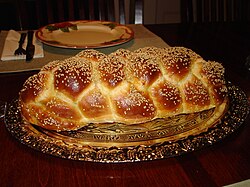
 Challah sprinkled with sesame seeds | |
| Alternative names | khala, khale, chałka, kitke, berkhes, barches, bukhte, dacher, koylatch, koilitsh, shtritsl, kozunak |
|---|---|
| Type | Bread |
| Main ingredients | Eggs, fine white flour, water, yeast, sugar and salt |
Challah or hallah (/ˈxɑːlə, ˈhɑːlə/ (K)HAH-lə;[1] Hebrew: חַלָּה, romanized: ḥallā, pronounced [χaˈla, ħalˈlaː]; pl. [c]hallot, [c]halloth or [c]hallos, Hebrew: חַלּוֹת), also known as berches in Central Europe, is a special bread in Jewish cuisine, usually braided and typically eaten on ceremonial occasions such as Shabbat and major Jewish holidays (other than Passover).
Ritually acceptable challah is made of dough from which a small portion has been set aside as an offering. Challah may also refer to the dough offering. The word is biblical in origin, meaning "loaf".[2] Similar (usually braided) breads with mainly the same ingredients including brioche, kalach, kozunak, panettone, pulla, tsoureki, vánočka are found across European cuisines.
Name and origins
[edit]The term challah in Biblical Hebrew meant a kind of loaf or cake.[3] The targum is גריצא (pl. גריצן, var. Classical Syriac: ܓܪܝܨܐ / ܓܪܝܣܐ) which also means loaf.[4] The word derives from the root chet-lamed-lamed (hallal), which means "pierced." According to Ludwig Köhler, challah was a sort of bread with a central hole, designed to hang over a post.[5]
In Rabbinic terminology, challah often refers to the portion of dough which must be separated before baking, and set aside as a tithe for the Kohen,[6] since the biblical verse which commands this practice refers to the separated dough as a "challah".[2] The practice of separating this dough sometimes became known as separating challah (הפרשת חלה) or taking challah.[7] The food made from the balance of the dough is also called challah.[8] The obligation applies to any loaf of bread, not only to the Shabbat bread, but it is traditional to intentionally bake bread for the Sabbath in such a manner as to obligate oneself, to dignify the Shabbat.[9] By synecdoche, the term challah came to refer to the whole of the loaf from which challah is taken.

There is no consensus as to the source of challah’s braided form. Author of A Blessing of Bread, Maggie Glezer, writes that the braiding began in 15th century Austria and Southern Germany, "with Jewish housewives following their non-Jewish counterparts, who plaited the loaves they baked on Sundays".[10] The braids were meant to symbolize the Sabbath bride’s hair, according to Professor Hasia R. Diner. Another food historian Hélène Jawhara Piñer, a scholar of medieval Sephardic cuisine, has suggested that a recipe for a leavened and braided bread found in a 13th-century Arabic cookbook from Spain, the Kitāb al-ṭabīẖ, may have been a precursor to challah.[11] However, while this bread closely resembles the preparation of challah, it was flavored with saffron and fried, was described in the book as 'the making of braids,' translated into Spanish as 'guedejas', and can be translated to Hebrew as 'peot'.[12] According to Piñer's analysis, following their expulsion from Spain, Sephardic Jews brought this bread northward through Italy in the 15th and 16th centuries.[12]
Variant names
[edit]
Challah may also be referred to as cholla bread.[13][14] In Poland it is commonly known as chałka (pronounced [ˈxawka] ⓘ; diminutive of chała [ˈxawa]), in Ukraine as kolach or khala and khala (хала) in Belarus and Russia.[15][16]
Yiddish communities in different regions of Europe called the bread khale, berkhes or barches, bukhte, dacher, kitke, koylatch or koilitsh, or shtritsl.[17][18] Some of these names are still in use today, such as kitke in South Africa.[18]
The term koylatch is cognate with the names of similarly braided breads consumed on special occasions by other cultures outside the Jewish tradition in several European cuisines. These are the Russian kalach, the Serbian kolač, the Ukrainian kolach the Hungarian kalács (in Hungary, the Jewish variant is differentiated as Bárhesz), and the Romanian colac. These names originated from Proto-Slavic kolo meaning "circle", or "wheel", and refer to the circular form of the loaf.[19][20]
In the Middle East, regional Shabbat breads were referred to by the local word for bread, such as noon in Farsi or khubz in Arabic.[citation needed]
Ingredients and preparation
[edit] | This section needs additional citations for verification. (December 2024) |

Most traditional Ashkenazi challah recipes use numerous eggs, fine white flour, water, sugar, yeast, oil (such as vegetable or canola), and salt, but "water challah" made without eggs and having a texture like French baguette also exists, which is typically suitable for those following vegan diets. Modern recipes may replace white flour with whole wheat, oat, or spelt flour or sugar with honey or molasses.
According to Sephardic Jewish observance of halachah, a bread with too much sugar changes the status of the bread to cake. This would change the blessing used over the bread from Hamotzi (bread) to Mezonot (cake, dessert breads, etc.) which would invalidate it for use during the Kiddush for Shabbat.[21] While braided breads are sometimes found in Sephardic cuisine, they are typically not challah but are variants of regional breads like çörek, eaten by Jews and non-Jews alike.
Egg challah sometimes also contains raisins and/or saffron. After the first rising, the dough is rolled into rope-shaped pieces which are braided, though local (hands in Lithuania, fish or hands in Tunisia) and seasonal (round, sometimes with a bird's head in the centre) varieties also exist. Poppy or sesame (Ashkenazi) and anise or sesame (Sephardi) seeds may be added to the dough or sprinkled on top. Both egg and water challah are usually brushed with an egg wash before baking to add a golden sheen.
Challah is always pareve (containing neither dairy nor meat—important in the laws of Kashrut), unlike brioche and other enriched European breads, which contain butter or milk as it is typically eaten with a meat meal.
Israeli breads for shabbat are very diverse, reflecting the traditions of Persian, Iraqi, Moroccan, Russian, Polish, Yemeni, and other Jewish communities who live in the State of Israel. They may contain eggs or olive oil in the dough as well as water, sugar, yeast, salt, honey, and raisins. It may be topped with sesame or other seeds according to various minhagim.
Rituals and religious significance
[edit]
According to Jewish tradition, the three Sabbath meals (Friday night, Saturday lunch, and Saturday late afternoon) and two holiday meals (one at night and lunch the following day) each begin with two complete loaves of bread.[22] This "double loaf" (in Hebrew: לחם משנה) commemorates the manna that fell from the heavens when the Israelites wandered in the desert after the Exodus. The manna did not fall on the Sabbath or holidays; instead, a double portion would fall the day before the holiday or sabbath to last for both days.[23] While two loaves are set out and the blessing is recited over both, most communities only require one of them to be cut and eaten.[citation needed]
In some Ashkenazi customs, each loaf is woven with six strands of dough. Together, the loaves have twelve strands, alluding to the twelve loaves of the showbread offering in the Temple. Other numbers of strands commonly used are three, five, and seven. Occasionally, twelve are used, referred to as a "Twelve Tribes" challah. Some individuals – mostly Hasidic rabbis – have twelve separate loaves on the table.[citation needed]
Challot - in these cases extremely large ones - are also sometimes eaten at other occasions, such as a wedding or a Brit milah, but without ritual.[citation needed]
Traditional Sabbath meal procedure
[edit]

It is customary to begin the evening and day Sabbath and holiday meals with the following sequence of rituals:

- The challah is covered, customarily with a dedicated challah cover cloth. (Normally, in the order of saying blessings, bread would precede wine. Covering the challah allows the Kiddush blessing to come first.)
- Kiddush is recited over a cup of wine.
- Each attendee ritually washes their hands in preparation for eating bread. (In some communities, the hands are washed before the Kiddush. It is customary not to talk between this washing and the consumption of the bread.[24])
- The challah cover is removed.
- The two loaves are held up together.
- The head of the household recites the blessing over bread: "Baruch atah Adonai, eloheinu melech ha'olam, hamotzi lechem min ha'aretz" (Translation: "Blessed are you LORD our God, King of the Universe, who brings forth bread from the earth").
- The bread (one or two, depending on minhag) is sliced (or torn) and salted, and the pieces are distributed to each person at the meal to eat.
The specific practice varies. Some dip the bread into salt before blessing the bread.[25] Others say the blessing, cut or tear the challah into pieces, and only then dip the pieces in salt, or sprinkle them with salt before they are eaten.[26] Some communities may make a nick in the bread with a cutting knife.
Normally, the custom is not to talk between washing hands and eating bread. However, according to some, if salt is not placed on the table, it is permitted to ask for someone to bring salt before the blessing on bread is recited.[27]
Salting
[edit]Salting challah is considered a critical component of the meal. Customs vary whether the challah is dipped in salt, salt is sprinkled on it, or salt is merely present on the table. This requirement applies to any bread, though it is observed most strictly at Sabbath and holiday meals.[28]
The Torah requires that Temple sacrifices to God be offered with salt.[29] Following the destruction of the Second Temple, Rabbinic literature suggested that a table set for a meal symbolically replaces the Temple altar; therefore, the blessing over food should only be recited with salt present on the table.[24] Should one eat a meal without performing a commandment, the covenant of salt protects him.[30]
To the rabbis, a meal without salt was considered no meal.[31] Furthermore, in the Torah, salt symbolizes the eternal covenant between God and Israel.[32] As a preservative, salt never spoils or decays, signifying the immortality of this bond.[33]
Special challah
[edit]Rosh Hashanah
[edit]On Rosh Hashanah, the Jewish New Year, the challah may be rolled into a circular shape (sometimes referred to as a "turban challah"), symbolizing the cycle of the year, and is sometimes baked with raisins in the dough. Some have the custom of continuing to eat circular challah from Rosh Hashana through the holiday of Sukkot. In the Maghreb (Morocco, Tunisia, Algeria) many Jews will simply bake their challah in the shape of "turban challah" year-round.[citation needed]
Sometimes the top is brushed with honey to symbolize the "sweet new year." According to some traditions, challah eaten on Rosh Hashanah is not dipped in or sprinkled with salt but instead is dipped in or sprinkled with honey. As above, some continue to use honey instead of salt through the Sukkot holiday.[citation needed]

Shlissel challah
[edit]For the Shabbat Mevarchim preceding Rosh Chodesh Iyar (i.e., the first Shabbat after the end of Passover), some Ashkenazi Jews have the custom of baking shlissel[a] challah ("key challah") as a segula (propitious sign) for parnassa (livelihood). Some make an impression of a key on top of the challah before baking, some place a key-shaped piece of dough on top of the challah before baking, and some bake an actual key inside the challah.[34]
The earliest written source for this custom is the Ohev Yisrael of Avraham Yehoshua Heshel (1748–1825), published in 1863. He refers to schlissel challah as a preexisting custom and offers several kabbalistic interpretations.[35][34]
The custom has been criticized for allegedly having its source in Christian or pagan practices.[36]
Challah rolls
[edit]Challah rolls, known as a bilkele or bulkele or bilkel or bulkel (plural: bilkelekh; Yiddish: בילקעלע) or bajgiel (Polish) is a bread roll made with eggs, similar to a challah bun. It is often used as the bread for Shabbat or holiday meals.[citation needed]
Similar breads
[edit]Similar braided, egg-enriched breads are made in other traditions. The Romanian colac is a similar braided bread traditionally presented for holidays and celebrations such as Christmas caroling colindat.[37] The Polish chałka is similar, though sweeter than challah. The Czech vánočka and Slovak vianočka is very similar and traditionally eaten at Christmas. In Bulgarian and Romanian cuisine there is a similar bread called cozonac (Bulgarian: козунак), while tsoureki bread (also known as choreg or çörek) is popular in Armenian,[38] Greek and Turkish cuisines. A sweet bread called milibrod (Macedonian: милиброд), similarly braided as the challah, is part of the dinner table during Orthodox Easter in Macedonia. Zopf is a similar bread from Germany, Austria and Switzerland, with a sweeter variant known as Hefezopf or Hefekranz. In Finnish cuisine, pulla (also known as cardamom bread in English) is a small braided pastry seasoned with cardamom that is very popular in Finnish cafés. Brioche is an egg-enriched bread, but it is not braided.[citation needed]
Unlike challah, which by convention is pareve, many of these breads also contain butter and milk.[citation needed]
See also
[edit]

- Challa (disambiguation page)
- Pain petri
- Kubaneh
- Mouna
- Israeli cuisine
- Jewish cuisine
- Prosphora
- Kolach
- Korovai
Notes
[edit]- ^ or schlissel
References
[edit]- ^ "challah". Merriam-Webster.com Dictionary. Merriam-Webster. Retrieved 10 April 2020.
- ^ a b Numbers 15:20
- ^ "Strong's Concordance".
- ^ Payne Smith, J. (1903). A compendious Syriac Dictionary: founded upon the Thesaurus Syriacus of R. Payne Smith (in Syriac and English). Oxford: Clarendon Press. p. 78. OCLC 251355373.
- ^ Köhler, Ludwig (1948). "Miszellen". Theologische Zeitschrift. 4 (2).
- ^ Jastrow, חַלָּה (meaning 2)
- ^ "Ask the Expert: Taking Challah". MyJewishLearning.com.
What does it mean to take challah
- ^ "AlHatorah Concordance-Dictionary, s.v. חַלָּה".
- ^ "Shulchan Arukh, Orach Chayim 242:1". www.sefaria.org. Retrieved 3 March 2024.
- ^ "A Short History of Challah Bread, and How It Got So Sweet in America". 16 December 2020.
- ^ Piñer, Hélène Jawhara (2021). Sephardi: cooking the history: recipes of the Jews of Spain and the diaspora, from the 13th century to today. Boston. pp. 16–17. ISBN 978-1-64469-531-9. OCLC 1200038942.
{{cite book}}: CS1 maint: location missing publisher (link) - ^ a b Jawhara Piñer, Hélène (2020). "The Sephardi Origin of the Challah Braided Bread". Meldar: Revista Internacional de Estudios sefardíes. 1: 69–71.
- ^ Arnold E. Bender (1975). Dictionary of Nutrition and Food Technology (4th ed.). London: Newnes-Butterworths. p. 54. ISBN 0-408-001437.
- ^ "Loaves For Jewish Festivals "Not Bread"". The London Times. No. 55124. London. 4 July 1961. p. 8.
- ^ Леонид Беловинский (2015). "Хала". Энциклопедический словарь истории советской повседневной жизни (in Russian). Новое Литературное Обозрение. ISBN 978-5444803783.
- ^ Barbara Rolek. Polish Egg-Twist Bread Chalka Recipe. The Spruce, 2017.
- ^ Come ’Round. Forward.com, 2004.
- ^ a b South African Challah?. Forward.com, 2005. The etymology of kittke is given as Kitt + -ke: Kitt in German means "putty" [1]; "-ke" is the Slavic diminutive suffix found in many Yiddish words and names. Kitke referred not to the whole challah but simply to the braids or decorations that were attached to the challah like putty before baking, and the word must have originally referred to these.
- ^ Colac (in Romanian). DEXOnline: Dictionar Explicativ al Limbii Romane (Romanian online dictionary). References: Miklosich, Slaw. Elem., 25; Cihac, II, 67; Conev 66
- ^ Колач (in Russian). Max Vasmer. Russisches etymologisches Wörterbuch. Winter, Heidelberg 1953–1958 (in German). Russian translation by Oleg Trubachyov: Этимологический словарь русского языка. Progress, Moscow, 1964–1973.
- ^ Spolter, Rabbi Yair; Simmons, Rabbi Shraga (7 September 2015). "10. Three Mezonot Categories". aishcom. Archived from the original on 6 March 2021. Retrieved 1 March 2021.
- ^ Maimonides (d. 1204), Mishneh Torah Hilchot Shabbos, Chapter 30, Law 9. (Hebrew)
- ^ Sol Scharfstein, Understanding Jewish Holidays and Customs, page 16 (1999)
- ^ a b "Salt". Jewish Encyclopedia. Retrieved 7 March 2013.
- ^ Isserles, in Shulcḥan 'Aruch, l.c.
- ^ Both practices are based on different parts of the same verse in Leviticus
- ^ Shulchan Aruch, Oraḥ Ḥayyim 167:5; Jacob Zausmer, "Bet Ya'aḳob," No. 168; comp. Berachot 40a.
- ^ "פרק ג - ברכת המוציא". פניני הלכה (in Hebrew). Retrieved 10 October 2025.
- ^ Leviticus 2:13
- ^ Tosafot, Berachot 40a
- ^ Berachot 44a
- ^ Silberberg, Naftali. "Why is the Challah dipped in Salt". Chabad.org. Retrieved 7 March 2013.
- ^ Rabinowitz, Louis Isaac. "Salt". Encyclopedia Judaica.
- ^ a b "Second Thoughts: The Key to Parnassah." Hamodia, Feature Section, p. C3. 23 April 2009.
- ^ "Ohev Yisrael, For the Shabbat After Pesach 1:1". www.sefaria.org. Retrieved 7 July 2024.
- ^ Shelomo Alfassa, Shlissel Challah – “The Loaf of Idolatry?”
- ^ "Reteta Colaci impletiti".
- ^ "Adventures in Armenian Cooking". St. Sarkis. Archived from the original on 21 May 2008.
External links
[edit]| History | |||||||||
|---|---|---|---|---|---|---|---|---|---|
| Types | |||||||||
| Religious dietary laws | |||||||||
| Chefs | |||||||||
| Religious foods | |||||||||
| Breads |
| ||||||||
| Sweets |
| ||||||||
| Pastries | |||||||||
| Fried foods | |||||||||
| Dumplings, pastas and grain dishes | |||||||||
| Casseroles and savory baked dishes | |||||||||
| Snacks and other baked goods | |||||||||
| Sandwiches | |||||||||
| Egg dishes | |||||||||
| Meat dishes | |||||||||
| Fish dishes | |||||||||
| Salads and pickles | |||||||||
| Vegetable dishes | |||||||||
| Soups and stews | |||||||||
| Cheeses and other dairy products | |||||||||
| Condiments, dips and sauces | |||||||||
| Beverages | |||||||||
| Herbs, spices and seasonings | |||||||||
| Eateries | |||||||||
| Related lists | |||||||||

| National | |
|---|---|
| Other | |

Challah
View on GrokipediaEtymology and History
Origins of the Name
The word challah originates from Biblical Hebrew, where it refers to a portion or loaf set aside as an offering, as commanded in Numbers 15:17–21: "When you eat of the bread of the land, you shall offer up a portion to the Lord as a gift" (the term challah denotes this separated dough).[5] This etymology ties directly to the mitzvah (commandment) of hafrashat challah, the ritual separation of a small piece of dough during bread preparation to sanctify the rest, a practice rooted in ancient Israelite agricultural laws.[6] In Jewish diaspora communities, the name evolved with linguistic adaptations. In Yiddish, it is commonly spelled hallah or khale, reflecting Ashkenazi pronunciation and orthographic conventions influenced by Germanic languages during medieval migrations to Central and Eastern Europe.[7] Sephardic Jews, particularly those speaking Ladino (Judeo-Spanish), use variants like chala or halá, incorporating Spanish phonetic elements from their expulsion from Iberia in 1492 and subsequent settlements in the Ottoman Empire and North Africa.[8] These transliterations highlight how diaspora influences shaped the term's form while preserving its core reference to the biblical offering. In English and other non-Jewish contexts, the bread is sometimes generically termed "egg bread" due to its enriched, egg-based dough, though this lacks the ritual connotation of the original Hebrew.[9] The name's symbolic depth in halakha (Jewish law) emphasizes themes of separation and sanctity. By designating a portion of ordinary (chol) dough for divine use, challah transforms the mundane act of baking into a holy ritual, symbolizing the elevation of the physical world toward spiritual purity and reminding practitioners that all blessings—such as sustenance or prosperity—must first be dedicated to God before personal enjoyment.[5] This interpretation underscores the name's role in fostering mindfulness of sanctity amid daily life, a principle echoed in rabbinic texts linking the mitzvah to broader themes of tikkun olam (world rectification).[6]Historical Development
The origins of challah trace back to biblical commandments in the Torah, where the term refers to a portion of dough (terumah) separated as an offering to the priests (kohanim) from any batch large enough for five loaves, as described in Numbers 15:18–21.[10] This simple priestly tribute, performed during the baking process, symbolized gratitude and holiness in everyday life, evolving from agricultural first-fruits offerings into a core ritual practice by the Second Temple period (c. 516 BCE–70 CE).[11] During this era, ritual breads like the lechem hapanim—twelve weekly loaves placed on a golden table in the Temple sanctuary—represented the twelve tribes of Israel and served as a perpetual offering before God, linking proto-challah forms to temple worship.[12] Archaeological evidence from sites across ancient Israel, including tannur ovens and grain storage facilities uncovered at locations like Tel Halif, supports the prevalence of wheat-based leavened breads in daily and ritual contexts, with imprints of flat loaves and baking tools dating to the Iron Age and Second Temple era.[13][14] In medieval Europe, particularly among Ashkenazi Jews from the 12th to 15th centuries, challah developed into a distinct Sabbath and holiday bread, influenced by the availability of wheat and rye in regions like the Rhineland and Austria.[15] Jewish communities adapted local Christian baking traditions, such as the enriched Sunday loaf (berches), transforming it into a braided, egg-enriched wheat bread to fulfill the mitzvah while distinguishing it from everyday rye loaves.[10] The first written reference to "challah" as the name for this Sabbath bread appears in the 1488 Austrian text Leket Yosher by Yosef ben Moshe, a student of Rabbi Israel Isserlein; braiding, symbolizing unity and blessing, emerged in 15th-century Central Europe (Austria and southern Germany), though the practice likely began earlier in the 12th–13th centuries amid growing Jewish settlement there.[16] Some scholarship suggests possible earlier braided influences from Sephardic traditions in medieval Al-Andalus, based on 13th-century recipes, though the consensus attributes the modern braided form to Ashkenazi development.[17] This Ashkenazi style spread eastward to Poland and Russia with migrations, solidifying challah as a cultural marker of Jewish life in the diaspora. Sephardic and Mizrahi Jews in the Middle East and North Africa maintained earlier, pre-European adaptations of challah, incorporating local flours like semolina or barley and shapes suited to regional climates and ovens, often predating the braided Ashkenazi form.[18] In places like Morocco, Tunisia, Iraq, and Yemen, these breads were typically flatter, round, or ladder-shaped—such as the Moroccan kaak or Iraqi khubz—baked in communal tabun ovens with sesame, nigella, or anise seeds, reflecting ancient Levantine influences and less emphasis on sweetness due to ingredient scarcity.[19] These variations, documented in oral traditions and early Ottoman-era records, emphasized simplicity and portability for Sabbath meals in arid environments, contrasting with European enrichments.[20] The 19th and 20th centuries saw challah's global spread through Jewish diaspora migrations, particularly the mass immigration of over two million Eastern European Ashkenazim to America between 1881 and 1914, where it became a staple in urban Jewish communities from New York to Chicago. In the U.S., abundant sugar, eggs, and commercial yeast—introduced by Hungarian-Jewish immigrants like the Fleischmann brothers in the mid-19th century—transformed the bread into a sweeter, taller loaf, adapting to American tastes and home baking.[21] Post-World War II commercialization accelerated this evolution, with instant yeast (developed in the 1970s) and supermarket bakeries enabling mass production; by the 1950s, brands like Arnold and Pepperidge Farm offered pre-braided challah nationwide, making it accessible beyond Orthodox circles while preserving its ritual role.[22] This era marked challah's transition from homemade tradition to a commercial icon, reflecting Jewish assimilation and economic prosperity in the post-Holocaust diaspora.[23]Ingredients and Preparation
Core Ingredients
Challah dough traditionally consists of wheat flour, water, yeast, sugar, eggs, oil, and salt as its core components.[24] These ingredients create an enriched bread that is soft, slightly sweet, and suitable for braiding.[1] In classic recipes, proportions typically include 4 to 5 cups of all-purpose or bread flour for a standard batch yielding one or two braided loaves, along with about 1 cup of water, 1 tablespoon of active dry yeast, 2 to 3 tablespoons of sugar or honey, 2 to 3 eggs, ¼ to ½ cup of vegetable oil, and 1 to 2 teaspoons of salt.[24][25] The flour provides structure, while high-gluten varieties are sometimes preferred for better elasticity during braiding.[26] Eggs add richness, tenderness, and a distinctive golden hue to the crust when baked, contributing to the bread's luxurious texture.[26] Vegetable oil, often canola or olive, ensures the dough remains moist and helps achieve a soft crumb; it also maintains the bread's parve status under kosher laws, making it neutral for meals with meat or dairy.[1][24] Sweetness levels vary, with some recipes using plain sugar for a subtle flavor and others incorporating honey for a more pronounced sweetness and subtle floral notes.[25] Toppings such as poppy seeds or sesame seeds are commonly sprinkled on the surface before baking to add crunch and visual appeal.[24] Modern adaptations include vegan substitutions like aquafaba or flaxseed mixtures in place of eggs to replicate binding and moisture, and gluten-free flour blends such as rice or almond flour for those with dietary restrictions.[27][28] These changes can affect the traditional texture and rise.[29]Braiding and Baking Methods
After the dough has been mixed with core ingredients such as flour, yeast, eggs, oil, sugar, and salt, it undergoes thorough kneading to develop gluten structure, typically for 10 to 12 minutes by hand or with a stand mixer until smooth and elastic.[30] This process ensures the dough's elasticity, allowing it to hold its braided shape during rising and baking. In traditional Jewish practice, after kneading while the dough is still one piece, a small portion (the size of an olive, about 1 ounce) is separated as hafrashat challah to fulfill the mitzvah; if the dough is from at least 2.25 kg (5 lbs) of flour, a blessing is recited over the separation, and the piece is burned or wrapped and discarded.[31] The kneaded dough is then placed in a lightly oiled bowl, covered, and allowed to undergo an initial rise for 1 to 2 hours in a warm, draft-free environment until it doubles in volume.[26] Once risen, the dough is gently deflated, divided into portions, and rolled into strands of equal length, usually 12 to 20 inches depending on the desired loaf size. Traditional braiding employs 3 to 6 strands per loaf; a 3-strand braid involves crossing the outer strands over the center alternately, while 4- or 6-strand versions follow a more intricate over-under pattern for a fuller appearance.[32] Some traditions use 12 strands to symbolize the Twelve Tribes of Israel, achieved by braiding each of two loaves with six strands.[33] For beginners, a simple twist of two or three strands suffices, providing practice in handling the supple dough without complex weaving.[34] The braided loaf is placed on a parchment-lined baking sheet, covered loosely, and proofed during a second rise of 45 to 60 minutes until puffy and nearly doubled, allowing further gluten relaxation and gas expansion for a light crumb. Before baking, the loaf is brushed with an egg wash—typically a whole egg or yolk mixed with water—for a glossy, golden finish that enhances its visual appeal.[25] Baking occurs in a preheated oven at 350°F to 375°F for 25 to 40 minutes, until the crust achieves a deep golden brown and the internal temperature reaches 190°F, ensuring even doneness without drying out the interior.[35] Common baking issues include a dense texture, often resulting from over-kneading with excessive flour, which toughens the gluten, or under-proofing, where insufficient rising time prevents proper aeration.[36] To mitigate this, bakers should adhere to measured flour additions during kneading and verify proofing by the gentle poke test, where the dough springs back slowly. Essential equipment includes a large mixing bowl for dough development, a stand mixer with dough hook for efficiency, and rimmed baking sheets lined with parchment to support the loaf's expansion. Optional proofing baskets can aid in maintaining shape during the second rise, though they are less common in traditional challah preparation compared to free-form braiding on sheets.[25]Religious and Cultural Significance
Role in Jewish Rituals
The biblical mandate for challah originates in Numbers 15:20, which instructs, "You shall offer up a loaf (challah) from the first of your dough as a gift" to God, establishing it as one of the 24 gifts to the priests and a positive commandment (mitzvah) in Jewish law.[37] This separation of a small portion of dough—typically performed before baking and historically burned or given to a priest—serves as a reminder of divine provision and sanctity in everyday food preparation.[6] In Orthodox Jewish homes, this mitzvah is traditionally fulfilled by women, who recite a specific blessing over the dough, emphasizing its role in infusing the home with holiness.[38] The symbolism of challah extends deeply into Jewish theology and observance. The twisted or braided shape of the loaf often represents unity and interconnectedness, with strands evoking themes of love, peace, and justice, while some interpretations link it to the double portion of manna that fell on Fridays during the Israelites' desert wanderings, symbolizing abundance and preparation for the Sabbath.[10] Additionally, certain braided forms, such as ladder-shaped challot for specific rituals, allude to Jacob's ladder in Genesis, bridging heaven and earth as a conduit for divine blessings.[15] The use of two loaves on the Sabbath table recalls the lechem paniym (showbread), the twelve loaves placed in the ancient Temple each week to signify God's eternal presence and the tribes of Israel.[16] Challah plays a significant role in Jewish lifecycle events, marking transitions with its ritual presence. At weddings, it is often featured under the chuppah or during the seudat mitzvah (festive meal), where the groom may recite the Hamotzi blessing over a braided loaf to invoke prosperity and unity in the new union.[39] For bar and bat mitzvahs, challah is central to celebratory gatherings, symbolizing the young person's entry into religious adulthood and communal responsibility.[40] In funerals and shiva (mourning period), challah is provided as comfort food during meals, offering solace through its familiarity and association with sustenance amid grief.[41] Regarding gender roles, while the mitzvah of separating challah is obligatory for all Jews, Orthodox tradition assigns it particularly to women as one of three "women's mitzvot," reflecting their spiritual influence in the domestic sphere.[42] In egalitarian and Reform communities, however, men and women share this practice equally, adapting the ritual to promote gender inclusivity without diminishing its sanctity.[43] It also holds prominence in seudat mitzvah meals following events like circumcisions or Torah completions, underscoring joy and divine favor through shared bread.[44]Sabbath and Holiday Traditions
During the Friday evening Shabbat meal, known as the seudat Shabbat, two loaves of challah are placed on the table, traditionally covered with a cloth to show respect. The cover is removed before the meal, and the hamotzi blessing is recited over both intact loaves, acknowledging God for bringing forth bread from the earth.[45][46] In some communities, particularly among Sephardic and certain Ashkenazi traditions, the challah is torn by hand rather than cut with a knife, a practice observed especially on Friday evenings to distinguish the sacred meal.[47] Following the blessing, salt is sprinkled or the challah is dipped in salt three times before distribution, a ritual performed after handwashing and evoking the salted offerings of the ancient Temple.[48][46] The Shabbat meal begins with the Kiddush, recited over a cup of wine or grape juice to sanctify the day, followed by ritual handwashing. Only then is the hamotzi blessing said over the challah, with pieces torn or cut and shared among all at the table to commence the meal.[49][50] This sequence ensures the wine's sanctity precedes the bread, maintaining the order of blessings as outlined in Jewish law. On Saturday night, the Havdalah ceremony marks the end of Shabbat, and any braided challah remnants from the meals are often distributed as charity or fed to birds, aligning with customs to avoid waste and honor the week's provisions.[50] For major holidays, challah integrates into specific observances. At the Yom Kippur break-fast meal following the 25-hour fast, round challah is customarily served, continuing the High Holiday tradition of circular forms.[51] During Sukkot, ladder-shaped challah appears at meals in the sukkah, reflecting communal gatherings.[52] These procedures adapt the standard Shabbat rituals to the holiday's themes, with the challah blessed and shared similarly after Kiddush.[50]Variations and Adaptations
Holiday-Specific Forms
Challah takes on distinctive forms during Jewish holidays, with shapes and ingredients adapted to reflect symbolic themes of renewal, atonement, harvest, revelation, and seasonal transitions. These variations maintain the bread's ritual role while incorporating holiday-specific motifs, often drawing from biblical imagery or mystical traditions. For Rosh Hashanah, the Jewish New Year, challah is typically baked round to symbolize the cyclical nature of the year and life itself, evoking continuity and the hope for a sweet future.[53] Raisins or apples are commonly added to the dough for added sweetness, representing blessings and renewal in the coming year.[54] In some Ashkenazi traditions, a ladder-shaped challah is prepared, signifying spiritual ascent and elevation during the High Holy Days.[15] During Yom Kippur, the Day of Atonement, challah is often round, bird-shaped, or in the form of hands for the pre-fast meal (Seudat Mufseket), symbolizing aspiration toward heaven, hope, and eternity, rather than elaborate sweetness.[55] The ladder shape may also appear here, symbolizing a climb toward divine judgment and moral elevation.[15] Sukkot, the Feast of Tabernacles, inspires elongated or multi-stranded braids in challah, mimicking the lulav (palm frond) from the holiday's Four Species ritual or bundles of harvest sheaves to celebrate agricultural abundance.[52] These forms highlight themes of gratitude for the earth's bounty and the temporary dwellings (sukkot) of the Israelites.[56] On Shavuot, commemorating the giving of the Torah at Sinai, challah incorporates dairy elements, such as milk or cheese blended into the dough, to evoke the "land flowing with milk and honey" and the purity of revelation.[57] Floral or petal-shaped designs are sometimes used, representing the blooming of spiritual enlightenment and the mountain's transformation during the divine encounter.[58] Shlissel challah, a mystical custom rooted in Kabbalah, features a key either shaped into the bread or baked inside (wrapped in foil for safety), typically prepared for the Shabbat immediately after Passover to invoke fertility, prosperity, and "unlocking" blessings.[59] This practice draws from symbolic interpretations of biblical keys and gates, though modern observers note health risks from potential lead in metal keys and advise using safe alternatives like ceramic or avoiding embedding altogether.[60] During Passover, when leavened breads are prohibited, traditional challah is replaced by egg-free matzah—unleavened flatbread made solely from flour and water—as a ritual substitute to fulfill the blessing over bread at the Seder and meals. This adaptation upholds the holiday's focus on freedom from Egypt while adhering to dietary laws against chametz (leavened products).[61]Regional and Modern Variations
Challah exhibits significant regional variations shaped by the historical migrations of Jewish communities. In Ashkenazi traditions, prevalent among Eastern European Jews, the bread is characteristically sweeter and egg-enriched, yielding a soft, golden loaf often braided into elaborate shapes for a tender, pull-apart texture.[62] In contrast, Sephardic versions, rooted in Iberian and Mediterranean influences, rely on olive oil for richness, resulting in lighter, sometimes flatter loaves that may omit eggs entirely and incorporate flavors like sesame or caraway seeds.[63] [64] These differences stem from distinct flour types and preparation methods, with Sephardic challah tracing origins to 13th-century Al-Andalus recipes emphasizing oil-based doughs.[17] In the United States, post-immigration adaptations have introduced innovative fillings and commercial scalability. American challah often features indulgent additions like chocolate swirls or cinnamon, amplifying its sweetness to align with local palates, a shift accelerated by access to refined sugars and commercial yeast in the early 20th century.[22] Commercial varieties became widely available in the 20th century, popularizing challah beyond home baking.[65] Israeli challah reflects the nation's multicultural fabric, influenced by successive immigration waves from diverse regions. Everyday loaves frequently incorporate whole wheat flour for a nuttier, heartier profile, while toppings like za'atar—a blend of herbs, sesame, and sumac—infuse Middle Eastern notes, blending Ashkenazi braiding with Sephardic savoriness.[66] [67] Contemporary global trends address modern dietary needs and cultural fusions. Post-2010, vegan adaptations using aquafaba (chickpea brine) as an egg replacer have proliferated, maintaining the bread's fluffiness without animal products, while gluten-free recipes substitute almond flour for traditional wheat, catering to health-conscious consumers.[68] [69] [70] Fusion experiments, such as concha-challah hybrids, merge the braided structure with Mexican pan dulce's crumbly, flavored toppings like vanilla or chocolate streusel, symbolizing intercultural dialogue in diaspora communities.[71] The widespread adoption of challah in non-Jewish bakeries has prompted debates on authenticity, particularly within Reform Judaism, where some view it as cultural appreciation fostering interfaith understanding, while others critique commercialization or adaptations like "challah crosses" as appropriation diluting sacred traditions.[72] [2]Comparisons and Influences
Similar Breads Worldwide
Challah shares structural and textural similarities with several enriched breads from Eastern Europe, where braided or tall loaves enriched with eggs and sugar are common in festive contexts. Russian kulich, a tall, cylindrical Easter bread made with yeast, eggs, butter, and dried fruits, resembles challah in its soft, sweet crumb and golden glaze, though it is typically taller and crowned with icing rather than braided.[73] Ukrainian kalach, a braided yeast bread often formed into a ring shape, mirrors challah's braiding technique and use of eggs for richness, but it is usually savory and served during holidays without the ritual significance of challah.[74] In the Middle East and surrounding regions, some breads echo challah's egg-washed crust and potential for fillings, though they diverge in form. Armenian zhengyalov hats, a flatbread stuffed with wild greens and sometimes nuts, is typically unleavened, lacks braiding, and emphasizes herbal flavors over sweetness.[75] Turkish çörek, a versatile yeast pastry that can be sweet or savory with nut or fruit fillings, often features an egg wash for a shiny finish similar to challah, but it is baked in smaller, coiled shapes rather than loaves.[76] Italian breads like brioche exhibit textural parallels to challah through their high egg and fat content, yielding a light, fluffy interior, but brioche relies on butter for enrichment and is shaped into buns or loaves without ritual braiding.[77] Ciabatta, an Italian rustic bread with a high hydration dough, offers a chewy texture influenced by similar wheat flours but remains flatter and crustier, without the sweetness or braiding of challah.[78] Asian breads provide further analogies in softness and enrichment. Japanese shokupan, or milk bread, achieves a pillowy texture akin to challah through eggs and milk in the dough, often baked in loaf pans for uniformity, though it is unbraided and milder in flavor.[79] A key distinction across these comparisons is challah's adherence to kosher dietary laws, which prohibit lard—a common fat in many European breads like certain Eastern European kolaches or Italian pastries—requiring vegetable oil or schmaltz instead for its richness.[80]Cultural Exchanges and Evolutions
During the medieval period, Ashkenazi challah emerged in the Alsace region of France around the 11th-12th centuries, drawing influences from local French enriched breads such as brioche, which shared similar dough enrichment techniques with eggs, oil, and sugar.[81] This development coincided with Jewish migrations eastward from the Rhineland and Alsace, prompted by expulsions and persecutions during the First Crusade, which facilitated the spread and adaptation of braiding techniques symbolizing unity and sanctity in the bread.[81] The braiding style, initially a practical and aesthetic evolution from regional European baking, became a hallmark of Ashkenazi tradition as communities resettled in Germany and later Eastern Europe.[81] In colonial contexts, Jewish communities in regions like the Caribbean and South Africa incorporated local ingredients and flavors into challah, reflecting interactions with surrounding non-Jewish culinary traditions. Similarly, South African Jewish cuisine, shaped by Ashkenazi and Sephardic immigrants from the 19th century onward, adapted kitke—a local term for challah—while adhering to kosher laws.[82][83] The 20th-century globalization of challah accelerated through Jewish immigration to the United States, particularly post-World War II, when refugees and survivors from Europe introduced artisanal baking techniques to urban centers. Hungarian Jewish immigrants like Charles and Max Fleischmann popularized commercial yeast in the late 19th century, enabling sweeter, more accessible American-style challah that entered supermarkets via expanding kosher sections in the Northeast by the 1910s and 1940s.[22] This era also saw hybrids like marbled rye challah emerge in American Jewish baking, combining the braided form and egg enrichment of challah with rye flour and caraway seeds from Eastern European rye traditions, appealing to deli culture and broader palates.[84] In contemporary settings, challah has featured in cross-cultural peace initiatives in the Middle East, where joint baking events symbolize reconciliation between Jewish and Arab communities. For instance, following the 2020 Abraham Accords, Israeli and Emirati women participated in synchronized challah-baking under multilingual slogans like "Together," fostering dialogue through shared bread-making rituals that blend Jewish traditions with regional hospitality.[85] While direct fusions with Arab flatbreads like manaeesh remain rare, online recipes increasingly merge challah with global techniques, such as sourdough starters, creating tangy, fermented variations that democratize the bread beyond traditional yeast methods and attract diverse home bakers worldwide.[86] These evolutions have sparked debates within Jewish communities about commercialization's impact, with some viewing mass-produced challah in supermarkets as eroding ritual authenticity and familial baking traditions, while others argue it enhances accessibility and preserves cultural continuity for diaspora Jews facing time constraints. Ethnographic studies highlight a dialectical process where innovations, such as flavored or symbolically shaped challahs, allow for creative expression without fully diluting core religious significance, particularly among non-Orthodox groups seeking inclusive practices.[87]References
- https://en.wiktionary.org/wiki/challah