Hubbry Logo
Spada da latoSpada da latoMain
Open search
Spada da lato
Community hub
Spada da lato
logo
8 pages, 0 posts
0 subscribers
Be the first to start a discussion here.
Spada da lato
Spada da lato
from Wikipedia

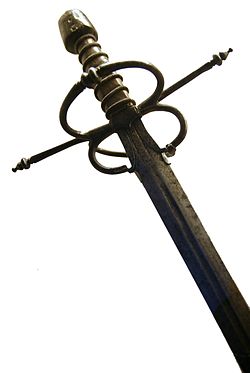
An early rapier or "side-sword" on exhibit in the Castle of Chillon.

The spada da lato (Italian) or side-sword is a type of sword popular in Italy during the Renaissance. It is a continuation of the medieval knightly sword, and the immediate predecessor, or early form, of the rapier of the early modern period. Side-swords were used concurrently with rapiers as well, particularly for military applications, although differentiating swords between civilian and military use was not something that was done in the period when a soldier had to arm himself. Its use was taught in the Dardi school of Italian fencing and others, and was influential on the classical rapier fencing of the 17th century.[1] The equivalent Spanish term, espada ropera ("dress sword") is seen as the origin of the term rapier, although this is disputed.[2] Italian antiquarians use the term spada da lato for rapiers typical of the period of c. 1560–1630, the Italian term for the fully developed rapier of the later 17th century is spada da lato striscia, or just spada striscia "strip-sword".,[3] but the term rapier or rapiera is also used in modern Italian.

References

[edit]
Revisions and contributorsEdit on WikipediaRead on Wikipedia
from Grokipedia
The spada da lato, Italian for "side-sword," is a civilian sword that emerged in late 15th-century Italy as an evolution of the medieval arming sword, featuring a single-handed design optimized for both cutting and thrusting in duels and self-defense. Distinguished from its later successor, the rapier, by its broader blade profile and emphasis on versatile combat techniques, the spada da lato typically measured around 40 inches in overall length with a blade width of about 1.25 inches at the base, tapering to a sharp point suitable for penetration. Developed during the amid shifting warfare and civilian fashion trends, it incorporated complex designs—such as ringed or swept guards—to protect the hand, reflecting advancements in Italian treatises by masters like Achille Marozzo. By the late , the spada da lato had spread across , influencing military and civilian armaments until the early , when thrust-centric rapiers began to supplant it in specialized dueling contexts.

History

Origins and Development

The spada da lato, translating literally to "sword by the side," denoted a versatile civilian sidearm designed for wear with everyday dress, setting it apart from heavier longswords intended for use. This emphasized a balance of cutting and thrusting capabilities, suited to personal defense rather than armored . The spada da lato emerged in late 15th-century as an evolution of the medieval arming sword and early Renaissance cut-and-thrust types, reflecting adaptations to changing combat needs. Its development coincided with the (c. 1450–1550), a period marked by rapid urban expansion in city-states, the proliferation of dueling as a means of settling honor disputes among nobility and burghers, and the increasing prevalence of firearms, which diminished the reliance on full plate armor and favored lighter, more agile weapons for unarmored encounters. Historical records indicate the first clear references to the spada da lato in Italian inventories around the 1490s, with the weapon becoming widespread by the 1520s in northern urban centers such as Venice and Milan, where it served as both a practical tool and a status symbol among the affluent. Initially concentrated in northern Italy, its design incorporated influences from Spanish espada ropera (a contemporary civilian thrusting sword) and German short swords like the Katzbalger, contributing to variations in blade proportions and hilt complexity across regions.

Transition to Rapier

The , referred to in Italian as the spada da lato a striscia, developed as a slender, thrust-optimized of the spada da lato between approximately 1550 and 1600, serving primarily as a dueling rather than a sidearm. This descendant featured a typically measuring 40 to 43 inches in length, narrowed to about 1 inch at the forte for enhanced penetration, marking a departure from the broader, cut-and-thrust profile of its predecessor. Central to this transformation were modifications in blade design and hilt construction: blades were elongated and tapered to prioritize linear thrusts over slashes, improving speed and reach in unarmored engagements, while hilts incorporated increasingly elaborate protections such as sweeping quillons, rings, and loops to shield the hand and fingers during close-quarters parries. These changes reflected broader technological advancements in , allowing for lighter yet resilient blades weighing 2 to 3.5 pounds. The evolution was propelled by cultural and geopolitical factors, including the influx of the Spanish espada ropera—a "sword of the robes" designed for civilian dress—via trade routes, Habsburg alliances, and conflicts like the , which exposed Italian swordsmiths and fencers to Iberian precision-oriented styles. Italian masters, adapting these influences for dueling contexts, emphasized footwork and to exploit the rapier's reach, as evidenced in treatises that bridged traditional and modern forms. By the 1570s, fencing manuals such as Giacomo di Grassi's Ragione di adoprar sicuramente l'Arme (1570) depicted hybrid techniques integrating spada da lato cuts with emerging thrusts, signaling the transitional phase. The attained full dominance in European civilian combat by the 1590s, supplanting earlier sideswords in treatises and urban carry, as its design aligned with the era's focus on personal honor and judicial duels. This shift diminished the emphasis on cutting, as the rapier's lighter construction suited agile, armorless civilian encounters where rapid thrusts offered superior lethality and control compared to power-dependent slashes.

Design and Features

Blade Characteristics

The blades of the spada da lato typically measured 80–90 cm in length, with an overall sword length of 95–105 cm and a weight of 1.0–1.3 kg, providing a balance suitable for both cutting and thrusting actions. These straight, double-edged blades featured a central fuller running along much of their to reduce weight while maintaining structural integrity, often with a hexagonal cross-section that tapered gradually to a sharp point for effective penetration. The profile was broad at the base—measuring approximately 3–4 cm wide near the —allowing for powerful cuts, before narrowing to enhance thrusting capability. Constructed from high-carbon steel, the blades were frequently tempered through quenching processes, such as water or oil on the edges, to achieve (around 480–600 HV) while the —an unsharpened section at the base—facilitated safe parrying without risking blade damage. This lenticular or flattened hexagonal cross-section, sometimes with a pronounced mid-rib for added stiffness, reflected advanced metallurgical techniques common in northern Italian production during the late 15th and early 16th centuries. The functional design emphasized versatility, with a broader midsection optimized for slicing cuts and a reinforced, stiff tip for thrusts; military variants often featured even wider blades for enhanced chopping power in battlefield contexts. Specific examples include blades from Milanese workshops, which sometimes bore etched decorations or maker's marks denoting origin and quality.

Hilt and Guard Variations

The basic structure of the spada da lato's hilt evolved from the simple guards of medieval arming swords, incorporating quillons, a knuckleguard, and a finger ring to provide essential hand protection during one-handed use. These elements formed a protective cage around the hand, allowing the wielder to pair the sword with a secondary such as a , while the was typically short and ergonomic for agile manipulation. The pommel, often disc-shaped or lenticular, balanced the and facilitated counterweighting for thrusts and cuts. Key variations in hilt design appeared in the early , with "integral" hilts featuring side rings attached directly to the for enhanced enclosure of the fingers. By the mid-, "swept" hilts emerged as a prominent type, characterized by multiple curved loops or branches that swept downward from the quillons, offering superior protection against sliding blades while maintaining versatility for both cutting and thrusting actions. These swept designs were particularly refined in Italian workshops, reflecting advancements in techniques that emphasized hand safety. Materials for hilts were predominantly iron or , frequently blued for resistance or gilded with and silver inlays to denote status, especially in or ceremonial examples. Grips were commonly wrapped in or wire for secure control, preventing slippage during dynamic engagements. Ergonomically, the hilts accommodated one-handed operation, with some variants including a or extension to allow the to rest along the blade for precise control in parrying and pointing. Specific types included the "" style, influenced by German mercenaries and featuring prominent shell-shaped guards that provided broad, curved protection akin to early basket hilts, popular among northern Italian users in the early to mid-16th century. By the 1570s, many spada da lato hilts transitioned toward -like cage configurations, with intricate loops and bars forming a more enclosed structure that foreshadowed the fully developed guard. This evolution marked a shift from versatile military designs to specialized civilian dueling weapons.

Combat Use

Fencing Techniques

Fencing with the spada da lato emphasized a balance of offensive and defensive maneuvers, drawing from the traditions outlined in early treatises such as Fiore dei Liberi's Fior di Battaglia (ca. 1410) and later Bolognese masters like Achille Marozzo in his Opera Nova (1536). The system integrated cuts and thrusts while prioritizing control of distance and timing to exploit openings. Central to these techniques were four primary guard positions, which provided stable stances for initiating or responding to attacks, with the blade angled to cover vital lines. The porta di ferro (iron gate), a low guard with the sword held horizontally across the body and the point forward or to the side, featured a forward stance with the right foot advanced, emphasizing defensive strength against incoming strikes. Its variant, porta di ferro mezana (middle iron gate), positioned the blade at mid-level along the body's center line, with the point directed forward for quick thrusts, requiring a longer blade for optimal leverage. The cinghiale (boar's tooth), another low guard, involved the right foot forward and the sword's point aimed high toward the opponent's face or chest, allowing for upward deflections and counter-thrusts. These positions, as described by Fiore, transitioned fluidly into action, with the blade's angle adapting to the opponent's measure. Marozzo expanded on these for the sidesword, including variants like porta di ferro stretta (narrow iron gate) for closer engagements and cinghiale porta di ferro with the left foot forward to facilitate evasion. Fundamental actions combined cuts and thrusts to maintain pressure, often chaining them to control the fight's tempo. Cuts included the fendente (descending vertical strike from high to low, ending in a low guard like porta di ferro), sottani (rising underhand cuts targeting the underbelly or arms), and riverso (backhand descending or circular cuts from the left side). Thrusts featured the straightforward (direct stab from guards like coda lunga) and the imbroccata (overhead thrust delivered from a high guard, driving downward into the chest). In close quarters, half-swording—gripping the blade with the off-hand for added control and power—was emphasized for binding the opponent's weapon or delivering precise stabs, as taught in Marozzo's foundational exercises. Core principles governed these actions: referred to the precise timing of strikes to act first or counter effectively, often in a single motion (dui tempi) for parry-riposte sequences; measure controlled distance through steps like the gran passo (large passing step) to enter or exit safely; and voiding involved evasive footwork, such as retreating or crossing steps (incrossare), to dodge thrusts while repositioning the blade. These were integrated with secondary weapons, where the spada da lato paired with a for close binds or a (brochiero) to deflect cuts, allowing seamless transitions from wide to narrow play. Specific techniques highlighted leverage and deception, such as the imbroccata from guardia alta to bypass high defenses, or the riverso fendente to counter from porta di ferro by sweeping the blade backhand across the torso. Disarms relied on , using grips or binds (presa) to twist the opponent's weapon away, often following a voiding step to unbalance them. Marozzo stressed ending all actions in a guard to maintain readiness. Training emphasized progressive drills to internalize these elements, beginning with solo molinelli (circular sword spins simulating cuts like fendente and riverso to build wrist strength and precision) and advancing to partner sparring. Sparring incorporated protective gear, such as padded jackets or masks, to practice full exchanges from guards while applying tempo and measure, as outlined in Marozzo's proficiency examinations.

Role in Duels and Self-Defense

The spada da lato found primary application in urban scenarios during the , where civilians confronted threats from bandits, rivals, or opportunistic attackers in the bustling streets of Italian cities. As a versatile cut-and-thrust weapon, it allowed for quick draws and maneuvers suited to confined spaces, enabling users to protect themselves without the encumbrance of heavier arms. Historical treatises from the Bolognese school, such as those by Achille Marozzo, emphasize its role in practical encounters, training practitioners to handle surprise assaults or group ambushes with efficiency. In judicial duels, the spada da lato was regulated by emerging codes of honor that governed to resolve disputes over insults, property, or lineage, particularly from the early onward. These codes, detailed in Marozzo's Opera Nova (1536), which includes rules for duels, outlined procedures for challenges, weapons, and conduct, often limiting fights to or to avoid unnecessary fatalities. In and other city-states, such duels were semi-official, serving as extensions of legal systems to uncover "hidden truths" in cases where courts lacked evidence, though they were increasingly scrutinized by authorities amid rising urban violence. The sword was frequently paired with off-hand weapons like the (main-gauche precursor) or rotella to enhance parrying capabilities, especially in tight environments such as narrow alleys or crowded taverns where space restricted full swings. Bolognese masters like Antonio Manciolino described techniques for sword-and- combinations that trapped blades or deflected strikes, while the rotella provided mobile protection against multiple foes in brawls. Socially, the spada da lato symbolized status among and affluent merchants, its ornate hilts and blades signifying wealth and readiness, yet legal restrictions in states like the and limited public carry to licensed elites, with commoners facing fines or confiscation for unauthorized possession. Its effectiveness in unarmored combat stemmed from a balanced design for both slashing wounds and precise thrusts, making it ideal for civilian clashes where plate armor was absent. Accounts from 16th-century treatises and legal records note numerous disputes resolved via , minimizing deaths while restoring honor, as seen in Venetian cartel letters challenging opponents to spada da lato bouts. During the (1494–1559), the weapon supplemented pikes in condottieri ranks, featuring prominently in vendettas among rival factions where personal grudges erupted into street fights or camp skirmishes, contributing to the era's high rates.

Cultural and Historical Context

Influence in Italian Renaissance

During the , the spada da lato emerged as a prominent symbol in artistic depictions, embodying , virtue, and noble status. Engravings accompanying early fencing treatises further immortalized the spada da lato, illustrating its form and use to bridge with the pedagogical needs of education. In literature, the spada da lato reflected broader themes of warfare, honor, and civic duty. , in his 1521 treatise , highlighted swords as essential sidearms for foot soldiers, effective in close-quarters combat after initial pike engagements, thereby emphasizing their tactical importance in contemporary Italian military strategy. Socially, the spada da lato signified civility and honor among the rising bourgeoisie and nobility, with its ornate hilts—often embellished with gold, enamel, or intricate engravings—serving as markers of wealth and refinement. In Renaissance Italy, where personal defense intertwined with public reputation, the sword became a decorative artifact as much as a deadly implement, its elaborate designs reflecting the era's artistic patronage. Sumptuary laws, enacted from the late 13th to the 16th centuries, sought to curb such extravagance by limiting luxury in clothing and accessories, including weapons, to preserve class distinctions and economic restraint. The spada da lato's influence extended beyond through cultural exchange, as Italian fencing masters traveled to France and , disseminating techniques and the weapon's prestige to European courts. This diffusion shaped courtly manners, dueling etiquette, and the evolution of across the continent, fostering a shared ideal of refined prowess. Predominantly a male accoutrement, it underscored gendered norms of protection and honor, though period narratives occasionally alluded to women's defensive use of similar blades in contexts of personal safety.

Notable Treatises and Masters

Fiore dei Liberi's Fior di Battaglia, completed around 1409, served as an early precursor to Italian traditions, outlining comprehensive systems, including swordplay with guards (poste) and disarms that emphasize versatility in close-quarters combat and laid groundwork for later developments in side-sword techniques. The work's emphasis on practical defenses against various edged weapons laid groundwork for later by prioritizing tactical positioning over brute force. Achille Marozzo's Opera Nova (1536) represents a pivotal advancement, as the first printed manual dedicated to systematizing spada da lato usage. Marozzo, a Bolognese master, detailed a balanced of cuts (tagli), thrusts (stoccate), and guards, promoting fluid transitions between offense and defense tailored to the side-sword's cut-and-thrust capabilities. His expanded on earlier traditions by incorporating illustrated plates and structured lessons, making complex techniques accessible for and practitioners alike. Camillo Agrippa's Trattato di Scientia d'Arme (1553) introduced a revolutionary geometric framework to spada da lato , defining 12 principal guards based on angular measurements and promoting linear footwork to favor thrusts over cuts. This shift reflected evolving priorities toward precision and distance control, influencing the transition from side-swords to rapiers. Agrippa's analytical approach, including diagrams of attack vectors, underscored the intellectual rigor of Italian theory during the mid-16th century. Other notable contributors include Giovanni dall'Agocchie, whose Dell'Arte di Scrima Libri Tre (1572) emphasized dagger integration (spada e pugnale) with the side-sword, detailing parries and counters that enhanced off-hand utility in duels. Similarly, Giacomo di Grassi's Ragione di Adoprar Sicuramente l'Arme (1570) advocated universal fencing principles applicable to spada da lato, stressing (giudicio) and true times (tempi veri) for safe, effective engagements across weapons. Collectively, these treatises preserved and evolved spada da lato methodologies within the Bolognese school of fencing, ensuring the transmission of Italian martial knowledge through printed works that shaped European swordsmanship for generations. Their legacy endures in the emphasis on integrated sword-and-dagger systems and tactical adaptability, core tenets of combat doctrine.

Modern Interpretations

Reproductions and Collections

Modern reproductions of the spada da lato are produced by specialized makers who draw from surviving historical examples to create functional replicas suitable for collectors, reenactors, and practitioners of (HEMA). Italian firm Del Tin Armi Antiche offers models such as the 6163, a mid-16th-century Venetian spada da lato with a double-edged and characteristic swept , forged to replicate period dimensions and balance. Similarly, Kingston Arms crafts a functional side sword using 5160 high-carbon for the , ensuring resilience during cutting and thrusting while maintaining a lightweight, agile feel akin to originals. Reproduction techniques emphasize historical and finishing methods to achieve authenticity. Blades are often heat-treated from alloys like 5160, which provide the flexibility and toughness comparable to 16th-century composites, though modern steels offer superior consistency without the inconsistencies of period forging. Hilts may incorporate accurate on steel guards to mimic decorative patterns seen in museum pieces, while bluing processes—using chemical solutions or —recreate the dark that protected iron components from in the humid Italian climate. Challenges in reproducing the spada da lato include balancing historical accuracy with modern standards, particularly for HEMA use. Original blades varied in flexibility based on handmade , but contemporary replicas must incorporate blunted edges and rolled tips to reduce injury during , often resulting in weapons weighing 1.0–1.3 kg, comparable to period examples (typically 0.9–1.2 kg). Variations in blade flex—measured by deflection under load—can affect ; overly stiff blades breakage, while excessive flex may compromise control, prompting ongoing testing by HEMA organizations to standardize parameters without sacrificing to treatises like those of Achille Marozzo. Preserved examples of the spada da lato are held in major museum collections, providing reference points for reproductions. The in houses 16th-century Italian sideswords, including examples with chiselled steel hilts and double-edged blades exemplifying Bolognese design influences. The in New York features Italian hilts from the Renaissance period, highlighting the transition from cutting to thrusting emphasis in civilian arms. A notable artifact is the circa 1560–70 Milanese sidesword in the Armouries collection in (object IX.7974), featuring a straight two-edged blade with a 44 cm and complex iron guard, representative of urban weapons from northern Italy's armoring centers. These collections underscore the spada da lato's role as a versatile civilian , with originals often showing wear from practical use rather than ceremonial display.

Historical European Martial Arts Practice

The reconstruction of spada da lato techniques within (HEMA) began in the 1980s, driven by enthusiasts accessing historical treatises to revive European combat systems that had largely faded by the 19th century. Organizations such as the Academy of Historical Fencing in the UK have since specialized in Bolognese-style training, emphasizing the single-handed sidesword alongside complementary weapons like bucklers and daggers. Similarly, the Chicago Swordplay Guild in focuses on the full spectrum of Bolognese , interpreting plays from masters like Achille Marozzo for both solo drills and partnered exercises. Modern HEMA training for spada da lato prioritizes safe, practical interpretation of period sources, incorporating with synthetic weapons such as blades to simulate historical cuts and thrusts without risk of injury. Practitioners adapt techniques from treatises by Marozzo and Camillo Agrippa, focusing on guards, assaults, and transitions while using protective gear like masks, padded jackets, and reinforced gloves to enable full-speed free-play. These methods often integrate spada da lato study with later forms for comparative analysis, highlighting evolutions in Italian from cutting-oriented sideswords to thrusting rapiers. HEMA events and federations promote spada da lato through structured competitions and professional development, such as tournaments at the Historical European Martial Arts Coalition's (HEMAC) annual gatherings in , , where sidesword categories feature alongside other disciplines. The HEMA offers instructor certifications, requiring candidates to demonstrate proficiency in historical interpretation, safe teaching, and practical application to ensure standardized quality across clubs. The practice has spread globally, with active communities in —particularly Italy, the , and —and , supported by online repositories like Wiktenauer, which provides digitized scans of Bolognese manuals for accessible study and cross-referencing. As of 2025, HEMA communities have expanded with new online resources and international events following the . This international network fosters ongoing refinement of techniques through workshops, online videos, and collaborative research, maintaining fidelity to 16th-century sources while adapting for contemporary safety.

References

Add your contribution
Related Hubs
User Avatar
No comments yet.