Hubbry Logo
Signaling gameSignaling gameMain
Open search
Signaling game
Community hub
Signaling game
logo
8 pages, 0 posts
0 subscribers
Be the first to start a discussion here.
Signaling game
Signaling game
from Wikipedia
An extensive form representation of a signaling game

In game theory, a signaling game is a type of a dynamic Bayesian game.[1]

The essence of a signaling game is that one player takes action, the signal, to convey information to another player. Sending the signal is more costly if the information is false. A manufacturer, for example, might provide a warranty for its product to signal to consumers that it is unlikely to break down. A traditional example is a worker who acquires a college degree not because it increases their skill but because it conveys their ability to employers.

A simple signaling game would have two players: the sender and the receiver. The sender has one of two types, which might be called "desirable" and "undesirable," with different payoff functions. The receiver knows the probability of each type but not which one this particular sender has. The receiver has just one possible type.

The sender moves first, choosing an action called the "signal" or "message" (though the term "message" is more often used in non-signaling "cheap talk" games where sending messages is costless). The receiver moves second, after observing the signal.

The two players receive payoffs dependent on the sender's type, the message chosen by the sender, and the action chosen by the receiver.[2][3]

The tension in the game is that the sender wants to persuade the receiver that they have the desirable type, so they try to choose a signal. Whether this succeeds depends on whether the undesirable type would send the same signal and how the receiver interprets the signal.

Perfect Bayesian equilibrium

[edit]

The equilibrium concept relevant to signaling games is the "perfect Bayesian equilibrium," a refinement of the Bayesian Nash equilibrium.

Nature chooses the sender to have type with probability . The sender then chooses the probability with which to take signaling action , which can be written as for each possible The receiver observes the signal but not , and chooses the probability with which to take response action , which can be written as for each possible The sender's payoff is and the receiver's is

A perfect Bayesian equilibrium combines beliefs and strategies for each player. Both players believe that the other will follow the strategies specified in the equilibrium, as in simple Nash equilibrium, unless they observe something with probability zero in the equilibrium. The receiver's beliefs also include a probability distribution representing the probability put on the sender having type if the receiver observes signal . The receiver's strategy is a choice of The sender's strategy is a choice of . These beliefs and strategies must satisfy certain conditions:

  • Sequential rationality: each strategy should maximize a player's expected utility, given their beliefs.
  • Consistency: each belief should be updated according to the equilibrium strategies, the observed actions, and Bayes' rule on every path reached in equilibrium with positive probability. On paths of zero probability, known as "off-equilibrium paths," the beliefs must be specified but can be arbitrary.

The kinds of perfect Bayesian equilibria that may arise can be divided into three categories: pooling equilibria, separating equilibria, and semi-separating. A given game may or may not have more than one equilibrium.

  • In a pooling equilibrium, senders of different types all choose the same signal. This means that the signal does not give any information to the receiver, so the receiver's beliefs are not updated after seeing the signal.
  • In a separating equilibrium, senders of different types always choose different signals. This means the signal always reveals the sender's type, so the receiver's beliefs become deterministic after seeing the signal.
  • In a semi-separating equilibrium (also called partial-pooling), some types of senders choose the same message, and others choose different messages.

If there are more types of senders than messages, the equilibrium can never be a separating equilibrium (but maybe semi-separating). There are also hybrid equilibria, in which the sender randomizes between pooling and separating.

Examples

[edit]

Reputation game

[edit]
Receiver
Sender
Stay Exit
Sane, prey P1+P1, D2 P1+M1, 0
Sane, accommodate D1+D1, D2 D1+M1, 0
Crazy, prey X1, P2 X1, 0

In this game,[1][4] the sender and the receiver are firms. The sender is an incumbent firm, and the receiver is an entrant firm.

  • The sender can be one of two types: sane or crazy. A sane sender can send one of two messages: prey and accommodate. A crazy sender can only prey.
  • The receiver can do one of two actions: stay or exit.

The table gives the payoffs at the right. It is assumed that:

  • , i.e., a sane sender prefers to be a monopoly , but if it is not a monopoly, it prefers to accommodate than to prey . The value of is irrelevant since a crazy firm has only one possible action.
  • , i.e., the receiver prefers to stay in a market with a sane competitor than to exit the market but prefers to exit than to remain in a market with a crazy competitor .
  • A priori, the sender has probability to be sane and to be crazy.

We now look for perfect Bayesian equilibria. It is convenient to differentiate between separating equilibria and pooling equilibria.

  • A separating equilibrium, in our case, is one in which the sane sender always accommodates. This separates it from a crazy sender. In the second period, the receiver has complete information: their beliefs are "If accommodated, then the sender is sane, otherwise the sender is crazy". Their best-response is: "If accommodate then stay, if prey then exit". The payoff of the sender when they accommodate is D1+D1, but if they deviate from preying, their payoff changes to P1+M1; therefore, a necessary condition for a separating equilibrium is D1+D1≥P1+M1 (i.e., the cost of preying overrides the gain from being a monopoly). It is possible to show that this condition is also sufficient.
  • A pooling equilibrium is one in which the sane sender always preys. In the second period, the receiver has no new information. If the sender preys, then the receiver's beliefs must be equal to the apriori beliefs, which are the sender is sane with probability p and crazy with probability 1-p. Therefore, the receiver's expected payoff from staying is: [p D2 + (1-p) P2]; the receiver stays if-and-only-if this expression is positive. The sender can gain from preying only if the receiver exits. Therefore, a necessary condition for a pooling equilibrium is p D2 + (1-p) P2 ≤ 0 (intuitively, the receiver is careful and will not enter the market if there is a risk that the sender is crazy. The sender knows this, and thus hides their true identity by always preying like crazy). But this condition is insufficient: if the receiver exits after accommodating, the sender should accommodate since it is cheaper than Prey. So the receiver must stay after accommodate, and it is necessary that D1+D1<P1+M1 (i.e., the gain from being a monopoly overrides the cost of preying). Finally, we must ensure that staying after accommodate is a best response for the receiver. For this, the receiver's beliefs must be specified after accommodating. This path has probability 0, so Bayes' rule does not apply, and we are free to choose the receiver's beliefs, e.g., "If accommodated, then the sender is sane."

Summary:

  • If preying is costly for a sane sender (D1+D1≥P1+M1), they will accommodate, and there will be a unique separating PBE: the receiver will stay after accommodating and exit after prey.
  • If preying is not too costly for a sane sender (D1+D1<P1+M1), and it is harmful to the receiver (p D2 + (1-p) P2 ≤ 0), the sender will prey. There will be a unique pooling PBE: again, the receiver will stay after accommodate and exit after prey. Here, the sender is willing to lose some value by preying in the first period to build a reputation of a predatory firm and convince the receiver to exit.
  • If preying is neither costly for the sender nor harmful for the receiver, pure strategies will not have a PBE. Mixed strategies will have a unique PBE, as both the sender and the receiver will randomize their actions.

Education game

[edit]

Michael Spence's 1973 paper on education as a signal of ability starts the economic analysis of signaling.[5][1]: 329–331 [6] In this game, the senders are workers, and the receivers are employers. The example below has two types of workers and a continuous signal level.[7]

The players are a worker and two firms. The worker chooses an education level the signal, after which the firms simultaneously offer a wage and , and the worker accepts one or the other. The worker's type, which is privately known, is either "high ability," with , or "low ability," with each type having probability 1/2. The high-ability worker's payoff is , and the low-ability's is A firm that hires the worker at wage has payoff and the other firm has payoff 0.

In this game, the firms compete for the wage down to where it equals the expected ability, so if there is no signal possible, the result would be This will also be the wage in a pooling equilibrium where both types of workers choose the same signal, so the firms are left using their prior belief of .5 for the probability the worker has high ability. In a separating equilibrium, the wage will be 0 for the signal level the Low type chooses and 10 for the high type's signal. There are many equilibria, both pooling and separating, depending on expectations.

In a separating equilibrium, the low type chooses The wages will be and for some critical level that signals high ability. For the low type to choose requires that so and we can conclude that For the high type to choose requires that so and we can conclude that Thus, any value of between 5 and 10 can support an equilibrium. Perfect Bayesian equilibrium requires an out-of-equilibrium belief to be specified, too, for all the other possible levels of besides 0 and levels which are "impossible" in equilibrium since neither type plays them. These beliefs must be such that neither player would want to deviate from his equilibrium strategy 0 or to a different A convenient belief is that if another, more realistic, belief that would support an equilibrium is if and if . There is a continuum of equilibria, for each possible level of One equilibrium, for example, is

In a pooling equilibrium, both types choose the same One pooling equilibrium is for both types to choose no education, with the out-of-equilibrium belief In that case, the wage will be the expected ability of 5, and neither type of worker will deviate to a higher education level because the firms would not think that told them anything about the worker's type.


The most surprising result is that there are also pooling equilibria with Suppose we specify the out-of-equilibrium belief to be Then the wage will be 5 for a worker with but 0 for a worker with wage The low type compares the payoffs to and if the worker is willing to follow his equilibrium strategy of The high type will choose a fortiori. Thus, there is another continuum of equilibria, with values of in [0, 2.5].


In the signaling model of education, expectations are crucial. If, as in the separating equilibrium, employers expect that high-ability people will acquire a certain level of education and low-ability ones will not, we get the main insight: that if people cannot communicate their ability directly, they will acquire education even if it does not increase productivity, to demonstrate ability. Or, in the pooling equilibrium with if employers do not think education signals anything, we can get the outcome that nobody becomes educated. Or, in the pooling equilibrium with everyone acquires education they do not require, not even showing who has high ability, out of concern that if they deviate and do not acquire education, employers will think they have low ability.

Beer-Quiche game

[edit]

The Beer-Quiche game of Cho and Kreps[8] draws on the stereotype of quiche eaters being less masculine. In this game, an individual B is considering whether to duel with another individual A. B knows that A is either a wimp or is surly but not which. B would prefer a duel if A is a wimp but not if A is surly. Player A, regardless of type, wants to avoid a duel. Before making the decision, B has the opportunity to see whether A chooses to have beer or quiche for breakfast. Both players know that wimps prefer quiche while surlies prefer beer. The point of the game is to analyze the choice of breakfast by each kind of A. This has become a standard example of a signaling game. See[9]: 14–18  for more details.

Applications of signaling games

[edit]

Signaling games describe situations where one player has information the other does not have. These situations of asymmetric information are very common in economics and behavioral biology.

Philosophy

[edit]

The first signaling game was the Lewis signaling game, which occurred in David K. Lewis' Ph. D. dissertation (and later book) Convention. See[10] Replying to W.V.O. Quine,[11][12] Lewis attempts to develop a theory of convention and meaning using signaling games. In his most extreme comments, he suggests that understanding the equilibrium properties of the appropriate signaling game captures all there is to know about meaning:

I have now described the character of a case of signaling without mentioning the meaning of the signals: that two lanterns meant that the redcoats were coming by sea or whatever. But nothing important seems to have been left unsaid, so what has been said must somehow imply that the signals have their meanings.[13]

The use of signaling games has been continued in the philosophical literature. Others have used evolutionary models of signaling games to describe the emergence of language. Work on the emergence of language in simple signaling games includes models by Huttegger,[14] Grim, et al.,[15] Skyrms,[16][17] and Zollman.[18] Harms,[19][20] and Huttegger,[21] have attempted to extend the study to include the distinction between normative and descriptive language.

Economics

[edit]

The first application of signaling games to economic problems was Michael Spence's Education game. A second application was the Reputation game.

Biology

[edit]

Valuable advances have been made by applying signaling games to several biological questions. Most notably, Alan Grafen's (1990) handicap model of mate attraction displays.[22] The antlers of stags, the elaborate plumage of peacocks and bird-of-paradise, and the song of the nightingale are all such signals. Grafen's analysis of biological signaling is formally similar to the classic monograph on economic market signaling by Michael Spence.[23] More recently, a series of papers by Getty[24][25][26][27] shows that Grafen's analysis, like that of Spence, is based on the critical simplifying assumption that signalers trade-off costs for benefits in an additive fashion, the way humans invest money to increase income in the same currency. This assumption that costs and benefits trade-off in an additive fashion might be valid for some biological signaling systems but not for multiplicative trade-offs, such as the survival cost – reproduction benefits trade-off that is assumed to mediate the evolution of sexually selected signals.

Charles Godfray (1991) modeled the begging behavior of nestling birds as a signaling game.[28] The nestlings begging not only informs the parents that the nestling is hungry but also attracts predators to the nest. The parents and nestlings conflict. The nestlings benefit if the parents work harder to feed them than the parents' ultimate benefit level of investment. The parents are trading off investment in the current nestlings against investment in future offspring.

Pursuit deterrent signals have been modeled as signaling games.[29] Thompson's gazelles are known sometimes to perform a 'stott,' a jump into the air of several feet with the white tail showing, when they detect a predator. Alcock and others have suggested that this action signals the gazelle's speed to the predator. This action successfully distinguishes types because it would be impossible or too costly for a sick creature to perform. Hence, the predator is deterred from chasing a stotting gazelle because it is obviously very agile and would prove hard to catch.

The concept of information asymmetry in molecular biology has long been apparent.[30] Although molecules are not rational agents, simulations have shown that through replication, selection, and genetic drift, molecules can behave according to signaling game dynamics. Such models have been proposed to explain, for example, the emergence of the genetic code from an RNA and amino acid world.[31]

Costly versus cost-free signaling

[edit]

One significant application of signaling games in both economics and biology is to identify the conditions that allow honest signaling to serve as an equilibrium within the game. Essentially, this raises the question: under which circumstances can we anticipate that rational individuals or animals influenced by natural selection will disclose details regarding their types?

If both parties have coinciding interests, that is, they prefer the same outcomes in all situations, then honesty is an equilibrium. (Although in most of these cases, non-communicative equilibria also exist.) However, if the parties' interests do not perfectly overlap, then the maintenance of informative signaling systems raises an important problem.

Consider a circumstance described by John Maynard Smith regarding transfer between related individuals. Suppose a signaler is starving or just hungry, and they can signal that fact to another individual with food. Suppose they would like more food regardless of their state but that the individual with food only wants to give them the food if they are starving. While both players have identical interests when the signaler is starving, they have opposing interests when the signaler is only hungry. When they are only hungry, they are incentivized to lie about their food needs. And if the signaler regularly lies, the receiver should ignore the signal and do whatever they think is best.

Economists and biologists have been interested in understanding the signaling stability in these scenarios. They have separately proposed that signal costs could be a factor. If sending a signal is expensive, it may only be justifiable for a starving individual to do so. Investigating when costs are essential to maintaining honesty has become a major research focus in both disciplines.

See also

[edit]

References

[edit]
Revisions and contributorsEdit on WikipediaRead on Wikipedia
from Grokipedia
A signaling game is a dynamic game of incomplete in , typically involving two players: an informed sender who possesses private about their type and chooses a signal to send, and an uninformed receiver who observes the signal (but not the sender's type) and responds with an action that affects both players' payoffs. The sender's strategy specifies signals contingent on their type, while the receiver's strategy and beliefs about the sender's type are contingent on the observed signal, with payoffs depending on the type, signal, and action. Signaling games were pioneered in economics by Michael Spence's 1973 model of education as a signal of worker productivity in labor markets and in biology by Amotz Zahavi's 1975 handicap principle for honest signaling, with formal developments in the 1980s refining the framework for strategic communication under asymmetric information. The standard solution concept is the perfect Bayesian equilibrium (PBE), which requires sequential rationality—where the sender optimizes their signal given the receiver's response, and the receiver optimizes their action based on updated Bayesian beliefs about the sender's type—and consistency of beliefs with the equilibrium strategies using Bayes' rule on the equilibrium path. Equilibria can be separating (different types send distinct signals, fully revealing types), pooling (all types send the same signal, preserving ambiguity), or semi-separating (some types pool while others separate), often leading to multiple equilibria that require refinements like the Intuitive Criterion to select plausible outcomes by restricting off-equilibrium beliefs. These models have broad applications across disciplines, including (e.g., job market signaling, limit pricing by incumbents, and financial disclosure), (e.g., via costly displays), and (e.g., agenda-setting and veto threats), highlighting how signals can convey credible information despite incentives for deception. Extensions include multi-stage and repeated signaling games, where long-lived senders interact with short-lived receivers, and evolutionary signaling games that analyze strategy stability over time.

Fundamentals

Definition and Components

A signaling game is a dynamic of incomplete involving two players: a , who possesses private , and a receiver, who lacks this . The selects a signal based on their private type to influence the receiver's subsequent action, with the goal of achieving a preferred outcome under . This framework models situations where communication is strategic and the of signals depends on the incentives of the informed party. The key components include the sender's type, drawn from a over a of possible types, which represents the private information (such as productivity or quality) known only to the sender. The sender then chooses a signal from a predefined signal space, which is an action or message observable by the receiver but not revealing the type directly. Upon observing the signal, the receiver forms or updates beliefs about the sender's type using Bayes' rule, where on-path beliefs (for expected signals) are derived from the prior distribution and the sender's , while off-path beliefs (for unexpected signals) may be specified arbitrarily. The receiver then selects an action from their action space, which determines the payoffs for both players based on the true type, signal, and action. In extensive form, the game unfolds sequentially: nature first draws the sender's type according to the commonly known prior distribution; the sender, observing their type, chooses and sends the signal; the receiver observes only the signal and responds with an action, without knowledge of the type. This structure assumes common knowledge of the game's rules, including the payoff functions, the prior distribution over types, and the available strategies, as well as the rationality of both players in maximizing their expected utilities. Sequential rationality ensures that actions are optimal given current beliefs at every decision point. The solution concept for such games is the , which requires consistent beliefs and optimal strategies throughout.

Payoff Structure

In signaling games, payoffs are defined through utility functions that capture the strategic interdependence between the sender's private type, chosen signal, and the receiver's subsequent action. The sender's utility is typically expressed as us(t,s,a)u_s(t, s, a), where tt is the sender's type, ss is the signal sent, and aa is the receiver's action, reflecting how the sender's welfare depends on revealing or concealing information about tt to influence aa. The receiver's utility is given by ur(t,s,a)u_r(t, s, a), which also hinges on the true type tt (even if unobserved), the observed signal ss, and the chosen action aa, ensuring that the receiver's optimal response aligns with accurate inference from ss. These payoffs form a triple (t,s,a)(t, s, a) that determines outcomes, with the sender bearing any costs associated with ss (often type-dependent) and both players gaining from alignment in preferred actions when types are high-value. Incentive compatibility arises from the structure of these payoffs, particularly when signals are costly and costs vary with type, making it advantageous for high types to send separating signals while deterring low types from mimicking them. For instance, high-productivity types face lower marginal costs for signals like , allowing them to achieve higher expected utilities by distinguishing themselves, whereas low types find such signals prohibitively expensive relative to their payoffs. This condition ensures that in equilibrium, the sender's —mapping types to signals—maximizes expected given the receiver's response function, preventing profitable deviations. Payoffs thus enforce single-crossing or monotonicity properties, where the indifference curves of types do not cross, sustaining incentives for truthful signaling by high types without low-type . The payoff structure leads to two primary equilibrium outcomes: separating and pooling. In separating equilibria, distinct signals fully reveal types, as each tt maps to a unique ss, enabling the receiver to take type-specific actions that maximize joint payoffs based on precise beliefs (e.g., μ(st)=1\mu(s | t) = 1 for the signaling type). Conversely, pooling equilibria occur when all types send the same signal ss^*, leaving beliefs at prior probabilities and prompting the receiver to take an action averaged over type distributions, often resulting in less efficient outcomes due to unresolved . The prevalence of each depends on payoff parameters, such as signal costs and alignment of interests, with separating favored when costs are sufficiently differential. Beliefs play a crucial role in the payoff mechanics, especially off the equilibrium path, where they discipline potential deviations by assigning probabilities to types for unsent signals, thereby influencing the receiver's action and the sender's expected from straying. For example, pessimistic off-equilibrium beliefs about deviations can deter low types from mimicking, reinforcing without altering on-path payoffs. This belief-dependent structure ensures that payoffs not only reflect direct type-signal-action interactions but also strategic anticipation of , stabilizing equilibria amid multiple possibilities.

Equilibrium Analysis

Perfect Bayesian Equilibrium

In signaling games, a Perfect Bayesian Equilibrium (PBE) consists of a strategy profile for the sender and receiver, along with a system of beliefs for the receiver, such that the strategies are sequentially rational given the beliefs, and the beliefs are consistent with Bayes' rule whenever possible. The sender's strategy specifies a (possibly mixed) signal choice for each type, denoted as σs:T×M[0,1]\sigma_s: T \times M \to [0,1], where TT is the set of sender types, MM is the set of possible messages or signals, and mMσs(t,m)=1\sum_{m \in M} \sigma_s(t,m) = 1 for each tTt \in T. The receiver's strategy maps each signal to an action, σr:MA\sigma_r: M \to A, where AA is the action set. Beliefs are represented by a function μ:MΔ(T)\mu: M \to \Delta(T), assigning a distribution over sender types to each signal. To derive a PBE, one begins by specifying the sender's strategies, which determine the probability of each signal being sent by each type. The receiver then forms best responses by choosing actions that maximize expected utility given beliefs: σr(m)argmaxaAE[ur(a,t)μ(m)]\sigma_r(m) \in \arg\max_{a \in A} \mathbb{E}[u_r(a, t) \mid \mu(\cdot \mid m)], where uru_r is the receiver's payoff function. Beliefs on the equilibrium path are updated using Bayes' rule: μ(tm)=σs(t,m)Pr(t)tTσs(t,m)Pr(t)\mu(t \mid m) = \frac{\sigma_s(t, m) \Pr(t)}{\sum_{t' \in T} \sigma_s(t', m) \Pr(t')}, ensuring consistency with prior type probabilities Pr(t)\Pr(t). For off-equilibrium path signals (those sent with zero probability in equilibrium), beliefs are specified arbitrarily but must support the equilibrium by making the sender's strategy incentive compatible, meaning no type benefits from deviating to such a signal. The sender's incentive compatibility requires, for each type tTt \in T and signal mMm' \in M, us(t,σs(t),σr(σs(t)))us(t,m,σr(m))u_s(t, \sigma_s(t), \sigma_r(\sigma_s(t))) \geq u_s(t, m', \sigma_r(m')) in the pure strategy case (or expected payoffs for mixed strategies), where usu_s is the sender's payoff. PBEs always exist in finite signaling games, but multiplicity arises primarily from the freedom in specifying off-path beliefs, which can sustain a variety of pooling, separating, or semi-separating outcomes. For instance, in a two-type, two-signal game, different off-path beliefs can support either type pooling on one signal or separating equilibria. Refinements like the intuitive criterion address this multiplicity by restricting off-path beliefs to eliminate equilibria where a deviation would be equilibrium-dominated for some types, though such criteria go beyond the baseline PBE concept.

Equilibrium Refinements

In signaling games, perfect Bayesian equilibria often suffer from multiplicity due to arbitrary off-equilibrium beliefs, prompting the development of refinement criteria that impose intuitive restrictions on such beliefs to select more plausible outcomes. These refinements focus on eliminating equilibria where deviations are implausibly attributed to certain sender types, thereby narrowing the set of surviving equilibria. The Intuitive Criterion, introduced by and Kreps, addresses this by ruling out equilibria in which an unused signal (off-equilibrium message) is sent only if it is equilibrium-dominated for some sender types relative to their equilibrium payoffs. Specifically, if there exists a deviation that no type would rationally pursue—because it yields a payoff worse than the equilibrium outcome for all types—then off-equilibrium beliefs following that signal must place zero probability on those types, as they have no incentive to deviate. This criterion leverages the equilibrium path to restrict beliefs, eliminating "unintuitive" pooling or separating equilibria where low types mimic high types without credible threat. In applications, it has been shown to select separating outcomes in models like the job market signaling game. Building on this, Banks and Sobel proposed the criterion as a stricter refinement, which requires that off-equilibrium beliefs following a deviation favor types for whom the deviation provides the greatest relative benefit compared to their equilibrium payoffs. Formally, for a set of types that could potentially deviate to an unused signal, beliefs must concentrate on the subset where the deviation is most attractive across a range of possible receiver responses, excluding types that benefit less or not at all. Universal extends this to environments where payoffs depend on the receiver's actions, ensuring consistency even when equilibrium actions vary by type. This refinement strengthens the Intuitive Criterion by considering comparative incentives more rigorously, often selecting a unique equilibrium in finite signaling games. The D1 criterion, also developed by and Kreps, provides an even more demanding restriction on beliefs. It eliminates an equilibrium if, for an off-equilibrium signal, there is a type t' that strictly benefits from sending it under any belief that makes another type t at least as well off as in equilibrium, requiring beliefs to assign zero probability to t. This compares deviation profitability across types under varying belief supports, effectively pruning equilibria supported only by implausible attributions to less incentivized types. D1 is known to imply both the Intuitive Criterion and in many cases. These refinements have significant applications in models exhibiting the single-crossing property, where sender preferences over signals and receiver actions cross once, such as in Spence's education signaling framework; here, the D1 criterion uniquely selects the least-cost separating equilibrium, where higher types choose higher signals at minimal cost to distinguish themselves. However, the criteria do not always align—for instance, the Intuitive Criterion may exclude equilibria that Divinity preserves, and neither guarantees uniqueness across all signaling games, highlighting ongoing debates about their foundational assumptions and scope.

Illustrative Examples

Education Signaling Model

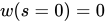
The education signaling model, developed by , exemplifies a separating equilibrium in labor markets where education acts as a signal of workers' innate productivity under asymmetric information between workers and employers. In this framework, workers are divided into high-productivity types (with productivity ηH\eta_H) and low-productivity types (with productivity ηL<ηH\eta_L < \eta_H), each comprising a known proportion of the population. Employers cannot directly observe a worker's type but can observe the level of education ee obtained, which serves as a costly signal. The cost of education c(e,θ)c(e, \theta) depends on both the education level ee and the worker's type θ\theta (where θH>θL\theta_H > \theta_L), satisfying the conditions ce>0\frac{\partial c}{\partial e} > 0 (increasing with education) and 2ceθ<0\frac{\partial^2 c}{\partial e \partial \theta} < 0 (lower marginal cost for high types due to greater ability, known as the single-crossing property). In the separating equilibrium, high types acquire e>0e^* > 0, while low types acquire none (e=0e = 0). Wages reflect employers' beliefs about expected productivity based on the observed signal: w(e=0)=ηLw(e = 0) = \eta_L and w(e=e)=ηHw(e = e^*) = \eta_H. The equilibrium level ee^* is determined by the high type's indifference condition between signaling and pooling with low types: ηHc(e,θH)=ηLc(0,θH),\eta_H - c(e^*, \theta_H) = \eta_L - c(0, \theta_H), ensuring high types just prefer to signal. For low types, deviation to ee^* is unprofitable: ηHc(e,θL)<ηLc(0,θL),\eta_H - c(e^*, \theta_L) < \eta_L - c(0, \theta_L), due to their higher costs, preventing mimicry. This configuration forms a perfect Bayesian equilibrium, as beliefs and strategies are mutually consistent. Spence's model appeared in the Quarterly Journal of Economics in 1973, originating from his 1972 Harvard dissertation. It critiques human capital theory—pioneered by Gary Becker—by showing that education can function primarily as a signaling device rather than a direct enhancer of productivity, potentially leading to socially wasteful expenditures on credentials. This insight has profoundly influenced labor economics, sparking ongoing debates about the returns to education and policy implications for skill certification.

Beer-Quiche Game

The Beer-Quiche game, introduced by Cho and Kreps, serves as a canonical example in signaling games to illustrate multiple perfect Bayesian equilibria (PBEs) and the need for refinements like the Intuitive Criterion. In this two-player game, Nature first selects the sender's type—a "strong" (surly) man with probability 0.9 or a "weak" (wimp) man with probability 0.1—with the type known only to the sender. The sender then chooses his breakfast: beer or quiche. The receiver, a woman, observes the choice but not the type and decides whether to "duel" (challenge him) or not. The breakfast choice signals the sender's toughness, as beer is stereotypically associated with strength while quiche suggests weakness. Payoffs incorporate utilities from breakfast preferences and the duel outcome. For breakfast, the strong type derives 1 from beer and 0 from quiche, while the weak type derives 1 from quiche and 0 from beer. For the interaction, no duel yields 2 to the sender and 0 to the receiver regardless of type. A duel yields 1 additional to a strong sender and 0 to a weak sender (on top of breakfast utility), while the receiver gains -1 against a strong type and 2 against a weak type. Thus, the full payoffs (sender, receiver) are: strong-beer-no duel (3, 0); strong-beer-duel (2, -1); strong-quiche-no duel (2, 0); strong-quiche-duel (1, -1); weak-beer-no duel (2, 0); weak-beer-duel (0, -1); weak-quiche-no duel (3, 0); weak-quiche-duel (1, 2). The receiver prefers to duel weak types and avoid strong ones, while the strong sender prefers beer and is willing to duel, but the weak sender prefers quiche and fears dueling. The game admits two PBEs, both pooling. In the pooling equilibrium on beer, both types choose beer, the receiver infers strength and does not duel (yielding payoffs of 2 for weak and 3 for strong), and out-of-equilibrium beliefs after quiche assign sufficient probability to weakness (>1/3) to induce dueling. In the pooling equilibrium on quiche, both types choose quiche (no duel, payoffs 3 for weak and 2 for strong), with out-of-equilibrium beliefs after beer assigning >1/3 probability to weakness to induce dueling. The Intuitive Criterion, a refinement proposed in the same work, eliminates the unintuitive pooling equilibrium on . In this equilibrium, a deviation to would not benefit the weak type (maximum payoff from deviation is 2, less than 3 on path), but would benefit the strong type (3 > 2 on path if no follows). Thus, rational beliefs after assign zero probability to the weak type, inducing no and making the deviation profitable for strong, which unravels the equilibrium. The pooling on equilibrium survives this refinement, selecting the outcome where the weak type mimics the strong by forgoing . In finite-horizon repeated versions of the game, reputation effects do not robustly support mimicking in trembling-hand perfect equilibria without additional structure, as unravels incentives in the last period. However, in infinite-horizon repetitions, trembling-hand perfection allows small probabilities of "irrational" play (trembles) to build , enabling the weak type to mimic the strong over time and deter duels, aligning with the intuitive outcome from the refinement.

Reputation Signaling

Reputation signaling emerges in repeated signaling games where a long-lived sender interacts with short-lived receivers over multiple periods, and the accumulated history of the sender's actions signals their private type, shaping receivers' beliefs and future . Unlike one-shot signaling models, this framework emphasizes how past signals build a that influences ongoing interactions, often leading to short-term sacrifices for long-term gains. The sender's type—such as "tough" versus "weak"—remains fixed but unknown to receivers, who update beliefs based on observed actions, creating incentives for the sender to mimic desirable types through costly . The foundational framework is illustrated by the chain-store game, introduced by Selten in 1978, involving a monopolistic chain store facing sequential entry decisions by independent challengers in distinct markets. The incumbent's type is either tough, incurring a fighting cost but securing monopoly profits if entry is deterred, or weak, preferring accommodation to avoid losses. Challengers observe prior outcomes and decide to enter or stay out, with the history serving as a persistent signal of the incumbent's type. Selten demonstrated that in a finite-horizon game with perfect rationality, backward induction unravels any reputation: the incumbent accommodates in the final period, and by induction, in all periods, resulting in entry everywhere despite intuitive incentives to fight early and deter future challengers—this is known as the chain-store paradox. Reputation equilibria address this paradox by incorporating incomplete information about the sender's type, allowing short-run losses to sustain or deterrence in the long run. In Kreps and Wilson's 1982 resolution, the incumbent is normal (weak) with probability 1-ε and committed to fighting with small probability ε > 0, where the committed type ignores costs and always resists entry. The normal type may then fight initially to pool with the committed type, building a for toughness that raises challengers' beliefs and deters entry later; this equilibrium holds if ε is large enough relative to the discount factor, as the reputation value outweighs immediate costs. However, in finite horizons, reputation still unravels near the end unless ε is implausibly high, highlighting the paradox's persistence. Critiques note that such models rely on off-equilibrium beliefs and commitment-like behavior from rational types, raising questions about credibility. More advanced models, such as those by Mailath and Samuelson (2006), generalize reputation dynamics in repeated games with types—where types like "good" (cooperative) or "bad" (opportunistic) occur with positive probability—and persistent signals from action histories. These frameworks show sustainability requires conditions like infinite horizons, patient players (high discount factors), and signals that credibly update beliefs without full ; otherwise, unraveling occurs as in finite games. For instance, a small probability of a persistently "good" type can support equilibria where normal players cooperate to maintain , but if signals fade or types evolve stochastically without persistence, effects diminish over time.

Real-World Applications

Economic Contexts

Signaling models address market failures arising from asymmetric information, particularly , where uninformed parties cannot distinguish high-quality from low-quality agents or goods. In markets, Akerlof's 1970 analysis of the "market for lemons" demonstrates how quality uncertainty leads to , with extensions showing that buyers of (the informed parties) may signal their low-risk type through choices like partial coverage or deductibles to separate from high-risk individuals and mitigate market collapse. This signaling helps sustain competitive equilibria but implies policy needs, such as mandatory disclosure or subsidized low-risk pools, to prevent underinsurance among high-quality risks. In credit markets, Stiglitz and Weiss's 1981 model illustrates due to , where higher interest rates attract riskier borrowers, leading lenders to restrict supply rather than raise rates. Signaling mechanisms, such as collateral or equity financing, allow safe borrowers to separate themselves, as shown in de Meza and Webb's 1987 framework, where low-risk entrepreneurs post collateral to signal project quality and overcome . These dynamics exacerbate inefficiencies in capital allocation, prompting policies like credit guarantees or information-sharing bureaus to reduce and support . In , dividends serve as signals of firm quality under asymmetric information, challenging the Miller-Modigliani theorem's irrelevance proposition by incorporating managerial private information about earnings. Miller and Rock's 1985 model posits that high-earnings firms pay higher dividends to signal prospects, as mimicking low-earnings firms is costly due to external financing needs, leading to positive stock price reactions. Similarly, stock splits signal undervaluation or positive future performance, with Lakonishok and Lev's 1987 empirical analysis showing abnormal returns post-split announcements, attributed to managers conveying optimism about earnings growth. Such signaling influences investor confidence but can distort decisions, informing regulatory scrutiny of payout policies to curb manipulative practices. Beyond the foundational education signaling model, labor markets feature certifications and promotions as signals of worker productivity. Certifications, such as occupational licenses, act as costly signals that separate skilled workers from others, with Blair and Chung's 2022 study demonstrating wage premiums from licensing that exceed productivity gains, particularly for underrepresented groups. Promotions similarly signal ability to external markets, as Waldman's 1984 model predicts higher wage increases following promotions in firms with informative internal assessments, reducing search costs for employers. These mechanisms alleviate hiring frictions but may perpetuate inequality if signaling costs disadvantage certain demographics, suggesting policies like standardized certification to broaden access. Empirical evidence from 1990s studies supports signaling's role in determination, showing that college degree premiums often exceed differences. Weiss's 1995 review highlights " effects," where gains accrue mainly to degree completers rather than incremental schooling, indicating signaling over accumulation, with premiums persisting despite weak correlations to measured output. More recent studies, such as those on the effects of employer learning and instruments for , continue to affirm signaling's influence on . This underscores implications for addressing overinvestment in credentials and underinvestment in verifiable skills to correct labor market inefficiencies.

Biological Contexts

In , signaling games provide a framework for understanding how animals communicate reliably despite potential incentives for deception, particularly through mechanisms that ensure signal honesty. Amotz Zahavi's , introduced in 1975, posits that costly signals evolve to convey honest information about an individual's quality, as only high-quality individuals can afford the fitness costs associated with producing and maintaining such signals. A classic example is the elaborate tail of the peacock (Pavo cristatus), which signals genetic fitness to potential mates despite imposing significant survival costs, such as increased predation risk and energetic demands. The handicap principle sparked debate, notably with William D. Hamilton, centering on whether signal reliability requires absolute costs or can arise from differential costs borne more heavily by low-quality individuals. Zahavi emphasized that handicaps enforce honesty by making deception prohibitively expensive for deceivers, while critics like Hamilton argued that in certain contexts, such as kin selection, signals could remain reliable without substantial costs due to shared genetic interests. This perspective highlights reliability through asymmetric costs rather than uniform handicaps. Alan Grafen's 1990 formalization using signaling games resolved aspects of this debate, demonstrating mathematically that handicap signals can evolve as evolutionarily stable strategies (ESS) in animal communication, where receivers benefit from attending to costly displays that correlate with sender quality. Biological applications of signaling games abound in contexts like and . In honey bees (Apis mellifera), the serves as an honest signal of food source profitability, with its reliability maintained by colony-level benefits outweighing individual deception incentives, integrating with ESS concepts. Similarly, in bird , such as the elaborate tail of the (Euplectes progne), males signal viability through costly ornaments that females assess, aligning with (PBE) where beliefs about quality update based on observed signals. These examples illustrate how signaling games link to ESS and PBE, ensuring stable honest communication under . Critiques of the note limitations in scenarios involving costless or low-cost signals, particularly in contexts where promotes reliability without handicaps. Hamilton's 1964 work on provides a foundational example, showing how signals among relatives, such as alarm calls in social insects, can evolve honesty through genetic relatedness rather than differential costs. This underscores that while costly signaling—analogous to biological handicaps—dominates many inter-individual interactions, alternative mechanisms suffice in cooperative kin groups.

Philosophical Contexts

In philosophical contexts, signaling games provide a framework for understanding communication under uncertainty, particularly in the and . Drawing from David Lewis's foundational work, these games model the sender as observing a state of the world and selecting a signal to convey that information to a receiver, who then chooses an action based on the signal received, facilitating coordination and the emergence of meaning. Brian Skyrms extended this in the by incorporating dynamics and learning processes, demonstrating how simple signaling systems can lead to the evolution of semantic conventions in without presupposing innate structures or central coordination. In these Lewis-Skyrms models, meaning arises as a stable mapping between states, signals, and actions through repeated interactions, offering insights into how linguistic conventions coordinate human behavior in uncertain environments. Epistemic applications of signaling games further illuminate processes like testimony and trust, where private information creates asymmetry between communicator and recipient. Testimony can be viewed as a sender signaling the reliability of their knowledge about a proposition, with the receiver assessing the signal's credibility to form beliefs, akin to epistemic trust games involving hidden information that affects cooperative knowledge-sharing. This setup highlights challenges in justifying belief formation from others' assertions, as the receiver must infer the sender's epistemic state from potentially costly or costless signals, paralleling broader concerns in social epistemology about vulnerability to deception or misinformation. Philosophical critiques often contrast game-theoretic signaling with Gricean , noting that while Grice's explain pragmatic inferences through shared rationality and , signaling games emphasize strategic incentives and potential conflicts, which may yield non- equilibria not captured by implicature theory. Skyrms's 2010 book on the evolution of conventions critiques traditional views by showing how signaling dynamics foster arbitrary yet stable linguistic norms, adapting concepts like to trace convention formation rather than assuming pre-existing . These critiques underscore tensions between intentionalist accounts of meaning and emergent, game-driven explanations. A key distinction from economic applications lies in the philosophical emphasis on the spontaneous of conventions for shared understanding and , rather than optimizing or in markets. This focus prioritizes foundational questions about how meaning and epistemic norms arise in human cognition and social interaction, treating signaling as a tool for convention-building over strategic advantage.

Signal Cost Dynamics

Costly Signaling

In signaling games, costly signaling refers to a mechanism where senders convey private information about their type through actions that impose differential costs based on that type, typically with higher-quality or higher types incurring lower marginal costs for the signal relative to lower types. This structure allows high types to separate themselves credibly from low types, as the signal's cost deters by those for whom it is prohibitively expensive. The foundational model, introduced by Spence in the of labor markets, posits that signals like serve this role when the cost function satisfies single-crossing preferences, ensuring that the net benefit of signaling increases with type. The theoretical development of costly signaling emerged in the , building directly on Spence's framework, where costs act as a to enforce honest revelation in equilibrium by aligning incentives against deviation. Subsequent refinements, such as Riley's analysis of informational equilibria, established that among potential separating equilibria, the least-cost separating equilibrium—often termed the Riley outcome—prevails as the unique refinement where signals are chosen to minimize total costs while preventing low types from imitating high types. In this equilibrium, the signal level for each type is set such that the indifference condition binds exactly for the next-lower type, sustaining separation through the threat of costly failure. For instance, the payoff structure incorporates these type-dependent costs to ensure that high types' advantages in signal production make pooling unattractive. Costly signals' sustainability hinges on their ability to deter low types from mimicking, as the equilibrium condition requires that the cost differential exceeds any potential gain from deception, leading to robust separation. A representative example is product warranties offered by firms, where high-quality producers can afford longer or more comprehensive warranties due to lower expected repair costs, signaling their reliability without low-quality firms being able to profitably imitate. This application illustrates how costly signaling resolves information asymmetries in markets by making false claims economically unviable.

Costless Signaling

In costless signaling, also referred to as cheap talk, the messages sent by the informed sender incur no differential costs based on the sender's private type, such that the payoffs from sending any particular signal are independent of the underlying . This structure frequently results in babbling equilibria, where signals provide no informational value, as the receiver's beliefs remain unchanged across messages, rendering all strategies equivalent in expectation. The foundational model of costless signaling is presented in Crawford and Sobel (1982), where an informed observes a state of the world drawn from a continuous distribution and communicates a to an uninformed receiver, who selects an action that influences both parties' utilities. The utilities are uniformly aligned except for a fixed in the sender's preferred action relative to the receiver's, creating incentives for the sender to exaggerate or distort information strategically. In equilibrium, communication takes the form of partition equilibria, in which the sender's strategy divides the state space into a finite number of intervals, with each message revealing only which interval the true state occupies, thereby transmitting coarse rather than precise information. The informativeness of these equilibria hinges on the degree of preference alignment between sender and receiver; when biases are small, partitions can be finer, allowing more detailed categorization of states and greater information flow. Conversely, larger biases coarsen the partitions, reducing the number of distinct messages and the overall precision of communication, up to the point where only a single partition—the babbling equilibrium—emerges. Multiple equilibria often coexist in these games, including fully uninformative ones, with the selection among them depending on equilibrium refinements or contextual assumptions. A central result of this framework is that costless signaling cannot sustain full of the sender's private information in standard setups with even mild misalignment, as the sender's incentive to mislead prevents equilibria where every state is distinguished by a unique message. Full separation requires perfect alignment of interests, limiting the model's applicability to scenarios with partial overlap in .

Implications of Cost Differences

In signaling games, the structure of signal costs fundamentally influences equilibrium outcomes through comparative statics. When signals are costly and differentially so across sender types—such that higher types face lower marginal costs—separating equilibria become feasible, allowing receivers to infer sender types accurately from observed signals. In contrast, costless signals typically lead to pooling equilibria, where all sender types send the same signal, resulting in no information revelation and reliance on prior beliefs. Hybrid models incorporating partial costs, where signals have both fixed and variable components or context-dependent expenses, can yield semi-separating equilibria, blending elements of pooling and separation to partially resolve information asymmetries. The robustness of these equilibria varies with cost perturbations. Separating equilibria supported by costly signals are often sensitive to small changes in cost functions, as even minor reductions in differential costs can unravel separation, leading to pooling or babbling outcomes where signals convey no value. This sensitivity underscores the fragility of costly signaling under , prompting implications such as targeted subsidies to maintain cost differentials and preserve informative equilibria; for instance, subsidies that lower signaling costs for high-productivity types can enhance separation without inducing by low types. Such interventions aim to bolster the credibility of signals in markets with asymmetric information, though their effectiveness depends on precise calibration to avoid distorting incentives. Theoretical advances in the 1990s extended these implications to continuous type spaces and nonlinear cost functions, revealing that equilibrium existence and uniqueness hinge on the convexity or concavity of costs, which can amplify or dampen separation incentives. For example, single-crossing cost conditions ensure that monotone signaling strategies form separating equilibria, providing a foundation for analyzing efficiency losses from excessive signaling expenditures. However, these models highlight persistent gaps, including an over-reliance on perfect rationality in cost assumptions, which may not hold under bounded rationality or strategic cost manipulation, potentially leading to inefficient or unstable outcomes in real-world applications.

Multi-Stage Signaling

Multi-stage signaling games extend the single-stage framework by incorporating sequential interactions over multiple periods, where senders transmit signals iteratively and receivers update their beliefs based on observed actions and histories. In these models, the sender's type remains persistent across periods, allowing for dynamic building or erosion, while receivers form posterior beliefs using Bayes' rule at each stage. This temporality introduces history dependence, as past signals influence future incentives and equilibrium outcomes, contrasting with static single-period analyses. The structure typically involves a long-lived informed facing short-lived or repeated uninformed receivers, with action histories enabling updating over time. Sequential signals allow for gradual revelation of private information, where early actions can serve as costly commitments that affect later-period responses. For instance, in dynamic markets, firms may make preemptive offers during a worker's process, prompting revisions about the worker's as rejections or acceptances occur. This setup applies to labor markets, where incomplete information persists, leading to ongoing signaling through or other investments. Equilibria in multi-stage signaling games are analyzed using Markov Perfect Bayesian Equilibria (MPBE), which require sequential rationality and belief consistency conditional on the history or a sufficient , such as accumulated . History dependence arises because off-equilibrium deviations can trigger updates that carry over, with often modeled as a tracking unused signaling costs from prior periods. In such equilibria, high-type senders may under-signal early to build for future gains, while low types mimic to pool temporarily, ensuring persistence of type-based incentives across stages. A key model is Swinkels (1999), which examines a dynamic job market where firms offer wages before completion; here, a unique sequential equilibrium emerges with no wasteful over- for high types, as private offers prevent public carryover and maintain pooling beliefs that evolve monotonically over time. Challenges in these models include a folk theorem-like multiplicity of equilibria in infinite-horizon settings, where patient players can sustain a wide range of outcomes through threats or punishments, complicating equilibrium selection. To address this, refinements like least-cost separating equilibria optimize signaling costs while ensuring and individual rationality across periods. These features highlight how multi-stage dynamics amplify the role of in sustaining separation or pooling, with applications extending to and limit pricing in competitive markets.

Pooling vs. Separating Equilibria

In signaling games, equilibria are classified as pooling or separating based on whether the sender's allows the receiver to update beliefs about the sender's type upon observing the signal. A pooling equilibrium occurs when all sender types select the same signal with probability one, leaving the receiver's posterior beliefs unchanged from the prior distribution and resulting in no transmission of private information. Such equilibria are supported in (PBE) if the sender's is optimal given the receiver's best response, and deviations by any type are deterred, often through receiver beliefs that assign sufficiently pessimistic types to off-equilibrium signals. In contrast, a separating equilibrium arises when each sender type chooses a distinct signal from a disjoint set, enabling the receiver to fully infer the sender's type from the observed signal and achieving complete revelation of private information. The existence of separating equilibria typically requires the single-crossing property, where the or benefit of signals increases (or decreases) monotonically with the sender's type, ensuring that higher types prefer higher signals while lower types do not mimic them. This condition, formalized as the Spence-Mirrlees single-crossing assumption, underpins models like the job market signaling game, where high-productivity workers acquire more to separate from low-productivity ones. When both pooling and separating equilibria exist in a signaling game, equilibrium selection often favors separating outcomes through refinements to the PBE , such as the intuitive criterion, which restricts off-equilibrium beliefs to eliminate implausible pooling equilibria. For instance, in games with multiple pooling possibilities, refinements like D1 eliminate those where a deviation would be profitable only for types that could not benefit from misleading the receiver. These selection criteria trace back to foundational work in the , building on earlier models that highlighted the multiplicity of equilibria. The trade-offs between pooling and separating equilibria reflect tensions in efficiency and coordination: separating equilibria provide greater informational by revealing types fully, but they impose signaling costs that may lead to socially wasteful outcomes, whereas pooling equilibria avoid such costs at the expense of incomplete information and potential coordination failures. In Spence's seminal job market model, for example, the separating equilibrium involves over-investment in education by all types relative to the first-best, illustrating the inefficiency inherent in credible signaling.

Empirical Evidence and Critiques

Empirical studies of signaling games have provided mixed support for theoretical predictions, particularly in settings where controlled environments allow testing of equilibrium concepts like cheap talk . For instance, experiments in the 2000s demonstrated that costless pre-play communication (cheap talk) can enhance coordination and in coordination games, even when suggests it should not bind, as participants often converge on Pareto-superior outcomes after learning. These findings indicate that cheap talk influences behavior beyond strict rational predictions, though success depends on factors like message clarity and repeated interactions. Field evidence from labor markets offers further insights, with studies on returns revealing ambiguous between signaling and accumulation. Instrumental variable approaches in the estimated substantial causal wage premiums from additional schooling, suggesting effects dominate pure signaling, yet residual unexplained returns leave room for signaling interpretations in contexts like credential inflation. Such mixed results highlight challenges in disentangling signaling from productivity enhancements in observational data. Critiques of signaling game models often center on their overreliance on full rationality, with behavioral experiments in the 2000s showing systematic deviations driven by framing and social norms. For example, relabeling a prisoner's dilemma as a "community game" versus a "stock market game" significantly boosts cooperation rates, indicating that psychological context alters beliefs and actions in ways unaccounted for by standard models. Additionally, core assumptions of incomplete information face scrutiny in the big data era, where abundant data reduces informational asymmetries, potentially undermining traditional signaling incentives and requiring more robust equilibrium concepts that hold across information structures. Post-2010 developments in have begun integrating brain imaging to examine signaling es, revealing neural correlates of trust and deception in interactive games akin to signaling setups. Functional MRI studies show activation in regions like the during formation about others' types, providing biological for how senders and receivers signals under . In parallel, AI applications have extended signaling models to , where machine agents infer intentions from order flows in high-frequency markets, modeled as dynamic signaling games to predict manipulative behaviors or . Recent advances as of 2024-2025 include the integration of signaling games with large language models (LLMs) and , enabling analysis of in AI agents and evolutionary dynamics in complex environments. For example, systematic surveys highlight how game-theoretic frameworks, including signaling, inform LLM interactions in multi-agent settings, while approaches test equilibrium stability in simulated signaling scenarios. Despite these advances, notable gaps persist, including limited cross-cultural empirical tests that could reveal how societal norms shape signaling equilibria. Furthermore, integration with for dynamic belief updating remains underexplored, though emerging work draws parallels between Bayesian updating in games and probabilistic inference in ML algorithms.

References

Add your contribution
Related Hubs
User Avatar
No comments yet.








