Recent from talks
Nothing was collected or created yet.
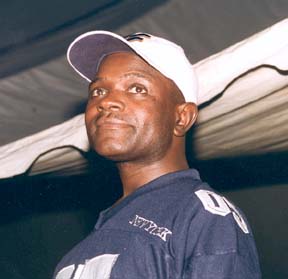
Simon Chimbetu
View on Wikipedia
This article needs additional citations for verification. (August 2009) |
Key Information
Simon Chimbetu (23 September 1955 – 14 August 2005) was a Zimbabwean guitarist, vocalist and composer. He was the founding member of his band Orchestra Dendera Kings. He was known by many stage names, including "Chopper, "Mr Viscose" (before imprisonment), "Cellular", "Simomo" and "Mukoma Sam".[2]
Early life
[edit]Chimbetu was born in the Musengezi area of Mbire District in Mashonaland Province of Southern Rhodesia, on 23 September 1955. He was of the Yao tribe and his ancestral roots can be traced to the town of Tukuyu, in Southern Tanzania. His father Benson Mwakalile was a bricklayer and Simon regularly accompanied his father on his business errands. He attended the local Musengezi High School before trekking to Harare(then Salisbury) to look for employment.
Rhodesian Bush War
[edit]During the Rhodesian Bush War, Chimbetu went to Tanzania to join the Zimbabwe African National Union (ZANU), which employed him as an entertainer for its guerrillas in exile. At some point prior to 1980, Chimbetu returned to Rhodesia.
Return to Harare
[edit]Chimbetu worked for a tobacco processing company for many years after the attainment of Zimbabwe's internationally recognised independence in 1980. His passion for music did not wane. Rather, he regularly played at Mushandirapamwe Hotel in Highfield, a high-density suburb in Harare. At this point he was backed by John Chibadura's Sungura Boys as he did not have his own instruments. His younger brother, Naison backed him and together they performed as Marxist Brothers because of the then prevailing political ideology which had also shaped Simon's war experiences. Together, the siblings penned songs like "Dr Nero"(Naison) and "Nherera"(Simon) which gave them visibility on the Zimbabwean music scene. After recording several albums together, the two split in 1988 with Simon forming his own band, The Orchestra Dendera Kings while Naison formed his Gee(Great) 7 Commandos. It was after splitting with Naison that Simon recorded the hit album Nguva Yakaoma(Hard Times).
The album carried hits such as "Spare Wheel", the soulful "Samatenga", "Pasi Rapinduka", and others. "Samatenga" stayed at the number one spot for a long time; it was somewhat prophetic in that the suffering it describes was mirrored in Simon's own life soon after when he was arrested for theft/receiving stolen property. Although he pleaded his innocence, he was found guilty and incarcerated at Khami Prison in Bulawayo.
Rise to fame
[edit]Chimbetu realised greater success when he went solo, recording classics like "Kuipa Chete", "Ngoma Yanditora Moyo", "Mwana Wedangwe", "Southern Africa" and many others. He called his brand of sungura 'dendera', a reference to the Southern Ground Hornbill's booming bass sound. Chimbetu's songs are distinguished by this deep, booming bass guitar.
What also distinguished Simon from many other sungura/museve artists at this time and throughout his career was that his music focused on contemporary social and political topics. The song "Kuipa Chete", for example, is about black Zimbabweans being abused and exploited economically by white commercial farmers. Towards the end of the 1990s, Chimbetu recorded many hits and grew to be force to reckon with on the scene. He is famous for penning and singing such songs as "Samatenga", "One Way", "Dzandipedza Mafuta" and many others. Simon also had a great facility with languages, being fluent in several and having in sung in Shona, Chewa, Ndebele and Swahili, among others. Chimbetu is also noted for his critical lyrics such as in the songs "Southern Africa", "Kuipa Chete" and "Simba Nederere", among many others.
Out of the two brothers, Chimbetu had the greater success. This was interrupted by his 4-year imprisonment from 1991 after being convicted of receiving stolen property. He was released in 1995 and immediately shot to the top with Pachipamwe (Welcome Back). The song "Saina", off Pachipamwe, was favourite of many at weddings and social gatherings. His albums Survival and Lullaby are highly critical of the Mugabe regime. One of Chimbetu's distinct successes was being able to reclaim his top spot even after being jailed for such a long time. While in prison, another musician, Leonard Zhakata had wooed many fans with his similarly styled beat and well thought out lyrics. After this purple patch, Simon's career plummeted after he became more directly linked to the ruling ZANU-PF party.
Controversy and Decline
[edit]Chimbetu wasn't far from controversy during his career. At the peak of his popularity, he spent four years in jail and thereafter, rumours hit in 2002 that he hadn't paid his own farm workers for months. Additionally, his pro-government stance contributed to his somewhat rising unpopularity. As the economic situation in Zimbabwe worsened with the controversial land reform programme, musicians who were seen to side with the land reform and general ZANU-PF policies became unpopular.
His political rhetoric, with songs like "Pane Asipo", especially on the highly political album, Survival, was obviously out of tune with the masses. Some fans deserted him but many still liked his music. In "Zuva Raenda", (the sun is setting) Chimbetu laments the delays in redistributing the land from white to black Zimbabweans.
Chimbetu died on 14 August 2005, following injuries sustained in a car accident. Curiously, at the time of his death, his career appeared to be on the mend with the release of 10 Million Pounds Reward. On this album, he sings about many issues, one of which is the unequal resource distribution in Zimbabwe on the Chewa song, "Governor Cornwell". Chimbetu was of Chewa origin, although born and raised in Zimbabwe; when declared a provincial hero, his actual burial was kept a secret in line with his religious burial traditions. A younger brother who was already part of the Orchestra Dendera Kings, Allan, fronted the band for a while before Suluman Chimbetu, Simon's second eldest son took over. His eldest son being Collin "Kodza" Chimbetu who ventured into farming. He has recorded a well-received albums has toured overseas.He has managed to take over from Simon as well as he is a Simon lookalike which has popular musician Alick Macheso to mimick on stage that Sulu anenge Chopper literally translated as Sulu is like Chopper(Simon's common alias)
Discography
[edit]The Marxist Brothers
[edit]- Mwana Wedangwe (1984)
- Kunjere Kunjere (1985)
- Dendera Resango (1986)
- Afrika(1987)
Simon Chimbetu and Orchestra Dendera Kings
[edit]- Kuipa Chete (1988)
- Boterekwa (1989)
- Nguva Yakaoma (1990)
- Sold Gold (1990)
- Shura Regore Riya (1991)
- Ndouraiwa (1992)
- Karikoga (1993
- Ruregerero(1994)Briam on vocals
- Pachipamwe (1995[3])
- Zuva Raenda (1996)
- Survival (1997)
- Lullaby (1998)
- African Panorama – Chapter One (1999)
- 2000 Blend (2000)
- African Panorama – Chapter Two (2001)
- Hoko (2002)
- Takabatana (2003)
- 10 Million Pounds Reward (2005)
References
[edit]- ^ Ncube, Sarah (2 October 2009). "Chimbetu's Ghost Comes Alive". Zimbabwe Telegraph. Archived from the original on 25 February 2012. Retrieved 30 May 2010.
- ^ "Simon Chimbetu | The Herald".
- ^ Grama Records
Simon Chimbetu
View on GrokipediaEarly Life
Childhood and Family Background
Simon Chimbetu was born on 23 September 1955 in the Musengezi area of Mbire District, Mashonaland Central Province, then part of Southern Rhodesia.[5] His father, Benson Chimbetu, worked as a bricklayer of Malawian descent and frequently relocated across Zimbabwe for construction projects on houses and other structures, which meant the family experienced a somewhat nomadic lifestyle tied to available labor opportunities.[1][6] This mobility instilled early lessons in adaptability and self-reliance within a household shaped by economic necessity rather than fixed rural stability. Chimbetu grew up among siblings including Naison and Allan, both of whom later entered the music industry and occasionally collaborated with him, reflecting a shared familial aptitude for performance that emerged over time.[7] The family's Yao ethnic origins, linked to ancestral roots in Malawi, placed them within Zimbabwe's broader socio-cultural fabric, where traditional values of communal support and resourcefulness were essential for survival amid colonial-era constraints on mobility and employment for black families.[2][6] His formative years in the rural Mashonaland region exposed him to the hardships of agrarian life and itinerant work, fostering a worldview grounded in practical resilience without the benefits of urban amenities or early formal education in arts.[5] This environment, characterized by limited infrastructure and reliance on extended kin networks, contributed to his unpolished yet intuitive development of interests that would later manifest creatively, though specific childhood musical engagements remain undocumented beyond the family's later collective pursuits.[1]Education and Early Influences
Chimbetu attended Musengezi High School in the Mbire District of Mashonaland Province, receiving limited formal education amid the socioeconomic constraints faced by black families in Southern Rhodesia.[1] [6] His father worked as a bricklayer, and Chimbetu often accompanied him on job errands, exposing him early to manual labor and the practical demands of survival in a racially stratified society.[6] These experiences, combined with the broader economic hardships of pre-independence Rhodesia—such as restricted opportunities for black Zimbabweans—prompted Chimbetu to leave school prematurely and migrate to Salisbury (now Harare) as a youth in search of employment, a common path for many in his cohort.[2] [1] During his adolescence, Chimbetu encountered the systemic racial inequalities enforced under Rhodesian rule, including land dispossession and political exclusion, which fostered a direct, causal awareness of the underlying grievances driving black resistance movements.[1] As a member of the Yao ethnic group with ancestral ties to Malawi, he absorbed traditional cultural narratives and resilience-oriented values from family and community, honing skills in oral storytelling that emphasized historical continuity and endurance.[8] This groundwork, alongside exposure to urbanizing influences upon arriving in Salisbury, cultivated an intuitive grasp of narrative depth and social critique, indirectly shaping his later capacities for both ideological commitment and creative expression.[1]Military Service
Enlistment in ZANLA
Simon Chimbetu enlisted in the Zimbabwe African National Liberation Army (ZANLA), the military wing of the Zimbabwe African National Union (ZANU), during the Rhodesian Bush War by crossing into Tanzania, where ZANU operated training camps for recruits. This journey from his home in the Musengezi area of Mashonaland West represented a deliberate choice to participate in the armed resistance against the Rhodesian Front government, which maintained white minority rule through enforced racial hierarchies.[6][9] His motivations were grounded in the concrete impacts of Rhodesian policies on black Zimbabweans, including the Land Apportionment Act of 1930 and subsequent measures like the 1969 Land Tenure Act, which reserved over half of the country's arable land for a white population comprising less than 5% of residents, displacing African communities and restricting economic mobility. These structural inequalities, combined with limited political representation and enforced segregation, created conditions of systemic disenfranchisement that fueled recruitment into liberation forces, prioritizing redress of material dispossession over abstract political theory. Chimbetu's rural origins in an area affected by such policies underscored the causal link between state-enforced resource allocation and the decision to join the guerrilla ranks.[9] Following enlistment, Chimbetu received brief initial training in Tanzania, focusing on basic guerrilla tactics and ideology, before anticipated deployment to operational areas. This phase signified an abrupt departure from civilian pursuits, immersing him in the disciplined structure of ZANLA cadres amid the logistical challenges of external bases.[1][6]Training and Combat Experience
Chimbetu joined the Zimbabwe African National Union (ZANU) during the Rhodesian Bush War and traveled to Tanzania for military training as a guerrilla fighter.[10] In Tanzania's training camps, such as those operated by ZANLA, recruits like Chimbetu learned small arms handling, basic tactics, and survival skills in harsh bush environments, preparing them for infiltration into Rhodesia.[11] While primarily employed as an entertainer to boost troop morale through performances, he underwent this foundational combat preparation alongside other recruits from Zimbabwe.[12] Upon returning to Zimbabwe, Chimbetu participated in ZANLA operations in eastern regions, contributing to logistics and support roles amid ongoing skirmishes against Rhodesian forces.[1] He survived multiple engagements, gaining firsthand exposure to the realities of guerrilla warfare, including ambushes and the perils of operating in hostile terrain. In personal accounts, Chimbetu described holding dying comrades during combat, underscoring the visceral toll of the conflict on fighters.[12] These experiences provided authentic insights into soldier life, which he later channeled into compositions reflecting tactics, endurance, and the unromanticized hardships of the bush war.[11]Post-War Transition
Return to Zimbabwe
Chimbetu returned to Harare shortly before Zimbabwe's independence on 18 April 1980, amid the ceasefire and demobilization processes stemming from the Lancaster House Agreement of December 1979.[6] As with thousands of other ex-combatants, his reintegration occurred during a phase of national transition where the government lacked a comprehensive blueprint for absorbing former guerrillas into civilian society, resulting in logistical strains at assembly points and delayed processing.[13] War veterans broadly encountered high unemployment and difficulties adapting to urban life in the early 1980s, with up to 25,000 remaining jobless by 1990 due to insufficient reintegration programs and economic absorption capacity.[14] Chimbetu, whose precise wartime role remains subject to conflicting accounts—including claims of combat involvement contrasted with reports of brief abduction and repatriation due to youth—relied on informal personal networks for initial stability rather than formal state assistance or public appeals to veteran privileges.[10] He maintained a deliberately low-profile existence upon arrival, eschewing overt dependence on war credentials for opportunities and rarely disclosing details of his experiences, which contributed to an aura of personal reserve amid the era's veteran identity politics.[10] This approach reflected broader causal pressures on demobilized fighters, where over-reliance on conflict-era status often yielded inconsistent outcomes in a nascent independent economy prioritizing reconstruction over individual entitlements.[13]Initial Settlement and Employment
Upon returning to Zimbabwe shortly before the attainment of independence on 18 April 1980, Simon Chimbetu settled in Harare, the capital, where he sought economic stability amid the uncertainties of the post-colonial transition.[6][2] In the early 1980s, he secured employment at a tobacco processing company, a common industrial role in the nascent economy reliant on agricultural exports, and held the position for several years to sustain himself.[15][6][2] This factory work exemplified Chimbetu's adaptive resilience, prioritizing steady labor over immediate pursuit of artistic ambitions or potential preferential treatment as a former ZANLA participant, in an era when ex-combatants often navigated limited formal reintegration programs.[15]Musical Career
Formation of Early Bands
Simon Chimbetu and his brother Naison formed the Marxist Brothers in 1980, initially drawing on backing experience from established groups such as the OK Success Band to launch their collaborative effort.[2] The band's name evoked the socialist ideologies dominant in Zimbabwe following independence, influenced by the era's political rhetoric, though their focus remained on crafting accessible music for broader audiences rather than strict ideological adherence.[1] Together, the siblings recruited instrumentalists and performed as co-leads, honing skills through urban performances that transitioned from informal survival gigs to structured shows at small Harare venues, gradually cultivating a local following amid economic challenges.[10] Chimbetu, primarily self-taught on guitar during his military service and subsequent city hustles, contributed vocals and instrumentation while emphasizing rhythmic guitar-driven arrangements suited to Zimbabwean dance halls.[16] The group's grassroots approach involved persistent bookings at community events and bars, where they built repertoire through trial-and-error experimentation, prioritizing crowd engagement over polished production in their early phase. This period marked a deliberate pivot from post-war resettlement struggles toward professional music as a viable livelihood, with the brothers sharing songwriting duties to reflect everyday urban experiences. Their initial breakthrough came via local recordings, including the single "Nherera," which secured airplay on state radio stations like Radio Two, validating their shift to formalized aspirations and exposing them to wider Zimbabwean listeners.[17][2] By producing multiple albums as Marxist Brothers through the mid-1980s, they established a foundation of collaborative output that underscored commercial persistence, though internal dynamics foreshadowed the 1988 split allowing individual pursuits.[1]Rise to Prominence with Dendera Kings
Following the split from the Marxist Brothers around 1987, Simon Chimbetu assembled the Orchestra Dendera Kings, transitioning from collaborative efforts to leading his own ensemble.[18] This formation occurred amid a burgeoning post-independence music scene in Zimbabwe, where Chimbetu drew on prior experience to recruit musicians and focus on guitar-driven sounds appealing to local tastes.[1] The band's establishment enabled Chimbetu to assert greater creative control, resulting in rapid output of material that captured national attention by the late 1980s. The Orchestra Dendera Kings' early releases marked Chimbetu's breakthrough, with albums like Boterekwa issued in 1989 featuring tracks such as "Usandisiye" that achieved airplay and sales success in both urban Harare markets and rural areas.[19] These works reflected organic growth through cassette distribution and radio broadcasts, fostering a dedicated fanbase without reliance on major international promotion. By the end of the decade, the band's hits had expanded Chimbetu's reach, evidenced by consistent performance bookings and increasing recognition as a leading act in Zimbabwean popular music. Live tours further amplified the band's prominence, with performances at key Zimbabwean venues drawing crowds that underscored Chimbetu's appeal to diverse audiences.[10] This phase established the Dendera Kings as a staple on the national circuit, building metrics of success through repeat engagements and grassroots popularity rather than formal charts, which were limited at the time. Chimbetu's leadership in these efforts positioned the group as a commercial force by 1990.Key Albums and Hit Songs
Simon Chimbetu's album Zuva Raenda, released in 1996, marked a commercial peak with the hit "Kumaroro," which addressed hardships in post-independence Zimbabwe and achieved extensive radio airplay across the country.[20] The track's popularity stemmed from its relatable depiction of economic struggles, contributing to the album's strong sales in local markets.[20] Earlier, Survival (also known as re-recorded versions under Gramma Records) featured tracks like "Pane Asipo," "Sawara," and "Hapana Chandatadza," which highlighted social resilience and gained traction through live performances and cassette distribution in the mid-1990s.[21] These releases were largely self-produced initially, reflecting Chimbetu's independence before label involvement, and underscored his market dominance with over 100,000 units sold regionally for key titles.[22] Following his 1995 release from prison, the album Pachipamwe propelled hits such as "Saina," which topped Zimbabwean charts and dominated airwaves, signaling a career resurgence with immediate sales exceeding prior benchmarks.[23] Other enduring singles like "Samatenga" from Nguva Yakaoma (1990) further cemented his radio dominance, with consistent top placements on state broadcaster playlists.[24]Musical Innovations
Origins and Characteristics of Dendera Genre
The Dendera genre emerged in mid-1980s Zimbabwe as a distinctive variant of sungura music, pioneered by Simon Chimbetu with the formation of Orchestra Dendera Kings around 1984. It fused guitar-driven Congolese rumba influences with East African kanindo—a slower-paced rhumba style originating from Tanzania—and elements of traditional Shona guitar picking techniques, creating a sound rooted in urban Zimbabwean experiences yet evocative of rural hornbill calls. Chimbetu named the genre after the Southern Ground Hornbill (Bucorvus leadbeateri), whose resonant bass-like vocalizations inspired the heavy, booming bass guitar undertones that became a hallmark, setting it apart from the faster, dance-oriented jit genre or the mbira-centric chimurenga traditions.[25][2] Key characteristics include mid-tempo rhythms with layered percussion and drum beats supporting extended narrative structures, complex repetitive guitar riffs, and interspersed solos that frame call-and-response vocals for dynamic interplay between lead singer and chorus. This instrumentation prioritized melodic depth and rhythmic resonance over high-energy propulsion, enabling detailed lyrical storytelling on personal hardships, historical events, and social realities—often drawing from Chimbetu's own guerrilla warfare background—without the dilution seen in more commercialized pop forms that avoided overt political or experiential candor.[25][2]Lyrical Themes and Social Commentary
Chimbetu's lyrics frequently drew from his experiences in the Zimbabwean bush war, depicting the physical and emotional tolls of guerrilla combat, including separation from family, ambushes, and the constant threat of death, as evidenced in tracks like "Ndarangarira Gamba," which recounts personal sacrifices and the valor of comrades in the liberation struggle.[2] These narratives emphasized the universal human costs of armed conflict, such as loss and endurance, without romanticizing violence or assigning blame to abstract ideologies, instead grounding observations in the causal realities of survival under duress.[11] Post-independence, Chimbetu's work shifted to critique societal decay, particularly corruption and bureaucratic inertia that undermined the war's gains, as seen in songs addressing scandals like Willowgate and leaders' detachment from citizens' needs.[26] In "Vana Vaye," he implored authorities to prioritize essentials like bread and mealie-meal amid economic hardships, highlighting how elite self-interest eroded public trust and perpetuated poverty through misgovernance rather than external forces alone.[27] Such commentary avoided partisan endorsements, focusing instead on empirical failures in resource allocation and accountability that fostered disillusionment.[28] A recurring motif was personal agency and resilience, portraying self-reliance as the antidote to systemic shortcomings, exemplified in "Hoko (Peg)," where Chimbetu urged ordinary Zimbabweans to claim land through direct action during reforms, praising individual initiative over passive reliance on state benevolence.[29] This countered narratives of enduring victimhood by stressing causal links between effort and outcomes, as in his broader discography blending humor with admonitions against complacency, drawn from his own post-war ascent via disciplined musicianship.[2] His approach thus privileged triumphs born of perseverance, reflecting a realist view that individual resolve, informed by war's lessons, drives progress amid collective setbacks.[30]Personal Life
Marriages and Family Dynamics
Simon Chimbetu engaged in polygamous marriages consistent with traditional Shona customs, under which men of sufficient means may take multiple wives to expand family networks and ensure lineage continuity.[31] He had several wives, including Angela Chimbetu, a much younger spouse born around 1981 whom he married prior to his death; she survived him by eight years, passing away on August 24, 2013.[32][1] These unions produced at least six acknowledged children, among them musicians Suluman Chimbetu (born May 27, 1982) and Saiwe Chimbetu, though additional paternity claims—such as those by Boroma Chimbetu in 2013—have periodically emerged, highlighting interpersonal strains within the extended household.[1][33][34] Chimbetu's family formed a foundational support structure, bolstered by his role as primary provider; music revenues from hits and tours enabled him to maintain households, educate children, and navigate the logistical demands of polygamy, such as resource allocation among co-wives and offspring.[1] Nonetheless, the arrangement fostered inherent tensions, including rivalries over attention and inheritance, compounded by cultural expectations of male authority amid shifting modern views critiquing polygamy's implications for women's autonomy and equality.[35] Chimbetu himself addressed such dynamics in lyrics, as in "Barika," cautioning against the conflicts endemic to plural marriages.[31]Health Challenges
In 1990, Simon Chimbetu suffered a stroke that significantly impacted his health. According to his son Tryson, Chimbetu recovered after about one year but underwent noticeable changes consistent with post-stroke effects, altering his physical and personal demeanor.[36] The stroke initiated a period of progressive health deterioration, with incomplete recovery leading to ongoing impairments in mobility and general vitality. Despite these challenges, Chimbetu persisted in his musical activities, though the condition contributed to reduced physical capacity over time, reflecting limited access to advanced rehabilitation typical for many Zimbabwean artists during that era.[7]Controversies
Polygamous Relationships and Social Backlash
Chimbetu's personal relationships involved multiple partners, resulting in six acknowledged children and claims of additional offspring from extramarital affairs, which drew media scrutiny and family disputes over perceived favoritism toward certain children. In 2008, Chamu Boroma publicly asserted he was Chimbetu's illegitimate son, a contention rejected by other family members who argued it undermined established familial lines.[1] Domestic tensions escalated during Chimbetu's 1990–1994 imprisonment for vehicle theft, when his first wife abandoned him, leaving him to navigate single parenthood amid public visibility as a musician.[6] He subsequently married Angela Chimbetu, with whom he shared family responsibilities until his death; she passed away in 2013.[32] These dynamics reflected broader Zimbabwean cultural debates, where customary law permits polygamous unions as a traditional mechanism for economic stability and lineage expansion in contexts of historical instability and high fertility—Zimbabwe's total fertility rate stood at approximately 5.4 births per woman in the early 1990s, favoring larger households for agricultural labor and social security.[37] Traditional adherents viewed such arrangements as pragmatic adaptations to resource scarcity, while progressive critics and media reports highlighted exploitative elements, including jealousy and unequal resource allocation among co-wives or partners, as echoed in Chimbetu's own song "Barika," which depicts polygamous households as rife with inevitable conflicts.[35] No formal legal polygamous marriages were documented for Chimbetu, but his experiences underscored tensions between cultural acceptance and modern condemnations of relational inequities.Legal Disputes Over Estate
After Simon Chimbetu's death on August 14, 2005, disputes arose over the management and financial proceeds of Orchestra Dendera Kings, with the estate executor Chimbare accusing band member Allan Chimbetu—Simon's brother—of failing to pay Simon's designated share of earnings into the estate for distribution to his children.[38] These conflicts centered on music performance revenues and band leadership, involving extended family members including Tryson Chimbetu, son of Simon's brother Naison.[38] Chimbare noted that Allan had not remitted payments despite repeated demands, complicating equitable allocation to biological heirs.[38] The High Court intervened in the band wrangle, ruling that the executor must either collect funds directly at performance venues or deposit them into a designated bank account, with proceeds divided according to predefined percentages to benefit the estate and Simon's children.[38] Sulumani Chimbetu, Simon's son and a key figure in continuing the Dendera legacy, complied by remitting $300,000 to the estate after organizing two shows, marking the largest single contribution received at that time.[38] Tensions persisted, including attempts by Sulumani to restrict Tryson from performing Simon's compositions without authorization, highlighting competing claims to music rights.[39] Property disputes further complicated the estate administration, as in 2016 when the Chimbetu family risked eviction from their Glen Norah home—a asset included in Simon's estate—due to challenges from the Muzangaza family asserting superior ownership claims absent a formal lease or title documentation.[40] The case proceeded in Zimbabwean courts, emphasizing the lack of clear legal occupancy rights for the heirs.[41] These proceedings illustrated the application of inheritance laws prioritizing verifiable estate assets for biological children, amid broader family acrimony over unequal perceived distributions and control.[38] By 2021, Sulumani downplayed ongoing rifts as outdated narratives, suggesting partial resolutions through legal and familial negotiations.[42]Death and Immediate Aftermath
Final Years and Cause of Death
In his final years, Simon Chimbetu continued to engage in musical performances and album releases, with his career showing signs of resurgence despite health setbacks.[43] A few months before his death, he sustained injuries in a car accident while traveling to Karoi, which led to ongoing complaints of chest pains that he linked to internal damage from the steering wheel impact.[4][44][10] These injuries exacerbated his condition, contributing to a rapid decline in health. On August 14, 2005, Chimbetu collapsed at his Mabelreign home in Harare after reporting chest pains and dizziness, succumbing to a short illness at the age of 49.[1][4] The immediate cause was tied to the complications from the recent accident, amid a backdrop of prior physical strains from his time as a liberation war veteran, though specific medical diagnoses beyond the reported symptoms were not publicly detailed.[45][46]Funeral and Public Response
Chimbetu's body lay in state in Harare on August 16, 2005, drawing large crowds that gathered as early as 10 a.m. at Gwanzura Stadium in Highfield, where fans viewed the casket and reflected on his career amid an atmosphere of communal mourning.[47] The following day, August 17, he was buried in a Muslim-style ceremony at the Mashonaland West Provincial Heroes Acre in Chinhoyi, a site reserved for recognized national figures, after the state declared him a liberation war hero—the 16th interred there.[10][48] This honor reflected official acknowledgment of his wartime musical support for Zimbabwe's independence struggle, though public attendance indicated broad, non-coerced esteem beyond government orchestration.[48] Thousands of mourners converged on the burial site, including politicians such as Chegutu MP Webster Shamu and Mashonaland West governor Nelson Samkange, alongside representatives from the National Arts Council and Gramma Records.[10] Fellow musicians Alick Macheso, Nicholas Zakaria, and Tongai Moyo attended, offering eulogies that praised Chimbetu's innovations in sungura and Dendera genres without tying them to partisan narratives.[10] In Harare, the city's routine paused as residents jostled at funeral parlors like Mashfords for a final glimpse, underscoring genuine popular attachment evidenced by the scale of turnout rather than media-amplified spectacle.[10][47] Media accounts from the period, including reports in Zimbabwean outlets, emphasized the event's organic character, with crowds engaging in song and reminiscence at venues like Gwanzura, where grief manifested through shared appreciation of his hits rather than formalized protests or elite-driven pageantry.[47] No significant reports emerged of family divisions or opportunistic political leveraging during the proceedings, distinguishing the response as rooted in Chimbetu's direct cultural impact on everyday listeners.[10]Legacy
Influence on Zimbabwean Music
Simon Chimbetu pioneered the Dendera genre in the late 1970s as a subgenre of sungura, characterized by its heavy bass guitar lines mimicking the call of the ground hornbill bird, or dendera in Shona, fused with East African influences like kanindo, chachacha, and rumba alongside Shona and Swahili lyrics.[49][2] This style emphasized entertainment through rhythmic guitar techniques such as masiganda, which interwove bass and rhythm, diverging from the protest-oriented mbira-guitar fusion of chimurenga music popularized by artists like Thomas Mapfumo.[49] By forming the Marxist Brothers and later Orchestra Dendera Kings in 1990, Chimbetu established a self-contained band model that prioritized urban guitar traditions, enabling performances in township bars and public venues that bypassed reliance on state patronage common in earlier genres.[1] Dendera's persistence is evidenced by its dominance in Zimbabwean airplay, occupying over 50% of slots on stations like National FM and Radio Zimbabwe by the 1990s, driven by Chimbetu's high-selling albums such as Mwana Wedangwe (1984) and Nguva Yakaoma (1990), which spread the genre nationwide from mining and farming communities to urban centers.[49] His trendsetting vocal elements, including ululations and chants, were emulated by post-1980 bands like Dindingwe Stars, fostering a broader sungura ecosystem where over 70% of Gramma Records' output specialized in the style.[49] This influence extended to non-family artists, shaping urban guitar performance norms through elegant staging and body movements that elevated musicians' professional image beyond township stereotypes.[49] While Chimbetu's innovations in social commentary and Pan-African themes innovated within sungura's entertainment framework, some critiques note that later adopters have overemphasized nostalgic replication of his bass-heavy sound at the expense of fresh rhythmic or lyrical evolution, contributing to perceptions of genre stagnation in contemporary Zimbabwean music.[49][50] Nonetheless, claims of co-creation by figures like Foster Mkweu highlight potential distortions in attributing Dendera's origins solely to Chimbetu, though his recordings and live circuits empirically anchored its mainstream endurance.[18]Continuation by Family and Cultural Impact
Sons Suluman and Tryson Chimbetu have sustained the Orchestra Dendera Kings tradition by leading performances and releasing new material in the Dendera style into the 2020s.[51] Suluman Chimbetu, often performing as Sulu, issued albums such as Entanglement in 2020, Jamboree in 2020, Syllubus in 2021, Mafuta in 2022, Gunship in 2023, and Tsapo—a 14-track solo effort—in 2025.[52][53][54][55] Tryson Chimbetu, collaborating with the Marxist Dendera Brothers, has maintained live engagements, including joint appearances with family members at commemorative events and album launches as recently as June 2025.[56][57] Family galas, such as the 2020 Simon Chimbetu Commemorations, have featured multiple generations performing classics like "Dendera," ensuring the genre's continuity.[58] Chimbetu's compositions continue to inform social discourse in Zimbabwe, with tracks repurposed for commentary on historical memory and rights. For instance, "Ndarangarira Gamba" has been invoked in 2024 tributes to liberation heroes, emphasizing sacrifices for independence, while broader analyses highlight songs addressing poverty, marital dynamics, and cultural preservation.[59][25] Songs like "Pane Asipo" and "Hatikanganwe" resurfaced in viral challenges and discussions by late 2024, linking personal loss to national struggles.[25] The Dendera genre pioneered by Chimbetu reinforced Shona linguistic and rhythmic elements, fostering a locally rooted musical identity amid competition from imported styles.[27] By blending guitar-driven rhythms with Shona narratives on social justice and spirituality, it elevated vernacular expression over Western pop dominance, as evidenced in its enduring appeal in Zimbabwean cultural narratives.[60] Family-led revivals, including third-generation introductions by Allan Chimbetu in 2025, perpetuate this resonance.[61]Discography
With the Marxist Brothers
The Marxist Brothers, comprising Simon Chimbetu and his brother Naison Chimbetu, debuted with the single "Nherera" backed by "Kosamu" in the early 1980s, marking their entry into Zimbabwe's Sungura music scene amid the post-independence era's political influences that inspired the band's name.[17] [62] Their collaborative releases emphasized sibling vocal harmonies and rhythmic interplay, with key albums including Mwana We Dangwe (1984) and Afrika (1987), which featured tracks blending traditional Shona elements with guitar-driven Sungura.[63] A standout track, "Dr. Nero," composed by Naison Chimbetu and released around 1986, highlighted their compositional synergy and secured regional radio play in Zimbabwe.[64] [65] The duo produced four successive albums in total during this period, relying on modest, self-managed recordings typical of emerging independent acts in the local music industry.[25] This phase concluded with the brothers' split in 1988, paving the way for Simon Chimbetu's solo endeavors, though their joint output established foundational popularity in Harare's music circuits.[25][51]Solo Work with Orchestra Dendera Kings
Chimbetu launched his solo career with Orchestra Dendera Kings in 1990 following the disbandment of the Marxist Brothers, debuting with the album Nguva Yakaoma.[1] Over the ensuing years, he released 13 solo albums, producing hits including "One Way" from earlier transitional work and "Lullaby" from the 1998 album of the same name.[1] [66] His output reflected an evolution from early 1990s breakthroughs amid personal challenges, such as a prison term from 1990 to 1994, to commercial peaks in the late 1990s and early 2000s, with releases shifting from vinyl-dominant formats to CDs as music production technology advanced.[1] The following table enumerates his major solo albums with Orchestra Dendera Kings, listed chronologically by release year where verifiable:| Album | Release Year |
|---|---|
| Nguva Yakaoma | 1990 |
| Ndouraiwa | 1992 |
| Karikoga | 1993 |
| Pachipamwe | 1995 |
| Zuva Raenda | 1996 |
| Survival | 1997 |
| Lullaby | 1998 |
| African Panorama – Chapter One | 1999 |
| 2000 Blend | 2000 |
| African Panorama – Chapter Two | 2001 |
| Hoko | 2002 |
| Takabatana | 2003 |
| 10 Million Pounds Reward | 2005 |
