Hubbry Logo
SirenidaeSirenidaeMain
Open search
Sirenidae
Community hub
Sirenidae
logo
8 pages, 0 posts
0 subscribers
Be the first to start a discussion here.
Sirenidae
Sirenidae
from Wikipedia

Sirenidae
Temporal range:
Late Cretaceous - Present, 95–0 Ma
Siren intermedia
Scientific classification Edit this classification
Kingdom: Animalia
Phylum: Chordata
Class: Amphibia
Order: Urodela
Family: Sirenidae
Gray, 1825
Genera

  †Habrosaurus
  Pseudobranchus
  Siren

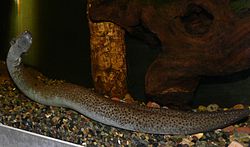
Sirenidae, the sirens, are a family of neotenic aquatic salamanders. Family members have very small fore limbs, and lack hind limbs altogether.[1] In one species, the skeleton in their fore limbs is made of only cartilage. In contrast to most other salamanders, they have external gills bunched together on the neck in both larval and adult states. Sirens are found only in the Southeastern United States and northern Mexico.[1]

Although they are primarily carnivorous, they are the only salamanders observed eating plant material.[2]

Description

[edit]

Sirens are quite distinct from other salamanders, and in some classifications they form their own suborder, Sirenoidea, or as a completely distinct order (Meantes or Trachystomata). Genetic analysis variously places them as the sister to other Salamandroidea[3][4] or as sister to all other salamanders.[5] Many of their unique characteristics seem to be partly primitive and partly derivative.

Sirens are generally eel-like in form, with two tiny, but otherwise fully developed, fore limbs. They range from 25–95 cm (9.8–37.4 in) in length.[1] They are neotenic, although the larval gills are small and functionless at first, and only adults have fully developed (but inefficient) gills. They are obligate air-breathers with well developed lungs.[6] Proving they likely evolved from a terrestrial ancestor with an aquatic larval stage. Like amphiumas, they are able to cross land on rainy nights.

These amphibians are omnivorous, feeding mainly on worms, small snails, shrimps, and filamentous algae.[7] They are notable among salamanders (and most amphibians, aside from a few frog species) due to their semi-herbivorous habits.[2] Their jaws possess sharp-edged keratinised and toothless ridges, like many anuran tadpoles, but the coronoid bone in the lower jaw and the vomer and palatine bone in the upper jaw have patches of monocuspid and unbladed teeth arranged in polystichous patterns.[8]

If the conditions of a water source are unsuitable, a larva will shrink its gills to mere stumps, and these may not function at all.[7] They are also able to burrow into mud of drying ponds and encase themselves with a cocoon of mucus to survive periods of drought.[1] During such periods, they breathe with their small but functional lungs.[citation needed]

Unlike other salamanders, an interventricular septum is present in the heart. At least two of the species can produce vocalizations.

The structure of sirens' reproductive systems suggests they employ external fertilization.[1] This has finally been confirmed in captive breeding experiments, showcasing that males also engage in parental care, building nests for their offspring.[9] Parental care among sirens is paternal due to external fertilization. In S. intermedia males circle around females and may rub or bite her flank region.[9] Both male and female will go on their backs and turn. It is assumed here where the female spawns and the male fertilizes her eggs.[9] After the courtship is over, the female leaves and the male guards the eggs. Males could potentially guard more than one brood, but they are known to bite females who enter a nesting site.[9] Paternal care has also been observed in Cryptobranchoidea, the other suborder with external fertilization.[9] This is critical to phylogeny, as Salamandroidea, the third suborder, use internal fertilization which may be pair with maternal care, meaning that sirens are one of the oldest groups of salamanders.[9]

The combined biomass of Siren intermedia species in a Texas pond exceeded the total biomass of the pond's seven species of fish.[10]

Taxonomy

[edit]

The siren family (Sirenidae) is subdivided into five genera, three extinct, and two extant with two and three extant species, respectively:

References

[edit]
[edit]
Revisions and contributorsEdit on WikipediaRead on Wikipedia
from Grokipedia
Sirenidae is a family of entirely aquatic salamanders in the order Urodela, distinguished by their eel-like bodies, permanent (perennibranchiate condition), absence of hind limbs, and presence of only short forelimbs with four toes in the genus Siren or three in Pseudobranchus. These salamanders lack eyelids and premaxillary teeth, instead possessing a horny , and exhibit a system typical of aquatic amphibians. Native exclusively to freshwater habitats in the and northeastern , sirenids inhabit swamps, marshes, slow-moving streams, and ditches, where they remain submerged throughout their lives. The family comprises two extant genera: Siren, including the greater siren (S. lacertina, up to nearly 1 meter in length), the lesser siren (S. intermedia, up to 69 cm), the (S. reticulata, up to 61 cm), the western lesser siren (S. nettingi, up to 50 cm), and the seepage siren (S. sphagnicola, up to 20 cm); and Pseudobranchus, encompassing the dwarf sirens (P. axanthus and P. striatus, typically under 25 cm). Sirenids are carnivorous, feeding primarily on aquatic invertebrates such as , , snails, and worms, often foraging nocturnally along the substrate. Their is oviparous, with females laying eggs in water that hatch into aquatic larvae retaining ; adults produce sounds like clicks or grunts, despite lacking . Fossil records indicate that sirenids were once more widespread, occurring in , , and during the , but modern species have been confined to their current range since the late Eocene, reflecting a long evolutionary history with relatively conserved morphology. Conservation concerns arise for some species due to habitat loss in ecosystems like forests, though they are generally resilient in stable aquatic environments.

Physical Description

Morphology

Members of the Sirenidae family exhibit a highly specialized, eel-like body morphology adapted to a fully aquatic lifestyle, characterized by an elongated trunk and tail that together comprise the majority of their total length, ranging from 10 to 95 cm. The skin is smooth and scaleless, covered in glandular tissue that secretes a protective layer, with no evidence of in external features across . This body form lacks hind limbs and associated pelvic girdles entirely, while forelimbs are diminutive and vestigial, typically bearing 3 to tipped with small horny claws and lacking . The skeletal structure further emphasizes this elongation, with the vertebral column including a long presacral series marked by 29–40 along the trunk, and amphicoelous centra that support only anterior . is notably reduced throughout the , particularly in the , where the is tiny and detached, premaxillae are toothless, and many elements retain cartilaginous qualities indicative of ; the bone, for instance, develops as a separate similar to that in anurans. Coloration varies by species and age, generally featuring mottled brown to gray dorsal surfaces with lighter ventral regions, though juveniles often display longitudinal light stripes that persist into adulthood in Pseudobranchus, such as the narrow yellow or tan stripes on the back and sides of P. axanthus. A distinctive feature of sirenid morphology is their unique dental apparatus, where the jaws lack true teeth on the premaxillary, maxillary, and dentary bones, replaced instead by sharp-edged, keratinized ridges that function like beaks for scraping and processing food. These ridges, covered by a horny sheath, are complemented by monocuspid, polystichous tooth patches on the , , and coronoid bones, arranged in multiple rows for secondary shredding; this configuration varies slightly between genera, with broader ridges in Siren species compared to the narrower ones in Pseudobranchus.

Sensory and Respiratory Adaptations

Members of the Sirenidae family exhibit neotenic traits, retaining throughout their adult lives as primary organs for aquatic respiration. These gills are bushy, highly vascularized structures that facilitate efficient oxygen extraction from water, a key for their permanently aquatic lifestyle. In addition to branchial respiration, sirenids possess well-developed lungs that function as secondary respiratory organs, enabling them to breathe air at the surface and rendering them air-breathers. This bimodal respiration—combining gill-based aquatic uptake with pulmonary air breathing—allows sirenids to thrive in low-oxygen environments, such as hypoxic swamps, where they can partition across gills, lungs, and even (trimodal in species like Siren lacertina). For instance, in S. lacertina, lungs contribute up to 75% of oxygen uptake at warmer temperatures (25°C), while dominates in colder conditions (5°C), supporting survival in shallow, weed-choked waters with fluctuating oxygen levels. Sensory adaptations in sirenids are tailored to their murky, vegetated habitats, with reduced reliance on vision and enhanced non-visual cues. Their eyes are small and poorly developed, providing limited , which is insufficient in turbid waters where they primarily . Unlike many salamanders, sirenids lack a nasolabial groove but compensate with an enhanced system for mechanoreception, consisting of neuromasts arranged in pit fields that detect water vibrations and movements from prey or environmental stimuli. This system remains functional throughout life, aiding navigation and predation in low-visibility conditions. Chemosensory capabilities, primarily through olfaction, further support locating food via chemical cues in their dense aquatic environments. During periods of , sirenids by burrowing into mud, forming a protective cocoon from shed skin layers (often misdescribed as , but composed of desquamated epithelial cells) that minimizes loss and . This cocoon envelops the body, including the gills, which but retain partial function for limited with surrounding , allowing survival for months to over two years depending on body size (S. lacertina adults >500 g endure 2–3 years). Internally, their buoyant lungs not only aid flotation and control in but also contribute to overall hypoxia tolerance by enabling periodic air access. Furthermore, sirenids exhibit a reduced metabolic rate during and hypoxic stress—dropping 60–70% below active levels—which conserves energy and enhances endurance in oxygen-poor or desiccating conditions.

Habitat and Distribution

Geographic Range

The family Sirenidae is native to , with all extant species confined to the and . Their range spans from eastern southward through the coastal plains to and , extending westward into the drainage and into northeastern , particularly in the state of . Specific distributions vary among genera and species. The genus Pseudobranchus, comprising the dwarf sirens, is restricted to lowlands in the , with P. striatus occurring from southern through Georgia and northern , and P. axanthus limited to peninsular . Siren lacertina, the , is widespread across the Atlantic and Gulf coastal plains from the vicinity of Washington, D.C., to southern and southwestern . The eastern lesser siren (S. intermedia) has a range from southeastern to , extending westward through the Mississippi valley to the of . The western lesser siren (S. nettingi, resurrected as a full species in 2023) has a broader interior distribution, extending westward from to , northward to , and into northeastern . The (S. reticulata) is known from limited localities in the and southern , with potential extension into southwestern Georgia. The seepage siren (S. sphagnicola, described in 2023) occurs in seepage-fed wetlands in the western , southeastern , coastal , and adjacent . All species of Sirenidae are endemic to freshwater systems in subtropical and temperate zones of the , with no verified records outside this region. Their current distributions reflect post-glacial recolonization following the Pleistocene, when populations expanded northward and eastward from southern refugia as ice sheets retreated, as evidenced by genetic patterns in species like S. lacertina. The greatest species diversity occurs in the peninsula, where ranges of Pseudobranchus axanthus, Siren lacertina, Siren intermedia, Siren reticulata, and Siren sphagnicola overlap extensively.

Aquatic and Terrestrial Microhabitats

Sirenidae species predominantly inhabit stagnant or slow-moving freshwater microhabitats, such as swamps, ponds, ditches, canals, sloughs, and vegetation-choked creeks, where dense aquatic vegetation—like water hyacinth and rooted macrophytes—combined with soft, muddy substrates offers shelter, sites, and breeding areas. These environments are often acidic and hypoxic, with sirenids exhibiting high tolerance for low oxygen levels through reliance on pulmonary respiration to periodically surface for air. They avoid fast-flowing rivers, favoring instead calm, turbid waters with abundant organic debris that support their neotenic, fully aquatic lifestyle. In the , sirenids are closely associated with swamps, flooded forests, and roadside ditches that function as critical refugia, providing connectivity during wet periods and protection from predators. Water temperatures in these microhabitats typically range from 10°C to 30°C, with peak activity occurring in warmer, shallow conditions around 15–25°C during fall and spring. Seasonal flooding is essential for maintaining connectivity, allowing recolonization of isolated wetlands and facilitating among populations. During dry seasons, sirenids shift to terrestrial microhabitats by burrowing into mud banks, tunnels, or leaf litter, where they enter encased in a cocoon of and desquamated skin to minimize water loss; this state can persist for several months to over five years, depending on body size and nutritional reserves. Aestivating individuals may lose up to 80% of their body mass but recover rapidly upon rehydration. For dispersal, they occasionally undertake short nocturnal overland excursions on rainy nights, though such movements are limited by their reduced limbs and aquatic adaptations.

Behavior and Ecology

Feeding Habits

Sirenidae exhibit an omnivorous diet, consuming a variety of aquatic invertebrates such as annelid worms, snails, crustaceans, and small , alongside significant amounts of matter including , vascular , and . This mixed feeding strategy is unique among salamanders, as sirenids are the only known to engage in intentional herbivory, with material often comprising a substantial portion of their intake rather than incidental ingestion during prey capture. For instance, in the greater siren (Siren lacertina), vascular and can make up at least 75% of ingested by volume, highlighting their reliance on for . Foraging in Sirenidae occurs primarily at night, with individuals acting as bottom-feeders that probe substrates in vegetated aquatic environments. They employ a gape-and-suck mechanism to capture prey and incidentally or intentionally scrape plant material using keratinized ridges, which function as cutting and grinding tools to process both animal and vegetal foods. This opportunistic scavenging behavior is facilitated by complex three-dimensional chewing motions, involving retraction and protraction to shred and grind ingested items against the ridges. In species like the lesser siren (Siren intermedia), gut content analyses reveal that plant material can exceed the volume of , supporting up to 50% or more in the diet depending on local availability. Dietary composition in Sirenidae shows seasonal variations, with increased consumption of plant matter during summer months when aquatic vegetation is more abundant, aligning with peaks in overall activity. These patterns reflect adaptations to fluctuating resource availability in their habitats. Juveniles feed primarily on small , while adults consume a wider variety including molluscs, , , , and filamentous . The digestive system of Sirenidae is relatively simple, featuring a linear gut with an enlarged posterior intestine, yet it supports their mixed diet through microbial symbionts that facilitate breakdown via . In S. lacertina, for example, produced by gut microbes in the posterior regions indicate active fermentation of ingested and vascular , providing nutritional benefits from otherwise indigestible . This symbiotic process, evidenced by acetate-dominant profiles (approximately 83% of ), underscores the evolutionary of sirenids to herbivory despite their paedomorphic morphology.

Reproduction and Parental Care

Sirenidae species reach between 1 and 3 years of age, depending on the species and environmental conditions. Breeding typically occurs in late winter to spring, from November to May, with timing varying by latitude and local rainfall that triggers increased activity and migration to shallow waters. Mating involves complex behaviors, including circling, coiling, and head rubbing between males and females in shallow aquatic habitats. Fertilization is external, with males releasing directly over eggs as females deposit them, rather than through spermatophores or internal mechanisms. Eggs are laid in gelatinous clusters attached to submerged vegetation or constructed nests, often in protected shallow areas. Clutch sizes in the genus Siren range from 200 to 700 eggs per female, while smaller clutches occur in Pseudobranchus (up to ~58 eggs). Eggs hatch after 1.5 to 2.5 months, producing neotenic larvae that retain and forelimbs throughout life, without developing hindlimbs or undergoing . In the dwarf siren genus Pseudobranchus, eggs hatch in about 30 days, with larvae reaching 16 mm in total length. Parental care is exhibited primarily by males in the genus Siren, where they guard nests, fan eggs to oxygenate them, and defend clutches and hatched larvae against intruders for up to a week post-hatching. No such care has been observed in Pseudobranchus species, where adults may even cannibalize eggs or larvae if not separated. Breeding is asynchronous across populations, influenced by regional variations. During breeding periods, adults occasionally crawl overland on wet nights to reach suitable aquatic sites, using their forelimbs and undulating bodies for locomotion.

Taxonomy and Phylogeny

Current Classification

The family Sirenidae belongs to the order Urodela (also known as ), within the class Amphibia, and is classified in the suborder Sirenoidea, although some earlier schemes proposed elevating it to the distinct order Sireniformes due to its primitive traits. The family currently includes two extant genera: Pseudobranchus and Siren, with a total of seven recognized species. The genus Pseudobranchus (dwarf sirens) contains two species: P. axanthus (southern dwarf siren) and P. striatus (northern dwarf siren). The genus Siren (sirens) comprises five species: S. intermedia (lesser siren), S. lacertina (), S. nettingi (seepage siren), S. reticulata (), and S. sphagnicola (narrow-striped siren). Some classifications recognize subfamilies, with Sireninae encompassing the genus Siren and Pseudobranchinae encompassing Pseudobranchus, though this division is not universally adopted in modern taxonomy. The name "Sirenidae" was established by John Edward Gray in 1825, derived from the Greek word seirēn (Σειρήν), alluding to the mythical sirens—half-woman, half-fish creatures known for their enchanting songs—owing to the family's aquatic lifestyle and vocalizations. Molecular phylogenetic analyses, including the large-scale study by Pyron and Wiens (2011), confirm the monophyly of Sirenidae as a basal clade within Urodela, though debates persist on its precise position relative to other suborders like Cryptobranchoidea.

Evolutionary History and Fossil Record

The family Sirenidae represents one of the most basal lineages of the suborder Sirenoidea, positioned as the to the suborder Salamandroidea (all other advanced salamanders excluding the basal (Cryptobranchidae and Hynobiidae)). Molecular phylogenetic analyses, incorporating extensive multilocus data from 286 species, support an early divergence of Sirenidae from other salamandroids, likely occurring in the period around 148–171 million years ago, though the crown group radiation aligns more closely with the based on evidence. This basal placement underscores Sirenidae's retention of primitive traits, including obligate —a paedomorphic condition where larval features such as and aquatic morphology are retained into adulthood, representing a key evolutionary from ancestral urodele larvae. The fossil record of Sirenidae spans from the mid-Cretaceous to the present, documenting a temporal range of approximately 100 million years ago to Recent, with major diversification occurring in Paleogene wetland environments of North America. The oldest known sirenid is the extinct genus Kababisha (K. sudanensis), from the Cenomanian deposits (ca. 100–93 Ma) of Sudan in Africa. Habrosaurus, represented by two species (H. dilatus and H. prodilatus), is known from skull elements, vertebrae, and other postcranial remains in the middle Campanian to middle Maastrichtian deposits (ca. 83–66 Ma) of the Lance and Hell Creek Formations in Wyoming and Montana; it is recognized as an early North American sirenid and the sister taxon to the clade comprising extant genera Siren and Pseudobranchus, exhibiting characteristics such as reduced hindlimbs and specialized dentition for crushing hard-shelled prey. The family historically includes at least five genera, with three extinct: Kababisha (Africa), Noterpeton (South America, Maastrichtian of Bolivia), Habrosaurus (North America), and Adelphesiren (often synonymized within Habrosaurus), along with fragmentary records potentially assignable to additional basal forms from Cretaceous localities in North America, Africa, and South America. Evolutionary adaptations in Sirenidae are closely tied to their permanent aquatic lifestyle, with limb reduction—manifested as tiny forelimbs and complete absence of hindlimbs—emerging as a specialization for navigating vegetated wetlands and reducing drag in water, a trait evident in Habrosaurus fossils and retained in modern species. This paedomorphic limb morphology likely evolved in response to selective pressures favoring eel-like body forms in stable aquatic habitats, contrasting with the more terrestrial or amphibious lifestyles of other salamandroids. Post-Cretaceous diversification during the saw sirenids adapting to subtropical swampy environments, where neotenic traits provided advantages in oxygen-poor waters, contributing to their persistence through climatic shifts into the .

Conservation and Threats

Population Status

The majority of Sirenidae species are assessed as Least Concern by the , reflecting their relatively wide distributions and presumed stable populations across much of the . However, regional declines have been noted, particularly for subspecies like the Everglades dwarf siren (Pseudobranchus axanthus belli), which is considered vulnerable due to its restricted range in southern wetlands. Similarly, the (Siren lacertina) experiences local population reductions or extirpations in areas with wetland loss, though it remains secure overall. Population densities vary significantly by habitat and location, with abundances highest in core ranges such as Florida's swamps and marshes. For instance, Siren lacertina can reach densities of approximately 1.3 individuals per square meter in productive southeastern wetlands, contributing to substantial (up to 233 g/), while marginal populations in northern or western extents are notably sparser. Monitoring through surveys, including trap-based studies, indicates stable populations in protected areas like national wildlife refuges, but challenges in detecting these cryptic, aquatic species limit comprehensive trend assessments. The reticulated siren (Siren reticulata), described in 2018, has limited population data due to its recent recognition and restricted distribution in the Florida Panhandle and adjacent Alabama, suggesting a potential Data Deficient status pending further evaluation; its narrow range raises concerns for vulnerability. Demographic factors, including longevity of up to 25 years in captivity for species like S. lacertina, and slow recruitment rates influenced by environmental stressors such as drought, contribute to overall population resilience but also heighten sensitivity to perturbations in suitable aquatic habitats.

Human Impacts and Protection Efforts

Human activities pose significant threats to Sirenidae species, primarily through habitat alteration and degradation. Wetland drainage for agricultural expansion and urbanization has fragmented and reduced the availability of essential aquatic habitats such as swamps, ponds, and slow-moving streams across the southeastern United States, directly impacting species like the greater siren (Siren lacertina) and lesser siren (Siren intermedia). These modifications disrupt the permanent and semi-permanent water bodies preferred by this fully aquatic family, limiting dispersal and breeding opportunities. Additionally, pollution from agricultural runoff, including pesticides, contaminates wetlands and affects amphibian physiology; for instance, chemical exposure can impair reproduction in sensitive larval stages of sirens by disrupting endocrine functions and reducing egg viability. Climate change exacerbates these pressures by inducing droughts that alter , leading to prolonged dry periods in wetlands and forcing sirens into or overland migrations to seek water. Such migrations increase vulnerability to indirect threats like road mortality, as individuals cross terrestrial barriers during habitat shifts, particularly in developed areas. In altered ecosystems, further compound risks; for example, the (Monopterus albus) preys on shared resources like in the , potentially reducing food availability and intensifying competition for native sirens. Emerging disease threats, such as the salamander chytrid fungus (Batrachochytrium salamandrivorans, Bsal), pose risks to including Sirenidae; as of January 2025, the U.S. Fish and Wildlife Service has proposed listing all as injurious wildlife under the Lacey Act to prevent Bsal introduction, which could impact and management efforts. Conservation efforts for Sirenidae focus on habitat protection and monitoring, though challenges persist due to the family's cryptic . Certain subspecies receive state-level safeguards; the Gulf Hammock dwarf siren (Pseudobranchus striatus lustricolus) has been petitioned for federal listing under the U.S. Endangered Species Act. Habitat restoration initiatives, such as the Comprehensive Restoration Plan (CERP), aim to restore natural water flows and wetland integrity in , benefiting aquatic amphibians by improving hydroperiods and reducing fragmentation—amphibian communities serve as key indicators of these successes. Research and management include limited programs and innovative monitoring techniques; post-2020 studies have developed (eDNA) assays for detecting elusive species like the Rio Grande siren (Siren intermedia texana), achieving detection rates over 98% in turbid waters and supporting population assessments without disturbance. These tools enhance conservation by enabling targeted interventions in protected wetlands.

References

Add your contribution
Related Hubs
User Avatar
No comments yet.