Hubbry Logo
Liner notesLiner notesMain
Open search
Liner notes
Community hub
Liner notes
logo
8 pages, 0 posts
0 subscribers
Be the first to start a discussion here.
Liner notes
Liner notes
from Wikipedia
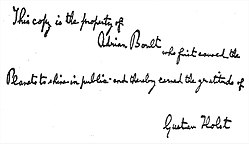
Handwritten inscription by Gustav Holst on Adrian Boult's copy of the score of The Planets (from liner note to EMI CD 5 66934 2)

Liner notes (also sleeve notes or album notes) are the writings found on the sleeves of LP record albums and in booklets that come inserted into the compact disc jewel case or cassette j-cards.[1]

Origin

[edit]

Liner notes are descended from the program notes for musical concerts, and developed into notes that were printed on the outer album jacket or the inner sleeve used to protect a traditional 12-inch vinyl record, i.e., long playing or gramophone record album. The term descends from the name "record liner" or "album liner". Album liner notes survived format changes from vinyl LP to cassette to CD.[2] These notes can be sources of information about the contents of the recording as well as broader cultural topics.[3]

Contents

[edit]

Common material

[edit]

Such notes often contained a mix of factual and anecdotal material, and occasionally a discography for the artist or the issuing record label. Liner notes were also an occasion for thoughtful signed essays on the artist by another party, often a sympathetic music journalist, a custom that has largely died out. However, the liner note essay has survived in reissues and retrospective compilations, particularly in box sets. It is also a tradition in Japan, especially for foreign artist releases. Liner notes often include complete song lyrics for the album.[4]

Biographies

[edit]

Liner notes now[when?] usually include information about the musician, lyrics, a personnel list, and other credits to people the musicians want to thank and people or companies involved in the production of the music.[5] They also can give details on the extent of each musical piece, and sometimes place them in historical or social context. Liner notes for classical music recordings often provide information in several languages; if the piece includes vocal parts, they will often include a libretto, possibly also translated into several languages.

Label copy

[edit]

The factual information in liner notes comes from the label copy. Label copy is the record label's official info sheet for the published release.[6][7] It contains information that accompanies a musical work, including artist name, song title, song length, ISRC code, catalogue number, composer, publisher, rights holder, technical and artistic credits, A&R and producer credits, recording dates and locations. In digital music, the label copy is contained within what's known as metadata.[8]

Metadata

[edit]

Liner notes sometimes provide metadata that can help when cataloguing private or public collections of sound recordings.[4][9] However, the information provided on liner notes varies considerably depending on the studio or label which produced the record. It also varies how much of the metadata digital media services such as Spotify and iTunes make public.[5] In 2018, Tidal launched official music credits supplied by distributors across their database of 90 million recordings.[10] In 2019 Australian company Jaxsta launched a database of official music credits and liner notes. The database is made up of content-owner supplied metadata rather than crowd-sourced data, making previous hidden metadata more widely available to the music industry as well as the public domain.[11][12] In 2019, French company Qobuz launched official music credits and digital liner notes booklets appearing in the player.[13] Pandora also launched full credits within their player in 2019.[14] Metadata credits are sent from official sources to all databases and streaming services using the DDEX ERN standard, however not all services display this data to the consumer.[15][16]

Digital liner notes

[edit]

Awards

[edit]

A Grammy Award for Best Album Notes has been given annually since the 6th Annual Grammy Awards, May 12, 1964.[22]

References

[edit]
[edit]
Revisions and contributorsEdit on WikipediaRead on Wikipedia
from Grokipedia
Liner notes, also known as notes or notes, are the written texts included in the physical of music recordings, such as on record , cassette inserts, or booklets, encompassing credits, , production details, and often essays or commentary by artists, critics, or cultural figures that provide contextual and interpretive insights into the music. These notes originated with the advent of long-playing (LP) vinyl records in the early , utilizing the expansive space on covers—up to 144 square inches—to deliver detailed information beyond the audio itself. Historically, liner notes evolved significantly during the and , a period when physical album sales, dominated by LPs, were booming, with total shipments across formats peaking at nearly 1 billion units in 1999 according to RIAA data, allowing for socio-political commentary that intertwined music with broader cultural narratives, as exemplified in albums like Bob Dylan's or releases that addressed civil rights issues. Writers like Ralph Gleason for exemplified this by blending musical analysis with social critique, turning notes into platforms for advocacy during politically turbulent times. In genres like , notes often detailed instrumentation, recording sessions, and artistic intent, as in Miles Davis's (1970), enhancing the album's conceptual depth. The importance of liner notes lies in their role as a bridge between creators and listeners, fostering a polytextual dialogue that enriches the listening experience by offering emotional, historical, and narrative context, thereby preserving and supporting music scholarship. Efforts to digitize these materials, such as the Liner Notes Markup Language (LNML) project encoding data from over 100 albums across rock and jazz, underscore their value for in the digital age. However, their prominence declined in the with the shift to cassettes and CDs, which offered less space, and further eroded in the due to streaming and downloads, though reissues, vinyl revivals, and recent surges in physical sales (44 million vinyl units in 2024 per RIAA) have revived the tradition.

Origins and Early Development

Pre-Recording Era Contributions

In the , printed program notes emerged as essential accompaniments to live musical performances, providing audiences with contextual explanations, historical background, and structural guidance for the works being presented. These notes first gained prominence in Britain during the , particularly at chamber concerts, where they used aural sign-postings to elucidate formal structures and enhance listener comprehension. In settings, librettos served a similar function, printed in advance for productions across and the to include full texts, synopses, cast lists, and production details, enabling audiences to follow the dramatic narrative amid often rapid vocal delivery. Composers like actively contributed such explanatory materials; for instance, in 1860, he penned a program note for a performance of his works describing thematic transfigurations, and in 1873, he supplied detailed annotations for Zurich concerts that previewed overture motifs from Tannhäuser to orient listeners. By the late 1800s, illustrated booklets evolved as another precursor to liner notes, combining with visual and narrative elements to engage amateur musicians and home performers. These publications, common from the 1850s onward, typically featured colorful lithographic covers depicting scenes of romance, patriotism, or daily life, alongside full for vocal pieces and occasional promotional text highlighting the song's origins or cultural appeal. Some booklets included brief artist biographies or composer profiles, particularly for popular songs derived from operas or , serving to build interest and provide interpretive context for performers lacking formal training. The 1890s marked the first widespread incorporation of descriptive text with mechanical music aids through player piano rolls, which included accompanying labels and booklets explaining selections to broaden access for non-musicians. Introduced commercially around 1895, these perforated paper rolls for self-playing pianos often came with printed enclosures detailing the piece's mood, historical anecdotes, or lyrical content, mirroring the educational role of earlier program notes while adapting to home entertainment. This textual support helped demystify complex compositions, paving a brief path toward explanatory materials in early recorded formats.

Emergence in the Phonograph and Vinyl Age

Liner notes emerged alongside the commercialization of records in the early , initially as simple printed labels on the sleeves of 78 RPM discs introduced in the late . These early sleeves were often blank or contained only basic information such as the recording title, artist name, and details, serving primarily as protective covers rather than informative accompaniments. By , as multi-disc sets became common for longer works, liner notes expanded into folded inserts within cardboard binders, providing brief descriptions or credits to contextualize the for listeners. A pivotal development occurred with ' 1950 release of Benny Goodman's The Famous 1938 Carnegie Hall Jazz Concert, a four-disc LP set that included extensive narrative essays by music critic Irving Kolodin, who had originally written program notes for the live event. Kolodin's contributions, which analyzed the concert's historical significance and jam session dynamics, represented a shift toward more elaborate, essay-style liner notes that elevated the accompanying text beyond mere credits to interpretive commentary. This album, one of the first million-selling LPs, helped popularize such detailed annotations in recordings. The introduction of the 12-inch long-playing (LP) record in 1948 by Columbia Records standardized larger 12x12-inch sleeves, enabling multi-page booklets that accommodated richer content. By the mid-1950s, this format had become industry-wide, allowing for comprehensive inserts that included artwork, lyrics, and extended prose. A notable example is Frank Sinatra's 1955 Capitol Records album In the Wee Small Hours, which featured detailed poetic annotations accompanying its concept-driven ballads on themes of melancholy and lost love. In jazz and classical releases during this period, liner notes played a crucial educational role, elucidating complex arrangements and providing insights into recording sessions to guide listeners unfamiliar with intricate genres. For instance, notes often detailed improvisation techniques in jazz or interpretive choices in classical performances, fostering deeper appreciation and serving as didactic tools akin to concert program notes from the pre-recording era.

Traditional Content and Formats

Core Elements and Common Inclusions

Liner notes for physical music albums typically encompass a set of essential textual components that provide foundational information about the recording. Track listings form a core element, enumerating the songs with details such as titles, durations, and composers or arrangers when relevant, enabling listeners to navigate the album's structure. Personnel credits are another standard inclusion, specifying the roles of musicians, producers, engineers, and other contributors, often with notations for instruments played or pseudonyms used. Production notes detail key logistical aspects, including studio locations, recording dates, and sometimes equipment or techniques employed, offering insight into the album's creation process. Beyond these basics, common inclusions enhance the listener's engagement with the music. , presented in full or excerpted form, allow fans to follow along with the vocals, a practice that became widespread in the mid-. Dedications and thank-yous frequently appear, acknowledging influences, collaborators, or supporters, fostering a around the release. For instance, in 1960s rock albums like ' Sgt. Pepper's Lonely Hearts Club Band, liner notes included full alongside descriptions of the accompanying artwork, enhancing the album's immersive experience. Visual aspects of liner notes are inherently tied to the physical format's constraints and possibilities, distinguishing them from purely digital metadata. These notes often integrate seamlessly with the album's , utilizing space on inner sleeves or panels for expanded layouts that accommodate dense text without overwhelming the design. Fold-out designs, prevalent in vinyl releases, provide additional real estate for multi-page spreads, while captions accompany photographs of performers or sessions, contextualizing the within the album's . Variations in liner notes occur across music genres, reflecting differing priorities in audience education and promotion. In classical recordings, notes prioritize , composer biographies in brief form, and analytical breakdowns of musical structures, such as thematic development or , to listeners through complex works. By contrast, pop and rock notes often emphasize promotional hype through enthusiastic essays, counter-cultural commentary, or fan-oriented anecdotes that build excitement and personal connection, aligning with the genres' commercial and experiential focus.

Specialized Sections like Biographies and Credits

Specialized sections in liner notes, such as artist biographies and expanded credits, extend beyond standard track listings to offer narrative depth and detailed attributions that enrich the listener's understanding of the recording process and the artists involved. These elements often include short profiles that trace an artist's career milestones, key influences, and personal anecdotes, fostering a personal connection between the audience and the music. For example, in the liner notes for Miles Davis's seminal 1959 album , pianist contributed a philosophical describing the album's spontaneous modal approach, likening it to the Japanese art of sumi-e painting where the artist captures the essence of a subject through minimal, intuitive strokes, thereby highlighting Davis's innovative leadership and the ensemble's improvisational influences from to emerging . This biographical insight not only contextualizes the musicians' lineages but also underscores Davis's role in shifting jazz paradigms during the late . Expanded credits in liner notes go further than basic personnel listings, incorporating specifics on guest appearances, recording equipment, and legal disclaimers to provide transparency about the collaborative and technical aspects of production. In progressive rock albums of the 1970s, such as Yes's , these credits often detailed the integration of classical and rock elements, including guest contributions and the instruments used. Legal disclaimers, such as copyright notices or production warnings, were commonly appended to protect and inform consumers of recording conditions, ensuring comprehensive documentation that credits all contributors from session musicians to engineers. Label copy embedded within these specialized sections serves a dual purpose, blending promotional blurbs that hype the album's significance with essential catalog metadata like release dates and catalog numbers, which aid in distribution and archival . These blurbs often frame the release within the artist's evolving , such as touting a milestone collaboration or stylistic breakthrough, while the metadata—typically including the 's catalog identifier and precise issuance date—facilitates precise identification in music libraries and sales tracking. Ultimately, these specialized sections contribute significantly to building artist lore by weaving narrative threads that immortalize personal and creative stories, with notes frequently authored by critics for objective authority or by the artists themselves for unfiltered authenticity. Jazz critic , for instance, penned numerous biographical essays for albums, lending historical weight through his analyses of musicians' influences and innovations, while artists like composer-percussionist occasionally wrote their own notes to directly convey artistic intent and rebut critics. This practice enhances the perceived genuineness of the accompanying music, transforming liner notes into a vital medium for cultural storytelling and legacy preservation.

Evolution in the Digital Age

Adaptations for CDs and Physical Media

The advent of the (CD) in the early marked a pivotal adaptation for liner notes, as the standard jewel case packaging enabled multi-page booklets that expanded beyond the spatial limitations of vinyl sleeves. These inserts, commonly 4 to 8 pages in length, facilitated the inclusion of full-color photographs, intricate artwork, and denser textual content, such as extended essays and complete , which enhanced the visual and informational depth for listeners. A landmark example occurred with the 1982 Japanese reissue of Billy Joel's 52nd Street, the first commercially released , which featured a detailed booklet containing liner notes, , and production credits, establishing a template for future CD packaging that prioritized comprehensive documentation. This format allowed producers to incorporate high-quality color imagery and biographical details that were often constrained on vinyl, though it required careful design to fit within the rigid jewel case structure. Parallel adaptations appeared in cassette releases during the same period, where liner notes shifted to slim, foldable J-card inserts that abbreviated content to suit the compact format, focusing on essential credits and track listings while integrating functional additions like UPC barcodes for inventory tracking. From 1985 onward, these inserts also prominently displayed the Recording Industry Association of America's (RIAA) Parental Advisory Label, a black-and-white sticker warning of explicit lyrics or themes, which became a standard requirement on physical media packaging to inform consumers. Later physical formats, such as introduced in the late , further refined these adaptations with even slimmer inserts or detachable booklets that maintained abbreviated notes but retained barcodes and parental advisories for compliance and retail purposes. A notable innovation in the involved enhanced CDs, which embedded interactive elements—like video clips and hyperlinks—directly on the disc, transforming static liner notes into dynamic experiences accessible via computer; this approach redefined supplementary content by linking text to audiovisual artist interviews and behind-the-scenes footage. Despite these advancements, a persistent challenge in post-vinyl physical media was preserving readability, as the shift to smaller jewel cases and cassette sleeves necessitated finer fonts and condensed layouts, often compromising compared to the larger, designs of earlier LP era notes. Designers addressed this by employing varied type sizes and strategic use of white space, though the overall trend favored brevity over exhaustive detail to avoid overwhelming the limited real estate.

Challenges and Innovations in Streaming and Downloads

The transition to digital music distribution in the late and early prompted liner notes to evolve from physical inserts to downloadable PDFs and integrated app features, bridging the gap from CD-era booklets. Apple introduced digital booklets as PDF files bundled with album purchases starting with iTunes 4.7 in October 2004, allowing users to access credits, , and artwork alongside tracks. By the 2010s, platforms like incorporated album descriptions and linked web pages as liner notes, providing contextual summaries and production details directly within the app interface. This shift introduced significant challenges, primarily the loss of physical tangibility, which diminished readership as users no longer engaged with notes as a ritualistic part of the listening experience. further exacerbated issues by often stripping embedded metadata, including basic note fragments, during unauthorized , reducing the incentive for artists to invest in detailed content. Additionally, space constraints in mobile apps limited the depth and visibility of notes, confining them to brief text fields rather than expansive narratives. Innovations emerged to counteract these limitations, including interactive digital notes featuring hyperlinks to artist interviews, embedded audio clips of studio sessions, and multimedia enhancements. For instance, Rhapsody pioneered expanded digital liner notes in 2013, integrating clickable elements for deeper song context and discovery. Taylor Swift's 2014 album exemplified this with a bundled digital booklet containing lyrics, credits, and thematic visuals, complemented by promotional animated lyric videos that extended the narrative beyond static text. More recently, Spotify's 2020 Songwriter Pages introduced virtual liner notes with collaborative credits and behind-the-scenes insights, accessible via app links. A key technical advancement involved metadata standards like tags, which use the COMM (comment) frame to embed basic liner notes or production details directly into audio files, ensuring portability across players. This evolved into richer formats, such as full HTML-based booklets on platforms like , where album pages support formatted descriptions with images, hyperlinks, and extended narratives to mimic traditional inserts.

Recognition and Cultural Impact

Awards for Excellence in Liner Notes

The Grammy Award for Best Album Notes, presented annually by since 1964, serves as the premier recognition for outstanding contributions to album liner notes, honoring writers whose work provides exceptional context and depth to musical recordings. This category specifically celebrates notes that accompany albums released during the eligibility period, focusing on their ability to illuminate the artist's intent, historical significance, and artistic nuances. By the 67th Annual Grammy Awards in 2025, more than 60 such honors had been bestowed, with recipients frequently drawn from rock and genres due to the detailed, narrative-driven styles common in those fields. Beyond the Grammys, other notable recognitions include the Association for Recorded Sound Collections (ARSC) Awards for Excellence, established in 1991, which annually honor superior liner notes alongside books and articles on recorded sound history, emphasizing scholarly and preservation efforts. Similarly, the ASCAP Foundation's / Awards, part of broader music writing honors, recognize excellence in liner notes for their insightful and enhancement of musical appreciation. Independent labels occasionally offer specialized honors, such as through A2IM's , which highlight innovative packaging and notes in niche releases, though these are less formalized than major industry awards. The criteria for these awards prioritize depth of insight, rigorous , and the overall enhancement of the listener's , often requiring to reveal previously unexplored aspects of or artists involved. Judging panels typically comprise music professionals, including critics, historians, and voting members, who evaluate submissions based on , accuracy, and to the album's content. For instance, the 2025 Grammy winner, Ricky Riccardi for the accompanying Centennial by King Oliver's Creole Jazz Band, was lauded for its meticulous historical documentation that enriched understanding of early ensembles. In the , these awards evolved to encompass digital formats, reflecting the shift toward streaming and downloads; eligibility rules were updated to include non-physical releases, ensuring liner notes in e-booklets or supplements could compete alongside traditional print versions. This adaptation broadened access, allowing notes for digitally distributed albums to gain recognition for their role in sustaining contextual storytelling amid declining physical media sales.

Notable Examples and Influential Writers

was a pivotal figure in rock criticism, known for his raw, essay-style liner notes that captured the chaotic energy of punk and albums. His contributions to various punk and releases exemplified this approach, blending personal anecdote with sharp cultural commentary to immerse readers in the music's rebellious spirit. Similarly, contributed influential criticism and essays on folk- and early artists during the late 1960s and 1970s, offering incisive feminist perspectives on figures like and , as collected in her writings on . Notable examples of impactful liner notes include those in reissues of ' Pet Sounds (1966), where Brian Wilson's personal reflections provided insight into the album's introspective creation process, highlighting his shift toward more ambitious, emotionally layered compositions. Likewise, the liner notes in reissues of ' Exile on Main St. (1972) featured cryptic, drug-influenced prose that mirrored the album's hazy, hedonistic vibe, enhancing its mystique through fragmented narratives and session anecdotes. These liner notes extended beyond mere description, profoundly influencing fan communities and by fostering deeper engagement with albums. During the CD reissue boom, expanded notes in deluxe editions encouraged critical reevaluation of classic works, bridging generational gaps and inspiring scholarly on rock's . By late 2025, archival projects such as Rhino Records' box sets continued to revive and extend the legacy of these classic notes, incorporating new essays alongside originals in announced releases like the edition of Yes' Tales from Topographic Oceans (scheduled for 2026).

References

Add your contribution
Related Hubs
User Avatar
No comments yet.