Hubbry Logo
International Standard Musical Work CodeInternational Standard Musical Work CodeMain
Open search
International Standard Musical Work Code
Community hub
International Standard Musical Work Code
logo
7 pages, 0 posts
0 subscribers
Be the first to start a discussion here.
International Standard Musical Work Code
from Wikipedia

The International Standard Musical Work Code (ISWC) is a unique identifier for musical works, similar to the book's ISBN. It is adopted as international standard ISO 15707. The ISO subcommittee responsible for the standard is TC 46/SC 9.

Format

[edit]

Each code is composed of three parts:[1]

  1. prefix element (1 character)
  2. work identifier (9 digits)
  3. check digit (1 digit)

Currently, the only prefix defined is "T," indicating Musical works. However, additional prefixes may be defined in the future to expand the available range of identifiers and/or expand the system to additional types of works.

Computation of the check digit

[edit]

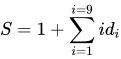
With

  • : one of the nine digits of the work identifier (i=1 to 9) from left to right.
  • : check digit.

Example: T-034.524.680-C

[edit]
1 2 3 4 5 6 7 8 9
0 3 4 5 2 4 6 8 0
0 6 12 20 10 24 42 64 0

ISWC identifiers are commonly written the form T-123.456.789-C. The grouping is for easy reading only; the numbers do not incorporate information about the work's region, author, publisher, etc. Rather, they are simply issued in sequence. These separators are not required, and no other separators are allowed.

The first ISWC was assigned in 1995, for the song "Dancing Queen" by ABBA; the code is T-000.000.001-0.[2]

Usage

[edit]

To register an ISWC, the following minimal information must be supplied:

  • title
  • names of all composers, arrangers, and authors, with their role in the piece (identified by role code) and their CAE/IPI number
  • work classification code (CIS)
  • identification of other works it is a derivative of

Note: an ISWC identifies works, not recordings. ISRC can be used to identify recordings. Nor does it identify individual publications (e.g. issues of a recording on physical media, sheet music, broadcast at a particular frequency/modulation/time/location...)

Its primary purpose is collecting society administration and identify works in legal contracts. It would also be useful in library cataloguing.

Due to the fact that a musical work can have multiple authors, it is inevitable that, on rare occasions, a duplicate ISWC might exist and not be detected immediately. Because of the existing business practices among collecting societies, it is not possible to declare an ISWC as obsolete. In such cases, as soon as they are identified, the system will deal with duplicate registrations by linking such registration records in the ISWC database and its related products.[3]

See also

[edit]

References

[edit]
[edit]
Revisions and contributorsEdit on WikipediaRead on Wikipedia
from Grokipedia
The International Standard Musical Work Code (ISWC) is a unique, permanent identifier for musical works as intangible creations, standardized by the (ISO) under ISO 15707 to facilitate their global identification in databases and rights administration systems. It distinguishes the underlying composition or work itself—such as a song's and —from specific manifestations like recordings (identified by ISRC) or performances, ensuring accurate tracking across the music industry regardless of status or commercial distribution. Administered by the International ISWC Agency on behalf of the International Confederation of Societies of Authors and Composers (CISAC), the ISWC system assigns codes through a centralized process that promotes among collecting societies, publishers, and digital platforms. The code's structure includes a fixed prefix "T-", a nine-digit numeric work identifier (ranging from 000000001 to 999999999), and a single calculated via a modulus 10 to validate integrity, typically formatted for readability as T-034.524.680-1 with optional hyphens or dots. Eligible works encompass original compositions, adaptations, arrangements, and excerpts, but exclude non-musical elements or derivative non-musical uses. First published as ISO 15707 in 2001 to address the digital era's demands for efficient , the standard was revised in 2022 to enhance metadata association, allocation rules, and overall accuracy in an increasingly globalized music . By enabling precise linkage of works to creators and holders, ISWCs support royalty distribution, licensing, and anti-piracy efforts, with nearly 80 million codes assigned as of May 2025 through affiliated organizations like ASCAP and .

Overview

Definition and Purpose

The International Standard Musical Work Code (ISWC) is a unique, permanent, and internationally recognized alphanumeric code designed to identify musical works as intangible creations, such as compositions or songs, regardless of their status or distribution arrangements. Analogous to the Book Number () for books, the ISWC provides a standardized means of distinguishing one musical work from another, even when titles are similar or multiple versions exist. The primary purpose of the ISWC is to facilitate accurate tracking, administration, and royalty distribution for musical works within the global . By offering a consistent identifier, it enables collecting management organizations (), publishers, digital platforms, and other stakeholders to connect creators with their works efficiently, reducing errors in attribution and payments across borders and languages. This supports seamless data exchange and software integration for registration, identification, and remuneration processes, ultimately ensuring creators receive fair compensation for usage. Key benefits include enhanced copyright management, as the ISWC identifies the underlying composition without referencing specific performances, recordings, or adaptations—unlike the (ISRC), which targets sound recordings. Developed by the International Confederation of Societies of Authors and Composers (CISAC) to address longstanding challenges in identifying musical works amid growing international and , the ISWC was first implemented in the mid-1990s, with the initial codes assigned around 1996.

Scope and Limitations

The International Standard Musical Work Code (ISWC) applies exclusively to musical works, defined as intangible creations consisting of a combination of sounds, with or without accompanying text, such as compositions, songs, and scores. It identifies the underlying creative content of these works regardless of the medium of expression, including both published and unpublished pieces, as well as newly created or existing ones. This scope encompasses derivatives of musical works, including arrangements, adaptations, lyric translations, excerpts, medleys, cadenzas, revisions, and cues from audiovisual soundtracks, each of which qualifies as a distinct musical entity eligible for its own ISWC. However, the ISWC has clear limitations and does not extend to sound recordings, performances, or publications of musical works, which are instead identified by the for audio and video recordings. It also excludes non-musical works, physical objects like or instruments, and manifestations related to a musical work, such as audiovisual productions better suited to the . In cases of similar or duplicate works, including unauthorized arrangements that may infringe , each is assigned a unique ISWC, with relationships between them (e.g., to the original work) indicated through metadata linkages in registration databases to facilitate rights management. ISWCs are designed to be permanent and non-reusable once assigned, ensuring stable identification even for works in the or those issued in error; a code allocated to one musical work cannot be reassigned to another under any circumstances. This permanence supports long-term tracking in global databases without the risk of identifier obsolescence.

History and Development

Origins and Introduction

The International Standard Musical Work Code (ISWC) emerged in the early amid the digital music revolution, particularly following the introduction of the format in , which accelerated the need for standardized identification of musical works to address growing challenges in global licensing and exchange among collecting societies. The system was developed to enable efficient tracking and administration of rights, responding to the increasing complexity of international music distribution and the limitations of existing identification methods that often relied on titles alone, leading to ambiguities. The key initiator was the International Confederation of Societies of Authors and Composers (CISAC), which began developing the ISWC coding system in the mid-1990s, specifically from the end of 1994, as part of its Common Information System (CIS) plan to standardize information exchange worldwide. CISAC aimed to create a unique, permanent identifier for musical works to support composers, authors, and publishers in royalty distribution and rights management across borders. This initiative was driven by the necessity to interconnect databases of member societies and improve the accuracy of work identification in an era of expanding digital exploitation. The ISWC was introduced in 1995, with the first code assigned to ABBA's "" as T-000.000.001-0, marking the system's initial rollout focused on enhancing administrative efficiency for creators and rights holders. Early adoption emphasized streamlining processes for collecting societies, though it was later formalized as the ISO 15707 in 2001. In its formative years, the ISWC faced challenges such as limited integration with existing and reliance on manual assignment procedures, which hindered scalability before the widespread adoption of digital tools in the late and early 2000s. These issues were compounded by the rapid growth in musical works requiring identification, but the system's unique coding addressed persistent problems like duplicate titles and varying international naming conventions.

Standardization Process

The standardization of the International Standard Musical Work Code (ISWC) was formally undertaken by the (ISO) through its Technical Committee 46 (TC 46), Information and documentation, and Subcommittee 9 (SC 9), Identification and description. This process recognized ISWC as ISO 15707 in 2001, establishing it as an international standard for uniquely identifying musical works to facilitate rights administration and data exchange. The first edition, ISO 15707:2001, defined the core structure and principles of ISWC, emphasizing its role in distinguishing musical works as intangible creations within databases and documentation systems, while excluding identifiers for physical manifestations like recordings or scores. This edition promoted global interoperability by standardizing the code's format and usage, enabling efficient administration of rights by collecting societies. In 2019, CISAC launched a major project to upgrade the ISWC system, which was completed in 2020 with enhancements to allocation processes, metadata standards, and database to better support digital music distribution and high-volume streaming. The second edition, ISO 15707:2022, superseded the 2001 version and incorporated refinements to address evolving needs, including the addition of a normative references and clause renumbering for clarity, while maintaining the fundamental identification mechanism. These updates enhanced compatibility with digital systems, supporting improved database in the context of modern music distribution and rights management. CISAC serves as the designated for ISWC, overseeing its implementation and maintenance to ensure consistent application across member societies. Collaboration with organizations like the International Federation of the Phonographic Industry (IFPI) has helped align ISWC with complementary standards such as the (ISRC), fostering broader industry harmonization. This ISO standardization has secured ISWC's legal recognition in international treaties and contracts related to , driving its adoption through CISAC's network of 228 member societies in 111 countries as of 2025. By 2025, this framework continues to promote widespread use, enhancing transparency and efficiency in global music rights tracking.

Format

Structure

The International Standard Musical Work Code (ISWC) is structured as a compact alphanumeric identifier comprising 11 characters in total. It consists of a fixed prefix element ("T"), a nine-digit work identifier, and a single . The prefix "T-" denotes that the code identifies a musical work, distinguishing it from potential future variants for other types of creative content as outlined in the ISO 15707 standard. The work identifier follows immediately, forming a unique nine-digit sequence assigned sequentially by registering agencies, with no inherent semantic significance in its digit groupings. For human readability, this identifier is conventionally formatted into three groups of three digits separated by hyphens, resulting in a display like T-123-456-789-0, though hyphens and any dots are optional in digital databases and systems. The final element is a hyphen followed by the check digit, a single numeral that enables basic validation to detect transcription errors, with its computation detailed separately in the standard. The work identifier ranges from 000-000-000 to 999-999-999, theoretically supporting up to one billion unique musical works, though practical assignment begins from 000-000-001 to avoid null values.

Check Digit Computation

The check digit in an International Standard Musical Work Code (ISWC) serves to validate the code's integrity by detecting common transcription errors, such as single-digit substitutions or transpositions, and is routinely implemented in software validation routines and databases for musical works registration. This digit is computed using a weighted modulus 10 applied to the nine-digit work identifier portion of the ISWC, ensuring the full code remains unique and verifiable. The algorithm begins by calculating a weighted sum SS from the digits of the work identifier. Let the nine digits be denoted as d1,d2,,d9d_1, d_2, \dots, d_9, read from left to right (ignoring hyphens used for readability). Then, S=1+i=19idiS = 1 + \sum_{i=1}^{9} i \cdot d_i where the weights ii increase sequentially from 1 to 9. The CC is then derived as C=(10(Smod10))mod10C = (10 - (S \mod 10)) \mod 10 yielding a value between 0 and 9. This formula ensures that the entire ISWC, prefixed with "T-" and suffixed with the check digit (e.g., T-XXX.XXX.XXX-C), satisfies the modulus condition for error detection. For example, consider the work identifier 034524680 (formatted as 034.524.680 for readability). The digits are d1=0d_1 = 0, d2=3d_2 = 3, d3=4d_3 = 4, d4=5d_4 = 5, d5=2d_5 = 2, d6=4d_6 = 4, d7=6d_7 = 6, d8=8d_8 = 8, d9=0d_9 = 0. The weighted products are 1×0=01 \times 0 = 0, 2×3=62 \times 3 = 6, 3×4=123 \times 4 = 12, 4×5=204 \times 5 = 20, 5×2=105 \times 2 = 10, 6×4=246 \times 4 = 24, 7×6=427 \times 6 = 42, 8×8=648 \times 8 = 64, 9×0=09 \times 0 = 0, summing to 178. Adding the constant gives S=1+178=179S = 1 + 178 = 179. Then, 179mod10=9179 \mod 10 = 9, so C=(109)mod10=1C = (10 - 9) \mod 10 = 1, resulting in the full ISWC T-034.524.680-1. To verify an existing ISWC, the same process is applied to the nine-digit identifier, and the computed CC is compared against the provided ; a mismatch indicates an error.

Assignment and Administration

Registration Requirements

To register a musical work for an International Standard Musical Work Code (ISWC), eligibility is open to songwriters, composers, authors, publishers, and other holders, provided that at least one creator is affiliated with an authorized Registration Agency, such as a collective management organization (CMO) or rights management entity (RME). The process is accessible through these agencies worldwide, with no direct cost for the ISWC assignment itself, though it may require membership in a collecting society or agency. The required data for registration includes the original title of the work and the full names, roles (such as , , or arranger), and (IPI) numbers—previously known as CAE numbers—for all creators involved. IPI numbers uniquely identify creators and are mandatory to ensure accurate attribution before an ISWC can be assigned. Submission occurs via a Registration Agency, which verifies the work's uniqueness against the central ISWC database and submits the request for a sequential identifier upon approval. For new works, this assignment happens automatically during the registration process; existing works can receive an ISWC retroactively through the same agencies. Derivative works, such as arrangements, adaptations, translations, medleys, or excerpts, are eligible for their own unique ISWC to identify them as distinct musical creations. During registration, details of the relationship to any prior or original work are included in the metadata, creating a link in the central database for tracking purposes, even if the is unauthorized. This ensures comprehensive identification while maintaining connections between related works for rights administration.

Assigning Agencies and Database

The International Confederation of Societies of Authors and Composers (CISAC) serves as the primary international registration authority for the International Standard Musical Work Code (ISWC), having been appointed by the (ISO) to oversee its administration. Since 2020, ISWCs have been assigned centrally by CISAC to ensure consistency and accuracy, with coordination through a network of national and regional performing rights organizations (PROs) and collecting societies, which act as local Registration Agencies; examples include the American Society of Composers, Authors and Publishers (ASCAP) and Broadcast Music, Inc. (BMI) in the United States, as well as in the . These agencies handle the initial registration of musical works and request ISWCs from CISAC on behalf of creators and publishers, ensuring standardized global application. ISWC assignment operates through a centralized , where approved Registration Agencies submit complete metadata for new works, and CISAC allocates unique identifiers after validation. All allocated ISWCs are recorded in the central ISWC Net database, a global repository maintained by CISAC that stores comprehensive metadata for searching, linking, and verifying musical works across borders. This database functions as the authoritative hub, with agencies integrating via secure APIs or file uploads to submit and retrieve data, facilitating seamless interoperability in the music industry. Key features of the ISWC Net database include support for advanced queries by work title, creator names, or ISWC itself, allowing users to access public metadata such as linked creators without revealing sensitive commercial details. As of the latest available data, it contains over 52 million unique musical work entries, with built-in centralized validation processes that check for duplicates and resolve conflicts during allocation to maintain the integrity of the system. This validation ensures that each ISWC remains a permanent, throughout a work's lifecycle. International underpins the ISWC framework, with CISAC's membership comprising 228 societies across 111 countries that participate in data exchange and standardization efforts. Over 50 of these societies serve as active registration agencies, contributing to the database's growth and enabling APIs for third-party integration by music platforms, digital service providers, and publishers to automate ISWC retrieval and usage tracking. This collaborative structure promotes efficient rights management worldwide, reducing administrative redundancies among participating organizations.

Applications

Royalty Collection and Tracking

The International Standard Musical Work Code (ISWC) serves as a critical tool in royalty collection and tracking by uniquely identifying musical works and connecting them to exploitation data from various sources, including digital streams, radio broadcasts, television performances, and live events. This identification process allows performing rights organizations (PROs) and collective management organizations () to aggregate usage reports and compute royalty shares for songwriters, composers, and publishers based on predefined ownership splits. For instance, when a is streamed or performed, the ISWC ensures that the underlying composition—distinct from any specific recording—is accurately traced back to its rights holders, enabling automated processing and reducing manual reconciliation efforts. ISWCs are deeply integrated into the operational workflows of PROs such as ASCAP and , as well as affiliated with the International Confederation of Societies of Authors and Composers (CISAC), where they facilitate the matching of usage data against registered works in centralized databases. Digital service providers (DSPs) like and incorporate ISWCs into their royalty reporting to PROs and CMOs, ensuring that mechanical and performance royalties are allocated correctly across borders through standardized data exchanges like those defined by CISAC's Common Information System (CIS). This integration supports real-time or periodic reporting from platforms, allowing CMOs to distribute earnings efficiently even for fractional uses in streaming environments. Key benefits of ISWCs in this include minimizing errors and disputes over works with identical or similar titles, as the code provides an unambiguous, permanent reference that transcends language or regional variations in naming. It also enables the viable collection of micro-payments—often fractions of a cent per —by streamlining data flows and reducing administrative overhead in high-volume digital ecosystems. Globally, CISAC's of upgraded ISWC systems enhances cross-society reporting, promoting transparency and faster payouts for international . As of , ISWCs facilitate the tracking and distribution of music royalties totaling €12.59 billion annually through CISAC's network of 228 member societies, which handle collections representing the vast majority of international musical —accounting for 90% of CISAC's overall €13.97 billion in global creator royalties. Digital exploitation generated €5 billion in royalties, highlighting ISWCs' role in sustaining equitable compensation amid in music consumption. The International Standard Musical Work Code (ISWC) plays a crucial role in legal applications within the music industry, serving as a for musical works in agreements, licenses, and registrations. In agreements, ISWCs are incorporated to clearly delineate ownership shares and rights transfers among songwriters, composers, and publishers, facilitating precise administration and dispute resolution. For licenses, which permit the use of musical compositions in visual media such as films or advertisements, the ISWC ensures unambiguous referencing of the work, streamlining negotiations and compliance with licensing terms. In registrations, ISWCs may be voluntarily included to identify musical works. Beyond legal documentation, ISWCs are integral to industry integration through metadata standards and databases that support efficient cataloging and operations. The DDEX (Digital Data Exchange) standards, developed for the global music , mandate the inclusion of ISWCs in messages for , enabling automated exchange of work details between labels, distributors, and digital service providers. Databases like , an open music , incorporate ISWCs to catalog and link musical works with associated metadata, such as titles and creators, promoting collaborative maintenance and accessibility for developers and researchers. ISWCs also address evolving challenges and support technological advancements in rights management. The ISO 15707:2022 update to the ISWC standard emphasizes its application to intangible musical creations. This evolution promotes interoperability with technologies such as , where standardized identifiers like the ISWC enable transparent tracking of rights across decentralized platforms, reducing fragmentation in global licensing. Globally, ISWCs have seen widespread adoption, with CISAC requiring its member societies—representing 111 countries—to allocate ISWCs for works entering their repertoires, making it effectively mandatory for licensing in many jurisdictions. This bolsters anti-piracy efforts by providing consistent work identifiers in enforcement databases and monitoring tools, allowing rights holders to trace unauthorized uses more effectively across borders.

References

Add your contribution
Related Hubs
User Avatar
No comments yet.