Hubbry Logo
LeiognathidaeLeiognathidaeMain
Open search
Leiognathidae
Community hub
Leiognathidae
logo
8 pages, 0 posts
0 subscribers
Be the first to start a discussion here.
Leiognathidae
Leiognathidae
from Wikipedia

Leiognathidae
Temporal range: 56–0 Ma Eocene to Present[1]
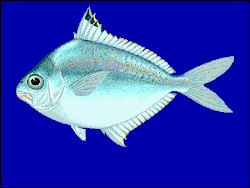
Eubleekeria splendens
Scientific classification Edit this classification
Kingdom: Animalia
Phylum: Chordata
Class: Actinopterygii
Order: Acanthuriformes
Family: Leiognathidae
T. N. Gill, 1893[2]
Type species
Leiognathus argenteus
Genera

see text

Leiognathidae, the ponyfishes, slipmouths or slimys / slimies, are a small family of fishes in the order Perciformes.[4] They inhabit marine and brackish waters in the Indian and West Pacific Oceans. They can be used in the preparation of bagoong.

Characteristics

[edit]

Ponyfishes are small and laterally compressed in shape, with a bland, silvery colouration. They are distinguished by highly extensible mouths, and the presence of a mechanism for locking the spines in the dorsal and anal fins. They also possess a highly integrated light organ in their throats that houses symbiotic bioluminescent bacteria that project light through the animal's underside.[5][6][7] Typically, the harbored bacterium is only Photobacterium leiognathi, but in the two ponyfish species Photopectoralis panayensis and Photopectoralis bindus, Photobacterium mandapamensis is also present.[8] Two of the most widely studied uses for luminescence in ponyfish are camouflage by ventral counterillumination[9][10] and species-specific sexual dimorphism.[6][7][11][12] The light organ systems of ponyfishes are highly variable across species and often between sexes.[11][12]

Taxonomy

[edit]

Leiognathidae is classified within the suborder Percoidei by the 5th edition of Fishes of the World, but they are placed in an unnamed clade which sits outside the superfamily Percoidea. This clade contains 7 families which appear to have some relationship to Acanthuroidei, Monodactylidae, and Priacanthidae.[13] Other authorities have placed the family in the order Chaetodontiformes alongside the family Chaetodontidae.[14]

Timeline of genera

[edit]
QuaternaryNeogenePaleogeneHolocenePleist.Plio.MioceneOligoceneEocenePaleoceneLeiognathusGazza (fish)QuaternaryNeogenePaleogeneHolocenePleist.Plio.MioceneOligoceneEocenePaleocene

Genera

[edit]

The following genera are classified within the Leiognathidae, divided between two subfamilies based on Eschmeyer's Catalog of Fishes:[4][3][15]

The following fossil genera are also known:

References

[edit]
Revisions and contributorsEdit on WikipediaRead on Wikipedia
from Grokipedia
Leiognathidae, commonly known as ponyfishes, slipmouths, or slimys, is a family of small ray-finned fishes in the order , comprising 10 genera and 53 species distributed primarily across the Indo-West Pacific, with one species established in the Mediterranean via the . These fishes are characterized by their strongly compressed, slimy bodies covered in small scales, a naked head with bony ridges, a small protractile lacking teeth on the , and dorsal and anal fins with specific spine and ray counts (8-9 spines and 14-16 soft rays in the , 3 spines in the anal fin). All species possess unique esophageal luminous organs that produce bacterial-mediated light. Molecular phylogenetic studies confirm the family's . Inhabiting shallow coastal waters, tidal creeks, and occasionally freshwater or brackish environments, leiognathids are bottom-dwellers that feed mainly on benthic such as crustaceans and polychaetes. They exhibit nonguarding , with females producing demersal eggs, and maintain a normal activity level in their habitats. Economically significant as fish in their range, they are easily captured using trawls or beach seines due to their abundance in inshore areas. The family's has evolved with molecular phylogenetic studies, recognizing subfamilies such as Leiognathinae and Gazzinae, and distinguishing genera based on mouth morphology, light organ structure, and scale patterns. Recent revisions have expanded the number of genera from earlier counts of three to ten, reflecting improved understanding of their evolutionary relationships within the percomorph fishes.

Description and morphology

Body structure and size

Members of the Leiognathidae exhibit an oblong to ovate body form that is strongly laterally compressed, providing hydrodynamic advantages for schooling in coastal waters. The skin is covered in a slimy layer, which, combined with small, easily shed scales, contributes to their slippery texture. Dorsal and ventral profiles range from straight in more elongate to distinctly convex in deeper-bodied forms, such as those with a humped nuchal . These fishes typically attain small to medium sizes, with standard lengths ranging from 5-10 cm in many species to up to 25 cm, though the maximum recorded standard length reaches approximately 25 cm in Leiognathus equulus. The head is characterized by a highly protrusible adapted for bottom feeding, featuring small, conical or villiform teeth arranged in bands on the jaws, lacking teeth on the and . Eyes are laterally placed but positioned more dorsally in certain genera like , aiding in the detection of surface prey during upward-protracting feeding motions. Fin morphology includes a single continuous with 8-9 slender spines anteriorly and 14-16 soft rays posteriorly, often with a scaly basal sheath and a locking mechanism for the spines. The anal fin comprises 3 spines and 13-15 soft rays, similarly equipped with a basal sheath and locking feature. Pectoral fins are long and pointed, extending beyond the origin of the anal fin in many species. Scales are small and , covering the body but absent on the head and often the breast, which enhances their sliminess as they shed readily when handled. The is complete, running along the mid-flank, though it appears faint due to the silvery .

Coloration and bioluminescence

Leiognathidae species typically exhibit a silvery or bluish overall coloration, with iridescent scales that enhance their reflective appearance in shallow marine environments. This iridescence arises from the crystals in their scales, contributing to their streamlined, school-forming lifestyle. Some species display additional markings, such as dark spots, irregular black dots on the ventral half of the body, or stripes; for instance, Karalla daura features a broad yellow stripe along the , which fades posteriorly. The laterally compressed body structure further aids in uniform light reflection across the flanks, supporting their visual adaptations. All Leiognathidae possess an internal light organ located in the pectoral axillary region, consisting of a circumesophageal structure that houses symbiotic . This organ contains dense populations of Photobacterium leiognathi, which produce blue-green light through the oxidation of a long-chain and reduced , catalyzed by the . The emitted light, peaking at approximately 490 nm, is ventrally directed to match ambient light, providing that reduces the fishes' silhouette visibility to predators from below. Light organ morphology varies across genera, reflecting adaptations for light distribution. In Leiognathus, the organ features primarily ventral expansion without pronounced external modifications. In contrast, species have hypertrophied ventrolateral lobes with silvery, guanine-lined light tubes that channel and reflect light toward translucent gular patches. These structural differences optimize light projection for in schooling formations. Sexual dimorphism is evident in the light organs of several genera, with males possessing larger or more complex structures than females. In Photopectoralis, for example, males exhibit dorsolateral and ventral expansions of the light organ, along with translucent pectoral-axil patches absent in females, potentially linked to signaling functions. This dimorphism underscores genus-specific variations in organ volume and associated translucent tissues. The symbiosis with P. leiognathi involves environmental acquisition by larvae, where the developing light organ in flexion-stage juveniles (around 6 mm) becomes colonized from surrounding seawater, often by multiple strains of the bacterium. Once established, the bacteria reside densely within the organ, with light output regulated by the host through muscular shutters and chromatophores. In schooling Leiognathidae, light intensity peaks at night, aligning with reduced ambient light to enhance counter-illumination during group activities.

Distribution and habitat

Geographic range

The family Leiognathidae, commonly known as ponyfishes or slipmouths, exhibits a primarily Indo-West Pacific distribution, spanning from the Red Sea and East African coasts (including Madagascar) through the Indian Ocean, Southeast Asia, and extending eastward to Australia, Japan, and the central Pacific as far as Fiji. This range encompasses tropical and subtropical marine waters, with the family notably absent from the eastern Pacific Ocean and the Atlantic Ocean. The core of Leiognathidae diversity is concentrated in , particularly in regions such as and the , where over 30 species have been recorded, reflecting the area's role as a for the family. In contrast, peripheral areas like the coasts of the support lower , with fewer than 20 species typically reported. Some species have established extralimital populations beyond the native Indo-West Pacific range, including Lessepsian migrants entering the via the ; notable among these is Equulites klunzingeri, originally endemic to the northern , which has successfully colonized waters. Endemism patterns within Leiognathidae highlight regional specialization, with several species restricted to Australian waters, including areas around the , contributing to the 21 species documented in Australian marine environments. Recent surveys in the have documented range expansions for certain ponyfishes, potentially linked to climate-driven shifts in tropical water distributions. Fossil evidence indicates a broader distribution for Leiognathidae ancestors, with otoliths and skeletal remains found in , , and , suggesting historical expansions beyond the current range (detailed further in the fossil record section).

Environmental preferences

Leiognathidae species primarily inhabit shallow marine and brackish waters, typically at depths ranging from 0 to 50 meters, though some adults occur up to 70-110 meters; they are commonly found in coastal bays, estuaries, and tidal creeks where juveniles frequent areas for shelter. These fishes exhibit broad tolerance, thriving in full marine conditions (30-35 ppt) as well as brackish environments (5-20 ppt), with certain species like Leiognathus equula occasionally entering freshwater habitats during early life stages. In tropical and subtropical regions, they prefer water temperatures between 24°C and 32°C, aligning with their distribution in warm coastal zones. Substrate preferences center on sandy or muddy bottoms, which facilitate burrowing behaviors and support their demersal lifestyle; species such as Equulites leuciscus and Leiognathus equula are often observed over these soft sediments, occasionally forming large schools above beds or near reefs for and predator avoidance. Key environmental adaptations include a highly protrusible that enables efficient bottom-feeding in turbid, low-visibility conditions typical of estuarine and coastal night environments, complemented by esophageal bioluminescent organs that produce for intraspecific communication during periods of reduced ambient in these shallow habitats. Habitat threats to Leiognathidae arise from and coastal development, which degrade essential estuarine and bay environments through sedimentation, nutrient loading, and , thereby reducing available soft-bottom nurseries and increasing vulnerability to via trawls and seines. These pressures exacerbate risks in their preferred shallow-water niches, where anthropogenic alterations disrupt the brackish-marine gradients critical for their life cycle.

Biology and ecology

Diet and feeding behavior

Leiognathidae species are primarily benthic invertivores, with diets dominated by small crustaceans such as copepods, amphipods, and mysids, alongside polychaetes and mollusks including bivalves and gastropods. Some taxa supplement this with surface or midwater feeding on zooplankton like ostracods, cladocerans, and euphausiids, as well as occasional detritus or algal material. This opportunistic foraging reflects their adaptation to soft-bottom habitats where such prey is abundant. The family's feeding mechanism centers on a highly protrusible mouth that enables suction feeding to extract prey from sediments or the water column, with protrusion direction varying by genus—ventral in Secutor for benthic prey, rostral (forward) in Gazza for mobile prey such as fish and invertebrates, and dorsal (upward) in Leiognathus for midwater plankton. Nocturnal activity predominates, enhanced by bioluminescent light organs used for schooling cohesion and camouflage in dim conditions. Schooling behavior supports cooperative foraging, as synchronized movements and bioluminescent signaling help maintain group cohesion while pursuing prey aggregations. Juveniles initially target planktonic organisms, shifting to predominantly benthic invertebrates as they mature and settle into demersal lifestyles. In coastal food webs, Leiognathidae function as mid-level consumers, linking to higher predators like ribbonfishes and tunas, while their high biomass sustains important demersal fisheries across regions. Feeding rates exhibit seasonal variation, with elevated intensity during monsoon periods in the due to increased prey availability from and runoff. Morphometric analyses reveal that interspecific differences in and jaw morphology correlate with dietary specializations, such as enhanced benthic versus pelagic .

Reproduction and development

Leiognathidae species are dioecious, exhibiting with separate sexes, and reproduce via in marine environments. Spawning typically occurs in groups over sandy or muddy coastal bottoms, synchronized with tropical seasonal peaks influenced by environmental cues such as temperature and salinity; for instance, in Leiognathus equulus from southwestern waters, the main spawning period spans May to August, with elevated gonadosomatic indices and development indicating multiple batches per season. Similarly, Leiognathus splendens in Indian coastal regions exhibits prolonged spawning nearly year-round, with peaks in to . Females exhibit moderate , releasing pelagic eggs that float in the to facilitate wide dispersal. In L. splendens, estimated total ranges from approximately 5,700 to 37,200 eggs per female, varying with body size from 88 to 106 total length, while batch in L. equulus averages around 28,000 eggs per spawning event. Eggs hatch into planktonic larvae within days, with early featuring yolk-sac absorption and the onset of feeding on microplankton. is absent, leaving larvae to develop independently in the . Larval stages are planktonic for 15 to 30 days, during which preflexion and flexion larvae (2–6.5 mm standard length) disperse offshore before migrating inshore as postflexion stages. Settlement occurs in shallow coastal waters, marking the transition to demersal juveniles; involves rapid scale formation, development, and protrusion of the specialized for bottom feeding. Light organs, integral to , begin developing in flexion larvae around 6 mm, coinciding with the inception of . Growth is rapid in juveniles, with individuals reaching at 6–16 cm total length within 6–12 months, depending on species and environmental conditions; for example, L. equulus matures at about 16 cm fork length. Lifespans typically range from 1 to 3 years across genera, though some reach up to 5 years in optimal habitats, reflecting high reproductive turnover in these short-lived fishes. Bioluminescent symbiosis with Photobacterium leiognathi is established horizontally in larvae through environmental acquisition, likely via or contact with during the flexion stage, rather than vertical . Genomic analyses of symbiotic Photobacterium strains confirm polymorphism adapted to host-specific , but no evidence supports genetic mechanisms for direct inheritance in Leiognathidae.

Taxonomy and systematics

Classification history

The family Leiognathidae was established by Theodore N. Gill in 1893 and initially classified within the order . Prior to this formal recognition, many ponyfish species had been described and placed in other perciform families, such as and Theraponidae, owing to superficial morphological similarities like their compressed bodies and schooling behavior. During the early to mid-20th century, taxonomic revisions focused on morphological characters, leading to the splitting of genera within Leiognathidae. Henry W. Fowler, in works spanning the 1910s to 1950s, described several genera, including in 1918, based on differences in mouth structure and fin morphology. Other contributions, such as those by I. S. R. Munro in 1955 for Sri Lankan species, further refined species boundaries but highlighted ongoing confusion due to subtle interspecific variations. The advent of in the early 2000s prompted significant revisions, with John S. Sparks and Prosanta Chakrabarty's 2004 study using sequences to resolve relationships and identify monophyletic clades, leading to the resurrection of genera like Eubleekeria (formally elevated in 2008 based on this foundational work). Their subsequent 2007 analysis of Nuchequula further delimited species and described new taxa, emphasizing light-organ morphology as a key diagnostic trait. These efforts addressed high levels of synonymy, as over 80 species had been described historically, but molecular and morphological evidence reduced the valid count to approximately 52 species by the 2011 review. Taxonomic challenges persist due to the family's conservative morphology and cryptic , but recent updates include the 2015 description of the new genus Photolateralis by Sparks and Chakrabarty, distinguished by unique light-organ configurations, with an additional added in 2019. In 2019, revisions to Nuchequula incorporated osteological data to confirm limits, while a 2024 phylogenetic study using mitochondrial genomes affirmed the monophyly of Leiognathidae. Higher-level classification has also shifted; although traditionally in , molecular and anatomical evidence in the 2010s reclassified Leiognathidae within , as reflected in databases like and WoRMS, with further support from osteological analyses in 2019 confirming its position in this order.

Current classification and genera

The family Leiognathidae is classified within the order of the class . This family currently includes 53 valid species (as of November 2025) distributed among 10 genera. The recognized genera are: Aurigequula, Deveximentum, Equulites, Eubleekeria, Gazza, Karalla, Leiognathus, Nuchequula, Photopectoralis, and Photolateralis. is highest in Equulites (10 species as of 2023), while Leiognathus includes several commercially important taxa, such as L. equula, which supports artisanal fisheries across the Indo-West Pacific. Genera are distinguished by morphological and anatomical traits, including variations in jaw structure and light organ configuration; for example, Gazza species exhibit an enlarged, protrusible lower jaw suited to substrate feeding, whereas Deveximentum (incorporating former Secutor taxa) features a reduced, internally positioned esophageal light organ. A 2023 taxonomic revision of Equulites clarified species boundaries and elevated the status of certain synonyms, such as Equula lineolata.

Evolutionary history

Fossil record

The fossil record of Leiognathidae extends back to the middle , approximately 60 million years ago, with the earliest known evidence consisting of otoliths assigned to the taxon Leiognathidarum tashlikensis from deposits at Luzanivka in the district of . These otoliths represent the initial appearance of the family in the paleontological record, shortly after the Cretaceous-Paleogene extinction event. The primary diversification and abundance of Leiognathidae fossils occur during the epoch (23–5 million years ago), with skeletal remains and otoliths documented across , , and . In , Early skeletal fossils from the Carpathian Basin include the genus Leiognathoides, such as L. minutus, preserving nearly complete specimens that reveal diagnostic features like a deep body and protrusible jaws. In , Middle remains from Japan's Iwami Formation in include Euleiognathus tottori (originally described as Leiognathus tottori), dated to around 15 million years ago, based on well-preserved skeletal elements. African records, though less detailed, consist mainly of otoliths from coastal deposits, indicating a broader Tethyan distribution. Otolith-based identifications dominate the Leiognathidae fossil record due to the family's fragile, lightly ossified skeletons, which rarely preserve intact; more than 20 species and genera have been described, predominantly from regions. Several genera, including Euleiognathus and Leiognathoides, became extinct by the end of the epoch, likely due to marine regressions and habitat shifts. The modern diversity of Leiognathidae emerged following a radiation, coinciding with marine expansions. Notable gaps exist in the record, particularly sparse Eocene occurrences, with only isolated s and fragmentary remains like Eoleiognathus dorsalis from Ypresian deposits in . A 2021 study on Carpathian Basin fossils highlights their role in Tethys Sea dispersal pathways, linking Paratethyan assemblages to proto-Indo-Pacific faunas via morphology and biogeographic correlations.

Phylogenetic relationships

Leiognathidae is recognized as a monophyletic family within the order , based on molecular and morphological phylogenies that integrate extensive character datasets. This placement is supported by analyses from 2005 to 2022, which consistently recover the family as part of a well-supported clade with high bootstrap values exceeding 90%. The closest relatives of Leiognathidae include other acanthuriform families such as (surgeonfishes) and Luvaridae, forming part of the broader radiation, as evidenced by genomic-scale phylogenies incorporating nuclear and mitochondrial markers. Internally, the phylogeny of Leiognathidae reveals three main clades primarily delineated by the evolution of the light organ system, a key bioluminescent adaptation. The basal clade comprises genera such as Gazza and Secutor, characterized by simpler light organ configurations, while more derived lineages include Leiognathus and related taxa with complex, sexually dimorphic structures. This topological structure is corroborated by the 2007 taxonomic revision of Nuchequula, which elevated it to generic rank and aligned it within a derived clade based on mitochondrial DNA sequences and morphological synapomorphies. A seminal study by Sparks (2005) utilized 6175 morphological and molecular characters to reconstruct this phylogeny, demonstrating monophyly for Leiognathidae, Gazza, and Secutor, while resolving Leiognathus as paraphyletic pending further revision. The diversification of Leiognathidae is estimated to have originated around 50 million years ago in the Tethys Sea during the , with major radiations occurring in the driven by vicariance and the expansion of coastal habitats. Bacterial co-evolution with symbiotic Photobacterium species has been a key driver of this diversification, influencing light organ complexity and host specificity across lineages. Recent analyses, including a 2024 mitochondrial genome study of Leiognathus equula, further refine internal relationships and confirm the family's using whole-mitogenome sequences from the populations. The evolution of the organ symbiosis in Leiognathidae indicates a single origin within the family, with subsequent genus-specific modifications in organ morphology and bacterial associations enhancing bioluminescent functionality for schooling and . The 2019 American Museum of Natural History project on highlights how these interactions have shaped distributions, integrating phylogenetic and microbiological data to trace co-evolutionary patterns. among symbiotic bacteria, particularly in lux operons for production, has facilitated adaptive diversification without altering core host phylogeny.

References

Add your contribution
Related Hubs
User Avatar
No comments yet.