Hubbry Logo
SotnikSotnikMain
Open search
Sotnik
Community hub
Sotnik
logo
8 pages, 0 posts
0 subscribers
Be the first to start a discussion here.
Sotnik
Sotnik
from Wikipedia
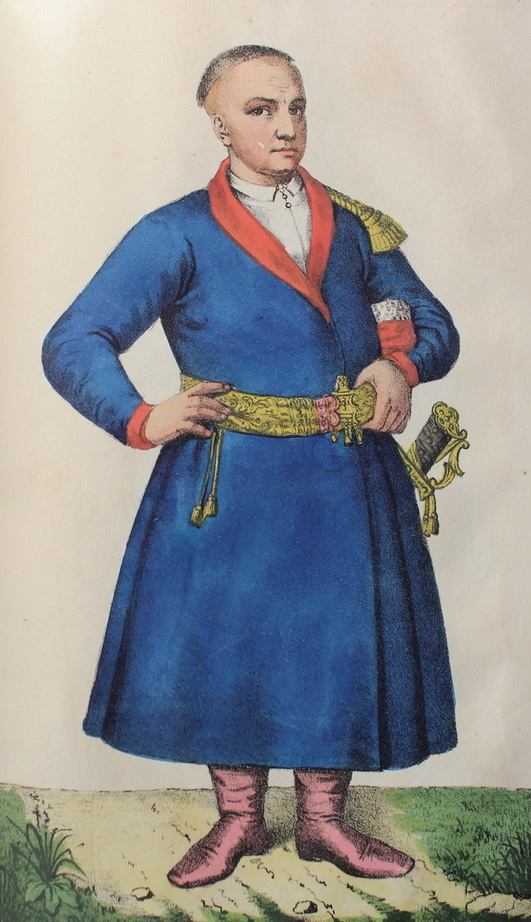
Sotnyk of Ukrainian Cossacks

Sotnik or sotnyk (Russian: сотник; Ukrainian: сотник; Bulgarian: стотник) was a military rank among the Cossack starshyna (military officers), the Russian streltsy and Cossack cavalry, the Ukrainian Insurgent Army, the Ukrainian Galician Army, and the Ukrainian People's Army.

Administrative rank

[edit]

Holders of the rank also served as leaders of territorial units. In the Cossacks' paramilitary society of the Zaporozhian Host, Cossack Hetmanate, and Sloboda Ukraine, territories were organized along the lines of military organization and commanded by officers. During the Khmelnytsky Uprising and in the Cossack Hetmanate (17th-18th centuries), sotnyks were leaders of territorial administrative subdivisions called sotnyas. Such sotnyks were subordinated to polkovnyks (colonel) who were in control of a polk (primary administrative division) and a regiment (military unit).

Military ranks

[edit]

The word sotnik literally means commander of a hundred men in most Slavonic languages, much like how the Latin term Centurion reflected a commander of a similar number of troops in the Roman Empire. In the Russian rank-structure the military role of a sotnik developed into that of a poruchik (Russian: поручик), eventually known as "lieutenant" (Russian: лейтенант, romanizedleytenant). Ukrainian military formations retained the rank of sotnyk (Ukrainian: сотник) well into the 20th century as the equivalent of an army captain.[1] The rank did not officially change, but rather fell out of use after the Soviet Army and intelligence services suppressed the Ukrainian Insurgent Army in the late 1940s and 1950s.

Some translations render the word sotnik as "Captain", however the "Lieutenant" interpretation also appears in common usage, and for the sake of historical and social clarity the original rank-name is used.

Slovenia

[edit]

The rank is still used by the Slovenian Armed Forces,[2] and is equal to the rank of captain in other armed forces.[3]

Legacy

[edit]

The name of "Sotnik" has been adopted as a surname.

References

[edit]
[edit]
Revisions and contributorsEdit on WikipediaRead on Wikipedia
from Grokipedia
A sotnik (Ukrainian: сотник; Russian: сотник), literally meaning "commander of a hundred," was a military rank denoting the leader of a sotnia, an administrative and tactical unit typically comprising 100 to 200 Cossack warriors in historical Slavic forces. This rank emerged in the Cossack starshyna hierarchy during the 16th to 18th centuries, functioning as an equivalent to a captain or lieutenant in regular armies, with sotniks responsible for both combat command and local governance in Cossack hosts such as the Zaporozhian Sich and the Hetmanate. In the Russian imperial structure, the sotnik oversaw strelets troops and cavalry subunits, evolving into formalized roles under Peter the Great's military reforms, where it paralleled the poruchik rank. The sotnik's authority extended beyond the to judicial and electoral duties within the Cossack community, reflecting the semi-autonomous nature of these forces that played pivotal roles in events like the and defenses against Ottoman and Polish incursions. Elected by peers in democratic Cossack traditions, sotniks embodied martial prowess and leadership, often advancing to higher strata like esaul or based on merit and service. The rank persisted into the 20th century, appearing in formations such as the during , underscoring its enduring symbol of regional military autonomy amid shifting empires and national struggles.

Origins and Etymology

Linguistic and Conceptual Roots

The term sotnik (Ukrainian: sotnyk; Russian: сотник) derives from East Slavic linguistic roots, combining sot' or sъtъ—the inherited Proto-Slavic word for "hundred" (sъto)—with the agentive suffix -nik, which denotes a person performing a role or function, yielding a literal meaning of "hundred-man" or "commander of a hundred." This formation parallels similar compounds in other Slavic languages, such as Polish sotnik or Czech stovník, underscoring its deep embedding in the shared lexical heritage of East and West Slavs. The suffix -nik is productive in denoting professions or leaders, as seen in terms like voevodnik (war leader) or kormčnik (helmsman), reflecting a grammatical pattern for nominalizing roles tied to numerical or functional units. Conceptually, the sotnik embodies a pragmatic adaptation of military subdivision, where authority is delegated to leaders of subunits of roughly 100 fighters—a scale enabling direct oversight, rapid decision-making, and accountability in fluid, often characteristic of and frontier conflicts. This mirrors ancient precedents like the Roman centurio (commander of a centuria of 100) or Anglo-Saxon hundredman, but in Slavic contexts, it aligned with the tribal and communal of East Slavic polities, where sotni (hundreds) served as building blocks for larger hosts without rigid hierarchies. The rank's persistence into Cossack and systems highlights its utility for semi-autonomous groups reliant on elected or merit-based local command, prioritizing cohesion through personal loyalty over centralized bureaucracy.

Early Historical Emergence

The sotnik rank, denoting a commander of a sotnya (a military subunit of roughly 100 warriors), originated within the decimal-based organization of armies in Kievan Rus', spanning approximately the 9th to 13th centuries. This structure divided princely druzhina (retinues) and levied forces into units of 10 (desyatka, led by a desyatnik), 100 (sotnya, led by a sotnik), and 1,000 (tysyacha, led by a tysyatsky), enabling scalable command in campaigns against nomadic incursions from Pechenegs and Cumans. Historical evidence for this early form draws from analyses of Rus' military practices, where the sotnik functioned as a mid-level in fluid, cavalry-heavy forces reliant on loyalty to princes rather than feudal levies. The rank's conceptual roots in Slavic tribal assemblies and Byzantine influences predated Mongol invasions (beginning 1237), after which decimal elements persisted but evolved under Horde suzerainty. No precise inaugural date survives in chronicles like the (compiled circa 1113), but the system's prevalence aligns with Rus' expansion under (r. 980–1015) and (r. 1019–1054), when armies numbered in thousands for defensive wars. By the late Kievan period, sotniks likely held administrative duties alongside tactical roles, such as mustering local militias (poliudie contingents), reflecting the rank's dual military-civil character that later amplified in Cossack formations. This early emergence underscores a pragmatic adaptation to steppe warfare, prioritizing numerical hierarchy over rigid professionalization.

Historical Military Usage

In Medieval and Early Modern Slavic Forces

In the military structure of Kievan Rus' and successor East Slavic principalities during the medieval period (roughly 9th–15th centuries), the sotnik (alternatively spelled sotski) functioned as a subunit commander overseeing a sotnia, a tactical formation typically comprising 100 warriors drawn from town militias, princely retinues (druzhina), or levied peasants. This organization reflected a decimal system of command inherited from steppe nomadic influences and earlier Slavic tribal practices, where units were grouped by multiples of ten for administrative and combat efficiency. The sotnia emphasized light cavalry and infantry skirmishers suited to the forested and steppe terrain of Eastern Europe, enabling rapid mobilization for defensive wars against nomads like the Pechenegs or internal princely conflicts. The earliest documented reference to the sotnik appears in the for the year 1118, describing such an officer in the context of local governance and levies under the assembly system. In Novgorod and similar northern principalities, sotniki often led quarter-based militias responsible for manning specific sections of city walls, integrating with offensive campaigns; for instance, they coordinated archers and spearmen in battles like those against Swedish incursions in the . By the 13th–14th centuries, amid Mongol overlordship, the rank persisted in principalities such as and Galicia-Volhynia, where sotniki supported tysyatskie (commanders of thousands) in hybrid forces blending Slavic infantry with Turkic , as evidenced by accounts of organized resistance during the Mongol invasions starting in 1237. Transitioning into the early modern era (16th–17th centuries), the sotnik rank adapted to the centralized state under Ivan IV (r. 1547–1584), particularly within the —professional infantry units formed in the 1550s to supplement traditional levies. Each polk (regiment) of about 500–1,000 men subdivided into five sotni of roughly 100 troops apiece, with the sotnik acting as responsible for , pay distribution, and tactical deployment in musket volleys and pike squares. This structure proved effective in conquests like the capture of in 1552, where sotniki coordinated fire support for assaults, though the units' semi-autonomous nature later contributed to revolts such as the 1682 uprising. The rank's persistence highlights continuity from medieval decimal systems into firearm-era warfare, bridging feudal levies and emerging standing armies across East Slavic territories.

In Cossack Hosts and Streletsky Troops

In Cossack hosts, including the , Don Host, and later imperial formations, the sotnik commanded a , the primary tactical and administrative subunit typically consisting of 100 to 200 . This unit operated within regimental structures led by a polkovnik, engaging in such as mounted raids, scouting, and defensive actions against Ottoman, Polish-Lithuanian, and Tatar forces from the onward. Sotniks, often selected for demonstrated valor in elections during the host's semi-autonomous phase, held responsibilities extending to civil administration, including tax collection, dispute resolution, and maintenance of order in stanitsas (Cossack settlements). By the , as hosts integrated into the Russian Empire's military system, the rank standardized as equivalent to a , with appointments shifting toward bureaucratic oversight by atamans and imperial officials, though retaining field command roles in campaigns like the Russo-Turkish Wars. The Streletsky troops, Russia's first permanent firearm infantry formed under Ivan IV around 1550, employed sotniks as captains over sotni of roughly 100 each, subdivided within larger prikazy (administrative orders) or polki (regiments) totaling 500 to 1,000 men per major unit. These officers, drawn from experienced and paid 12 to 20 rubles annually—substantially above the common strelets's 5-7 rubles—led formations armed with muskets and pikes in battles such as the (1558–1583) and suppression of internal revolts during the (1598–1613). Beyond combat, sotniks enforced garrison duties, policed and provincial cities, and managed hereditary streltsy privileges, including land grants and trade exemptions, which fostered corps cohesion but also bred unrest. Peter I disbanded the between 1698 and 1722 following mutinies, abolishing the sotnik rank within this context amid broader army reforms.

In the Russian Empire and Pre-Revolutionary Period

In the Russian Empire, established in 1721, the sotnik rank was retained and formalized within the various Cossack hosts, such as the Don, Kuban, Terek, Ural, Orenburg, and Siberian hosts, serving as an officer position in irregular cavalry units integrated into imperial service. The sotnik commanded a sotnia, the basic tactical subunit typically comprising 100 to 200 Cossacks, responsible for mounted reconnaissance, skirmishing, and shock tactics in warfare. This role emphasized mobility and autonomy, with sotniks often leading independent detachments during campaigns, as seen in the Napoleonic Wars (1805–1815) where Cossack sotnias under sotnik command harassed French supply lines and pursued retreating forces. Under the promulgated by on January 24, 1722, Cossack ranks were partially aligned with the imperial hierarchy, though preserved distinct terminology to maintain host traditions; the sotnik was classified as equivalent to a poruchik () in the , positioned at Class 10 by the 1884 revisions and holding precedence below yesaul ( equivalent) but above khorunzhiy ( or ). Promotion to sotnik required demonstrated service, often through election by Cossack assemblies in earlier periods transitioning to imperial appointment, and entailed dual and administrative duties, including maintaining order, tax collection, and mobilization within host territories. Throughout the 19th century, sotniks participated in key imperial conflicts, including the Russo-Turkish Wars (1806–1812, 1828–1829) and the (1853–1856), where their units provided frontier security and rapid-response capabilities against Ottoman and Caucasian forces. By the early , prior to the 1917 Revolution, the rank remained integral to Cossack regiments structured into 4–10 sotnias per regiment, with sotniks adapting to modernized equipment like rifles and lances while retaining traditional organizational roles; no substantive reforms altered the sotnik's status in the pre-revolutionary era.

Administrative and Civil Roles

Governance in Cossack Communities

In the , the sotnik headed the , a district-level administrative-territorial and unit within the regimental system, typically comprising 200–400 divided into 10–20 kurins (subunits) across several villages. This structure integrated with local , where the sotnik exercised authority over administrative affairs, supported by assistants including horodovyi and sotnia otamans, a pysar (), osavul (), and khorunzhyi (). Sotniks held substantial judicial powers, presiding over courts to resolve disputes and enforce Cossack , with town otamans substituting in their absence. They also managed fiscal responsibilities such as revenue collection and for campaigns, ensuring while maintaining order in their . Initially elected by local Cossack councils until 1649, sotniks were subsequently appointed by regimental colonels or the , reflecting a shift toward centralized control. In the Zaporozhian Host's society, sotniks served as administrative heads of sotnias, equivalent to counties, overseeing territorial units that paralleled military companies of 100–200 Cossacks. Their duties encompassed local administration, including communal decision-making and , symbolized by the sotnik's banner (znachok) as a mark of authority. This dual role underscored the ' self-governing ethos, where military ranks directly supported civil functions in autonomous communities.

Integration with Local Administration

In Cossack communities, particularly within the and later imperial hosts like the Don and , the functioned dually as a subunit and territorial administrative division, with the sotnik as its head exercising integrated authority over both spheres. This structure enabled sotniks to oversee local civil functions, including the adjudication of disputes, enforcement of communal laws, and coordination of labor duties, thereby bridging martial discipline with everyday governance in semi-autonomous stanitsas (Cossack settlements). Elected initially by Cossack assemblies for terms typically lasting one year, sotniks derived their legitimacy from democratic processes within the host, which helped maintain internal cohesion while adapting to external imperial demands. As Russian imperial control intensified from the late onward, sotnik appointments shifted toward confirmation or direct selection by higher authorities or the War Ministry, aligning local administration more closely with state hierarchies without fully eroding Cossack traditions. Sotniks managed financial obligations such as tax levies on communal lands and contributions to host-wide funds, often disbursing stipends from imperial allocations— for instance, in the Orenburg Host, sotniks received designated payments alongside stanitsa to support administrative operations. This integration facilitated the hosts' role as buffers against frontier unrest, where sotniks reported to regimental commanders while retaining on-the-ground authority over policing and resource allocation, ensuring loyalty to the through localized enforcement. Judicial powers vested in sotniks included presiding over minor criminal and civil cases within their , with appeals escalating to esauls or atamans, reflecting a layered system that minimized central interference in routine matters. In practice, this arrangement allowed Cossack hosts to administer vast territories efficiently, as seen in the Don Host's handling of land disputes and nomadic interactions, where sotniks balanced Cossack customs against imperial edicts like the 1835 statutes formalizing host governance. Such embedded roles underscored the sotnik's evolution from a purely elective warrior-leader to a hybrid official, instrumental in the hosts' partial incorporation into the empire's administrative framework while preserving operational autonomy until the early reforms.

Modern Military Equivalents

In Ukrainian Armed Forces

In the modern , the historical rank of sotnyk is not part of the official nomenclature, which was standardized in to align with post-Soviet reforms and international military conventions. The equivalent role—commanding a (sotnya, literally "hundred") of approximately 100-150 personnel—is fulfilled by the rank of kapitan, typically a responsible for tactical leadership, training, and operational execution at the subunit level. This structure emphasizes NATO-compatible interoperability, with kapitan positioned between starshiy leytenant () and mayor (major) in the officer hierarchy. Proposals to revive traditional Ukrainian ranks, including designating sotnyk as the official term for kapitan to reflect Cossack heritage and reduce Russified terminology, have surfaced periodically. For instance, a to the advocated renaming kapitan to sotnyk, alongside other changes like mayor to osavul, arguing for cultural authenticity amid national defense efforts. However, no legislative action has implemented these shifts, preserving the current system amid ongoing wartime priorities as of October 2025. Informal or ceremonial use of sotnyk may occur in Cossack revival organizations or territorial defense units drawing on historical traditions, but it lacks formal authority in the regular forces.

In Slovenian Armed Forces

In the Slovenian Armed Forces (Slovenska vojska), the rank of stotnik—the Slovenian variant of the Slavic term sotnik—serves as a mid-level commissioned officer position equivalent to the NATO OF-2 grade of captain. It is positioned above nadporočnik (senior lieutenant) and below major in the officer hierarchy, requiring candidates to have completed at least five years of service as nadporočnik with exemplary evaluations, alongside mandatory staff training (štavno šolanje). Stotniki typically assume command roles over companies (sotnje, echoing the historical unit size of 100–400 troops) or equivalent operational and staff duties within the , such as leading contingents in multinational missions. For instance, in June 2025, a stotnik took command of the 7th Slovenian contingent deployed to as part of commitments. The rank supports career tracks in command, staff, or specialist pillars, emphasizing to ensure operational readiness in a fully professional force established post-2003. Historically, during the Territorial Defense of the Republic of (TO RS) prior to full , a senior variant known as stotnik 1. stopnje existed above the standard stotnik, functioning akin to a senior captain before rank standardization aligned with structures upon Slovenia's 2004 accession. for stotnik feature three silver stars on epaulets in dress uniforms, reflecting continuity with Central European military traditions while integrating into alliance protocols.

In Other Contemporary Contexts

In Russian Cossack hosts, which function as registered public organizations with paramilitary elements and provide auxiliary support to the Russian Armed Forces, the sotnik rank persists as a traditional officer position equivalent to a company commander or lieutenant, overseeing units of approximately 100 personnel. These hosts, including the Kuban and Terek Cossack Hosts, integrate into volunteer formations such as BARS (Combat Army Reserve) detachments deployed in the Ukraine conflict since 2022, where sotniks lead tactical subunits in combat roles. For example, in BARS-10, a Cossack-affiliated unit, personnel adopt "Sotnik" as a call sign for operational leadership, reflecting the rank's ongoing utility in irregular warfare contexts. Over 15,000 Cossack fighters, structured under such ranks, have participated in frontline operations by mid-2024, supplementing regular forces amid high attrition rates. This usage maintains historical Cossack autonomy while aligning with state-directed military efforts, though these units operate outside standard Russian rank hierarchies like those in the regular army.

Recent Developments

Russian Sotnik Combat Gear Program

The Sotnik combat gear program, initiated by Russia's State Corporation, represents an effort to develop a third-generation equipment system to supersede the Ratnik ensemble. Publicly announced in January 2021, the program encompasses multiple subsystems designed to enhance soldier survivability, load-bearing capacity, and battlefield integration, with development coordinated under a prospective inter-agency target program extending to 2035. Core components of Sotnik include advanced utilizing lightweight fibers and plates, claimed to resist penetration from 12.7 mm caliber ammunition, such as rounds, while maintaining a total system weight of around 12 kilograms—significantly lighter than the Ratnik's 20 kilograms. The ensemble incorporates a passive to support carrying up to 50 kilograms of additional load without fatigue, mine-resistant boots, and a thermal camouflage suit intended to reduce detectability. Further subsystems target ammunition ("Sotnik-BP"), small arms ("Sotnik-SO"), and individual protection ("Sotnik-SIB"), with integration of helmets featuring AI-assisted targeting, visor-mounted displays, and controls for micro-drone swarms and robotic platforms. Autonomous power systems, including and extended battery life, are also specified to support prolonged operations. Despite these ambitious specifications from and Ministry of Defense sources, the program's realization remains unconfirmed as of 2024, with reports indicating it had not advanced to production by late amid shifting priorities toward alternative gear like the Legioner system. Independent military analysts have characterized Sotnik announcements as likely , highlighting inconsistencies in claimed capabilities—such as .50 caliber resistance from thin materials—and the absence of fielded units, especially given resource constraints from ongoing conflicts. Initial plans targeted initial deployment in 2025, but no verified evidence of operational use has emerged, and development appears stalled or reoriented.

Technical Features and Deployment Status

The Sotnik combat ensemble, spearheaded by since 2021, integrates an —initially passive but evolving toward active variants—to augment soldier mobility and payload capacity up to 50 kg without fatigue, alongside modular constructed from fibers weighing approximately 20 kg total. This armor is advertised to deflect 12.7 mm projectiles, including those from heavy machine guns, while maintaining flexibility through elastic tailoring. Complementary elements encompass mine-resistant boots with reinforced soles, a featuring visors for tactical data overlay, and embedded sensors for vital monitoring. Further enhancements include a thermal-insulating suit rendering the wearer undetectable by detectors via adaptive materials, an autonomous climate-control system functional in environments from -40°C to +40°C, and anti-radar coatings to evade detection. The system emphasizes networked integration, enabling operators to command micro-drone swarms or robotic assets via interfaces, treating the gear as a unified platform rather than disparate items. These capabilities build on Ratnik's foundations but prioritize reduced weight—targeting under 20 kg for core protection—compared to prior generations exceeding 25 kg. Skepticism persists regarding feasibility, as ballistic claims defy current material limits without prohibitive bulk or cost; analyses from defense observers indicate the specifications likely serve promotional purposes amid drives, with no independent verification of .50-caliber resistance in lightweight form. Russian state announcements, prone to overstatement, contrast with practical constraints evidenced by stalled trials in operations. Deployment remains developmental as of October 2025, with projecting initial units for troops in 2025 to supplant Ratnik, followed by broader adoption by 2030; however, August 2025 unveilings describe prototypes as conceptual, and resource strains from the conflict have delayed analogous programs, yielding no confirmed field issuances. Ongoing trials focus on refinements, but mass production hurdles— including issues for advanced composites—suggest limited rollout at best.

Legacy and Influence

Impact on Rank Hierarchies

The sotnik rank, positioned as a mid-level command in Cossack formations, structured hierarchies around the unit, which typically encompassed 100 to 300 fighters and functioned dually as a combat detachment and territorial administrative entity. This integration compelled sotniks to oversee not only tactical operations but also local fiscal collection, judicial proceedings, and , thereby embedding military authority within civilian oversight and promoting a decentralized chain of command responsive to frontier conditions. In the (1648–1764), sotniks reported to regimental colonels while retaining significant autonomy in their districts, numbering up to 20 per , which stabilized amid frequent warfare and migrations. This model diverged from centralized European armies by incorporating elective elements—sotniks were often selected by within their sotnias—fostering hierarchies that prioritized proven valor and communal consensus over strict noble , though imperial oversight increasingly formalized appointments by the . The approach influenced Russian imperial integration of Cossack hosts post-1654, where sotniks equated roughly to captains but preserved distinct and advancement paths, exempt from Peter the Great's 1722 that standardized progression across regular forces. Cossack units thus maintained parallel hierarchies, with sotniks leading autonomous squadrons in campaigns like the , contributing over 500,000 cavalry by 1914 while resisting full assimilation into structures. In administrative terms, the sotnik's role reinforced a pyramidal structure from or at the apex, through colonels, to sotniks and lower esaul ranks, enabling scalable mobilization; for instance, during the 17th-century , this facilitated rapid assembly of 60,000+ across 20 regiments. Such flexibility impacted broader Eurasian military adaptations, as Russian forces adopted hybrid irregular-regular formations for warfare, where sotnik-led sotnias scouted and raided independently, contrasting rigid companies elsewhere. Post-Hetmanate, this persisted in hosts like the Don and , where sotnik hierarchies supported border defense until the 1917 revolutions, underscoring resilience against top-down reforms.

Cultural and Symbolic References

In Nikolai Gogol's historical novella (originally published in 1835 and revised in 1842), sotniks are depicted as the elected commanders of Cossack hundreds, responsible for leading troops in battles against Polish forces during the 17th century. The narrative highlights their authority within the Zaporozhian Sich's democratic military structure, where Bulba summons "all the sotniks or captains of hundreds" to celebrate his sons' return and prepare for campaign, underscoring the rank's integral role in Cossack valor and communal warfare. This portrayal romanticizes the sotnik as a figure of rugged , blending tactical command with the steppe warriors' unyielding loyalty to the host. The sotnik has also appeared symbolically in Cossack revival movements since the late , where it represents historical continuity and ethnic martial identity. In post-Soviet Russian and Ukrainian Cossack organizations, the rank is reinstated in ceremonial hierarchies—alongside khorunzhyi and esaul—to evoke pre-revolutionary traditions during cultural festivals, historical reenactments, and gatherings, emphasizing elected merit over rigid . Such usages position the sotnik as an emblem of autonomous, democratic soldiery rooted in 16th-18th century confederations, though interpretations vary between romanticized heritage and politicized .

References

Add your contribution
Related Hubs
User Avatar
No comments yet.