Hubbry Logo
Critique of Pure ReasonCritique of Pure ReasonMain
Open search
Critique of Pure Reason
Community hub
Critique of Pure Reason
logo
8 pages, 0 posts
0 subscribers
Be the first to start a discussion here.
Critique of Pure Reason
from Wikipedia

Key Information

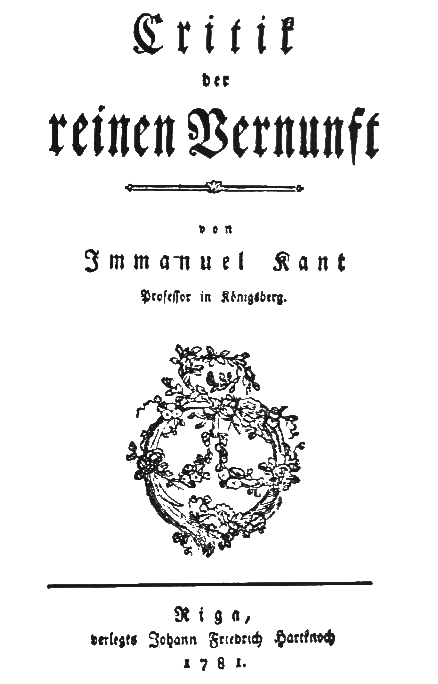
The Critique of Pure Reason (German: Kritik der reinen Vernunft; 1781; second edition 1787) is a book by the German philosopher Immanuel Kant, in which the author seeks to determine the limits and scope of metaphysics. Also referred to as Kant's "First Critique", it was followed by his Critique of Practical Reason (1788) and Critique of Judgment (1790). In the preface to the first edition, Kant explains that by a "critique of pure reason" he means a critique "of the faculty of reason in general, in respect of all knowledge after which it may strive independently of all experience" and that he aims to decide on "the possibility or impossibility of metaphysics".

Kant builds on the work of empiricist philosophers such as John Locke and David Hume, as well as rationalist philosophers such as René Descartes, Gottfried Wilhelm Leibniz and Christian Wolff. He expounds new ideas on the nature of space and time, and tries to provide solutions to the skepticism of Hume regarding knowledge of the relation of cause and effect and that of René Descartes regarding knowledge of the external world. This is argued through the transcendental idealism of objects (as appearance) and their form of appearance. Kant regards the former "as mere representations and not as things in themselves", and the latter as "only sensible forms of our intuition, but not determinations given for themselves or conditions of objects as things in themselves". This grants the possibility of a priori knowledge, since objects as appearance "must conform to our cognition...which is to establish something about objects before they are given to us." Knowledge independent of experience Kant calls "a priori" knowledge, while knowledge obtained through experience is termed "a posteriori".[3] According to Kant, a proposition is a priori if it is necessary and universal. A proposition is necessary if it is not false in any case and so cannot be rejected; rejection is contradiction. A proposition is universal if it is true in all cases, and so does not admit of any exceptions. Knowledge gained a posteriori through the senses, Kant argues, never imparts absolute necessity and universality, because it is possible that we might encounter an exception.[4]

Kant further elaborates on the distinction between "analytic" and "synthetic" judgments.[5] A proposition is analytic if the content of the predicate-concept of the proposition is already contained within the subject-concept of that proposition.[6] For example, Kant considers the proposition "All bodies are extended" analytic, since the predicate-concept ('extended') is already contained within—or "thought in"—the subject-concept of the sentence ('body'). The distinctive character of analytic judgments was therefore that they can be known to be true simply by an analysis of the concepts contained in them; they are true by definition. In synthetic propositions, on the other hand, the predicate-concept is not already contained within the subject-concept. For example, Kant considers the proposition "All bodies are heavy" synthetic, since the concept 'body' does not already contain within it the concept 'weight'.[7] Synthetic judgments therefore add something to a concept, whereas analytic judgments only explain what is already contained in the concept.

Before Kant, philosophers held that all a priori knowledge must be analytic. Kant, however, argues that our knowledge of mathematics, of the first principles of natural science, and of metaphysics, is both a priori and synthetic. The peculiar nature of this knowledge cries out for explanation. The central problem of the Critique is therefore to answer the question: "How are synthetic a priori judgments possible?"[8] It is a "matter of life and death" to metaphysics and to human reason, Kant argues, that the grounds of this kind of knowledge be explained.[8]

Though it received little attention when it was first published, the Critique later attracted attacks from both empiricist and rationalist critics, and became a source of controversy. It has exerted an enduring influence on Western philosophy, and helped bring about the development of German idealism. The book is considered a culmination of several centuries of early modern philosophy and an inauguration of late modern philosophy.

Background

[edit]

Early rationalism

[edit]

Before Kant, it was generally held that truths of reason must be analytic, meaning that what is stated in the predicate must already be present in the subject (e.g., "An intelligent man is intelligent" or "An intelligent man is a man").[9] In either case, the judgment is analytic because it is ascertained by analyzing the subject. It was thought that all truths of reason, or necessary truths, are of this kind: that in all of them there is a predicate that is only part of the subject of which it is asserted.[9] If this were so, attempting to deny anything that could be known a priori (e.g., "An intelligent man is not intelligent" or "An intelligent man is not a man") would involve a contradiction. It was therefore thought that the law of contradiction is sufficient to establish all a priori knowledge.[10]

David Hume at first accepted the general view of rationalism about a priori knowledge. However, upon closer examination of the subject, Hume discovered that some judgments thought to be analytic, especially those related to cause and effect, were actually synthetic (i.e., no analysis of the subject will reveal the predicate). They thus depend exclusively upon experience and are therefore a posteriori.

Kant's rejection of Hume's empiricism

[edit]

Before Hume, rationalists had held that effect could be deduced from cause; Hume argued that it could not and from this inferred that nothing at all could be known a priori in relation to cause and effect. Kant, who was brought up under the auspices of rationalism, was deeply impressed by Hume's skepticism. "I freely admit that it was the remembrance of David Hume which, many years ago, first interrupted my dogmatic slumber and gave my investigations in the field of speculative philosophy a completely different direction."[11]

Kant decided to find an answer and spent at least twelve years thinking about the subject.[12] Although the Critique of Pure Reason was set down in written form in just four to five months, while Kant was also lecturing and teaching, the work is a summation of the development of Kant's philosophy throughout those twelve years.[13]

Kant's work was stimulated by his decision to take seriously Hume's skeptical conclusions about such basic principles as cause and effect, which had implications for Kant's grounding in rationalism. In Kant's view, Hume's skepticism rested on the premise that all ideas are presentations of sensory experience. The problem that Hume identified was that basic principles such as causality cannot be derived from sense experience only: experience shows only that one event regularly succeeds another, not that it is caused by it.

In section VI ("The General Problem of Pure Reason") of the introduction to the Critique of Pure Reason, Kant explains that Hume stopped short of considering that a synthetic judgment could be made 'a priori'. Kant's goal was to find some way to derive cause and effect without relying on empirical knowledge. Kant rejects analytical methods for this, arguing that analytic reasoning cannot tell us anything that is not already self-evident, so his goal was to find a way to demonstrate how the synthetic a priori is possible.

To accomplish this goal, Kant argued that it would be necessary to use synthetic reasoning. However, this posed a new problem: how is it possible to have synthetic knowledge that is not based on empirical observation; that is, how are synthetic a priori truths possible? This question is exceedingly important, Kant maintains, because he contends that all important metaphysical knowledge is of synthetic a priori propositions. If it is impossible to determine which synthetic a priori propositions are true, he argues, then metaphysics as a discipline is impossible.

Synthetic a priori judgments

[edit]
Immanuel Kant, lecturing to Russian officers—by I. Soyockina / V. Gracov, the Kant Museum, Kaliningrad

Kant argues that there are synthetic judgments such as the connection of cause and effect (e.g., "... Every effect has a cause.") where no analysis of the subject will produce the predicate. Kant reasons that statements such as those found in geometry and Newtonian physics are synthetic judgments. Kant uses the classical example of 7 + 5 = 12. No amount of analysis will find 12 in either 7 or 5 and vice versa, since an infinite number of two numbers exist that will give the sum 12. Thus Kant concludes that all pure mathematics is synthetic though a priori; the number 7 is seven and the number 5 is five and the number 12 is twelve and the same principle applies to other numerals; in other words, they are universal and necessary. For Kant then, mathematics is synthetic judgment a priori. Conventional reasoning would have regarded such an equation to be analytic a priori by considering both 7 and 5 to be part of one subject being analyzed, however Kant looked upon 7 and 5 as two separate values, with the value of five being applied to that of 7 and synthetically arriving at the logical conclusion that they equal 12. This conclusion led Kant into a new problem as he wanted to establish how this could be possible: How is pure mathematics possible?[12] This also led him to inquire whether it could be possible to ground synthetic a priori knowledge for a study of metaphysics, because most of the principles of metaphysics from Plato through to Kant's immediate predecessors made assertions about the world or about God or about the soul that were not self-evident but which could not be derived from empirical observation (B18-24). For Kant, all post-Cartesian metaphysics is mistaken from its very beginning: the empiricists are mistaken because they assert that it is not possible to go beyond experience and the dogmatists are mistaken because they assert that it is possible to go beyond experience through theoretical reason.

Therefore, Kant proposes a new basis for a science of metaphysics, posing the question: how is a science of metaphysics possible, if at all? According to Kant, only practical reason, the faculty of moral consciousness, the moral law of which everyone is immediately aware, makes it possible to know things as they are.[14] This led to his most influential contribution to metaphysics: the abandonment of the quest to try to know the world as it is "in itself" independent of sense experience. He demonstrated this with a thought experiment, showing that it is not possible to meaningfully conceive of an object that exists outside of time and has no spatial components and is not structured following the categories of the understanding (Verstand), such as substance and causality. Although such an object cannot be conceived, Kant argues, there is no way of showing that such an object does not exist. Therefore, Kant says, the science of metaphysics must not attempt to reach beyond the limits of possible experience but must discuss only those limits, thus furthering the understanding of ourselves as thinking beings. The human mind is incapable of going beyond experience so as to obtain a knowledge of ultimate reality, because no direct advance can be made from pure ideas to objective existence.[15]

Kant writes: "Since, then, the receptivity of the subject, its capacity to be affected by objects, must necessarily precede all intuitions of these objects, it can readily be understood how the form of all appearances can be given prior to all actual perceptions, and so exist in the mind a priori" (A26/B42). Appearance is then, via the faculty of transcendental imagination (Einbildungskraft), grounded systematically in accordance with the categories of the understanding. Kant's metaphysical system, which focuses on the operations of cognitive faculties (Erkenntnisvermögen), places substantial limits on knowledge not found in the forms of sensibility (Sinnlichkeit). Thus it sees the error of metaphysical systems prior to the Critique as failing to first take into consideration the limitations of the human capacity for knowledge. Transcendental imagination is described in the first edition of the Critique of Pure Reason but Kant omits it from the second edition of 1787.[16]

It is because he takes into account the role of people's cognitive faculties in structuring the known and knowable world that in the second preface to the Critique of Pure Reason Kant compares his critical philosophy to Copernicus' revolution in astronomy. Kant (Bxvi) writes:

Hitherto it has been assumed that all our knowledge must conform to objects. But all attempts to extend our knowledge of objects by establishing something in regard to them a priori, by means of concepts, have, on this assumption, ended in failure. We must therefore make trial whether we may not have more success in the tasks of metaphysics, if we suppose that objects must conform to our knowledge.

Kant's view is that in explaining the movement of celestial bodies, Copernicus rejected the idea that the movement is only in the stars in order to allow that such movement is also due to the motion of ourselves as spectators. Thus, the Copernican revolution in astronomy shifted our understanding of the universe from one that is geocentric, without reference to the motion of ourselves as spectators, to one that is heliocentric with reference to the motion of ourselves as spectators. Likewise, Kant aims to shift metaphysics from one that requires our understanding to conform to the nature of objects to one that requires the objects of experience to conform to the necessary conditions of our knowledge. Consequently, knowledge does not depend solely on the object of knowledge but also on the capacity of the knower.[17]

Transcendental idealism

[edit]

Kant's transcendental idealism should be distinguished from idealistic systems such as that of George Berkeley which deny all claims of extramental existence and consequently turn phenomenal objects into things-in-themselves. While Kant claimed that phenomena depend upon the conditions of sensibility, space and time, and on the synthesizing activity of the mind manifested in the rule-based structuring of perceptions into a world of objects, this thesis is not equivalent to mind-dependence in the sense of Berkeley's idealism. Kant defines transcendental idealism:

I understand by the transcendental idealism of all appearances the doctrine that they are all together to be regarded as mere representations and not things in themselves, and accordingly that time and space are only sensible forms of our intuition, but not determinations given for themselves or conditions of objects as things in themselves. To this idealism is opposed transcendental realism, which regards space and time as something given in themselves (independent of our sensibility).

— Critique of Pure Reason, A369

Kant's approach

[edit]

In Kant's view, a priori intuitions and concepts provide some a priori knowledge, which also provides the framework for a posteriori knowledge. Kant also believed that causality is a conceptual organizing principle imposed upon nature, albeit nature understood as the sum of appearances that can be synthesized according to a priori concepts.

In other words, space and time are a form of perceiving and causality is a form of knowing. Both space and time and conceptual principles and processes pre-structure experience.

Things as they are "in themselves"—the thing in itself, or das Ding an sich—are unknowable. For something to become an object of knowledge, it must be experienced, and experience is structured by the mind—both space and time being the forms of intuition (Anschauung; for Kant, intuition is the process of sensing or the act of having a sensation)[18] or perception, and the unifying, structuring activity of concepts. These aspects of mind turn things-in-themselves into the world of experience. There is never passive observation or knowledge.

According to Kant, the transcendental ego—the "Transcendental Unity of Apperception"—is similarly unknowable. Kant contrasts the transcendental ego to the empirical ego, the active individual self subject to immediate introspection. One is aware that there is an "I," a subject or self that accompanies one's experience and consciousness. Since one experiences it as it manifests itself in time, which Kant proposes is a subjective form of perception, one can know it only indirectly: as object, rather than subject. It is the empirical ego that distinguishes one person from another providing each with a definite character.[19]

Contents

[edit]

The Critique of Pure Reason is arranged around several basic distinctions. After the two Prefaces (the A edition Preface of 1781 and the B edition Preface of 1787) and the Introduction, the book is divided into the Doctrine of Elements and the Doctrine of Method.

Doctrine of Elements and of Method

[edit]

The Doctrine of Elements sets out the a priori products of the mind, and the correct and incorrect use of these presentations. Kant further divides the Doctrine of Elements into the Transcendental Aesthetic and the Transcendental Logic, reflecting his basic distinction between sensibility and the understanding. In the "Transcendental Aesthetic" he argues that space and time are pure forms of intuition inherent in our faculty of sense. The "Transcendental Logic" is separated into the Transcendental Analytic and the Transcendental Dialectic:

  • The Transcendental Analytic sets forth the appropriate uses of a priori concepts, called the categories, and other principles of the understanding, as conditions of the possibility of a science of metaphysics. The section titled the "Metaphysical Deduction" considers the origin of the categories. In the "Transcendental Deduction", Kant then shows the application of the categories to experience. Next, the "Analytic of Principles" sets out arguments for the relation of the categories to metaphysical principles. This section begins with the "Schematism", which describes how the imagination can apply pure concepts to the object given in sense perception. Next are arguments relating the a priori principles with the schematized categories.
  • The Transcendental Dialectic describes the transcendental illusion behind the misuse of these principles in attempts to apply them to realms beyond sense experience. Kant’s most significant arguments are the "Paralogisms of Pure Reason", the "Antinomy of Pure Reason", and the "Ideal of Pure Reason", aimed against, respectively, traditional theories of the soul, the universe as a whole, and the existence of God. In the Appendix to the "Critique of Speculative Theology" Kant describes the role of the transcendental ideas of reason.

The Doctrine of Method contains four sections. The first section, "Discipline of Pure Reason", compares mathematical and logical methods of proof, and the second section, "Canon of Pure Reason", distinguishes theoretical from practical reason.

The divisions of the Critique of Pure Reason

[edit]

Dedication

1. First and second Prefaces
2. Introduction
3. Transcendental Doctrine of Elements
A. Transcendental Aesthetic
(1) On space
(2) On time
B. Transcendental Logic
(1) Transcendental Analytic
a. Analytic of Concepts
i. Metaphysical Deduction
ii. Transcendental Deduction
b. Analytic of Principles
i. Schematism (bridging chapter)
ii. System of Principles of Pure Understanding
a. Axioms of Intuition
b. Anticipations of Perception
c. Analogies of Experience
d. Postulates of Empirical Thought (Refutation of Idealism)
iii. Ground of Distinction of Objects into Phenomena and Noumena
iv. Appendix on the Amphiboly of the Concepts of Reflection
(2) Transcendental Dialectic: Transcendental Illusion
a. Paralogisms of Pure Reason
b. Antinomy of Pure Reason
c. Ideal of Pure Reason
d. Appendix to Critique of Speculative Theology
4. Transcendental Doctrine of Method
A. Discipline of Pure Reason
B. Canon of Pure Reason
C. Architectonic of Pure Reason
D. History of Pure Reason

Table of contents

[edit]
Critique of Pure Reason[20]
Transcendental Doctrine of Elements Transcendental Doctrine of Method
First Part: Transcendental Aesthetic Second Part: Transcendental Logic Discipline of Pure Reason Canon of Pure Reason Architectonic of Pure Reason History of Pure Reason
Space Time First Division: Transcendental Analytic Second Division: Transcendental Dialectic
Book I: Analytic of Concepts Book II: Analytic of Principles Transcendental Illusion Pure Reason as the Seat of Transcendental Illusion
Clue to the discovery of all pure concepts of the understanding Deductions of the pure concepts of the understanding Schematism System of all principles Phenomena and Noumena Book I: Concept of Pure Reason Book II: Dialectical Inferences of Pure Reason
Paralogisms (Psychology) Antinomies (Cosmology) The Ideal (Theology)

I. Transcendental Doctrine of Elements

[edit]

Transcendental Aesthetic

[edit]

The Transcendental Aesthetic, as the Critique notes, deals with "all principles of a priori sensibility."[21] As a further delimitation, it "constitutes the first part of the transcendental doctrine of elements, in contrast to that which contains the principles of pure thinking, and is named transcendental logic".[21] In it, what is aimed at is "pure intuition and the mere form of appearances, which is the only thing that sensibility can make available a priori."[22] It is thus an analytic of the a priori constitution of sensibility; through which "Objects are therefore given to us..., and it alone affords us intuitions."[23] This in itself is an explication of the "pure form of sensible intuitions in general [that] is to be encountered in the mind a priori."[24] Thus, pure form or intuition is the a priori "wherein all of the manifold of appearances is intuited in certain relations."[24] from this, "a science of all principles of a priori sensibility [is called] the transcendental aesthetic."[21] The above stems from the fact that "there are two stems of human cognition...namely sensibility and understanding."[25]

This division, as the critique notes, comes "closer to the language and the sense of the ancients, among whom the division of cognition into αισθητα και νοητα is very well known."[26] An exposition on a priori intuitions is an analysis of the intentional constitution of sensibility. Since this lies a priori in the mind prior to actual object relation; "The transcendental doctrine of the senses will have to belong to the first part of the science of elements, since the conditions under which alone the objects of human cognition are given precede those under which those objects are thought".[27]

Kant distinguishes between the matter and the form of appearances. The matter is "that in the appearance that corresponds to sensation" (A20/B34). The form is "that which so determines the manifold of appearance that it allows of being ordered in certain relations" (A20/B34). Kant's revolutionary claim is that the form of appearances—which he later identifies as space and time—is a contribution made by the faculty of sensation to cognition, rather than something that exists independently of the mind. This is the thrust of Kant's doctrine of the transcendental ideality of space and time.

Kant's arguments for this conclusion are widely debated among Kant scholars. Some see the argument as based on Kant's conclusions that our representation (Vorstellung) of space and time is an a priori intuition. From here Kant is thought to argue that our representation of space and time as a priori intuitions entails that space and time are transcendentally ideal. It is undeniable from Kant's point of view that in Transcendental Philosophy, the difference of things as they appear and things as they are is a major philosophical discovery.[28] Others see the argument as based upon the question of whether synthetic a priori judgments are possible. Kant is taken to argue that the only way synthetic a priori judgments, such as those made in geometry, are possible is if space is transcendentally ideal.

In Section I (Of Space) of Transcendental Aesthetic in the Critique of Pure Reason Kant poses the following questions: What then are time and space? Are they real existences? Or, are they merely relations or determinations of things, such, however, as would equally belong to these things in themselves, though they should never become objects of intuition; or, are they such as belong only to the form of intuition, and consequently to the subjective constitution of the mind, without which these predicates of time and space could not be attached to any object?[29] The answer that space and time are real existences belongs to Newton. The answer that space and time are relations or determinations of things even when they are not being sensed belongs to Leibniz. Both answers maintain that space and time exist independently of the subject's awareness. This is exactly what Kant denies in his answer that space and time belong to the subjective constitution of the mind.[30]: 87–88 

Space and time

[edit]

Kant gives two expositions of space and time: metaphysical and transcendental. The metaphysical expositions of space and time are concerned with clarifying how those intuitions are known independently of experience. The transcendental expositions purport to show how the metaphysical conclusions give insight into the possibility of already obtained a priori scientific knowledge (A25/B40).

In the transcendental exposition, Kant refers back to his metaphysical exposition in order to show that the sciences would be impossible if space and time were not kinds of pure a priori intuitions. He asks the reader to take the proposition, "two straight lines can neither contain any space nor, consequently, form a figure," and then to try to derive this proposition from the concepts of a straight line and the number two. He concludes that it is simply impossible (A47-48/B65). Thus, since this information cannot be obtained from analytic reasoning, it must be obtained through synthetic reasoning, i.e., a synthesis of concepts (in this case two and straightness) with the pure (a priori) intuition of space.

In this case, however, it was not experience that furnished the third term; otherwise, the necessary and universal character of geometry would be lost. Only space, which is a pure a priori form of intuition, can make this synthetic judgment, thus it must then be a priori. If geometry does not serve this pure a priori intuition, it is empirical, and would be an experimental science, but geometry does not proceed by measurements—it proceeds by demonstrations.

The other part of the Transcendental Aesthetic argues that time is a pure a priori intuition that renders mathematics possible. Time is not a concept, since otherwise it would merely conform to formal logical analysis (and therefore, to the principle of non-contradiction). However, time makes it possible to deviate from the principle of non-contradiction: indeed, it is possible to say that A and non-A are in the same spatial location if one considers them in different times, and a sufficient alteration between states were to occur (A32/B48). Time and space cannot thus be regarded as existing in themselves. They are a priori forms of sensible intuition.

The current interpretation of Kant states that the subject possesses the capacity to perceive spatial and temporal presentations a priori. The Kantian thesis claims that in order for the subject to have any experience at all, then it must be bounded by these forms of presentations (Vorstellung). Some scholars have offered this position as an example of psychological nativism, as a rebuke to some aspects of classical empiricism.[citation needed]

Kant's thesis concerning the transcendental ideality of space and time limits appearances to the forms of sensibility—indeed, they form the limits within which these appearances can count as sensible; and it necessarily implies that the thing-in-itself is neither limited by them nor can it take the form of an appearance within us apart from the bounds of sensibility (A48-49/B66). Yet the thing-in-itself is held by Kant to be the cause of that which appears, and this is where an apparent paradox of Kantian critique resides: while we are prohibited from knowledge of the thing-in-itself, we can attribute it as being something beyond ourselves as a causally responsible source of representations within us. Kant's view of space and time rejects both the space and time of Aristotelian physics and the space and time of Newtonian physics.

Transcendental Logic

[edit]
Outline of Kant's division of the science of logic into special logic, general logic, and the pure and applied forms of general logic

In the Transcendental Logic, there is a section (titled The Refutation of Idealism) that is intended to free Kant's doctrine from any vestiges of subjective idealism, which would either doubt or deny the existence of external objects (B274-79).[31] Kant's distinction between the appearance and the thing-in-itself is not intended to imply that nothing knowable exists apart from consciousness, as with subjective idealism. Rather, it declares that knowledge is limited to phenomena as objects of a sensible intuition. In the Fourth Paralogism ("... A Paralogism is a logical fallacy"),[32] Kant further certifies his philosophy as separate from that of subjective idealism by defining his position as a transcendental idealism in accord with empirical realism (A366–80), a form of direct realism.[33][a] "The Paralogisms of Pure Reason" is the only chapter of the Dialectic that Kant rewrote for the second edition of the Critique of Pure Reason. In the first edition, the Fourth Paralogism offers a defence of transcendental idealism, which Kant reconsidered and relocated in the second edition.[36]

Whereas the Transcendental Aesthetic was concerned with the role of the sensibility, the Transcendental Logic is concerned with the role of the understanding, which Kant defines as the faculty of the mind that deals with concepts.[37] Knowledge, Kant argued, contains two components: intuitions, through which an object is given to us in sensibility, and concepts, through which an object is thought in understanding. In the Transcendental Aesthetic, he attempted to show that the a priori forms of intuition were space and time, and that these forms were the conditions of all possible intuition. It should therefore be expected that we should find similar a priori concepts in the understanding, and that these pure concepts should be the conditions of all possible thought. The Logic is divided into two parts: the Transcendental Analytic and the Transcendental Dialectic. The Analytic Kant calls a "logic of truth";[38] in it he aims to discover these pure concepts which are the conditions of all thought, and are thus what makes knowledge possible. The Transcendental Dialectic Kant calls a "logic of illusion";[39] in it he aims to expose the illusions that we create when we attempt to apply reason beyond the limits of experience.

The idea of a transcendental logic is that of a logic that gives an account of the origins of our knowledge as well as its relationship to objects. Kant contrasts this with the idea of a general logic, which abstracts from the conditions under which our knowledge is acquired, and from any relation that knowledge has to objects. According to Helge Svare, "It is important to keep in mind what Kant says here about logic in general, and transcendental logic in particular, being the product of abstraction, so that we are not misled when a few pages later he emphasizes the pure, non-empirical character of the transcendental concepts or the categories."[40]

Kant's investigations in the Transcendental Logic lead him to conclude that understanding and reason can only legitimately be applied to things as they appear phenomenally to us in experience. What things are in themselves as being noumenal, independent of our cognition, remains limited by what is known through phenomenal experience.

First Division: Transcendental Analytic

[edit]

The Transcendental Analytic is divided into an Analytic of Concepts and an Analytic of Principles, as well as a third section concerned with the distinction between phenomena and noumena. In Chapter III (Of the ground of the division of all objects into phenomena and noumena) of the Transcendental Analytic, Kant generalizes the implications of the Analytic in regard to transcendent objects preparing the way for the explanation in the Transcendental Dialectic about thoughts of transcendent objects, Kant's detailed theory of the content (Inhalt) and origin of our thoughts about specific transcendent objects.[30]: 198–199  The main sections of the Analytic of Concepts are The Metaphysical Deduction and The Transcendental Deduction of the Categories. The main sections of the Analytic of Principles are the Schematism, Axioms of Intuition, Anticipations of Perception, Analogies of Experience, Postulates and follow the same recurring tabular form:

1. Quantity
2. Quality
3. Relation
4. Modality

In the 2nd edition, these sections are followed by a section titled the Refutation of Idealism.

The metaphysical deduction
[edit]

In the Metaphysical Deduction, Kant aims to derive twelve pure concepts of the understanding (which he calls "categories") from the logical forms of judgment. In the following section, he will go on to argue that these categories are conditions of all thought in general. Kant arranges the forms of judgment in a table of judgments, which he uses to guide the derivation of the table of categories.[41]

The role of the understanding is to make judgments. In judgment, the understanding employs concepts which apply to the intuitions given to us in sensibility. Judgments can take different logical forms, with each form combining concepts in different ways. Kant claims that if we can identify all of the possible logical forms of judgment, this will serve as a "clue" to the discovery of the most basic and general concepts that are employed in making such judgments, and thus that are employed in all thought.[41]

Logicians prior to Kant had concerned themselves to classify the various possible logical forms of judgment. Kant, with only minor modifications, accepts and adopts their work as correct and complete, and lays out all the logical forms of judgment in a table, reduced under four heads:

1. Quantity of Judgments
2. Quality
3. Relation
4. Modality

Under each head, there corresponds three logical forms of judgment:[42]

1. Quantity of Judgments
  • Universal
  • Particular
  • Singular
2. Quality
  • Affirmative
  • Negative
  • Infinite
3. Relation
  • Categorical
  • Hypothetical
  • Disjunctive
4. Modality
  • Problematic
  • Assertoric
  • Apodeictic

This Aristotelian method for classifying judgments is the basis for his own twelve corresponding concepts of the understanding. In deriving these concepts, he reasons roughly as follows. If we are to possess pure concepts of the understanding, they must relate to the logical forms of judgment. However, if these pure concepts are to be applied to intuition, they must have content. But the logical forms of judgment are by themselves abstract and contentless. Therefore, to determine the pure concepts of the understanding we must identify concepts which both correspond to the logical forms of judgment, and are able to play a role in organising intuition. Kant therefore attempts to extract from each of the logical forms of judgment a concept which relates to intuition. For example, corresponding to the logical form of hypothetical judgment ('If p, then q'), there corresponds the category of causality ('If one event, then another'). Kant calls these pure concepts 'categories', echoing the Aristotelian notion of a category as a concept which is not derived from any more general concept. He follows a similar method for the other eleven categories, then represents them in the following table:[43]

1. Categories of Quantity
  • Unity
  • Plurality
  • Totality
2. Categories of Quality
  • Reality
  • Negation
  • Limitation
3. Categories of Relation
  • Inherence and Subsistence (substance and accident)
  • Causality and Dependence (cause and effect)
  • Community (reciprocity between agent and patient)
4. Categories of Modality
  • Possibility—Impossibility
  • Existence—Non-existence
  • Necessity—Contingency

These categories, then, are the fundamental, primary, or native concepts of the understanding. These flow from, or constitute the mechanism of understanding and its nature, and are inseparable from its activity. Therefore, for human thought, they are universal and necessary, or a priori. As categories they are not contingent states or images of sensuous consciousness, and hence not to be thence derived. Similarly, they are not known to us independently of such consciousness or of sensible experience. On the one hand, they are exclusively involved in, and hence come to our knowledge exclusively through, the spontaneous activity of the understanding. This understanding is never active, however, until sensible data are furnished as material for it to act upon, and so it may truly be said that they become known to us "only on the occasion of sensible experience". For Kant, in opposition to Christian Wolff and Thomas Hobbes, the categories exist only in the mind.[44]

These categories are "pure" conceptions of the understanding, in as much as they are independent of all that is contingent in sense. They are not derived from what is called the matter of sense, or from particular, variable sensations. However, they are not independent of the universal and necessary form of sense. Again, Kant, in the "Transcendental Logic", is professedly engaged with the search for an answer to the second main question of the Critique: How is pure physical science, or sensible knowledge, possible? Kant, now, has said, and, with reference to the kind of knowledge mentioned in the foregoing question, has said truly, that thoughts, without the content which perception supplies, are empty. This is not less true of pure thoughts, than of any others. The content which the pure conceptions, as categories of pure physical science or sensible knowledge, cannot derive from the matter of sense, they must and do derive from its pure form. And in this relation between the pure conceptions of the understanding and their pure content there is involved, as we shall see, the most intimate community of nature and origin between sense, on its formal side (space and time), and the understanding itself. For Kant, space and time are a priori intuitions. Out of a total of six arguments in favor of space as a priori intuition, Kant presents four of them in the Metaphysical Exposition of space: two argue for space a priori and two for space as intuition.[30]: 75 

The transcendental deduction
[edit]

In the Transcendental Deduction, Kant aims to show that the categories derived in the Metaphysical Deduction are conditions of all possible experience. He achieves this proof roughly by the following line of thought: all representations must have some common ground if they are to be the source of possible knowledge (because extracting knowledge from experience requires the ability to compare and contrast representations that may occur at different times or in different places). This ground of all experience is the self-consciousness of the experiencing subject, and the constitution of the subject is such that all thought is rule-governed in accordance with the categories. It follows that the categories feature as necessary components in any possible experience.[45]

1.Axioms of intuition
2.Anticipations of perception
3.Analogies of experience
4.Postulates of empirical thought in general
The schematism
[edit]

In order for any concept to have meaning, it must be related to sense perception. The 12 categories, or a priori concepts, are related to phenomenal appearances through schemata. Each category has a schema. It is a connection through time between the category, which is an a priori concept of the understanding, and a phenomenal a posteriori appearance. These schemata are needed to link the pure category to sensed phenomenal appearances because the categories are, as Kant says, heterogeneous with sense intuition. Categories and sensed phenomena, however, do share one characteristic: time. Succession is the form of sense impressions and also of the Category of causality. Therefore, time can be said to be the schema of Categories or pure concepts of the understanding.[46]

The refutation of idealism
[edit]

In order to answer criticisms of the Critique of Pure Reason that Transcendental Idealism denied the reality of external objects, Kant added a section to the second edition (1787) titled "The Refutation of Idealism" which turns the "game" of idealism against itself by arguing that self-consciousness presupposes external objects. Defining self-consciousness as a determination of the self in time, Kant argues that all determinations of time presuppose something permanent in perception and that this permanence cannot be in the self, since it is only through the permanence that one's existence in time can itself be determined. This argument inverted the supposed priority of inner over outer experience that had dominated philosophies of mind and knowledge since René Descartes. In Book II, chapter II, section III of the Transcendental Analytic, right under "The Postulates of Empirical Thought", Kant adds a "Refutation of Idealism (Widerlegung des Idealismus)", where he refutes both Descartes' problematic idealism and Berkeley's dogmatic idealism. According to Kant, in problematic idealism the existence of objects is doubtful or impossible to prove, while in dogmatic idealism the existence of space and therefore of spatial objects is impossible. In contradistinction, Kant holds that external objects may be directly perceived and that such experience is a necessary presupposition of self-consciousness.[47]

Appendix: "Amphiboly of Concepts of Reflection"
[edit]

As an Appendix to the First Division of Transcendental Logic, Kant intends the "Amphiboly of the Conceptions of Reflection" to be a critique of Leibniz's metaphysics and a prelude to Transcendental Dialectic, the Second Division of Transcendental Logic. Kant introduces a whole set of new ideas called "concepts of reflection": identity/difference, agreement/opposition, inner/outer and matter/form. According to Kant, the categories do have but these concepts have no synthetic function in experience. These special concepts just help to make comparisons between concepts judging them either different or the same, compatible or incompatible. It is this particular action of making a judgment that Kant calls "logical reflection."[30]: 206  As Kant states: "Through observation and analysis of appearances we penetrate to nature's inner recesses, and no one can say how far this knowledge may in time extend. But with all this knowledge, and even if the whole of nature were revealed to us, we should still never be able to answer those transcendental questions which go beyond nature. The reason of this is that it is not given to us to observe our own mind with any other intuition than that of inner sense; and that it is yet precisely in the mind that the secret of the source of our sensibility is located. The relation of sensibility to an object and what the transcendental ground of this [objective] unity may be, are matters undoubtedly so deeply concealed that we, who after all know even ourselves only through inner sense and therefore as appearance, can never be justified in treating sensibility as being a suitable instrument of investigation for discovering anything save always still other appearances – eager as we yet are to explore their non-sensible cause." (A278/B334)

Second Division: Transcendental Dialectic

[edit]

Following the systematic treatment of a priori knowledge given in the transcendental analytic, the transcendental dialectic seeks to dissect dialectical illusions. Its task is effectively to expose the fraudulence of the non-empirical employment of the understanding. The Transcendental Dialectic shows how pure reason should not be used. According to Kant, the rational faculty is plagued with dialectic illusions as man attempts to know what can never be known.[48]

This longer but less dense section of the Critique is composed of five essential elements, including an Appendix, as follows: (a) Introduction (to Reason and the Transcendental Ideas), (b) Rational Psychology (the nature of the soul), (c) Rational Cosmology (the nature of the world), (d) Rational Theology (God), and (e) Appendix (on the constitutive and regulative uses of reason).

In the introduction, Kant introduces a new faculty, human reason, positing that it is a unifying faculty that unifies the manifold of knowledge gained by the understanding. Another way of thinking of reason is to say that it searches for the 'unconditioned'; Kant had shown in the Second Analogy that every empirical event has a cause, and thus each event is conditioned by something antecedent to it, which itself has its own condition, and so forth. Reason seeks to find an intellectual resting place that may bring the series of empirical conditions to a close, to obtain knowledge of an 'absolute totality' of conditions, thus becoming unconditioned. All in all, Kant ascribes to reason the faculty to understand and at the same time criticize the illusions it is subject to.[49][verification needed]

The paralogisms of pure reason
[edit]

One of the ways that pure reason erroneously tries to operate beyond the limits of possible experience is when it thinks that there is an immortal Soul in every person. Its proofs, however, are paralogisms, or the results of false reasoning.

The soul is substance
[edit]

Every one of my thoughts and judgments is based on the presupposition "I think". "I" is the subject and thinking is the predicate. Yet the ever-present logical subject of every thought should not be confused with a permanent, immortal, real substance (soul). The logical subject is a mere idea, not a real substance. Unlike Descartes, who believes that the soul may be known directly through reason, Kant asserts that no such thing is possible. Descartes declares cogito ergo sum, but Kant denies that any knowledge of "I" may be possible. "I" is only the background of the field of apperception and as such lacks the experience of direct intuition that would make self-knowledge possible. This implies that the self in itself could never be known. Like Hume, Kant rejects knowledge of the "I" as substance. For Kant, the "I" that is taken to be the soul is purely logical and involves no intuitions. The "I" is the result of the a priori consciousness continuum, not of direct intuition a posteriori. It is apperception as the principle of unity in the consciousness continuum that dictates the presence of "I" as a singular logical subject of all the representations of a single consciousness. Although "I" seems to refer to the same "I" all the time, it is not really a permanent feature but only the logical characteristic of a unified consciousness.[50]

The soul is simple
[edit]

The only use or advantage of asserting that the soul is simple is to differentiate it from matter and therefore prove that it is immortal, but the substratum of matter may also be simple. Since we know nothing of this substratum, both matter and soul may be fundamentally simple and therefore not different from each other. Then the soul may decay, as does matter. It makes no difference to say that the soul is simple and therefore immortal. Such a simple nature can never be known through experience. It has no objective validity. According to Descartes, the soul is indivisible. This paralogism mistakes the unity of apperception for the unity of an indivisible substance called the soul. It is a mistake that is the result of the first paralogism. It is impossible that thinking (Denken) could be composite for if the thought by a single consciousness were to be distributed piecemeal among different consciousnesses, the thought would be lost. According to Kant, the most important part of this proposition is that a multi-faceted presentation requires a single subject. This paralogism misinterprets the metaphysical oneness of the subject by interpreting the unity of apperception as being indivisible and the soul simple as a result. According to Kant, the simplicity of the soul as Descartes believed cannot be inferred from the "I think" as it is assumed to be there in the first place. Therefore, it is a tautology.[51]

The soul is a person
[edit]

In order to have coherent thoughts, I must have an "I" that is not changing and that thinks the changing thoughts. Yet we cannot prove that there is a permanent soul or an undying "I" that constitutes my person. I only know that I am one person during the time that I am conscious. As a subject who observes my own experiences, I attribute a certain identity to myself, but, to another observing subject, I am an object of his experience. He may attribute a different persisting identity to me. In the third paralogism, the "I" is a self-conscious person in a time continuum, which is the same as saying that personal identity is the result of an immaterial soul. The third paralogism mistakes the "I", as unit of apperception being the same all the time, with the everlasting soul. According to Kant, the thought of "I" accompanies every personal thought and it is this that gives the illusion of a permanent I. However, the permanence of "I" in the unity of apperception is not the permanence of substance. For Kant, permanence is a schema, the conceptual means of bringing intuitions under a category. The paralogism confuses the permanence of an object seen from without with the permanence of the "I" in a unity of apperception seen from within. From the oneness of the apperceptive "I" nothing may be deduced. The "I" itself shall always remain unknown. The only ground for knowledge is the intuition, the basis of sense experience.[52]

The soul is separated from the experienced world
[edit]

The soul is not separate from the world. They exist for us only in relation to each other. Whatever we know about the external world is only a direct, immediate, internal experience. The world appears, in the way that it appears, as a mental phenomenon. We cannot know the world as a thing-in-itself, that is, other than as an appearance within us. To think about the world as being totally separate from the soul is to think that a mere phenomenal appearance has independent existence outside of us. If we try to know an object as being other than an appearance, it can only be known as a phenomenal appearance, never otherwise. We cannot know a separate, thinking, non-material soul or a separate, non-thinking, material world because we cannot know things, as to what they may be by themselves, beyond being objects of our senses. The fourth paralogism is passed over lightly or not treated at all by commentators. In the first edition of the Critique of Pure Reason, the fourth paralogism is addressed to refuting the thesis that there is no certainty of the existence of the external world. In the second edition of the Critique of Pure Reason, the task at hand becomes the Refutation of Idealism. Sometimes, the fourth paralogism is taken as one of the most awkward of Kant's invented tetrads. Nevertheless, in the fourth paralogism, there is a great deal of philosophizing about the self that goes beyond the mere refutation of idealism. In both editions, Kant is trying to refute the same argument for the non-identity of mind and body.[53] In the first edition, Kant refutes the Cartesian doctrine that there is direct knowledge of inner states only and that knowledge of the external world is exclusively by inference. Kant claims mysticism is one of the characteristics of Platonism, the main source of dogmatic idealism. Kant explains skeptical idealism by developing a syllogism called "The Fourth Paralogism of the Ideality of Outer Relation:"

  1. That whose existence can be inferred only as a cause of given perceptions has only a doubtful existence.
  2. And the existence of outer appearances cannot be immediately perceived but can be inferred only as the cause of given perceptions.
  3. Then, the existence of all objects of outer sense is doubtful.[54]

Kant may have had in mind an argument by Descartes:

  1. My own existence is not doubtful
  2. But the existence of physical things is doubtful
  3. Therefore, I am not a physical thing.

It is questionable that the fourth paralogism should appear in a chapter on the soul. What Kant implies about Descartes' argument in favor of the immaterial soul is that the argument rests upon a mistake on the nature of objective judgment not on any misconceptions about the soul. The attack is mislocated.[55]

These Paralogisms cannot be proven for speculative reason and therefore can give no certain knowledge about the Soul. However, they can be retained as a guide to human behavior. In this way, they are necessary and sufficient for practical purposes. In order for humans to behave properly, they can suppose that the soul is an imperishable substance, it is indestructibly simple, it stays the same forever, and it is separate from the decaying material world. On the other hand, anti-rationalist critics of Kant's ethics consider it too abstract, alienating, altruistic or detached from human concern to actually be able to guide human behavior. It is then that the Critique of Pure Reason offers the best defense, demonstrating that in human concern and behavior, the influence of rationality is preponderant.[56]

The antinomy of pure reason
[edit]

Kant presents the four antinomies of reason in the Critique of Pure Reason as going beyond the rational intention of reaching a conclusion. For Kant, an antinomy is a pair of faultless arguments in favor of opposite conclusions. Historically, Leibniz and Samuel Clarke (Newton's spokesman) had just recently engaged in a titanic debate of unprecedented repercussions. Kant's formulation of the arguments was affected accordingly.[57]

The Ideas of Rational Cosmology are dialectical. They result in four kinds of opposing assertions, each of which is logically valid. The antinomy, with its resolution, is as follows:

  • Thesis: The world has, as to time and space, a beginning (limit).
  • Antithesis: The world is, as to time and space, infinite.
Both are false. The world is an object of experience. Neither statement is based on experience.
  • Thesis: Everything in the world consists of elements that are simple.
  • Antithesis: There is no simple thing, but everything is composite.
Both are false. Things are objects of experience. Neither statement is based on experience.
  • Thesis: There are in the world causes through freedom.
  • Antithesis: There is no freedom, but all is nature.
Both may be true. The thesis may be true of things-in-themselves (other than as they appear). The antithesis may be true of things as they appear.
  • Thesis: In the series of the world-causes there is some necessary being.
  • Antithesis: There is nothing necessary in the world, but in this series all is contingent.
Both may be true. The thesis may be true of things-in-themselves (other than as they appear). The antithesis may be true of things as they appear.

According to Kant, rationalism came to fruition by defending the thesis of each antinomy while empiricism evolved into new developments by working to better the arguments in favor of each antithesis.[58]

The ideal of pure reason
[edit]

Pure reason mistakenly goes beyond its relation to possible experience when it concludes that there is a Being who is the most real thing (ens realissimum) conceivable. This ens realissimum is the philosophical origin of the idea of God. This personified object is postulated by Reason as the subject of all predicates, the sum total of all reality. Kant called this Supreme Being, or God, the Ideal of Pure Reason because it exists as the highest and most complete condition of the possibility of all objects, their original cause and their continual support.[59]

Refutation of the ontological proof of God's existence of Anselm of Canterbury
[edit]

The ontological proof can be traced back to Anselm of Canterbury (1033–1109). Anselm presented the proof in chapter II of a short treatise titled "Discourse on the existence of God." It was not Kant but the monk Gaunilo and later the Scholastic Thomas Aquinas who first challenged the success of the proof. Aquinas went on to provide his own proofs for the existence of God in what are known as the Five Ways.[60]

The ontological proof considers the concept of the most real Being (ens realissimum) and concludes that it is necessary. The ontological argument states that God exists because he is perfect. If he did not exist, he would be less than perfect. Existence is assumed to be a predicate or attribute of the subject, God, but Kant asserted that existence is not a predicate. Existence or Being is merely the infinitive of the copula or linking, connecting verb "is" in a declarative sentence. It connects the subject to a predicate. "Existence is evidently not a real predicate ... The small word is, is not an additional predicate, but only serves to put the predicate in relation to the subject." (A599) Also, we cannot accept a mere concept or mental idea as being a real, external thing or object. The Ontological Argument starts with a mere mental concept of a perfect God and tries to end with a real, existing God.

The argument is essentially deductive in nature. Given a certain fact, it proceeds to infer another from it. The method pursued, then, is that of deducing the fact of God's being from the a priori idea of him. If man finds that the idea of God is necessarily involved in his self-consciousness, it is legitimate for him to proceed from this notion to the actual existence of the divine being. In other words, the idea of God necessarily includes existence. It may include it in several ways. One may argue, for instance, according to the method of Descartes, and say that the conception of God could have originated only with the divine being himself, therefore the idea possessed by us is based on the prior existence of God himself. Or we may allege that we have the idea that God is the most necessary of all beings—that is to say, he belongs to the class of realities; consequently it cannot but be a fact that he exists. This is held to be proof per saltum. A leap takes place from the premise to the conclusion, and all intermediate steps are omitted.

The implication is that premise and conclusion stand over against one another without any obvious, much less necessary, connection. A jump is made from thought to reality. Kant here objects that being or existence is not a mere attribute that may be added onto a subject, thereby increasing its qualitative content. The predicate, being, adds something to the subject that no mere quality can give. It informs us that the idea is not a mere conception, but is also an actually existing reality. Being, as Kant thinks, actually increases the concept itself in such a way as to transform it. You may attach as many attributes as you please to a concept; you do not thereby lift it out of the subjective sphere and render it actual. So you may pile attribute upon attribute on the conception of God, but at the end of the day you are not necessarily one step nearer his actual existence. So that when we say God exists, we do not simply attach a new attribute to our conception; we do far more than this implies. We pass our bare concept from the sphere of inner subjectivity to that of actuality. This is the great vice of the Ontological argument. The idea of ten dollars is different from the fact only in reality. In the same way the conception of God is different from the fact of his existence only in reality. When, accordingly, the Ontological proof declares that the latter is involved in the former, it puts forward nothing more than a mere statement. No proof is forthcoming precisely where proof is most required. We are not in a position to say that the idea of God includes existence, because it is of the very nature of ideas not to include existence.

Kant explains that, being, not being a predicate, could not characterize a thing. Logically, it is the copula of a judgment. In the proposition, "God is almighty", the copula "is" does not add a new predicate; it only unites a predicate to a subject. To take God with all its predicates and say that "God is" is equivalent to "God exists" or that "There is a God" is to jump to a conclusion as no new predicate is being attached to God. The content of both subject and predicate is one and the same. According to Kant then, existence is not really a predicate. Therefore, there is really no connection between the idea of God and God's appearance or disappearance. No statement about God whatsoever may establish God's existence. Kant makes a distinction between "in intellectus" (in mind) and "in re" (in reality or in fact) so that questions of being are a priori and questions of existence are resolved a posteriori.[61]

Refutation of the cosmological ("prime mover") proof of God's existence
[edit]

The cosmological proof considers the concept of an absolutely necessary Being and concludes that it has the most reality. In this way, the cosmological proof is merely the converse of the ontological proof. Yet the cosmological proof purports to start from sense experience. It says, "If anything exists in the cosmos, then there must be an absolutely necessary Being. " It then claims, on Kant's interpretation, that there is only one concept of an absolutely necessary object. That is the concept of a Supreme Being who has maximum reality. Only such a supremely real being would be necessary and independently existent, but, according to Kant, this is the Ontological Proof again, which was asserted a priori without sense experience.

Summarizing the cosmological argument further, it may be stated as follows: "Contingent things exist—at least I exist; and as they are not self-caused, nor capable of explanation as an infinite series, it is requisite to infer that a necessary being, on whom they depend, exists." Seeing that this being exists, he belongs to the realm of reality. Seeing that all things issue from him, he is the most necessary of beings, for only a being who is self-dependent, who possesses all the conditions of reality within himself, could be the origin of contingent things. And such a being is God.

Kant argues that this proof is invalid for three chief reasons. First, it makes use of a category, namely, Cause. And, as has been already pointed out, it is not possible to apply this, or any other, category except to the matter given by sense under the general conditions of space and time. If, then, we employ it in relation to Deity, we try to force its application in a sphere where it is useless, and incapable of affording any information. Once more, we are in the now familiar difficulty of the paralogism of Rational Psychology or of the Antinomies. The category has meaning only when applied to phenomena. Yet God is a noumenon. Second, it mistakes an idea of absolute necessity—an idea that is nothing more than an ideal—for a synthesis of elements in the phenomenal world or world of experience. This necessity is not an object of knowledge, derived from sensation and set in shape by the operation of categories. It cannot be regarded as more than an inference. Yet the cosmological argument treats it as if it were an object of knowledge exactly on the same level as perception of any thing or object in the course of experience. Thirdly, according to Kant, it presupposes the Ontological argument, already proved false. It does this, because it proceeds from the conception of the necessity of a certain being to the fact of his existence. Yet it is possible to take this course only if idea and fact are convertible with one another, and it has just been proved that they are not so convertible.[62]

Physico-theological ("watch maker") proof of God's existence
[edit]

The physico-theological proof of God's existence is supposed to be based on a posteriori sensed experience of nature and not on mere a priori abstract concepts. It observes that the objects in the world have been intentionally arranged with great wisdom. The fitness of this arrangement could never have occurred randomly, without purpose. The world must have been caused by an intelligent power. The unity of the relation between all of the parts of the world leads us to infer that there is only one cause of everything. That one cause is a perfect, mighty, wise, and self-sufficient Being. This physico-theology does not, however, prove with certainty the existence of God. For this, we need something absolutely necessary that consequently has all-embracing reality, but this is the Cosmological Proof, which concludes that an all-encompassing real Being has absolutely necessary existence. All three proofs can be reduced to the Ontological Proof, which tried to make an objective reality out of a subjective concept.

In abandoning any attempt to prove the existence of God, Kant declares the three proofs of rational theology known as the ontological, the cosmological and the physico-theological as quite untenable.[63] However, it is important to realize that while Kant intended to refute various purported proofs of the existence of God, he also intended to demonstrate the impossibility of proving the non-existence of God. Far from advocating for a rejection of religious belief, Kant rather hoped to demonstrate the impossibility of attaining the sort of substantive metaphysical knowledge (either proof or disproof) about God, free will, or the soul that many previous philosophers had pursued.

II. Transcendental Doctrine of Method

[edit]

The second book in the Critique, and by far the shorter of the two, attempts to lay out the formal conditions of the complete system of pure reason.

In the Transcendental Dialectic, Kant showed how pure reason is improperly used when it is not related to experience. In the Method of Transcendentalism, he explained the proper use of pure reason.

The discipline of pure reason

[edit]

In section I, the discipline of pure reason in the sphere of dogmatism, of chapter I, the discipline of pure reason, of Part II, transcendental discipline of method, of the Critique of Pure Reason, Kant enters into the most extensive discussion of the relationship between mathematical theory and philosophy.[64]

Discipline is the restraint, through caution and self-examination, that prevents philosophical pure reason from applying itself beyond the limits of possible sensual experience. Philosophy cannot possess dogmatic certainty. Philosophy, unlike mathematics, cannot have definitions, axioms or demonstrations. All philosophical concepts must be ultimately based on a posteriori, experienced intuition. This is different from algebra and geometry, which use concepts that are derived from a priori intuitions, such as symbolic equations and spatial figures. Kant's basic intention in this section of the text is to describe why reason should not go beyond its already well-established limits. In section I, the discipline of pure reason in the sphere of dogmatism, Kant clearly explains why philosophy cannot do what mathematics can do in spite of their similarities. Kant also explains that when reason goes beyond its own limits, it becomes dogmatic. For Kant, the limits of reason lie in the field of experience as, after all, all knowledge depends on experience. According to Kant, a dogmatic statement would be a statement that reason accepts as true even though it goes beyond the bounds of experience.[65]

Restraint should be exercised in the polemical use of pure reason. Kant defined this polemical use as the defense against dogmatic negations. For example, if it is dogmatically affirmed that God exists or that the soul is immortal, a dogmatic negation could be made that God does not exist or that the soul is not immortal. Such dogmatic assertions cannot be proved. The statements are not based on possible experience. In section II, the discipline of pure reason in polemics, Kant argues strongly against the polemical use of pure reason. The dogmatic use of reason would be the acceptance as true of a statement that goes beyond the bounds of reason while the polemic use of reason would be the defense of such statement against any attack that could be raised against it. For Kant, then, there cannot possibly be any polemic use of pure reason. Kant argues against the polemic use of pure reason and considers it improper on the grounds that opponents cannot engage in a rational dispute based on a question that goes beyond the bounds of experience.[65]

Kant claimed that adversaries should be freely allowed to speak reason. In return, they should be opposed through reason. Dialectical strife leads to an increase of reason's knowledge. Yet there should be no dogmatic polemical use of reason. The critique of pure reason is the tribunal for all of reason's disputes. It determines the rights of reason in general. We should be able to openly express our thoughts and doubts. This leads to improved insight. We should eliminate polemic in the form of opposed dogmatic assertions that cannot be related to possible experience.

According to Kant, the censorship of reason is the examination and possible rebuke of reason. Such censorship leads to doubt and skepticism. After dogmatism produces opposing assertions, skepticism usually occurs. The doubts of skepticism awaken reason from its dogmatism and bring about an examination of reason's rights and limits. It is necessary to take the next step after dogmatism and skepticism. This is the step to criticism. By criticism, the limits of our knowledge are proved from principles, not from mere personal experience.

If criticism of reason teaches us that we cannot know anything unrelated to experience, can we have hypotheses, guesses, or opinions about such matters? We can only imagine a thing that would be a possible object of experience. The hypotheses of God or a soul cannot be dogmatically affirmed or denied, but we have a practical interest in their existence. It is therefore up to an opponent to prove that they do not exist. Such hypotheses can be used to expose the pretensions of dogmatism. Kant explicitly praises Hume on his critique of religion for being beyond the field of natural science. However, Kant goes so far and not further in praising Hume basically because of Hume's skepticism. If only Hume would be critical rather than skeptical, Kant would be all-praises. In concluding that there is no polemical use of pure reason, Kant also concludes there is no skeptical use of pure reason. In section II, the discipline of pure reason in polemics, in a special section, skepticism not a permanent state for human reason, Kant mentions Hume but denies the possibility that skepticism could possibly be the final end of reason or could possibly serve its best interests.[66]

Proofs of transcendental propositions about pure reason (God, soul, free will, causality, simplicity) must first prove whether the concept is valid. Reason should be moderated and not asked to perform beyond its power. The three rules of the proofs of pure reason are: (1) consider the legitimacy of your principles, (2) each proposition can have only one proof because it is based on one concept and its general object, and (3) only direct proofs can be used, never indirect proofs (e.g., a proposition is true because its opposite is false). By attempting to directly prove transcendental assertions, it will become clear that pure reason can gain no speculative knowledge and must restrict itself to practical, moral principles. The dogmatic use of reason is called into question by the skeptical use of reason but skepticism does not present a permanent state for human reason. Kant proposes instead a critique of pure reason by means of which the limitations of reason are clearly established and the field of knowledge is circumscribed by experience. According to the rationalists and skeptics, there are analytic judgments a priori and synthetic judgments a posteriori. Analytic judgments a posteriori do not really exist. Added to all these rational judgments is Kant's great discovery of the synthetic judgment a priori.[67]

The canon of pure reason

[edit]

The canon of pure reason is a discipline for the limitation of pure reason. The analytic part of logic in general is a canon for the understanding and reason in general. However, the Transcendental Analytic is a canon of the pure understanding for only the pure understanding is able to judge synthetically a priori.[68]

The speculative propositions of God, immortal soul, and free will have no cognitive use but are valuable to our moral interest. In pure philosophy, reason is morally (practically) concerned with what ought to be done if the will is free, if there is a God, and if there is a future world. Yet, in its actual practical employment and use, reason is only concerned with the existence of God and a future life. Basically, the canon of pure reason deals with two questions: Is there a God? Is there a future life? These questions are translated by the canon of pure reason into two criteria: What ought I to do? and What may I hope for? yielding the postulates of God's own existence and a future life, or life in the future.[69]

The greatest advantage of the philosophy of pure reason is negative, the prevention of error. Yet moral reason can provide positive knowledge. There cannot be a canon, or system of a priori principles, for the correct use of speculative reason. However, there can be a canon for the practical (moral) use of reason.

Reason has three main questions and answers:

  1. What can I know? We cannot know, through reason, anything that cannot be a possible sense experience; ("that all our knowledge begins with experience there can be no doubt")
  2. What should I do? Do that which will make you deserve happiness;
  3. What may I hope? We can hope to be happy as far as we have made ourselves deserving of it through our conduct.

Reason tells us that there is a God, the supreme good, who arranges a future life in a moral world. If not, moral laws would be idle fantasies. Our happiness in that intelligible world will exactly depend on how we have made ourselves worthy of being happy. The union of speculative and practical reason occurs when we see God's reason and purpose in nature's unity of design or general system of ends. The speculative extension of reason is severely limited in the transcendental dialectics of the Critique of Pure Reason, which Kant would later fully explore in the Critique of Practical Reason.[70]

In the transcendental use of reason, there can be neither opinion nor knowledge. Reason results in a strong belief in the unity of design and purpose in nature. This unity requires a wise God who provides a future life for the human soul. Such a strong belief rests on moral certainty, not logical certainty. Even if a person has no moral beliefs, the fear of God and a future life acts as a deterrent to evil acts, because no one can prove the non-existence of God and an afterlife. Does all of this philosophy merely lead to two articles of faith, namely, God and the immortal soul? With regard to these essential interests of human nature, the highest philosophy can achieve no more than the guidance, which belongs to the pure understanding. Some would even go so far as to interpret the Transcendental Analytic of the Critique of Pure Reason as a return to the Cartesian epistemological tradition and a search for truth through certainty.[71]

The architectonic of pure reason

[edit]

All knowledge from pure reason is architectonic in that it is a systematic unity. The entire system of metaphysic consists of: (1.) Ontology—objects in general; (2.) Rational Physiology—given objects; (3.) Rational cosmology—the whole world; (4.) Rational Theology—God. Metaphysic supports religion and curbs the extravagant use of reason beyond possible experience. The components of metaphysic are criticism, metaphysic of nature, and metaphysic of morals. These constitute philosophy in the genuine sense of the word. It uses science to gain wisdom. Metaphysic investigates reason, which is the foundation of science. Its censorship of reason promotes order and harmony in science and maintains metaphysic's main purpose, which is general happiness. In chapter III, the architectonic of pure reason, Kant defines metaphysics as the critique of pure reason in relation to pure a priori knowledge. Morals, analytics and dialectics for Kant constitute metaphysics, which is philosophy and the highest achievement of human reason.[72]

The history of pure reason

[edit]

Kant writes that metaphysics began with the study of the belief in God and the nature of a future world, beyond this immediate world as we know it, in our common sense. It was concluded early that good conduct would result in happiness in another world as arranged by God. The object of rational knowledge was investigated by sensualists (Epicurus), and intellectualists (Plato). Sensualists claimed that only the objects of the senses are real. Intellectualists asserted that true objects are known only by the understanding mind. Aristotle and Locke thought that the pure concepts of reason are derived only from experience. Plato and Leibniz contended that they come from reason, not sense experience, which is illusory. Epicurus never speculated beyond the limits of experience. Locke, however, said that the existence of God and the immortality of the soul could be proven. Those who follow the naturalistic method of studying the problems of pure reason use their common, sound, or healthy reason, not scientific speculation. Others, who use the scientific method, are either dogmatists (Wolff) or skeptics (Hume). In Kant's view, all of the above methods are faulty. The method of criticism remains as the path toward the completely satisfying answers to the metaphysical questions about God and the future life in another world.

Terms and phrases

[edit]

Intuition and concept

[edit]

Kant distinguishes between two different fundamental types of representation: intuitions and concepts:

  1. Concepts are "mediate representations" (see A68/B93). Mediate representations represent things by representing general characteristics of things. For example, consider a particular chair. The concepts "brown," "wooden," "chair," and so forth are, according to Kant, mediate representations of the chair. They can represent the chair by representing general characteristics of the chair: being brown, being wooden, being a chair, and so forth.
  2. Intuitions are "immediate representations" (see B41), that is, representations that represent things directly. One's perception of the chair is, according to Kant, an immediate representation. The perception represents the chair directly, and not by means of any general characteristics.
A diagram of Immanuel Kant's system of thought

Kant divides intuitions in the following ways:

  1. Kant distinguishes intuitions into pure intuitions and empirical intuitions. Empirical intuitions are intuitions that contain sensation. Pure intuitions are intuitions that do not contain any sensation (A50/B74). An example of an empirical intuition would be one's perception of a chair or another physical object. All such intuitions are immediate representations that have sensation as part of the content of the representation. The pure intuitions are, according to Kant, those of space and time, which are our mind's subjective condition of coordinating sensibilia. Our representations of space and time are not objective and real, but immediate representations that do not include sensation within those representations. Thus both are pure intuitions.
  2. Kant also divides intuitions into two groups in another way. Some intuitions require the presence of their object, i.e. of the thing represented by the intuition. Other intuitions do not. (The best source for these distinctions is Kant's Lectures on Metaphysics.) We might think of these in non-Kantian terms as first, perceptions, and second, imaginations (see B151). An example of the former: one's perception of a chair. An example of the latter: one's memory (Gedachtnis/Erinnerung) of a chair that has subsequently been destroyed. Throughout the Transcendental Aesthetic, Kant seems to restrict his discussion to intuitions of the former type: intuitions that require the presence of their object.

Kant also distinguished between a priori (pure) and a posteriori (empirical) concepts.

Tables of principles and categories of understanding in the critique

[edit]

Kant borrowed the term categories from Aristotle, but with the concession that Aristotle's own categorizations were faulty. Aristotle's imperfection is apparent from his inclusion of "some modes of pure sensibility (quando, ubi, situs, also prius, simul), also an empirical concept (motus), none of which can belong to this genealogical register of the understanding."

Kant's divisions, however, are guided by his search in the mind for what makes synthetic a priori judgments possible.[citation needed]

Function of thought in judgment Categories of understanding Principles of pure understanding
Quantity Quantity
Universal
Particular
Singular
Unity
Plurality
Totality
Axioms of Intuition
Quality Quality
Affirmative
Negative
Infinite
Reality
Negation
Limitation
Anticipations of Perception
Relation Relation
Categorical
Hypothetical
Disjunctive
Of Inherence and Subsistence (substantia et accidens)
Of Causality and Dependence (cause and effect)
Of Community (reciprocity between the agent and patient)
Analogies of Experience
Modality Modality
Problematical
Assertorical
Apodeictical
Possibility-Impossibility
Existence-Non-existence
Necessity-Contingence
Postulates of Empirical Thought in General

Reception

[edit]

Early responses: 1781–1793

[edit]

The Critique of Pure Reason was the first of Kant's works to become famous.[73] According to the philosopher Frederick C. Beiser, it helped to discredit rationalist metaphysics of the kind associated with Leibniz and Wolff which had appeared to provide a priori knowledge of the existence of God, although Beiser notes that this school of thought was already in decline by the time the Critique of Pure Reason was published. In his view, Kant's philosophy became successful in the early 1790s partly because Kant's doctrine of "practical faith" seemed to provide a justification for moral, religious, and political beliefs without an a priori knowledge of God.[74] However, the Critique of Pure Reason received little attention when it was first published. Kant did not expect reviews from anyone qualified to appraise the work, and initially heard only complaints about its obscurity. The theologian and philosopher Johann Friedrich Schultz wrote that the public saw the work as "a sealed book" consisting in nothing but "hieroglyphics". The first review appeared in the Zugaben zu den Göttinger gelehrte Anzeigen in 1782. The review, which denied that there is any distinction between Kant's idealism and that of Berkeley, was anonymous and became notorious. Kant reformulated his views because of it, redefining his transcendental idealism in the Prolegomena to Any Future Metaphysics (1783) and the second edition of the Critique of Pure Reason. The review was denounced by Kant, but defended by Kant's empiricist critics, and the resulting controversy drew attention to the Critique of Pure Reason.[75]

Kant believed that the anonymous review was biased and deliberately misunderstood his views. He discussed it in an appendix of the Prolegomena, accusing its author of failing to understand or even address the main issue addressed in the Critique of Pure Reason, the possibility of synthetic a priori judgments, and insisting on the distinction between transcendental idealism and the idealism of Berkeley. In a letter to Kant, the philosopher Christian Garve admitted to having written the review, which he disowned due to editorial changes outside his control. Though Garve did not inform Kant of this, the changes were made by J. G. Feder. Following the controversy over Garve's review, there were no more reviews of the Critique of Pure Reason in 1782 except for a brief notice. The work received greater attention only in 1784, when Shultz's commentary was published and a review by the philosopher and historian of philosophy Dietrich Tiedemann was published in the Hessische Beyträge zur Gelehrsamkeit und Kunst. Tiedemann attacked the possibility of the synthetic a priori and defended the possibility of metaphysics. He denied the synthetic status of mathematical judgments, maintaining that they can be shown to be analytic if the subject term is analyzed in full detail, and criticized Kant's theory of the a priori nature of space, asking how it was possible to distinguish one place from another when the parts of absolute space are identical in themselves. Kant issued a hostile reaction. He maintained that Tiedemann did not understand the problems facing the critical philosophy.[76]

Christian Gottlieb Selle, an empiricist critic of Kant influenced by Locke to whom Kant had sent one of the complimentary copies of the Critique of Pure Reason, was disappointed by the work, considering it a reversion to rationalism and scholasticism, and began a polemical campaign against Kant, arguing against the possibility of all a priori knowledge. His writings received widespread attention and created controversy. Though Kant was unable to write a reply to Selle, he did engage in a public dispute with Feder, after learning of Feder's role in the review published in Zugaben zu den Göttinger Gelehrten Anzeigen. In 1788, Feder published Ueber Raum und Causalität: Zur Prüfung der kantischen Philosophie, a polemic against the Critique of Pure Reason in which he argued that Kant employed a "dogmatic method" and was still employing the methodology of rationalist metaphysics, and that Kant's transcendental philosophy transcends the limits of possible experience. Feder believed that Kant's fundamental error was his contempt for "empirical philosophy", which explains the faculty of knowledge according to the laws of nature. With Christian Meiners, he edited a journal, the Philosophische Bibliothek, opposed to Kantianism.[77]

Feder's campaign against Kant was unsuccessful and the Philosophische Bibliothek ceased publication after only a few issues. Other critics of Kant continued to argue against the Critique of Pure Reason, with Gottlob August Tittel, who was influenced by Locke, publishing several polemics against Kant, who, although worried by some of Tittel's criticisms, addressed him only in a footnote in the preface to the Critique of Practical Reason. Tittel was one of the first to make criticisms of Kant, such as those concerning Kant's table of categories, the categorical imperative, and the problem of applying the categories to experience, that have continued to be influential. The philosopher Adam Weishaupt, founder and leader of the secret society the Illuminati, and an ally of Feder, also published several polemics against Kant, which attracted controversy and generated excitement. Weishaupt charged that Kant's philosophy leads to complete subjectivism and the denial of all reality independent of passing states of consciousness, a view he considered self-refuting. Hermann Andreas Pistorius was another empiricist critic of Kant. Kant took Pistorius more seriously than his other critics and believed that he had made some of the most important objections to the Critique of Pure Reason. Beiser writes that many sections of the Critique of Practical Reason are "disguised polemics against Pistorius". Pistorius argued that, if Kant were consistent, his form of idealism would not be an improvement over that of Berkeley, and that Kant's philosophy contains internal contradictions.[78]

Though the followers of Wolff, such as J. G. E. Maass, J. F. Flatt, and J. A. Ulrich, initially ignored the Critique of Pure Reason, they began to publish polemics against Kant in 1788. The theologian Johann Augustus Eberhard began to publish the Philosophisches Magazin, which was dedicated to defending Wolff's philosophy. The Wolffian critics argued that Kant's philosophy inevitably ends in skepticism and the impossibility of knowledge, defending the possibility of rational knowledge of the supersensible world as the only way of avoiding solipsism. They maintained that the criterion Kant proposed to distinguish between analytic and synthetic judgments had been known to Leibniz and was useless, since it was too vague to determine which judgments are analytic or synthetic in specific cases.[citation needed] These arguments led to a controversy between the Wolffians and Kant's followers over the originality and adequacy of Kant's criterion.

Later responses

[edit]

The Critique of Pure Reason has exerted an enduring influence on Western philosophy.[79] The constructive aspect of the work, Kant's attempt to ground the conditions for the possibility of objects in the conditions of experience, helped bring about the development of German idealism. The work also influenced Young Hegelians such as Bruno Bauer, Ludwig Feuerbach and Karl Marx, and also, Friedrich Nietzsche, whose philosophy has been seen as a form of "radical Kantianism" by Howard Caygill. Other interpretations of the Critique by philosophers and historians of philosophy have stressed different aspects of the work. The late 19th-century neo-Kantians Hermann Cohen and Heinrich Rickert focused on its philosophical justification of science, Martin Heidegger and Heinz Heimsoeth on aspects of ontology, and Peter Strawson on the limits of reason within the boundaries of sensory experience. Hannah Arendt and Jean-François Lyotard dealt with its work of orientation of a limited understanding in the field of world history.[80] According to Physiologist Homer W. Smith,

Kant's Critique of Pure Reason is important because it threw the philosophy of the nineteenth century into a state of temporary confusion. That it failed to prove its cardinal point, the existence of a priori truths, rapidly became clear. If there were no promises the fulfillment of which was to be expected, 'lying' would indeed be a universal law of action, and by Kant's own criterion lying would now be moral, and it would be truth that would be immoral.[81]

Legacy

[edit]

Many titles have been used by different authors in reference or as a tribute to Kant's main Critique, or his other, less famous books using the same basic concept, Critique of Practical Reason and Critique of Judgment. Since the 18th century, books using "critique" in their title became common. Also, when "reason" is added after an adjective which qualifies this reason, this is usually a reference to Kant's most famous book. A few examples:

English translations

[edit]
  • Critique of Pure Reason. Translated by Francis Haywood. William Pickering. 1838. critick of pure reason. (first English translation)
  • Critique of Pure Reason. Translated by John Meiklejohn. 1855 – via Project Gutenberg.
  • Critique of Pure Reason. Translated by Thomas Kingsmill Abbott. 1873.
  • Critique of Pure Reason. Translated by Friedrich Max Müller. The Macmillan Company. 1881. (Introduction by Ludwig Noiré)
  • Critique of Pure Reason. Translated by Norman Kemp Smith. Palgrave Macmillan. 1929. ISBN 1-4039-1194-0. Archived from the original on 2009-04-27. {{cite book}}: ISBN / Date incompatibility (help)
  • Critique of Pure Reason. Translated by Wolfgang Schwartz. Scientia Verlag und Antiquariat. 1982. ISBN 978-3-5110-9260-3.
  • Critique of Pure Reason. Translated by Werner S. Pluhar, including the 24-pp. Introduction by Patricia W. Kitcher. Hackett Publishing. 1996. ISBN 978-0-87220-257-3.
  • Critique of Pure Reason, Abridged. Translated by Werner S. Pluhar. Hackett Publishing. 1999. ISBN 978-1-6246-6605-6.
  • Critique of Pure Reason. Translated and edited by Paul Guyer and Allen W. Wood. Cambridge University Press. 1999. ISBN 978-0-5216-5729-7.{{cite book}}: CS1 maint: others (link)
  • Critique of Pure Reason. Translated by Marcus Weigelt. Penguin Books. 2007. ISBN 978-0-1404-4747-7.

See also

[edit]

Notes

[edit]

References

[edit]

Sources

[edit]

Further reading

[edit]
[edit]
Revisions and contributorsEdit on WikipediaRead on Wikipedia
from Grokipedia
The Critique of Pure Reason (German: Kritik der reinen Vernunft) is a foundational philosophical treatise written by the German philosopher Immanuel Kant and first published in 1781 in Riga by Johann Friedrich Hartknoch. In this work, Kant systematically examines the nature, sources, and limits of human cognition, seeking to resolve longstanding debates between rationalism and empiricism by determining how synthetic a priori judgments—statements that are informative yet known independently of experience—are possible. He proposes a revolutionary shift, often called the "Copernican turn" in philosophy, where the mind's structures actively shape our experience of objects rather than passively receiving them. The book underwent significant revisions and was republished in a second edition in 1787, with changes including a new and alterations to key sections like the Transcendental Deduction to address criticisms and clarify arguments. Its structure is divided into two main parts: the Transcendental of Elements, which analyzes the a priori conditions of , and the Transcendental of Method, which discusses the proper use of reason in philosophical inquiry. Within the Doctrine of Elements, the Transcendental Aesthetic establishes and time as pure forms of sensible that organize sensory , while the Transcendental Logic—comprising the Analytic and —explores how the understanding applies categories (such as and substance) to phenomena and critiques reason's tendency to overreach into metaphysics, leading to antinomies and illusions. Central to Kant's argument is , the view that we know only phenomena (appearances shaped by the mind) and not noumena (things-in-themselves), thereby limiting metaphysics to the realm of possible experience while preserving its speculative value within bounds. This framework underpins the transcendental deduction, which justifies the objective validity of the categories, and the Dialectic's exposure of reason's dialectical errors in attempting to know the soul, world, and God. Regarded as one of the most influential works in , Critique of Pure Reason marks the inception of Kant's and has profoundly shaped , metaphysics, and subsequent thinkers from to contemporary .

Background and Context

Historical Philosophical Landscape

The philosophical landscape preceding Kant's Critique of Pure Reason was dominated by the contending schools of and , which grappled with the foundations of in the 17th and 18th centuries. , originating in , posited that reason and innate ideas provide the primary route to certain , independent of sensory experience. exemplified this approach through his method of doubt, systematically questioning all beliefs to establish indubitable foundations, culminating in the as a self-evident truth derived from rational rather than empirical . Baruch Spinoza advanced rationalist metaphysics with his substance , arguing in that there exists only one infinite substance— or —from which all reality follows deductively through geometric demonstrations, emphasizing the deductive certainty of rational principles over empirical contingency. Gottfried Wilhelm Leibniz further developed this tradition by proposing pre-established harmony, a system where mind and body interact without direct causation but through a divinely synchronized order of monads, innate simple substances that unfold according to internal rational principles. These rationalists collectively championed a priori —truths known independently of experience—as the bedrock of metaphysics, , and , viewing deduction from innate ideas as the path to universal certainty. In contrast, British empiricism emphasized sensory experience as the sole origin of knowledge, rejecting innate ideas in favor of ideas derived from perception. articulated this in , introducing the concept of the mind as a (blank slate) at birth, upon which all ideas are inscribed through sensation and reflection, denying any pre-existing rational structures. extended empiricism into immaterialism, contending in A Treatise Concerning the Principles of Human Knowledge that physical objects exist only as ideas in perceiving minds—"to be is to be perceived"—thus reducing reality to sensory perceptions without underlying material substances. radicalized the empiricist position with profound , particularly regarding causation and induction; in An Enquiry Concerning Human Understanding, he argued that causal inferences arise from habitual association of sensory impressions rather than rational necessity, and inductive generalizations lack logical justification beyond custom. Hume's empiricism thus highlighted the limits of knowledge derived from experience, portraying it as probabilistic and contingent rather than certain. The central debates between rationalists and empiricists revolved around the sources and scope of , with rationalists defending a priori truths accessible through reason alone, while empiricists insisted that all substantive stems from . A pivotal example is , his distinction in An Enquiry Concerning Human Understanding between "relations of ideas"—intuitive or demonstrative truths like mathematical propositions, known a priori and necessarily true—and "matters of fact," empirical claims about the world whose denial is conceivable, rendering them uncertain and non-demonstrative. This dichotomy challenged rationalist pretensions to metaphysical , such as proofs of God's or the soul's , by relegating them to neither category, thus exposing the fragility of dogmatic systems built on unexamined rational assumptions. These opposing traditions engendered a philosophical , fostering what Kant later described as a "dogmatic slumber" in which thinkers uncritically adhered to either rationalist deduction or empiricist induction without reconciling their tensions. Hume's skeptical , in particular, disrupted the complacency of rationalist metaphysics, prompting a need for a critical synthesis that would address the possibility of secure beyond mere or innate speculation.

Kant's Pre-Critical Period and Awakening

was born in 1724 in , , into a family influenced by , a Lutheran movement emphasizing personal piety and moral discipline over doctrinal orthodoxy. His early education at the Collegium Fridericianum, under the direction of Pietist Franz Albert , integrated rigorous classical studies with religious instruction, fostering a disciplined intellectual approach while exposing him to Wolffian through 's lectures. later attended the , studying , , and physics, where professors like Martin Knutzen further reinforced the Leibniz-Wolff synthesis, blending rationalist metaphysics with Newtonian science. During his pre-critical period, Kant's early publications reflected this rationalist framework while engaging contemporary scientific debates. In his 1747 dissertation Thoughts on the True Estimation of Living Forces, Kant intervened in the vis viva controversy, arguing against Descartes' mv formulation and supporting Leibniz's mv² by positing force as a dynamic inherent in bodies, on metaphysical principles to reconcile it with empirical observation. His 1755 work Universal Natural History and Theory of the Heavens applied Newtonian mechanics to cosmology, proposing a where the solar system formed from a rotating primordial cloud, thus explaining the universe's structure through natural laws without invoking divine intervention. These texts exemplified Kant's adherence to the Leibniz-Wolffian system, which treated space and time as absolute relations among substances and privileged rational deduction in metaphysics. This phase of dogmatic complacency, often described as Kant's "dogmatic slumber," persisted until the mid-1770s, during which he largely accepted the synthetic unity of Leibnizian and Wolffian systematization as unproblematic. The awakening came through David Hume's , particularly his challenge to causal necessity as mere habit rather than rational insight, which Kant later credited with disrupting his rationalist assumptions around 1771. In a 1772 letter to Marcus Herz, Kant reflected on this influence, noting how Hume's ideas prompted him to question the grounds of synthetic a priori and the connection between representations and objects. This crisis initiated Kant's "silent decade" from 1772 to 1781, a period of intense, unpublished reflection on and metaphysics, during which he refrained from major writings to resolve these foundational issues. A key precursor to this turn was Kant's 1770 Inaugural Dissertation upon assuming his professorship, titled On the Form and Principles of the and Intelligible World. Here, Kant distinguished from understanding, positing and time not as objective properties of things but as a priori forms of that structure sensory experience, marking an initial shift toward a transcendental perspective on . This work laid groundwork for examining how the mind contributes to , bridging his pre-critical with the critical inquiries that would culminate in the Critique of Pure Reason.

Influence of Hume and Rationalist Traditions

Immanuel Kant's engagement with Hume's profoundly shaped the central concerns of the Critique of Pure Reason, particularly through Hume's skeptical analysis of and induction. In his Enquiry Concerning Human Understanding (1748), Hume argued that the concept of cause and effect arises not from any necessary connection observable in the world, but from habitual associations formed through repeated experiences, where we infer future events based on past patterns without rational justification. This view undermined the rationalist assumption of objective necessities, reducing to subjective expectation and posing a severe threat to metaphysics, which relies on such principles to extend beyond empirical data. Hume's further intensified this challenge, questioning how we can legitimately generalize from observed instances to unobserved ones, thereby casting doubt on the foundations of and philosophical speculation. Kant first encountered Hume's Enquiry in a German translation around 1758 during his early career, but its deeper impact struck during the 1770s, famously "awakening" him from what he called his "dogmatic slumber." In the preface to the (1783), Kant reflected that Hume's objections, encountered "many years ago," disrupted his uncritical acceptance of rationalist doctrines and redirected his philosophical inquiries toward examining the possibility of synthetic a priori knowledge. This Humean prompted Kant to confront the limits of human cognition, motivating the Critique's core project of determining how judgments that are both informative (synthetic) and independent of (a priori) could ground reliable knowledge in , physics, and , without succumbing to empirical . While Hume's influence drove Kant away from unchecked , residues of the rationalist tradition, particularly from and Christian Wolff, persisted in a critically modified form. Kant's education in the Leibniz-Wolffian school had instilled a commitment to innate principles and a priori structures, such as Leibniz's and the idea of monads as simple substances underlying reality. However, Kant rejected the dogmatic application of these elements, which assumed uncritical access to supersensible truths without boundaries, leading to speculative excesses in metaphysics. Instead, he retained a priori contributions—like the categories of understanding and the forms of intuition—but subjected them to transcendental critique, ensuring they apply only within the limits of possible experience to avoid the rationalist pitfalls of illusionary knowledge about things-in-themselves. Kant's synthesis thus aimed to reconcile Hume's cautionary with rationalist aspirations, securing the synthetic a priori as the bedrock for scientific laws (e.g., the necessary connection in causal judgments) and moral imperatives, while foreclosing reversion to pre-critical speculation. This balanced approach, forged in response to Hume's disruption during the 1770s "silent period" of intense reflection, culminated in the 's in , marking a pivotal shift from dogmatic to .

Core Philosophical Problems

Synthetic A Priori Judgments

In Kant's Critique of Pure Reason, judgments are classified based on their relation to and . Analytic judgments are those in which the predicate is already contained within the subject , making the judgment true by virtue of definitions alone, such as "All bodies are extended." Synthetic judgments, by contrast, connect the predicate to the subject in a way that adds new information beyond what is analytically given, as in "All bodies are heavy," where heaviness is not inherent to the mere of body. This distinction highlights how synthetic judgments expand rather than merely clarifying it. Judgments are further divided by their source of justification: a priori judgments are known independently of sensory experience, possessing strict universality and necessity, while a posteriori judgments derive from empirical observation and remain contingent. Synthetic a priori judgments combine these features, being both ampliative—extending our understanding with novel content—and independent of experience, thus necessary and universal. They represent a crucial category for Kant, as they underpin domains like mathematics and natural science without relying solely on tautology or induction. Illustrative examples abound in mathematics and physics. The arithmetic statement "7 + 5 = 12" exemplifies a synthetic a priori judgment: the concept of sum does not analytically include the number 12, yet the equality holds universally without requiring empirical counting. Similarly, the principle "every event has a cause" is synthetic, as causality is not contained in the mere notion of an event, but it is known a priori as a necessary condition for experience. In geometry, axioms such as "the shortest distance between two points is a straight line" (from Euclidean geometry) are synthetic a priori, providing foundational truths that structure spatial intuition independently of measurement. Newton's laws of motion, like the principle of inertia, function likewise as synthetic a priori foundations, enabling the prediction of physical phenomena with necessity while extending beyond empirical data alone. This concept precipitated an epistemological crisis in the eighteenth century. David Hume's empiricist skepticism, particularly his analysis of causation as arising from habitual association rather than rational necessity, denied the possibility of synthetic a priori judgments, threatening to reduce scientific laws to mere inductive generalizations lacking universality. Meanwhile, rationalist philosophers like Leibniz and Wolff extended a priori methods into speculative metaphysics, yielding dogmatic claims about the soul, world, and God that exceeded verifiable bounds. Together, these approaches left unresolved how humans could possess reliable, universal knowledge of the natural world without either collapsing into skepticism or unfounded speculation. At the heart of the Critique of Pure Reason lies Kant's guiding question: "How are synthetic a priori judgments possible?" This inquiry serves as the work's central thread, aiming to secure the foundations of mathematics, physics, and metaphysics by demonstrating the conditions under which such judgments can yield genuine knowledge.

Limits of Human Knowledge

In the Critique of Pure Reason, Immanuel Kant establishes that the faculty of the understanding is confined to objects of possible experience, applying its a priori categories—such as causality and substance—solely to sensory intuitions to generate empirical knowledge. Without the mediation of sensibility, the understanding remains empty and incapable of cognizing reality directly; thus, it cannot access "things in themselves" (noumena), which exist independently of our cognitive forms. [A51/B75] This limitation ensures that all cognition remains within the bounds of what can be given in intuition, preventing the understanding from extending to supersensible entities or absolute realities. [A239/B298] Central to these boundaries is Kant's distinction between phenomena (appearances) and noumena, where phenomena represent objects as they appear to us, structured by the a priori forms of and time inherent to . and time, as pure intuitions, do not characterize things in themselves but only the manner in which they affect our senses, rendering noumena unknowable in any positive sense while serving as a negative boundary to curb speculative excesses. [A19/B33] [A42/B59] By confining to phenomena, this doctrine avoids contradictions arising from attempting to apply empirical concepts beyond , thereby safeguarding the coherence of cognition. [Bxviii] Kant's critical turn reorients pure reason by designating its ideas—the , the as a totality, and —as regulative rather than constitutive principles, meaning they do not yield objective but guide the systematic organization of empirical . These ideas promote the unity and completeness of experience without claiming to represent actual objects, functioning instead as maxims for scientific . [A642/B670] For instance, the idea of a divine of regulates the search for order in the without asserting metaphysical into its . This framework profoundly impacts metaphysics, as traditional rationalist proofs—seeking to demonstrate the soul's immortality, the world's beginning, or God's existence through pure reason—fail by transcending the limits of possible and illicitly treating ideas as objects of . Such endeavors produce dialectical illusions rather than secure , compelling metaphysics to restrict itself to a critical examination of reason's own capacities. [Axi]

Transcendental Idealism as Solution

Transcendental idealism constitutes Kant's central solution to the problem of synthetic a priori judgments, positing that space and time are not properties of things as they are in themselves but rather a priori forms of sensibility through which objects must appear to us. This doctrine asserts that while we can have knowledge of appearances structured by these forms, the noumenal reality independent of our cognition remains unknowable. Complementing this is empirical realism, which maintains the objective validity of appearances in space and time as real entities experienced intersubjectively, thereby avoiding about the external world. Kant introduces this framework through an analogy to the in astronomy, reversing the traditional assumption that our conforms to objects by proposing instead that objects conform to our cognitive faculties. In the to the second edition, he explains: "Hitherto it has been assumed that all our must conform to objects [...] We must therefore make trial whether we may not have more success [...] if we assume that objects must conform to our ." This shift enables a priori by making the mind an active contributor to the of , rather than a passive recipient. To distinguish his view from George Berkeley's subjective , Kant argues that , as an a priori form of outer , underpins the synthetic a priori propositions of , which provide necessary truths about empirical objects without reducing to mere illusion. Berkeley treated spatial properties as abstracted from sensation and thus mind-dependent in a way that denies their objective , but Kant counters that 's universal and necessary character—such as the proposition that "the shortest path between two points is a straight line"—demonstrates 's transcendental ideality as a condition for experiencing objects as extended and located. This secures the of for all finite intuitions without committing to its existence as a . Ultimately, transcendental idealism resolves the possibility of synthetic a priori judgments by explaining how the mind's forms of intuition impose necessity and universality on appearances, allowing reliable knowledge of the phenomenal world while delimiting metaphysics to avoid overreaching into the noumenal. These forms enable judgments that extend beyond mere concepts to connect with sensible content, as in mathematical and physical principles that hold necessarily for all possible experience.

Overall Structure and Methodology

Division into Elements and Method

The Critique of Pure Reason is divided into two principal sections: the Transcendental and the Transcendental , a structure that Kant explicitly outlines as essential for a complete system of pure reason. This division reflects Kant's aim to systematically investigate the faculties of , beginning with their foundational components before addressing their regulated application. As Kant explains, transcendental philosophy "ought to comprehend, first, a , and, secondly, a of pure reason," ensuring that the critique covers both the substance and the procedure of rational inquiry. The Transcendental Doctrine of Elements forms the first and more extensive part of the work, focusing on the a priori sources of derived from and understanding. It analyzes as the faculty receptive to intuitions and the understanding as the faculty productive of concepts, thereby identifying the pure elements that constitute the possibility of . This establishes the objective validity of these elements by demonstrating how they contribute to synthetic a priori judgments, which extend beyond mere while remaining independent of empirical input. In contrast, the Transcendental Doctrine of Method comprises the second part, which prescribes the formal conditions for employing pure reason without falling into or dogmatism. It outlines disciplinary rules to limit reason's speculative excesses and provides guidelines for its critical, methodical use in both theoretical and practical domains. Kant emphasizes that this doctrine determines "the formal conditions of a complete system of pure reason," ensuring that reason operates within secure boundaries to avoid the antinomies and paralogisms arising from unchecked metaphysics. The purpose of this twofold division lies in distinguishing the content of pure knowledge—what can be known a priori—from the method of its critical application—how it should be used to advance genuine cognition. The Elements supply the raw materials of , wherein appearances are structured by the mind, while the Method imparts the form necessary for reason's self-regulation, thereby resolving the crisis in metaphysics provoked by empiricist . This architecture parallels the organization in Kant's (1783), where the same division serves to ground the possibility of synthetic a priori propositions by first elucidating their elements and then their methodical employment.

Transcendental Approach

Kant's transcendental approach constitutes a distinctive method of philosophical aimed at determining the a priori conditions that render human possible. Rather than examining objects directly, as in empirical science, or asserting metaphysical truths dogmatically, this method focuses on the cognitive faculties and structures prerequisite for any whatsoever. In the Introduction to the Critique of Pure Reason, Kant defines transcendental knowledge as that "which is occupied not so much with objects but rather with our a priori modes of of objects insofar as this is to be possible at all," emphasizing its concern with the subjective conditions enabling objective . Central to this approach is the deployment of transcendental arguments, which proceed regressively from established facts of experience—such as the universality and necessity of certain judgments—to the necessary preconditions that must underlie them. For instance, assuming the reality of coherent experience, the method deduces the forms of intuition and categories of understanding as indispensable for synthesizing sensory data into knowledgeable representations. This technique inverts traditional epistemology by prioritizing the conditions of possibility over the objects themselves, thereby establishing the foundations of synthetic a priori judgments without relying on induction from particulars. In contrast to the speculative excesses of rationalist metaphysics, which posit ungrounded principles about the supersensible realm, Kant's transcendental method anchors in the limits of subjectivity, critiquing reason's pretensions to transcend while securing its legitimate use within it. By inquiring into what must be the case for to occur, it avoids both empiricism's reduction to contingent observations and dogmatism's unchecked assertions, fostering a critical self-examination of reason's capacities. This approach unifies the Critique's doctrines by systematically tracing the a priori contributions of , understanding, and reason to the possibility of , from the pure forms of in the Aesthetic to the regulative ideas in the . Through this linkage, Kant demonstrates how arises not from passive reception but from active synthesis under transcendental conditions, resolving longstanding antinomies between and .

Role of the Table of Contents

The prefaces to the Critique of Pure Reason introduce the work's argumentative framework and navigational purpose, with the first edition preface (A, 1781) portraying metaphysics as a chaotic "battlefield" of endless disputes among rationalists and empiricists, where human reason's innate drive for speculative leads to unresolved conflicts without empirical . This metaphor underscores the urgency of a critical examination to delimit reason's boundaries and prevent dogmatism, positioning the Critique as a to judge reason's capacities rather than extend its illusions. In contrast, the second edition preface (B, ) adopts a more structured and optimistic tone, likening the critical method to a in which the mind's forms shape objects of experience, thereby clarifying the work's systematic divisions and addressing misunderstandings from the initial reception. The introduction builds on these prefaces by delineating the core problem of synthetic a priori judgments, which extend beyond mere conceptual yet hold independently of , forming the foundation of sciences like and physics. It sharply distinguishes analytic judgments, where the predicate is analytically contained within the subject (e.g., "all bachelors are unmarried"), from synthetic ones that add substantive content (e.g., "all bodies are extended"), and contrasts a priori universality with contingency derived from observation. This distinction previews the Critique's transcendental logic, which investigates the a priori conditions enabling such judgments, serving as a roadmap for the subsequent doctrines of elements and method. The acts as an interpretive key, systematically organizing the to reflect pure reason's inherent architectonic unity, dividing the inquiry into the Transcendental Doctrine of Elements (addressing and understanding) and the Transcendental Doctrine of Method (examining reason's proper use). By mirroring reason's systematicity, it guides readers through the work's deductive progress, ensuring that each section builds upon prior divisions to resolve the synthetic a priori problem without digressions into empirical or dialectical errors. Revisions in the B edition significantly enhance this navigational role, incorporating a rewritten Transcendental Deduction of the categories with greater clarity and rigor, alongside added sections like the Refutation of , which streamline the argumentative path outlined in the table and prefaces. These changes respond to criticisms of obscurity in the A edition, providing explicit deductions for how pure concepts apply to intuitions and reinforcing the introduction's promise of a secure foundation for knowledge. Overall, the prefaces, introduction, and table collectively frame the Critique as a self-contained system, enabling readers to trace reason's limits and possibilities with precision.

Transcendental Doctrine of Elements

Transcendental Aesthetic

The Transcendental Aesthetic forms the initial component of the Transcendental Doctrine of Elements in Immanuel Kant's Critique of Pure Reason, functioning as a of that examines the a priori conditions of . refers to the faculty through which the mind receives representations from objects via , where denotes a singular, immediate representation as opposed to the general nature of concepts. Intuitions divide into empirical ones, derived from actual sensations or perceptions, and pure ones, independent of any sensory content and thus a priori, providing the formal structure for all appearances. This distinction underscores that while empirical intuitions supply the matter of experience, pure intuitions furnish its form, enabling objective knowledge prior to particular encounters with objects. Kant posits space as the pure a priori form of outer intuition, essential for representing objects as external to and alongside one another. In the Metaphysical Exposition of space, he advances four arguments to demonstrate its a priori status. First, space cannot be an empirical concept abstracted from outer experiences, as every such experience already presupposes spatial relations to be possible. Second, space is a necessary a priori representation underlying all outer appearances, without which no determination of external objects could occur. Third, space represents neither relations among objects nor a discursive concept but a pure intuition, since geometry's propositions—such as the synthesis involved in constructing equilateral triangles—yield necessary synthetic knowledge that exceeds mere analysis of definitions. Fourth, space serves as the form specific to outer sense, through which the mind apprehends the spatial configuration of appearances. The subsequent Transcendental Exposition reinforces this by linking space's a priori intuition to geometry's status as a science of synthetic a priori truths, where spatial constructions guarantee universality and necessity. These arguments collectively establish space as a subjective condition of experience, indispensable for any empirical cognition of outer objects. Analogously, time constitutes the pure a priori form of inner , governing the apprehension of objects as successive or simultaneous within the mind. The Metaphysical Exposition of time parallels that of with four key claims. First, time is not an empirical concept derived from observing changes but an a priori condition presupposed in all perceptions of succession or coexistence. Second, time is a necessary representation that founds the possibility of all temporal determinations in appearances. Third, time functions as a pure rather than a general concept, evident in arithmetic's synthetic a priori operations, such as the of units in successive moments to form magnitudes. Fourth, time is the immediate form of inner sense, through which all phenomena, including outer ones, must be inwardly intuited. The Transcendental Exposition ties time to arithmetic, arguing that the science's apodictic propositions rely on the continuous progression in time as a pure . Thus, time provides the universal framework for sequencing all experiences, inner or outer. The implications of these analyses culminate in the doctrine of transcendental ideality, articulated in the General Note on the Principles of Transcendental Idealism. Space and time are ideal, not as illusions or subjective inventions, but as subjective forms of human sensibility that structure appearances without applying to things in themselves, which remain unknowable beyond these forms. This position refutes empiricist accounts, such as those positing space and time as derived solely from sensory experience, by showing their necessity precedes and enables such experience. It also counters intellectualist interpretations, like those viewing space and time as abstract intellectual relations abstracted from objects, by emphasizing their intuitive, non-conceptual origin in sensibility. Consequently, appearances possess empirical reality—they conform to space and time in experience—but things in themselves transcend these conditions, preserving the limits of knowledge while grounding mathematical certainty.

Transcendental Analytic

The Transcendental Analytic constitutes the core of Kant's positive account of human cognition in the Critique of Pure Reason, elucidating how the understanding contributes to synthetic a priori by providing the necessary concepts and principles for experience. It divides into two main parts: the Analytic of Concepts, which derives and justifies the pure concepts of the understanding (categories), and the Analytic of Principles, which applies these categories to intuitions through schemata and establishes fundamental principles of empirical cognition. This section builds on the Transcendental Aesthetic by showing how concepts structure sensory data, enabling objective without extending beyond possible experience. The Analytic of Concepts begins with the Metaphysical Deduction, where Kant derives the categories from the table of judgments in traditional logic. He posits that the forms of judgment—classified under quantity (universal, particular, singular), quality (affirmative, negative, infinite), relation (categorical, hypothetical, disjunctive), and modality (problematic, assertoric, apodeictic)—correspond to pure concepts of the understanding that apply a priori to objects. For instance, the judgment form of categorical relation yields the category of substance and accident, while hypothetical relation yields causality. This deduction yields twelve categories, mirroring the logical table's completeness, as "the same function that gives unity to the different representations in a judgment also gives unity to the mere synthesis of different representations in an intuition." (A79/B104). Following the Metaphysical Deduction, the Transcendental Deduction addresses the objective validity of the categories, arguing they are not merely logical forms but conditions for the possibility of experience itself. In the first (A) edition, Kant emphasizes three syntheses—apprehension in , reproduction in , and recognition in —unified by the transcendental unity of , the "" that accompanies all representations and enables . He contends that without categories applying to s, the unity of consciousness would be impossible, as "the must be able to accompany all my representations." (B131). The second (B) edition streamlines this into two steps: the subjective deduction traces the mind's synthetic activity, while the objective deduction proves categories' necessity for object , asserting that "the categories are which prescribe a priori to the manifold of the unity of ." Both editions resolve the quid juris question by linking categories to the unity of , ensuring they legitimate synthetic judgments about objects. The Analytic of Principles then bridges pure concepts and empirical intuitions via the Schematism, addressing the "transcendental doctrine of " to mediate between the abstract categories and the sensible manifold. Kant introduces schemata as transcendental products of —time-determinations that homogenize concepts with appearances—since time underlies all . For example, the schema of substance is permanence in time, is succession according to a rule, and is the generation of time in an (number). This procedure allows categories to "determine the inner with respect to the manifold of its representation," rendering pure understanding applicable to . (A145/B184). Applying schemata yields four principles of pure understanding, divided into mathematical and dynamical categories. The Axioms of Intuition assert that all intuitions are extensive magnitudes, grounding mathematics on the synthesis of homogeneous manifolds in space and time: "All intuitions are extensive magnitudes." The Anticipations of Perception state that every appearance has intensive quantity (degree of reality), allowing sensations to be quantified continuously between zero and full intensity, as "in all appearances sensation...has an intensive magnitude." (A166/B207). The Analogies of Experience, dynamical principles, establish relational conditions for objective time-determination: the First Analogy posits substance's permanence ("In all change of appearances substance is permanent"), the Second requires causality for sequence ("Everything that happens, that is, begins to be, presupposes something upon which it follows"), and the Third demands community for simultaneity ("All substances, insofar as they can be perceived to coexist in space, are in thoroughgoing reciprocity"). These ensure experience's temporal order through necessary connections. Finally, the Postulates of Empirical Thought define possibility, actuality, and necessity in relation to intuition: a concept is possible if consistent with formal conditions of experience, actual if corresponding to perception, and necessary if its opposite contradicts those conditions. (A218/B266). Together, these principles constitute the a priori rules under which appearances must stand to yield unified, objective knowledge.

Transcendental Dialectic

The Transcendental Dialectic constitutes the second part of the Transcendental Doctrine of Elements in Kant's Critique of Pure Reason, where he systematically critiques the illusory pretensions of pure reason when employed transcendentally to grasp objects beyond the domain of possible . Unlike the Transcendental Analytic, which establishes the legitimate conditions for objective knowledge through sensibility and understanding, the Dialectic exposes reason's inherent tendency to seek the unconditioned— the absolute totality of conditions underlying all empirical syntheses—leading to unavoidable dialectical illusions in metaphysics. These illusions arise because reason, driven by its principle of inferring from the conditioned to the unconditioned, misapplies the categories of understanding to supersensible realms, generating apparent contradictions and dogmatic assertions about the , the , and . Kant structures this critique into three books, demonstrating that such speculative excesses stem from a "logic of illusion" rather than genuine cognition, ultimately diagnosing the limits of theoretical reason while preserving its practical and regulative functions. In the first book, the Paralogisms of Pure Reason, Kant targets the illusions of rational psychology, which seeks to derive substantive of the from the formal unity of the "" in (A341/B399). He identifies four paralogisms, each a subtle where reason confuses the logical subject of thought (transcendental) with an object of (empirical), thereby ascribing predicates like substance or to the self as if it were a knowable thing. The first paralogism claims the is a substance because thinking requires a permanent logical subject; Kant counters that permanence is a category for outer appearances only, not applicable to inner sense, rendering the 's substantiality undemonstrable (A342/B400). The second paralogism asserts the 's , arguing division would disrupt unity of ; yet Kant shows cannot be proven for the thinking subject itself, as no supports it (A355/B399). The third posits the 's numerical identity over time, inferring personal persistence from apperception's unity; Kant clarifies this identity is merely logical, not ontological, without empirical criteria for a -substance (A361–A362). The fourth concludes the 's distinction from the body and potential ; however, reason illicitly extends the category of interaction to the supersensible self, mistaking the paralogical for the real (A366–A368). Through these critiques, Kant reveals how rationalists like Descartes err by treating the "I" as an intuitive object, yielding no genuine of an immortal, immaterial . The second book, the Antinomies of Pure Reason, illustrates reason's dialectical conflicts in rational cosmology by presenting four pairs of contradictory propositions about the world's totality, each seemingly provable with equal rigor (A405/B432). The antinomies divide into two mathematical (concerning quantity and divisibility) and two dynamical (concerning causality and necessity), highlighting reason's quest for the unconditioned in space, time, and existence. In the first antinomy, the thesis holds that the world has a beginning in time and is finite in space, as an infinite regress would imply an impossible eternal past; the antithesis counters that no first event or boundary is conceivable, implying infinite extension (A426/B454–A429/B457). The second antinomy's thesis posits the world as composed of simple parts, necessary for composite magnitude; the antithesis denies simples, arguing any decomposition leads to infinite divisibility (A433/B461–A436/B464). The third antinomy's thesis introduces freedom as a cause alongside natural causality to explain spontaneous action; the antithesis insists all events follow deterministic laws, excluding uncaused beginnings (A444/B472–A445/B473). The fourth antinomy's thesis locates an absolutely necessary being within the world to ground contingency; the antithesis places necessity outside, as the world-series cannot contain its own unconditioned cause (A452/B480–A453/B481). Kant resolves these by invoking transcendental idealism: the antinomies arise from applying categories to the world as a totality of appearances, where phenomena allow infinite regress (no beginning, infinite divisibility, thoroughgoing determinism) but leave the noumenal substrate—the thing-in-itself—untouched by such contradictions, as it transcends spatial-temporal conditions (A504/B532–A567/B595). This distinction dissolves the apparent conflicts without denying reason's drive, showing the world-whole as an idea regulative for empirical inquiry rather than constitutive knowledge. The third book, the Ideal of Pure Reason, examines the supreme illusion of rational theology in constructing an "ideal" of pure reason—the ens realissimum, or being possessing all as the unconditioned ground of finite (A567/B595). Kant traces this idea's genesis to reason's demand for the absolute totality of , leading to the dialectical inference of a necessary, infinite, omnipotent, omniscient, and holy being. He critiques three traditional proofs of 's , revealing their failures to bridge the gap from possibility to actuality. The ontological proof (from Anselm and Descartes) deduces from the concept of a most real being, as is a predicate completing ; Kant refutes this by showing is not a real predicate but a positing of the object in , rendering the argument a tautology without objective validity (A599/B627–A602/B630). The cosmological proof infers a necessary cause from the contingency of the world-series; yet it covertly relies on the ontological, smuggling empirical premises into a priori , and assumes the of sufficient reason applies transcendentally (A607/B635–A608/B636). The physico-theological proof appeals to in (order, purposiveness) as of an intelligent designer; Kant argues it reduces to the cosmological, unable to prove necessity or uniqueness without ontological assumptions, and observationally contingent (A620/B648–A626/B654). Despite these critiques, Kant affirms the ideal's positive role as a regulative , guiding reason to maximize systematic unity in —postulating and heuristically for moral practice, not theoretically (A642/B670–A688/B716). Thus, the Dialectic culminates in affirming reason's quest for the unconditioned as inevitable but delimiting its speculative overreach, paving the way for its critical employment in and .

Transcendental Doctrine of Method

Discipline of Pure Reason

The Discipline of Pure Reason forms the initial component of Kant's Transcendental Doctrine of Method in the Critique of Pure Reason, serving to establish disciplinary rules that restrain pure reason from speculative overreach and ensure its employment remains within the bounds of legitimate . By imposing these limits, Kant aims to protect reason from the transcendental illusions that emerge when it attempts to cognize objects beyond the realm of possible , such as the supersensible. This section underscores that pure reason, while powerful in organizing empirical knowledge, must be subjected to self-critique to avoid the dogmatic pretensions of traditional metaphysics. In its polemical employment, reason functions as a defensive weapon against dogmatism, wielding the critical method to dismantle unsubstantiated claims in metaphysics. Kant views this approach as essential for countering the assertive philosophies that treat rational ideas—like the soul's substantiality or the universe's infinite regress—as objects of theoretical knowledge, thereby exposing their illusory foundations without advancing new dogmas. For instance, the critique reveals how such dogmatisms lead to irresolvable conflicts, as briefly illustrated in the dialectical antinomies where reason's principles clash when applied transcendentally. This polemical role transforms reason from a source of unchecked speculation into a tool for intellectual vigilance, promoting skepticism toward ungrounded assertions while preserving reason's authority within its proper domain. Kant delineates disciplinary boundaries by distinguishing constitutive principles, which actively determine and synthesize the objects of through categories and intuitions, from regulative principles, which merely guide reason's investigative efforts without yielding determinate . Constitutive principles, such as those of the understanding, are indispensable for constituting empirical , whereas regulative principles—like the idea of systematic unity in nature—direct reason toward completeness in knowledge-seeking but do not posit actual objects. This bifurcation prevents reason from illegitimately extending constitutive functions to the supersensible, thereby averting the errors of transcendental illusion. Concerning certainty, Kant posits that reason can attain a form of subjective necessity for certain ideas, which compel assent due to their indispensable role in rational coherence, yet they lack objective validity or demonstrative proof in the theoretical sphere. Exemplified by the postulates of practical reason—such as the , freedom, and immortality—these ideas are subjectively necessary to make postulates coherent but cannot be theoretically proven without overstepping experience's limits. This subjective thus bridges theoretical and practical reason, allowing action without succumbing to speculative dogmatism. Kant's of traditional metaphysical proofs centers on their methodological deficiencies, which stem from reason's improper application beyond sensory , leading to fallacious inferences and contradictions. He identifies flaws such as the ontological proof's confusion of logical possibility with real existence, the cosmological proof's reliance on an ambiguous without empirical grounding, and the physico-theological proof's inadequate leap from finite observations to an infinite cause. These critiques demonstrate that such proofs fail due to their dogmatic assumption of reason's constitutive power over the supersensible, reinforcing the need for disciplinary restraint to maintain philosophical rigor.

Canon of Pure Reason

The Canon of Pure Reason constitutes the affirmative dimension of the Transcendental Doctrine of Method in Kant's Critique of Pure Reason, providing guidance for the proper employment of pure reason in its practical capacity, distinct from its theoretical use. Whereas theoretical reason seeks to extend beyond possible , leading to dialectical illusions as critiqued earlier, the Canon delineates pure reason's role in directing toward moral ends. This practical orientation posits reason not as a faculty for speculative of supersensible realities but as a legislative power that prescribes duties and orients the will toward ethical imperatives. Central to the Canon are the postulates of pure practical reason—freedom, immortality, and the existence of God—which serve as necessary assumptions for the fulfillment of moral duty rather than objects of theoretical proof. is postulated as the condition enabling the will to act autonomously in accordance with the moral law, independent of empirical causation. ensures the infinite progression toward moral perfection, as finite human life cannot achieve complete virtue within temporal limits. The is required to guarantee the harmony between virtue and happiness, making possible the realization of moral obligations in a just order. These postulates, while not demonstrable through theoretical reason, acquire rational validity through their indispensable role in practical deliberation. The highest good represents the synthesis of virtue and happiness, serving as the ultimate object of pure practical reason's striving. , understood as conformity of the will to the moral law, constitutes the supreme good in itself, yet reason demands its union with proportionate to motivate ethical action fully. This ideal functions regulatively, guiding moral conduct by orienting efforts toward an anticipated that empirical conditions alone cannot secure, thus underscoring reason's ethical . In contrast to the Transcendental Dialectic's exposure of reason's speculative overreach, the Canon shifts focus to practical employment, where reason's ideas gain legitimacy not through constitutive but through their service to practice. This transition affirms pure reason's positive vocation, transforming potential illusions into practical beliefs that support the pursuit of without venturing into ungrounded metaphysics.

Architectonic of Pure Reason

In the Critique of Pure Reason, the Architectonic of Pure Reason constitutes the final component of the Transcendental Doctrine of Method, delineating how pure reason organizes its cognitions into a atic whole. Architectonic is explicitly defined as "the art of constructing a ," wherein reason imitates the technical skill of an who designs a building from diverse materials according to a unified plan, ensuring that all parts contribute to a coherent . This atic approach contrasts with mere aggregates of knowledge, which lack intrinsic connection and resemble either a rhapsody of scattered representations or a heap of unhewn stones. The governing this architectonic emphasize the unity of reason's cognitions under a single, highest end, which Kant identifies as the pursuit of as the ultimate goal of human reason. This unity demands that every part of the system relates teleologically to the whole, avoiding rhapsody—characterized by , non-systematic presentations—and , which arbitrarily combines elements without a rational of connection. By adhering to these principles, reason ensures that its edifice is not built haphazardly but follows an a priori plan derived from its own capacities, promoting completeness and interdependence among cognitions. The Architectonic relates to the broader structure of the Critique by treating the Transcendental Doctrine of Elements as the repository of raw materials—the fundamental concepts, principles, and categories of pure reason—while the Doctrine of Method supplies the rules for their formal construction into a science. In this framework, the Architectonic serves as the capstone, illustrating how these elements can be assembled without overstepping reason's limits, thereby laying the groundwork for an integrated that encompasses theoretical, practical, and historical dimensions of reason. The implications of this architectonic extend to establishing metaphysics as a proper , achievable only through the critical examination that reveals reason's systematic potential while guarding against dogmatic excesses. By providing architectonic unity, the transforms metaphysics from a collection of into a disciplined inquiry, where cognitions cohere under regulative principles that guide but do not constitute empirical knowledge. This approach underscores that true philosophical progress demands not mere accumulation of ideas but their organization into a rational system oriented toward the highest ends of reason.

Key Concepts and Frameworks

Intuitions, Sensations, and Concepts

In Immanuel Kant's Critique of Pure Reason, are defined as singular, immediate representations through which relates directly to objects, distinguishing them from more abstract forms of representation. This immediacy means that an intuition does not require intermediary steps or generalizations; it provides a direct, particular grasp of something given to the mind. Kant differentiates between empirical intuitions, which arise from sensory experience and involve actual objects affecting the senses, and pure intuitions, such as space and time, which are a priori forms of sensibility not derived from any specific empirical content. Sensations, in contrast, constitute the raw, subjective material of empirical , representing the affection of the mind by external or internal objects without yet forming a structured representation. They provide the "matter" of appearances, the undetermined multiplicity that sensations deliver to , but lack objectivity on their own until synthesized through . For Kant, sensations are inherently empirical, emerging solely from the receptive capacity of the mind in response to stimuli, and they play no role in pure independent of . Concepts, unlike intuitions, are general and mediate representations that subsume multiple particulars under a unified rule, serving as the building blocks of thought. Kant distinguishes empirical concepts, which are abstracted from sensory data and represent objects encountered in , from pure concepts, such as the categories of understanding, which are a priori and apply universally to possible without deriving from it. Within the hierarchy of representations, concepts form a scale from simple predicates describing attributes to higher, more abstract categories that organize , with each level building on mediate relations to objects. The interdependence of these elements is central to Kant's : intuitions supply the sensory content necessary for , while concepts provide the discursive structure to make that content intelligible, as encapsulated in his dictum that "thoughts without content are empty, intuitions without concepts are blind." Without concepts, intuitions remain a chaotic manifold of sensations; without intuitions, concepts lack empirical grounding and cannot yield knowledge of objects. This relation underscores Kant's view that all human arises from the synthesis of and understanding.

Categories and Schemata of Understanding

In the Transcendental Analytic of the Critique of Pure Reason, Immanuel Kant introduces the categories as the pure concepts of the understanding, which are a priori forms necessary for any objective experience. These categories originate from the logical forms of judgment as articulated in traditional logic, serving as the basis for the metaphysical deduction that establishes their objective validity. Kant derives twelve categories by systematically applying the four headings of judgment—quantity, quality, relation, and modality—each with three moments, thus mirroring the structure of judgmental functions to ensure their completeness and necessity for synthesizing intuitions into knowledge. The categories under quantity include unity, plurality, and totality; under quality, reality, negation, and limitation; under relation, inherence and subsistence (substance and accident), causality and dependence (cause and effect), and community (interaction); and under modality, possibility and impossibility, existence and non-existence, and necessity and contingency. Their purpose is to provide the fundamental rules for the objective synthesis of representations, enabling the understanding to connect manifold intuitions in a unified cognition without which experience would remain mere subjective chaos. To apply these abstract categories to sensible intuitions, which are always given in time, Kant posits the schematism as a transcendental procedure of the that generates schemata as mediating representations. The schemata are defined as transcendental time-determinations, pure images of time that determine the inner in specific ways to homogenize the heterogeneous realms of pure understanding and empirical . This process prevents the arbitrary or empty application of categories by providing them with temporal conditions that make them applicable to appearances, thereby securing the possibility of synthetic a priori judgments about objects. For instance, the schema of plurality (under ) is the representation of time as successive moments, yielding the of number through the synthesis of homogeneous units in time; similarly, the schema of (under ) is the sensation of filling time continuously, allowing the category to correspond to the degree of presence in empirical perceptions. Kant illustrates the schemata for relational categories with particular emphasis on their temporal structure to ground objective validity. The schema of substance is the permanence of , whereby the underlying subject endures through changing determinations, providing the substrate for alterations in appearances. For , the schema is the succession of appearances according to a rule, where one state follows another necessarily , distinguishing objective sequence from mere subjective association and enabling inferences about necessary connections in . These examples demonstrate how schematization transforms the categories into rules for the temporal synthesis of the manifold, ensuring that the understanding's functions yield genuine knowledge of objects as they appear, rather than mere logical forms detached from .

Principles of Empirical and Pure Knowledge

In the Critique of Pure Reason, delineates the principles of pure understanding as synthetic a priori rules that govern the possibility of experience, bridging the categories of understanding with the forms of to yield objective knowledge of appearances. These principles, articulated in the Analytic of Principles, are foundational for both and physics, ensuring that empirical conforms to necessary laws derived from the mind's . Kant divides them into mathematical principles, which concern the quantities of appearances, and dynamical principles, which address the relations and modalities of existence in time. The Axioms of Intuition establish the principle that all intuitions are extensive magnitudes, meaning appearances are given only through the synthesis of a manifold and time, where arises from the successive addition of homogeneous parts. Kant argues that this principle grounds , particularly , as the representation of requires the apprehension of a plurality filling it out, such as in the of a line through successive points. For instance, the extensive magnitude of a body is determined by how it occupies , allowing arithmetic to apply universally to phenomena. The Anticipations of Perception posit that in all appearances, —that which corresponds to sensation—has an intensive , varying continuously through all degrees from zero (mere ) to a maximum (complete ), without leaping from one state to another. This anticipates experience by asserting that sensations possess degrees of intensity, independent of extensive synthesis, as in the gradual increase of from to . Kant emphasizes that while the extensive can be divided indefinitely, the intensive is a continuum grounded in the quality of sensation, providing a priori to the metric of in physics. The Analogies of Experience supply the dynamical principles necessary for the unity of apperception in time, ensuring that appearances cohere as objective sequences rather than subjective successions. The First Analogy asserts the permanence of substance: in all change of appearances, substance persists while its accidents alter, as time itself cannot change and requires a fixed correlate in , exemplified by the enduring underlying alterations in a body's properties. The Second Analogy establishes that every event has a cause producing its effect according to a rule, distinguishing objective succession (e.g., the ball's impact causing motion) from subjective , thereby making time-order knowable. The Third Analogy posits reciprocal interaction among substances in coexistence: things stand in if changes in one imply simultaneous changes in others, as in the mutual influence of bodies in space, grounding the simultaneity of empirical relations. The Postulates of Empirical Thought in General define the modalities of possibility, actuality, and necessity relative to the conditions of and understanding. The first postulate states that what agrees with the formal conditions of in space and time, and concepts of understanding—is possible, as in the coherence of a triangle's properties with spatial form. The second requires that actuality be determined through and its connection to empirical , distinguishing real from mere thinkability, such as verifying an object's presence via sensation. The third holds that what is bound to actuality in the necessary unity of is necessary, applying to laws like that hold invariably for all appearances. These postulates limit modal concepts to the realm of , avoiding transcendent claims. Central to the application of these principles is the schematism of the pure concepts of understanding, which provides transcendental time-determinations—such as the of as number or of as succession—for subsuming intuitions under categories, ensuring their objective employment in experience.

Tables of Judgment and Categories

Table of Judgments

In the Critique of Pure Reason, presents the Table of Judgments as a systematic of the fundamental forms of logical judgment, serving as the basis for deriving the pure concepts of the understanding known as categories. This table is introduced in the section on the metaphysical deduction, where Kant argues that the forms of judgment provide the a priori framework through which the understanding cognizes objects. Kant's Table of Judgments draws its roots from Aristotelian logic, particularly the traditional classification of propositional forms in syllogistics, but he adapts and expands it for transcendental philosophy by treating these forms not merely as tools of formal inference but as the objective conditions for synthesizing experience. In the first edition (A edition), Kant explicitly states that this table "is the key to the understanding of the pure understanding as a whole" (A69/B94), modifying the inherited to align with his critical project of limiting knowledge to possible experience. The table organizes judgments into four headings—quantity, quality, relation, and modality—each subdivided into three distinct forms, resulting in twelve judgments that Kant claims exhaust the possibilities of human thought. This quadripartite division reflects the completeness of pure general logic, ensuring that no form of judgment escapes the classification.
HeadingForms of Judgment
QuantityUniversal, Particular, Singular
QualityAffirmative, Negative, Infinite
RelationCategorical, Hypothetical, Disjunctive
ModalityProblematic, Assertoric, Apodeictic
For quantity, universal judgments apply predicates to all subjects (e.g., "All bodies are extended"), particular to some (e.g., "Some bodies are heavy"), and singular to an individual (e.g., "The sun is warm"). Quality encompasses affirmative judgments that posit a predicate (e.g., "Bodies are divisible"), negative that deny it (e.g., "Bodies are not divisible"), and infinite that relate to a as a (e.g., "Bodies are non-divisible"). In relation, categorical judgments connect subject and predicate directly (e.g., "The sun warms the stone"), hypothetical express conditionals (e.g., "If the sun exists, then the stone is warm"), and disjunctive divide possibilities (e.g., "The weather is either clear or overcast"). Modality includes problematic judgments as possible (e.g., "It may rain"), assertoric as actual (e.g., "It is raining"), and apodeictic as necessary (e.g., "It must rain"). The primary function of the Table of Judgments is to mirror these logical forms in the pure concepts of the understanding, thereby guaranteeing the systematic unity and completeness of by deriving categories directly from the "transcendental" employment of . Kant emphasizes that "the pure concepts of the understanding... must be in complete agreement with those [judgments] of pure general logic" (A79/B104–5), ensuring that the categories provide the objective validity needed for synthetic judgments about the world. For example, categorical judgments under the heading of relation yield the categories of substance and accident, where the subject represents a permanent thing (substance) and the predicate its variable properties (accident). This mirroring establishes the table's role in preventing arbitrary additions to the understanding's repertoire, promoting a rigorously delimited metaphysics.

Table of Categories

In the Critique of Pure Reason, presents the Table of Categories as a systematic enumeration of the pure a priori concepts of the understanding, derived directly from the logical forms of outlined in the table of judgments. These categories, totaling twelve, are grouped into four headings—, , Relation, and Modality—each containing three moments that parallel the triadic structure of the corresponding judgment forms. argues that these concepts provide the necessary conditions for any possible experience, forming the basis for the transcendental deduction by establishing their objective validity in relation to . The categories under Quantity are unity, plurality, and totality. Unity corresponds to the singular judgment form, representing the concept of one; plurality to the plural form, denoting several; and totality to the universal form, synthesizing the previous two into an all-encompassing whole. Under Quality, the categories include , , and limitation. Reality aligns with affirmative judgments, positing that which corresponds to sensation; negation with negative judgments, indicating absence; and limitation with infinite (or restrictive) judgments, mediating between by bounding . For Relation, the categories are substance and (or and subsistence), and effect (or causality and dependence), and (or reciprocity between efficient causes). Substance and derive from categorical judgments, where substance endures as the substrate of changing ; and effect from hypothetical judgments, establishing necessary succession; and from disjunctive judgments, expressing mutual interdependence among substances. The categories of Modality consist of possibility and impossibility, and non-, and necessity and contingency. These stem from problematic, assertoric, and apodeictic judgments, respectively: possibility/impossibility concerns what may or may not agree with the formal conditions of ; /non- addresses actual agreement with those conditions; and necessity/contingency pertains to what must or may not so agree. In the second edition (B edition) of 1787, Kant refined the presentation of the table for greater clarity, adjusting terminology—such as specifying "inherence and subsistence" more precisely—and emphasizing the categories' exhaustive and complete nature as derived from the completeness of the judgment forms, without altering the fundamental list. This arrangement underscores the categories' role as the fundamental predicates of things in general, enabling the understanding to bring sensory manifold into unified .

Deduction and Application of Categories

The transcendental deduction in Immanuel Kant's Critique of Pure Reason seeks to establish the objective validity of the pure categories of the understanding, demonstrating that these a priori concepts are necessary conditions for the possibility of experience by showing how they structure the manifold of intuitions into unified objects of knowledge. In both the first (A) edition of 1781 and the revised second (B) edition of 1787, Kant argues that without the categories, sensory data would remain a disordered flux, incapable of yielding coherent cognition. This deduction is "transcendental" because it traces the a priori conditions under which empirical knowledge becomes possible, rather than deriving from empirical observation. In the A edition, Kant presents the deduction through a subjective and logical pathway, emphasizing the mind's active synthesis of representations to achieve unity in . This involves a threefold synthesis: first, the synthesis of apprehension in , where the mind successively grasps the manifold of sensory data in a temporal sequence; second, the synthesis of reproduction in , which retains prior apprehensions to connect them into a coherent series, preventing the flux from dissolving; and third, the synthesis of recognition in a , where the understanding applies categories to unify the reproduced manifold under rules, enabling judgment about objects. For instance, perceiving requires apprehending its parts in sequence, reproducing the earlier parts while viewing later ones, and recognizing the whole as an object via the category of substance. Through this process, Kant argues that the categories gain objective validity because they are indispensable for self-conscious experience, where representations must belong to the unified "." The B edition shifts to an objective and physiological approach, centering on the transcendental unity of as the highest principle of all . Kant posits that all representations must be capable of being accompanied by the "," implying a synthetic unity of the manifold whereby diverse intuitions are combined into a single (B131–136). This unity requires the categories to determine the manifold a priori, as pure understanding provides the rules for synthesis that render intuitions objectively valid for knowledge of objects (B137–148). Unlike the A edition's focus on imagination's reproductive role, the B deduction stresses the understanding's legislative function, arguing that the objective form of judgments (derived from the categories) must govern empirical synthesis to produce as a connected whole. The application of the categories lies in their role as functions that unify intuitions into determinate objects of , relying on the same threefold synthesis outlined in the A edition but integrated with in the B version. Categories such as or substance serve to subsume the synthesized manifold under universal rules, transforming mere sensations into empirical ; for example, the category of connects sequential intuitions (like billiard balls in motion) into an objective event, rather than subjective association. This unification ensures that experience is not a passive reception but an active construction, where the categories provide the necessary conditions for objects to appear as persistent and interrelated (A98–104). Kant's deduction addresses objections from , such as George Berkeley's, by establishing the objective necessity of the categories in synthesizing the manifold, thereby refuting the claim that objects are mere mental creations without independent spatial-temporal structure. While reduces reality to perceptions in the mind, Kant's deduction shows that categories apply to appearances as intersubjectively valid, grounded in the necessary unity of apperception, thus securing a form of empirical realism against idealism's denial of external relations (A edition, §§20–27; B edition, §26). This argument demonstrates that without categorial synthesis, no coherent or knowledge of objects would be possible, countering Berkeleyan about the objectivity of experience.

Reception and Interpretations

Early Critiques and Defenses (1781–1800)

The first edition of Immanuel Kant's Critique of Pure Reason appeared in 1781, published in by Johann Friedrich Hartknoch, and was attributed to Kant on the title page, though its intricate and dense argumentation led to limited initial sales and a largely perplexed reception among contemporaries. Early readers struggled with the work's novel terminology and abstract structure, resulting in few reviews and widespread misunderstanding of its aims to limit metaphysics while securing the foundations of . The most influential early critique came in the anonymous review by Johann Georg Heinrich Feder and Christian Garve, published in the Göttingische Gelehrte Anzeigen on January 19, 1782, which portrayed Kant's as a revival of George Berkeley's , accusing it of fostering by rendering knowledge of external objects uncertain and denying direct access to things as they are in themselves. Kant viewed this review as a distortion, noting that Feder had drastically shortened and altered Garve's original manuscript—reducing it from over 300 lines to about 140—while introducing the Berkeley comparison that particularly incensed him. Johann Gottfried , Kant's former student, also attacked the Critique for imposing undue limits on reason's capacity to grasp organic and historical realities, arguing in his 1799 Metakritik zur Kritik der reinen Vernunft that Kant's framework inadequately incorporated language, experience, and the dynamic forces of nature, thereby stifling philosophical inquiry. In defense, Kant issued the Prolegomena to Any Future Metaphysics in 1783 as a more accessible exposition, reframing the Critique's core arguments—such as the synthetic a priori judgments underlying and physics—in response to the Feder-Garve review and to preempt further misinterpretations of his position as skeptical. Supporters emerged soon after, notably , who popularized Kantianism through his Briefe über die kantische Philosophie (1786–1787), praising the Critique as a revolutionary foundation for philosophy and emphasizing its resolution of empiricist-rationalist tensions. Yet debates persisted; Gottlob Ernst Schulze's (1792) endorsed aspects of Kant's anti-skeptical intent but critiqued Reinhold's and Kant's transcendental deduction for circularly assuming the very synthetic a priori principles it sought to justify, echoing Humean empiricist challenges. These criticisms, particularly regarding the deduction's proof of the categories' objective validity, prompted Kant to revise the Critique for its second edition in 1787, where he substantially rewrote the transcendental deduction to present a more unified and persuasive argument linking the categories to the unity of in experience. This B edition also included clarifications on to distinguish Kant's view from Berkeley's, aiming to solidify the work's defenses against early skeptical charges.

19th-Century Developments

The 19th century saw the Critique of Pure Reason profoundly shape , as philosophers like and radicalized its emphasis on subjectivity. Fichte transformed Kant's by positing the absolute I as the self-positing foundation of reality in his Wissenschaftslehre (1794), eliminating the and deriving the entire world from the ego's productive activity, thereby extending the Copernican turn into a subjective absolutism where the non-ego arises solely from the self's positing. Schelling, building on Fichte, critiqued adherence to the "letter" of Kant's system—its rigid categories and dualisms—while embracing its "spirit" as a method of transcendental striving toward unity, developing through the concept of the absolute as an indifferent identity of and spirit in works like System of Transcendental Idealism (1800), where becomes the unconscious objectivity of the absolute's . Georg Wilhelm Friedrich Hegel further appropriated Kant dialectically but decisively rejected the as an empty, negative limit that contradicts reason's infinite progress, viewing it as a remnant of that severs phenomena from their true unity. In the Phenomenology of Spirit (1807), Hegel presented an alternative through the dialectical unfolding of toward absolute knowing, where the noumenal and phenomenal realms are sublated (aufgehoben) into the self-mediating absolute spirit, resolving not by limiting knowledge but by revealing reason's historical and conceptual development as the substance of reality. Arthur Schopenhauer offered a pessimistic extension of Kantian by identifying the noumenal essence as the will—a blind, insatiable striving force—directly knowable through inner , thus bridging the gap between the unknowable and phenomenal representation. In The World as Will and Representation (1818), Schopenhauer argued that this will underlies all phenomena as their inner reality, transforming Kant's into a metaphysics of where aesthetic and ethical denial of the will provide temporary escape from its ceaseless demands. By the mid-to-late , emerged as a "return to Kant" against the excesses of and rising scientific , revitalizing the Critique's epistemological focus. Friedrich Albert Lange, in History of Materialism (1866), integrated Kant's distinction between phenomena and noumena with empirical and Darwinian , portraying as a for and cultural progress while maintaining skepticism toward ultimate reality. led the Marburg school, emphasizing the logical foundations of the in Kant's Theory of Experience (1871), deriving space, time, and categories from the "fact of " as productive thought rather than . In contrast, the (Southwest) school, represented by and , applied Kantian critique to normative values, distinguishing natural from idiographic cultural in works like Rickert's Science and History (1899), prioritizing methodological for historical and ethical .

20th-Century and Contemporary Views

In , P.F. Strawson's 1966 work The Bounds of Sense provided a seminal reinterpretation of Kant's of Pure Reason, emphasizing its contributions to descriptive metaphysics while bracketing the text's more speculative as unnecessary for understanding the conditions of objective experience. Strawson argued that Kant's analysis of space, time, and categories elucidates the necessary structure of empirical thought, influencing subsequent analytic engagements with Kant as a precursor to conceptual scheme theories in . Building on this, Jonathan Bennett's Kant's Analytic (1966) offered a detailed of the first half of the Critique, aiming to clarify and critique Kant's arguments through modern logical reconstruction, highlighting issues like the synthetic a priori while defending Kant's innovations against empiricist reductions. Recent links between Kant's philosophy and have revived interest in his notions of conceptual schemes and schemata, portraying them as anticipating predictive processing models where the mind actively structures sensory input rather than passively receiving it. For instance, Kant's schematism—bridging pure concepts and intuitions—parallels how cognitive architectures integrate top-down expectations with bottom-up data, as explored in studies connecting to neural mechanisms of . In , Martin Heidegger's Kant and the Problem of Metaphysics (1929) radically reoriented Kant's toward an , interpreting the transcendental deduction as revealing the finitude of human understanding and laying groundwork for fundamental ontology centered on Dasein's temporal being. Heidegger contended that Kant unwittingly exposed metaphysics' roots in the temporal conditions of subjectivity, shifting focus from to the question of Being. , in his deconstructive readings, critiqued Kant's metaphysical framework in the as perpetuating a logocentric of presence, particularly through the privileging of pure reason over sensible intuition, though his analyses often extended to the . Contemporary debates surrounding Kant's continue to grapple with its implications for realism and , with scholars like Lucy Allais arguing that it aligns with modern positions—such as those of Wittgenstein, Putnam, and Dummett—by denying mind-independent access to things-in-themselves while affirming empirical objectivity. Feminist critiques have highlighted the 's universal subjectivity as implicitly gendered, with proposing that Kant's account of personhood in the transcendental unity of apperception offers epistemic tools for marginalized perspectives, despite its exclusionary assumptions about rational . Similarly, H.E. Mason and others have examined how Kant's emphasis on abstract reason overlooks embodied differences, advocating reconstructive appropriations to address these biases. Parallels between Kant's cognitive framework and have emerged in recent interdisciplinary work, where his distinction between and understanding informs designs for embodied AI systems that simulate synthetic a priori judgments through integrated sensory-conceptual processing. For example, efforts to model Kantian schemata in AI aim to enable machines to generate spatiotemporal representations akin to human cognition, bridging transcendental conditions with computational embodiment. Global receptions of the Critique underscore underemphasized non-Western comparisons, particularly with ; scholars note parallels between Kant's phenomenal-noumenal distinction and Advaita Vedānta's māyā (illusion) versus (ultimate reality), where both traditions posit appearances shaped by subjective structures while limiting access to the absolute. This affinity, as analyzed by Manidipa Sanyal, highlights shared epistemological regarding reason's bounds, fostering dialogues on .

Editions, Revisions, and Translations

Original Publications and Revisions

The Critique of Pure Reason (Kritik der reinen Vernunft) was first published in April 1781 by the publisher Johann Friedrich Hartknoch in , with a total of 856 pages. This initial edition, known as the A edition, presented Kant's full transcendental deduction of the categories but faced criticism for its dense and obscure presentation, particularly in that section. The revisions for the second edition were influenced by early reception, including the 1782 Garve-Feder review in the Göttinger Gelehrte Anzeigen, which faulted the work's stylistic difficulty and interpreted it as promoting akin to Berkeley's. In response, Kant published the (1783) to clarify his ideas and directly rebut the review, emphasizing his commitment to things-in-themselves as mind-independent realities. These critiques prompted Kant to restructure the text for greater accessibility and logical flow. The second edition, or B edition, appeared in from the same Riga publisher, Hartknoch, with extensive revisions to the preface, introduction, and transcendental deduction—rewritten entirely to address charges of obscurity and to strengthen the argument for the objective validity of the categories—resulting in a slightly longer text overall (884 pages vs. 856 in the first edition). Key additions included a new "Refutation of " section in the Postulates of Empirical Thought, defending the reality of external objects, and clarifications to the schematism chapter to better explain how pure concepts apply to sensible intuitions. These changes aimed to make the overall structure more systematic and reader-friendly while preserving the core arguments. Following Kant's death in 1804, the Critique was incorporated into posthumous collected editions of his works, such as those prepared by contemporaries and later the , featuring minor textual variants drawn from Kant's manuscripts and notes.

Major Scholarly Editions

The Akademie-Ausgabe (Kant's Gesammelte Schriften), edited under the auspices of the and published by Georg Reimer and later starting in 1902, establishes the authoritative German text of the Critique of Pure Reason in volume 4 (pages 5–252), edited by Benno Erdmann. This edition compiles the 1781 (A) and 1787 (B) versions with a documenting textual variants, printing errors, and revisions, enabling precise scholarly comparison of Kant's alterations, such as expansions in the Transcendental Deduction. It remains the foundational reference for German-language research, with ongoing supplements addressing newly discovered manuscripts. More recent digital enhancements by (as of 2017) include searchable texts and linked supplementary materials. Recent scholarly efforts include an updated edition of the Cambridge series edited by Paul Guyer (, November 2025), featuring revised annotations and improved accessibility for contemporary analysis. The Cambridge Edition of the Works of : Critique of Pure Reason (1998), translated and edited by Paul Guyer and Allen W. Wood, provides a parallel English resource that standardizes the text against the Akademie-Ausgabe pagination for cross-referencing. While not featuring facing-page German-English layout, it presents the complete A and B editions separately, incorporates Kant's from his annotated copy of the first edition as footnotes, and includes detailed annotations on key differences, such as the revised Paralogisms section in B. This edition advances accessibility for Anglophone scholars by balancing literal fidelity with interpretive clarity in translation. Digital resources have transformed engagement with the Critique, notably through the searchable online Akademie-Ausgabe hosted by the University of Duisburg-Essen's Kant corpus project, which integrates volume 4 with variant apparatus and capabilities for analyzing revisions across editions. De Gruyter's 2017 digital enhancements to the Akademie-Ausgabe further support integrated study by linking texts to supplementary materials, including digitized . Editorial advances in these editions systematically address A/B differences—such as the shortened Aesthetic and expanded in B—through parallel presentations and footnotes, while incorporating excerpts from Kant's lecture notes (e.g., from his Logic and Metaphysics courses) to illuminate conceptual developments not explicit in the published text.

English and Other Language Translations

The first English translation of Kant's Critique of Pure Reason appeared in 1838, rendered by Francis Haywood as Critick of Pure Reason, marking the initial dissemination of the text in the Anglophone world despite its publication in German over half a century earlier. This early effort, while pioneering, was limited in accuracy and stylistic fidelity, paving the way for more scholarly versions in the . Norman Kemp Smith's 1929 translation, building on his 1918 commentary, became the standard English edition for decades, particularly influencing analytic philosophers through its clear prose and interpretive notes that emphasized Kant's epistemological innovations. Its enduring impact stems from rendering complex German terms accessibly, though some archaic phrasing has drawn criticism for obscuring nuances in Kant's . Modern English translations prioritize precision and readability, addressing limitations in earlier works. The 1996 rendition by Werner Pluhar (Hackett Publishing) is noted for its fluid style, making the text approachable for contemporary readers while maintaining close adherence to the original German structure. Paul Guyer and Allen W. Wood's 1997–1998 edition stands out for its scholarly rigor, including a comprehensive and parallel pagination to the standard German Akademie edition, which has facilitated detailed comparative analysis in Anglophone scholarship. These versions have supplanted Kemp Smith's as the preferred choices in academic settings, with Guyer and Wood's praised for resolving ambiguities in key concepts like Anschauung (). A new unabridged English translation appeared in 2024, offering updated phrasing for accessibility while preserving philosophical depth. Non-English translations have similarly shaped global reception, often sparking debates on to Kant's . The first complete French version, by Jules Barni, began appearing in 1848 and was finalized in subsequent volumes through the 1860s, introducing Kant's to French intellectuals amid post-Revolutionary debates on reason and metaphysics. Contemporary French editions, such as Alain Renaut's for Garnier-Flammarion (1980, revised editions ongoing), emphasize philosophical clarity and updated annotations, though critics argue earlier efforts like Barni's occasionally sacrificed precision for rhetorical elegance. issues persist across languages; for instance, translations of Anschauung as "" in English and French have been critiqued for underemphasizing its spatial-temporal dimensions, potentially altering interpretations of Kant's synthetic a priori judgments. Early Asian translations expanded Kant's influence beyond , with a partial Japanese rendition emerging in 1884 during the Meiji era's efforts, titled Doitsu Tetsugaku Eika (Outline of ), which introduced core ideas like the limits of pure reason to Japanese scholars. Full Japanese translations followed in the early , such as Teiyu Amano's complete version (1907–1911), fostering Kantian studies in . These efforts, alongside Chinese adaptations from the late , integrated Kant into non-Western philosophical discourses, influencing debates on and in global contexts. Overall, these translations have profoundly impacted Anglophone and international scholarship by enabling with Kant's ideas, from analytic critiques in the to hermeneutic applications in French and Asian traditions, though ongoing revisions highlight the challenges of conveying his dense prose without interpretive bias.
TranslationYearPublisherKey Features/Impact
Francis Haywood (Critick of Pure Reason)1838William PickeringFirst English version; limited accuracy but foundational for accessibility.
Norman Kemp Smith1929 (rev. 1933)MacmillanStandard for ; readable with notes; influenced 20th-century interpretations.
Werner Pluhar1996HackettReadable modern prose; suitable for students.
Paul Guyer & Allen W. Wood1997–1998Precise, with glossary; preferred for research.

References

Add your contribution
Related Hubs
User Avatar
No comments yet.