Hubbry Logo
SpermatidSpermatidMain
Open search
Spermatid
Community hub
Spermatid
logo
8 pages, 0 posts
0 subscribers
Be the first to start a discussion here.
Contribute something
Spermatid
Spermatid
from Wikipedia
Spermatid
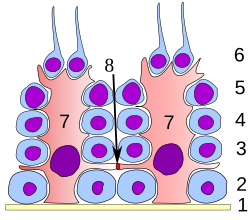
Germinal epithelium of the testicle.
1: basal lamina
2: spermatogonia
3: spermatocyte 1st order
4: spermatocyte 2nd order
5: spermatid
6: mature spermatid
7: Sertoli cell
8: tight junction (blood testis barrier)
Transverse section of a tubule of the testis of a rat. × 250.
Identifiers
MeSHD013087
FMA72294
Anatomical terminology

The spermatid is the haploid male gametid that results from division of secondary spermatocytes. As a result of meiosis, each spermatid contains only half of the genetic material present in the original primary spermatocyte.

Spermatids are connected by cytoplasmic material and have superfluous cytoplasmic material around their nuclei.

When formed, early round spermatids must undergo further maturational events to develop into spermatozoa, a process termed spermiogenesis (also termed spermeteliosis).

The spermatids begin to grow a living thread, develop a thickened mid-piece where the mitochondria become localised, and form an acrosome. Spermatid DNA also undergoes packaging, becoming highly condensed. The DNA is packaged firstly with specific nuclear basic proteins, which are subsequently replaced with protamines during spermatid elongation. The resultant tightly packed chromatin is transcriptionally inactive.

In 2016 scientists at Nanjing Medical University claimed they had produced cells resembling mouse spermatids artificially from stem cells. They injected these spermatids into mouse eggs and produced pups.[1]

During spermatid haploid genome remodeling, the majority of histones are replaced by protamines, and the DNA is compacted. During this compaction, transient single- and double-strand breaks are introduced into the sperm DNA.[2] The conventional non-homologous end joining pathway for repairing double-strand breaks is not available for elongated spermatids. However, spermatids can carry out limited repair of exogenous and programmed double-strand breaks using an alternative error-prone non-homologous end joining repair pathway.[3] If DNA strand breaks persist in mature sperm, the result can be increased sperm DNA fragmentation which is associated with impaired fertility and an increased incidence of miscarriage.[4]

DNA repair

[edit]

As postmeiotic germ cells develop to mature sperm they progressively lose the ability to repair DNA damage that may then accumulate and be transmitted to the zygote and ultimately the embryo.[5] In particular, the repair of DNA double-strand breaks by the non-homologous end joining pathway, although present in round spermatids, appears to be lost as they develop into elongated spermatids.[6]

Additional images

[edit]

See also

[edit]

References

[edit]
[edit]
Revisions and contributorsEdit on WikipediaRead on Wikipedia
from Grokipedia
A spermatid is a haploid male germ cell formed by the second meiotic division of a secondary during , representing the immediate precursor to the mature spermatozoon in the production of . These cells are initially round and non-motile, lacking a , and are generated in the seminiferous tubules of the testes, where they remain connected to sister cells via cytoplasmic bridges that allow sharing of gene products despite their haploid state. In humans, spermatids arise from spermatogonial stem cells through successive mitotic and meiotic divisions, with the entire process taking approximately 65–74 days from start to mature release. Spermatids undergo a complex differentiation process known as , transforming into elongated spermatozoa capable of motility and fertilization. This maturation involves nuclear condensation, where histones are replaced by protamines to compact the DNA; formation of the , a cap-like structure containing enzymes essential for egg penetration; development of the for propulsion; and shedding of excess into a residual body. The process is tightly regulated by Sertoli cells, which provide structural support and secrete hormones like testosterone, ensuring proper alignment and nourishment of spermatids near the tubule lumen. Defects in spermatid development, such as impaired acrosome biogenesis or flagellum assembly, can lead to or conditions like oligoasthenoteratozoospermia. In mammalian species, including humans, four spermatids are typically produced from each primary , highlighting the efficiency of in generating for . Spermatids also play a regulatory role by influencing functions, such as secretion and differentiation, through signaling molecules that coordinate the overall testicular environment. While the core features of spermatid formation and maturation are conserved across vertebrates, variations exist; for instance, in some non-mammalian models like C. elegans, spermatids activate post-release via environmental triggers rather than within the . Understanding spermatids is crucial for , as they represent a key checkpoint in before spermiation, the release of spermatozoa into the tubule lumen.

Overview and Definition

Definition

A spermatid is a haploid male germ cell derived from the secondary spermatocyte during spermatogenesis. Spermatids are initially classified as round spermatids in their early stage, before transitioning through elongating and mature forms as part of their differentiation. Morphologically, the round spermatid is a small, spherical cell featuring a large nucleus that occupies most of the cell volume, accompanied by minimal cytoplasm and an absence of motility. This cell contains a haploid with 23 chromosomes, formed after the second meiotic division.

Role in Spermatogenesis

is the process of sperm cell production in the , beginning with the proliferation and differentiation of diploid spermatogonia in the seminiferous tubules of the testes. This process progresses through mitotic divisions of spermatogonia to form primary spermatocytes, which then undergo I to produce secondary spermatocytes. The secondary spermatocytes complete meiosis II, yielding haploid spermatids as the post-meiotic stage, which subsequently differentiate into mature spermatozoa via . Spermatids thus represent a critical intermediate phase, bridging meiotic recombination and the final maturation required for fertilization. As the final haploid products of meiosis, spermatids ensure genetic diversity in gametes through mechanisms such as chromosomal crossing over and independent assortment during the two meiotic divisions. This diversity is essential for sexual reproduction, allowing each spermatid to carry a unique combination of maternal and paternal genetic material, with 23 chromosomes in humans. Prior to spermiogenesis, spermatids maintain this haploid state without further division, preserving the reduced chromosome number necessary for zygote formation upon fertilization. In terms of yield, one primary typically produces four spermatids through the two successive meiotic divisions, maximizing the efficiency of gamete production from the initial diploid cell. Spermatids first appear in the seminiferous tubules at the onset of in humans, marking the initiation of continuous production that persists throughout adult life. This timeline aligns with hormonal activation of the hypothalamic-pituitary-gonadal axis, sustaining indefinitely under normal conditions.

Formation and Development

Origin from Secondary Spermatocytes

Secondary spermatocytes, which are haploid cells containing 23 replicated chromosomes (each consisting of two ), complete to form spermatids. This division, resembling in its mechanics, separates the sister chromatids without an intervening for , resulting in two round spermatids per secondary spermatocyte, each with 23 unreplicated chromosomes. The process ensures equitable distribution of genetic material, producing four haploid spermatids from each original primary . Cytokinesis during meiosis II is incomplete in mammalian spermatogenesis, leaving the resulting spermatids interconnected via narrow cytoplasmic bridges approximately 1 μm in diameter, which facilitates the formation of a syncytium among germ cells. This division allocates minimal cytoplasm to each spermatid, prioritizing nuclear and essential organelle partitioning while reserving excess cytoplasmic components for later elimination, thereby streamlining the cells for subsequent differentiation. The bridges allow synchronized development and sharing of gene products among connected spermatids. Meiosis II occurs in the adluminal compartment of the seminiferous within the seminiferous tubules of the testis, a region protected by the blood-testis barrier formed by tight junctions. This localization follows the migration of secondary spermatocytes from the basal compartment during late meiosis I, positioning them for nutrient support from surrounding . regulate the timing and progression of meiosis II through secretion of growth factors and hormones, and by acting as a biological clock synchronized to hormonal cues, ensuring coordinated advancement. In humans, meiosis II is rapid, completing shortly after meiosis I as part of the overall 24-day meiotic phase within the 64-72 day spermatogenic cycle. Post-meiosis II, spermatids exhibit expression of haploid-specific genes, marking their transition to the post-meiotic phase. These include genes encoding proteins for formation (e.g., acrosin) and flagellar structures (e.g., axonemal dyneins), which are transcribed in the haploid despite earlier initiation in some cases. Transcription factors like SOX30 initiate this haploid gene program during late and early , enabling the synthesis of spermatid-specific transcripts essential for maturation. This haploid expression underscores the functional independence of individual spermatid nuclei within the .

Stages of Spermiogenesis

Spermiogenesis is the process by which round spermatids, derived from secondary spermatocytes, undergo a series of morphological and biochemical transformations to become streamlined spermatozoa. This differentiation occurs within the seminiferous tubules of the testes and is divided into four main phases: the Golgi phase, cap phase, phase, and maturation phase. These phases encompass key events such as formation, nuclear condensation, development, and the shedding of excess . In the Golgi phase, the round spermatid's Golgi apparatus produces proacrosomal vesicles that fuse to form an acrosomal granule, which attaches to the . This initial formation establishes the foundation for the head's apical structure, while the begins organizing the flagellar . Nuclear condensation initiates mildly, with early . This phase corresponds to early steps in mammalian models and sets the stage for subsequent elongation. The cap phase follows, where the acrosomal granule flattens and spreads over the anterior nuclear surface, forming a cap-like structure that covers approximately half of the nucleus. The spermatid remains round, but the matures with the incorporation of hydrolytic enzymes essential for fertilization. Cytoplasmic and the manchette begin to form, aiding in shaping, while the elongates further. This phase involves dynamic trafficking to expand the acrosomal vesicle. During the acrosome phase, the spermatid elongates dramatically as the nucleus condenses and the adheres tightly to the nuclear membrane. The manchette, a transient structure, sculpts the posterior head and facilitates compaction by replacing histones with transition proteins and protamines. The flagellum develops accessory structures like outer dense fibers in the midpiece. Nuclear elongation aligns the sperm head into its streamlined form, with the differentiating into distinct regions. The maturation phase completes spermiogenesis, where the fully elongated spermatid sheds excess cytoplasm as residual bodies phagocytosed by s. The flagellum matures with the formation of the principal and end pieces, enabling . Spermiation occurs as the mature spermatozoon detaches from the , entering the tubular lumen. This phase ensures the removal of unnecessary organelles, resulting in a highly specialized cell optimized for and fertilization. Hormonal regulation of spermiogenesis is mediated primarily by testosterone and (FSH), both acting through Sertoli cells to support adhesion, nutrient provision, and timely release. Testosterone maintains Sertoli- junctions during elongation, while FSH enhances metabolic support for and development. Disruptions in these signals can lead to spermiation failure or abnormal morphology. In humans, spermiogenesis spans approximately 16-20 days and is characterized by variations in shape and timing compared to , with detailed progression described in 16 distinct stages adapted from classical observations. One cycle of the seminiferous epithelium lasts about 16 days, during which multiple spermatid cohorts advance through these phases. Species differences, such as morphology (e.g., paddle-like in humans), reflect adaptations to reproductive strategies but conserve the core four-phase framework.

Morphology and Ultrastructure

Nuclear Changes

In round spermatids, the nucleus is large, spherical, and predominantly euchromatic, characterized by loosely packed, nucleosome-based that supports transcriptional activity. This initial nuclear configuration occupies a substantial portion of the cell's volume, reflecting the haploid genome's organization following . During , the nucleus undergoes profound and condensation, beginning with the sequential eviction of histones and their replacement by transition proteins TP1 and TP2 as transient intermediates. TP1, comprising about 60% of the basic nuclear proteins in elongating spermatids, primarily relaxes DNA structure, while TP2 promotes compaction through tight binding and phosphorylation-dependent mechanisms. This histone-to-transition protein exchange, peaking in steps 9–15 of , facilitates the initial stages of nuclear elongation and prepares the for further . Subsequently, transition proteins are displaced by protamines (PRM1 and PRM2), which bind DNA to form stable nucleoprotamine complexes, resulting in hyper-compaction where approximately 85–99% of histones are replaced depending on the species. Protamines induce DNA toroid formation and stabilize the structure via disulfide bonds between cysteine residues, achieving a volume reduction of the nucleus by a factor of 6–20 compared to the nucleosomal state in round spermatids. This process renders the mature spermatid nucleus compact, transcriptionally inert, and resistant to external damage.

Acrosome Development

The acrosome originates during the Golgi phase of , where proacrosomal vesicles derived from the trans-Golgi network in round spermatids begin to form. These vesicles, initially small and numerous, transport hydrolytic enzymes and other components essential for future function; they cluster near the and progressively fuse to create a single, larger acrosomic granule that adheres to the anterior surface of the spermatid nucleus. This fusion marks the initial assembly of the , establishing its foundational structure before further maturation. During the subsequent cap phase, the acrosomic granule undergoes significant maturation as the spermatid nucleus begins to elongate. The granule enlarges and flattens, spreading dorsally over the anterior portion of the nucleus to form a cap-like structure that covers approximately half of the nuclear surface. This spreading is facilitated by cytoskeletal elements and vesicular trafficking, resulting in a flattened vesicle that encapsulates a concentrated matrix of hydrolytic enzymes, including acrosin (a ) and (which degrades in the ). These enzymes are vital for the acrosome's role in gamete interaction, though their precise localization within the acrosomal vesicle evolves as the structure matures. The mature is delimited by two specialized membranes: the inner acrosomal membrane (IAM), which lies adjacent to the , and the outer acrosomal membrane (OAM), which faces the and eventually interacts with the egg's investments. In certain mammalian species, such as , an additional perforatorium—a rigid, electron-dense structure—forms beneath the , extending into the subacrosomal region and aiding in the stabilization of the sperm head during penetration. This compartmentalized architecture ensures the controlled storage of enzymes until activation. In preparation for fertilization, the enables the release of its enzymatic contents through the , an exocytic event triggered upon sperm-egg contact, though detailed mechanisms occur later in spermatozoa.

Flagellum and Midpiece Formation

During , the of the sperm begins to form in the maturation phase, originating from the distal of the spermatid, which serves as a template for the characteristic 9+2 arrangement consisting of nine outer doublet surrounding two central singlet . This structure provides the core scaffold for flagellar motility, with the proximal remaining associated with the nucleus while the distal elongates into the to nucleate axonemal assembly. The process involves the of α- and β-tubulin heterodimers, facilitated by microtubule-associated proteins, ensuring the precise cylindrical architecture essential for dynein-driven bending. The midpiece develops proximal to the principal piece, where mitochondria migrate and assemble into a helical sheath that tightly wraps around the and outer dense fibers, forming a compact spiral of 10-14 gyres to supply ATP for flagellar beating via . This mitochondrial organization begins with individual organelles attaching to the outer dense fibers during late , followed by their elongation and coiling, which is regulated by proteins such as ARMC12 to maintain spatiotemporal dynamics and prevent misalignment. The helical arrangement not only optimizes energy delivery but also contributes to the of the midpiece, which spans approximately 8-10 μm in length. Distal to the midpiece, the principal piece forms as the longest segment of the , featuring a fibrous sheath composed of two continuous longitudinal columns connected by circumferential ribs that encase the and outer dense fibers, enhancing flexibility and force transmission during . This sheath, built from proteins like AKAP3 and AKAP4, emerges during tail elongation and extends over about 40-45 μm, demarcated from the midpiece by the annulus. The end piece, a short terminal segment of 4-5 μm, lacks the fibrous sheath and outer dense fibers, consisting solely of the enveloped by the plasma membrane, allowing for tapering and fine-tuned tip dynamics. In humans, the overall measures approximately 50-60 μm, enabling effective through the reproductive tract.

Molecular and Cellular Processes

Cytoplasmic Reduction

During spermiogenesis, spermatids eliminate excess through the formation and shedding of residual bodies, a critical step that occurs in the later stages of development. This process culminates in spermiation, where the residual bodies—comprising the bulk of the superfluous cytoplasmic material—are by Sertoli cells in the seminiferous epithelium. Sertoli cells recognize and engulf these bodies via receptors such as scavenger receptor class B type I (SR-BI) binding to on the residual body surface, often mediated by the TAM receptor/Gas6 system, followed by lysosomal degradation within phagolysosomes. This ensures the timely release of mature spermatozoa into the tubule lumen while preventing the accumulation of cellular that could disrupt spermatogenic progression. The residual bodies primarily contain ribosomes, , Golgi complex, and other unused organelles that are no longer required for sperm function, effectively partitioning these components away from the elongating spermatid's head and . Prior to shedding, biochemical mechanisms involving ubiquitination target cytoplasmic proteins for degradation by the , further streamlining the cytoplasm; for instance, the ubiquitin-proteasome system (UPS) employs ligases like CRL3 to ubiquitinate and degrade proteins in the enfolded cytoplasmic lobe, including those associated with mitochondria and other superfluous elements. This targeted , facilitated by testis-specific proteasomal subunits such as PSMA8 in the core, complements the physical shedding and ensures efficient removal of non-essential material. The overall outcome of cytoplasmic reduction is the production of a highly streamlined spermatozoon, with minimal residual retained as a small droplet that is typically shed during epididymal transit. This optimized morphology enhances the sperm's motility and hydrodynamic efficiency for passage through the and female reproductive tract, while the of residual bodies by Sertoli cells recycles nutrients like back to the , supporting ongoing without contaminating the luminal contents.

DNA Packaging and Condensation

During spermiogenesis, spermatids undergo a critical histone-to-protamine transition, where somatic histones are progressively replaced by small, arginine-rich protamine proteins to achieve extreme chromatin compaction. This process begins with the eviction of canonical histones, facilitated by hyperacetylation and incorporation of testis-specific histone variants, followed by transient binding of transition proteins that stabilize the DNA before protamine incorporation. In humans, the primary protamines are PRM1 and PRM2, encoded by distinct genes on chromosome 16, with PRM1 present universally in mammalian sperm and PRM2 found in primates and certain rodents. Protamines bind DNA through their arginine-rich domains, which interact electrostatically with the phosphate backbone, neutralizing negative charges and enabling the formation of compact toroidal structures that organize the genome into doughnut-shaped loops. These toroids stack and interconnect, achieving a packaging density up to 20 times greater than histone-based chromatin in somatic cells. The PRM1/PRM2 ratio, typically around 1:1 in fertile human sperm, is crucial for proper toroid assembly; imbalances lead to incomplete condensation and infertility. Chromatin stability is further enhanced by disulfide crosslinking between cysteine residues in protamines, particularly in PRM2, which forms covalent bonds post-elongation. This crosslinking occurs via oxidation of groups, as represented by the reaction: 2 protamine-SHprotamine-S-S-protamine+2H\text{2 protamine-SH} \rightarrow \text{protamine-S-S-protamine} + 2\text{H} These intermolecular bridges create a rigid network that resists mechanical stress and enzymatic degradation during transit. Incomplete crosslinking correlates with increased DNA vulnerability in subfertile males. Not all histones are evicted during this transition; approximately 1-10% are retained in spermatozoa, often at gene regulatory elements such as promoters and enhancers, preserving epigenetic marks like and for post-fertilization gene activation and embryonic development. This selective retention suggests a role in , where histone modifications influence zygotic transcription without altering DNA sequence. The overall effect of packaging and crosslinking dramatically reduces nuclear volume; the haploid , extending approximately 1 meter if uncoiled, is condensed into a nucleus measuring about 5 μm in length, achieving a linear compaction exceeding 200,000-fold. This hypercondensation protects the genome from damage while facilitating .

DNA Repair Mechanisms

Spermatids, as haploid cells undergoing spermiogenesis, exhibit heightened vulnerability to DNA damage due to the transient exposure of their genome during chromatin remodeling, where histones are progressively replaced by transition proteins and protamines. This exposure leaves the DNA less protected against endogenous threats, particularly oxidative stress arising from reactive oxygen species (ROS) produced by mitochondria in the midpiece region, which can induce base modifications and strand breaks. To counteract these risks, spermatids activate targeted DNA repair pathways. (BER) is prominent, initiated by the enzyme 8-oxoguanine DNA glycosylase (OGG1), which recognizes and excises —a prevalent oxidative formed by oxidation—to prevent . For more severe double-strand breaks (DSBs), (NHEJ) serves as the primary mechanism, involving proteins such as Ku70/Ku80 and DNA-PK to ligate broken ends, though this pathway operates with limitations in later spermatid stages due to transcriptional silencing. Sertoli cells, as nurturing somatic partners, bolster spermatid DNA maintenance by supplying required for repair synthesis and antioxidants like (SOD), which neutralize ROS and mitigate oxidative damage within the adluminal compartment of the seminiferous tubules. Deficient DNA repair in spermatids results in unrepaired lesions persisting into spermatozoa, causing mutations that manifest as through impaired fertilization or early embryonic arrest, and in offspring as de novo genetic defects including chromosomal abnormalities and developmental disorders.

Function and Maturation

Transformation into Spermatozoa

The final phase of spermatid transformation, known as spermiation, involves the detachment of mature spermatids from Sertoli cells within the seminiferous epithelium, culminating in their release into the tubule lumen. This process requires extensive remodeling of structures, including the disassembly of ectoplasmic specializations that anchor spermatids to Sertoli cells. cytoskeleton dynamics play a central role, with regulatory proteins such as Eps8 and Arp3 modulating actin filament organization to facilitate disengagement; initially, actin bundling maintains , but subsequent branching and depolymerization enable release. During spermiation, the spermatid's residual is phagocytosed by Sertoli cells, leaving streamlined spermatozoa. Following release, spermatozoa undergo post-testicular maturation in the , where they acquire essential functional attributes. Epididymal transit involves modifications to the plasma membrane, including remodeling that reduces the cholesterol-to-phospholipid ratio, thereby stabilizing and preparing spermatozoa for subsequent interactions. Proteins and glycoproteins are incorporated via epididymosomes, enhancing surface charge and structural integrity without altering the core morphology developed earlier in . Key viability markers emerge during this maturation, notably the acquisition of progressive in the epididymal caput and corpus regions, driven by signaling pathways such as sonic hedgehog and events. This enables forward progression, while membrane changes prime spermatozoa for , a later involving efflux and hyperactivated movement, though full occurs post-ejaculation. In humans, approximately 100-200 million spermatids are produced daily across both testes, with roughly 50% achieving viability as functional spermatozoa capable of and maturation.

Role in Fertilization

The mature spermatozoon, derived from the spermatid, plays a pivotal role in fertilization by navigating the female reproductive tract to reach the . Propulsion occurs through rhythmic flagellar beating, typically at frequencies of 10-20 Hz, enabling progressive in viscous environments. In physiological media mimicking the tract, spermatozoa achieve speeds of 35-50 μm/s, equivalent to roughly 0.6-0.9 body lengths per second given their total length of approximately 55 μm. This is essential for upstream migration against fluid flows and through mucosal barriers, ensuring only competent sperm approach the . Upon contacting the oocyte's , the spermatozoon undergoes the , an exocytic event triggered by influx of calcium ions (Ca²⁺). This reaction fuses the outer acrosomal with the plasma , releasing hydrolytic such as acrosin and that facilitate penetration of the matrix. The Ca²⁺-dependent process is induced by glycoproteins, particularly ZP3, which bind receptors and initiate signaling cascades leading to enzyme dispersal and remodeling over the anterior head. Successful zona traversal exposes the inner acrosomal , allowing the to fuse with the plasma . Following fusion, the spermatozoon's -packaged DNA decondenses within the to form the male . factors, including and nucleoplasmin, reduce protamine disulfide bonds and replace protamines with histones, enabling and . This decondensation is rapid, occurring within hours post-entry, and is crucial for syngamy with the female . The spermatozoon's entry also triggers the oocyte's cortical granule reaction, contributing to the block. Sperm-oolemma fusion initiates Ca²⁺ oscillations that promote of cortical granules, releasing enzymes like ovastacin that cleave ZP2 in the , hardening it against additional sperm binding. This zona reaction, combined with oolemma modifications, ensures monospermic fertilization.

Clinical and Research Aspects

Abnormalities and Infertility

Spermatid represents a critical failure in , where development halts at the round spermatid stage, resulting in the round spermatid-only syndrome and subsequent non-obstructive . This condition prevents the progression to elongated spermatids and mature atozoa, leading to as no viable are present in the ejaculate. The disrupts formation and nuclear condensation, often linked to genetic or environmental factors that impair cellular remodeling during late . Structural defects in spermatids contribute significantly to through abnormal morphology that renders non-functional. Globozoospermia, characterized by the absence of the and round-headed spermatozoa, arises from defective biogenesis during , preventing penetration of the during fertilization. Similarly, acephalic spermatozoa syndrome involves headless due to improper attachment of the to the head, stemming from neck region defects in spermatid elongation. These abnormalities severely impair and fertilization capacity, often resulting in total without assisted . Genetic factors underlie many spermatid abnormalities, with mutations in specific genes disrupting . Homozygous deletions or mutations in the DPY19L2 gene, which encodes an inner nuclear membrane protein essential for anchoring, are a primary cause of globozoospermia, affecting up to 70% of cases in some populations. Mutations in SPATA16, involved in formation, similarly lead to globozoospermic by halting spermatid maturation. Y-chromosome microdeletions in the azoospermia factor (AZF) regions, particularly AZFc, frequently cause spermatogenic arrest at the spermatid stage, contributing to 10-15% of non-obstructive cases. Diagnosis of spermatid-related abnormalities typically involves testicular biopsy, which reveals immature round spermatids and confirms maturation arrest without elongated forms or mature sperm. This procedure not only aids diagnosis but also enables sperm retrieval for assisted reproduction. (ICSI) using round spermatids, known as round spermatid injection (ROSI), offers a potential treatment for men with spermatid arrest, with reported live births in select cases, though success rates remain low due to technical challenges and risks of genetic transmission. activation protocols, such as calcium , are often required to improve fertilization outcomes in ROSI.

Evolutionary and Comparative Biology

Spermatids, as the haploid cells resulting from II in , emerged evolutionarily alongside the transition to in early metazoans, where disruptive selection favored small, mobile male s specialized for fertilization over larger, provision-rich female s. This origin is tied to the broader of gamete dimorphism, with spermatid formation enabling the differentiation of streamlined spermatozoa adapted for and efficient gamete fusion. Across metazoans, a core genetic program regulates spermatid development, involving approximately 10,000 protein-coding genes, of which 65-70% are deeply conserved from ancient bilaterian ancestors, as evidenced by comparative transcriptomics in humans, mice, and fruit flies. Comparatively, spermatid morphology and maturation vary widely, reflecting adaptations to reproductive environments and modes of fertilization. In invertebrates like Drosophila melanogaster, spermatids form within syncytial cysts connected by intercellular bridges, undergoing elongation and coiling to produce exceptionally long flagellated sperm, a process synchronized by conserved signaling pathways such as JAK-STAT. In contrast, nematodes like Caenorhabditis elegans produce aflagellate spermatids that activate motility only during spermiogenesis in the female reproductive tract via polymerization of major sperm protein. Vertebrates, particularly mammals, feature round spermatids that individualize and elongate, developing an acrosome and flagellum; for instance, in rodents, histone-to-protamine chromatin repackaging in elongated spermatids ensures compact, hydrodynamic sperm heads optimized for internal fertilization. These differences highlight how external versus internal fertilization drives divergence, with non-flagellated forms in some arthropods and ascidians representing basal states, while flagellated spermatids predominate in most bilaterians. At the molecular level, spermatids exhibit accelerated evolution, particularly in post-meiotic stages, driven by positive selection from . In mammals, rates in round and elongated spermatids show the highest divergence across species, with reduced purifying selection allowing rapid fixation of changes and de novo gene origination—younger s increasingly dominate spermatid transcriptomes compared to earlier stages. For example, testis-enriched proteins like protamines evolve quickly via , as seen in murine Pgk2, enhancing sperm function under pressures. Cross-species analyses reveal that while core regulators (e.g., 79 functional networks) remain conserved, changes in apes and monkeys affect ~635 s in spermatids, underscoring adaptive innovations in reproduction. further shapes this evolution, selecting for enhanced spermatid numbers and morphological traits, such as longer nuclei in dung beetles, without universally altering velocity or size across taxa.

References

Add your contribution
Related Hubs
Contribute something
User Avatar
No comments yet.