


Community hub
Recent from talks
Contribute something
Nothing was collected or created yet.
Sphericon
View on Wikipedia


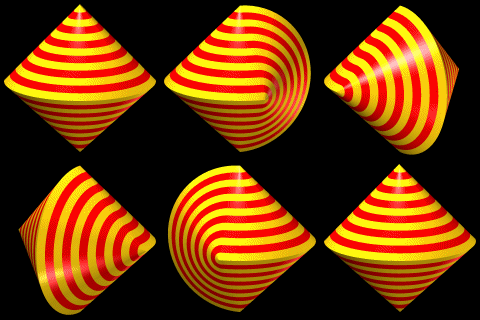
In solid geometry, the sphericon is a solid that has a continuous developable surface with two congruent, semi-circular edges, and four vertices that define a square. It is a member of a special family of rollers that, while being rolled on a flat surface, bring all the points of their surface to contact with the surface they are rolling on. It was discovered independently by carpenter Colin Roberts (who named it) in the UK in 1969,[1] by dancer and sculptor Alan Boeding of MOMIX in 1979,[2] and by inventor David Hirsch, who patented it in Israel in 1980.[3]
Construction
[edit]The sphericon may be constructed from a bicone (a double cone) with an apex angle of 90 degrees, by splitting the bicone along a plane through both apexes, rotating one of the two halves by 90 degrees, and reattaching the two halves.[4] Alternatively, the surface of a sphericon can be formed by cutting and gluing a paper template in the form of four circular sectors (with central angles ) joined edge-to-edge.[5]

Geometric properties
[edit]The surface area of a sphericon with radius is given by

- .

The volume is given by
- ,

exactly half the volume of a sphere with the same radius.
History
[edit]
Around 1969, Colin Roberts (a carpenter from the UK) made a sphericon out of wood while attempting to carve a Möbius strip without a hole.[1]
In 1979, David Hirsch invented a device for generating a meander motion. The device consisted of two perpendicular half discs joined at their axes of symmetry. While examining various configurations of this device, he discovered that the form created by joining the two half discs, exactly at their diameter centers, is actually a skeletal structure of a solid made of two half bicones, joined at their square cross-sections with an offset angle of 90 degrees, and that the two objects have exactly the same meander motion. Hirsch filed a patent in Israel in 1980, and a year later, a pull toy named Wiggler Duck, based on Hirsch's device, was introduced by Playskool Company.
In 1999, Colin Roberts sent Ian Stewart a package containing a letter and two sphericon models. In response, Stewart wrote an article "Cone with a Twist" in his Mathematical Recreations column of Scientific American.[1] This sparked quite a bit of interest in the shape, and has been used by Tony Phillips to develop theories about mazes.[6] Roberts' name for the shape, the sphericon, was taken by Hirsch as the name for his company, Sphericon Ltd.[7]


In popular culture
[edit]In 1979, modern dancer Alan Boeding designed his "Circle Walker" sculpture from two crosswise semicircles, a skeletal version of the sphericon. He began dancing with a scaled-up version of the sculpture in 1980 as part of an MFA program in sculpture at Indiana University, and after he joined the MOMIX dance company in 1984 the piece became incorporated into the company's performances.[2][8] The company's later piece "Dream Catcher" is based around a similar Boeding sculpture whose linked teardrop shapes incorporate the skeleton and rolling motion of the oloid, a similar rolling shape formed from two perpendicular circles each passing through the center of the other.[9]
In 2008, British woodturner David Springett published the book "Woodturning Full Circle", which explains how sphericons (and other unusual solid forms, such as streptohedrons) can be made on a wood lathe.[10]
References
[edit]- ^ a b c Stewart, Ian (October 1999). "Mathematical Recreations: Cone with a Twist". Scientific American. 281 (4): 116–117. JSTOR 26058451. Archived from the original on 2019-02-12.
- ^ a b Boeding, Alan (April 27, 1988), "Circle dancing", The Christian Science Monitor
- ^ David Haran Hirsch (1980): "Patent no. 59720: A device for generating a meander motion; Patent drawings; Patent application form; Patent claims
- ^ Paul J. Roberts (2010). "The Sphericon". Archived from the original on 2012-07-23.
- ^ A mesh at www.pjroberts.com/sphericon, archived by web.archive.org
- ^ Michele Emmer (2005). The Visual Mind II. MIT Press. pp. 667–685. ISBN 978-0-262-05076-0.
- ^ ""Sphericon Ltd. - Israel-Export" (pdf)" (PDF).
- ^ Green, Judith (May 2, 1991), "hits and misses at Momix: it's not quite dance, but it's sometimes art", Dance review, San Jose Mercury News
- ^ Anderson, Jack (February 8, 2001), "Leaping Lizards and Odd Denizens of the Desert", Dance Review, The New York Times
- ^ Springett, David, Woodturning Full Circle

External links
[edit]
- Sphericon construction animation at the National Curve Bank website.
- Paper model of a sphericon Make a sphericon
- Sphericon variations using regular polygons with different numbers of sides
- A Sphericon in Motion showing the characteristic wobbly motion as it rolls across a flat surface
Sphericon
View on GrokipediaDefinition and Construction
Basic Definition
The sphericon is a three-dimensional solid in geometry characterized by a continuous developable surface featuring two congruent semi-circular edges and four vertices that form a square.[4] It is formed by taking a bicone—two right circular cones with equal dimensions joined at their bases—and slicing it along a plane that passes through both apexes to create a square cross-section, after which one half is rotated by 90 degrees relative to the other before rejoining.[1] This results in a shape with a single continuous surface, distinguishing it from typical solids of revolution like spheres, which lack edges, or polyhedra, which have discrete flat faces; instead, the sphericon bridges these by combining curved and straight elements in a hybrid form.[5] Visually, the sphericon resembles two identical right circular cones connected at their bases, but with the cones twisted 90 degrees out of alignment, creating a spindle-like appearance with quarter-circle arcs connecting the vertices.[1] The basic parameters include the radius of the cone bases (which equals the side length of the square cross-section and the height of each cone for the standard form) and an opening angle of 90 degrees at each apex, determined by the geometry of the generating right-isosceles triangle used in the bicone's revolution.[1] When rolled, it exhibits a distinctive wobbling motion that maintains a straight path, unlike the smooth rotation of a sphere.[5]Construction Methods
The primary method for constructing a basic sphericon involves generating a bicone as a solid of revolution and then applying a twist. Begin with a square in the meridional plane, where the side length is chosen such that the distance from the center to a vertex along the diagonal equals the desired height of each cone, with for a 90-degree opening angle, where is the base radius. Rotate this square 180 degrees around its diagonal axis, which passes through opposite vertices in the plane of the square, to form the bicone; this axis serves as the symmetry axis of the resulting solid. The bicone consists of two right circular cones joined at their bases, each with a semi-vertical angle of 45 degrees. Next, slice the bicone along a plane containing this axis, producing two congruent halves each with a square cross-section perpendicular to the axis. Rotate one half by 90 degrees relative to the other around the axis and rejoin them along the cut faces, ensuring the generating lines align continuously at the seam. This twist creates the characteristic two semicircular edges and a single developable surface.[1][6] Mathematically, the axis of rotation for the initial solid of revolution lies in the plane of the base profile (square or Reuleaux triangle) and passes through its center of symmetry along the line of opposite vertices or equivalent points. For the standard 90-degree cone angle, the generating curve for each edge is a semicircle of radius (the original cone's base radius), with its center offset from the equatorial plane by to maintain the 45-degree surface slope and ensure the edges lie in perpendicular planes separated by the sphericon's width. The parametric equations for one edge in cylindrical coordinates, post-twist, can be expressed as , , for , with the offset preserving the metric continuity across the seam.Generalizations
The n-icon family generalizes the sphericon to solids derived from even-sided regular polygons with sides, where the base polygon is rotated around a mirror axis to produce a solid featuring sectors.[7][8] Each sector has an angle given by , ensuring the twisted halves align properly after a rotation of .[7] The basic sphericon corresponds to the quadracon case with , using a square base.[7] For the hexacon with , the construction yields a solid with three sectors and a hexagonal cross-section, maintaining the characteristic single continuous surface while introducing more pronounced curvature in the rolling edges.[7][8] Star variants, such as the star sphericon, extend this to non-convex polygons like star polygons, resulting in self-intersecting or spiked surfaces that preserve the core rotational symmetry but add complexity to the topology. As increases, the number of edge discontinuities rises to , but the overall form smooths out, approaching the geometry of a sphere with a continuous, rounded surface devoid of sharp seams.[7][8] All n-icons retain a single continuous outer surface, distinguishing them from polyhedra with multiple disconnected faces, though the increasing edges create subtle topological variations in seam alignment.[7]Geometric Properties
Topology and Surface Characteristics
The sphericon is topologically equivalent to a sphere, being a closed orientable surface of genus 0 with Euler characteristic . This topological invariance holds despite its unconventional construction, as the surface remains simply connected without holes or handles. In terms of a cell complex decomposition, it features one continuous face, two congruent semicircular geodesic edges, and four cone points at the endpoints serving as vertices defining a square.[1] The surface of the sphericon is developable, meaning it possesses zero Gaussian curvature almost everywhere and can be isometrically mapped onto a plane, consisting of straight-line rulings that generate the entire shape. It is composed of two congruent sectors, each akin to a portion of a hyperbolic paraboloid, joined along straight generators to form a single unified surface.[9] These sectors meet continuously, but the two semi-circular edges introduce discontinuities where the rulings converge in cusps, creating four cone points. At these cone points, the Gaussian curvature is concentrated positively, with each contributing (where is the relevant sector angle), while the edges themselves exhibit zero curvature along their lengths except at the cusps.[10] The total Gaussian curvature integrates to , consistent with the Gauss-Bonnet theorem for a spherical topology, though distributed unevenly rather than uniformly as on a standard sphere.[11] The edges, despite being geodesics, do not join smoothly at the cone points, resulting in angular discontinuities or "corners" that disrupt tangential continuity across the otherwise flat rulings. Superficially similar to the oloid in its rolling properties and ruled construction, the sphericon differs topologically by maintaining a single continuous face, whereas the oloid features two distinct faces separated by its edges.Rolling Dynamics
The sphericon's rolling motion is characterized by a distinctive wobbling action as it alternates contact between its two congruent semi-circular edges, resulting in an overall straight-line translation of its center of mass. This behavior stems from the 90-degree rotational twist during construction, which aligns the edges symmetrically to ensure balanced surface contact and prevents deviation from a linear path, unlike asymmetric rollers such as cones.[12] The center of mass follows a meandering path consisting of circular arcs at constant height, with a period corresponding to the length of one edge, reflecting the periodic switching between edges. This results in an overall straight trajectory over long distances. During rolling on a flat surface, the center of mass maintains constant height, keeping potential energy invariant and enabling sustained wobbling motion until dissipative friction converts kinetic energy to heat. This contrasts with a sphere's purely translational rolling, where no oscillatory component exists, as the sphericon's edge structure induces perpetual vertex pivots without net curvature in the path.[12] Experimentally, the sphericon descends inclines in straight lines, independent of initial orientation, unlike cylinders that curve due to asymmetric contact, as observed in physical prototypes rolling under gravity.[13]Metric Properties
The basic sphericon, constructed from two cones with semi-angle α = 45°, exhibits specific metric properties that can be computed from its geometry as a solid of revolution with a twist. The volume remains unchanged from the original bicone due to the reassembly without overlap or gaps. For the standard sphericon, the volume is where r is the base radius of each cone. This can be derived as twice the volume of a single cone with height h = r (since \cot 45^\circ = 1), giving .[1][14] The surface area consists of the two lateral surfaces of the cones, excluding the joined bases, and for the standard sphericon is This arises from the lateral surface of each cone being with slant height , so total .[1] The edges of the sphericon form two congruent semi-circular paths, with the full equivalent circumference of these edges calculated as This length is obtained by considering the projection of the generator onto the plane perpendicular to the axis, where the arc length derivation involves the cosine factor from the cone's geometry, integrated along the edge path. Each semi-circular edge has arc length .[1] Assuming uniform density, the inertia tensor (with centroid at the origin) is reflecting the distribution of mass symmetric about the principal axes, which underscores its balanced yet asymmetric rolling properties. The moment about the rolling axis aligns with one of the principal moments.[1]History and Development
Independent Discoveries
The sphericon has roots in earlier geometric explorations, notably the oloid invented by Swiss artist and mathematician Paul Schatz in 1929 as part of his studies on space-filling polyhedra and cube eversions; while the oloid shares the property of rolling along its entire surface without slipping, it differs from the sphericon in lacking corners and having a smoother, non-polyhedral form.[15] In 1969, British carpenter Colin Roberts independently discovered the shape while experimenting with woodworking techniques to create a solid Möbius strip, crafting a mahogany model that he named the "sphericon" for its spherical rolling motion as a toy.[16] Roberts's invention remained largely unknown until 1999, when it was highlighted in a Scientific American article as a novel geometric solid.[17] In 1979, American dancer and sculptor Alan Boeding, a member of the performance troupe MOMIX, rediscovered a skeletal version of the sphericon while designing props for dance; he constructed the "Circle Walker," a wire sculpture of two perpendicular semicircles that enabled unique rolling movements in choreography.[18] The shape was independently reinvented in 1980 by Israeli inventor David Hirsch, who explored it as a device for generating meandering motion and later generalized it into a family of developable rollers known as polycons during his mathematical studies in the 1990s and beyond.[2]Patents and Recognition
The sphericon's formal recognition began with Israeli inventor David Hirsch's patent application in 1979, granted as Israeli Patent No. 59720 in 1980, titled "A Device for Generating a Meander Motion." This patent described the shape as a solid composed of two perpendicular half-disks joined along their diameters, enabling a unique wobbling roll, and marked the first documented commercial embodiment of the sphericon as a toy.[19] Independently, British carpenter Colin Roberts, who discovered the shape in the 1960s while experimenting with Möbius strips, did not pursue a formal patent but received credit for naming it "sphericon." Roberts' work gained prominence in mathematical literature during the 1990s, notably through his 1999 correspondence with mathematician Ian Stewart, leading to its feature in Scientific American as a novel geometric solid.[1][20] Academic acknowledgment expanded in the early 2000s, with the sphericon's inclusion in authoritative geometry resources such as Wolfram MathWorld, which detailed its construction and properties as a developable surface. Further scholarly exploration appeared in subsequent publications, including Hirsch's own 2019 paper on polycons, which generalized the sphericon and reiterated its patented origins.[1] Key milestones in recognition include the National Museum of Mathematics (MoMath) featuring star sphericons in its 2011 exhibits and online content, highlighting their educational value in demonstrating non-spherical rolling dynamics. Post-2010, the rise of accessible 3D printing technologies has significantly boosted the sphericon's visibility, enabling widespread fabrication and customization, as evidenced by specialized design systems for printable variants.[21]Applications and Cultural Impact
Toys and Educational Tools
The sphericon serves as an engaging toy that demonstrates unconventional rolling motion, first conceptualized in David Hirsch's 1980 Israeli patent for "a device for generating a meander motion," which described the shape as a play object capable of producing a wobbling, straight-line path.[19] This early design laid the foundation for its use in recreational items, though commercial production in the 1980s remained limited. In the 2010s, the advent of affordable 3D printing popularized DIY kits, with open-source models on platforms like Thingiverse enabling widespread creation of printable sphericons for personal and educational play.[22] Sphericons are integrated into STEM educational tools to teach geometric concepts, particularly solids of revolution formed by rotating a semicircle around an axis offset from its diameter.[1] Their single continuous developable surface illustrates basic topology and the properties of ruled surfaces, while their non-intuitive rolling—wobbling along curved ridges to trace straight paths—highlights principles of rigid body dynamics without requiring advanced mathematics. For instance, the National Museum of Mathematics (MoMath) incorporates sphericons into its outreach materials, such as the 2011 Math Monday feature on star variants, providing 3D-printable resources for workshops that encourage hands-on exploration of symmetry and motion in geometry curricula.[21] Play variations enhance interactivity, including magnetic sphericons with embedded rare-earth magnets in the halves for secure assembly and modular experimentation.[23] Educational sets often include multiple n-icons—generalizations based on regular polygons with n sides—to compare rolling trajectories, such as the basic quadrilateral sphericon versus hexagonal or higher-order versions that produce smoother or more complex paths. Regarding safety and accessibility, commercial and kit-based sphericons use non-toxic materials like PLA plastic or untreated wood, with typical diameters from 5 cm for compact desk toys to 20 cm for interactive play, making them suitable for children aged 8 and older under supervision.[24]Art, Sculpture, and Media Appearances
The Sphericon has inspired several artistic interpretations, particularly in sculpture, where its unique rolling dynamics and geometric form lend themselves to dynamic installations. In 1979, dancer and sculptor Alan Boeding created "Circle Walker," a large-scale wire-frame rolling sculpture constructed from stainless steel pipes, weighing 160-180 pounds and capable of traversing 21 feet in a single motion. This skeletal design, inspired by a smaller prototype that unexpectedly rolled off Boeding's desk, functions as a mobile platform for performance, allowing dancers to interact with it through balancing, tumbling, and inversion while maintaining constant contact with the ground. Boeding's work exemplifies the Sphericon's potential as a kinetic art piece, blending engineering precision with expressive movement.[18] Boeding's "Circle Walker" has been prominently featured in productions by the MOMIX dance company, where he served as a performer and collaborator, transforming the sculpture into a central element of illusionistic choreography. In a 1991 MOMIX performance reviewed by The New York Times, dancer Jim Cappelletti navigated the towering gyroscopic wheel—described as a web-like structure—walking through its frets, reclining against it as it rotated, and assuming prayer-like poses to evoke human physicality and grandeur, accompanied by an eerie score. Similarly, a 2018 Wall Street Journal critique of MOMIX's "Partners in Motion" highlighted dancers riding and clambering over Boeding's gyroscope-like construction, emphasizing its smooth, interactive motion in live stage presentations. These appearances underscore the Sphericon's role in contemporary dance as a prop that merges visual art with physical performance.[25][26] More recently, the Sphericon has entered modern sculptural design as a desktop object celebrating geometric simplicity. In 2018, artist Miguel Duran launched a Kickstarter campaign to produce Sphericon sculptures in high-quality metals such as stainless steel, brass, and copper, positioning them as desk pieces that reflect light, promote concentration, and demonstrate paradoxical rolling paths. These compact forms, measuring approximately 1.73 inches per side and weighing up to 5.7 ounces in brass, synthesize art and science, with variations like the Hexasphericon extending the original shape's principles. Duran's editions, now available through retailers like Matter Collection, highlight the Sphericon's aesthetic appeal beyond functional toys.[27][28]References
- https://commons.wikimedia.org/wiki/File:Patent59720-claims.pdf