Hubbry Logo
Archispirostreptus gigasArchispirostreptus gigasMain
Open search
Archispirostreptus gigas
Community hub
Archispirostreptus gigas
logo
8 pages, 0 posts
0 subscribers
Be the first to start a discussion here.
Archispirostreptus gigas
from Wikipedia

Giant African millipede
Scientific classification Edit this classification
Kingdom: Animalia
Phylum: Arthropoda
Subphylum: Myriapoda
Class: Diplopoda
Order: Spirostreptida
Family: Spirostreptidae
Genus: Archispirostreptus
Species:
A. gigas
Binomial name
Archispirostreptus gigas
(Peters, 1855)
Synonyms[1]
  • Spirostreptus gigas Peters, 1855
  • Aethiopistreptus attemsi Verhoeff, 1938
  • Spirostreptus plumaceus Voges, 1878
  • Spirostreptus semicylindricus Voges, 1878
  • Spirostreptus opistheurys Attems, 1902
  • Spirostreptus msalaensis Kraus, 1958

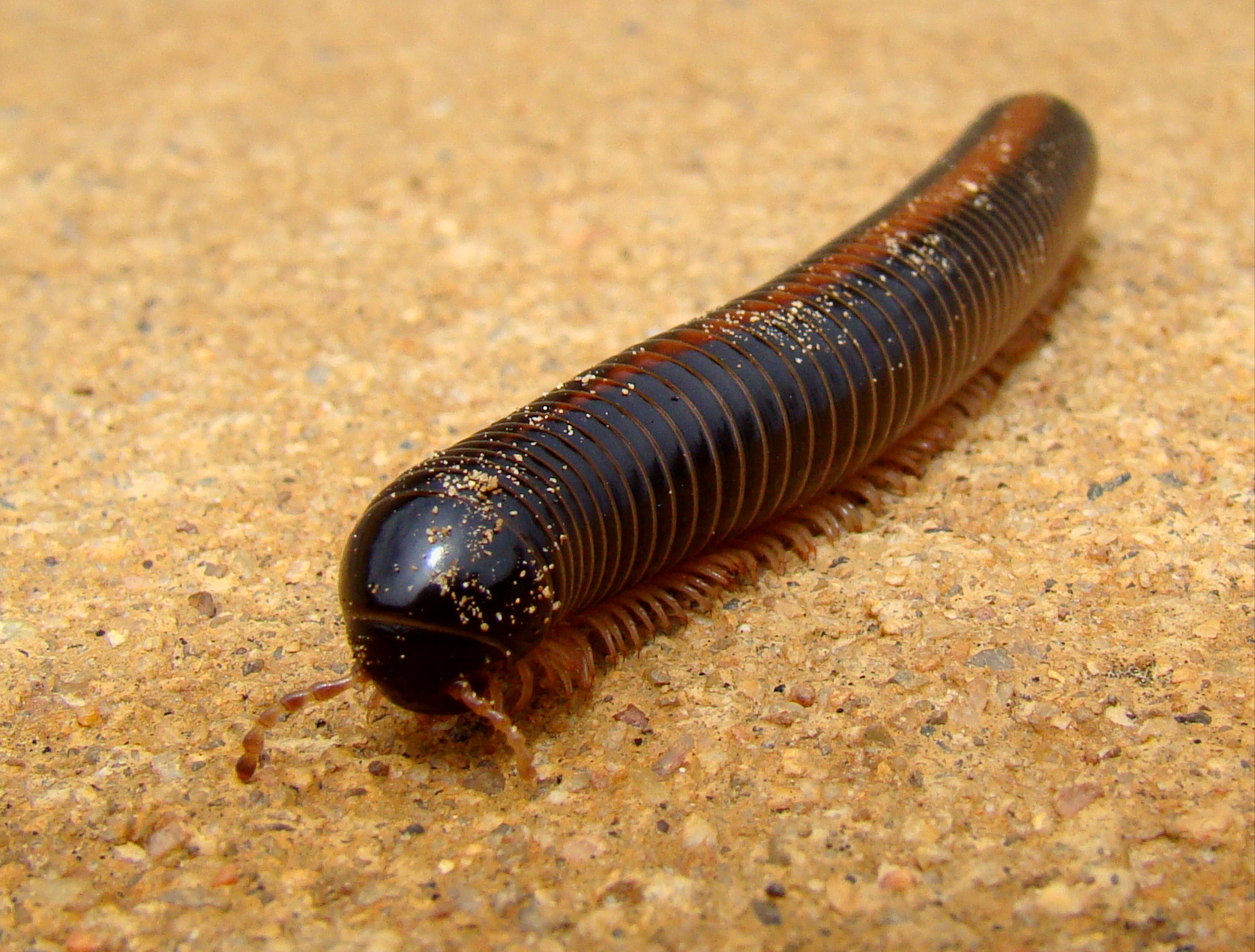
Archispirostreptus gigas, known as the giant African millipede, shongololo or Bongololo, is the largest extant species of millipede, growing up to 33.5 centimetres (13.2 in) in length, 67 millimetres (2.6 in) in circumference. It has approximately 256 legs, although the number of legs changes with each molting so it can vary according to each individual.[2]

It is a widespread species in lowland parts of East Africa, from Mozambique to Kenya, but rarely reaches altitudes above 1,000 metres (3,300 ft).[3] It lives mostly in forests, but can also be found in areas of coastal habitat that contain at least a few trees.[3] It is native to Southern Arabia, especially Dhofar.

In general, giant millipedes have a life expectancy of about 7–10 years.[4]

Defence

[edit]
Giant millipede coiled in defence

Giant millipedes have two main modes of defence if they feel threatened: curling into a tight spiral exposing only the hard exoskeleton, and secretion of an irritating liquid from pores on their body. This liquid can be harmful if introduced into the eyes or mouth.[4] Because of this defense, A. gigas is one of the few invertebrates that driver ants are incapable of taking as prey. The chemicals identified in this millipede’s defensive secretion are toluquinone and 2-methoxy-3-methylbenzoquinone.[5]

Small mites are often observed crawling on their exoskeleton and among their legs. The millipedes have a symbiotic relationship with these mites, in which the mites help clean the millipede's exoskeleton in exchange for food and the protection of their host.[6]

A docile species, A. gigas is sometimes seen in the pet trade.[7] However, the U.S. federal government requires anyone bringing giant millipedes into the country to have permits for them.[8]

Ecological role

[edit]

Archispirostreptus gigas plays an important role as a decomposer in tropical ecosystems. They help break down decaying plant material which returns nutrients to the soil and supports forest floor health. A. gigas uses hemocyanin, a copper-based protein, for oxygen transport. Recent research has shown that the giant African millipede (Archispirostreptus gigas) contributes to nutrient recycling in tropical forests through methanogenesis in its gut microbiota, which aids in the breakdown of plant matter and carbon cycling (Horváthová et al., 2021).”They are also well adapted to low-oxygen environments like rotting logs and dense leaf litter, which allows them to stay active in areas where oxygen is limited. Thus, they thrive in key nutrient-cycling zones of the ecosystem.[9]

Giant African millipede in Namibia

References

[edit]
[edit]
Revisions and contributorsEdit on WikipediaRead on Wikipedia
from Grokipedia
Archispirostreptus gigas, commonly known as the giant African millipede, is a large of belonging to the Spirostreptidae within the order Spirostreptida. It is one of the largest extant millipede species, capable of growing up to 33 centimeters (13 inches) in length and weighing between 0.4 and 0.5 pounds. The millipede features a cylindrical, segmented body with 40 or more segments, each bearing two pairs of legs, resulting in a total of 300 to 400 legs, and it possesses simple eyes (ocelli) and two antennae for sensory functions. Its is typically dark brown to black, providing on the . Native to the lowland rainforests and coastal regions of East and West , including countries such as , , , , and , A. gigas thrives in warm, humid environments on the forest floor, often burrowing near rotting wood or leaf litter. As a nocturnal , it primarily feeds on decaying matter, such as dead leaves, fruits, and wood, contributing significantly to nutrient recycling in its . For defense, the coils into a tight spiral and secretes a foul-smelling, irritant fluid containing from repugnatorial glands along its body, deterring predators like birds, reptiles, and small mammals. Reproduction in A. gigas is sexual, with males using modified legs to grasp females during ; females then lay hundreds of eggs in a , which hatch after about into tiny, white juveniles that undergo multiple molts—up to 7–10 times—over several years to reach maturity. The species has a lifespan of 5–7 years in the wild, potentially extending to 10 years in captivity. Classified as Least Concern by the , A. gigas populations remain abundant and stable across their range, with no major threats identified, though habitat loss from could pose future risks. This is also popular in the pet trade and serves as a in ecophysiological due to its size and ease of study.

Taxonomy and etymology

Classification

Archispirostreptus gigas belongs to the kingdom Animalia, Arthropoda, Myriapoda, class Diplopoda, order Spirostreptida, Spirostreptidae, Archispirostreptus, and gigas. This hierarchical placement situates it within the millipedes, characterized by two pairs of legs per body segment, distinguishing the class Diplopoda from other myriapods. As the largest species in the genus Archispirostreptus, A. gigas exemplifies the Spirostreptidae family, which comprises around 100 genera of millipedes featuring cylindrical bodies and a predominantly tropical to subtropical distribution across , the Americas, and parts of Asia. The family's members are noted for their elongated, robust forms adapted to humid environments. The species was originally described as Spirostreptus gigas by Wilhelm Peters in 1855 based on specimens from Mozambique. It was subsequently transferred to the genus Archispirostreptus by Filippo Silvestri in 1895, a reclassification that has been upheld in later revisions. Several junior synonyms, including Aethiopistreptus attemsii Verhoeff, 1938, and Graphidostreptus gigas (Peters, 1855), have been synonymized with A. gigas through taxonomic studies addressing morphological variations, particularly in gonopod structure.

Naming

The scientific name Archispirostreptus gigas reflects its morphological characteristics through classical linguistic roots. The genus name Archispirostreptus was established by Silvestri in 1895. The species epithet gigas, originally assigned by Peters in 1855, comes from the Latin word for "giant," emphasizing its position as the largest known species, capable of reaching lengths up to 33.5 cm. Common names for A. gigas vary by region and cultural context, often highlighting its size or behavior. In English-speaking contexts, it is widely referred to as the giant African millipede, a name that underscores its impressive dimensions and native range across . Among Zulu-speaking communities in , it is known as shongololo, derived from the Zulu verb ukushonga meaning "to roll up," in reference to its habit of curling into a tight spiral when threatened. In East African countries like , regional variations include bongololo in local languages such as ChiTonga, similarly evoking the coiling action.

Physical description

Size and coloration

Archispirostreptus gigas is one of the largest , with adults reaching lengths of up to 38.7 cm (15.2 inches), a body diameter of 15–19 mm, and weights of 181–227 grams. The cylindrical body comprises 62–70 segments, each bearing two pairs of legs, resulting in a total of approximately 250–280 legs, though popular accounts often cite 300–400 legs to emphasize their profuse limbation. The exhibits a glossy dark brown to black coloration, providing in leaf litter. Juveniles are notably paler, appearing white or light-colored upon hatching, and progressively darken through successive molts as they mature. There is no apparent in size or coloration; males and females appear similar externally.

Anatomy

Archispirostreptus gigas exhibits a cylindrical and elongated body structure typical of diplopod millipedes, composed of a head followed by a series of diplosegments. Each diplosegment bears two pairs of legs, enabling coordinated locomotion, while the initial body rings are haplosegments with single pairs of legs. The head is equipped with a pair of simple eyes known as ocelli, a pair of antennae that contain olfactory sensilla for chemosensory detection of environmental chemicals. The mouthparts of A. gigas consist of ventral structures including weak mandibles adapted for grinding , a gnathochilarium, and maxillae; these are suited for processing plant-based food without venom delivery or strong biting force. Paired repugnatorial glands are distributed along the lateral sides of the body segments, serving as defensive organs that secrete irritants such as and benzoquinones, including 2-methyl-3-methoxy-1,4-benzoquinone, to deter predators. The features a network of tracheae that branch internally, opening externally via spiracles positioned on the sternites near the leg bases.

Distribution and habitat

Geographic range

Archispirostreptus gigas is native to eastern, southern, and western , ranging from and to , , , and . The species is particularly widespread along the east coast of , with records extending inland in subtropical regions. Specific locales include and Ngaia Forest in , Tete Province in (the type locality), in , various sites in such as , and and in . First described by Peters in 1855 based on specimens from , the species' distribution has shown stability in historical records, as documented in taxonomic revisions spanning from the late to recent assessments, despite ongoing pressures in parts of its range. No confirmed introduced populations exist outside its native African range.

Habitat preferences

Archispirostreptus gigas primarily inhabits subtropical and tropical rainforests as well as moist lowland forests, where it thrives in environments that provide ample and cover. These habitats are typically found at elevations ranging from up to approximately 1,000 meters, allowing the to occupy diverse forested landscapes across its range. Within these forests, the prefers microhabitats on the , where it burrows into leaf litter, rotting wood, and humus-rich soil to maintain protection and . This helps it avoid exposure to drier conditions, as it actively seeks out shaded, damp areas under fallen logs or vegetation debris. The species is particularly sensitive to , limiting its presence in open or arid zones. A. gigas inhabits warm, humid forest ecosystems with stable moist microclimates buffered by dense canopy cover.

Behavior

Daily activity

Archispirostreptus gigas displays a predominantly nocturnal lifestyle in the wild, emerging from its hiding places at night to engage in foraging and movement while spending the daylight hours burrowed underground or concealed under leaf litter and decaying wood to evade predators and prevent in the tropical environment. This aligns with the species' sensitivity to light and heat, as its poor eyesight and reliance on chemosensory antennae for make nighttime conditions more suitable for activity. During the day, individuals exhibit resting behavior characterized by loose coiling within burrows or under cover objects, with minimal to no locomotion, conserving energy and maintaining humidity around their bodies. This inactive state helps mitigate risks from diurnal predators and environmental stressors, allowing the millipede to remain protected until dusk. Nighttime travel employs its characteristic wave-like locomotion to navigate forest floors efficiently. Seasonal variations influence overall activity levels, with heightened surface activity during wet seasons when increased rainfall enhances and food availability, promoting more frequent emergences. In contrast, during dry periods, activity is markedly reduced, with individuals burrowing deeper to avoid and limiting exposure until conditions improve. This pattern reflects adaptations to the forest habitats of , and , where distinct rainy and dry phases dictate ecological opportunities.

Locomotion and defense

Archispirostreptus gigas moves via a slow, undulating crawl across the , utilizing its numerous legs in coordinated metachronal waves that propagate from anterior to posterior segments. This wave-like pattern, where legs on each segment alternate in protraction and retraction, enables steady despite the animal's large size and high leg count. While primarily terrestrial and preferring leaf litter and soil, the is capable of climbing low vegetation or obstacles using its legs' gripping action, though such behavior is infrequent. For defense, A. gigas primarily relies on its body into a tight spiral when disturbed, positioning its softer ventral side and legs inward while exposing the hardened dorsal to potential threats. This posture minimizes accessible surface area and leverages the plates of the , which provide mechanical protection and contribute to overall unpalatability. Complementing this physical barrier, the secretes irritant chemicals from repugnatorial glands along its body sides, releasing a fluid containing benzoquinones such as 2-methyl-1,4-benzoquinone and 2-methyl-3-methoxy-1,4-benzoquinone. These compounds act as topical irritants, causing burning sensations on and mucous membranes upon contact, thereby deterring predators effectively. As a nocturnal , such defensive responses are most commonly deployed during evening foraging periods.

Reproduction and life cycle

Mating and egg-laying

Mating in Archispirostreptus gigas begins with the male emitting pheromones to attract a receptive female. The male then approaches, walks alongside her, and slips underneath to coil around her body in a embrace. During this process, the male mounts the female and performs a drumming display by rhythmically beating the ground with groups of legs for about 15 minutes to stimulate her. Sperm transfer occurs indirectly via a , facilitated by the male's gonopods—modified legs on the seventh body segment. The male first moves sperm from his gonopore (located behind the second pair of legs) to the gonopods using a tube-like organ, a preparation that takes around 10 minutes. Copulation itself is brief, lasting about 10 seconds, during which the is inserted into the female's genital opening; this may repeat up to three times per mating event. Mating is seasonal, typically taking place during the transition from dry to wet periods to align with favorable conditions for egg development. After fertilization, the female burrows into moist soil to construct a nest and lays a clutch of 20 to 300 eggs, often singly or in small groups. These eggs are small (approximately 2–3 mm in diameter), white, and coated with a protective layer of and substrate to deter predators and maintain . Breeding occurs once per year, with the female providing brief by guarding the nest for a short period before departing.

Development stages

The development of Archispirostreptus gigas begins with the stage, where females lay clutches of hundreds of fertilized s in small burrows or moist depressions. These eggs incubate for approximately three months under humid conditions before . Upon , the neonates are small, white, and translucent, possessing only a few body segments and three pairs of legs; they receive no and must independently. Within the first 12 hours after emergence, these hatchlings undergo their initial molt, which begins the process of segment addition and leg development. Subsequent juvenile or stages involve a series of 7 to 10 molts over several years, during which the progressively adds body segments (typically one per molt) and corresponding pairs of legs (four per molt), gradually increasing in length and darkening to the characteristic coloration. This anamorphic growth allows the organism to reach up to 30-38 cm in length by adulthood, with juveniles exhibiting faster development in consistently environments that support frequent molting and nutrient uptake. is attained after these molts, generally in 2 to 5 years depending on environmental conditions, with optimal and accelerating the process to as little as 10-24 months in favorable settings. The total lifespan of A. gigas ranges from 5 to 7 years in the wild, though individuals in captivity can live up to 10 years with proper care; mature adults may breed annually during this period until .

Ecology

Diet and foraging

Archispirostreptus gigas is primarily detritivorous, feeding on decaying organic matter such as rotting leaves, fruits, vegetables, decaying wood or bark, fungi, and soft plant material found on the forest floor. The species does not consume fresh hardwood or wood chips, as fresh wood is unsuitable as food, and wood chips are typically used as substrate rather than food. Occasionally, individuals consume live vegetation, including plant roots and rootlets, though this is not their primary food source. Foraging occurs nocturnally, with individuals emerging from burrows to scavenge on the surface for detritus, often crawling slowly along the forest floor to locate food. They may also burrow to access buried detritus, aligning with their fossorial habits during the day. Antennae play a key role in food detection, equipped with chemoreceptors that sense odors and taste to identify suitable decaying matter. The digestive system features a simple tubular gut adapted for processing lignocellulosic material, relying on microbial symbionts to break down through and enzymatic activity. These symbionts, including and fungi in the , enable efficient decomposition of plant detritus, supporting nutrient extraction in a low-nitrogen diet.

Ecological role

Archispirostreptus gigas serves as a key in tropical and subtropical ecosystems, where it decomposes decaying matter such as leaf litter and wood, thereby accelerating the breakdown of organic material and facilitating recycling into the . This process releases essential nutrients like and , enhancing and supporting growth in nutrient-poor environments. By burrowing through the , A. gigas contributes to soil aeration, improving its structure, water infiltration, and oxygen availability, which benefits microbial activity and root development in forest floors. These activities not only prevent but also promote the fragmentation of organic debris, further aiding by exposing it to microbes. In the , A. gigas occupies the position of primary consumer and prey for various predators, including birds, small mammals, frogs, and reptiles, thereby transferring energy from to higher trophic levels. However, its chemical defenses, consisting of repugnatorial secretions rich in benzoquinones from specialized glands, effectively deter many predators by producing a foul and , as well as exhibiting properties that limit successful attacks. Symbiotic interactions within A. gigas involve gut microorganisms, including anaerobic methanogenic and , which assist in the and of , enhancing the efficiency of nutrient extraction from litter. These microbial symbionts contribute to production and overall decomposition processes, underscoring the millipede's role in microbial diversity and ecosystem dynamics.

Human interactions

In captivity

Archispirostreptus gigas is a popular choice for beginner enthusiasts due to its docile temperament and relatively straightforward care requirements. This species is commonly kept as a pet or educational animal in homes, schools, and zoos, where its large size and calm demeanor make it suitable for handling during demonstrations. has been successfully achieved in institutional settings, supporting sustainable populations without reliance on wild collection. Enclosures for A. gigas should mimic the humid of its native East African , using a minimum 10-15 for a single adult to allow ample space for burrowing and movement. The substrate typically consists of 4-6 inches of moist fiber mixed with and topped with leaf litter for hiding and foraging opportunities, while providing cork bark or decaying wood as additional shelters. Humidity levels must be maintained at 70-80% through regular misting, with temperatures held between 72-78°F (22-25°C) using a gentle heat source like a emitter; good ventilation prevents mold growth. In captivity, A. gigas is fed a detritivorous diet of decaying organic matter, including rotting leaves, fruits, vegetables, and decaying wood or bark. Fresh hardwood is unsuitable as food, and wood chips are typically used as substrate rather than as food. Decaying hardwood leaves and soft decaying wood are recommended, supplemented with appropriate fruits and vegetables. Handling A. gigas is generally safe, as the species rarely bites and can be gently supported along its entire body, making it ideal for educational purposes. However, when stressed, it may release a foul-smelling, irritating from its glands, so handlers should wash with and afterward to avoid skin or eye discomfort. In captivity, individuals typically live 5-10 years with proper care, though frequent handling can reduce , so rotation is recommended in group or display settings. Breeding in captivity closely parallels wild behaviors, with often observed in colonies of multiple adults housed together in spacious enclosures. Females lay clutches of 25-200 eggs in moist substrate after cues around 24-28°C trigger , and hatchlings require similar humid conditions for development. Successful colonies are common among experienced keepers, contributing to the species' availability in the pet trade.

Conservation status

Archispirostreptus gigas has not been formally assessed by the International Union for Conservation of Nature (, but it is widely regarded as being of least concern due to its extensive distribution across subtropical regions of and its adaptability to varying environmental conditions. The primary threats to the species include habitat loss driven by , agricultural expansion, and activities, which fragment and degrade the moist and savanna woodlands it inhabits. Additionally, may exacerbate these risks by altering rainfall patterns and drying out habitats, potentially affecting levels critical for the species' survival. Collection for the international pet trade appears to have minimal overall impact on wild populations, given the species' abundance. No specific legal protections target A. gigas, but the species indirectly benefits from general conservation initiatives aimed at preserving African rainforests. Populations are considered stable across much of its range, though ongoing monitoring is recommended to address emerging threats from alteration.

References

Add your contribution
Related Hubs
User Avatar
No comments yet.