Hubbry Logo
Splash padSplash padMain
Open search
Splash pad
Community hub
Splash pad
logo
8 pages, 0 posts
0 subscribers
Be the first to start a discussion here.
Splash pad
Splash pad
from Wikipedia
Urban beach style splash pad located within the municipal swimming baths of Toronto's High Park

A splash pad or spray pool is a recreation area, often in a public park, for water play that has little or no standing water. This is said to eliminate the need for lifeguards or other supervision, as there is little risk of drowning.

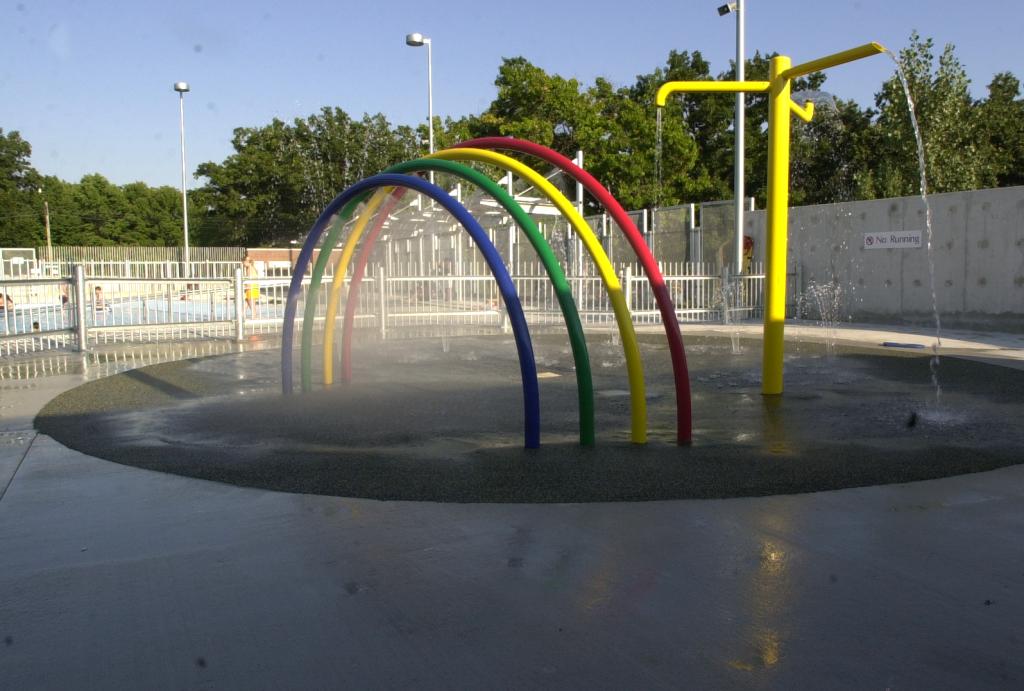
Typically there are ground nozzles that spray water upwards out of the splash pad's raindeck[clarification needed]. There may also be other water features such as a rainbow (semicircular pipe shower), or mushroom- or tree-shaped showers. Some splash pads feature movable nozzles similar to those found on fire trucks to allow users to spray others. The showers and ground nozzles are often controlled by a hand activated-motion sensor, to run for limited time.

Typically the water is either freshwater, or recycled and treated water, that is typically treated to at least the same level of quality as swimming pool water standards. These splash pads are often surfaced in textured non-slip concrete or in crumb rubber.

Definitions

[edit]

A typical definition was laid out by a 1986 Heath Act in British Columbia which stated that a spray pool is "an artificially constructed depression or basin for use by children, into which potable water is sprayed but not allowed to accumulate in the bottom."[1]

Similarly, the city of Norfolk, Virginia, specifically defines a spray pool as "any shallow manmade structure constructed from materials other than natural earth or soil used for spraying humans with water and which has a drainage area designated to remove the water from the shower or spray nozzles at a rate sufficient to prevent the impounding of water."[2]

Spray pool features may also be referred to as "interactive fountains"[3] or "wet decks".[4]

Splash fountains

[edit]
The Splash Fountain in Krasnodar, Russia, the largest splash fountain in Europe[5]

Splash fountains, unlike splash pads, encourage use from people of all ages. These fountains are usually designed to be both visually appealing (from a distance) and also interactive. As such, they are designed to allow easy access, often at ground level. They tend to feature nonslip surfaces, and have no standing water, to eliminate possible drowning hazards, so that no lifeguards are required. Multiple fountains may start and stop in unison or according to a pattern for artistic effect. While they may be placed in public parks like children's splash pads, splash fountains are also likely to be placed in public squares or at urban beaches.

Popularity

[edit]

Popular in summertime and especially prevalent in urban areas, the spray pool offers an alternative to the practice of opening fire hydrants so that children can play and cool off in the water – a practice which is illegal and has been cited as dangerous in that it lowers the water pressure in a given area and makes firefighting more difficult.[6] A spray pool does not need to be staffed by qualified lifeguards.

Common features

[edit]

Spray force

[edit]

Depending upon the strength and arc of the flow, the force of the spray can be relatively strong (especially close to the point where the water emerges) or may have more resemblance to rainfall or even a fine mist. Many splash pads have some features such as fine mist, that are designed to be moderate enough for children. Other splash fountains are designed for adults, e.g. for joggers or concert goers to cool off in.

Drainage

[edit]

The area beneath a spray pool typically has drain openings so that the water it produces will not flood the surrounding landscape. In some instances, the water collected in these drains is recycled back into the spray mechanism, thereby conserving water. Alternatively, the water emanating from the spray nozzles may be continually drawn from a fresh water supply.

Special features

[edit]

Hydraulophones

[edit]
One of the features of the circular splash pad in front of the Ontario Science Centre is a hydraulophone flute with 45 finger holes. Here a hydraulist demonstrates hydraulophone technique.

Hydraulophones are the world's first musical instrument that makes music from vibrations in water. By pressing on jets of water laid out to a musical scale, hydraulophones make a unique sound. Hydraulophones have been installed in water parks, museums, and science centres around the world, including the Legoland California Resort, Chicago Children's Museum, and the Ontario Science Centre in Toronto.

Heating

[edit]

At the splash fountain at Dundas Square in Toronto, Ontario, the water is heated by solar energy captured by special dark-colored granite slabs.[citation needed]

Safety

[edit]

Inadequately treated, recirculated spray pool systems present a health hazard.[4] In certain jurisdictions, splash pads may not be subject to public swimming pool water quality requirements because they do not contain standing water. People wearing regular clothing and street shoes, pets and young children may introduce pathogens into the spray pool when they cool off in it.[3]

Outbreaks of cryptosporidiosis associated with water parks have occurred in Florida in 1999,[7] in New York in 2005[4] and in Idaho in 2007.[8]

Since 2021 there have been 3 child deaths from primary amoebic meningoencephalitis (PAM) caused by the amoeba Naegleria fowleri contracted from exposure to inadequately disinfected water in splash pads, two in Texas and one in Arkansas.[9][10]

Examples

[edit]

Placement and management of spray pools varies according to the municipality in which they are located. For example:

  • On Boston Common, the so-called "Frog Pond" (which is a public ice-skating rink in winter) becomes a spray pool for children in the summer.[11] The facility is managed by the Boston Common Frog Pond Foundation and staffed by youth workers from the Boston Youth Fund.[12]
  • The spray pool at Phillips Park in Aurora, Illinois, dates from the 1930s and has closed and reopened several times. It is now part of the Phillips Park Family Aquatic Center next to the Phillips Park Zoo.[13]
  • Seattle & King County, Washington, has a "Plan Guide for Water Recreation Facilities – Spray Pools" listing very specific considerations such as the use of non-slip surfaces and the positioning of the spray pools so as to "minimize pollution by dust, smoke, soot and other undesirable substances."[14]
  • Oregon City, Oregon, has a spray pool at the Oregon City Carnegie Center. Formerly run by the city, the center and its programs recently reopened under the auspices of a private organization called Fine Art Smarts.[15][16]
  • North Berwyn Park District in Berwyn, Illinois, offers a permit for the use of a city-owned community center and spray pool for birthday parties.[17]

See also

[edit]

References

[edit]
Revisions and contributorsEdit on WikipediaRead on Wikipedia
from Grokipedia
A splash pad, also known as a spray pad, splash park, interactive fountain, or wet deck, is a recreational aquatic venue designed for water play that features sprays and jets of directed at users, typically with little or no standing to minimize risks. These installations are commonly found in public parks, community centers, and recreational facilities, providing a barrier-free environment suitable for children of all ages and abilities. Primarily intended for young children under five years old, splash pads offer an accessible and engaging way to cool off during warm weather without the supervision intensity required for traditional pools. Splash pads evolved in the late , with the first commercial installations in the mid-1990s pioneered by companies like Vortex Aquatic Structures International, as a safer alternative to pools and informal play, such as children opening hydrants for relief on hot summer days, addressing concerns over hazards and maintenance. Their popularity surged in the and due to lower operational costs, easier upkeep compared to pools, and that accommodates diverse users, making them a top-requested in community parks. By the 2020s, splash pads had become widespread across urban and suburban areas, promoted for and social interaction while adapting to regulations post-outbreaks of waterborne illnesses, with ongoing vigilance following additional incidents in 2023 and ; as of 2025, the industry continues to expand with innovations and new installations. Key features of splash pads include ground-based jets, arching water sprays, misters, tipping buckets, and interactive activation elements like buttons or motion sensors, often themed with animal shapes or colorful patterns to enhance play value. Designs typically incorporate zoned areas for different age groups, slip-resistant surfacing such as with embedded , and extended dry decking to prevent slips beyond the wet zone. Water systems vary between recirculating setups, which filter and treat for , and spray-to-drain models where water percolates into the ground, both adhering to local codes for limits (under 20 feet per second) to avoid injury. Safety is a core principle in splash pad operation, with the absence of standing water significantly reducing submersion risks, though users must avoid swallowing water or allowing it to enter the nose to prevent germ transmission like or . Proper maintenance, including daily disinfection where required, pH balancing (7.0–7.8), and hygiene practices such as pre-entry showers and frequent bathroom breaks, are essential to mitigate outbreaks, as evidenced by incidents affecting thousands in the early that led to stricter U.S. regulations. Overall, splash pads balance fun, accessibility, and , fostering community recreation in a low-barrier format.

Definition and Origins

Definition

A splash pad is a recreational water play area commonly located in public parks, community centers, or similar public settings, designed for interactive -based activities with features such as sprays, nozzles, and fountains that minimize or eliminate standing to reduce risks. These installations prioritize by ensuring play occurs on a flat, non-submersive surface, making them suitable for unsupervised or lightly supervised environments. Key characteristics of splash pads include ground-based water outlets like nozzles and jets that project water intermittently, often activated by timers, motion sensors, or manual buttons to create engaging, unpredictable play patterns. They are primarily intended for children and families, fostering and social interaction in a low-risk setting, and often employ recirculated, treated water systems that filter and disinfect the water for reuse, or spray-to-drain systems, promoting environmental efficiency and where applicable. In distinction from swimming pools, wading pools, or spraygrounds with containment, splash pads feature zero-depth designs that avoid any accumulation of water deeper than a thin film on the surface, shifting the focus from immersion or soaking to active, evasive spraying for pure recreational enjoyment. This approach enhances while eliminating the need for lifeguards or extensive barriers.

History

The roots of splash pads trace back to the late 19th and early 20th centuries, when urban and wading pools emerged as key components of public recreation for children. The first municipal playground in the United States opened in 1903 at Seward Park in , providing supervised spaces for amid growing concerns over child welfare in densely populated immigrant neighborhoods. This development coincided with the broader playground movement, which emphasized safe, organized play to counter street hazards. By the 1920s and 1930s, public swimming pools and wading pools experienced a significant boom, with thousands constructed nationwide, often funded by municipal bonds and federal programs like the , transforming them into central features of community parks and leisure. In the mid-20th century, municipalities began enhancing existing wading pools with simple spray features, such as overhead showers and basic fountains, to mitigate challenges from standing water and reduce the need for constant . These additions addressed rising concerns over bacterial and accidental drownings in shallow pools, which required lifeguards and regular draining. By the 1970s and 1980s, as public wading pools faced closures due to maintenance difficulties, these spray elements evolved into more integrated play options, laying the groundwork for safer water recreation. The modern standalone splash pad emerged in the late and proliferated from the 1990s onward, driven by heightened awareness of child risks following safety campaigns and legislative efforts in the , such as mandatory pool fencing laws. An early example was the UFO-H2O interactive water play area at the 1986 World Exposition in , which showcased zero-depth water features without standing pools, influencing subsequent designs. Splash pads gained traction as low-risk alternatives, particularly for urban heat mitigation, offering cooling without the hazards of deeper water. Their adoption accelerated in the amid a decline in traditional public pools, attributed to high operational costs, liability concerns from and injuries, and shifts toward , resulting in thousands of installations across by the late 2010s—for instance, over 1,700 in the United States alone by 2018. This growth reflected a broader preference for inclusive, low-maintenance public spaces that prioritized accessibility and minimal supervision. Into the 2020s, splash pads continued to expand, with northeastern U.S. cities like (15.1 per 100,000 residents) and (14.3 per 100,000) leading in density as of 2024, driven by urban heat mitigation and inclusive needs.

Design and Features

Common Components

Splash pads typically feature durable, safety-oriented surface materials designed to minimize injuries in wet environments. Common flooring options include non-slip, impact-absorbing materials such as rubberized surfaces or textured , which provide cushioning against falls while ensuring traction on wet decks. These surfaces are engineered to for efficient drainage and are often constructed from materials like or sealants to enhance slip resistance and longevity. Typical splash pad areas range from 500 to 5,000 square feet, allowing for scalable installations in public parks or community centers. Layout designs prioritize open, inclusive spaces that promote safe user interaction and accommodate diverse needs. Facilities often incorporate zoned play sections tailored to different age groups, with gentler sprays for younger children and more dynamic areas for older users, fostering an engaging yet controlled environment. is integrated through features like wheelchair ramps, ensuring paths connect all play elements without barriers. Shaded structures, such as pergolas or canopies, along with benches for observers, enhance comfort and encourage prolonged use while providing respite from direct sun exposure. Basic fixtures form the interactive core of splash pads, focusing on ground-level elements that stimulate movement without elevated structures. Ground-embedded nozzles deliver intermittent sprays upward, creating unpredictable patterns that prompt children to dodge and chase. Arch sprays, often in the form of hoops or tunnels, release cascading overhead, inviting users to run through for a refreshing drench. Tipping buckets, mounted at low heights or integrated into the ground, fill gradually before dumping a sudden , building anticipation and encouraging group play. These fixtures are typically motion-activated to conserve and align with passive play dynamics.

Water Delivery Systems

Splash pads employ spray mechanisms that deliver through variable jets operating at low pressures, typically ranging from 1 to 5 psi, to ensure safe and engaging play experiences without excessive . These jets emerge from pop-up nozzles, which retract when not in use to prevent tripping hazards, or fixed heads designed for continuous or targeted spraying. Flow rates for such nozzles commonly fall between 5 and 15 gallons per minute (GPM) at 5 psi, allowing for adjustable patterns from focused to wide fans. Designs adhere to standards such as the CDC's Model Aquatic Health Code (MAHC), which limits to under 20 feet per second to avoid . To promote , activation is often intermittent, controlled by timers that cycle sprays on and off or motion sensors that trigger features only when users are present. Effective drainage and recirculation are integral to splash pad operations, featuring sloped surfaces that direct water toward grated drains to prevent pooling and ensure quick surface drying. These drains channel water into underground collection systems, where closed-loop recirculation filters and treats the water for , often achieving over 80% in water recovery. By filtering out and sanitizing via UV or chemical methods, these systems minimize intake, typically limiting overall consumption to 1,000 to 5,000 gallons per hour depending on pad size and usage intensity. Pumping and control systems in splash pads prioritize energy efficiency and , utilizing variable-speed pumps that adjust output to match demand and reduce use. Automated shutoffs, managed through programmable controllers, halt flow during idle periods or , further conserving resources. Integration with sensors, including weather detection for or , enables operation tailored to conditions, activating features primarily during suitable hot weather while ensuring safe shutdowns in adverse scenarios. These smart controls often include remote monitoring capabilities to optimize performance and sustainability.

Advanced Features

Advanced splash pads may incorporate hydraulophones, which are innovative water-based musical instruments that enable interactive acoustic play. These devices produce sound through water jets that vibrate reeds or similar mechanisms when partially blocked by users' fingers, allowing children to create melodies by manipulating the water flow. Invented by Steve Mann, hydraulophones integrate seamlessly into splash pad designs, transforming standard water features into educational tools that combine hydrodynamics with , as demonstrated in public installations where they encourage creative expression without requiring additional power sources beyond the water system. Heating systems extend the usability of splash pads in cooler climates by maintaining water at comfortable temperatures, typically between 78°F and 86°F to ensure safety and enjoyment. Solar heating panels capture sunlight to warm recirculating , offering an energy-efficient option that reduces operational costs while minimizing environmental impact. Alternatively, boiler-based systems provide reliable heating through gas or electric boilers, suitable for indoor or year-round outdoor facilities where consistent temperatures are needed despite variable weather. These systems are often integrated with existing filtration setups to deliver heated via standard spray features. Thematic integrations elevate splash pads by blending artistry, technology, and inclusivity to create immersive environments. Custom sculptures, crafted from durable materials like fiberglass or GFRC, serve as both aesthetic focal points and interactive elements, such as animal-shaped sprayers that align with park themes to spark imaginative play. LED lighting systems synchronized with water sprays add visual spectacle, especially at dusk, where programmable colors and patterns enhance safety and ambiance without interfering with water dynamics. Accessibility aids, including adjustable spray heights and ground-level controls, ensure participation for users of all abilities, from young children to those with mobility challenges, promoting equitable access in diverse community settings.

Safety and Operations

Safety Measures

Splash pads are engineered with specific design protocols to minimize risks, primarily through the elimination of standing water across the play area. According to the Centers for Disease Control and Prevention (CDC), these facilities are typically sloped to ensure that water drains continuously, preventing accumulation that could lead to submersion incidents. The International Swimming Pool and Spa Code further mandates that water depths in spray pools, including any incidental pooling, shall not exceed 6 inches (152 mm) to maintain shallow conditions incompatible with . To mitigate injuries from falls or slips, splash pads incorporate compliant surfacing materials tested under standard F1292 for impact attenuation, which determines the critical fall height—the maximum drop from which a surface can cushion impacts to reduce severe injury risk. These surfaces are rated to handle critical fall heights up to 12 feet, aligning with broader safety benchmarks while accommodating the low-profile features of splash pads. signage is a key operational measure, prominently displaying rules such as prohibitions on running, diving, or rough play to prevent slips and collisions on wet surfaces. Non-slip surfacing materials further enhance traction in wet conditions. Health regulations focus on preventing , particularly in recirculating systems prone to fecal contamination. Facilities often implement barriers, such as dedicated diaper-changing stations away from the play area and policies excluding incontinent users or those in diapers, to limit introduction of contaminants like , a chlorine-resistant parasite responsible for numerous outbreaks. Ongoing monitoring includes maintaining free levels at 1–3 parts per million (ppm) to inactivate most bacteria and viruses, though supplemental measures like UV treatment may be required for control, as recommended by the CDC's Model Aquatic Health Code.

Maintenance Practices

Maintaining a splash pad involves rigorous daily routines to ensure , functionality, and user . Operators conduct visual inspections before opening and closing to identify damage, leaks, or hazards in features and surfaces, while removing debris from drains and nozzles to prevent clogs and . Water quality testing is performed before opening and every 2-4 hours during operation, targeting a range of 7.2-7.8 and free levels of at least 1.0 ppm (or 2.0-3.0 ppm with ) to effectively disinfect without irritating or eyes. Splash pads are typically shut down for 30 minutes every 2-4 hours for thorough cleaning, including scrubbing surfaces to remove and high-touch areas with approved disinfectants, followed by rinsing to maintain operational standards. Seasonal tasks focus on protecting from environmental damage and preparing for extended use. In colder climates, requires fully draining all water lines, pumps, and features to prevent freezing and pipe bursts, along with inspecting and tightening hardware, or removing spray nozzles, and installing protective winter caps or covers. Annual deep involves disassembling and sanitizing the recirculation tank, replacing filters, and servicing equipment like pumps and valves to address wear and ensure efficiency. These activities, including professional inspections, typically cost between $5,000 and $20,000 per year, depending on facility size and location, covering labor, chemicals, and parts. Integrating practices reduces chemical use and environmental impact while upholding . Many modern splash pads employ secondary disinfection systems such as UV or generators, which inactivate pathogens like with 99.9% efficacy and allow lower dosages, minimizing byproduct formation. Water recycling through recirculation systems, with turnover times of 30 minutes or less and reuse ratios up to 3:1, captures and treats runoff to limit freshwater consumption and discharge into systems.

Usage and Examples

Popularity and Benefits

Splash pads have experienced significant growth worldwide, with installations in over 50 countries by 2025, particularly in urban areas where they provide essential relief from heatwaves and promote in densely populated settings. By 2025, installations continued to rise, with many communities adding splash pads to address urban heat islands and promote resilient public spaces. This surge in popularity accelerated after 2010, driven by their affordability compared to traditional swimming pools; construction costs for splash pads typically range from $100,000 to $500,000, while pools often exceed several million dollars due to requirements for excavation, filtration systems, and ongoing infrastructure. The health benefits of splash pads are substantial, as they encourage unstructured that helps combat by increasing moderate-to-vigorous play in outdoor environments. Socially, these facilities foster inclusivity by accommodating users of all ages and abilities through zero-depth designs, wide ramps, and sensory features that ensure without barriers. Additionally, their free public access promotes by drawing diverse groups to shared spaces, enhancing social interactions and neighborhood cohesion. Economically, splash pads offer incentives through reduced operational costs, as they eliminate the need for lifeguards, extensive , and high water filtration systems required for pools. They also boost local and attendance, with studies showing increases of 20-50% in visitor numbers and related economic activity from nearby businesses due to heightened foot traffic.

Notable Installations

One prominent example in is the Gateway Fountain at Discovery Green in , which opened in 2008 as part of a 12-acre featuring interactive water jets up to 14 feet high on a gently sloping surface, divided into thematic zones including a children's and misting areas nearby. In , the Maggie Daley Park's Play Garden, inaugurated in 2014, includes the 1,200-square-foot "Watering Hole" splash area designed for children aged 2-5, with animal-themed interactive elements that seamlessly integrate with adjacent climbing structures and playgrounds to promote inclusive play. Internationally, the Far East Organization Children's Garden at in , part of the park's 2012 opening, incorporates elevated sprays and misting features within an eco-themed landscape of tree houses and trails, emphasizing sustainable rainwater collection for play elements. In , urban retrofits like the Parc Martin King in Paris's 17th arrondissement, developed in the on a former rail site, feature a play zone with 50 jets inspired by nearby green spaces, enhancing cooling in dense neighborhoods. Among innovative outliers, the splash pad at Davis Farmland in , which opened in 2025 and spans extensive interactive zones to accommodate high visitor volumes. projects in drought-prone regions, such as the Ron Wood Park splash pad in , completed in 2024, employ a 10,000-gallon underground recirculation tank using treated recycled water to minimize consumption while providing community access.

References

Add your contribution
Related Hubs
User Avatar
No comments yet.