Hubbry Logo
Split-step methodSplit-step methodMain
Open search
Split-step method
Community hub
Split-step method
logo
7 pages, 0 posts
0 subscribers
Be the first to start a discussion here.
Split-step method
Split-step method
from Wikipedia

In numerical analysis, the split-step Fourier method is a pseudo-spectral numerical method used to solve nonlinear partial differential equations like the nonlinear Schrödinger equation. The name arises for two reasons. First, the method relies on computing the solution in small steps, and treating the linear and the nonlinear steps[dubiousdiscuss] separately (see below). Second, it is necessary to Fourier transform back and forth because the linear step is made in the frequency domain while the nonlinear step is made in the time domain.

An example of usage of this method is in the field of light pulse propagation in optical fibers, where the interaction of linear and nonlinear mechanisms makes it difficult to find general analytical solutions. However, the split-step method provides a numerical solution to the problem. Another application of the split-step method that has been gaining a lot of traction since the 2010s is the simulation of Kerr frequency comb dynamics in optical microresonators.[1][2][3] The relative ease of implementation of the Lugiato–Lefever equation with reasonable numerical cost, along with its success in reproducing experimental spectra as well as predicting soliton behavior in these microresonators has made the method very popular.

Description of the method

[edit]

Consider, for example, the nonlinear Schrödinger equation[4]

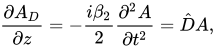
where describes the pulse envelope in time at the spatial position . The equation can be split into a linear part,

and a nonlinear part,
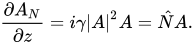
Both the linear and the nonlinear parts have analytical solutions, but the nonlinear Schrödinger equation containing both parts does not have a general analytical solution.

However, if only a 'small' step is taken along , then the two parts can be treated separately with only a 'small' numerical error. One can therefore first take a small nonlinear step,

using the analytical solution. Note that this ansatz imposes and consequently .

The dispersion step has an analytical solution in the frequency domain, so it is first necessary to Fourier transform using

,

where is the center frequency of the pulse. It can be shown that using the above definition of the Fourier transform, the analytical solution to the linear step, commuted with the frequency domain solution for the nonlinear step, is

By taking the inverse Fourier transform of one obtains ; the pulse has thus been propagated a small step . By repeating the above times, the pulse can be propagated over a length of .

The above shows how to use the method to propagate a solution forward in space; however, many physics applications, such as studying the evolution of a wave packet describing a particle, require one to propagate the solution forward in time rather than in space. The non-linear Schrödinger equation, when used to govern the time evolution of a wave function, takes the form

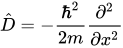
where describes the wave function at position and time . Note that

and , and that is the mass of the particle and is the reduced Planck constant.
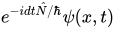
The formal solution to this equation is a complex exponential, so we have that

.

Since and are operators, they do not in general commute. However, the Baker-Campbell-Hausdorff formula can be applied to show that the error from treating them as if they do will be of order if we are taking a small but finite time step . We therefore can write

.

The part of this equation involving can be computed directly using the wave function at time , but to compute the exponential involving we use the fact that in frequency space, the partial derivative operator can be converted into a number by substituting for , where is the frequency (or more properly, wave number, as we are dealing with a spatial variable and thus transforming to a space of spatial frequencies—i.e. wave numbers) associated with the Fourier transform of whatever is being operated on. Thus, we take the Fourier transform of

,

recover the associated wave number, compute the quantity

,

and use it to find the product of the complex exponentials involving and in frequency space as below:

,

where denotes a Fourier transform. We then inverse Fourier transform this expression to find the final result in physical space, yielding the final expression

.

A variation on this method is the symmetrized split-step Fourier method, which takes half a time step using one operator, then takes a full-time step with only the other, and then takes a second half time step again with only the first. This method is an improvement upon the generic split-step Fourier method because its error is of order for a time step . The Fourier transforms of this algorithm can be computed relatively fast using the fast Fourier transform (FFT). The split-step Fourier method can therefore be much faster than typical finite difference methods.[5]

References

[edit]

External references

[edit]
Revisions and contributorsEdit on WikipediaRead on Wikipedia
from Grokipedia
The split-step method, often referred to as the split-step Fourier method (SSFM), is a pseudo- numerical technique for solving time-dependent partial differential equations, particularly the (NLSE), by decomposing the evolution operator into alternating substeps that handle dispersive (kinetic) and potential (nonlinear or refractive) effects separately, leveraging fast Fourier transforms for efficient computation in the spectral domain. Originally introduced by Hardin and Tappert in 1973 for solving nonlinear and variable-coefficient wave equations in ocean acoustics, the method gained prominence in through the work of Fleck, Morris, and Feit in 1976, who applied it to model the propagation of high-energy beams through the atmosphere, accounting for , absorption, and nonlinear effects. In , it serves as a standard tool for simulating the of wavefunctions under the time-dependent , enabling accurate integration over long times with reduced computational cost compared to finite-difference methods. The core algorithm operates by factorizing the time-evolution operator via the Trotter-Suzuki decomposition or Baker-Campbell-Hausdorff formula, typically into a symmetric sequence: a half-step for the potential term (solved exactly in the spatial domain as a phase multiplication), a full step for the kinetic term (handled via , phase multiplication in space, and inverse transform), and another half-step for the potential, achieving second-order accuracy with error scaling as the square of the step size. This approach yields a computational complexity of O( log ) per step, where N is the number of grid points, making it highly efficient for high-dimensional simulations on uniform grids and amenable to parallelization. Key applications span for modeling propagation, supercontinuum generation in fibers, and beam propagation in waveguides; quantum dynamics for Bose-Einstein condensates and molecular simulations; and other fields like and acoustics for evolution. Variants, such as adaptive step-size controls and higher-order splittings, address challenges like numerical instability in wave trains or rapid variations in , preserving essential physical properties including and dispersion relations.

Introduction

Definition and Purpose

The split-step method is a pseudo-spectral numerical technique designed to solve time-dependent nonlinear partial differential equations (PDEs), such as those modeling wave propagation, by decomposing the evolution into alternating steps that handle linear dispersive effects and nonlinear interactions separately. This approach leverages operator splitting to approximate the solution operator over discrete time intervals, enabling the efficient treatment of systems where dispersion and nonlinearity compete, as in optical fibers or quantum systems. The primary purpose of the split-step method is to facilitate computationally efficient simulations of wave propagation phenomena governed by equations like the (NLSE), where direct time-stepping methods become prohibitive due to the stiffness arising from disparate linear and nonlinear terms. By isolating these operators, the method avoids the need for fully implicit schemes, which are often expensive, and instead promotes stability and accuracy through explicit, sequential advancements, particularly for long-distance or long-time propagations in . At its core, the method approximates the full evolution operator exp(iΔt(A^+B^))\exp(-i \Delta t (\hat{A} + \hat{B})) for a time step Δt\Delta t, where A^\hat{A} denotes the linear (dispersive) operator and B^\hat{B} the nonlinear operator, via the symmetric product exp(iΔtA^/2)exp(iΔtB^)exp(iΔtA^/2)\exp(-i \Delta t \hat{A}/2) \exp(-i \Delta t \hat{B}) \exp(-i \Delta t \hat{A}/2). This second-order accurate splitting, rooted in Strang's formulation, preserves key physical properties like energy conservation while minimizing phase errors in dispersive waves. The pseudo-spectral character of the method is realized through the use of fast Fourier transforms (FFTs) to compute spatial derivatives in the linear operator, transforming the problem into the for dispersion and back to the spatial domain for nonlinearity, which is especially advantageous for periodic or extended domains.

Historical Development

The split-step method traces its origins to operator splitting techniques for ordinary differential equations, with foundational work by in 1968, who introduced symmetric splitting schemes that achieve second-order accuracy by alternating the application of sub-operators in a balanced manner. Pioneering numerical simulations by Norman J. Zabusky and Martin D. Kruskal in 1965 demonstrated soliton interactions and recurrence in a collisionless plasma model governed by a KdV-like equation using finite-difference methods, coining the term "" and inspiring later numerical techniques for nonlinear waves, including split-step approaches. A significant advancement came in 1973 with the development of the split-step Fourier method by Robert H. Hardin and Frank D. Tappert, who applied it to solve nonlinear and variable-coefficient wave equations, including prototypes of the (NLSE), by decomposing the evolution operator into linear (dispersive) and nonlinear parts, with the former handled via fast Fourier transforms. This pseudo- approach drew inspiration from earlier spectral methods, as detailed in the 1977 book by David Gottlieb and Steven A. Orszag, which emphasized Fourier-based discretizations for efficient computation of dispersive phenomena. The method gained prominence in in 1976 through the work of J. A. Fleck Jr., J. R. Morris, and M. D. Feit, who adapted it to model the propagation of high-energy beams through the atmosphere, accounting for , absorption, and nonlinear effects. The method's to quantum propagation was formalized in 1982 by Mark D. Feit, James A. Fleck Jr., and Arthur Steiger, who combined split-operator techniques with fast Fourier transforms to accurately simulate the time-dependent linear , demonstrating high efficiency for dynamics. Key formalizations for the NLSE followed, such as the analysis by J. A. C. Weideman and B. M. Herbst, who presented a comprehensive split-step framework, including stability and convergence properties, for simulating and recurrence. The saw evolution toward higher-order variants, incorporating multi-stage splittings to enhance accuracy while preserving computational efficiency, as explored in subsequent works building on Strang's symmetrization principles.

Mathematical Foundation

Operator Splitting Technique

The operator splitting technique addresses the numerical solution of time-dependent evolution equations in a , typically of the form ut=(A^+B^)u(t)\frac{\partial u}{\partial t} = (\hat{A} + \hat{B}) u(t), where A^\hat{A} and B^\hat{B} are linear operators that generally do not commute, making direct of the combined operator exp(t(A^+B^))\exp(t(\hat{A} + \hat{B})) computationally challenging. The core idea is to approximate the exact solution operator by products of simpler semigroups generated by A^\hat{A} and B^\hat{B} individually, leveraging their potentially easier solvability, such as through analytical expressions or efficient numerical schemes. A foundational result in this framework is the Trotter product formula, which states that for strongly continuous semigroups generated by A^\hat{A} and B^\hat{B}, the approximation exp(t(A^+B^))=limn[exp(tA^n)exp(tB^n)]n\exp(t(\hat{A} + \hat{B})) = \lim_{n \to \infty} \left[ \exp\left(\frac{t \hat{A}}{n}\right) \exp\left(\frac{t \hat{B}}{n}\right) \right]^n holds in the strong operator topology, with the error scaling as O(1/n)O(1/n). This was extended by the Trotter-Kato theorem, which provides conditions for the convergence of such approximations to the semigroup generated by A^+B^\hat{A} + \hat{B}, including consistency of resolvents and uniform boundedness, ensuring the limit operator generates a strongly continuous semigroup. For practical time-stepping with step size Δt\Delta t, the Lie-Trotter splitting approximates exp(Δt(A^+B^))exp(ΔtA^)exp(ΔtB^)\exp(\Delta t (\hat{A} + \hat{B})) \approx \exp(\Delta t \hat{A}) \exp(\Delta t \hat{B}) (or the reverse order), achieving local of O(Δt2)O(\Delta t^2) due to the non-commutativity term [A^,B^][\hat{A}, \hat{B}], as derived from the Baker-Campbell-Hausdorff formula. Global error over [0,T][0, T] with N=T/ΔtN = T/\Delta t steps is then O(Δt)O(\Delta t), assuming stability of the individual semigroups. In Hamiltonian systems, where the evolution arises from iut=H^ui \frac{\partial u}{\partial t} = \hat{H} u with H^=T^+V^\hat{H} = \hat{T} + \hat{V} (kinetic plus operators), splitting methods preserve the symplectic structure if the individual flows are symplectic, ensuring long-term up to O(Δt)O(\Delta t) for schemes and preventing artificial in nonlinear wave simulations. Higher accuracy is obtained via , exp(Δt(A^+B^))exp(ΔtA^2)exp(ΔtB^)exp(ΔtA^2)\exp(\Delta t (\hat{A} + \hat{B})) \approx \exp\left(\frac{\Delta t \hat{A}}{2}\right) \exp(\Delta t \hat{B}) \exp\left(\frac{\Delta t \hat{A}}{2}\right), which reduces the local error to O(Δt3)O(\Delta t^3) and maintains symplecticity for separable Hamiltonians.

The Nonlinear Schrödinger Equation

The (NLSE) is a fundamental that models the of wave envelopes in dispersive and , serving as the core equation addressed by the split-step method. In its standard one-dimensional cubic form for optical applications, it reads iψz+122ψt2+ψ2ψ=0,i \frac{\partial \psi}{\partial z} + \frac{1}{2} \frac{\partial^2 \psi}{\partial t^2} + |\psi|^2 \psi = 0, where ψ(z,t)\psi(z, t) represents the complex envelope of the , zz is the distance, and tt is the in a frame moving with the . This normalized form assumes anomalous and Kerr nonlinearity, balancing dispersive spreading against . The equation can be expressed as ψ/z=A^ψ+B^ψ\partial \psi / \partial z = \hat{A} \psi + \hat{B} \psi, where the linear operator A^=i(1/2)2/t2\hat{A} = i (1/2) \partial^2 / \partial t^2 accounts for dispersion, and the nonlinear operator B^=iψ2\hat{B} = i |\psi|^2 describes due to the intensity-dependent . In optics, the NLSE is derived from under the , assuming a quasi-monochromatic field, negligible polarization changes, and weak nonlinearity, leading to the inclusion of second-order dispersion and third-order Kerr effects. Similarly, in , an analogous form arises as the Gross-Pitaevskii equation for Bose-Einstein condensates (BECs), derived from the many-body in the mean-field limit for dilute, weakly interacting bosons, where the nonlinear term represents two-body interactions. Normalized versions introduce dimensionless parameters such as the dispersion length LD=T02/β2L_D = T_0^2 / |\beta_2| (with T0T_0 the pulse width and β2\beta_2 the dispersion coefficient) and nonlinear length LNL=1/(γP0)L_{NL} = 1 / (\gamma P_0) (with γ\gamma the nonlinear coefficient and P0P_0 peak power), scaling zz by LDL_D and tt by T0T_0 to yield the standard form. Generalized forms extend this by incorporating higher-order effects, such as Raman scattering (delayed nonlinear response), self-steepening, and higher dispersion terms, resulting in equations like iψ/z+(1/2)2ψ/t2+ψ2ψ+iϵ(ψ2ψ)/t+=0i \partial \psi / \partial z + (1/2) \partial^2 \psi / \partial t^2 + |\psi|^2 \psi + i \epsilon \partial (|\psi|^2 \psi) / \partial t + \cdots = 0, where ϵ\epsilon quantifies Raman contributions. Exact solutions exist for the standard NLSE, including soliton profiles that propagate without distortion due to the balance between dispersion and nonlinearity. The fundamental is given by ψ(z,t)=\sech(t)exp(iz/2)\psi(z, t) = \sech(t) \exp(i z / 2), representing a , localized . The split-step method exploits the separation of linear and nonlinear operators to numerically integrate this equation efficiently.

Algorithm

Basic Split-Step Fourier Method

The basic split-step Fourier method provides an efficient numerical scheme for propagating solutions of the one-dimensional (NLSE) by decomposing the evolution into linear dispersion and nonlinear operators. The linear operator is handled exactly in the Fourier domain via fast Fourier transforms (FFTs), while the nonlinear operator is solved analytically in the , enabling accurate simulations of dynamics and pulse evolution in . To advance the wave function ψ(t,z)\psi(t, z) over a propagation step Δz\Delta z, the algorithm first applies a half-step linear evolution. The field is transformed to the frequency domain: ψ^(k,z)=F{ψ(t,z)}\hat{\psi}(k, z) = \mathcal{F}\{\psi(t, z)\}, where F\mathcal{F} denotes the . The dispersion phase is then applied: ψ^(k,z+Δz/2)=ψ^(k,z)exp(ik2Δz4)\hat{\psi}(k, z + \Delta z/2) = \hat{\psi}(k, z) \exp\left(-i \frac{k^2 \Delta z}{4}\right). An inverse Fourier transform yields ψ(t,z+Δz/2)=F1{ψ^(k,z+Δz/2)}\psi(t, z + \Delta z/2) = \mathcal{F}^{-1}\{\hat{\psi}(k, z + \Delta z/2)\}. This step accounts for half the dispersive effects over Δz\Delta z. The full nonlinear evolution follows in the time domain, where the NLSE's nonlinearity permits an exact solution: ψ(t,z+Δz/2)ψ(t,z+Δz/2)exp(iψ(t,z+Δz/2)2Δz)\psi(t, z + \Delta z/2) \leftarrow \psi(t, z + \Delta z/2) \exp\left(i |\psi(t, z + \Delta z/2)|^2 \Delta z\right). This multiplication incorporates the intensity-dependent phase shift over the entire step Δz\Delta z. The process concludes with a second half-step linear evolution, mirroring the first: transform to , multiply by exp(ik2Δz4)\exp\left(-i \frac{k^2 \Delta z}{4}\right), and inverse transform to obtain ψ(t,z+Δz)\psi(t, z + \Delta z). These steps are iterated for subsequent distances. The following pseudocode illustrates the implementation for a single step on a discrete grid with NN time points and corresponding wavenumbers kk:

import numpy as np # Assuming Python with [NumPy](/page/NumPy) for FFT def basic_split_step_fourier(psi, delta_z, k): # First half linear step (dispersion) psi_hat = np.fft.fft(psi) psi_hat *= np.exp(-1j * (k**2 * delta_z / 4)) psi = np.fft.ifft(psi_hat) # Full nonlinear step psi *= np.exp(1j * np.abs(psi)**2 * delta_z) # Second half linear step (dispersion) psi_hat = np.fft.fft(psi) psi_hat *= np.exp(-1j * (k**2 * delta_z / 4)) psi = np.fft.ifft(psi_hat) return psi

import numpy as np # Assuming Python with [NumPy](/page/NumPy) for FFT def basic_split_step_fourier(psi, delta_z, k): # First half linear step (dispersion) psi_hat = np.fft.fft(psi) psi_hat *= np.exp(-1j * (k**2 * delta_z / 4)) psi = np.fft.ifft(psi_hat) # Full nonlinear step psi *= np.exp(1j * np.abs(psi)**2 * delta_z) # Second half linear step (dispersion) psi_hat = np.fft.fft(psi) psi_hat *= np.exp(-1j * (k**2 * delta_z / 4)) psi = np.fft.ifft(psi_hat) return psi

This routine assumes and complex-valued arrays; initial conditions ψ(t,0)\psi(t, 0) are propagated by looping over multiple Δz\Delta z. Each requires two FFT pairs, yielding a of O(NlogN)O(N \log N) per step, where NN is the number of grid points, making it highly efficient for high-resolution simulations compared to direct finite-difference methods.

Symmetric and Higher-Order Variants

The symmetric variant of the split-step method, known as the , achieves second-order accuracy by symmetrizing the operator application around the nonlinear term. In this scheme, the full evolution operator exp(Δt(A+B))\exp(\Delta t (A + B)) is approximated as exp(Δt2A)exp(ΔtB)exp(Δt2A)\exp(\frac{\Delta t}{2} A) \exp(\Delta t B) \exp(\frac{\Delta t}{2} A), where AA represents the linear dispersion operator and BB the nonlinear operator, resulting in a local of O(Δt3)O(\Delta t^3). This approach reduces dispersion and phase errors relative to the first-order Godunov splitting, which simply alternates full steps of each operator. Higher-order variants extend this symmetry through composition methods, such as those developed by , which construct symplectic integrators of arbitrary even order by combining multiple Strang splittings with optimized coefficients. For example, a fourth-order scheme composes three second-order Strang steps with coefficients w0=1221/3w_0 = \frac{1}{2 - 2^{1/3}} for the outer steps and w1=21/3221/3w_1 = -\frac{2^{1/3}}{2 - 2^{1/3}} for the inner step, yielding exp(w0Δt(A+B))exp(w1Δt(A+B))exp(w0Δt(A+B))\exp(w_0 \Delta t (A + B)) \exp(w_1 \Delta t (A + B)) \exp(w_0 \Delta t (A + B)) approximated via the Strang formula, with local error O(Δt5)O(\Delta t^5). These compositions preserve key structural properties like symplecticity, making them suitable for long-time simulations of Hamiltonian systems. In implementations for the , the split-step method inherently employs exponential integrators for the nonlinear substep, computing exp(iψ2Δt)\exp(i |\psi|^2 \Delta t) exactly as a pointwise multiplication in position space without . This exact treatment enhances accuracy for the interaction term while the linear part is handled via Fourier transforms. Adaptive step-size variants of these symmetric and higher-order schemes incorporate local error estimators to dynamically adjust Δt\Delta t, allowing larger steps in regions of weak nonlinearity and smaller ones where dynamics are rapid, thereby balancing accuracy and computational cost. Such adaptations are particularly effective for problems with spatially or temporally varying coefficients.

Numerical Implementation

Discretization and Fourier Transform

In the split-step Fourier method, the spatial domain (often denoted as the transverse coordinate tt or xx) is discretized on a uniform grid consisting of NN points, given by tj=jΔtt_j = j \Delta t for j=N/2,,N/21j = -N/2, \dots, N/2 - 1, where Δt=L/N\Delta t = L / N and LL is the total domain length. This setup assumes , which align naturally with the (DFT) and enable efficient computation via the (FFT). The field u(t,z)u(t, z) is represented as a discrete vector u(z)=[u(tN/2,z),,u(tN/21,z)]T\mathbf{u}(z) = [u(t_{-N/2}, z), \dots, u(t_{N/2-1}, z)]^T, approximating the continuous solution over the periodic interval [L/2,L/2)[ -L/2, L/2 ). The linear dispersive operator in the is diagonalized in Fourier space, transforming the into pointwise . The corresponding wavenumbers are km=2πm/(NΔt)k_m = 2\pi m / (N \Delta t), where m=N/2,,N/21m = -N/2, \dots, N/2 - 1 are integers indexing the modes. For a step of size Δz\Delta z, the linear operator acts as by the exp(ikm2Δz2)\exp\left( -i \frac{k_m^2 \Delta z}{2} \right) in this spectral domain, exploiting the exact solvability of the linear part. The FFT procedures implement the operator splitting efficiently. For the linear half-step, a forward DFT (via FFT) transforms the field to Fourier space, followed by pointwise multiplication by the phase factor, and then an inverse DFT (via inverse FFT) returns to real space. The nonlinear step, involving the local term u2u|u|^2 u, is computed directly in real space through pointwise operations, such as u(tj,z+Δz/2)u(tj,z+Δz/2)exp(iu(tj,z+Δz/2)2Δz)u(t_j, z + \Delta z/2) \leftarrow u(t_j, z + \Delta z/2) \exp\left( i |u(t_j, z + \Delta z/2)|^2 \Delta z \right), avoiding the need for spectral representation of the nonlinearity. Aliasing errors arise primarily from the nonlinear term, as the product u2u|u|^2 u in real space corresponds to a in Fourier space, leading to contributions from high-wavenumber modes that wrap around due to the finite grid. These are mitigated using dealiasing techniques, such as Orszag's 2/3 rule, which sets the highest one-third of Fourier coefficients (corresponding to wavenumbers kmN/3|k_m| \geq N/3) to zero after computing the nonlinear but before the inverse transform. This truncation eliminates the primary while preserving most of the solution's energy. For problems lacking inherent periodicity, such as bounded domains or wave packets, extensions beyond uniform periodic grids are necessary. Non-uniform grids can be approximated using coordinate transformations or adaptive meshing, though this increases computational cost. Alternatively, windowing techniques apply tapering functions (e.g., Gaussian or Blackman-Harris windows) to the field edges before FFT, reducing Gibbs phenomena and artificial reflections, or embed the domain in a larger artificial periodic grid with absorbing layers to simulate open boundaries. These approaches maintain the efficiency of FFT while accommodating non-periodic conditions.

Stability and Accuracy Considerations

The split-step method's accuracy is primarily determined by the local introduced by the operator splitting. In the basic formulation, the local is of order O(Δz2)O(\Delta z^2), resulting in a global error of O(Δz)O(\Delta z). The symmetric variant, employing , improves this to a local of O(Δz3)O(\Delta z^3) and a global error of O(Δz2)O(\Delta z^2), providing higher fidelity for long-time simulations of wave propagation. Stability analysis reveals that the linear dispersive operator is handled exactly via the exponential propagator in Fourier space, rendering this portion unconditionally regardless of step size. The nonlinear operator, implemented as a multiplication by exp(iγu2Δz)\exp(i \gamma |u|^2 \Delta z), is also unitary and thus inherently ; however, the overall method requires small step sizes to prevent numerical instabilities arising from the splitting on backgrounds like , where perturbations can amplify if the phase accumulation exceeds critical thresholds. On backgrounds, further restrictions apply. A key source of error stems from the non-commutativity of the linear operator A^\hat{A} (dispersion) and nonlinear operator B^\hat{B} (), where [A^,B^]0[\hat{A}, \hat{B}] \neq 0. This introduces an artificial dispersion term proportional to Δz2[A^,B^]\Delta z^2 [\hat{A}, \hat{B}], manifesting as phase errors that accumulate over multiple steps and distort dynamics or pulse shapes. Higher-order variants mitigate this by refining the operator ordering, but the fundamental splitting error persists unless commutators vanish. The method exhibits strong conservation properties tailored to the nonlinear Schrödinger equation. Mass conservation, corresponding to the L2L^2 norm u2dx\int |u|^2 dx, is preserved exactly in each step because both the linear Fourier propagator and the nonlinear phase factor are unitary operations for the Kerr nonlinearity u2u|u|^2 u. , involving the Hamiltonian (xu212u4)dx\int (|\partial_x u|^2 - \frac{1}{2} |u|^4) dx, is only approximate due to the splitting-induced errors, with deviations growing as O(Δz2z)O(\Delta z^2 z) over propagation distance zz; symplectic formulations like the symmetric split-step enhance long-time energy preservation, maintaining near-conservation for simulations spanning thousands of steps. Numerical dispersion arises from the aforementioned , leading to spurious wave spreading not present in the exact solution, while is absent owing to the unitary steps, ensuring no artificial . In comparison to finite-difference methods, the split-step Fourier approach incurs less numerical dispersion for the linear part, as the exact treatment avoids approximation errors in second derivatives, though both suffer splitting-induced dispersion; finite-difference variants may introduce additional spatial instabilities if Δz>Δx\Delta z > \Delta x.

Applications

In Nonlinear Optics

The split-step method plays a central role in simulating pulse propagation in optical fibers, where it solves the (NLSE) by separating the linear dispersion operator A^\hat{A}, which accounts for , and the nonlinear operator B^\hat{B}, which incorporates the Kerr nonlinearity. This approach enables accurate modeling of how ultrashort pulses evolve over long distances, capturing the interplay between dispersive broadening and self-phase modulation. In particular, the method is essential for investigating dynamics in single-mode fibers, where pulses maintain their shape due to the balance of these effects. In the anomalous dispersion regime, characterized by a negative parameter β2<0\beta_2 < 0, the split-step Fourier method facilitates detailed simulations of supercontinuum generation and soliton fission. Supercontinuum generation occurs when high-power femtosecond pulses launched into photonic crystal fibers undergo extreme spectral broadening, spanning multiple octaves, through initial soliton fission followed by dispersive wave generation and Raman scattering. Soliton fission breaks higher-order (with soliton order N>1N > 1) into multiple fundamental , which then via the soliton self-frequency shift and interact via to populate new frequency components. These processes have been extensively modeled using enhanced split-step schemes, revealing how fiber parameters like zero-dispersion wavelength and nonlinearity coefficient γ\gamma influence the coherence and flatness of the resulting . A representative case study involves the stability of the fundamental soliton (N=1N = 1), which propagates without distortion over thousands of kilometers in ideal lossless fibers with balanced dispersion and nonlinearity, as verified through split-step simulations that track shape and phase integrity. However, in practical scenarios with multiple closely spaced solitons, effects introduce phase-matched interactions, leading to resonant energy transfer between s and potential that can degrade signal quality in communication systems. These simulations highlight how small perturbations, such as timing , amplify contributions, limiting bit rates in soliton-based transmission. The split-step method extends naturally to the vector NLSE, which describes polarization dynamics in birefringent fibers by coupling two orthogonal polarization components through cross-phase modulation and between polarizations. This formulation, often approximated by the Manakov model for weakly birefringent fibers, allows simulations of vector soliton propagation, including polarization rotation and thresholds under varying input states. Such extensions have been implemented via parallel split-step algorithms to handle the increased computational demands of coupled equations. Historically, early applications of split-step techniques in included Blow and Doran's 1983 simulations of interactions, which demonstrated how dispersion and nonlinearity govern collision dynamics and impose fundamental limits on dense packing in communication links.

In Quantum Mechanics and Other Fields

In , the split-step method is employed to numerically solve the time-dependent , enabling the simulation of propagation and dynamics such as the spreading of a Gaussian under free evolution or in the presence of potentials. This approach efficiently handles the dispersive nature of by alternating between kinetic energy propagation in momentum space via Fourier transforms and potential interactions in position space. For instance, it accurately captures the of wave packets, revealing quantum phenomena like tunneling and interference without excessive computational cost. A prominent application lies in modeling Bose-Einstein condensates (BECs), where the split-step method solves the Gross-Pitaevskii equation to simulate collective quantum behaviors. It facilitates the study of vortex dynamics, including the formation, , and decay of quantized vortices in rotating BECs, as well as interference patterns arising from superposition after release from optical traps. These simulations provide insights into and topological defects, crucial for understanding ultracold atomic systems. An illustrative example is the simulation of BEC collapse under attractive interatomic interactions, where the split-step method tracks the instability leading to implosion when the scattering length becomes negative, as tuned via Feshbach resonances. This reveals critical thresholds for stability, with the wave function norm conserved until , highlighting the method's utility in predicting experimental outcomes like sudden density peaks and energy dissipation. The method extends to multi-dimensional quantum systems, supporting 2D and 3D simulations of wave packet dynamics in complex potentials, such as those encountered in quantum dots or optical lattices. In 3D BECs, it models vortex splitting and multi-component interactions, enabling analysis of dimensional effects on coherence and phase transitions. Beyond quantum mechanics, the split-step method applies to analogous nonlinear Schrödinger equations in other fields. In fluid dynamics, it simulates shallow water waves by addressing modulation instabilities and soliton-like structures derived from the NLSE approximation. In acoustics, particularly underwater sound propagation, the method solves parabolic equations akin to the NLSE to model range-dependent environments and refraction effects. In plasma physics, it investigates wave envelope dynamics, such as Langmuir waves and beam-plasma instabilities, through NLSE formulations that capture nonlinear self-focusing and filamentation.

Advantages and Limitations

Benefits

The split-step method provides substantial computational efficiency, particularly through its reliance on the (FFT) to solve the linear dispersive operator in the . This enables efficient handling of large-scale propagations, such as simulating evolution over thousands of kilometers in optical fibers, with a per-step complexity of O(NlogN)O(N \log N) where NN is the grid size. The FFT-based formulation also supports effective parallelization, especially on graphics processing units (GPUs), yielding speedups of up to three orders of magnitude over traditional CPU-based implementations for multi-frequency simulations. In terms of accuracy, the method leverages the pseudo-spectral properties of the for the linear step, achieving exponential convergence rates for smooth solutions and outperforming finite-difference approaches in resolving dispersive effects. Higher-order variants, such as symmetrized splittings, maintain third-order accuracy in the propagation coordinate while minimizing errors from nonlinear interactions. The split-step method exactly conserves the L2L^2 norm (mass), as the unitary and the pointwise phase shift in the nonlinear step both preserve this invariant. It also approximately conserves and phase over extended simulation times, ensuring reliable preservation of key physical properties without introducing artificial . Furthermore, the method's modular structure offers high flexibility, allowing straightforward adaptation to varying dispersion profiles, inclusion of loss or gain terms, and extension to generalized nonlinear equations by adjusting the split operators. This adaptability, combined with its stability for long-time integrations, makes it particularly suitable for diverse applications requiring precise long-distance modeling.

Drawbacks and Alternatives

The first-order split-step Fourier method exhibits phase errors that accumulate linearly over multiple propagation steps due to its local truncation error scaling linearly with the step size, necessitating smaller steps for long-distance simulations to maintain accuracy. This accumulation is particularly pronounced in scenarios with extended propagation distances, where the overall error grows incoherently but can dominate for high-precision requirements. Additionally, the method is sensitive to strong nonlinearities, such as those near soliton backgrounds in the nonlinear Schrödinger equation, where numerical instabilities arise due to violations of the frozen-coefficients approximation, leading to rapid growth of high-frequency modes even with modest time steps. These instabilities are highly sensitive to grid parameters and soliton properties, often requiring careful parameter tuning or higher-order variants to mitigate. The method also assumes periodic boundary conditions inherent to the fast Fourier transform, which can introduce artifacts in non-periodic domains unless modified with absorbing layers. In multi-dimensional applications, the split-step method suffers from the curse of dimensionality, as the computational cost of the scales as O(NdlogNd)O(N^d \log N^d) where dd is the number of dimensions and NN the grid points per dimension, leading to exponential resource demands for d>2d > 2. Boundary condition handling exacerbates this, with periodic assumptions causing wrap-around effects that poorly represent open or irregular geometries without additional techniques like perfectly matched layers (PML). Alternatives to the split-step method include the finite-difference time-domain (FDTD) approach, which directly solves and is better suited for broadband signals and scenarios with reflections, though at higher computational cost. Runge-Kutta methods provide flexibility for non-spectral discretizations, particularly when adaptive stepping is needed without relying on Fourier transforms. Pseudospectral collocation methods without operator splitting offer spectral accuracy for the full but may require implicit solvers for stability in nonlinear cases. Alternatives are preferable for non-periodic domains, where PML boundaries can be integrated more naturally with FDTD or finite-element methods to avoid artificial reflections. For problems with stiff linear terms, such as highly dispersive media, Crank-Nicolson schemes provide unconditional stability for the linear operator, reducing step-size restrictions compared to explicit splitting. Developments in the 2020s include hybrid methods that combine split-step propagation with , such as (PINNs) trained to approximate the , achieving faster simulations by reducing the number of required steps while preserving accuracy. These approaches leverage the computational graph similarity between split-step iterations and deep neural networks to enable surrogate modeling for complex fiber-optic systems and nonlinear dynamics.

References

Add your contribution
Related Hubs
User Avatar
No comments yet.