


Community hub
Recent from talks
Contribute something
Nothing was collected or created yet.
Retarded time
View on Wikipedia| Electromagnetism |
|---|
 |
In electromagnetism, an electromagnetic wave (light) in vacuum travels at a finite speed (the speed of light c). The retarded time is an wave emission time, which is a wave observation time subtracted by the wave propagation delay between the emission and the observation, since it takes time for information to travel between an emitter and an observer. This arises due to causality.
Retarded and advanced times
[edit]
Retarded time tr or t′ is calculated with a "speed-distance-time" calculation for EM (Electro-Magnetic) fields.
If the EM field is radiated at position vector r′ (within the source charge distribution), and an observer at position r measures the EM field at time t, the time delay for the field to travel from the charge distribution to the observer is |r − r′|/c. Subtracting this delay from the observer's time t then gives the time when the field began to propagate, i.e. the retarded time t′.[1][2]
The retarded time is:
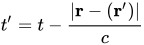
(which can be rearranged to , showing how the positions and times of source and observer are causally linked).

A related concept is the advanced time ta, which takes the same mathematical form as above, but with a “+” instead of a “−”:
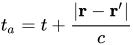
This is the time it takes for a field to propagate from originating at the present time t to a distance . Corresponding to retarded and advanced times are retarded and advanced potentials.[3]

Retarded position
[edit]The retarded position r' (the position where an EM wave emitted at the retarded time t') can be obtained from the current position of a particle by subtracting the distance it has travelled in the lapse from the retarded time to the current time. For an inertial particle, this position can be obtained by solving this equation:
- ,

where rc is the current position of the source charge distribution and v its velocity.
Application
[edit]Perhaps surprisingly - electromagnetic fields and forces acting on charges depend on their history, not their mutual separation.[4] The calculation of the electromagnetic fields at a present time includes integrals of charge density ρ(r', tr) and current density J(r', tr) using the retarded times and source positions. The quantity is prominent in electrodynamics, electromagnetic radiation theory, and in Wheeler–Feynman absorber theory, since the history of the charge distribution affects the fields at later times.
See also
[edit]References
[edit]- ^ Electromagnetism (2nd Edition), I.S. Grant, W.R. Phillips, Manchester Physics, John Wiley & Sons, 2008, ISBN 978-0471-927129
- ^ Introduction to Electrodynamics (3rd Edition), D.J. Griffiths, Pearson Education, Dorling Kindersley, 2007, ISBN 81-7758-293-3
- ^ McGraw Hill Encyclopaedia of Physics (2nd Edition), C.B. Parker, 1994, ISBN 0-07-051400-3
- ^ Classical Mechanics, T.W.B. Kibble, European Physics Series, McGraw-Hill (UK), 1973, ISBN 007-084018-0
Retarded time
View on GrokipediaCore Concepts
Definition of Retarded Time
In physics, retarded time refers to the moment at which a signal, such as an electromagnetic wave, is emitted from a source, accounting for the finite time required for the signal to propagate to an observer.[1] Formally, for a signal emitted at position and received at position at time , the retarded time is defined as where is the speed of light in vacuum.[1] This concept ensures that the observer's measurement reflects the source's state at the emission event, rather than instantaneously, due to the invariant finite propagation speed of signals.[5] The necessity of retarded time arises from the principle of causality in physical theories, which prohibits effects from preceding their causes, combined with the finite speed of light as established in special relativity.[6] In classical electrodynamics and relativity, signals cannot travel faster than , so interactions are delayed by the propagation time, preventing acausal influences.[1] This retardation enforces a temporal ordering where the source's past state determines the observed field or signal.[5] A familiar example is the observation of light from a distant star: the photons arriving at Earth today were emitted years or millennia ago, depending on the star's distance, such that the apparent position and spectrum represent the star's configuration at the retarded time .[5] For a star 10 light-years away, the light received on November 12, 2025, departed the star around November 12, 2015, illustrating how astronomical data inherently incorporate this delay.[7] Prerequisite to understanding retarded time are the concepts of light cones in Minkowski spacetime, which delineate the causal structure: the past light cone of an observation event encompasses all points from which signals can reach it at or below speed , ensuring causality by confining influences to timelike or lightlike separations.[7] Advanced time serves as the counterpart, representing hypothetical future emission times for signals arriving at the observer, though it is typically discarded in causal formulations.[1]Retarded and Advanced Times
In the context of wave propagation, advanced time is defined as the hypothetical time at which a signal would need to be emitted from a source position in the future to reach the observation point exactly at the present time , given by the formula , where is the speed of light.[8] This contrasts with retarded time, , which corresponds to emission in the past arriving at the present.[8] Both concepts arise naturally as solutions to time-dependent wave equations, reflecting the finite propagation speed of signals. The mathematical symmetry between retarded and advanced times is evident in the general solution to the homogeneous wave equation, such as d'Alembert's formula for the one-dimensional case, which can be expressed using arbitrary functions propagating forward and backward in time.[9] In three dimensions, the Green's functions for the wave operator similarly yield both retarded and advanced components, with the retarded Green's function depending on and the advanced on , both satisfying the same hyperbolic partial differential equation.[9] This duality stems from the time-reversal invariance of the underlying equations, allowing solutions that propagate signals either forward or backward along the light cone. Physically, retarded time is preferred over advanced time to uphold causality, as electromagnetic and gravitational signals are observed to propagate forward in time from cause to effect, consistent with the second law of thermodynamics and the observed arrow of time.[4] Advanced times, implying that future events influence the present, contradict empirical evidence in isolated systems and are thus discarded in standard formulations.[4] However, advanced times play a theoretical role in constructs like the Wheeler-Feynman absorber theory, where radiation from a source is modeled as a symmetric superposition of retarded waves (outgoing from past emission) and advanced waves (incoming from future absorption), ensuring overall causality through destructive interference of advanced components in the absence of perfect absorbers. In closed systems, such as a hypothetical universe with complete absorption boundaries or thermodynamic equilibrium, mixtures of retarded and advanced potentials can contribute equally to maintain time symmetry and energy conservation.[10] Nonetheless, in open universes like our own, where absorbers are incomplete and expansion dominates, the retarded solution prevails as the physically relevant choice, aligning with observed radiation patterns and the cosmological arrow of time.[10]Mathematical Foundations
Retarded Position and Coordinates
The retarded position, denoted as or , refers to the spatial location of a source (such as a particle or event) at the retarded time , which is the earlier moment when a signal emitted from that position would reach the observer's location at the observation time .[11] This concept ensures that the description of the source's state accounts for the finite propagation speed of information, typically the speed of light in vacuum.[12] Geometrically, the retarded position is determined by the intersection of the observer's past light cone—emanating backward from the observation event—with the worldline of the source.[13] In Minkowski spacetime, the past light cone consists of all points from which a light signal could reach the observer exactly at time , and the unique intersection point along the source's timelike worldline defines the retarded event, assuming no multiple crossings occur for causal trajectories.[13] This intersection enforces the light-speed limit on causal influences, distinguishing retarded descriptions from non-physical instantaneous ones. In flat spacetime, the retarded coordinate vector connecting the observer at position to the source is expressed as where is the retarded position of the source, and solves the implicit delay equation [12] This formulation arises in the context of solving wave equations for propagating disturbances, where the source's state is evaluated only at emission.[11] A representative example is the motion of a charged particle along a worldline; the retarded position at specifies where the particle was when it emitted the signal that arrives at the observer, thereby determining the relevant configuration for subsequent effects at reception. In contrast to the source's instantaneous (or present) position at , the retarded position prevents acausal influences by incorporating the propagation delay, aligning with the principle that no information can travel faster than light. In special relativity, retarded coordinates facilitate frame transformations that maintain this causal structure.[14]Formulation in Special Relativity
In special relativity, the concept of retarded time is generalized to account for the finite speed of light in the flat Minkowski spacetime, where signals propagate along null geodesics satisfying the condition . This ensures that the causal structure of spacetime is preserved, with light signals connecting events that are lightlike separated. The retarded time at which a signal is emitted from a source position to reach an observer at position and time is given by where is the speed of light. This expression arises from the null interval invariance , which remains unchanged under Lorentz transformations between inertial frames.[12][15] For a source moving along a worldline parameterized by its proper time , the retarded proper time is defined such that the emission event at is null-separated from the reception event at , satisfying . The proper time measures the invariant interval along the timelike worldline of the source, , ensuring that transforms covariantly under Lorentz boosts. This formulation maintains the invariance of retarded time across inertial frames because the spacetime interval is a Lorentz scalar.[16][15] A key consequence of this retarded formulation is its role in relativistic effects like the Doppler shift for moving sources. When observing light from a source approaching at relativistic speeds, the retarded time accounts for the changing distance during propagation, leading to a frequency shift for motion along the line of sight, where and is the emitted frequency; this arises directly from the null geodesic path in the observer's frame.[16][17]Physical Applications
In Electrodynamics and Radiation
In classical electrodynamics, the concept of retarded time is essential for describing the electromagnetic fields produced by moving charges, ensuring causality by linking the field at a point to the charge's state at an earlier time when the influence could have propagated at the speed of light. The Liénard-Wiechert potentials provide the foundational expressions for these fields in the Lorentz gauge, where the scalar potential is given by and the vector potential by with being the vector from the charge's retarded position to the observation point, the velocity at the retarded time , and the charge./10%3A_Radiation_by_Relativistic_Charges/10.01%3A_Lienard-Wiechert_Potentials) These potentials account for the finite propagation speed of electromagnetic influences, differing from static Coulomb and Biot-Savart laws by incorporating retardation effects.[18] The electric and magnetic fields are derived from these potentials using and , yielding expressions evaluated entirely at the retarded time . The general form for the electric field includes a velocity-dependent term resembling a relativistic correction to the Coulomb field and an acceleration-dependent term responsible for radiation: where , is the unit vector along , and is the acceleration at ; the magnetic field follows as .[19] These fields separate into near-field (static-like, ) and radiation () components, with all quantities determined by the source's motion at .[20] The radiation component, dominant at large distances, is proportional to the acceleration at the retarded time and falls as , carrying energy away from the source. For relativistic charges where , this term exhibits beaming: the radiation intensity peaks in a narrow cone along the velocity direction at , with the opening angle scaling as (where ), explaining observed patterns in synchrotron sources.[21] This relativistic focusing arises because the denominator becomes small when aligns with , amplifying emission forward.[22] For distributed sources, Jefimenko's equations express the fields directly as volume integrals over charge and current densities at retarded times, bypassing potentials: with a similar form for involving and , where . These equations, derived from Maxwell's equations, highlight how fields depend on the retarded history of sources, unifying point-charge and continuous cases.[23] A representative example is the radiation from an oscillating electric dipole, where the dipole moment varies harmonically. The far-field electric radiation is with the phase incorporating the retarded time delay (where ), leading to constructive interference in the equatorial plane () and nulls along the axis. This phase retardation across the dipole produces the characteristic power pattern, essential for understanding antenna radiation./07%3A_Time_Dependent_Electromagnetic_Fields./7.04%3A_An_Electric_Dipole_Radiator) The total radiated power, , scales with the fourth power of frequency, reflecting the acceleration's role at retarded times.[1]In General Relativity and Gravitation
In general relativity, retarded time is generalized to curved spacetime by defining it along the null geodesic connecting the emission event to the reception event, ensuring that signals propagate at the speed of light in the local frame. This construction accounts for the causal structure of the metric, where the retarded time at a point is determined by solving the null geodesic equation from the source worldline to the observer, often requiring numerical integration in non-stationary spacetimes.[24] Such definitions are essential for describing the propagation of gravitational influences in asymptotically flat or cosmological backgrounds.[25] In the framework of linearized gravity, retarded potentials arise as solutions to the wave equation for the metric perturbation , evaluated at the retarded time to enforce causality. The metric perturbation is expressed as an integral over sources using the retarded Green's function, analogous to electromagnetic retarded potentials but adapted to the tensor nature of gravity: , where in the weak-field limit.[26] This formulation captures the propagation of gravitational disturbances from matter and stress-energy sources.[27] For gravitational waves, the strain in the far field is dominated by the second time derivative of the quadrupole moment evaluated at retarded time, given approximately by in the transverse-traceless gauge, where and is the mass quadrupole. The transverse-traceless (TT) gauge simplifies the wave description by imposing and , isolating the two physical polarization degrees of freedom.[28] The peeling theorem further characterizes wave amplitudes near null infinity, stating that the Weyl tensor components fall off as for to , with the leading term corresponding to the radiative part observable as gravitational waves.[29] An illustrative application is in binary pulsar systems, where observed timing signals and orbital decay reflect gravitational wave emission from the retarded positions of the pulsar and companion, as the waves carry information from past configurations along null geodesics.[30] In cosmology, retarded time manifests as lookback time, the integral of along the null geodesic in an expanding universe, quantifying the light-travel delay from distant sources and enabling reconstruction of cosmic history from observed redshifts.[31]Historical Context
Origins in Classical Physics
The concept of retarded time emerged in classical physics as a way to account for the finite speed of signal propagation in wave phenomena, contrasting with instantaneous action-at-a-distance assumptions prevalent in Newtonian mechanics. Christiaan Huygens introduced foundational ideas in his 1678 memoir on light, proposing that light propagates as a wave with finite velocity, where each point on a wavefront serves as a source of secondary spherical wavelets that interfere to form the new wavefront.[32] This Huygens' principle inherently implied time delays in wave arrival, as the secondary wavelets expand at a constant speed, leading to retardation effects in the overall propagation. In the context of 19th-century wave optics, Augustin-Jean Fresnel built upon this in his 1818 diffraction theory, where the phase differences between wave paths from an aperture to the observation point effectively incorporated travel time variations, enabling accurate predictions of diffraction patterns without explicit instantaneous action. A significant application of retardation appeared in gravitational theory to resolve paradoxes of instantaneous action at a distance. In 1805, Pierre-Simon Laplace proposed that gravitational influences propagate at a finite speed, suggesting that the force between bodies should depend on their positions at retarded times, thereby stabilizing planetary orbits against perturbations that instantaneous action would cause.[33] Laplace modeled this by assuming a propagation velocity vastly exceeding light's speed, deriving that the retarded position of the attracting body determines the force direction, which mitigated issues like orbital instability in binary systems. This approach extended Newtonian gravity while preserving its inverse-square law, highlighting retardation as a mechanism for causality in long-range interactions. In electrodynamics, the idea of retarded time gained prominence through extensions of potential theory to dynamic cases involving moving charges within the luminiferous ether framework. The retarded potentials were first introduced by Ludvig Lorenz in 1867, deriving solutions to Maxwell's equations that incorporate the finite propagation speed. Building on this, J.J. Thomson in the 1880s calculated electromagnetic fields from moving charges, deriving expressions for low-velocity cases. Hendrik Lorentz further developed this in the 1890s, incorporating retarded potentials into his electron theory of matter, where interactions between moving electrons in the ether were governed by fields evaluated at retarded times to explain phenomena like dispersion and aberration. These contributions resolved inconsistencies in classical ether models by enforcing causality, paving the way for later relativistic interpretations.Development in Modern Relativity
In Albert Einstein's 1905 theory of special relativity, the concept of retarded time arose as a direct consequence of the invariance of the speed of light in vacuum, which rendered the luminiferous ether unnecessary for explaining electromagnetic propagation. By positing that light travels at a constant speed regardless of the source's motion, Einstein eliminated the need for an absolute reference frame, instead framing retardation as the time delay inherent in light signals traveling finite distances. This shift resolved paradoxes in classical electrodynamics, such as the asymmetry in electromagnetic forces between moving charges, by ensuring that interactions are evaluated at the retarded position where the signal originates.[34] Hermann Minkowski's 1908 formulation of spacetime further formalized retarded time within a four-dimensional geometric framework, introducing worldlines as trajectories of particles through spacetime and light cones to delineate causal boundaries. The retarded position of an event is defined as the intersection of the backward light cone—emanating from the observation point—with the worldline of the source, ensuring that influences propagate along null geodesics at speed . This geometric interpretation underscored the causal structure of special relativity, where only events within the past light cone can affect the present, providing a rigorous basis for computing retarded coordinates without reference to an ether.[35] Einstein's 1915 general theory of relativity extended retarded time to curved spacetime, incorporating retarded integrals into solutions of the Einstein field equations to describe propagating gravitational disturbances. In the linearized approximation for weak fields, the metric perturbation is expressed via retarded potentials, analogous to electromagnetic cases: , where the argument enforces causality for wave solutions traveling at light speed. This formulation yielded the first predictions of gravitational waves as transverse quadrupolar radiations, resolving initial errors in Einstein's 1916 analysis through harmonic gauge conditions.[36] Post-World War II developments revisited the symmetry between retarded and advanced times in John Archibald Wheeler and Richard Feynman's 1945 absorber theory, proposing that radiation arises from the interaction of both types of waves in a complete absorber-filled universe. By superposing advanced waves from absorbers with retarded waves from the source, the theory eliminates self-interaction divergences and restores Lorentz invariance, while the arrow of time emerges from initial conditions rather than fundamental asymmetry. This approach influenced later causal interpretations of electrodynamics, though it remains a theoretical construct without direct experimental validation. In the 1970s, numerical relativity simulations began incorporating retarded times to model black hole mergers, enabling the computation of gravitational waveforms from binary systems. Pioneering work by Larry Smarr in 1976 simulated head-on collisions of black holes, extracting wave signals and quantifying energy loss to radiation.[37] These efforts laid the groundwork for later full inspiral-merger-ringdown simulations, highlighting retarded time's role in enforcing causality amid strong-field dynamics. A modern extension appears in quantum field theory, where retarded Green's functions serve as causal propagators for real-time evolution, defined by contour integrals with poles shifted to ensure for . These functions underpin the computation of response functions in interacting theories, briefly relating to Feynman rules through time-ordered products in perturbation expansions, though the Feynman propagator itself combines retarded and advanced elements for vacuum expectations.[38]References
- https://en.wikibooks.org/wiki/Electrodynamics/Lienard-Wiechert_Potentials