Hubbry Logo
search
logo
2280949

Spring Lake, Michigan

logo
Community Hub0 Subscribers
Read side by side
from Wikipedia

Spring Lake is a village in Ottawa County in the U.S. state of Michigan. The population was 2,497 at the 2020 census. The village is located within Spring Lake Township; the two share a ZIP code, which also serves most of the neighboring city of Ferrysburg.

Key Information

History

[edit]

In 1837, Captain Benjamin Hopkins purchased land in the area and built a mill. The place became known as "Hopkins Mill". In 1849, Thomas W. White and S.C. Hopkins recorded a plat with the name "Mill Point". A post office was established with that name in May 1851. In May 1867, the post office was renamed "Spring Lake", which was also the name of a station on the Detroit, Grand Haven and Milwaukee Railway (later part of the Grand Trunk Western Railroad). The Village of Spring Lake was incorporated in 1869.[4] The post office continues to operate, with ZIP code 49456.

Geography

[edit]

According to the United States Census Bureau, the village has a total area of 1.74 square miles (4.51 km2), of which 1.18 square miles (3.06 km2) is land and 0.56 square miles (1.45 km2) is water.[5]

Demographics

[edit]
Historical population
CensusPop.Note
1860179
18701,156545.8%
18801,37218.7%
18901,168−14.9%
1900696−40.4%
191080215.2%
192097821.9%
19301,27130.0%
19401,3294.6%
19501,82437.2%
19602,06313.1%
19703,03447.1%
19802,731−10.0%
19902,537−7.1%
20002,514−0.9%
20102,323−7.6%
20202,4977.5%
U.S. Decennial Census[6]

2010 census

[edit]

As of the census[7] of 2019, there were 2,390 people, 1,107 households, and 963 families living in the village. The population density was 1,968.6 inhabitants per square mile (760.1/km2). There were 1,301 housing units at an average density of 1,102.5 per square mile (425.7/km2). The racial makeup of the village was 96% White, 3% African American, 0.2% Native American, 0.3% Asian, 0.1% Pacific Islander, 0.6% from other races, and 1.3% from two or more races. Hispanic or Latino of any race were 1.8% of the population.

There were 1,067 households, of which 25.8% had children under the age of 18 living with them, 48.5% were married couples living together, 8.3% had a female householder with no husband present, 2.7% had a male householder with no wife present, and 40.5% were non-families. 36.1% of all households were made up of individuals, and 17.6% had someone living alone who was 65 years of age or older. The average household size was 2.17 and the average family size was 2.84.

The median age in the village was 44.8 years. 21.6% of residents were under the age of 18; 6.3% were between the ages of 18 and 24; 22.5% were from 25 to 44; 29.1% were from 45 to 64; and 20.5% were 65 years of age or older. The gender makeup of the village was 47.0% male and 53.0% female.

2000 census

[edit]

As of the census[2] of 2000, there were 2,514 people, 1,098 households, and 666 families living in the village. The population density was 2,372.4 inhabitants per square mile (916.0/km2). There were 1,248 housing units at an average density of 1,177.7 per square mile (454.7/km2). The racial makeup of the village was 98.05% White, 0.32% African American, 0.44% Native American, 0.24% Asian, 0.36% from other races, and 0.60% from two or more races. Hispanic or Latino of any race were 1.31% of the population.

There were 1,098 households, out of which 25.3% had children under the age of 18 living with them, 50.5% were married couples living together, 7.6% had a female householder with no husband present, and 39.3% were non-families. 36.0% of all households were made up of individuals, and 17.7% had someone living alone who was 65 years of age or older. The average household size was 2.16 and the average family size was 2.84.

In the village, the population was spread out, with 20.7% under the age of 18, 5.2% from 18 to 24, 25.7% from 25 to 44, 21.9% from 45 to 64, and 26.5% who were 65 years of age or older. The median age was 44 years. For every 100 females, there were 84.2 males. For every 100 females age 18 and over, there were 79.2 males.

The median income for a household in the village was $37,889, and the median income for a family was $44,797. Males had a median income of $34,293 versus $23,986 for females. The per capita income for the village was $26,372. About 4.6% of families and 6.1% of the population were below the poverty line, including 6.8% of those under age 18 and 4.2% of those age 65 or over.

Education

[edit]

K–12 public education is provided by the Spring Lake Public School District, which includes Spring Lake High School.[8]

Notable people

[edit]

References

[edit]
[edit]
Revisions and contributorsEdit on WikipediaRead on Wikipedia
from Grokipedia
Spring Lake is a village in Ottawa County, Michigan, United States, situated on a peninsula between the namesake Spring Lake and the Grand River, offering residents and visitors direct access to waterfront recreation including a municipal boat launch, sandy beaches, fishing platforms, and canoe and kayak launches.[1] Incorporated in 1869, the village has a total area of 1.74 square miles and is part of Spring Lake Township, with a population of 2,497 as of 2024.[1][2][3] The area was originally inhabited primarily by the Ottawa, Chippewa, and Potawatomi tribes in the early 19th century and settled by European pioneers starting in 1837, with early developments including sawmills and frame houses that supported the region's lumber industry.[1][4] Geographically, Spring Lake lies about 25 miles northwest of Grand Rapids and minutes from Lake Michigan's shoreline, contributing to its appeal as a suburban community with a dense, walkable layout featuring parks, trails, and a 12-mile bicycle loop around the lake.[5] The village's economy centers on local retail, dining, and services, with over 15 restaurants, diverse shops ranging from art galleries to hardware stores, and proximity to tourism-driven activities in nearby Grand Haven.[1] Education is provided by the highly rated Spring Lake Public Schools district, which serves the village and surrounding areas with elementary, middle, and high schools emphasizing strong academic performance and extracurricular programs.[6] Notable community features include enhanced pedestrian infrastructure through Safe Routes to School initiatives and a commitment to preserving historical sites via the Spring Lake Historic Conservation Commission.[1][7]

History

Early settlement

Prior to European settlement, the area around Spring Lake was inhabited by Native American tribes, including the Ottawa, Potawatomi, and Chippewa, with evidence of Paleo-Indian presence dating back 10,000 years. Land cessions through treaties in 1821 and 1836 facilitated American expansion into the region.[4][8] The area now known as Spring Lake, Michigan, began to see European-American settlement in 1837, when Captain Benjamin Hopkins arrived from Canada and constructed the first sawmill on the southern banks of the lake, leading locals to refer to the site as Hopkins Mill.[4][8] That same year, other early pioneers including Jabez Barber and Richard Mason also fled to the region from Canada amid the unrest of the Upper Canada Rebellion, also known as Mackenzie's Rebellion, and soon contributed to the burgeoning lumber industry by partnering to build the Barber Mill in 1844 at what became a key milling hub.[1][8] These settlers, drawn by the abundant timber resources and access to water transport via the Grand River and Lake Michigan, laid the groundwork for the community's economic foundation in logging and milling.[4] By 1849, as more families arrived and the settlement expanded, the name shifted to Mill Point to reflect the concentration of sawmills and industrial activity along the waterfront, with the plat formally recorded that year by Silas C. Hopkins and Thomas W. White.[8][9] The prominence of the spring-fed lake, fed by numerous natural springs that shaped the local landscape and supported early water-powered operations, prompted another renaming in 1867 to Spring Lake, officially adopted on May 28 of that year to better capture the area's defining geographic feature.[8][4] The post office, initially established in 1851 under the Mill Point name with Le Moyne S. Smith as the first postmaster, transitioned alongside the community and continues to serve residents today under the Spring Lake designation with ZIP code 49456.[8][9] This postal milestone facilitated communication and commerce for the growing population of farmers, mill workers, and traders in the mid-19th century.[1]

Incorporation and development

Spring Lake was formally incorporated as a village on March 4, 1869, within Ottawa County, Michigan, following the platting of the area as Mill Point two decades earlier.[1][10] This establishment marked the transition from informal settlement to organized municipal governance, spurred by the lumber industry's expansion along the Spring Lake waterway. The village's early economy relied heavily on this sector, with infrastructure developments supporting resource extraction and transport. A major setback occurred in 1871 when the Haire & Cole Sawmill fire destroyed much of the village, leaving 70 families homeless, though the community rebuilt amid ongoing industrial activity.[8] In the late 19th century, Spring Lake saw significant infrastructural growth tied to its lumber and agricultural potential. By 1874, the village hosted nine sawmills—some of the largest on the river—along with two planing mills and a sash and door factory, processing vast quantities of timber from surrounding forests.[9] Key facilities included the Barber Mill, established in 1844 but integral to post-incorporation operations, and the Nortonville mill of White, Friant & Co., which by 1881 had a daily capacity of 200,000 board feet powered by a 400-horsepower engine. Transportation improvements complemented this, such as the 1866 Interurban Bridge over the Grand River, which facilitated access to Grand Haven and enhanced trade routes; it was later reinforced in 1903. The Detroit, Grand Haven & Milwaukee Railway, running east-west through the village, further connected Spring Lake to broader markets, while fruit cultivation emerged as a secondary industry, with half of the improved land dedicated to orchards by the mid-1870s.[9][10] The 20th century brought shifts from industrial dominance to residential and suburban expansion, influenced by Spring Lake's strategic location near Grand Haven and within commuting distance of Grand Rapids via I-96. Population growth reflected this transition, peaking at 3,034 in 1970 before a slight decline to 2,323 by 2010, driven by post-World War II housing booms that saw nearly 75% of existing structures built before 1980.[11] Suburban development emphasized single-family homes and higher-density options like condominiums, aligning with regional trends in the "Golden Triangle" metropolitan area encompassing Grand Rapids, Muskegon, and Holland. Industries such as the Verplank Dock Company, founded in 1908, persisted into the century, but tourism and residential appeal grew, with resort hotels adapting to maintain viability.[11][12] Preservation efforts have sustained the village's historical character amid modernization. The Historic Conservation Commission, established by the Village Council in 1995, oversees a district encompassing the entire village to protect pre-1980 structures through reviews of alterations, demolitions, and restorations.[13] It maintains a roster of landmarks, promotes rehabilitation projects, and accepts grants for conservation, exemplified by the relocation and adaptive reuse of the 1844 Barber School in 1987 for community meetings. This framework ensures that sites reflecting Spring Lake's lumber-era and small-town heritage remain integral to its identity.[13][10]

Geography and environment

Physical features

Spring Lake is situated in Ottawa County, Michigan, entirely within the boundaries of Spring Lake Township. The village lies along the western shore of the state, near Lake Michigan to the west, with the Grand River separating it from the lakeshore, and adjacent to the city of Grand Haven to the south. Its central geographic coordinate is approximately 43°04′37″N 86°11′49″W, with an average elevation of 597 feet (182 m) above sea level.[14][15] According to the U.S. Census Bureau, the village covers a total area of 1.74 square miles (4.51 km²), consisting of 1.18 square miles (3.06 km²) of land and 0.56 square miles (1.45 km²) of water. This water component primarily reflects the village's shoreline along Spring Lake and portions of the Grand River. The terrain features a gentle slope from the inland areas toward the lakefront, characteristic of the broader Lake Michigan coastal plain.[16] The defining natural feature is Spring Lake itself, a spring-fed inland body of water roughly 4 miles long and covering about 1,091 acres (4.42 km²), with an average depth of 18 feet (5.5 m). The lake connects directly to Lake Michigan via the Grand River, facilitating water exchange and supporting a diverse aquatic ecosystem. Surrounding the village are wetlands that serve as buffers along the lake's irregular shoreline, which exceeds 25 miles in total length, and coastal dunes that form part of the regional dune complex along Lake Michigan's eastern shore. These elements contribute to the area's ecological richness, including habitats for native flora and fauna adapted to the freshwater littoral zone, with nearby protected areas such as Duncan Woods Nature Preserve enhancing conservation efforts.[17][18] The village's boundaries are coterminous with its incorporation limits, fully enclosed by Spring Lake Township, creating a transitional landscape that blends compact residential and commercial zones with adjacent agricultural and wooded rural expanses. This setting underscores the community's position at the interface of developed waterfront and preserved natural hinterlands.[19]

Climate

Spring Lake experiences a humid continental climate classified as Köppen Dfb, characterized by cold, snowy winters and warm, humid summers.[20] The average annual temperature is approximately 50°F (10°C).[21] July, the warmest month, typically sees average highs of 80°F (27°C), while January, the coldest, has average lows around 20°F (-7°C).[22] Annual precipitation totals about 36 inches (914 mm), distributed relatively evenly throughout the year, with snowfall averaging 70-80 inches (178-203 cm) due to lake-effect snow from nearby Lake Michigan.[23] Winters are marked by frequent snow events and windy conditions, often influenced by Great Lakes storms that can bring heavy accumulations and gusty winds.[24] Springs and falls are mild transitional seasons, with increasing or decreasing temperatures and occasional rain, though the proximity to Lake Michigan helps moderate extremes by keeping coastal areas slightly warmer in winter and cooler in summer.[23]

Government and administration

Local government structure

Spring Lake, Michigan, operates under a council-manager form of government, established by its village charter ratified in 1997, which combines elected officials' policy-making authority with professional administration led by an appointed village manager.[25] The elected Village Council serves as the legislative body, overseeing major decisions on budgeting, ordinances, and community priorities, while the manager handles administrative functions such as personnel and operations.[25] This structure emphasizes efficient governance and community input, aligning with Michigan's home rule provisions for villages.[25] The Village Council comprises seven members: a president and six trustees, all elected at-large from the village in nonpartisan elections held during the November general election in even-numbered years.[26][25] The president, who presides over meetings and represents the village in official capacities, serves a two-year term, while trustees serve staggered four-year terms to ensure continuity.[27] The Village Clerk/Treasurer, responsible for record-keeping, financial reporting, elections administration, and serving as secretary to the council, is appointed by the Village Council based on the village manager's recommendation rather than being elected.[28] As of November 2025, Mark Powers holds the position of Village President, with his term expiring in December 2026.[26] Supporting the council are several key advisory bodies that inform policy on land use and development. The Planning Commission, consisting of appointed residents and council liaisons, develops and updates the village master plan, reviews site plans for commercial and industrial projects, and recommends zoning ordinance changes to guide sustainable growth.[29] The Downtown Development Authority (DDA), established in 1980, focuses on revitalizing the downtown district through public improvements, tax increment financing, and promotion of local businesses to attract investment.[30] The Historic Conservation Commission, made up of seven village residents, identifies and designates historic structures, offers educational programs on preservation, and advises on maintaining the community's heritage.[7] These commissions typically meet monthly—the Planning Commission on the fourth Tuesday, the DDA on the second and fourth Thursdays, and the Historic Conservation Commission on the fourth Monday—with agendas and minutes available publicly.[29][30][7] The council convenes for work sessions on the second Monday and regular meetings on the third Monday of each month, both open to the public, to deliberate on issues like zoning approvals and community development initiatives.[26] In 2025, under the current administration, these bodies have emphasized balanced growth, including zoning updates to support residential and commercial needs while protecting natural and historic assets.[31]

Public services

Spring Lake's public safety services are provided through contracts with external agencies to ensure comprehensive coverage. The Ottawa County Sheriff's Office delivers 24/7 law enforcement services to the village, including patrol, investigations, and community policing, with non-emergency contact available at (616) 215-1595.[32] Fire protection is handled by the Spring Lake Fire Department, which operates from stations in the area and responds to emergencies, medical calls, and fire prevention activities, reachable at (616) 215-1590 for non-emergencies.[33] The Department of Public Works manages infrastructure maintenance, including road repairs and street upkeep, overseen by village staff for efficient operations. In 2025, a major infrastructure project commenced on March 17, involving reconstruction and improvements on several streets including North Park Street, Summit Street, South Street, South Park Street, Monarch Street, Dixie Street, and Rex Street, with work continuing through November 2025 to address aging subterranean systems like sewers and water mains, concluding on November 13.[34][35] Water and sewer utilities are operated by dedicated village divisions on a fee-for-service model, providing potable water distribution and wastewater collection to residents and businesses, with after-hours emergency support at (616) 844-2104.[36] Bills for these services can be paid online, ensuring accessible management of utility accounts.[37] Waste management and recycling are contracted to Republic Services, which handles weekly trash collection, bi-weekly recycling pickup, and yard waste services for village residents, with a quarterly rate of $63.39 effective January 1, 2025.[38] The program emphasizes sorting recyclables like plastics, paper, glass, and metals to promote environmental sustainability in line with Ottawa County guidelines.[39] Facility rentals support community gatherings through the village's online reservation system, allowing bookings for pavilions at parks like Tanglefoot Park—suitable for weddings and reunions—and transient docks for boating access, along with boat launch fees.[40][41] Community support includes emergency management coordinated through the Ottawa County Emergency Operations Center, which serves as the focal point for disaster response and follows the Michigan Emergency Management Plan, with village procedures aligned for local implementation.[42][43] Accessibility initiatives feature elements like the universally accessible kayak launch at Tanglefoot Park, enhancing inclusive use of public facilities, while the fire department offers emergency notification forms to assist residents with access needs during crises.[41][33]

Demographics

2020 census

As of the 2020 United States Census, Spring Lake village, Michigan, had a total population of 2,497 residents.[44] This represented a growth of 174 people, or 7.5%, from the 2,323 residents recorded in the 2010 Census, reflecting stable population trends over the decade.[44] The population density stood at 1,997.6 persons per square mile across the village's land area of 1.25 square miles.[45] Demographically, the village was predominantly White (Non-Hispanic) (93.6%), with Two or More Races accounting for 2.7%, Hispanic or Latino individuals (of any race) comprising 1.8%, Asian residents 0.8%, and other racial and ethnic groups forming the remaining portion of the population.[46] The median age among residents was 44.8 years. In terms of household composition, there were 1,020 households in Spring Lake, with an average household size of 2.4 persons. Approximately 65% of the occupied housing units were owner-occupied.

Socioeconomic characteristics

Spring Lake residents enjoy a relatively affluent socioeconomic profile, with a median household income of $75,000 based on 2023 estimates and an average annual household income of $114,097.[46][47] The per capita income stands at $50,851, reflecting strong individual earnings in the community.[48] These figures contribute to a low poverty rate of approximately 7.9%, which is below the state average, alongside an unemployment rate of around 2%, indicating robust labor market conditions.[47][49] Educational attainment in Spring Lake is notably high, with 95% of residents aged 25 and older having graduated from high school or obtained an equivalent credential, surpassing national benchmarks.[49] Furthermore, about 42% of the adult population holds a bachelor's degree or higher, underscoring a well-educated populace that supports professional and knowledge-based occupations.[49][47] Housing in Spring Lake reflects its desirable lakeside location, with a median home value of $271,100 and an average monthly rent of $1,184, both indicative of a stable real estate market as of 2023.[46][50] The community maintains low vacancy rates, particularly for rental units, which helps sustain housing affordability amid growing demand from families and retirees.[47]

Economy

Overview and employment

Spring Lake, Michigan, functions primarily as a residential suburb of Grand Rapids, located approximately 25 miles northwest of Grand Rapids, with many residents commuting for work. The village supports a stable population of about 2,530 as of 2023.[46] The local economy features a labor force of roughly 1,400 employed residents, with an unemployment rate aligning with Ottawa County's 3.5% in 2023, aligning with the county's low jobless figures. Common occupations among residents include office and administrative support, management, and production roles, while key industries encompass manufacturing, health care and social assistance, and professional, scientific, and technical services.[46][51][46] Proximity to Lake Michigan drives economic activity through tourism, complemented by small local businesses fostered by the Village of Spring Lake Downtown Development Authority, which promotes public improvements to attract private investment. Following post-2020 recovery, employment grew by 3.95% from 2022 to 2023, and median household income rose from $71,813 to $75,000.[30][46]

Tourism and local business

Spring Lake serves as Michigan's best-kept secret for lakeside getaways, drawing visitors seeking a serene escape with access to water activities, sandy beaches, and scenic pathways.[52] The village attracts tourists from nearby areas like Grand Haven through its 12-mile Spring Lake loop, a paved path ideal for biking and walking that encircles the lake and offers views of woodlands and waterfronts.[52] This loop integrates with broader regional trails, enhancing its appeal for outdoor enthusiasts exploring the Grand Haven area.[5] Local businesses in Spring Lake thrive on tourism, supported by the Downtown Development Authority (DDA), which focuses on public improvements to foster private investment and revitalize the downtown district.[30] The downtown area features a mix of boutique shops, restaurants, and seasonal vacation rentals, catering to visitors year-round but peaking in summer with waterfront dining and lodging options.[1] Transient docks along the lake provide short-term mooring for boaters, facilitating access to marinas and enhancing the boating economy with slips available from April through fall.[53] These amenities, including public boat launches and floating docks for rent, support a vibrant commercial scene tied to recreational boating.[40] Tourism in Spring Lake contributes to Michigan's broader Great Lakes economy, where visitor spending generated $54.8 billion in total economic impact statewide in 2024, supporting over 351,000 jobs.[54] providing seasonal boosts through outdoor recreation like trail use and water sports that sustain local commerce during peak months.[55] Recent infrastructure developments underscore efforts to enhance tourism appeal, such as the 2025 repair project on the Tri-City Connector Path, which links Spring Lake to Grand Haven and Ferrysburg.[56] The path underwent a full closure from September 2 to October 15, 2025, for resurfacing and improvements, aiming to improve safety and accessibility for cyclists and pedestrians in this key connector to regional attractions.[56]

Education

Public school system

Spring Lake Public Schools is the public school district serving the village of Spring Lake, Michigan, and surrounding areas in Ottawa County, encompassing grades pre-K through 12 with an enrollment of 2,297 students as of the 2024-25 school year across six schools.[57] The district maintains a student-to-teacher/paraprofessional ratio of 11:1, with 85% of students residing within district boundaries and 15% attending via school-of-choice programs.[6] The district operates two elementary schools—Holmes Elementary School (pre-K to 4, serving 420 students) and Jeffers Elementary School (pre-K to 4, serving 368 students)—along with Spring Lake Intermediate School (grades 5-6), Spring Lake Middle School (grades 7-8), Spring Lake High School (grades 9-12), and Spring Lake Alternative High School (grades 9-12). Holmes and Jeffers emphasize foundational academics alongside enrichment in arts, music, STEM, and physical education to foster well-rounded development. At the intermediate and middle levels, the curriculum builds study habits, resilience, and core skills in math, language arts, health, applied arts, and foreign languages, preparing students for high school rigor. Spring Lake High School prioritizes academic excellence, artistic exploration, and student well-being, with 92% of students participating in after-school activities and 58% enrolled in Advanced Placement courses.[58][59][60][61][62] Academically, the district outperforms state averages, with 79% of elementary students proficient in reading and math on the Michigan Student Test of Educational Progress (M-STEP), and 78% proficient in reading and 76% in math at the intermediate level based on 2023-2024 data. Spring Lake Public Schools ranked among Michigan's top districts in recent state assessments, reflecting strong performance in STEM and arts-integrated programs. The high school boasts a 99% graduation rate, with nearly all graduates pursuing college, apprenticeships, military service, or the workforce.[57][63][64][6][65] Governance is provided by a seven-member Board of Education, with members elected at-large to staggered six-year terms, overseeing district operations and policy. Funding derives primarily from local property taxes, including an operating millage of 18 mills on non-homestead properties renewed by voters in May 2025, supplemented by state aid through the per-pupil foundation allowance of $10,050 as of the 2025-26 school year, as part of Michigan's School Aid Fund. The district's 2024-2025 budget supports academic supports via the Multi-Tiered System of Supports (MTSS) framework for both instruction and behavior.[66][67][68][69][70]

Community educational resources

The Spring Lake District Library serves as a primary educational resource for residents, housing a collection of approximately 83,000 items that includes physical books, DVDs, Blu-rays, CDs, audiobooks, ebooks, newspapers, and magazines.[71] It offers free public access to digital resources and hosts a variety of community programs, such as STEAM workshops for youth, adult crafting sessions like crocheting groups, and literacy-focused events including storytimes and summer reading initiatives.[72] Additionally, the library provides practical support for adult learners through individual assistance with resumes and cover letters, a mentor program, and referrals to ESL and GED preparation classes available via local partnerships.[73] For adult and continuing education, Spring Lake residents benefit from proximity to Grand Valley State University (GVSU), located approximately 15 miles away in Allendale, Michigan, which offers extension courses and professional development programs through its Center for Adult and Continuing Studies.[74] These include noncredit options for skill refreshment, license renewal, and career advancement, accessible to community members seeking flexible learning opportunities beyond traditional schooling.[75] While not formal partnerships specific to Spring Lake, GVSU's programs emphasize accessibility for regional adults, including online and hybrid formats. The Village of Spring Lake's Historic Conservation Commission further enriches community education by providing programs that promote awareness of local history and preservation efforts.[7] These initiatives include workshops and advisory sessions focused on the historical significance of area structures, fostering historical consciousness among residents through free, public-facing educational activities.[13] Overall, these resources prioritize inclusive, no-cost access to literacy enhancement and cultural learning, supporting lifelong education in the community.

Recreation and culture

Parks and outdoor recreation

Spring Lake offers a variety of waterfront parks managed by the Village of Spring Lake, providing residents and visitors with access to scenic areas for relaxation and family activities. Key parks include Mill Point Park and Tanglefoot Park, both featuring rentable pavilions suitable for picnics, weddings, and community events. These facilities emphasize accessibility and natural beauty, with amenities like grills, playgrounds, and restrooms to support outdoor gatherings.[76][41] Mill Point Park, located at the end of School Street, includes a bandshell pavilion available for rent at a nominal fee, along with picnic areas, a playground, and a nature preserve ideal for quiet exploration. The park provides direct water access to Spring Lake via a public boat launch, where village residents receive free seasonal passes upon registration, while non-residents pay $70 annually. Fishing platforms and ample parking enhance its appeal for casual outings. Tanglefoot Park, situated along the Grand River, features a modern pavilion with a catering kitchen and glass garage doors that can accommodate up to 299 people for events; it also includes a splash pad open from 10:00 a.m. to 8:00 p.m. during the season. Transient boat docks here are available on a first-come, first-served basis for $10 per day, limited to vessels up to 30 feet with no overnight mooring.[76][41][41] The village maintains an extensive trail system, highlighted by the 12-mile paved Lakeside Trail loop encircling Spring Lake, which supports biking, walking, and birdwatching year-round. This multipurpose path connects waterfront parks and offers restrooms at stops like Central Park, with LED lighting and winter snow removal for continued use. Complementing this is the Tri-City Connector Path, a recreational trail linking Spring Lake to Grand Haven and Ferrysburg across the Grand River, facilitating regional exploration by cyclists and pedestrians. In 2025, the village completed improvements to the Tri-City Connector, including a full closure from September 2 to mid-October for repairs to enhance safety and durability.[52][77][56][78] Water-based recreation is a cornerstone of the area's appeal, with public access points for fishing, kayaking, and swimming along Spring Lake's shores. Kayak launches, including a universally accessible one at Tanglefoot Park, allow easy entry for paddling, while a self-service rental kiosk provides on-site options. Swimming is popular at the sandy Lakeside Beach, and boating is supported by municipal launches and transient slips. During winter, when conditions permit, ice skating occurs on frozen sections of the lake near North Bank Park (formerly Central Park), drawing locals for seasonal enjoyment. These activities contribute to tourism, bolstering local businesses through visitor spending on rentals and events.[5][41][77]

Historic and cultural sites

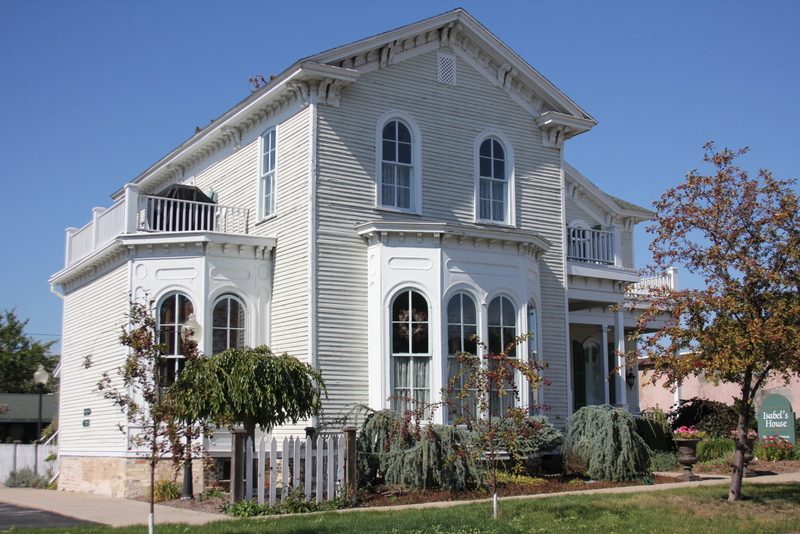
Spring Lake, Michigan, features several preserved historic structures and sites that reflect its 19th-century origins as a lumber and resort community. The Aloys Bilz House, located at 107 South Division Street, stands as a prominent example of late Victorian architecture and was constructed around 1890 for Aloys Bilz, a local businessman involved in real estate and merchandise.[79] This private residence was added to the National Register of Historic Places in 1987 under criterion C for its architectural significance, highlighting features typical of the period such as asymmetrical massing and decorative elements.[79] A historical marker at the site, placed by the Michigan Historical Commission, notes its role in the village's development during the late 1800s.[80] Remnants and markers of early sawmills, central to Spring Lake's settlement in the 1840s, are preserved as interpretive sites along the lakeshore. The original mill site, established by settlers like John H. Newcomb who built the area's first frame house and operated a sawmill, has been commemorated through plaques and exhibits that trace the lumber industry's impact on the community's growth.[1] These sites, including references to the Hopkins sawmill where magnetic mineral waters were discovered in the 1860s, underscore the transition from industrial logging to resort tourism.[81] The Village of Spring Lake's Historic Conservation Commission plays a key role in safeguarding these assets, established under local ordinance to review alterations to historic properties and accept grants or donations for preservation efforts.[13] In 2025, the commission recognized the rehabilitation of five village buildings, demonstrating its ongoing commitment to maintaining architectural heritage.[82] Cultural landmarks include the Spring Lake Historical Society Museum, which collects and displays artifacts from the area's pioneer era, including tools and documents related to lumber operations and early resorts.[12] Complementing this is the Tri-Cities Historical Museum, serving Spring Lake alongside Grand Haven and Ferrysburg, with exhibits on Native American history, fur trade, and lumberjacking through interactive displays and period artifacts.[83] Annual events tied to this heritage, such as the Spring Lake Historical Society's house tour—held since the 1980s and featuring self-guided visits to preserved homes like the Bilz House—foster public engagement with local history.[84] These initiatives, including plaque installations at key sites, enhance tourism by drawing visitors to explore the village's preserved landscape and strengthen community identity rooted in its industrial past.[84]

Notable residents

Artists and creators

Winsor McCay, born Zenas Winsor McCay (c. 1867–1934), who was raised in Spring Lake, Michigan, emerged as a pioneering animator and cartoonist whose early years in the village shaped his artistic beginnings.[85] Growing up in a lakeside community, McCay honed his drawing skills locally before moving to larger cities, where he created the influential comic strip Little Nemo in Slumberland in 1905, renowned for its innovative use of color, perspective, and dreamlike narratives.[86] His boyhood home in Spring Lake, from 1867 to around 1885, provided a serene environment that echoed in the fantastical, exploratory themes of his work, as explored in accounts of his formative years.[87] In the contemporary sphere, Orion Story, born Chance Lambert and raised in Spring Lake, has gained recognition as a drag performer and entertainer, marking a milestone as Michigan's first contestant on RuPaul's Drag Race in season 14 (2022).[88] Drawing from her upbringing in the area, Story's performances blend bold creativity with personal storytelling, contributing to the visibility of queer artists from small-town Michigan backgrounds.[89] Spring Lake's cultural scene has also nurtured other local creators, such as singer-songwriter John Mulder, who resided in the village and produced acoustic folk music inspired by themes of healing and community, including a 2020 album collaborating with hospice workers.[90] Similarly, painter Christi M. Dreese, a lifelong resident, captures the lakeshore's natural beauty in her impressionist oil works, reflecting the village's tranquil waterfront in pieces that emphasize light and movement.[91] These artists, alongside McCay and Story, illustrate how Spring Lake's picturesque setting and supportive community have influenced creative output, from early 20th-century animation to modern performance and visual arts.[92]

Politicians and public figures

Charles Augustus Boyle, born in Spring Lake, Ottawa County, Michigan, on August 13, 1907, served as a Democratic U.S. Representative from Illinois's 12th congressional district from 1955 until his death in 1959.[93] After attending local schools in Spring Lake and later moving to Chicago, Boyle practiced law and entered politics, winning election to the House in 1954 following the death of incumbent Noah M. Mason.[93] During his tenure, he focused on labor issues and urban development, reflecting his background as a lawyer representing working-class constituents in Chicago's north side.[94] Boyle died in an automobile accident in Chicago on November 4, 1959.[94] Lydia Jane Newcomb Comings, an early resident born in Spring Lake, Michigan, on July 25, 1850, emerged as a prominent 19th-century educator, lecturer, and advocate for women's rights. As a teacher and superintendent in Michigan's public schools, she promoted physical education and progressive teaching methods, later establishing innovative schools in Alabama emphasizing child-centered learning.[95] Comings actively supported woman suffrage, participating in Michigan's reform movements through organizations like the Women's Christian Temperance Union, where she served as state superintendent of physical culture in the 1890s.[96] Her advocacy extended to national efforts, including correspondence on equal suffrage conventions in the early 20th century, contributing to the broader push for women's voting rights.[97] Comings co-founded the Michigan Woman's Press Club and co-authored historical works on suffrage, dying on September 21, 1946, in Fairhope, Alabama.[95]

References

User Avatar
No comments yet.