Hubbry Logo
PostmasterPostmasterMain
Open search
Postmaster
Community hub
Postmaster
logo
8 pages, 0 posts
0 subscribers
Be the first to start a discussion here.
Postmaster
Postmaster
from Wikipedia
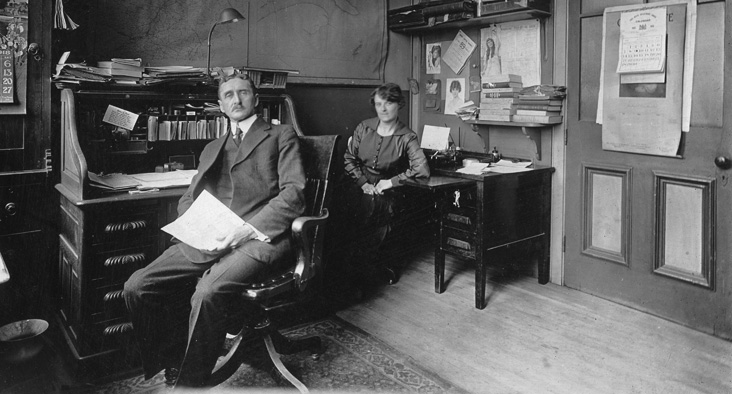
The postmaster of Sherbrooke, Quebec, in 1918

A postmaster is the head of an individual post office, responsible for all postal activities in a specific post office. When a postmaster is responsible for an entire mail distribution organization (usually sponsored by a national government), the title of Postmaster General is commonly used. Responsibilities of a postmaster typically include management of a centralized mail distribution facility, establishment of letter carrier routes, supervision of letter carriers and clerks, and enforcement of the organization's rules and procedures. The postmaster is the representative of the Postmaster General in that post office.[1]

In Canada, many early places are named after the first postmaster.[citation needed]

History

[edit]

In the days of horse-drawn carriages, a postmaster was an individual from whom horses and/or riders (known as postilions or "post-boys") could be hired. The postmaster would reside in a "post house".[2]

The first Postmaster General of the United States was the notable founding father Benjamin Franklin.

United States

[edit]

An appointed position, postmasters were prized offices for political party members as they helped keep your political representatives in power.[3] The appointment and removal of most postmasters was handled by the First Assistant United States Postmaster General in Washington, D.C., while postmasters who earned more than $1,000 annually were nominated by the president of the United States and confirmed by the U.S. Senate.[4] The system was often a patronage system, whereby the postmasters would get jobs in an informal way by the party in power.[5]

Historically in the United States, women served as postmasters since the American Revolutionary War and even earlier, under British rule, more than a century before they won the right to vote. The wave of female postmasters appointed during the late 19th century had been a crucial element for women's broader entry into the federal government system.[citation needed]

Many postmasters are members of a management organization that consults with the United States Postal Service (USPS) for compensation and policy. On November 1, 2016, the two organizations, the National Association of Postmasters of the United States (NAPUS) and the National League of Postmasters, merged to form the United Postmasters and Managers of America (UPMA).[6]

Level of pay is based on deliveries and revenue of the post office. Levels are from EAS (Executive and Administrative Service) 18 through 26. Smaller remotely managed post offices no longer have postmasters and report to a nearby larger office. Larger metropolitan post offices are PCES (Postal Career Executive Service).[citation needed]

Notable postmasters

[edit]

See also

[edit]

References

[edit]
[edit]
Revisions and contributorsEdit on WikipediaRead on Wikipedia
from Grokipedia
A postmaster is the head of an individual post office, responsible for managing all postal operations within that facility, including mail distribution, delivery, collection, window services, and retail transactions. In this role, the postmaster supervises staff, ensures adherence to operational standards, and handles administrative duties such as budgeting and compliance with postal regulations. Postmasters oversee facilities of varying sizes, from small rural or part-time post offices providing basic and delivery services to larger operations with extensive distribution . They may also manage remotely supervised units or contract routes, adapting to local mail volumes and service demands while maintaining and in handling correspondence and parcels. Historically, in the United States, postmaster positions were political appointments from 1832 until 1971, granting appointees considerable local authority and influence as custodians of federal funds and communications. This system ended with the Postal Reorganization Act of 1970, transitioning selections to a merit-based process under the U.S. Postal Service to prioritize operational competence over patronage. The role remains essential to the postal system's functionality, embodying the intersection of public service, logistics, and community connectivity.

Role and Responsibilities

Definition and Scope

A postmaster is the head official responsible for managing the operations of a specific post office or postal facility, including the handling, distribution, and delivery of mail. This role encompasses oversight of retail services such as stamp sales and package acceptance, as well as administrative functions like budgeting and compliance with postal laws. In smaller facilities, the postmaster may directly perform duties like sorting mail, while in larger ones, they delegate to subordinates while retaining ultimate accountability. The scope of a postmaster's typically includes supervising staff, establishing delivery routes, and resolving operational issues to maintain service , though it is bounded by national policies and regulations. For instance, postmasters must accurate mail to meet delivery standards and inquiries or complaints, often coordinating with higher postal for variances. Historically and in rural areas, this extended to broader postal needs, such as authorizing auxiliary mail collection points beyond the main , reflecting the role's to demands while adhering to centralized directives. The position's demands vary by facility size, with larger operations requiring skills in labor management and financial reconciliation.

Core Duties

The primary responsibilities of a postmaster encompass the overall operation of a post office, including the coordination of mail distribution, delivery, collection, and retail window services such as sales of postage stamps, money orders, and philatelic items. This involves direct or indirect supervision of carriers, clerks, and subordinate staff to ensure efficient processing and adherence to service standards, including sorting incoming and outgoing mail, establishing carrier routes, and managing variances in operational performance. Postmasters must also oversee administrative and financial aspects, such as preparing budgets, reconciling labor costs, handling hiring and of personnel, and maintaining inventory of supplies and . They are tasked with ensuring compliance with postal laws, protocols, and standards, including resolving complaints and providing on postal regulations. In smaller offices, postmasters may perform hands-on tasks like mail handling, while in larger facilities, emphasis shifts to and coordination with higher-level postal authorities. Additionally, postmasters bear for facility , of and funds, and promotion of revenue-generating services like parcel and , all while fostering to meet national postal objectives. These duties demand a balance of logistical oversight and to sustain in the postal system's reliability and . Postmasters oversee the of postal facilities, including the of subordinate staff, of service standards for and delivery, and of resources to operational variances. They are responsible for adhering to established guidelines, such as those outlined in position descriptions that emphasize program execution within budgetary and procedural constraints. In terms of financial management, postmasters maintain accountability for revenue collection, expenditure tracking, and fund remittances, historically reinforced by requirements to post official bonds guaranteeing faithful performance and coverage for any deputy actions during absences. This includes ensuring accurate accounting practices, as mandated in 19th-century postal regulations that required postmasters of third- and fourth-class offices to keep detailed ledgers under Section 241 of the 1887 Postal Laws and Regulations. Legally, postmasters must enforce compliance with federal statutes governing postal operations, including prohibitions on conduct that is criminal, dishonest, or prejudicial to the service, as specified in the Employee and Labor Relations Manual and Code of Federal Regulations. They hold authority to implement security measures, such as protecting against theft or unauthorized access to mail, and are obligated to report variances or incidents through official channels. In the United States, these duties align with the Postal Reorganization Act of 1970, which shifted postmasters to civil service roles under the U.S. Postal Service, emphasizing impartial enforcement of monopoly laws on letter mail while maintaining universal service obligations.

Historical Development

Origins in Europe

The of the postmaster emerged in alongside the creation of relay-based postal in the late , where designated s managed way stations to facilitate rapid , changes, and secure mail handling. These early systems prioritized for dispatches, with postmasters responsible for maintaining , inns, and while charging fees for services. The position typically involved hereditary or appointed nobles or trusted agents overseeing routes 20 to 30 miles apart, reflecting the logistical demands of pre-industrial . A foundational example arose in the under the Thurn und Taxis . In 1490, Franz von Taxis organized a network for the Fair of , which expanded into an imperial service by 1505 under I, granting the a postal monopoly across German states and beyond. Postmasters, often local appointees of the Taxis , operated relay stations from Brussels to Innsbruck and Naples, ensuring weekly dispatches and handling both official and private mail for a fee equivalent to distance traveled. This system, formalized by imperial privilege in 1512, covered over 20,000 miles of routes by the mid-16th century, with postmasters enforcing standardized tariffs and security protocols that reduced delivery times from weeks to days. In France, King Louis XI initiated a royal mounted courier service in 1477 with 230 riders for state communications, evolving into structured posts by the early 16th century under ordinances that appointed maîtres de poste to manage regional stations. These officials, regulated by the crown from 1520 onward, provided fresh mounts and guarded against theft, supporting expansions under Francis I that linked Paris to provincial centers. The role emphasized fiscal accountability, as postmasters collected duties on private letters while prioritizing royal mail. England's system developed similarly, with Henry VIII appointing Sir Brian Tuke as Master of the Posts in 1516 to coordinate cross-country relays, initially for diplomatic and mercantile needs. Local postmasters at posting houses along major roads, such as those from London to Dover, handled horse relays and rudimentary sorting, operating under royal warrant that prohibited unauthorized couriers. By 1626, under Charles I, the network formalized weekly services to Edinburgh, with postmasters liable for delays or losses, marking a shift toward semi-public access despite primary state focus. These European origins underscored causal incentives for reliability: private operators like Thurn und Taxis profited from and speed, fostering innovations in before state nationalizations in the 17th-18th centuries displaced monopolies with bureaucratic oversight. Empirical from imperial ledgers show delivery speeds averaging 100-150 miles per day, far surpassing ad hoc couriers, though corruption risks persisted without .

Expansion to the Americas

The expansion of the postmaster to the occurred through European colonial administrations, which adapted metropolitan postal models to facilitate , , and communication across distances. In , formal postal arrived in 1692 when Thomas Neale obtained a 21-year royal from the English to establish a network of post offices and routes in the colonies. Neale appointed Andrew Hamilton of New Jersey as the first Deputy Postmaster General for America, who initiated services with post offices in Philadelphia (the general letter office), New York, and Boston, connected by rudimentary roads and weekly carriers. Local postmasters, often merchants or officials, managed these stations, handling incoming and outgoing mail, collecting postage fees (typically 1 penny per letter mile), and coordinating with private couriers for remote areas. The British system grew incrementally, with 13 post offices by 1750 serving major ports from Portsmouth, New Hampshire, to Williamsburg, Virginia, supported by an annual budget of about £1,000 from fees and subsidies. Postmasters' duties included securing mail against theft—a persistent issue, as evidenced by colonial complaints of delays and losses—and expanding routes westward and southward as settlements proliferated. Following Britain's victory in the Seven Years' War (1756–1763), the postal network absorbed former French territories, appointing postmasters in Quebec by 1765 to integrate routes into Montreal and beyond, thereby linking an additional 100,000 square miles under Crown control. In the , postmasters known as correos mayores emerged in the within viceroyalties like and , overseeing estafetas—relay stations staffed by couriers on horseback who covered fixed routes between , , and Atlantic ports. These officials, often private contractors under royal oversight, managed both official dispatches and private letters, with services formalized through audiencias (high courts) that appointed locals to enforce tariffs and timetables. A royal decree of August 6, 1764, under King Carlos III, centralized transatlantic protocols, mandating postmasters to seal packets for galleon convoys and inland relays, which by the late spanned over miles of Andean and Mesoamerican roads. French efforts in New France (Canada) and Louisiana relied on informal couriers like voyageurs rather than dedicated postmasters until the 1760s, when British conquest imposed structured roles; no known permanent French colonial post offices existed, with mail volumes low—fewer than 1,000 letters annually to Europe pre-1759. In Portuguese Brazil, colonial postal contracts date to 1606, appointing mestres de correios for Bahia and Rio de Janeiro routes, but expansion lagged, limited to coastal relays serving sugar trade until the 18th century, when postmasters coordinated with Lisbon via annual fleets handling under 500 dispatches yearly. These systems prioritized official over civilian use, reflecting the extractive nature of colonial economies where postmasters doubled as intelligence gatherers for imperial authorities.

19th-Century Evolution

In the early 19th century, postal systems in Europe underwent significant reforms that transformed the postmaster's role from a primarily local facilitator of elite correspondence to a manager of mass communication. In Britain, Rowland Hill's Post Office Reform pamphlet of 1837 advocated for uniform low-rate postage prepaid by the sender, culminating in the Uniform Penny Post enacted on May 1, 1840, which charged one penny for letters up to half an ounce regardless of distance within the UK. This shift from distance-based recipient-paid rates to a prepaid, uniform system dramatically increased mail volume, rising from approximately 77 million letters in 1839 to 196 million in the first full year post-reform, necessitating postmasters to oversee expanded operations including stamp sales and cancellation processes. Adhesive postage stamps, such as the Penny Black introduced on May 6, 1840, further standardized duties, with postmasters required to maintain stocks, verify prepayment, and handle the administrative burden of a burgeoning public service. These changes professionalized postmasters' responsibilities, emphasizing and amid rising and ; by , many European postmasters, particularly in Britain and , managed integrated services like orders—introduced in Britain in 1792 but expanded significantly post-1840—and rudimentary parcel handling, while contending with oversight from central postal authorities to curb and . In , similar uniform rate experiments, influenced by British models, spread via bilateral treaties, multiplying postal agreements from dozens in the early 1800s to by century's end, which compelled postmasters to navigate international protocols alongside domestic duties. However, the role retained local variability, with postmasters often doubling as community figures—such as innkeepers or merchants—whose appointments depended on political loyalty or reliability, though reforms imposed stricter oaths and record-keeping to ensure fidelity. Across the Americas, the 19th-century postmaster evolved in tandem with territorial expansion and industrialization, particularly in the United States, where the number of post offices surged from around 8,000 in 1828 to over 28,000 by 1860, driven by westward migration and subsidized mail routes. American postmasters, typically political appointees with short tenures averaging under four years due to presidential changes, managed this growth by coordinating with stagecoaches and emerging railroads for mail transport, while introducing U.S. postage stamps in 1847 to mirror European prepaid systems and reduce collection disputes. Duties expanded to include handling increased newspaper and printed matter circulation—facilitated by low rates under the 1792 Postal Act—to support democratic information flow, though inefficiencies persisted, such as private carriers bypassing official routes until regulatory crackdowns in the 1840s. In Latin America, postmasters adapted European imports to sparse infrastructures, focusing on urban hubs amid slower rural penetration, underscoring the role's adaptation to causal demands of geography and governance rather than uniform centralization. Technological and administrative innovations further redefined the postmaster by late century, integrating rail-based sorting—pioneered in Britain from 1838 and adopted in the U.S. by the 1860s—which required postmasters to synchronize local operations with national schedules, handling sorted mail pouches and reducing manual sorting loads. Proposals like U.S. Postmaster General Montgomery Blair's 1862 advocacy for salaried city carriers marked a shift toward formalized delivery, though rural free delivery waited until 1896; these evolutions elevated postmasters from ad hoc operators to bureaucratic linchpins, accountable for revenue collection amid volume spikes—U.S. mail processed tripled between 1860 and 1900—while exposing patronage vulnerabilities, as frequent turnovers disrupted continuity until partial civil service protections emerged. Overall, the century's evolution reflected causal pressures of economic integration and public demand, transforming postmasters into stewards of accessible communication infrastructure essential for modern state-building.

United States Context

Establishment and Early Operations

The United States Post Office Department was formally established under the federal government by "An Act to establish the Post-Office and Post Roads within the United States," passed by the First Congress on September 22, 1789. This act fulfilled the constitutional mandate in Article I, Section 8, granting Congress authority over post offices and post roads to facilitate national communication and commerce. President George Washington appointed Samuel Osgood, a Massachusetts merchant and Continental Congress delegate, as the inaugural Postmaster General on September 26, 1789; Osgood served until his resignation on August 12, 1791, amid financial strains and administrative challenges. Inheriting a rudimentary network from the , the early under Osgood operated with approximately 75 post offices, concentrated along the Eastern seaboard from to Georgia, and roughly 2,400 miles of designated post roads. Mail relied on contracted horseback riders and stagecoaches, with postmasters—often local appointees—handling collection, sorting, and distribution from locations like taverns or stores. Osgood centralized administration in , establishing deputy postmasters in key cities and setting basic rates based on , though was inconsistent due to sparse and rudimentary . Early operations faced deficits, as revenues from postage—collected primarily on delivery—failed to offset carrier contracts and salaries, prompting congressional subsidies. Osgood's 1790 report to Congress highlighted these issues, advocating for route expansions and efficiency measures to support economic ties. His successor, Timothy Pickering, briefly oversaw interim reforms before the comprehensive Postal Act of February 20, 1792, which standardized rates (e.g., 6 to 8 cents per single sheet under 100 miles), prohibited private mail competition on post roads, and authorized new routes westward, laying groundwork for scaled operations into the 1790s. These steps prioritized reliability over profitability, reflecting the government's view of postal service as a public utility essential for governance and trade.

Political and Administrative Role

Local postmasters in the United States managed the operational aspects of postal facilities, including conducting inventories of all postal property and undelivered mail upon taking office, appointing assistants where required, and overseeing the receipt, processing, and dispatch of mail. They supervised employees, established routes for letter carriers, collected postage payments, and ensured compliance with federal postal laws and regulations governing mail handling and distribution. These duties positioned postmasters as deputies to the Postmaster General, responsible for maintaining efficient local service amid growing mail volumes driven by population expansion and economic activity. Politically, postmaster appointments were embedded in the patronage system from the early republic, with selections by the Postmaster General prioritizing party loyalty, donor status, and local influence rather than solely administrative competence. Postmasters often functioned as extensions of congressional and presidential political networks, serving as campaign coordinators, voter mobilizers, and informants on local sentiment, which granted them significant cachet in community power structures. Turnover was frequent, with new administrations replacing incumbents en masse—exemplified by Andrew Jackson's 1829 spoils system expansions—leading to inefficiencies but reinforcing party control over federal resources. Senate confirmation was required for larger offices, yet political considerations dominated, as evidenced by over 30,000 postmaster slots available for distribution by the mid-19th century. The Pendleton Civil Service Reform Act of January 16, 1883, mandated competitive examinations for many postal clerks and carriers but exempted postmasters, preserving their status as patronage plums amid ongoing scandals like embezzlement shielded by political protection. This exemption persisted into the 20th century, with postmasters continuing to reflect the appointing administration's affiliations; for instance, a 1969 Senate bill sought to terminate such patronage by requiring merit-based selections for over 30,000 positions. The Postal Reorganization Act of August 12, 1970, fundamentally altered this by corporatizing the U.S. Postal Service and converting most local postmaster roles to non-partisan civil service positions, reducing political interference and improving operational stability.

20th-Century Changes

In the early 20th century, postmasters oversaw the implementation of expanded services that transformed local postal operations. Parcel post service commenced on , 1913, enabling the nationwide shipment of packages weighing up to 11 pounds (later increased), which facilitated mail-order businesses and rural economic activity by providing affordable delivery options previously dominated by private express companies. Regular scheduled service began on May 15, 1918, with routes connecting Washington, D.C., Philadelphia, and New York using U.S. Army pilots and aircraft, reducing transit times for priority mail and laying the groundwork for commercial aviation integration, though initially limited by weather and mechanical challenges. Appointment practices for postmasters, historically tied to political patronage with presidential nominations and Senate confirmations for larger offices, underwent incremental civil service reforms amid ongoing partisan influence. President William Howard Taft's 1910 executive order extended merit-based protections to postmasters in about 8,000 larger facilities, reducing but not eliminating favoritism. Smaller fourth-class postmasters, numbering over 8,000 by the 1960s, largely remained political until the Postal Reorganization Act of August 12, 1970, enacted after a seven-day strike by 209,000 workers that exposed labor and efficiency failures; effective July 1, 1971, the act converted the Post Office Department into the independent United States Postal Service, reclassifying postmasters as career civil service positions selected through internal merit processes rather than political appointment, thereby insulating the role from electoral pressures while preserving tenure for incumbents.

Global Variations

In Commonwealth Countries

In Commonwealth countries, the postmaster role originated from the British colonial postal system, where appointees managed local mail handling, stamp sales, and rudimentary financial services under the oversight of a national Postmaster General. This structure emphasized reliable distribution networks across vast territories, with postmasters often serving as community hubs for communication and transactions. By the 20th century, as postal services corporatized, the position shifted toward operational management, including compliance with evolving regulations on data security and customer privacy. In the United Kingdom, sub-postmasters operate approximately 11,500 branches under Post Office Limited, distinct from Royal Mail's delivery arm since a 2011 separation. These self-employed contractors handle daily tasks such as parcel acceptance, bill payments, and government services, compensated via transaction fees rather than fixed salaries, a model intended to enhance efficiency but exposing operators to financial risks from volume fluctuations. Faulty accounting in the Horizon IT system from 1999 to 2015 caused shortfalls misattributed to sub-postmasters, leading to over 900 wrongful convictions for fraud or theft, with at least six suspected suicides linked to the fallout as identified in a 2025 inquiry report. Canada's postmasters, numbering in rural and group offices, oversee mail processing, customer inquiries, and ancillary duties like and premises upkeep, often integrating postal operations with personal businesses to sustain viability in low-volume areas. The role demands direct accountability for operational costs, with postmasters classified as contractors eligible for union representation through the Canadian Postmasters and Assistants Association, which negotiated a in June 2025 covering wages and conditions after 18 months of talks. Australia employs a licensed post office (LPO) framework, where postmasters as licensees manage over 4,000 outlets, providing core services like lodgment and postage assessment alongside retail , with supplying , , and shares. This contractual , rooted in the 1901 , prioritizes access in remote regions but requires licensees to meet metrics for retention. In India, postmasters operate within the government-run Department of Posts, supervising branch-level functions such as and savings scheme administration under regional Postmaster Generals, who oversee 23 circles serving 156,000 post offices as of 2024. The hierarchical model emphasizes —handling over 6 billion articles annually—with sub-postmasters requiring at least secondary education and focusing on inclusive services in underserved areas.

In Continental Europe and Asia

In continental Europe, postal systems originated under imperial and royal monopolies, with postmasters functioning as appointed local overseers responsible for mail relay stations and distribution. The Thurn und Taxis family established a dominant network across the Holy Roman Empire starting in the late 15th century, securing hereditary rights as postmasters general through contracts with Habsburg rulers, which enabled relay services between major cities like Brussels, Innsbruck, and Mechelen by 1500. This privatized yet regulated model persisted until Napoleonic disruptions, after which states nationalized services; for instance, in the German Confederation, the Prussian state assumed control post-1806, appointing postmasters as civil servants to manage local offices under uniform tariffs. In France, created a mounted in 1477 for royal dispatches, which expanded into by 1598 under Henry IV, with postmasters—often innkeepers or merchants—handling sorting and forwarding under royal oversight to enforce monopoly against private carriers. By the 17th century, this evolved into the Direction générale des postes, where postmasters reported to centralized authorities in , fees and maintaining routes amid frequent royal of privileges to favored operators. Similar patterns emerged in other states, such as Spain's estafetas managed by local maestros de postas from the 16th century, emphasizing state control over communication for administrative and fiscal purposes. In Asia, postal administration developed later, often adopting Western models during modernization efforts, with postmasters serving as branch managers in state-run hierarchies. Japan's Meiji-era postal system, launched on February 20, 1871, under the , designated local postmasters to oversee the initial 87 offices, focusing on uniform stamps and rural expansion to integrate remote areas into national communication. These roles emphasized efficiency in a feudal-to-modern transition, with postmasters handling savings and alongside mail by the early 20th century. In , the established the Imperial Post in 1896 amid foreign treaty port influences, appointing postmasters to branches in cities like Shanghai, where they managed sovereignty-challenged operations until Republican consolidation, prioritizing national connectivity over local autonomy. Across both regions, postmasters typically lacked the political patronage seen in Anglo-American systems, instead operating as bureaucratic functionaries in centralized monopolies, though inefficiencies arose from corruption and underfunding in expanding empires.

International Standards

The Universal Postal Union (UPU), established by the Treaty of Bern on October 9, 1874, and operating as a United Nations specialized agency since 1947, coordinates global postal policies and technical standards to facilitate cross-border mail exchange among its 192 member countries. Its foundational acts, including the Universal Postal Convention, mandate uniform rules for international postal services, such as standardized rates, delivery procedures, and quality-of-service benchmarks for letter-post and parcel-post items, ensuring equitable treatment of foreign-origin mail equivalent to domestic mail. These conventions require national postal operators to designate authorized entities for international exchanges, with local postmasters overseeing compliance at operational post offices by verifying adherence to classification, routing, and documentation protocols for outbound and inbound items. While the UPU imposes no prescriptive qualifications or certification for the postmaster role itself—leaving appointments, training, and administrative authority to national postal administrations—postmasters must enforce UPU-derived standards in practice, including liability rules for loss or damage (e.g., indemnity limits up to 100 SDR per item for registered letters) and retention periods for undelivered mail (typically 30 days). For instance, Article 30 of the Universal Postal Convention stipulates general delivery rules, with postmasters responsible for redirecting items per sender instructions or national laws, subject to UPU oversight via periodic congresses that amend acts every four years. Non-compliance can trigger disputes resolved through the UPU's Consultative Committee, emphasizing operational accountability over personnel standards. The UPU Standards Board further promulgates technical specifications, such as S10-series identifiers for postal items and messaging for between operators, which postmasters integrate into local workflows to enable seamless tracking and customs clearance in international shipments. These enable metrics like end-to-end delivery (e.g., D+5 for 80% of international items in some guidelines), though enforcement relies on national implementation rather than direct UPU audits of individual postmasters. In regions with variable , such as parts of and , UPU technical assistance programs promote capacity-building for postal , indirectly elevating postmaster competencies through workshops on standards compliance, but without binding global minima for the position. This framework prioritizes interoperability over harmonized personnel governance, reflecting the UPU's focus on service facilitation amid diverse national systems.

Notable Figures

Influential Local Postmasters

Abraham Lincoln served as postmaster of New Salem, Illinois, from May 7, 1833, to 1836, managing a small rural office that handled mail for local farmers and merchants. At age 24, he weighed incoming mail on a scale made from a steelyard and a beer keg, often carrying letters in his hat to deliver personally when short on funds for a horse, fostering community trust through reliable service amid economic hardship. This role provided Lincoln early administrative experience and insight into federal operations, which he later referenced in political career, though contemporaries noted his aversion to the position's low pay and routine. William McKinley, prior to his presidency, acted as postmaster in Poland, Ohio, from approximately 1869 to 1871, a position secured through Republican patronage in the village's modest office. Handling correspondence for a growing industrial area, McKinley used the role to build local networks, balancing postal duties with nascent legal practice and debt collection for a iron manufacturer, which honed his organizational skills amid post-Civil War expansion of mail volume. His tenure exemplified how local postmasters wielded influence via access to information and federal appointments, aiding McKinley's rise in Ohio politics without notable operational controversies. William Faulkner held the postmaster position at the University, Mississippi, post office from 1921 to 1924, overseeing mail for the academic community during a period of irregular service marked by his literary distractions. Faulkner delegated much work to assistants, reportedly spending time writing or playing cards, leading to complaints of inefficiency that prompted his resignation; yet, the job subsidized his early career, allowing completion of novels like Soldiers' Pay amid financial strain. This unconventional service highlighted tensions between patronage appointments—often favoring locals over merit—and operational reliability in small offices. Minnie Cox became the first African postmaster in the United States upon her appointment to Indianola, Mississippi, on January 11, 1891, by President , managing a Fourth-Class office serving a Delta town amid post-Reconstruction racial tensions. Facing white supremacist threats and boycotts that disrupted service, Cox resigned in 1892 after federal intervention, including President Harrison's temporary closure of , underscoring how local postmasters navigated—or exacerbated— divisions through control and federal symbolism. Her case drew national attention to Southern disenfranchisement, influencing postal policy on racial appointments without restoring her position. These figures illustrate the local postmaster's as a of federal and power, often appointed via until reforms in 1883 curtailed political favoritism, though influence persisted through gatekeeping and social ties in rural America. Empirical records from postal archives confirm such appointments correlated with population centers' growth, with postmasters facilitating economic ties via reliable delivery pre-telegraph dominance.

Prominent Postmasters General

Benjamin Franklin served as the first Postmaster General of the United Colonies, appointed on July 26, 1775, by the Second Continental Congress, where he organized post roads, simplified accounting for postmasters, and expedited mail delivery by relay riders, reducing transit times between major cities like Philadelphia and New York from weeks to days. His prior experience as deputy postmaster general for the British colonies since 1753 informed these reforms, which laid foundational principles for a reliable national communication network amid revolutionary disruptions. Samuel Osgood became the first Postmaster General under the U.S. Constitution on September 22, 1789, appointed by President George Washington, overseeing the transition from colonial to federal postal operations and establishing early administrative structures that integrated post offices into the new government framework. Montgomery Blair, appointed in 1861 by President Abraham Lincoln, directed the expansion of postal services during the Civil War, including the introduction of free city delivery by uniformed carriers on July 1, 1863, which marked the shift from recipient pickup to doorstep service and significantly boosted mail volume to over 449 million pieces annually by 1870. J. Edward Day, serving from 1961 to 1963 under President John F. Kennedy, implemented the Zone Improvement Plan (ZIP Code) system on July 1, 1963, standardizing five-digit codes to mechanize sorting and reduce delivery times, a reform that processed over 70 billion pieces of mail yearly by facilitating automated handling. Winton M. Blount, the final Postmaster General before the Postal Reorganization Act of 1970, led the transition to the independent United States Postal Service effective July 1, 1971, separating it from direct political control and introducing collective bargaining for employees, which aimed to address chronic deficits exceeding $700 million annually in the late 1960s. Louis DeJoy, appointed on June 15, , by the USPS Board of Governors, has overseen operational changes under the Delivering for America plan, including network consolidations to cut costs amid $9.5 billion losses in , though these drew bipartisan for and a Department of investigation into practices involving former employees. DeJoy divested holdings in competing firms like UPS and Amazon to mitigate identified conflicts with contractors such as XPO Logistics, yet faced ongoing congressional hearings in over service reliability.

Controversies and Criticisms

Major Scandals

The British Post Office Horizon scandal, occurring between 1999 and 2015, stands as one of the largest miscarriages of justice in UK history, directly implicating subpostmasters—local operators responsible for running post office branches. Faulty accounting software in the Horizon IT system generated erroneous reports of financial shortfalls, prompting the Post Office to prosecute over 900 subpostmasters for offenses including theft, fraud, and false accounting; approximately 700 were convicted, often based solely on the system's data without independent verification. These actions led to widespread personal devastation, including bankruptcies, imprisonments, family breakdowns, and at least 13 confirmed suicides linked to the prosecutions, with reports indicating up to 59 individuals contemplated suicide. The Post Office, acting as both operator and prosecutor, dismissed evidence of system bugs despite internal knowledge of glitches dating back to 2000, prioritizing corporate denial over empirical investigation. Public inquiry findings in 2024 and 2025 highlighted systemic failures in governance, legal processes, and IT oversight, resulting in the Post Office (Horizon System) Offences Act 2024 to automatically quash convictions and ongoing compensation schemes for around 10,000 affected parties, though delays persist. In the United States, the Congressional Post Office scandal of 1991–1992 exposed corruption within the House of Representatives' postal operations, involving embezzlement, check-kiting, and drug trafficking by postal clerks and ties to members of Congress. The investigation, initiated by U.S. Capitol Police into a single employee's theft, uncovered over $1 million in missing funds and fraudulent schemes, including unauthorized use of postal credit cards and rubber checks totaling millions circulated among accounts. Key figures, such as House Postmaster Robert V. Rota, faced charges for facilitating these activities, while lawmakers like Dan Rostenkowski were implicated in related financial improprieties, leading to indictments, convictions, and congressional reforms like enhanced oversight of the facility. This episode underscored vulnerabilities in politically influenced postal administration, with embezzlement schemes exploiting the post office's role in handling congressional mail and funds. Earlier U.S. scandals, such as the of the , involved and in postal contracts for rural mail delivery routes designated as "star routes." Officials in the Post Office Department, including Second Assistant Postmaster General Thomas W. Brady, allegedly inflated costs and awarded contracts to cronies, defrauding the of of thousands of dollars through padded bids and kickbacks. The ensuing trials in 1882–1883 acquitted high-level Republicans amid partisan divisions but exposed causal links between patronage appointments and systemic graft, prompting partial reforms in contract bidding. These incidents reflect recurring patterns where postmasters and executives, often politically appointed, enabled or participated in financial due to inadequate mechanisms.

Monopoly and Efficiency Debates

The postal monopoly, granting exclusive rights to deliver letters and access mailboxes, has been defended as essential for fulfilling the universal service (USO), which mandates delivery to all addresses regardless of profitability, thereby leveraging and network effects inherent to mail . Proponents argue this prevents "cream-skimming" by private competitors who might serve only dense urban areas, ensuring equitable access and subsidizing rural delivery through revenues from high-volume routes; for instance, the U.S. Postal Service (USPS) monopoly on letter mail generated an estimated $5.45 billion in value in fiscal year 2015, supporting nationwide coverage. Economic analyses from public policy advocates, such as those emphasizing USPS's role in national prosperity, contend that the monopoly mitigates market failures in a declining letter volume market dominated by electronic alternatives, where private firms would otherwise abandon unprofitable segments. Critics, however, assert that the monopoly fosters inefficiency by insulating operators from competitive pressures, leading to cost overruns, bureaucratic inertia, and cross-subsidization where monopoly-protected revenues fund unprofitable or competitive services. Empirical studies estimate significant deadweight losses; for example, the USPS's restriction on third-class bulk advertising mail imposes efficiency costs equivalent to billions in foregone consumer surplus annually, as private alternatives could deliver at lower rates due to specialized efficiencies. GAO consultations with experts in 2017 revealed that six of nine viewed the mailbox monopoly as a barrier to innovation, potentially spurring USPS improvements if lifted, while USPS financial reports show persistent deficits—$9.5 billion in fiscal year 2023—attributed to rigid labor contracts, legacy pension obligations, and lack of pricing flexibility absent competition. Debates intensify around or , with from partial reforms in like and indicating gains: post-1990s , Sweden's postal operator reduced costs by 20-30% through competitive for USO elements, though standards required ongoing subsidies. In the U.S., opponents of full warn of disrupted rural access, citing models where private firms prioritize parcels over letters, potentially raising effective costs for low-volume users by 30-140% without . Yet, economic reasoning from first-principles highlights that monopolies distort incentives, as seen in USPS's slower adoption of tracking technologies compared to rivals like UPS, which achieved 99% on-time delivery rates versus USPS's 84% for first-class mail in 2023 benchmarks; advocates for argue targeted USO vouchers could preserve equity without blanket monopoly distortions. These tensions underscore causal trade-offs: monopoly stability versus competitive dynamism, with outcomes hinging on regulatory to balance coverage and cost control.

Financial and Operational Failures

The British Post Office Horizon scandal exemplified profound operational failures in postal branch accounting systems, where the Horizon IT software, implemented from 1999, generated erroneous financial shortfalls reported by subpostmasters—local post office operators—leading to over 900 wrongful prosecutions for theft, fraud, and false accounting between 1999 and 2015. These discrepancies, often ranging from hundreds to thousands of pounds per branch, stemmed from at least 29 documented bugs, errors, and defects in the system, including issues with transaction replication and remote data overrides, which Post Office management dismissed as individual operator errors despite subpostmaster complaints dating back to 2000. The operational rigidity enforced by contracts requiring subpostmasters to cover shortfalls personally exacerbated the crisis, resulting in bankruptcies, imprisonments, and at least four confirmed suicides among affected operators, while the Post Office pursued private prosecutions without independent verification of the software's reliability. Financially, the scandal imposed escalating costs on the Post Office, including £58 million in a 2019 out-of-court settlement to 555 claimant subpostmasters following a High Court ruling that confirmed Horizon's faults had caused unexplained losses, alongside ongoing compensation schemes totaling over £1 billion by 2024 for victims, legal fees, and remediation efforts. Operationally, the failure reflected systemic governance lapses, such as inadequate oversight of Fujitsu's software maintenance and a culture of denial that prioritized short-term branch accountability over empirical auditing, delaying bug fixes until external investigations in 2012 exposed persistent defects. This led to broader inefficiencies, including branch closures and eroded public trust, with the UK government's 2024 public inquiry attributing the debacle to "institutional denial" rather than isolated technical glitches. In the United States, the United States Postal Service (USPS) has endured chronic financial deficits under successive Postmasters General, reporting net losses of $9.5 billion in fiscal year 2019 and averaging annual shortfalls exceeding $6 billion from 2011 to 2020, primarily due to the 2006 Postal Accountability and Enhancement Act's mandate to prefund retiree health benefits at $5.5 billion annually—a obligation unique among federal entities and deemed actuarially unsound by independent analyses. Operationally, these strains manifested in service delays and cost-cutting measures, such as the 2020 network realignment under Postmaster General Louis DeJoy, which removed sorting machines and reduced overtime, contributing to widespread mail backlogs during the presidential election period and prompting congressional scrutiny for prioritizing efficiency over reliability. Despite revenue from package growth amid e-commerce, declining first-class mail volumes—down 30% since 2007—compounded by deferred infrastructure maintenance estimated at $9 billion, highlighted operational vulnerabilities tied to monopoly status without pricing flexibility for legacy services. Reform proposals, including pricing adjustments and workforce reductions, remain stalled, perpetuating a cycle of borrowing against future revenues projected to exhaust liquidity by 2024 without legislative intervention.

Reforms and Modern Challenges

Legislative and Structural Reforms

The of 1970 fundamentally altered the of the postal by converting the cabinet-level Post Office Department into an independent , the (USPS), effective , 1971. This ended political in appointments, making the a presidential appointee confirmed by the but accountable to a bipartisan Board of Governors rather than direct executive oversight, and transitioned local postmasters from political appointees to career civil service positions to enhance operational professionalism and reduce inefficiency from prior taxpayer subsidies, which had constituted 25% of the budget. Subsequent financial reforms addressed ongoing fiscal pressures from declining first-class mail volumes and mandatory obligations. The Postal Accountability and Enhancement Act of 2006 imposed a break-even requirement while mandating annual prefunding of future retiree health benefits, totaling over $5.5 billion yearly by 2011 and exacerbating USPS debt to approximately $15 billion by 2020 due to overestimated liabilities unrelated to actual cash needs. The Postal Service Reform Act of 2022, enacted on April 6, 2022, repealed this prefunding mandate—saving an estimated $46 billion over 10 years—authorized Medicare Part B reimbursement for new retirees to integrate federal health benefits, and enhanced transparency through Postal Regulatory Commission oversight of pricing and service standards, aiming to restore financial viability without altering the universal service obligation. In the European Union, structural liberalization progressed through directives emphasizing competition while preserving universal service. Directive 97/67/EC, adopted December 15, 1997, initiated gradual market opening by requiring member states to liberalize cross-border and bulk mail, establishing national regulatory authorities independent from postal operators to prevent monopolistic abuses. The Third Postal Services Directive of 2008 mandated full liberalization of single-piece tariff mail by January 1, 2012 (or 2013 for Germany), reducing reserved areas to 50% of institutional mail volume and fostering private entrants, which captured 20-30% market share in some countries by 2020, though incumbent operators retained dominance in last-mile delivery. The United Kingdom's Postal Services Act 2011 exemplified national implementation of EU liberalization by authorizing the government's sale of Royal Mail shares—completed in 2013 at £3.3 billion—while transferring the historic pension deficit to public funds and establishing Ofcom as the independent regulator to enforce universal service obligations, including six-day delivery of letters at affordable uniform pricing. This restructuring separated the operator from policy-making, enabling Royal Mail to diversify into parcels amid e-commerce growth, with private competitors handling over 50% of bulk mail by 2020, though debates persist on whether such reforms improved efficiency or merely shifted costs to taxpayers. In 2025, USPS leadership under Postmaster General David Steiner reaffirmed commitment to agency independence and the "Delivering for America" 10-year plan, rejecting full privatization to maintain nationwide service without congressional subsidies.

Technological Integration

The integration of into postal operations began with in the late , when cancelling machines were patented in to automate postmarking, reducing manual labor in post offices. Early sorting relied on manual "pigeon-hole" methods, but by the mid-20th century, postal administrations adopted (OCR) systems; the (USPS) deployed large-scale OCR machines in 1965 to digitally read addresses and route mail automatically. This marked a shift from hand-sorting to machine-assisted , with the USPS opening its first fully automated post office in , on October 20, 1960, featuring integrated conveyor systems and electronic sorters. Automation accelerated in the 1980s and 1990s, driven by initiatives like the USPS's 1983 introduction of ZIP+4 codes, which enabled bar code sorters (BCS) and advanced OCR channel sorters by mid-1984, boosting sorting efficiency. By 2000, such technologies allowed the USPS to handle 145% more mail volume than in 1970 using only 22% more employees, attributing gains to over 15,000 automated machines that increased productivity by 50% from 1993 onward. Internationally, postal services like the UK's Royal Mail incorporated similar systems, evolving toward hybrid models combining mechanical and early digital tools to address rising volumes amid declining letter mail. In the digital era, postmasters and postal executives have overseen transformations including electronic tracking via barcodes and QR codes, introduced by the USPS to offer discounts for scannable mail and enable real-time monitoring. Innovations such as robotic process automation (RPA), cloud computing, and drones have been adopted for parcel sorting and last-mile delivery; Royal Mail, for instance, integrated big data analytics and robotics to handle e-commerce surges, partnering in 2024 with Wiliot for battery-free digital tags to enhance network tracking and reduce carbon emissions. These efforts reflect a broader pivot to data-driven operations, though challenges persist, including workforce displacement from automation—evident in USPS union critiques—and the need for substantial investment amid parcel-dominated networks. Despite biases in academic analyses favoring state monopolies, empirical productivity data underscores technology's role in sustaining universal service obligations against private competitors.

Privatization and Competition Prospects

The U.S. Postal Service (USPS) continues to grapple with persistent financial losses, reporting a net loss of $6.5 billion in fiscal year 2023 and projecting further deficits amid declining first-class mail volumes, which fell by 7.5 percent year-over-year. These challenges, exacerbated by a statutory universal service obligation requiring delivery to all addresses six days a week, have intensified discussions on privatization as a means to enhance efficiency and reduce taxpayer exposure, though full privatization remains politically contentious. Proponents argue that privatizing profitable segments, such as parcel delivery—which generated $20.1 billion in revenue in 2023—could allow market-driven operations to subsidize or replace unprofitable letter mail, drawing from frameworks like a 2025 Wells Fargo analysis proposing asset sales and Medicare integration to cut health premiums by up to 20 percent. Competition prospects hinge on dismantling aspects of the USPS's statutory monopoly under the Private Express Statutes, which reserve letter mail delivery (under 13 ounces) exclusively for USPS, limiting rivals like UPS and FedEx primarily to parcels and express services. Deregulation advocates, including economists at the Cato Institute, contend that ending this monopoly could foster innovation and cost reductions, as evidenced by parcel markets where private carriers have captured over 60 percent market share through faster delivery and pricing flexibility. However, partial reforms under the 2022 Postal Service Reform Act have already alleviated some pension burdens, prefunding retiree health benefits at $5.5 billion annually, yet GAO analyses indicate that without broader competition in core mail services, USPS's $87 billion in liabilities as of 2023 will persist. Rural areas, comprising 40 percent of USPS delivery points but only 20 percent of revenue, pose causal risks: private entrants historically avoid low-density routes, potentially necessitating explicit subsidies to maintain universal access. International precedents illustrate mixed outcomes for privatization and liberalization. In the United Kingdom, Royal Mail's 2013 privatization led to a 30 percent workforce reduction and parcel revenue growth to £4.5 billion by 2023, but stamp prices rose 50 percent amid complaints of rural service degradation. Germany's Deutsche Post, fully privatized by 2005, achieved profitability through DHL integration but faced regulatory fines for cross-subsidization and higher letter rates, with volumes dropping 40 percent post-liberalization. Empirical studies across Europe and Asia show average price increases of 20-30 percent in privatized systems without compensatory public funding, underscoring that while competition boosts efficiency in dense urban markets—evidenced by 15-25 percent cost savings in deregulated segments—universal obligations require hybrid models blending private operations with state backstops to avert service gaps. In the U.S. context, 2025 proposals from figures like Elon Musk and advisory bodies suggest targeted deregulation over outright sale, potentially expanding competitive bidding for contracts while preserving monopoly elements for non-economic mail like ballots. Critics, including USPS leadership, warn of doubled prices and 100,000+ job losses, but causal analysis reveals that monopoly protections, not inherent inefficiency, underpin many deficits, as private firms demonstrate superior adaptability to e-commerce-driven shifts. Overall, prospects favor incremental competition over full privatization, contingent on legislative trade-offs balancing fiscal sustainability with equitable access.

References

Add your contribution
Related Hubs
User Avatar
No comments yet.