Hubbry Logo
Stereographic map projectionStereographic map projectionMain
Open search
Stereographic map projection
Community hub
Stereographic map projection
logo
8 pages, 0 posts
0 subscribers
Be the first to start a discussion here.
Stereographic map projection
from Wikipedia
Stereographic projection of the world north of 30°S. 15° graticule.
The stereographic projection with Tissot's indicatrix of deformation.

The stereographic projection, also known as the planisphere projection or the azimuthal conformal projection, is a conformal map projection whose use dates back to antiquity. Like the orthographic projection and gnomonic projection, the stereographic projection is an azimuthal projection, and when on a sphere, also a perspective projection.

On an ellipsoid, the perspective definition of the stereographic projection is not conformal, and adjustments must be made to preserve its azimuthal and conformal properties. The universal polar stereographic coordinate system uses one such ellipsoidal implementation.

History

[edit]
World map made by Rumold Mercator in 1587, using two equatorial aspects of the stereographic projection.

The stereographic projection was likely known in its polar aspect to the ancient Egyptians, though its invention is often credited to Hipparchus, who was the first Greek to use it.[citation needed] Its oblique aspect was used by Greek Mathematician Theon of Alexandria in the fourth century, and its equatorial aspect was used by Arab astronomer Al-Zarkali in the eleventh century. The earliest written description of it is Ptolemy's Planisphaerium, which calls it the "planisphere projection".

The stereographic projection was exclusively used for star charts until 1507, when Walther Ludd of St. Dié, Lorraine created the first known instance of a stereographic projection of the Earth's surface. Its popularity in cartography increased after Rumold Mercator used its equatorial aspect for his 1595 atlas.[1] It subsequently saw frequent use throughout the seventeenth century with its equatorial aspect being used for maps of the Eastern Hemisphere and Western Hemisphere.[2]

In 1695, Edmond Halley, motivated by his interest in star charts, published the first mathematical proof that this map is conformal.[3] He used the recently established tools of calculus, invented by his friend Isaac Newton.

Formulae

[edit]

The spherical form of the stereographic projection is usually expressed in polar coordinates:
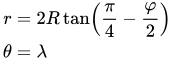
where is the radius of the sphere, and and are the latitude and longitude, respectively.

The sphere is normally chosen to model the Earth when the extent of the mapped region exceeds a few hundred kilometers in length in both dimensions. For maps of smaller regions, an ellipsoidal model must be chosen if greater accuracy is required.[1]

The ellipsoidal form of the polar ellipsoidal projection uses conformal latitude. There are various forms of transverse or oblique stereographic projections of ellipsoids. One method uses double projection via a conformal sphere, while other methods do not.

Examples of transverse or oblique stereographic projections include the Miller Oblated Stereographic[4] and the Roussilhe oblique stereographic projection.[2]

Properties

[edit]

As an azimuthal projection, the stereographic projection faithfully represents the relative directions of all great circles passing through its center point. As a conformal projection, it faithfully represents angles everywhere. In addition, in its spherical form, the stereographic projection is the only map projection that renders all small circles as circles.

3D illustration of the geometric construction of the stereographic projection.

The spherical form of the stereographic projection is equivalent to a perspective projection where the point of perspective is on the point on the globe opposite the center point of the map.

Because the expression for diverges as approaches , the stereographic projection is infinitely large, and showing the South Pole (for a map centered on the North Pole) is impossible. However, it is possible to show points arbitrarily close to the South Pole as long as the boundaries of the map are extended far enough.[1]

Derived projections

[edit]

The parallels on the Gall stereographic projection are distributed with the same spacing as those on the central meridian of the transverse stereographic projection.

The GS50 projection is formed by mapping the oblique stereographic projection to the complex plane and then transforming points on it via a tenth-order polynomial.

Comparison of the Stereographic map projection and some azimuthal projections centred on 90° N at the same scale, ordered by projection altitude in Earth radii. (click for detail)

References

[edit]
Revisions and contributorsEdit on WikipediaRead on Wikipedia
from Grokipedia
The is a that represents points on the surface of a by projecting them from a fixed point on the , typically the , onto a plane tangent to the at its opposite pole or the equatorial plane, preserving angles between curves while distorting areas and distances. Developed in ancient times, it was known to the Greek astronomer around the 2nd century BCE and later used in the construction of astrolabes for astronomical and navigational purposes by Hellenistic Greeks as early as the 1st century CE. Mathematically, for a , the projection of a point (x,y,z)(x, y, z) from the onto the plane z=0z = 0 yields coordinates (x/(1z),y/(1z))(x/(1 - z), y/(1 - z)), mapping circles on the to circles or straight lines on the plane, with great circles through the projection point projecting to straight lines and others to circles, and loxodromes to logarithmic spirals. Its conformality ensures that local shapes and angles are accurately preserved, making it particularly valuable for polar maps of the , where it is often centered at one of the poles to depict the hemisphere with minimal distortion near the center. In the 13th century, Jordanus Nemorarius provided a general proof of its circle-preserving property, solidifying its role in geometry and .

Introduction

Definition

The is a that geometrically projects points on the surface of a or onto a plane to the at a selected point, typically a pole, using the as the center of projection. In cartographic applications, while mathematically the projection is sometimes described onto the equatorial plane, the standard configuration uses the plane to ensure correct scale at the center. This method creates a perspective view where the acts as a screen, and lines of sight from the projection center intersect the sphere's surface before reaching the plane. It is commonly configured with either pole as the point of tangency and the opposite pole as the projection center, mapping the entire except the projection center onto the plane; for example, south pole tangency and north projection center for south polar maps. As an azimuthal projection, the stereographic method preserves directions from the map's center (the point of tangency), such that great circles passing through this center appear as straight lines radiating outward on the map. It is particularly suitable for mapping polar regions, where the central point corresponds to the pole of tangency, allowing accurate representation of areas around the poles with minimal near the center. The term "azimuthal" refers to this property of maintaining true azimuths ( directions) from the map center, distinguishing it from cylindrical or conic projections that do not inherently preserve radial directions in this way. The projection is conformal, meaning it preserves local angles and shapes, so that meridians and parallels intersect at right angles on the just as they do on , and the scale is uniform in all directions at any given point. Visually, points near the tangency point map close to the of the plane, with spacing between parallels increasing progressively toward the periphery; the projection , being opposite the tangency point, maps to , resulting in an unbounded that encompasses the entire hemisphere opposite the tangency point. This configuration ensures that small features retain their proportional shapes, making the projection valuable for applications requiring angular fidelity.

Geometric Construction

The stereographic projection is constructed geometrically by considering a unit sphere centered at the origin in , with the south pole located at the point (0, 0, -1) and the north pole at (0, 0, 1). The projection plane is the plane z = -1, tangent to the sphere at the south pole. To project a point P on the sphere's surface (excluding the north pole itself), a straight line is drawn from the north pole through P; this line intersects the tangent plane at a unique point, which serves as the projected image of P on the plane. In this setup, the at (0, 0, -1) is the point of tangency and projects to the origin of the map coordinates (after shifting the plane coordinates to center at (0,0)). The of the sphere maps to a of 2 centered at the origin on the . Points in the hemisphere around the project to the interior of this , while points in the opposite hemisphere project to the exterior, extending outward to as one approaches the along the sphere's surface. This ray-tracing process effectively "unwraps" the sphere onto the plane, preserving local geometric features near the where the mapping behaves almost like a simple flattening: small circles on the sphere near the south pole correspond to small circles on the plane, maintaining their shapes and sizes approximately. The infinite extent of the projection for the opposite hemisphere reflects the perspective nature of the construction, where rays diverge more widely as they pass through points closer to the projection point (). Standard diagrams illustrating this construction typically depict the unit with the tangent at the bottom (), positioned below the sphere's center. Rays are shown emanating from the through selected points on the sphere—such as points on the , meridians, or —intersecting the plane at their projected locations; for instance, equatorial points trace out the bounding of 2, while a meridian arcs outward from the origin. These visualizations highlight the perspective convergence and the conformal outcome of the geometry.

History

Ancient and Early Uses

The stereographic projection is often attributed to the astronomer (c. 190–120 BCE), who likely used it to map stars from the onto a plane, facilitating the representation of stellar positions for astronomical observations and catalogs, though direct evidence is lacking as his original works are lost and his contributions are inferred from later references. This method allowed for the projection of spherical coordinates into a two-dimensional format, preserving angular relationships essential for charting constellations and predicting celestial events. In the 2nd century CE, Claudius Ptolemy adapted and formalized the stereographic projection in his Planisphaerium (with references in the Almagest), using it to project the ecliptic and stellar positions onto a plane for mapping the heavens, which aided in the computation of planetary motions and the creation of star catalogs comprising over 1,000 entries. Ptolemy's approach involved projecting from the south celestial pole onto the equatorial plane, enabling accurate depiction of the obliquity of the ecliptic and supporting trigonometric calculations central to his geocentric model. This adaptation built directly on Hipparchus's foundational work, integrating the projection into a comprehensive astronomical framework that influenced subsequent generations. During the , scholars like (973–1048) extended these early uses in non-mathematical applications, particularly for , where engraved on the instrument's tympan facilitated angle measurements for timekeeping, , and without requiring complex derivations. 's treatises on the astrolabe described projections tailored to specific latitudes, incorporating and altitude circles to model the visible sky, which enhanced practical astronomy in regions from Persia to . These instruments democratized celestial observation, allowing users to solve problems like determining prayer times or directions through direct mechanical projection. The transition to cartographic applications remained limited in the medieval period due to the projection's computational complexity and the dominance of qualitative s, though it appeared in astronomical manuscripts and designs as a tool for celestial rather than terrestrial mapping. In the 13th century, Jordanus Nemorarius provided a general proof of its circle-preserving property, advancing its geometric foundations. References in Latin and Arabic codices, such as those preserving Ptolemy's works, noted stereographic methods for planispheric charts, but widespread adoption for earthly maps awaited later refinements. The first known instance of a applied to a terrestrial appeared in 1507, created by Gualterius Lud of St. Dié.

Development in the 16th to 19th Centuries

During the Renaissance, European cartographers revived ancient techniques from Ptolemy's Geography to develop projections suitable for terrestrial maps amid the Age of Exploration. Oronce Fine (1494–1555), a prominent French mathematician and cosmographer, contributed to this revival in the 1530s by adapting Ptolemaic methods for world maps, such as his 1531 double cordiform projection, that emphasized the Earth's sphericity while accommodating new discoveries in the Americas and Asia. Fine's works reflected broader efforts to modify projections—originally used for astrolabes—into practical tools for global representation, influencing subsequent mapmakers like Gerardus Mercator. A pivotal formalization occurred in 1613 with the publication of Opticorum libri sex by François d'Aguilon (1567–1617), a Flemish Jesuit scholar. D'Aguilon coined the term "" in Book VI, describing it as a perspective method to project spherical forms onto a plane from a point on the sphere's surface, akin to optical viewpoint construction. Illustrated with engravings by , including depictions of armillary spheres projected onto flat charts, the work linked the projection to perspective drawing, , and , establishing it as a versatile tool beyond astronomy for cosmographers and artists. In the , (1728–1777) provided rigorous of the projection's properties in his 1772 treatise Anmerkungen und Zusätze zur Entwerfung der Land- und Himmelskarten. Lambert demonstrated that belongs to the family of conformal mappings, preserving local angles and shapes, and showed it as a limiting case of the conformal conic projection when the cone's apex recedes to infinity. This unification with other projections, such as Mercator's, underscored its utility for accurate directional representation, influencing cartographic theory during an era of expanding scientific mapping. The 19th century saw further refinements, particularly for polar applications, as exploration pushed toward high latitudes. James Gall (1808–1895), a Scottish minister and cartographer, integrated stereographic latitudes—extended evenly to the poles—into his 1855 cylindrical projection, balancing scale across hemispheres while prioritizing polar fidelity over strict conformality. This adaptation complemented the projection's inherent strengths in rendering circles as circles, making it ideal for and charts. By mid-century, the polar stereographic variant gained prominence in surveying and nautical contexts for its minimal distortion at high latitudes, enabling precise coastal and polar mapping by agencies like the U.S. Coast and Geodetic Survey.

Mathematical Formulation

Forward Projection Formulas

The forward projection in stereographic map projection maps points on the unit , specified by geodetic latitude ϕ\phi (ranging from π/2-\pi/2 to π/2\pi/2) and λ\lambda (from π-\pi to π\pi), to Cartesian coordinates xx and yy on a plane tangent to the at the , with the projection center at the (ϕ0=π/2\phi_0 = \pi/2) and central meridian λ0=0\lambda_0 = 0 for simplicity. This formulation assumes azimuthal symmetry, where the λ\lambda determines the angular position relative to the central meridian, with λ=0\lambda = 0 aligned along the positive xx-axis in the plane. For the unit sphere (radius R=1R = 1), the radial distance ρ\rho from the origin to the projected point is given by ρ=2tan(π4ϕ2)\rho = 2 \tan\left(\frac{\pi}{4} - \frac{\phi}{2}\right), or equivalently using θ=π2ϕ\theta = \frac{\pi}{2} - \phi, ρ=2tan(θ2)\rho = 2 \tan\left(\frac{\theta}{2}\right). The Cartesian coordinates are then x=ρsin(λλ0),y=ρcos(λλ0),x = \rho \sin(\lambda - \lambda_0), \quad y = -\rho \cos(\lambda - \lambda_0), where the negative sign on yy orients the projection such that increasing moves toward the positive yy-direction from the origin. For a sphere of general RR, the coordinates scale by multiplying xx and yy by RR. The projection is conformal, with the scale factor kk (identical in all directions at a point) expressed as k=21+sinϕk = \frac{2}{1 + \sin \phi} for central scale factor k0=1k_0 = 1. This scale factor equals 1 at the and increases radially outward, reaching k=2k = 2 at the (ϕ=0\phi = 0). As a numerical example, the equatorial point at ϕ=0\phi = 0, λ=0\lambda = 0 projects to ρ=2\rho = 2, yielding coordinates (x,y)=(0,2)(x, y) = (0, -2), with scale factor k=2k = 2.

Inverse Projection Formulas

The inverse projection formulas for the stereographic map projection recover the geographic coordinates of latitude ϕ\phi and longitude λ\lambda from the Cartesian plane coordinates xx and yy, enabling reversibility for computational and analytical purposes in . These formulas are derived for a (R=1R = 1) in the polar aspect, with the projection center at the origin. The process begins by computing the radial in the plane: ρ=x2+y2\rho = \sqrt{x^2 + y^2}
Add your contribution
Related Hubs
User Avatar
No comments yet.