Hubbry Logo
EmonaEmonaMain
Open search
Emona
Community hub
Emona
logo
8 pages, 0 posts
0 subscribers
Be the first to start a discussion here.
Emona
Emona
from Wikipedia

Emona (early Medieval Greek: Ἤμονα)[1] or Aemona (short for Colonia Iulia Aemona) was a Roman castrum, located in the area where the navigable Nauportus[2] River came closest to Castle Hill,[3] serving the trade between the city's settlers – colonists from the northern part of Roman Italy – and the rest of the empire. Emona was the region's easternmost city,[4] although it was assumed formerly that it was part of the Pannonia or Illyricum, but archaeological findings from 2008 proved otherwise.

Key Information

The Visigoths camped by Emona in the winter of 408/9, the Huns attacked it during their campaign of 452, the Langobards passed through on their way to Italy in 568, and then came incursions by the Avars and Slavs. The ancient cemetery in Dravlje indicates that the original inhabitants and invaders were able to live peacefully side by side for several decades. After the first half of the 6th century, there was no life left in Emona.[3] The 18th-century Ljubljana Renaissance elite shared the interest in Antiquity with the rest of Europe, attributing the founding of Ljubljana to the mythical Jason and the Argonauts.[3] Other ancient Roman towns located in present-day Slovenia include Nauportus (now Vrhnika), Celeia (now Celje), Neviodunum (now the village of Drnovo) and Poetovio (now Ptuj).

History

[edit]
Reconstructed inscription (presumably talking about building town walls), dated in time between autumn AD 14 and spring of AD 15. The inscription has the names of emperors Augustus and Tiberius. The grey part was discovered in 1887, and the rest is a reconstruction. Presumably, this artifact was built into the wall above one of the town gates. From the collection of the National Museum of Slovenia in Ljubljana.[5]

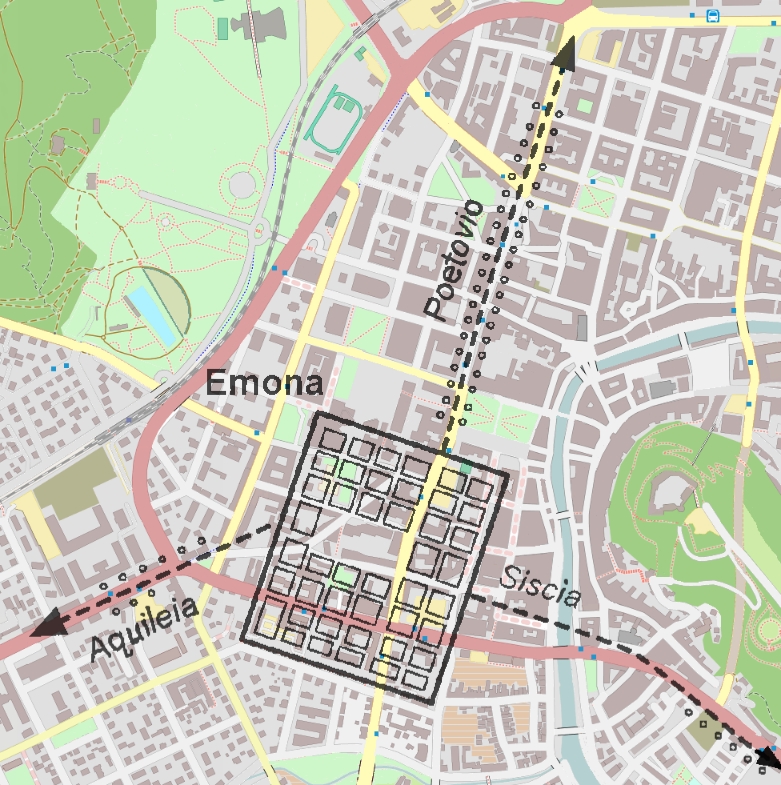
During the 1st century BC a Roman military stronghold was built on the site of the present Ljubljana, below Castle hill. Construction of the Roman settlement of Emona, fortified with strong walls, followed in AD 14. It had a population of 5,000 to 6,000 people, mostly merchants and craftsmen. The town had its own goddess, Equrna, and was also an important Early Christian centre. Emona's administrative territory or ager stretched from Atrans (Trojane) along the Karawanks mountains towards the north, near Višnja Gora to the east, along the Kolpa River in the south, and bordered to the west with the territory of Aquileia at the village of Bevke.

According to Ammianus Marcellinus, one of the reasons for the war between Licinius and Constantine the Great was that Licinius destroyed the busts and statues of Constantine at Emona.[8]

After few months of occupation in 388, the citizens of Emona saluted Emperor Theodosius I entering the liberated city after the victorious Battle of the Save, where Theodosius I defeated the army of the Roman usurper Magnus Maximus.


Historical descriptions

[edit]

According to Herodotus, Emona was founded by Jason, when he travelled through the country with the Argonauts, and named by him in honour of his Thessalian homeland. Sozomen wrote that when the Argonauts left from the Aeetes, they returned from a different route, crossed the sea of Scythia, sailed through some of the rivers there, and when they were near the shores of Italy, they built a city in order to stay at the winter, which they called Emona.[1] Zosimus wrote that after they left from the Aeetes, they arrived at the mouth of the Ister River which it discharges itself into the Black Sea and they went up that river against the stream, by the help of oars and convenient gales of wind. After they managed to do it, they built the city of Emona as a memorial of their arrival there.[9]

According to the 18th-century historian Johann Gregor Thalnitscher, the original predecessor of Emona was founded c. 1222 BC. (The date, although based on legend and poetic speculation, actually fits in both with Herodotus' account and the date of the earliest archaeological remains found so far)[citation needed]

According to 1938 article by the historian Balduin Saria, Emona was founded in late AD 14 or early AD 15, on the site of the Legio XV Apollinaris, after it left for Carnuntum, by a decree of Emperor Augustus and completed by his successor, Emperor Tiberius. Later archaeological findings have not rejected nor clearly confirmed this hypothesis and it is currently (as of 2014) most widely accepted.[10]

Location and layout

[edit]
Roman cup of multicolored glass, made with the millefiori technique. It was discovered in one of the graves of Emona.

The location of Emona overlaps with the southwest part of the old nucleus of the modern city of Ljubljana. In a rectangle with a central square or forum and a system of rectangular intersecting streets, Emona was laid out as a typical Roman town. According to Roman custom, there were cemeteries along the northern, western, and eastern thoroughfares into the city – from the directions of Celeia, Aquileia, and Neviodunum.[12] The wider area surrounding the town saw the development of typical Roman countryside: villages, hamlets, estates, and brickworks.[3]

Archaeological findings

[edit]
Location within Roman Italy.

Archaeological findings have been found in every construction project in the center of Ljubljana. Intensive archaeological research on Emona dates back 100 years, although it was the Roman town was portrayed from the 17th century onward. Numerous remains have been excavated there, such as parts of the Roman wall, residential houses, statues, tombstones, several mosaics, and parts of the early Christian baptistery, which can be still seen today.[10]

Regarding its location within Roman Italy, in 2001 a boundary stone between Aquileia and Emona was discovered in the vicinity of Bevke in the bed of the Ljubljanica River. The stone is made of Aurisina limestone. Because similar stones were only used to demarcate two communities belonging to the same Roman province and because it is not disputed that Aquileia belonged to Roman Italy, this means that both towns belonged to Italy and that Emona was never part of Illyricum (or, later, of the province of Pannonia).[4]

Archaeological parks and preserving of the heritage

[edit]

The architect Jože Plečnik redesigned the remains of the Roman walls: he cut two new passages to create a link to Snežnik Street (Slovene: Snežniška ulica) and Murnik Street (Slovene: Murnikova ulica), and behind the walls he arranged a park displaying architectural elements from Antiquity, with a stone monument collection in the Emona city gate. Above the passageway to Murnik Street he set up a pyramid, which he covered with turf. After the Second World War, attempts were made to embed references to Emona grid into modern Ljubljana, with the Roman forum becoming part of the Ferant Park apartment blocks and an echo of the rotunda located along Slovenia Street (Slovene: Slovenska cesta).[3]

Bishopric

[edit]

A Christian diocese of Aemona was originally based in the city, from the late 4th to the late 6th century.

Its bishop Maximus participated in the Council of Aquileia, 381, which condemned Arianism.

It had intensive contacts with the ecclesiastical circle of Milan, reflected in the architecture of the early Christian complex along Erjavec Street in present-day Ljubljana.

Emona in literary fiction

[edit]
  • Emona is the setting of a 1978 novel Tujec v Emoni (Stranger in Emona) by Mira Mihelič.
  • Emona is mentioned in Elizabeth Kostova's debut novel The Historian.
  • The four volumes of the 2014 series Rimljani na naših tleh (Romans on our soil) by Ivan Sivec describe Emona in various epochs.
  • Several chapters of the novel series Romanike are set in Emona.[13]
[edit]

References

[edit]

Further reading

[edit]
[edit]
Revisions and contributorsEdit on WikipediaRead on Wikipedia
from Grokipedia
Emona (Latin: Colonia Iulia Aemona), also known simply as Aemona, was an ancient Roman and city established in the early CE on the site of a pre-existing indigenous settlement in the River basin, corresponding to modern-day , . An initial Roman military encampment was established in the mid-1st century BCE, evolving into the civilian colony by 14–15 CE. It functioned as a key administrative, political, economic, and cultural hub, initially part of and later in the Roman Empire's province of , strategically positioned for trade along the navigable River and military defense within the Claustra Alpium Iuliarum barrier system. The city featured a classic Roman grid layout enclosed by robust defensive walls, a central forum with temples and basilicas, advanced infrastructure including drainage and , and suburbs with craft quarters, thriving from its founding until its abandonment in the early CE amid the invasions. Founded around 14–15 CE under Emperors and , Emona was settled by colonists primarily from , alongside local Celtic and Illyrian populations, transforming the area into a Roman urban center that introduced , monumental , and centralized to the region. Archaeological evidence reveals pre-Roman settlements dating back to prehistoric times, with a Celtic hill settlement in the late , but the city's Roman phase began with military camps that evolved into a colony by the mid-1st century, covering approximately 523 by 435 meters within its walls. Key events include its partial destruction during the and a plague in the 2nd century CE, a deliberate burning by citizens in 238 CE to resist Emperor , passage through the city by the under in 408 CE, and final devastation by the in 452 CE, after which it briefly served as a Christian bishopric before declining. Emona's legacy endures through extensive archaeological remains, including restored walls redesigned by architect in the 1930s, northern and southern cemeteries with notable artifacts like the "Emona Citizen" statue from the Trajanic period, and modern sites such as the Archaeological Park Emona, which traces the city's 2,000-year-old heritage via a network of ten preserved locations. As the easternmost Roman city in the Noricum-Pannonia region, it played a vital role in securing the empire's Alpine frontiers and facilitating commerce between the Adriatic and the Danubian provinces, influencing the urban development of contemporary .

Historical Development

Founding and Etymology

Emona was established around 14–15 CE by the Roman emperor as the Colonia Iulia Aemona, serving as a veteran colony for retired soldiers, particularly from . The settlement was founded on the site of a pre-existing indigenous community, likely a Celtic or Illyrian outpost inhabited by the local tribe, which had occupied the region since at least the 2nd century BC. This strategic location near the navigable River facilitated Roman control over key access points in the southeastern Alpine area. The name Colonia Iulia Aemona reflects both Roman imperial nomenclature and local linguistic heritage. The prefix "Iulia" honors the , the family of , including his daughter , as was customary for colonies founded during his reign to propagate the imperial lineage. The suffix "Aemona," or simply "Emona," is probably of Celtic, pre-Roman origin, alluding to the marshy, riverine environment of the Ljubljana Marshes where the settlement stood. Initially functioning as a castrum, Emona's primary purpose was to secure the vital riverine route along the Nauportus (modern Ljubljanica River), which connected Aquileia to inland networks, and to safeguard Alpine passes against potential incursions while promoting commerce along the ancient . The early population comprised a diverse mix of Roman veterans granted land allotments, members of the indigenous Nauportani or tribes who integrated into the colony, and merchants exploiting the site's role as a hub for goods like , timber, and metals transiting from the region to . This blend fostered a multicultural community estimated at 3,000 to 5,000 residents by the mid-1st century CE, centered on , , and oversight.

Roman Era Expansion

Following its establishment as Colonia Iulia Emona in the early CE under and , the city underwent significant expansion during the reigns of subsequent emperors, including in the early CE. Settled primarily by colonists from , particularly the , Emona was integrated into , an administrative subdivision of , as evidenced by a boundary stone discovered in 2001 marking the limit between Emona and Aquileia territories. This placement underscored its role as an eastern outpost of Italia, facilitating Roman control over the southeastern Alpine region rather than classifying it within . Emona's strategic importance stemmed from its position as a key crossroads on major connecting Aquileia to Siscia (modern ) and further along the to the , enabling efficient transport that bypassed mountainous terrain like the Ocra Mountains. These routes supported vital trade in commodities such as from the Baltic, salt from Adriatic sources, and wine from Italian vineyards, while also serving military logistics. The city's founding around 14 CE directly followed the Great Illyrian Revolt of 6–9 CE, reinforcing Roman authority in the hinterlands to suppress lingering unrest among local tribes and secure the vital link between and the eastern provinces. By the 2nd century CE, Emona had grown to a population of 3,000–5,000 inhabitants, comprising merchants, craftsmen, landowners, and a modest number of veterans and officials. The city suffered partial destruction during the (166–180 CE) and the in the late 2nd century CE. Major infrastructural developments included the construction of a central forum, a rectangular street grid, aqueducts for and cloacae for drainage into the River, and temples dedicated to deities like Aequorna, with significant building activity occurring during the (69–96 CE). A notable early 2nd-century monument was a gilded statue of an Emona citizen on a 5-meter column, modeled after , symbolizing civic pride and imperial loyalty. The city's economic prosperity in this period is attested by evidence of specialized workshops for pottery production in designated quarters and , alongside agricultural estates (villae rusticae) and in the surrounding countryside. Coin finds from the site, including Republican and early imperial issues, reflect active commerce and integration into broader Roman monetary networks, though no dedicated local mint operated there. Trade via the navigable River further bolstered its role as a regional emporium.

Decline and Transition

The Crisis of the Third Century severely impacted Emona, as barbarian invasions strained the Roman Empire's northern frontiers and economy. In 238 CE, during the , the citizens deliberately burned parts of the city to resist Emperor . In response to ongoing threats from Germanic groups, the city reinforced its defensive walls, which had been initially constructed around 14–15 CE and enclosed an area of approximately 23 hectares with thick stone fortifications up to 8 meters high and featuring 26 towers. Emona's final decline accelerated in the , culminating in its sacking by the in 452 CE, which caused significant destruction and depopulation. The city struggled to recover amid repeated incursions by groups like the and , and by the 6th century, it was largely abandoned as Slavic tribes migrated into the eastern Alps during the , leading to the end of organized Roman urban life at the site. Despite the collapse, the site maintained continuity into the Early Middle Ages, serving as a strategic point along routes from Aquileia to Pannonia and playing a role in Carolingian campaigns against the Avars in the late 8th century, such as the 791 expedition that secured the marches. The ancient name Emona faded with the Roman period, while the site later received a new Slavic name, evolving into the medieval form Laibach (first recorded in 1144), the German rendering of Ljubljana, meaning "beloved" from the Slavic root ljub-. This Roman foundation directly shaped the urban core of modern Ljubljana, with Emona's grid layout, walls, and infrastructure influencing the city's medieval and contemporary development.

Geography and Urban Design

Site Location

Emona was established on the left bank of the River (known in antiquity as the Nauportus), approximately 10 km upstream from its confluence with the River, at the base of Castle Hill in the territory of modern-day , . The site's coordinates are roughly 46°03′N 14°30′E, placing it within a natural basin that facilitated early settlement. The environmental setting featured marshy floodplains surrounding the , part of the broader Ljubljana Marshes (Ljubljansko barje), which supported navigation along the river but necessitated engineering interventions like drainage channels to mitigate frequent flooding. Proximity to the , rising sharply to the northwest, provided access to vital resources such as timber for construction and stone from local quarries, enhancing the area's suitability for Roman development. Strategically, Emona's position served as a key gateway linking Italy's northeastern regions, via routes from Aquileia, to the provinces, positioning it near critical passes through the and forming part of the defensive Claustra Alpium Iulium system. This location underscored its role in securing trade and military corridors between the and the . Prior to Roman foundation, the site overlay a pre-Roman oppidum in the Nauportus basin, inhabited by the Celtic tribe, who had settled the region by the 3rd century BCE and utilized the area for trade along early routes. Epigraphic evidence from indigenous names on tombstones indicates continuity of local populations into the Roman era.

City Layout and Infrastructure

Emona was established as a classic Roman castrum with a rectangular urban plan measuring approximately 522 meters by 433 meters, oriented to the cardinal directions and subdivided into roughly 47 insulae by a grid of streets. The primary north-south cardo maximus and east-west decumanus maximus, each about 12 meters wide, intersected at the city's center, while secondary cardines and decumani, averaging 6-8 meters in width, facilitated organized movement and divided the blocks systematically. Paved with layers of gravel, sand, and mortar, these streets incorporated covered sewers running parallel to the east-west axes, underscoring the engineered efficiency of Roman urban design. Enclosing the entire layout were robust defensive walls, constructed from stone and , reaching heights of 6 to 8 meters and thicknesses of 2.5 meters, punctuated by 26 to 29 semi-circular towers spaced every 60 meters and accessed via four main gates aligned with the principal thoroughfares. The core of Emona's public infrastructure centered on the forum, a sprawling complex occupying the equivalent of four insulae at the cardo-decumanus junction, which integrated administrative, commercial, and religious functions. Flanking the forum's northern edge stood the , the city's grandest edifice used for legal proceedings and civic assemblies, adjacent to the where the local council convened. Water supply was managed through two aqueducts built in the 2nd and 3rd centuries, sourcing from nearby western springs like Glinica and channeling via lead conduits to public fountains, , and private homes, ensuring reliable hydration for the colony's estimated 3,000-5,000 inhabitants. Outside the walls, traces suggest the presence of an amphitheater, though its precise form and location remain subjects of ongoing archaeological debate. Residential quarters within the insulae featured multi-story porticoed houses arranged around central courtyards, typically spanning 14 by 34 to 40 by 45 double paces, adorned with frescoes, mosaics, and underfloor heating systems for comfort. Public amenities included , or baths, embedded in insulae such as XVII and XXXIX, equipped with heated pools, exercise areas, and free access to promote social and hygienic standards. Temples dotted the landscape, with a prominent capitolium on the forum dedicated to the , Juno, and —alongside shrines to indigenous deities, reflecting syncretic worship practices. Defensive enhancements in the late incorporated double moats along the northern, western, and southern perimeters, complemented by additional watchtowers, to fortify Emona amid increasing regional instability.

Archaeological Discoveries

Major Excavations and Artifacts

Archaeological interest in Emona began in the early , with significant discoveries during urban construction. In , excavations for the foundations of the Kazina building in central unearthed a gilded of a togated man, likely part of a funerary , offering one of the earliest tangible links to Roman Emona's elite inhabitants. This find, now housed in the National Museum of Slovenia, highlighted the site's Roman heritage but did not yet reveal extensive structural remains. Systematic investigations gained momentum in the early . The first major excavations occurred between 1909 and 1912 in the Mirje district south of the city center, uncovering the complete southern section of Emona's defensive walls, including gates and towers, which spanned approximately 23 hectares and enclosed the urban core. Post-World War II efforts, particularly from the 1950s onward, expanded these digs amid Ljubljana's reconstruction, revealing key public structures such as the forum in the city center and residential insulae with porticoed streets, providing insights into Emona's orthogonal urban grid. Notable artifacts from these and subsequent digs include epigraphic inscriptions, such as dedications on linking to the Augustan era, and extensive tableware imported from and , stamped with makers' marks dating to the 1st and 2nd centuries CE. Coins from the 1st to 4th centuries CE, minted under emperors from to Constantine, have been recovered in large quantities, evidencing Emona's role in regional networks. Mosaics, though fragmentary, appear in domestic contexts, featuring geometric patterns typical of provincial Roman artistry. These portable finds, often from stratified layers in insulae, illustrate daily life, craftsmanship, and cultural exchanges within the colony. Burial grounds outside the walls have yielded significant , including urns from the 1st to 3rd centuries CE. The northern , explored in 2017–2018 along Gosposvetska Road, exposed a complex with over 350 burials, predominantly in urns such as wicker-basket forms and pseudo-urns made from repurposed vessels, accompanied by lamps and fibulae. Recent excavations in 2024, conducted since October near the Slovenian National Theatre Drama, uncovered well-preserved sections of two insulae and the connecting road within Emona's walls, along with domestic items like sherds and tools that reflect 2nd–4th century household activities. In spring 2025, excavations at the Emonika site ahead of revealed additional Roman artifacts, featured in a new at the City Museum of . Although no full amphitheater has been confirmed, remains under Kongresni trg include wall foundations possibly linked to public entertainment venues, integrated into the forum area. Methodological advances have enhanced these discoveries. Geophysical surveys, including magnetometry and , have mapped subsurface structures non-invasively, as applied in pre-excavation for Emona's urban genesis and military precursors. has dated wooden elements from early structures, aligning construction phases with the late 1st century BCE colonization.

Preservation and Public Sites

The preservation of Emona's archaeological remains in modern faces significant challenges from ongoing urban development, which has historically accelerated excavations but also risks damaging structures through construction and infrastructure expansion. These threats are mitigated by Slovenia's Cultural Heritage Protection Act (ZVKD-1) of 2008, which designates key Roman sites as protected cultural monuments and mandates conservation measures, including restrictions on development in heritage zones. Additional pressures include environmental factors like fluctuating temperature and humidity, which exacerbate deterioration of exposed mosaics and systems, necessitating seasonal coverings and regular monitoring. Key preservation initiatives date back to the early , with architect leading the restoration of sections of Emona's defensive walls in the 1930s, incorporating them into public parks while preserving original stonework. Post-World War II efforts intensified in the 1960s, resulting in the establishment of dedicated archaeological parks to protect and display remains; the Emonan House park opened in 1966, featuring conserved residential structures, while the Early Christian Centre followed in 1975 with its integrated chapel and baptistery. Walls and gates underwent further renovations in the 1990s, focusing on structural reinforcement at sites like the Mirje complex to ensure long-term stability. These efforts, managed by the Museum and Galleries of (MGML), emphasize , with ongoing maintenance including mechanical cleaning and protective roofing for vulnerable mosaics. Public access to Emona's heritage is facilitated through several key sites, including the Emonan House and Early Christian Centre archaeological parks, where visitors can explore preserved heating systems and floor mosaics via guided trails. The City Museum of houses a collection of Emona artifacts, such as Roman glassware and ceramics, displayed in permanent exhibitions that contextualize daily life in the colony. Underground insulae remains beneath the Cankarjev dom Culture and Congress Centre are visible through transparent pavements and accessible via specialized guided tours, offering insights into the city's grid layout without intrusive excavation. These venues, open seasonally with ticketed entry, promote educational programming like workshops and performances to engage the public in heritage stewardship. In the 2020s, preservation has benefited from EU-funded initiatives addressing climate vulnerabilities, including the ARCHEST project under the Creative Europe Programme, which supports digital documentation and enhanced protection for exposed sites. Broader efforts, such as the LIFE programme's restoration of the River, incorporate flood-resistant measures to safeguard low-lying Emona remains from increasing climate-related inundation risks. These projects, totaling millions in EU contributions, prioritize resilient infrastructure like elevated barriers and monitoring systems to preserve the site's integrity amid rising flood threats.

Administrative and Religious Role

Governance and Economy

As a Roman established in the early CE, Colonia Iulia Emona possessed a degree of typical of such settlements, administered by a local council known as the ordo decurionum, which handled municipal affairs including and civic organization. Equestrian prefects appointed from provided oversight for military and strategic matters, reflecting the city's integration into imperial structures. Emona's economy thrived on its strategic position as a trade hub along the River, facilitating commerce between the northern Adriatic ports and the regions via overland and fluvial routes. The surrounding ager—an extensive territory under the colony's control—supported robust agricultural production, with fertile lands dedicated to vineyards, livestock rearing, and grain cultivation, underscoring land ownership as a marker of wealth and status. Local crafts contributed to economic vitality, including a potters' quarter beyond the northern city wall for ceramic production and workshops yielding glass items, such as distinctive Trajanic-period beakers. Amphorae fragments recovered in excavations point to active exchange in commodities like wine and , bolstering the city's role in regional networks. Socially, the community comprised an elite of landowners residing in suburban villas, alongside craftsmen and merchants organized into collegia for mutual support and professional regulation, as evidenced by inscriptions honoring seviri like T. Caesernius Diphilus. Integration of indigenous populations advanced following the of 212 CE, which extended to nearly all free inhabitants of the empire, enabling broader participation in civic life. The colony contributed tribute to through taxation on agricultural yields and trade, while standard imperial coinage circulated without evidence of a local mint.

Bishopric Establishment

Christianity reached Emona during the 3rd century, as indicated by archaeological evidence from the early Christian cemetery at the Kozolec site in northern Emona, where burials associated with a Christian community date to the late 3rd and early 4th centuries. This presence aligns with the broader spread of Christianity in the northern Adriatic region during the late Roman period, facilitated by trade routes and military movements along the Sava and Ljubljanica rivers. By the late 4th century, Emona had developed a structured Christian community with intensive ties to the ecclesiastical centers of Milan and Aquileia, evidenced by correspondence from St. Jerome, including letters addressed to nuns and a monk named Anthony in Emona around 400 AD. The bishopric of Emona was formally established by the late as a under the metropolitan authority of Aquileia, reflecting the hierarchical organization of the Church in the province of . The first documented bishop, Maximus, participated in the Council of Aquileia in 381 AD, convened by Emperor to address and affirm Nicene orthodoxy; his attendance marks Emona's integration into regional synodal activities and the condemnation of heretical doctrines. Church construction accelerated in the 4th and 5th centuries, with early Christian basilicas and complexes built, including a significant ecclesiastical center along Erjavčeva Street featuring high-quality architecture such as mosaic floors and possible adaptations of earlier structures near the forum, symbolizing the Christian overlay on the Roman urban fabric. The played a role in the ecclesiastical network of and the until the late , when repeated barbarian incursions disrupted its continuity. Following Lombard invasions in 568 AD and subsequent Avar and Slavic raids, Emona's population declined sharply, leading to the lapse of the residential bishopric by the early . confirms the abandonment of Christian sites after the mid-6th century, coinciding with the destruction of the around 610–611 AD by Avar-Slavic forces. In the , the revived Aemona (the Latin form of Emona) as a in 1969, assigning it to non-residential bishops without a local flock.

Cultural Legacy

Ancient Descriptions

Ancient authors provide sparse but significant references to Emona, primarily situating it within the Roman provincial landscape of Pannonia and highlighting its role as a colony and waypoint. In his Geography, Claudius Ptolemy lists Emona among the settlements of Upper Pannonia, assigning it coordinates of 45°20' north latitude and 36°00' east longitude relative to his reference system, placing it inland from the Adriatic and near the borders with Noricum and Italy. This positioning underscores Emona's strategic location in the Julian Alps region, though Ptolemy's work offers no further descriptive details beyond its cartographic placement. Pliny the Elder, in Natural History Book 3, briefly mentions Emona as one of the key colonies in , alongside Siscia, within the territory bounded by the , the , and the Savus River. He describes the area as a transitional zone from Illyricum, emphasizing the navigable rivers like the Savus that facilitated connectivity, but provides no elaborate account of Emona's urban features or inhabitants, reflecting its status as a peripheral settlement in broader regional geography. The , a late Roman map, depicts Emona as a mansio (roadside station) on the primary route connecting Aquileia in to Siscia in , marking it with a symbolic structure indicating its function for travelers and military logistics. This representation highlights Emona's importance in the network, with distances noted to adjacent stations, though the map's schematic style prioritizes connectivity over topographic accuracy. Local epigraphic evidence from Emona complements these literary mentions, featuring inscriptions that praise Roman emperors and affirm the city's loyalty to imperial authority. For instance, Hadrianic-era dedications, such as those honoring the emperor's benevolence or military campaigns, appear on stone monuments recovered from the site, often invoking divine protection for the colony's prosperity and underscoring its administrative ties to . These texts, typically formulaic in style, reveal Emona's role in practices but lack narrative depth, focusing instead on political allegiance rather than daily life or . Overall, ancient descriptions portray Emona primarily as a functional outpost for trade and defense, with no extensive literary narratives dedicated to its cultural or monumental aspects.

Representations in Literature

In the 7th-century Chronicle of Fredegar, Emona is depicted as one of several Roman-era cities in the eastern Alpine region devastated by Avar incursions during their campaigns against Slavic groups in the mid-7th century. The chronicle describes how the Avars, advancing through areas including Poetovio (modern Ptuj), Celeia (Celje), and Emona (Ljubljana), razed settlements as part of broader conflicts involving Frankish and Lombard interventions under King Dagobert I. This portrayal frames Emona as a symbol of post-Roman ruin and vulnerability amid ethnic migrations and power struggles in the Balkans. In 20th-century Slovenian , Emona features prominently as a setting for exploring themes of cultural transition and religious conflict. Mira Mihelič's 1978 novel Tujec v Emoni (Stranger in Emona) unfolds in 4th-century Roman Emona, where a mysterious outsider navigates intrigues amid the rising dominance of and the suppression of pagan Roman cults. The narrative uses the city's walls and forums to evoke the tensions of imperial decline, blending archaeological details with dramatic personal stories to highlight Emona's role as a outpost. Modern international fiction has also drawn on Emona's legacy to evoke layered Balkan histories intertwined with mystery and exploration. In Elizabeth Kostova's 2005 debut novel , Emona serves as a pseudonym for , the starting point of a quest uncovering Dracula's historical roots through ancient manuscripts and hidden archives. The city is portrayed as a repository of forgotten lore, its Roman foundations symbolizing enduring secrets beneath layers of medieval and Ottoman influences, which propels the protagonists' journey across . Beyond specific works, Emona's representations in reinforce its cultural role as a foundational element in 's identity narratives, symbolizing continuity between ancient Roman urbanism and modern Slovenian heritage. Literary evocations often position Emona as a "dignified " to contemporary , underscoring themes of resilience and layered in national storytelling.

References

Add your contribution
Related Hubs
User Avatar
No comments yet.