Hubbry Logo
search
logo
2308068

Strike zone

logo
Community Hub0 Subscribers

Wikipedia

from Wikipedia
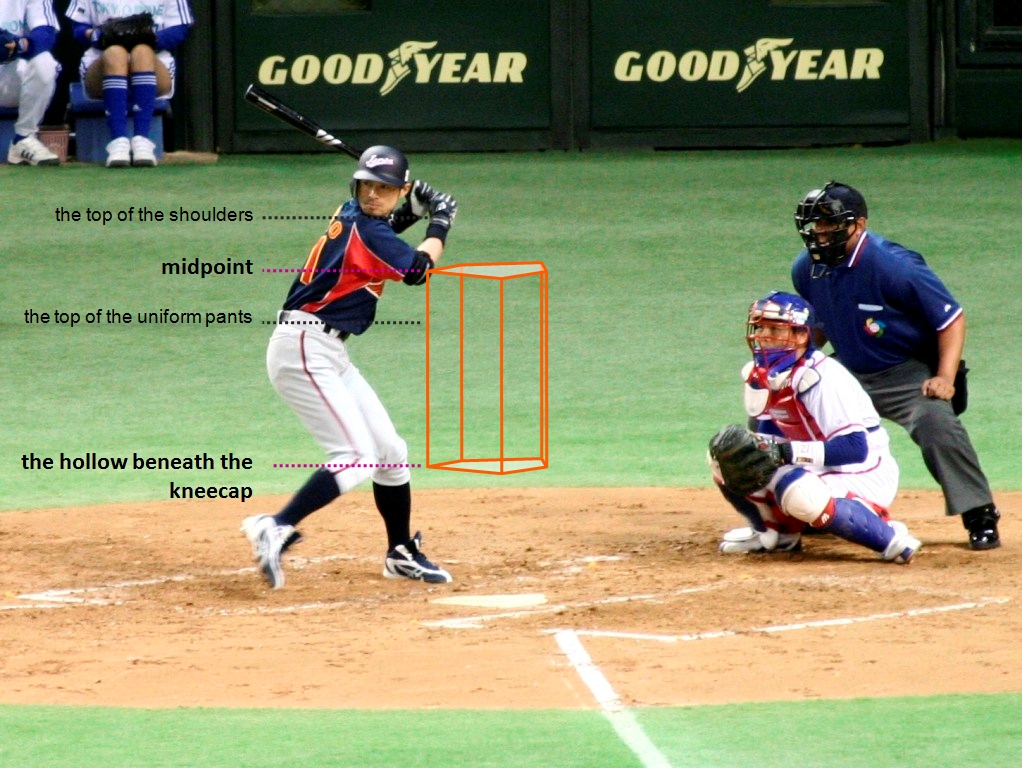
A labelled drawing of the strike zone superimposed onto an image from a game, showing a batter, catcher and umpire. The pitcher (not pictured) pitches a baseball to the catcher; the batter attempts to hit this baseball; and the umpire decides whether pitches are balls or strikes.

In baseball, the strike zone is the area of space through which a pitch must pass in order to be called a strike even if the batter does not swing. The strike zone is defined as the volume of space above home plate and between the batter's knees and the midpoint of his torso. Whether a pitch passes through the zone is decided by an umpire, who is generally positioned behind the catcher.

Strikes are desirable for the pitcher and the fielding team, as three strikes result in a strikeout of that batter. A pitch that misses the strike zone is called a ball if the batter does not swing at it. Balls are desirable for the batter and the batting team, as four balls allow the batter to take a "walk" to first base as a base on balls.

Tetsuto Yamada of the Tokyo Yakult Swallows swings and misses for strike one, 2024

Definition

[edit]

The strike zone is a volume of space, a vertical right pentagonal prism. Its sides are vertical planes extending up from the edges of home plate. The official rules of Major League Baseball define the top of the strike zone as the midpoint between the top of the batter's shoulders and the top of his uniform pants, and the bottom of the strike zone is at the hollow beneath the kneecap, both determined from the batter's stance as he is prepared to swing at the pitched ball, although the de facto enforced strike zone can vary based on the umpire's perspective. The official rules define a pitch as a strike "if any part of the ball passes through any part of the strike zone", with the ball required to have not bounced. Thus, a pitch that touches the outer boundary of the zone is as much a strike as a pitch that is thrown right down the center. A pitch passing outside the front of the strike zone but curving so as to enter this volume farther back (without being hit) is sometimes called a "back-door strike". Various other rulebooks for baseball and softball define the strike zone slightly differently.

A pitch is also a strike if the batter swings or offers the bat in an attempt to hit the pitch. A pitch batted into foul territory—a foul ball—is also a strike, unless the batter already has two strikes. Any pitch not called a strike, swung on and missed, or fouled-off, is a "ball" (originally "no ball").

A batter who accumulates three strikes in a single batting appearance has struck out and is ruled out (with the exception of an uncaught third strike); a batter who accumulates four balls in a single appearance has drawn a base on balls (or walk) and is awarded advancement to first base. In very early iterations of the rules during the 19th century, it took up to nine balls for a batter to earn a walk. However, to make up for this, he could request the ball to be pitched high, low, or medium.[1]

History

[edit]

Originally, the word "strike" was used literally: the batter striking at the ball in an effort to hit it. For example, the 11th rule of the Knickerbocker Rules (1845) read "Three balls being struck at and missed and the last one caught, is a hand-out." There was no adverse consequence if the batter did not swing, i.e. the called strike did not exist, the result being batters prepared to wait all day for "their" pitch. It was not until the 1858 NABBP convention that a rule was adopted authorizing the umpire to impose a penalty strike for such conduct: "Should a striker stand at the bat without striking at good balls repeatedly pitched to him, for the purpose of delaying the game or of giving advantage to a player, the umpire, after warning him, shall call one strike, and if he persists in such action, two and three strikes. When three strikes are called, he shall be subject to the same rules as if he had struck at three balls."[2] The called ball first appeared in the rules of 1863, similarly as a discretionary penalty imposed on the pitcher for persistently delivering "unfair" balls.[3]

Whether or not a pitch was "unfair" or the batter was being unreasonably picky was left entirely to the umpire's judgment. Well into the 1870s, umpires were reluctant to make such calls,[4] since they were viewed as penalties for unsportsmanlike play. By the 1880s, they had become routine, and the modern view took hold, that every pitch results in either a swing, a ball or a called strike. The first rule leading to the creation of a defined strike zone was enacted by the American Association before the 1886 season. As explained in The Sporting Life on March 17, 1886, "the ball must be delivered at the height called for by the batsman. If at such height it passes over any part of the plate then it is a strike. The idea is to give the pitcher a chance against some cranky umpires who compelled the twirlers to almost cut the plate in two before a strike would be called, even if the height was right."[5] The following year, the National League created the full strike zone, eliminating the batter's right to call the height of the pitch, and instead requiring the umpire to call a strike on any pitch that "passes over home plate not lower than the batsman's knee, nor higher than his shoulders."[6]

Major League Baseball has occasionally redefined the strike zone to control the balance of power between pitchers and hitters.[7] After the record home run year by Roger Maris in 1961, the major leagues increased the size of the strike zone by raising the top of the zone from the batter's armpit to the top of his shoulder.[8][9] In 1968, pitchers such as Denny McLain and Bob Gibson dominated hitters, producing 339 shutouts.[7] Carl Yastrzemski was the only American League hitter to finish the season with a batting average higher than .300.[7] In the National League, Gibson posted a 1.12 earned run average, the lowest in 54 years, while Los Angeles Dodgers pitcher Don Drysdale threw a record 58+23 consecutive scoreless innings during the 1968 season.[7] As a result of the dropping offensive statistics, Major League Baseball reduced pitchers' advantage by lowering the height of the mound from 15 inches (380 mm) to 10 inches (250 mm), and by reducing the size of the strike zone for the 1969 season to extend only from the batter's armpits to the top of the knees.[8][10] In 1985, the top of the strike zone was lowered to the midpoint of the batter's torso, as viewed from a vertical angle by the umpire.[8]

Enforcement

[edit]
An umpire calling a strike on Barry Bonds (#25)

While baseball rules provide a precise definition for the strike zone, in practice, it is up to the judgment of the umpire to decide whether the pitch passed through the zone.

The Official Baseball Rules (Rule 8.02(a), including Comment) state that objections to judgment calls on the field, including balls and strikes, shall not be tolerated, and any manager, coach, or player who leaves his dugout or field position to contest a judgment call will first be warned, and then ejected.[11]

Many umpires, players and analysts, including the authors of a University of Nebraska study on the subject,[12] believe that due to the QuesTec pitch-tracking system, the enforced strike zone in 2002–2006 was larger compared to the zone in 1996–2000 and thus closer to the rulebook definition. Some commentators believed the zone had changed so much that some pitchers, such as Tom Glavine, had to radically adjust their approach to pitching for strikes.[13] In 2003, a frustrated Curt Schilling took a baseball bat to a QuesTec camera and destroyed it after a loss, saying the umpires should not be changing the strike zone to match the machines.[14]

In 2009, a new system called Zone Evaluation was implemented in all 30 Major League ballparks, replacing the QuesTec system; the new system records the ball's position in flight more than 20 times before it reaches home plate.[15] Much of the early resistance from Major League umpires to QuesTec had diminished and the implementation of the new Zone Evaluation system in all the parks went largely unmentioned to fans. Like the old system, the new system will be used to grade umpires on accuracy and used to determine which umpires receive postseason assignments, but games themselves are still subject to their error.[16]

As of 2022, Minor League Baseball has been testing the Automated Ball-Strike System (ABS) on an experimental basis for several seasons. While the umpire continues to call balls and strikes, ABS determines the strike zone and could be used when a team challenged the umpire's call. Major League Baseball commissioner Rob Manfred said in October 2022 that ABS would eventually be used in Major League games. ESPN reported that all AAA games would use ABS in the 2023 season.[17][18] For 2023, the system was used for half of all games, with the other half using umpires, with ABS used for up to three challenges per team for each game.[19]

See also

[edit]

References

[edit]

Further reading

[edit]
[edit]

Grokipedia

from Grokipedia
The strike zone is an imaginary three-dimensional volume in baseball, positioned above home plate, that determines whether a pitched ball counts as a strike if the batter does not swing. In Major League Baseball, the current official definition, established in 1996, specifies the zone as the area over home plate extending vertically from a horizontal line at the midpoint between the top of the batter's shoulders and the top of the uniform pants down to a horizontal line just below the kneecap, with the width matching home plate's 17-inch dimensions; for a pitch to be a called strike, any part of the ball must pass through this space over any part of the plate.[1] The strike zone's boundaries have undergone numerous adjustments since baseball's early formalized rules in the late 19th century, often in response to shifts in gameplay dynamics between pitchers and hitters. Initial definitions in 1887 established it broadly from the knees to the shoulders, but by 1950 it narrowed to between the armpits and the top of the knees to favor pitchers amid rising offense; further tweaks in 1963 expanded it to the shoulders and knees, only for it to shrink again in 1969 to armpits and top of knees following the lowering of the pitcher's mound, with the modern configuration set in 1988 (midpoint to top of knees) and refined in 1996 to extend slightly lower.[2] These changes reflect ongoing efforts by rulemakers to maintain competitive balance, as alterations to the zone's size directly impact batting averages, home run rates, and overall game pace.[3] Enforcement of the strike zone falls to the home plate umpire, who must judge pitches in real time based on the batter's natural stance as they prepare to swing, though human variability in calls has prompted technological advancements like the automated ball-strike (ABS) system, introduced experimentally in minor leagues since 2021 and approved on September 23, 2025, for a challenge system implementation in Major League Baseball beginning in the 2026 season to enhance accuracy.[4] The zone's precise application is pivotal to strategic elements of the sport, guiding pitchers to target hittable areas while encouraging batters to exhibit plate discipline, and inconsistencies in its calling remain one of baseball's most debated aspects among players, coaches, and fans.[5]

Definition and Rules

Official Rulebook Description

The strike zone in Major League Baseball is defined in Rule 2.00 of the Official Baseball Rules as "that area over home plate the upper limit of which is a horizontal line at the midpoint between the top of the shoulders and the top of the uniform pants, and the lower level is a line at the hollow beneath the kneecap."[6] This zone is determined based on the batter's stance as they prepare to swing at a pitched ball.[6] A pitch is ruled a strike if any part of the ball passes through the strike zone without the batter swinging, as specified in Rule 5.05(a)(2).[6] Additional strike conditions related to the zone include a pitch that touches the batter in flight while passing through it, which is a strike (Rule 5.05(a)(6)). A pitch that touches the ground before passing through the strike zone is generally a ball (Rule 5.05(a)(3)), unless the batter swings and misses, in which case it is a strike.[6][7] Foul tips that pass through the zone are also strikes if caught cleanly by the catcher with fewer than two strikes on the batter (Rule 5.05(a)(7) and 5.09(c)).[6] The strike zone applies exclusively to the judgment of balls and strikes for advancing the count, distinguishing it from other umpire calls such as balks, which involve pitcher motion legality (Rule 6.02(a)), or interference, which pertains to offensive or defensive actions disrupting play (Rule 6.01).[6] It does not factor into determinations like safe or out on base paths or tag plays, which rely on separate positional rules.[6]

Physical Boundaries and Variations

The strike zone in Major League Baseball (MLB) is defined as the three-dimensional volume over home plate, with its upper boundary established by a horizontal line at the midpoint between the top of the batter's shoulders and the top of the uniform pants, and its lower boundary by a horizontal line at the hollow beneath the kneecap.[8] These boundaries are determined based on the batter's stance when prepared to swing at a pitched ball.[8] For an average-height MLB batter around 6 feet tall, the upper boundary typically sits 1.5 to 2 feet above the belt line, while the lower boundary is approximately 1.5 feet above the ground in a standard batting stance.[9] The width of the strike zone matches the dimensions of home plate, extending 17 inches across from foul line to foul line, and spans vertically from the upper to lower boundaries over the entire plate surface.[8] This creates a rectangular prism-shaped volume that accommodates the pitch's trajectory. The zone adjusts dynamically to the individual batter's anatomy and posture; for instance, a crouching batter lowers both the upper and lower limits compared to an upright stance, potentially reducing the vertical height of the zone by several inches to better suit shorter or more compact hitters.[10] League variations further adapt the strike zone to participant age and skill level. In Little League Baseball, the zone is defined differently as the space over home plate between the batter's armpits and the top of the knees when assuming a natural stance, which generally results in a higher lower boundary and a more generous vertical extent for younger players to promote fair play and development.[11] This contrasts with MLB's more precise anatomical midpoints, though the 17-inch width remains consistent across both.[11] Conceptually, the strike zone operates as a three-dimensional space to account for the baseball's 3-inch diameter and curved flight path; a pitch is a strike if any part of the ball passes through any part of this volume as it crosses the front plane of home plate.[12] This volumetric consideration ensures that borderline pitches—where the ball clips the edge of the zone—are accurately evaluated based on the rule's intent for the pitch to enter the defined area in flight.[8]

Historical Development

Early Origins and Evolution

In the nascent years of organized baseball during the mid-19th century, prior to the 1880s, there was no formalized strike zone, and umpires relied on informal judgments to call strikes, typically targeting pitches around the batter's waist or chest height. Batters held significant control, often calling for "high" or "low" pitches, with "high" defined as waist to shoulders and "low" as waist to about one foot off the ground; pitchers were obligated to deliver accordingly, or risk a ball being called. This system stemmed from baseball's roots in earlier bat-and-ball games and reflected the sport's evolving nature without standardized boundaries.[13] Key figures like Henry Chadwick, a pioneering sportswriter and rules advocate, played a pivotal role in pushing for uniformity during the 1860s and 1870s through his influential writings and early rulebooks, such as the 1867 Base Ball Player's Book of Reference, which emphasized consistent guidelines to professionalize the game and resolve discrepancies among amateur clubs.[14] His efforts laid groundwork for more precise regulations, including those governing pitch calling.[15] The first official strike zone emerged in 1887 when the National League amended its rules to eliminate the batter's ability to call pitch height, defining a strike as any pitch passing over home plate between the batter's knee and shoulder.[16] This marked a shift toward empowering pitchers and umpires with objective criteria, reducing subjectivity in calls.[2] When the American League formed in 1901 as a rival circuit, it promptly adopted the National League's strike zone framework, establishing consistency across major professional play. Early refinements followed, including the 1901 National League rule (extended to the American League in 1903) that counted most foul balls as strikes, which effectively expanded the zone's punitive reach and encouraged pitchers to target edges more boldly. By 1904, interpretations began favoring a knee-to-chest boundary in practice, though the core knee-to-shoulder definition persisted with minor clarifications in subsequent years.[2][13] These foundational developments profoundly influenced pre-1920 gameplay, notably boosting strikeout rates—leagues saw strikeouts per nine innings rise from around 2.5 in 1900 to over 3.5 by 1905—as the foul strike rule curbed batters' fouling tendencies and allowed pitchers to exploit a more defined target area. Pitching strategies evolved accordingly, with hurlers increasingly relying on control and deception over sheer velocity, contributing to the low-scoring dead-ball era characterized by defensive dominance.[17]

Key Rule Changes in the 20th and 21st Centuries

In 1950, Major League Baseball redefined the strike zone as the area over home plate between the batter's armpits and the top of the knees when assuming a natural batting stance, marking a shift from the prior vague knee-to-shoulder boundary that had led to inconsistent calls.[2] This adjustment aimed to standardize umpire judgments by tying the zone more precisely to the batter's stance, though it effectively narrowed the vertical dimensions compared to earlier interpretations.[18] The strike zone expanded vertically in 1963 to span from the top of the batter's shoulders to the knees, responding to calls for quicker at-bats and balanced gameplay amid rising offensive output in the early 1960s.[2] However, following the 1968 "Year of the Pitcher"—highlighted by Bob Gibson's 1.12 ERA and league-wide batting averages dipping to .237—MLB reverted the zone in 1969 to the armpits (often aligned with the jersey letters) to the top of the knees, shrinking it to favor hitters and counteract pitching dominance that had reduced hits and prolonged innings.[19] This change, combined with lowering the pitcher's mound from 15 to 10 inches, contributed to a rebound in offense, though strikeout rates remained around 15% of plate appearances in both 1968 and 1969.[20] By 1988, amid efforts to refine boundaries and boost scoring after a decade of variable umpiring, the zone was adjusted to extend from the midpoint between the top of the shoulders and the top of the uniform pants down to the top of the knees.[2] This modification, intended to expand the effective zone slightly for pitchers while clarifying references to uniform elements, helped maintain offensive balance but drew mixed reactions from players who perceived it as restrictive on high pitches.[21] In 1996, the lower boundary was expanded to the hollow beneath the kneecap, slightly increasing the zone's size to promote more strikes and faster games.[2] In 2001, MLB introduced the QuesTec system for umpire evaluation, enforcing the rulebook definition—including the 1996 lower boundary—more rigorously by using electronic tracking to reduce variability in calls, though it sparked debates over low-strike calls.[18] Into the 21st century, minor emphases emerged amid concerns over sagging zones contributing to declining batting averages. Post-2020, Statcast data has fueled discussions on consistency, revealing umpire-called zones averaging 0.5-1 inch lower than rulebook specs and prompting proposals for tweaks to address rising strikeout rates, which climbed from 15.8% in 1968 to over 22% by the 2020s (e.g., 23.4% in 2020 and 22.6% in 2024).[22][20] These evolutions reflect ongoing efforts to balance pitcher-batter dynamics through precise, data-informed adjustments.

Enforcement Practices

Umpire Responsibilities and Techniques

The home plate umpire is responsible for calling balls and strikes, positioning themselves directly behind the catcher in a crouched "slot" stance to maintain an unobstructed view of the strike zone, with their eyes aligned approximately at the top-inside corner of the zone for optimal judgment of pitch location relative to the batter's stance.[23] This alignment allows the umpire to track the ball's path from the pitcher's release through its trajectory over home plate, adjusting slightly for left-handed or right-handed batters to account for perceptual biases in zone enforcement.[24] To call a strike, the home plate umpire uses a combination of verbal announcement—"strike," delivered loudly and consistently in tone for clarity to the batter, catcher, and pitcher—and a physical signal, typically extending the right arm outward with a clenched fist at a 90-degree angle from the body to ensure visibility to all parties involved.[25] Catchers can influence these calls through pitch framing, a technique where they subtly adjust their glove position to present borderline pitches as strikes, potentially swaying the umpire's perception by up to several inches on the edges of the zone, though umpires are trained to focus on the ball's actual path rather than the glove movement.[26][27] Beyond direct strike zone enforcement, the home plate umpire must monitor for batter interference, ruling the batter out under Rule 6.03(a) if they hinder the catcher's attempt to field a foul tip or throw to a base, such as by leaning over the plate or failing to vacate the batter's box, with the ball declared dead and runners returning to their bases.[28] For checked swings, where the batter appears to abort a swing on a pitch called a ball, the plate umpire makes the initial judgment but may grant an appeal from the catcher or manager, consulting the first or third base umpire for a second opinion on whether the bat crossed the plane of home plate, using a "safe" gesture for no swing or clenched fist for a strike; this crew collaboration ensures consistent enforcement across the field.[29][30] Umpires undergo rigorous training at facilities like the Wendelstedt Umpire School, a leading professional umpire training school recognized by MLB, where candidates practice strike zone calls through simulated games and video reviews—as enhanced in 2025 with expanded integration of replay systems—emphasizing consistency via drills that replicate game-speed pitches and feedback on accuracy to within fractions of an inch using tracking systems.[31][32][33] These sessions focus on maintaining a uniform zone interpretation across counts and batters, with evaluations grading umpires on call accuracy to foster impartiality and reduce variability.[34] In professional levels like Major League Baseball, umpires employ a deep slot stance for close proximity to the action in four-umpire crews, enabling precise low-pitch tracking, whereas in NCAA college baseball, umpires often adopt slightly wider buffer stances in three-umpire systems to cover broader responsibilities, such as additional base coverage, while adhering to a similar strike zone definition but with mechanics adjusted for faster-paced amateur play.[35][36]

Factors Affecting Strike Calls

Catchers play a significant role in influencing strike calls through pitch framing techniques, where they subtly adjust their glove position to make borderline pitches appear within the strike zone. According to Statcast data, effective framing can increase the called strike rate on pitches in the "shadow zone" (the edges of the strike zone) by approximately 5 percentage points, with top framers achieving rates around 50% compared to the league average of 45% for non-swung pitches.[37] Pitchers also benefit indirectly, as their delivery style—such as consistent location or velocity—can align with framing to enhance the likelihood of favorable calls, though the catcher's receiving skill remains the primary variable.[26] Batter characteristics further complicate strike zone enforcement, as the official boundaries are defined relative to the individual's stance and physique. Taller batters receive a vertically larger strike zone due to the rule's reliance on the midpoint between the shoulders and uniform pants for the upper limit, resulting in zones up to 6-8 inches taller for players over 6'4" compared to those under 6'0".[10] Additionally, batters who crouch or adjust their stance lower the effective lower boundary of the zone to the hollow beneath the kneecap in that prepared position, potentially shrinking the vertical dimension by 2-4 inches and forcing pitchers to aim lower.[8] Environmental conditions can distort umpires' perception of pitch trajectory and location, leading to inconsistent calls. High temperatures above 95°F reduce umpire accuracy by about 1 percentage point, as heat stress impairs visual processing and decision-making speed.[38] Poor lighting or shadows, particularly in the "shadow zone" around home plate, exacerbate errors on edge pitches, with recent adjustments to umpire evaluation buffers narrowing called strikes in these areas by up to 3%.[39] Wind, even at 5-10 mph, can alter a pitch's path by several inches mid-flight, making it harder for umpires to judge crossing points accurately.[40] Umpire biases introduce systematic variations in strike calls, often favoring certain participants or situations. Studies reveal a status bias where umpires expand the strike zone for high-profile pitchers, calling approximately 2-3% more borderline pitches as strikes for All-Stars compared to non-All-Stars, reflecting a "halo effect" from reputation.[41] In high-leverage situations, such as late innings with runners in scoring position, umpires exhibit greater accuracy overall to minimize errors under pressure.[42] This aligns with broader psychophysical tendencies where context influences perceptual thresholds.[43] Statistical analyses highlight predictable patterns in call tendencies across at-bats. Umpires tend to call more strikes on borderline first pitches (0-0 counts) than in later counts, providing pitchers an early advantage by giving the benefit of the doubt on neutral situations.[44] This first-pitch bias contributes to league-wide first-pitch strike rates around 60%, sustaining offensive challenges from the outset.[45]

Modern Innovations and Controversies

Technological Aids for Accuracy

Technological aids have significantly enhanced the monitoring and evaluation of strike zone calls in baseball, primarily through advanced pitch-tracking systems that provide precise data on ball trajectories. The PITCHf/x system, developed by Sportvision and introduced during the 2006 Major League Baseball (MLB) playoffs, utilized two high-speed cameras to capture the speed, movement, and location of pitches, enabling the generation of strike zone heatmaps for post-game analysis.[46] This technology laid the groundwork for detailed umpire performance reviews, revealing patterns in called strikes and balls across games.[47] Building on PITCHf/x, MLB's Statcast system, fully implemented across all ballparks in 2015 after initial testing in 2014, integrates radar and optical tracking to monitor pitches at up to 300 frames per second using Hawk-Eye cameras.[48] Hawk-Eye, adopted for Statcast in 2020, employs 12 high-resolution cameras per stadium to track ball paths in real-time, supporting post-game reviews and visualizations like strike zone overlays during broadcasts.[49] These systems have quantified umpire accuracy, with data indicating overall ball and strike call correctness rates of approximately 92-93% in recent seasons, based on comparisons to tracked trajectories.[22] To provide real-time assistance to umpires, MLB has tested earpiece feedback devices in minor leagues as part of the Automated Ball-Strike (ABS) system since 2019, where Hawk-Eye data delivers audio or vibration alerts for borderline pitches via wireless earbuds like AirPods.[50] This assistive mode allows umpires to maintain primary decision-making while receiving subtle cues, improving consistency on challenging calls without full automation.[51] Video replay challenges, expanded in MLB starting in 2014, do not directly review individual ball and strike calls but have indirectly influenced strike zone enforcement by enabling scrutiny of related plays, such as tag-ups or force outs, and fostering discussions on call accuracy through broadcast visualizations.[52] Internationally, similar technologies ensure strike zone consistency in leagues like Nippon Professional Baseball (NPB) in Japan, where data analytics and pitch-tracking systems akin to Statcast are integrated for umpire evaluation and game analysis.[53] In events like the World Baseball Classic (WBC), Hawk-Eye-based tracking has been employed to monitor pitches, aligning international standards with MLB's precision tools for equitable competition.[54]

Debates Over Automated Systems

The introduction of automated ball-strike (ABS) systems in baseball has sparked significant debate, particularly regarding their potential to replace or augment human umpires in calling balls and strikes. Initial trials of full ABS automation occurred in the 2019 Arizona Fall League, where the system was used exclusively at Salt River Fields for all games, marking the first instance of computer-called balls and strikes in affiliated baseball.[55][56] Subsequent testing shifted toward hybrid models, such as the 2023 Triple-A challenge system, which allowed teams to contest umpire calls with ABS review; in that season, approximately 51% of challenges were overturned, demonstrating the technology's potential to correct errors without fully supplanting umpires.[57][58] Proponents of ABS argue that it would eliminate human error, which studies estimate affects approximately 10-12% of all calls and up to 27% of borderline pitches, costing teams 0.3 to 0.5 runs per game through inaccurate ball-strike decisions.[34][59] This precision could enhance fairness, especially in an era of analytics-driven strategies where pitchers and hitters rely on data for pitch location and selection, reducing biases tied to umpire tendencies or game situations.[60] Opponents, however, contend that ABS could disrupt game flow, as each challenge adds about 14 to 17 seconds, potentially extending contests already under scrutiny for length.[61][62] Additionally, the system risks eroding baseball's tradition of human umpires, whose judgment adds interpretive nuance, and introduces vulnerabilities to technical glitches, as evidenced by ongoing calibration issues reported in minor league implementations that delayed broader rollout.[63][64] As of late 2025, MLB has not adopted full ABS but approved a challenge-based hybrid system for the 2026 season following pilots in 2025 spring training, where 52.2% of challenges were overturned across 288 games with an average of 4.1 per contest. The system was employed in the 2025 MLB All-Star Game and the Arizona Fall League to further evaluate its impact.[65][4][66][67] This model, allowing two challenges per team with successful ones retained, represents a compromise, though full automation remains under consideration amid union negotiations.[68] Broader implications include effects on player development, where ABS's more consistent and potentially stricter zone—often 2 to 3 inches narrower at the edges compared to variable human calls—could alter how prospects adapt to pitch recognition and command, possibly increasing injury risks from over-reliance on velocity.[69][70] It may also diminish the value of catcher framing skills, shifting evaluations toward raw athleticism in minor leagues transitioning to ABS.[68][71]

References

User Avatar
No comments yet.