


Community hub
Recent from talks
Contribute something
Nothing was collected or created yet.
Studentized range distribution
View on Wikipedia| Studentized range distribution | |||
|---|---|---|---|
|
Probability density function  | |||
|
Cumulative distribution function  | |||
| Parameters |
k > 1, the number of groups > 0, the degrees of freedom | ||
| Support | |||
| CDF | |||


![{\displaystyle {\begin{matrix}f_{\text{R}}(q;k,\nu )={\frac {\,{\sqrt {2\pi \,}}\,k\,(k-1)\,\nu ^{\nu /2}\,}{\Gamma (\nu /2)\,2^{\left(\nu /2-1\right)}}}\int _{0}^{\infty }s^{\nu }\,\varphi ({\sqrt {\nu \,}}\,s)\,\times \\[0.5em]\left[\int _{-\infty }^{\infty }\varphi (z+q\,s)\,\varphi (z)\,\left[\Phi (z+q\,s)-\Phi (z)\right]^{k-2}\,\mathrm {d} z\right]\,\mathrm {d} s\end{matrix}}}](https://wikimedia.org/api/rest_v1/media/math/render/svg/7a08d81086431dd9b1ebae17991b17d2ee4642b6)
![{\displaystyle {\begin{matrix}F_{\text{R}}(q;k,\nu )={\frac {\,{\sqrt {2\pi \,}}\,k\,\nu ^{\nu /2}\,}{\,\Gamma (\nu /2)\,2^{\left(\nu /2-1\right)}}}\int _{0}^{\infty }s^{\nu -1}\,\varphi ({\sqrt {\nu \,}}\,s)\,\times \\[0.5em]\qquad \left[\int _{-\infty }^{\infty }\varphi (z)\,\left[\Phi (z+q\,s)-\Phi (z)\right]^{k-1}\,\mathrm {d} z\right]\,\mathrm {d} s\end{matrix}}}](https://wikimedia.org/api/rest_v1/media/math/render/svg/b83772014edd9847eab4060054dce9407acffaf2)
In probability and statistics, studentized range distribution is the continuous probability distribution of the studentized range of an i.i.d. sample from a normally distributed population.
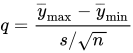
Suppose that we take a sample of size n from each of k populations with the same normal distribution N(μ, σ2) and suppose that is the smallest of these sample means and is the largest of these sample means, and suppose s² is the pooled sample variance from these samples. Then the following statistic has a Studentized range distribution.


Definition
[edit]Probability density function
[edit]Differentiating the cumulative distribution function with respect to q gives the probability density function.
![{\displaystyle f_{\text{R}}(q;k,\nu )={\frac {{\sqrt {2\pi \,}}\,k\,(k-1)\,\nu ^{\nu /2}}{\Gamma (\nu /2)\,2^{\left(\nu /2-1\right)}}}\int _{0}^{\infty }s^{\nu }\,\varphi ({\sqrt {\nu \,}}\,s)\,\left[\int _{-\infty }^{\infty }\varphi (z+q\,s)\,\varphi (z)\,\left[\Phi (z+q\,s)-\Phi (z)\right]^{k-2}\,\mathrm {d} z\right]\,\mathrm {d} s}](https://wikimedia.org/api/rest_v1/media/math/render/svg/20b454e7c3be46bad6a6b685406779af6e53aad8)
Note that in the outer part of the integral, the equation

was used to replace an exponential factor.
Cumulative distribution function
[edit]The cumulative distribution function is given by [1]
![{\displaystyle F_{\text{R}}(q;k,\nu )={\frac {{\sqrt {2\pi \,}}\,k\,\nu ^{\nu /2}}{\,\Gamma (\nu /2)\,2^{(\nu /2-1)}\,}}\int _{0}^{\infty }s^{\nu -1}\varphi ({\sqrt {\nu \,}}\,s)\left[\int _{-\infty }^{\infty }\varphi (z)\left[\Phi (z+q\,s)-\Phi (z)\right]^{k-1}\,\mathrm {d} z\right]\,\mathrm {d} s}](https://wikimedia.org/api/rest_v1/media/math/render/svg/c21803c454533585edeaa35d2b23061da152de3f)
Special cases
[edit]If k is 2 or 3,[2] the studentized range probability distribution function can be directly evaluated, where is the standard normal probability density function and is the standard normal cumulative distribution function.



![{\displaystyle f_{R}(q;k=3)=6{\sqrt {2\,}}\,\varphi \left(\,q/{\sqrt {2\,}}\right)\left[\Phi \left(q/{\sqrt {6\,}}\right)-{\tfrac {1}{2}}\right]}](https://wikimedia.org/api/rest_v1/media/math/render/svg/492f3d60fda45450ff9e9a619b855bb61fb1f5f1)
When the degrees of freedom approaches infinity the studentized range cumulative distribution can be calculated for any k using the standard normal distribution.
![{\displaystyle F_{R}(q;k)=k\,\int _{-\infty }^{\infty }\varphi (z)\,{\Bigl [}\Phi (z+q)-\Phi (z){\Bigr ]}^{k-1}\,\mathrm {d} z=k\,\int _{-\infty }^{\infty }\,{\Bigl [}\Phi (z+q)-\Phi (z){\Bigr ]}^{k-1}\,\mathrm {d} \Phi (z)}](https://wikimedia.org/api/rest_v1/media/math/render/svg/f380dc1c42ad0123fbaf0159324121161c99fec0)
Applications
[edit]Critical values of the studentized range distribution are used in Tukey's range test.[3]
The studentized range is used to calculate significance levels for results obtained by data mining, where one selectively seeks extreme differences in sample data, rather than only sampling randomly.
The Studentized range distribution has applications to hypothesis testing and multiple comparisons procedures. For example, Tukey's range test and Duncan's new multiple range test (MRT), in which the sample x1, ..., xn is a sample of means and q is the basic test-statistic, can be used as post-hoc analysis to test between which two groups means there is a significant difference (pairwise comparisons) after rejecting the null hypothesis that all groups are from the same population (i.e. all means are equal) by the standard analysis of variance.[4]
Related distributions
[edit]When only the equality of the two groups means is in question (i.e. whether μ1 = μ2), the studentized range distribution is similar to the Student's t distribution, differing only in that the first takes into account the number of means under consideration, and the critical value is adjusted accordingly. The more means under consideration, the larger the critical value is. This makes sense since the more means there are, the greater the probability that at least some differences between pairs of means will be significantly large due to chance alone.
Derivation
[edit]The studentized range distribution function arises from re-scaling the sample range R by the sample standard deviation s, since the studentized range is customarily tabulated in units of standard deviations, with the variable q = R⁄s . The derivation begins with a perfectly general form of the distribution function of the sample range, which applies to any sample data distribution.
In order to obtain the distribution in terms of the "studentized" range q, we will change variable from R to s and q. Assuming the sample data is normally distributed, the standard deviation s will be χ distributed. By further integrating over s we can remove s as a parameter and obtain the re-scaled distribution in terms of q alone.
General form
[edit]For any probability density function fX, the range probability density fR is:[2]
![{\displaystyle f_{R}(r;k)=k\,(k-1)\int _{-\infty }^{\infty }f_{X}\left(t+{\tfrac {1}{2}}r\right)f_{X}\left(t-{\tfrac {1}{2}}r\right)\left[\int _{t-{\tfrac {1}{2}}r}^{t+{\tfrac {1}{2}}r}f_{X}(x)\,\mathrm {d} x\right]^{k-2}\,\mathrm {d} \,t}](https://wikimedia.org/api/rest_v1/media/math/render/svg/462ed05fb46aaf8cae430562c3f64d5c1e0d06a7)
What this means is that we are adding up the probabilities that, given k draws from a distribution, two of them differ by r, and the remaining k − 2 draws all fall between the two extreme values. If we change variables to u where is the low-end of the range, and define FX as the cumulative distribution function of fX, then the equation can be simplified:

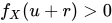
![{\displaystyle f_{R}(r;k)=k\,(k-1)\int _{-\infty }^{\infty }f_{X}(u+r)\,f_{X}(u)\,\left[\,F_{X}(u+r)-F_{X}(u)\,\right]^{k-2}\,\mathrm {d} \,u}](https://wikimedia.org/api/rest_v1/media/math/render/svg/f87b66f2887c8ba73d449fe77097473b9bffeb25)
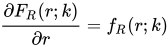
We introduce a similar integral, and notice that differentiating under the integral-sign gives
![{\displaystyle {\begin{aligned}{\frac {\partial }{\partial r}}&\left[k\,\int _{-\infty }^{\infty }f_{X}(u)\,{\Bigl [}\,F_{X}(u+r)-F_{X}(u)\,{\Bigr ]}^{k-1}\,\mathrm {d} \,u\right]\\[5pt]={}&k\,(k-1)\int _{-\infty }^{\infty }f_{X}(u+r)\,f_{X}(u)\,{\Bigl [}\,F_{X}(u+r)-F_{X}(u)\,{\Bigr ]}^{k-2}\,\mathrm {d} \,u\end{aligned}}}](https://wikimedia.org/api/rest_v1/media/math/render/svg/79ce11373630f6a4a3d2e1d4b738219af75b9388)
which recovers the integral above,[a] so that last relation confirms
![{\displaystyle {\begin{aligned}F_{R}(r;k)&=k\int _{-\infty }^{\infty }f_{X}(u){\Bigl [}\,F_{X}(u+r)-F_{X}(u)\,{\Bigr ]}^{k-1}\,\mathrm {d} \,u\\&=k\int _{-\infty }^{\infty }{\Bigl [}\,F_{X}(u+r)-F_{X}(u)\,{\Bigr ]}^{k-1}\,\mathrm {d} \,F_{X}(u)\end{aligned}}}](https://wikimedia.org/api/rest_v1/media/math/render/svg/c5194b7fd58dd44d6e6c4929e2f2e6387e481c29)
because for any continuous cdf
Special form for normal data
[edit]The range distribution is most often used for confidence intervals around sample averages, which are asymptotically normally distributed by the central limit theorem.
In order to create the studentized range distribution for normal data, we first switch from the generic fX and FX to the distribution functions φ and Φ for the standard normal distribution, and change the variable r to s·q, where q is a fixed factor that re-scales r by scaling factor s:
![{\displaystyle f_{R}(q;k)=s\,k\,(k-1)\int _{-\infty }^{\infty }\varphi (u+sq)\varphi (u)\,\left[\,\Phi (u+sq)-\Phi (u)\right]^{k-2}\,\mathrm {d} u}](https://wikimedia.org/api/rest_v1/media/math/render/svg/0f9533dfe9031ad819e3339f0d818cdf94cd4655)
Choose the scaling factor s to be the sample standard deviation, so that q becomes the number of standard deviations wide that the range is. For normal data s is chi distributed[b] and the distribution function fS of the chi distribution is given by:
![{\displaystyle f_{S}(s;\nu )\,\mathrm {d} s={\begin{cases}{\dfrac {\nu ^{\nu /2}\,s^{\nu -1}e^{-\nu \,s^{2}/2}\,}{2^{\left(\nu /2-1\right)}\Gamma (\nu /2)}}\,\mathrm {d} s&{\text{for }}\,0<s<\infty ,\\[4pt]0&{\text{otherwise}}.\end{cases}}}](https://wikimedia.org/api/rest_v1/media/math/render/svg/bc1a8ce22925692c9ab3ea76b180775656bcd99e)
Multiplying the distributions fR and fS and integrating to remove the dependence on the standard deviation s gives the studentized range distribution function for normal data:
![{\displaystyle f_{R}(q;k,\nu )={\frac {\nu ^{\nu /2}\,k\,(k-1)}{2^{\left(\nu /2-1\right)}\Gamma (\nu /2)}}\int _{0}^{\infty }s^{\nu }e^{-\nu s^{2}/2}\int _{-\infty }^{\infty }\varphi (u+sq)\,\varphi (u)\,\left[\,\Phi (u+sq)-\Phi (u)\right]^{k-2}\,\mathrm {d} u\,\mathrm {d} s}](https://wikimedia.org/api/rest_v1/media/math/render/svg/13c262ebcd5ba753289f769a9460f66ab945c75d)
where
- q is the width of the data range measured in standard deviations,
- ν is the number of degrees of freedom for determining the sample standard deviation,[c] and
- k is the number of separate averages that form the points within the range.
The equation for the pdf shown in the sections above comes from using

to replace the exponential expression in the outer integral.
Notes
[edit]- ^ Technically, the relation is only true for points where , which holds everywhere for normal data as discussed in the next section, but not for distributions whose support has an upper bound, like uniformly distributed data.
- ^ Note well the absence of "squared": The text refers to the χ distribution, not the χ2 distribution.
- ^ Usually , where n is the total number of all datapoints used to find the averages that are the values in the range.


References
[edit]- ^ Lund, R.E.; Lund, J.R. (1983). "Algorithm AS 190: Probabilities and upper quantiles for the studentized range". Journal of the Royal Statistical Society. 32 (2): 204–210. JSTOR 2347300.
- ^ a b McKay, A.T. (1933). "A note on the distribution of range in samples of n". Biometrika. 25 (3): 415–420. doi:10.2307/2332292. JSTOR 2332292.
- ^ "StatsExamples | table of Q distribution critical values for alpha=0.05".
- ^ Pearson & Hartley (1970, Section 14.2)
Further reading
[edit]- Pearson, E.S.; Hartley, H.O. (1942). "The probability integral of the range in samples of N observations from a normal population". Biometrika. 32 (3): 301–310. doi:10.1093/biomet/32.3-4.309. JSTOR 2332134.
- Hartley, H.O. (1942). "The range in random samples". Biometrika. 32 (3): 334–348. doi:10.2307/2332137. JSTOR 2332137.
- Dunlap, W.P.; Powell, R.S.; Konnerth, T.K. (1977). "A FORTRAN IV function for calculating probabilities associated with the studentized range statistic". Behavior Research Methods & Instrumentation. 9 (4): 373–375. doi:10.3758/BF03202264.
External links
[edit]Studentized range distribution
View on GrokipediaDefinition
Probability density function
The studentized range is defined as the range of independent standard normal random variables divided by an independent estimate of the standard deviation, specifically , where is the range among the normals and with following a chi-squared distribution with degrees of freedom, independent of the normals.[2] This arises in the context of sample means from normal populations with equal sample sizes , where the range of the means is studentized by the pooled standard error , with based on degrees of freedom and total observations; the distribution of is free of and . The probability density function of for , with parameters (number of groups) and (degrees of freedom), is given by where and denote the standard normal probability density function and cumulative distribution function, respectively.[2] Here, represents the number of independent samples or groups compared, while reflects the degrees of freedom associated with the estimate of the variance.[3] This integral form for the PDF is derived from the joint distribution of the order statistics of the standard normal variables, which yields the marginal density of the range as for , reflecting the probability that one observation is at the lower extreme, another at the upper, and the remaining lie between them. Transforming to the studentized form then involves integrating the product of the range density, the density of , and the Jacobian factor , leading to the double integral representation above after substitution.Cumulative distribution function
The cumulative distribution function (CDF) of the studentized range random variable , denoted , where is the number of populations or samples and is the degrees of freedom, gives the probability that the studentized range does not exceed the value . This function is expressed through an integral representation involving the standard normal cumulative distribution function : where is the standard normal probability density function. This form arises from conditioning on the scaled variance estimate and integrating the conditional distribution of the range of standard normal variables. The CDF is strictly monotonically increasing in for , starting from the boundary condition since the range is nonnegative, and approaching 1 as . This monotonicity ensures that probabilities accumulate smoothly over the support . In practice, due to the complexity of the double integral, the CDF has historically been evaluated using tabulated values rather than direct computation.[4] The survival function, , represents the upper-tail probability and is particularly relevant in hypothesis testing for multiple comparisons, where it determines the likelihood of observing a range exceeding a critical threshold under the null hypothesis. Early evaluations of the CDF faced significant computational challenges, requiring laborious numerical integration methods on early computers, which prompted the creation of comprehensive tables for various and values before the advent of efficient numerical algorithms and software.[4]Quantiles and critical values
The quantile function of the studentized range distribution gives the value such that the probability , where is the studentized range random variable depending on the number of samples and degrees of freedom . This inverse of the cumulative distribution function is essential for determining thresholds in hypothesis testing.[5] Critical values are commonly tabulated for significance levels such as and , with parameters ranging from 2 to 10 and from small values like 5 up to infinity. These tables facilitate applications in multiple comparison procedures. For illustration, the following table shows selected critical values for :| 5 | 3.64 | 5.70 | 6.98 | 7.80 |
| 2.77 | 3.64 | 4.12 | 4.40 |
Properties
Moments and characteristic function
The moments of the studentized range distribution , where is the number of populations and is the degrees of freedom, are derived by integration with respect to its probability density function . Since the density is expressed as a multiple integral, the moments lack closed-form expressions and are typically computed numerically or approximated asymptotically. The first moment, or expected value, is given by , or equivalently for this non-negative random variable, , where is the cumulative distribution function. The studentized range can be decomposed as , where is the range of i.i.d. standard normal random variables (independent of ), and follows the distribution of the square root of a scaled chi-squared random variable. This independence allows , where is the cdf of . The cdf of has the exact integral form , with and denoting the cdf and pdf of the standard normal distribution, respectively. Thus, admits an exact integral expression involving the normal cdf, amenable to numerical evaluation. For large , in probability, so the moments of approach those of . In this regime, for large , derived from extreme value theory applied to the maximum and minimum order statistics of the normals. The variance follows from the second moment, , with . Asymptotically for large and large , , reflecting the Gumbel limiting distribution of the normalized extremes (with variance for each endpoint, leading to total asymptotic variance after adjustment by the scaling factor for the two endpoints). Higher moments for are obtained analogously via or by numerical integration of the density. These can also be derived from the characteristic function , with the -th central moment given by . Using the decomposition, , where is the characteristic function of , which itself integrates over the joint density of the order statistics. This form facilitates analysis in limit theorems, such as convergence to extreme value distributions for varying or . Asymptotic expansions for moments as or build on refinements of the Gumbel approximation, including subleading terms like for the expected maximum.Special cases and limiting behavior
When , the studentized range reduces to a scaled version of the absolute value of a Student's -distributed random variable with degrees of freedom, specifically where . This equivalence arises because the range between two group means, when standardized by the standard error of a single mean, corresponds to the two-sample -statistic scaled by to account for the standard error of the difference between means.[7] As , the studentized range distribution converges to the distribution of the range of independent standard normal random variables, since the sample standard deviation converges in probability to the true standard deviation (after standardization). This limiting distribution, often denoted as the range distribution for normal samples, has been tabulated and studied for its use in multiple comparisons under known variance. For large , extreme value theory implies that in probability, reflecting the asymptotic behavior of the range of standard normals where the maximum deviates approximately from the mean and the minimum by a symmetric amount. This normalization highlights the growth rate of the studentized range as the number of comparisons increases, connecting it to Gumbel-type extreme value distributions after further centering and scaling. At small , such as , the distribution exhibits increased variability with heavy tails resembling those of a scaled Cauchy distribution (the case for ), leading to wider critical values and less precise inferences in multiple comparisons due to the high uncertainty in estimating the error variance. As , the distribution degenerates to a point mass at zero, as the error degrees of freedom approach insufficiency for variance estimation, rendering the studentization undefined and the range effectively uninformative.Applications
Multiple comparison tests
The studentized range distribution is fundamental to post-hoc multiple comparison tests in one-way analysis of variance (ANOVA), enabling controlled assessments of pairwise differences among k group means after a significant overall F-test. These procedures leverage the distribution to establish critical differences that balance power and error control in comparing means from normal populations. Tukey's Honestly Significant Difference (HSD) test utilizes the studentized range to evaluate whether observed differences between sample means are statistically significant.[8] The test's rejection region for the null hypothesis of equal population means between groups i and j is defined as , where denotes the upper -quantile of the studentized range distribution with k means and degrees of freedom for the error mean square, s is the pooled standard error from the ANOVA, and n is the common sample size per group.[8] This formulation scales the range of ordered means by the estimated standard error, providing a conservative threshold for significance. The HSD test controls the family-wise error rate (FWER) at the nominal level across all pairwise comparisons, meaning the probability of declaring at least one false significant difference when all population means are equal does not exceed .[9] This strong control is achieved through the joint distribution properties of the studentized range, making the procedure suitable for exploratory analyses where multiple inferences are drawn simultaneously. Duncan's multiple range test extends this framework by using adjusted critical values derived from the studentized range distribution, tailored to the number of means in each subset comparison rather than the full set of k groups. These adjustments yield protection levels that increase with subset size, resulting in a less stringent test than HSD while still basing decisions on the same underlying distribution. Both tests require equal sample sizes n across groups, normality in the underlying populations, and homogeneity of variances to ensure the validity of the pooled error estimate and the distribution's applicability.[10] As an illustrative application, consider a one-way ANOVA involving k=4 treatment groups, each with n=10 observations, where the error degrees of freedom and the pooled standard deviation s=2.5. Following a significant ANOVA result, the HSD critical difference is ; thus, any pairwise mean difference exceeding 3.01 units would be deemed significant at , allowing researchers to identify specific differing groups while maintaining FWER control.[8][11]Analysis of variance extensions
The studentized range distribution extends beyond foundational pairwise multiple comparisons in analysis of variance (ANOVA) to more general scenarios involving linear contrasts and complex experimental designs. In these extensions, the distribution provides critical values for constructing simultaneous inference procedures that control the family-wise error rate while accommodating broader sets of hypotheses. Simultaneous confidence intervals for all linear contrasts can be formed using the studentized range statistic applied to normalized combinations of treatment means, specifically for contrasts of the form where . The half-width of such intervals is given by , where is the critical value from the studentized range distribution with groups and error degrees of freedom, ensuring joint coverage of 100(1-)% for the set of all such normalized contrasts. This approach leverages the fact that the maximum absolute value of these studentized normalized contrasts follows the studentized range distribution under the null hypothesis of equal means.[12] When sample sizes are unequal, the standard studentized range procedures require adjustment to maintain validity. The Spjøtvoll-Stoline method extends Tukey's T-method by incorporating an effective number of comparisons (typically between 2 and ), which approximates the studentized range critical value as scaled by the harmonic mean of sample sizes or similar adjustments to the standard error. This yields conservative simultaneous confidence intervals for pairwise differences, with performance superior to Scheffé's method when imbalance is moderate and focus is on selected contrasts; simulations show it controls the error rate closely while offering higher power than unadjusted alternatives.[13] Nonparametric analogs of the studentized range arise in rank-based multiple comparison tests, particularly for ordered alternatives, where the test statistic is the range of average ranks studentized by an estimate of scale. These methods, rooted in Hayter's one-sided studentized range test, replace sample means with rank sums and use asymptotic approximations or tables for critical values, providing robust inference without normality assumptions; for example, in the Kruskal-Wallis framework, the maximum rank range divided by a pooled rank variance follows a distribution analogous to the studentized range under the null. Such procedures maintain type I error control and detect shifts in location with efficiency comparable to parametric versions for non-normal data.[14] In balanced incomplete block designs (BIBD), the studentized range is applied to compare treatment effects after adjusting for block variability, treating the design as a fixed-effects ANOVA with the range of estimated treatment means . Critical values from the studentized range distribution with effective degrees of freedom (where is the number of blocks, the block size, and the number of treatments) are used for simultaneous intervals on , scaled by where is the pairwise concurrence parameter; this ensures balanced power for all pairwise treatment contrasts while accounting for incomplete blocking.[15] Power analysis for tests based on the studentized range distribution reveals that sensitivity increases with sample size and error variance estimate , but decreases with the number of groups , as larger inflates the critical value . The exact power function, derived for the one-way ANOVA model, depends on the least favorable configuration of means (e.g., equal spacing within the range), allowing sample size computation to achieve desired power under restricted alternatives; for instance, power approaches 1 as the noncentrality parameter (range of means over standard deviation) grows, but minimal guaranteed power is lowest when means are at extremes.[16]Related distributions
Connection to Student's t-distribution
The studentized range distribution exhibits a direct mathematical connection to Student's t-distribution, particularly evident when the number of samples . In this case, the studentized range is exactly equivalent to , where follows Student's t-distribution with degrees of freedom, typically in the context of analysis of variance with equal sample sizes.[17] This equivalence arises because, for two samples, the range reduces to the absolute difference between the two sample means, and the studentization factor aligns precisely with the denominator of the two-sample t-statistic, scaled by . Consequently, the quantiles of the studentized range for are identical to those of the scaled t-distribution, facilitating straightforward computation using standard t-tables adjusted by the scaling factor. For general , the studentized range can be expressed as the range of independent standard normal variables divided by an independent factor , where is a chi-squared random variable with degrees of freedom; this denominator is the same scaling that defines the t-distribution from a single normal variate. Equivalently, represents the range among correlated t-distributed statistics, as each studentized sample mean follows a t-distribution with the shared denominator introducing dependence across the statistics. This structure underscores the probabilistic link to the t-distribution while accounting for multiplicity through the extremal range. Early computational tables for the studentized range leveraged this connection by repurposing t-distribution tables for the case, simply applying the scaling to obtain critical values without needing separate computations. For , however, the distribution deviates, exhibiting thicker tails than the single t-distribution due to the increased variability from considering the extremal range across multiple samples, which amplifies the probability of large deviations relative to a pairwise t-test. This tail behavior enhances the conservatism of multiple comparison procedures like Tukey's HSD, ensuring control of family-wise error rates.Relation to uniform range distribution
The unstudentized range is defined as the difference between the maximum and minimum of independent and identically distributed (i.i.d.) random variables from a specified distribution, such as the uniform distribution on or the standard normal distribution with known standard deviation . For a general continuous distribution with cumulative distribution function (CDF) and probability density function (PDF) , the PDF of is given by where the integral is over the support where . For the specific case of i.i.d. uniform random variables, this simplifies to for . In contrast, for standard normals with known , the PDF involves a more intricate integral with the normal density and CDF, reflecting the unbounded support and leading to heavier tails in the distribution compared to the uniform case. The studentized range , where is an independent estimate of the standard deviation based on degrees of freedom (typically from a pooled sample variance following a distribution), introduces additional variability due to the randomness in . This studentization effect creates dependence between the numerator and the scaling factor, as can vary, resulting in heavier tails for the studentized range distribution relative to the unstudentized version; small values of inflate , increasing the probability of extreme values. The joint distribution arises from the product measure of the unstudentized range and the scaled chi distribution for , leading to a more dispersed overall form that is crucial for robust inference under unknown variance.[1] As the degrees of freedom become large, the sample standard deviation converges in probability to the true , causing the studentized range distribution to asymptotically approach that of the unstudentized range from standard normals. For large , both distributions exhibit similar tail behavior, with quantiles approximating , providing a scaling factor that normalizes the range to a limiting extreme value distribution; thus, the studentized range behaves approximately like the unstudentized range scaled by this factor in the tails. This convergence underscores their shared extremal properties for normal populations under stable variance estimation. In applications, the unstudentized range finds use in scenarios with known variance, such as statistical quality control charts where process is predetermined, allowing direct monitoring of variability through range limits without estimation error. Conversely, the studentized range is essential for statistical inference in multiple comparison procedures, like Tukey's honest significant difference test, where unknown variance requires scaling by to maintain valid control of error rates across comparisons. Moment comparisons highlight key differences: for the unstudentized range from i.i.d. uniform variables, the expected value is simply , reflecting the bounded support and linear simplicity of the uniform distribution. For the studentized range under normal assumptions, moments are more intricate, involving infinite series or integrals over the joint density of the range and chi-squared components, with increasing with and decreasing with , often tabulated rather than closed-form due to the added variability from studentization.Derivation
General form from order statistics
The studentized range distribution arises in the context of order statistics from the group sample means across multiple groups. Consider independent groups, each with observations denoted for to and to , where each independently. Under the null hypothesis that all group means are equal ( for all ), the group sample means are i.i.d. . Standardizing by the known yields , so the range of the standardized means , where i.i.d. The pooled standard deviation is derived from the mean square error (MSE) in the one-way ANOVA model, given by , where is the error degrees of freedom. The studentized range statistic is then , or equivalently since .[18] Under normality, the vector of group means and the pooled are independent. The probability structure of is built upon the distribution of the range of i.i.d. standard normals. For i.i.d. observations from a continuous distribution with pdf and cdf (standard normal), the cdf of is The cdf of is then where and is its pdf (a scaled chi distribution). Substituting the cdf of yields the double integral representation This structure emphasizes the role of order statistics of the standardized means in establishing the foundational probability integral for the studentized range under the normal model.[18] While the exact form relies on the normality assumption for independence and the joint density, generalizations to non-normal distributions can be approached via resampling methods such as bootstrapping, which approximates the sampling distribution of by generating empirical replicates from the observed data. However, the focus here remains on the precise integral-based derivation from order statistics of the group means under the normal model.Specific form for normal populations
When the underlying population follows a normal distribution, the studentized range distribution takes a specific form derived from the order statistics of standard normal random variables . The range is defined as , and an independent random variable with degrees of freedom yields the studentized range . This construction assumes the samples are drawn from , with the obtained after standardization by the known or estimated . The resulting distribution of is pivotal for normal populations and independent of and . The cumulative distribution function (CDF) of is given by the double integral for , where is the pdf of , denotes the CDF of the standard normal distribution, and its pdf. The pdf can be obtained by differentiating the CDF with respect to . This expression arises from the joint distribution of the order statistics under normality, with the inner integral capturing the conditional cdf of the scaled range. The inner integral employs the standard normal CDF , which can be expressed in terms of the error function as , facilitating numerical evaluation while preserving the closed-form integral structure. No simple closed-form pdf exists, and the distribution is typically evaluated numerically or via tables. Validation of the expression occurs in special cases; for instance, when , the distribution simplifies to a scaled Student's -distribution with degrees of freedom, specifically , aligning with the known two-sample comparison under normality.History
Origins in multiple comparisons
The studentized range distribution originated in the context of early 20th-century agricultural experiments, where statisticians sought reliable methods to compare multiple treatment means under limited sample sizes. Ronald A. Fisher developed analysis of variance (ANOVA) in the 1920s at the Rothamsted Experimental Station in England, motivated by the need to analyze field trials involving numerous crop varieties, fertilizers, and soil conditions.[19] While ANOVA provided an omnibus test for overall group differences, follow-up pairwise comparisons posed challenges, as repeated significance tests inflated error rates, prompting informal approaches to control Type I errors across multiple inferences.[20] Prior to formalization, Fisher and his collaborator Frank Yates explored range-based ideas in the 1930s for bioassays and agricultural designs, using the difference between the largest and smallest sample means as a simple metric for detecting treatment effects in experiments like yield comparisons or potency assays. These methods were ad hoc, often approximating significance via t-tests or unadjusted ranges, without an exact distribution, resulting in conservative procedures to mitigate false positives in multi-treatment settings.[21] Their 1938 tables for biological and agricultural research supported such analyses but highlighted the limitations of lacking precise critical values for ranges in normal populations.[22] The studentized range statistic, defined as the range divided by an independent estimate of the standard deviation, was suggested by W. S. Gosset ("Student") in his 1927 paper "Errors of Routine Analysis," where it appeared in discussions of small-sample variability from normal distributions in industrial quality control. The distribution was first derived by D. Newman in 1939, who calculated percentage points for the statistic .[1] A pivotal advancement for its application occurred in 1949 when John W. Tukey proposed using the studentized range as a core tool for multiple comparisons in his paper "Comparing Individual Means in the Analysis of Variance," published in Biometrics. Tukey applied the statistic to perform simultaneous pairwise tests following a significant ANOVA, explicitly designed to control the family-wise error rate at a specified level, such as 5%, across all comparisons.[23] This built directly on Newman's work and earlier ideas by Gosset. Early adoption of Tukey's method encountered significant hurdles due to the absence of exact distribution tables for the studentized range under varying degrees of freedom and group sizes, forcing practitioners to rely on conservative approximations like bounding the statistic with t-distribution quantiles or unstudentized range values.[5] By the 1950s, these limitations were addressed through the development of exact forms and computational tables, transitioning the approach from informal heuristics to a rigorous, implementable procedure integrated into standard statistical software and texts for ANOVA extensions.[5]Key developments and contributors
In 1952, M. Keuls extended the application of the studentized range to multiple comparisons in ANOVA, proposing a step-down procedure that uses quantiles from the distribution to test ordered means, forming the basis of the Newman-Keuls test.[24] In 1955, David B. Duncan developed the multiple range test, extending the application of the studentized range to perform ordered multiple comparisons with adjusted critical values based on protection levels derived from degrees of freedom.[25] During the 1960s, significant advancements in computational accessibility came from the compilation of extensive tables for the quantiles of the studentized range distribution. H. Leon Harter published comprehensive tables covering up to 24 groups (k=24) and degrees of freedom (ν) up to 120, facilitating practical use in analysis of variance procedures.[5] Earlier foundational tables had been provided by E. S. Pearson and H. O. Hartley in 1942, tabulating the probability integral for smaller sample sizes up to n=20, which laid the groundwork for these expansions.[26] By the 1980s, the studentized range was integrated into statistical software packages such as SAS and precursors to R, allowing automated calculation of critical values and p-values. Contributions from P. H. Ramsey and colleagues addressed extensions for unequal sample sizes (n), modifying the studentized range statistic to maintain control over family-wise error rates in unbalanced designs. Key figures in these developments include D. Newman for the initial derivation, John Tukey for application to multiple comparisons, M. Keuls and David Duncan for practical testing extensions, and table compilers like E. S. Pearson and H. O. Hartley, whose work ensured the distribution's widespread adoption in statistical practice. Post-2000, classical developments have been complemented by Bayesian extensions incorporating prior distributions on range parameters for robust multiple comparisons, and robust versions adapting the studentized range to non-normal data via trimmed means or bootstrapping.Numerical methods
Computation of distribution functions
The probability density function (PDF) and cumulative distribution function (CDF) of the studentized range distribution are expressed through double integrals that incorporate the standard normal density and the chi-squared distribution. Numerical evaluation of these functions relies on quadrature methods, such as Gauss-Legendre quadrature, to approximate the integrals with high precision. For instance, a 16-point Legendre formula is commonly applied to the inner integral over the normal density, while adaptive quadrature handles the outer integral to adjust for varying parameter values and ensure accuracy. These methods are essential for computing the PDF and CDF across a range of the number of groups , degrees of freedom , and the studentized range value . A foundational approach for exact computation is provided by Algorithm AS 190, which evaluates the CDF via numerical quadrature of the double integral representation: where and are the standard normal CDF and PDF, respectively, and is the PDF of . The algorithm uses adaptive limits and error controls to achieve relative accuracy of about , and quantiles are obtained by inverting the CDF using a secant method. Recurrence relations derived from differential equations satisfied by the CDF enable efficient updates for sequential values of or , reducing computational overhead in multiple evaluations.[27] Monte Carlo simulation offers a flexible, though approximate, method for estimating the distribution functions, particularly useful for validation or non-standard parameters. The procedure generates large numbers of independent samples from the standard normal distribution (size ), computes the sample range , estimates the standard deviation from pooled samples with degrees of freedom, and forms the studentized range . The empirical CDF is then the proportion of simulated values less than or equal to a given . With or more replications, this yields estimates accurate to within a few percent in the central region, though variance is higher in the tails.[28] For large or large , asymptotic expansions facilitate rapid approximations. When is large, the distribution converges to that of the range of standard normals, computed via a single integral over the normal density, avoiding the chi-squared component. Higher-order approximations, such as those using Edgeworth series expansions around the normal limit, incorporate skewness and kurtosis terms to improve tail accuracy for finite but large parameters. These are particularly effective for quick quantile estimates in high-dimensional settings.[2][27] Numerical methods for the studentized range can face convergence challenges, especially for small or large , where the integrands exhibit sharp peaks or slow decay, leading to potential underestimation of tail probabilities. In such cases, increasing the number of quadrature points, employing adaptive step-sizing, or switching to asymptotic forms mitigates errors, with relative accuracies typically maintained above through careful implementation.[29]Approximations and software tools
Several approximations have been developed to compute quantiles and distribution functions of the studentized range distribution efficiently, avoiding the computational intensity of exact numerical integration. One early approach involves normal approximations for upper quantiles, as outlined in Peiser (1943), which utilizes inverse normal distribution functions to estimate critical values. More comprehensive tables and approximation methods for probabilities and quantiles are provided in Miller (1981), including extensions for multiple comparisons that rely on normal and t-distribution approximations for practical tabularization.[30] A notable non-iterative approximation for upper quantiles was proposed by Hayter (1999), which derives studentized range quantiles directly from accurate t-distribution quantiles through simple arithmetic operations, achieving high precision across a wide range of parameters.[31] For large degrees of freedom (ν > 100,000), asymptotic approximations based on infinite degrees of freedom are employed, simplifying the cumulative distribution function to a form amenable to standard normal computations.[2] Software implementations facilitate practical computation of the studentized range distribution. In R, the basestats package provides functions such as ptukey() for the cumulative distribution function, qtukey() for quantiles, and ptukey() for tail probabilities, supporting Tukey's honest significant difference tests.[32] The multcomp package extends this with glht() for general linear hypotheses involving studentized range-based multiple comparisons. In Python, scipy.stats.studentized_range offers probability density, cumulative distribution, and quantile functions, while statsmodels.stats.multicomp.tukeyhsd() implements Tukey's test using these distributions.[2] SAS PROC GLM computes studentized range statistics via the LSMEANS statement with multiple comparison options, and the PROBMC procedure handles partitioned and full range probabilities.[33]
Updated tables for critical values extend classical works like those of Harter (1969) and Pearson and Hartley (1972) to higher parameters and are available through resources such as the Real Statistics ResourcePack for Excel on CRAN mirrors and online statistical appendices.[34] These tables cover α levels from 0.001 to 0.10, with k up to 100 and df up to infinity, surpassing earlier limitations like those in Dunn and Clark (1971).
Validation studies confirm the accuracy of these approximations relative to exact integrals. Hayter's (1999) method yields relative errors below 0.075% across 4,738 test cases (r > 2), with over 98% of errors under 0.02%, and maximum absolute errors limited to three units in the fourth decimal place for tabulated values.[31][35] Similarly, implementations in SciPy and R base functions report errors under 1% for quantile estimates when compared to high-precision numerical integrations, particularly for moderate to large ν.[2][32]