Hubbry Logo
Brodmann area 25Brodmann area 25Main
Open search
Brodmann area 25
Community hub
Brodmann area 25
logo
8 pages, 0 posts
0 subscribers
Be the first to start a discussion here.
Brodmann area 25
Brodmann area 25
from Wikipedia
Brodmann area 25
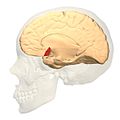
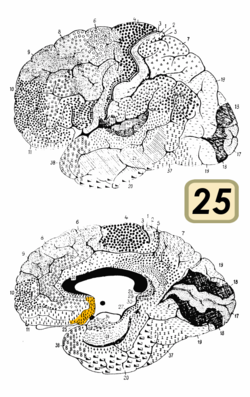
Brodmann area 25 is shown in orange.
Medial surface of the brain with Brodmann's areas numbered.
Details
Identifiers
Latinarea subgenualis
NeuroNames1029
FMA68622
Anatomical terms of neuroanatomy

Brodmann area 25 (BA25) is the subgenual area, area subgenualis or subgenual cingulate area in the cerebral cortex of the brain and delineated based on its cytoarchitectonic characteristics.

It is the 25th "Brodmann area" defined by Korbinian Brodmann. BA25 is located in the cingulate region as a narrow band in the caudal portion of the subcallosal area adjacent to the paraterminal gyrus. The posterior parolfactory sulcus separates the paraterminal gyrus from BA25. Rostrally it is bound by the prefrontal area 11 of Brodmann.[1]

History

[edit]

Brodmann described this area as it is labeled now in 1909. Originally in 1905, Brodmann labeled the area as part of area 24. In 1909, he divided the area into area 24 and 25.[2]

Function

[edit]

This region is extremely rich in serotonin transporters and is considered as a governor for a vast network involving areas like hypothalamus and brain stem, which influences changes in appetite and sleep; the amygdala and insula, which affect the mood and anxiety; the hippocampus, which plays an important role in memory formation; and some parts of the frontal cortex responsible for self-esteem.[3] This region is particularly implicated in the normal processing of sadness.[4][5]

Involvement in depression

[edit]

The subcallosal cingulate gyrus CG25 which consists of BA25 as well as parts of BA24 and BA32 has been implicated as playing an important role in major depression and has been the target of deep brain stimulation to treat the disorder.[6]

One study found that BA25 is metabolically overactive in treatment-resistant depression.[7] A different study found that metabolic hyperactivity in this area is associated with poor therapeutic response of persons with major depressive disorder to cognitive-behavioral therapy and venlafaxine.[8]

In 2005 Helen S. Mayberg and collaborators described how they successfully treated a number of depressed people—individuals virtually catatonic with depression despite years of talk therapy, drugs, and electroconvulsive therapy—with pacemaker-like electrodes (deep brain stimulation) in area 25.[9]

In 2013, Walker and Lawson conducted neurofeedback research with 183 subjects experiencing drug resistant depression. The neurofeedback specifically targeted Brodmann area 25. The treatment consisted of 6 neurofeedback sessions that were 20min long each over the course of 3 weeks. 1 year after the treatment 84% of subjects experienced over a 50% reduction in depression symptoms. 9% reported a 20-50% reduction in depression symptoms. 7% reported a 0-20% improvement. 1% initially reported positive effects, but had a depression relapse before the year follow up completed. There were no side effects or complications reported from the treatment.[10]

A study found that transcranial magnetic stimulation is more clinically effective treating depression when targeted specifically to Brodmann area 46, because this area has intrinsic functional connectivity (negative correlation) with area 25.[11]

Another study has found that the responses of area 25 to viewing sad stimuli are affected by cortisol.[12] This suggests that depression related changes in the activity in area 25 could be due to hypothalamic–pituitary–adrenal axis dysregulation.

Image

[edit]

See also

[edit]

Notes and references

[edit]
Revisions and contributorsEdit on WikipediaRead on Wikipedia
from Grokipedia
Brodmann area 25 (BA25), also known as the subgenual cingulate area or area subgenualis, is a distinct cytoarchitectonic region of the situated in the subcallosal portion of the anterior cingulate gyrus, positioned ventral to the genu of the and extending toward the rostrum. In humans, it exhibits an agranular cortical structure characterized by the absence of a distinct layer IV, poorly differentiated layers II and III that form a broad supragranular band, a prominent layer V with large pyramidal neurons, and a thin layer VI. This area, part of the medial , integrates cognitive, emotional, and visceral signals through dense reciprocal connections with limbic structures such as the , ventral striatum, and , as well as cortical regions including the , anterior insula, and medial . BA25 serves as a critical hub for autonomic , modulating cardiovascular parameters like and via projections to the and , as demonstrated in inactivation studies where its disruption leads to reduced sympathetic tone and . It also plays a central role in emotional processing, particularly in generating and sustaining negative affective states such as and anxiety, with hyperactivity in this region correlating with heightened responses and impaired reward in both and marmoset models. Furthermore, BA25 influences the hypothalamic-pituitary-adrenal (HPA) axis, contributing to stress responses and endocrine functions through its connections to the and dorsomedial . In the context of neuropsychiatric disorders, BA25 is prominently implicated in major depressive disorder (MDD), where increased metabolic activity and volumetric reductions (up to 35% in familial cases) are observed, alongside reduced glial cell density. This hyperactivity normalizes with effective treatments like antidepressants, electroconvulsive therapy, and deep brain stimulation (DBS) targeted at BA25, which yields response rates of 55% and remission in 35% of treatment-resistant patients by modulating downstream limbic and autonomic networks. Primate studies, including those in macaques and marmosets, underscore its conserved role in approach-avoidance behaviors and emotional dysregulation, highlighting BA25's evolutionary significance in affective neuroscience.

Anatomy

Location and Boundaries

Brodmann area 25 (BA25), also known as the subgenual area, is situated on the medial surface of the within the cingulate region, forming a narrow band in the caudal portion of the subcallosal area, or subgenual cingulate gyrus. It lies ventral to the genu of the , extending beneath this structure as part of the . This positioning places BA25 in a deep, ventral location relative to the . The rostral boundary of BA25 is defined by its adjacency to , the prefrontal cortex region on the medial orbital gyrus. Caudally, it borders the paraterminal gyrus, with the posterior parolfactory sulcus serving as the separating landmark. Dorsally, BA25 is positioned immediately below the genu of the , while its ventral extent aligns with the subcallosal folds without extending laterally beyond the midline. These boundaries are primarily identified through cytoarchitectonic distinctions in cortical layering and cell density. Within the broader subgenual , BA25 represents the core region, encompassing the most ventral and caudal aspects, while adjacent portions incorporate elements of s 24 and 32. This spatial relationship underscores BA25's integration into the subgenual complex, distinct from more rostral cingulate structures.

Cytoarchitecture

25 (BA25) is characterized as an agranular cortex, lacking a distinct internal granular layer IV, which contributes to its primitive laminar organization. Layers II and III are poorly developed and often fuse into a broad supragranular region containing medium-sized pyramidal neurons. Layer V features prominent, densely packed pyramidal cells, while layer VI consists of small, poorly differentiated multipolar neurons that intermingle with those in layer V, creating a compact infragranular structure. Layer III is notably broad, and the overall dense packing in layers III and V distinguishes BA25's cytoarchitecture from more differentiated cortical regions. This cytoarchitectural profile was first delineated by in his 1909 comparative study of cortical areas, where he identified area 25 based on its agranular features and differentiated it from adjacent regions such as area 24, which exhibits greater granularity and a more defined layer IV. Brodmann's analysis emphasized the region's uniform, less stratified appearance, setting it apart from the dysgranular or granular cortices nearby. These microscopic characteristics aid in precisely identifying BA25's boundaries during histological examination. BA25 is primarily known cytoarchitecturally as the subgenual cingulate area, reflecting its position and laminar simplicity within the cingulate gyrus.

Historical Development

Brodmann's Classification

Korbinian Brodmann developed his seminal classification of the cerebral cortex through meticulous microscopic examination of Nissl-stained sections from human and primate brains, parcellating the cortex into 52 distinct areas based on variations in cytoarchitecture, such as cell density, lamination, and morphology. This approach emphasized the principle that structural differences in cortical layering and neuronal organization correspond to functional specialization, building briefly on prior efforts in comparative neuroanatomy by researchers like Oskar Vogt. In his preliminary 1905 publication, Beiträge zur histologischen Lokalisation der Grosshirnrinde, Brodmann initially grouped the subcallosal cingulate region with area 24, treating it as a single agranular zone within the anterior cingulate gyrus. However, upon further analysis, he recognized distinct cytoarchitectonic features in this ventral portion, including finer granular elements and altered layering patterns that set it apart from the overlying area 24. Brodmann formalized this distinction in his 1909 monograph, Vergleichende Lokalisationslehre der Großhirnrinde in ihren Prinzipien dargestellt auf Grund des Zellenbaues, designating the subcallosal cingulate as area 25 based on its unique dysgranular to agranular structure and position caudal to the paraterminal . This classification highlighted area 25's transitional characteristics between limbic and prefrontal regions, contributing to the foundational map still referenced in modern .

Subsequent Refinements

In the early 20th century, and Georg N. Koskinas refined Brodmann's cytoarchitectonic parcellation through their comprehensive atlas of the human , published in 1925, where they identified 107 areas based on detailed histological examinations of multiple postmortem brains. They designated the subgenual region ventral to the genu of the corpus callosum as area Fm (genual area, EK 33), corresponding closely to 25, with boundaries extending medially from the cingulate sulcus and characterized by a thin layer I, prominent medium-sized pyramidal cells in layer III, and a dense layer V. This and delineation provided a more granular subdivision of the cingulate region, building on Brodmann's foundational criteria by incorporating variations in laminar organization and cell morphology observed across subjects. Advancements in during the 1990s and 2000s enabled non-invasive validation and refinement of BA25's boundaries using MRI-based parcellation techniques, which distinguished it from adjacent areas like 24 and 32 through probabilistic mapping and volumetric analysis. For instance, automated segmentation methods in structural MRI scans confirmed BA25's location in the subgenual cingulate, highlighting its ventral extension below the and thinner cortical profile relative to neighboring rostral cingulate zones, thus resolving ambiguities in postmortem-based definitions. These approaches, often integrated with diffusion tensor imaging, emphasized reproducible boundary delineation in living subjects, enhancing the precision of BA25 identification beyond early histological limits. In the 2000s, Brent A. Vogt and colleagues incorporated BA25 into expanded models of the cingulate gyrus, proposing a four-region framework (anterior, midcingulate, posterior, and retrosplenial) that positioned BA25 within the subgenual anterior cingulate as a key node in limbic circuitry. This integration refined BA25's anatomical context by mapping its connections to subcortical limbic structures, such as the amygdala and hypothalamus, while delineating its boundaries more clearly against the ventral prefrontal cortex through combined cytoarchitectonic and connectivity data. Such models underscored BA25's distinct parcellation within the broader cingulate architecture, facilitating its alignment with modern probabilistic atlases.

Connectivity

Structural Connections

Brodmann area 25 (BA25), also known as the , exhibits a rich array of structural connections that integrate it into limbic and autonomic networks, as revealed by tracer studies in nonhuman and postmortem analyses in humans. These anatomical pathways include both afferent and efferent projections, primarily identified through axonal tracing and histological examinations. Afferent inputs to BA25 originate from several key regions involved in emotional and cognitive processing. It receives dense reciprocal projections from the , providing direct emotional signals. The hippocampus contributes memory-related inputs, particularly from its anterior portions, linking contextual information to BA25. Inputs from the convey and reward valuation signals. Additionally, brainstem nuclei, such as the , supply autonomic control inputs, facilitating visceral regulation. Efferent outputs from BA25 target regions that modulate endocrine, sensory, and . Dense projections extend to the , including the preoptic, lateral, and dorsomedial nuclei, for endocrine regulation. Outputs to the anterior insula support interoceptive processing. BA25 sends connections to the , particularly the , influencing executive control. Projections to the ventral , including the , participate in reward processing pathways. BA25 maintains bidirectional connections with the (BA24), forming integrated circuits within the cingulate gyrus. These structural links position BA25 as a hub in the limbic loop, interfacing cortical and subcortical systems.

Functional Connectivity

Functional connectivity analyses using resting-state (fMRI) have revealed strong anticorrelations between Brodmann area 25 (BA25), also known as the subgenual (sgACC), and the dorsal (DLPFC). These anticorrelations reflect a push-pull dynamic where increased activity in BA25 is associated with decreased activity in the DLPFC, a implicated in mood and often disrupted in (MDD). For instance, the antidepressant efficacy of (TMS) targeting the DLPFC is greatest when the stimulation site exhibits the strongest anticorrelation with BA25, suggesting that modulating this dynamic can normalize mood-related networks. In task-based fMRI studies, BA25 demonstrates increased functional coupling with the during the processing of negative emotions. This enhanced connectivity facilitates the amplification of affective responses to stimuli such as fearful faces, particularly in contexts involving emotional challenges. BA25 is considered a subcomponent of the (DMN), particularly in pathological states like depression, where it exhibits hyperconnectivity with DMN regions such as the . This abnormal coupling is linked to persistent rumination and self-referential thinking. Additionally, during emotional states, BA25 shows hyperconnectivity to the , including nodes like the anterior insula, enabling rapid shifts toward emotionally relevant processing and underscoring its integrative function across major brain networks.

Functions

Emotional Processing

Brodmann area 25 (BA25), located in the subgenual , plays a central role in processing emotions, particularly negative affect. studies have mapped BA25's cortical connections, positioning it as a key region for integrating affective signals that contribute to emotional regulation and responses to stressors. In humans, BA25 shows during induction and is linked to negative mood states. BA25 influences mood through interactions with serotonin-related pathways; reduced serotonin availability, such as during depletion, heightens BA25 activity and correlates with mood declines and negative bias. Hyperactivity in BA25 is associated with persistent negative rumination, evidenced by enhanced connectivity within the , which sustains self-referential negative thinking. These effects highlight BA25's role in the psychological appraisal of emotions, where overactivation can bias perception toward threat and reduce positive emotional experiences. BA25 also modulates reward processing, with hyperactivity impairing anticipatory responses to rewards in models. Furthermore, BA25 facilitates the integration of visceral signals with emotional appraisal, modulating stress responses through limbic inputs that connect bodily states to affective . In models, stimulation of BA25 recruits widespread cortical areas involved in via feedback projections, supporting adaptive emotional responses. This architecture positions BA25 as a critical node for translating interoceptive cues into coherent emotional experiences, particularly those of negative valence.

Autonomic and Endocrine Regulation

Brodmann area 25 (BA25), also known as the subgenual cingulate cortex, exerts significant influence over autonomic functions through its dense projections to key subcortical structures. In primates, anatomical tracing reveals robust connections from BA25 to hypothalamic autonomic nuclei, including the , , and dorsomedial hypothalamus, as well as brainstem regions such as the and parabrachial nucleus. These pathways enable BA25 to modulate visceral responses, integrating emotional inputs with physiological adjustments during stress. Autonomic regulation by BA25 includes control of cardiovascular and respiratory parameters. In marmoset studies, inactivation of BA25 leads to decreased and , accompanied by increased indicative of enhanced parasympathetic tone. Electrical stimulation in macaques elicits transient followed by and altered respiratory patterns, underscoring BA25's role in coordinating these responses to emotional stressors. Human neuroimaging corroborates this, showing BA25 activity linked to parasympathetic modulation during affective tasks. On the endocrine front, BA25 modulates the hypothalamic-pituitary-adrenal (HPA) axis, influencing cortisol release. Primate research demonstrates that BA25 metabolism correlates with plasma cortisol levels across various stress contexts, positioning it as a neural regulator of HPA activity. In humans, exogenous cortisol administration blunts BA25 activation during sadness processing, suggesting bidirectional interactions within the stress response system. Additionally, BA25 is implicated in appetite regulation through its effects on reward processing; marmoset experiments show that BA25 activation suppresses anticipatory responses to rewards, potentially linking emotional states to feeding behaviors. BA25 also contributes to sleep-wake cycle regulation, with increased activity observed during sleep states in macaques, which may influence transitions between vigilance and rest via hypothalamic connections. Overall, and studies highlight BA25's function in integrating emotional states with visceral feedback, ensuring coordinated autonomic and endocrine adaptations to maintain . For instance, in adolescents, heightened HPA axis activation during stress predicts stronger functional connectivity between BA25 and salience networks at rest, facilitating this integration.

Clinical Significance

Role in Major Depressive Disorder

Brodmann area 25 (BA25), also known as the subgenual , exhibits metabolic hyperactivity in individuals with untreated (MDD), as evidenced by (PET) scans showing elevated glucose metabolism and blood flow in this region compared to healthy controls. This hyperactivity correlates with the severity of depressive symptoms, including persistent sadness and , suggesting BA25's involvement in maintaining pathological mood states. In the context of normal emotional processing, this overactivity represents a dysregulation where BA25's role in integrating affective signals becomes exaggerated, contributing to sustained negative . Structural alterations in BA25 are prominent in chronic MDD, with studies revealing reduced gray matter volume in this area, potentially reflecting neuronal loss or associated with prolonged illness. Additionally, dysregulation of the (SERT), influenced by the short allele of the polymorphism, leads to decreased gray matter integrity and heightened reactivity in BA25, which impairs mood regulation by weakening inhibitory connections to limbic structures like the . These changes exacerbate serotonin signaling imbalances, further entrenching depressive symptoms. BA25 hyperactivity in MDD establishes a bidirectional relationship with the disorder, wherein the region's overactivity perpetuates cognitive and emotional negative biases, while the chronic stress of depression intensifies BA25 dysfunction, creating a self-reinforcing cycle.

Therapeutic Interventions

(DBS) of 25 (BA25), also known as the , represents a targeted neurosurgical approach for treatment-resistant (MDD), aiming to normalize hyperactivity in this region implicated in . In a pioneering open-label study, Mayberg et al. (2005) implanted electrodes in the tracts adjacent to BA25 in six patients with severe, chronic depression unresponsive to multiple therapies; chronic high-frequency led to rapid mood elevation and sustained remission in four participants by six months, with PET imaging confirming decreased regional cerebral blood flow in BA25 correlating with symptom improvement. Long-term follow-up from subsequent trials has reinforced these outcomes, with sustained response rates of at least 50% and remission rates of at least 30% through years 2-8 of follow-up, though optimal electrode placement and stimulation parameters remain refined through connectivity-based targeting. Neurofeedback protocols using electroencephalography (EEG) to train self-regulation of BA25 activity have demonstrated non-invasive efficacy in reducing depressive symptoms by increasing beta waves (15-18 Hz) and decreasing slow waves (2-7 Hz) over frontal sites corresponding to BA25, targeting hyperactivity associated with rumination. Walker and Lawson (2013) conducted a clinical series with 183 adults diagnosed with drug-resistant MDD, applying six 30-minute sessions of targeted training over frontal sites corresponding to BA25; 84% of participants achieved greater than 50% reduction in Hamilton Depression Rating Scale scores, with effects persisting at three-month follow-up and no adverse events reported. This approach leverages real-time EEG feedback to enhance cortical inhibition, offering an accessible alternative for patients intolerant to pharmacological interventions. Transcranial magnetic stimulation (TMS), primarily applied to the , indirectly modulates BA25 through intrinsic functional connectivity, thereby alleviating depression by disrupting maladaptive limbic-prefrontal circuits. Fox et al. (2012) analyzed resting-state fMRI data from 23 MDD patients and 63 healthy controls, finding that TMS efficacy—measured by Hamilton Depression Rating Scale improvements—was strongest when stimulation sites exhibited high anti-correlation with BA25 activity; personalized targeting based on this connectivity improved response rates by 20-30% compared to standard protocols. Clinical guidelines now incorporate such network-informed positioning to enhance BA25 influence without direct deep . Emerging interventions explore precise circuit-level manipulations of BA25 to advance beyond current limitations. Optogenetic studies in models post-2020 have illuminated causal roles of BA25 homologs in depression-like behaviors; for example, channelrhodopsin-2 of medial prefrontal projections (analogous to BA25) during fMRI has revealed whole-brain dynamics in reward relevant to (Schmitt et al., 2020). Additionally, studies on receptors in the , including the infralimbic region homologous to BA25, highlight their role in stress and mood (McKlveen et al., 2013), informing pharmacological strategies to modulate the hypothalamic-pituitary-adrenal axis and dampen hyperactivity in MDD patients with elevated . As of 2025, ongoing clinical trials continue to refine DBS targeting, with a March 2025 implant at as part of a new trial. Additionally, a 2023 study identified cerebrospinal fluid biomarkers predicting DBS response in 90% of patients after six months. These advances underscore a shift toward multimodal, mechanism-specific treatments for BA25-related .

References

Add your contribution
Related Hubs
User Avatar
No comments yet.