Hubbry Logo
SudaSudaMain
Open search
Suda
Community hub
Suda
logo
8 pages, 0 posts
0 subscribers
Be the first to start a discussion here.
Suda
Suda
from Wikipedia

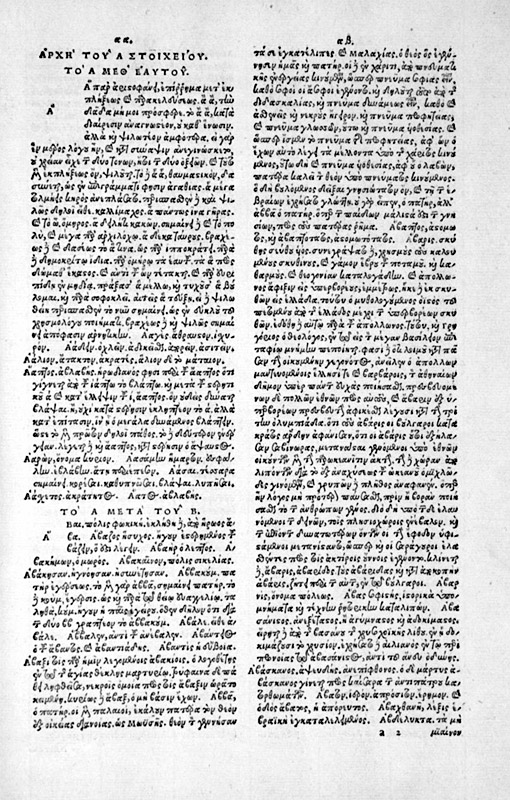
First page of an early printed edition of the Suda

The Suda or Souda (/ˈsdə/; Medieval Greek: Σοῦδα Soûda [ˈsuða]; Latin: Suidae Lexicon)[1] is a large 10th-century Byzantine encyclopedia of the ancient Mediterranean world, formerly attributed to an author called Soudas (Σούδας) or Souidas (Σουίδας). It is an encyclopedic lexicon, written in Greek, with 30,000 entries, many drawing from ancient sources that have since been lost, and often derived from medieval Christian compilers.

Title

[edit]

The exact spelling of the title is disputed.[2] The transmitted title (paradosis) is "Suida", which is also attested in Eustathius' commentary on Homer's epic poems; several conjectures have been made, both defending it and trying to correct it in "Suda".[3]

  • Paul Maas advocated for the Σοῦδα spelling, connecting it to the Latin verb sūdā, the second-person singular imperative of sūdāre, "to sweat".[4]
  • Franz Dölger also defended Σοῦδα, tracing its origins back to Byzantine military lexicon (σοῦδα, "ditch, trench", then "fortress").[5][6]
  • Henri Grégoire, starting from a critique to Dölger's interpretation, defended a proposal advanced by one of his pupils, and explained the word Σοῦδα as the acrostic of Συναγογὴ ὀνομάτων ὑπὸ διαφόρων ἀνδρῶν σοφῶν, "Collection of names (words) by different learned men", or alternatively Συναγογὴ ὀνομαστικῆς ὕλης δι’ ἀλφαβήτου, "Collection of lexicographical material in alphabetical order".[7][8][9][10] This suggestion was also supported by French Hellenist and Byzantinist Alphonse Dain.[11]
  • Silvio Giuseppe Mercati wrote on the matter twice: firstly in an article appeared in the academic journal Byzantion,[12] and later in an expanded version of the same.[13] He suggested a link with the Neo-Latin substantive guida ("guide"), transliterated in Greek as γουίδα and later miswritten as σουίδα. This interpretation was strongly criticized by Dölger, who also refused to publish Mercati's first article in the Byzantinische Zeitschrift; on the other hand, Giuseppe Schirò supported it.[14][15]
  • Bertrand Hemmerdinger interpreted Σουΐδας as a Doric genitive.[16]

Other suggestions include Jan Sajdak's theory that σοῦδα / σουίδα may derive from Sanskrit सुविद्या suvidyā (which he translated into Latin: perfecta cumulataque scientia, "collected and systemized knowledge");[17][18] Giuseppe Scarpat's link to an unidentified Judas, the supposed author of the Lexicon;[19] and Hans Gerstinger's explanation which points at Russian сюда sjudá "here", as the answer to the question "τί ποῦ κεῖται;" "what and where is it?".[20] The most recent explanation[which?] as of 2024 has been advanced by Claudia Nuovo, who defended Σοῦδα on palaeographical, philological and historical grounds[how?].[3]

Content and sources

[edit]

pecus est Suidas, sed pecus aurei velleris
[Suidas is cattle, but cattle with a golden fleece]

— Lipsius

The Suda is somewhere between a grammatical dictionary and an encyclopedia in the modern sense. It explains the source, derivation, and meaning of words according to the philology of its period, using such earlier authorities as Harpocration and Helladios.[21][22] It is a rich source of ancient and Byzantine history and life, although not every article is of equal quality, and it is an "uncritical" compilation.[21]

Much of the work is probably interpolated,[21] and passages that refer to Michael Psellos (c. 1017–1078) are deemed interpolations which were added in later copies.[21]

Biographical notices

[edit]

This lexicon contains numerous biographical notices on political, ecclesiastical, and literary figures of the Byzantine Empire to the tenth century, those biographical entries being condensations from the works of Hesychius of Miletus, as the author himself avers. Other sources were the encyclopedia of Constantine VII Porphyrogenitus (reigned 912–959) for the figures in ancient history, excerpts of John of Antioch (seventh century) for Roman history, the chronicle of Hamartolus (Georgios Monachos, 9th century) for the Byzantine age[22][21][24], the biographies of Diogenes Laërtius, and the works of Athenaeus and Philostratus. Other principal sources include a lexicon by "Eudemus," perhaps derived from the work On Rhetorical Language by Eudemus of Argos.[25]

Lost scholia

[edit]

The lexicon copiously draws from scholia to the classics (Homer, Aristophanes, Thucydides, Sophocles, etc.), and for later writers, Polybius, Josephus, the Chronicon Paschale, George Syncellus, George Hamartolus, and so on.[21][22] The Suda quotes or paraphrases these sources at length. Since many of the originals are lost, the Suda serves as an invaluable repository of literary history, and this preservation of the "literary history" is more vital than the lexicographical compilation itself, by some estimation.[22]

Organization

[edit]
Page from Vaticanus graecus 1296

The lexicon is arranged alphabetically with some slight deviations from common vowel order and place in the Greek alphabet[21] (including at each case the homophonous digraphs, e.g. αι, ει, οι, that had been previously, earlier in the history of Greek, distinct diphthongs or vowels) according to a system (formerly common in many languages) called antistoichia (ἀντιστοιχία); namely the letters follow phonetically in order of sound according the pronunciation of the tenth century, which was similar to that of Modern Greek. The order is:

α, β, γ, δ, αι, ε, ζ, ει, η, ι, θ, κ, λ, μ, ν, ξ, ο, ω, π, ρ, σ, τ, οι, υ, φ, χ, ψ[26]

In addition, double letters are treated as single for the purposes of collation (as gemination had ceased to be distinctive). The system is not difficult to learn and remember, but some editors—for example, Immanuel Bekker—rearranged the Suda alphabetically.

Background

[edit]

Little is known about the compiler of the Suda. He probably lived in the second half of the 10th century, because the death of emperor John I Tzimiskes and his succession by Basil II and Constantine VIII are mentioned in the entry under "Adam", which has a brief chronology of the world appended.[21] At any rate, the work must have appeared by the 12th century, since it is frequently quoted from and alluded to by Eustathius who lived from about 1115 to about 1195–1196.[21] It has also been stated that the work was a collective work, thus not having had a single author, and that the name which it is known under does not refer to a specific person.[27]

The work deals with biblical as well as pagan subjects, from which it is inferred that the writer was a Christian.[21] In any case, it lacks definite guidelines besides some minor interest in religious matters.[27]

The standard printed edition was compiled by Danish classical scholar Ada Adler in the first half of the twentieth century. A modern collaborative English translation, the Suda On Line, was completed on 21 July 2014.[28]

The Suda has a near-contemporaneous Islamic parallel, the Kitab al-Fihrist of Ibn al-Nadim. Compare also the Latin Speculum Maius, authored in the 13th century by Vincent of Beauvais.

Editions

[edit]
  • Küster, Ludolf, ed. (1705). Suidae Lexicon, Graece & Latine. Cambridge: Cambridge University Press.: vol. 1, vol. 2, vol. 3.
  • Gaisford, Thomas, ed. (1834). Suidae Lexicon. Oxford: Oxford University Press.: vol. 1 (A–Θ), vol. 2 (Κ–Ψ), vol. 3 (Indices).
  • Bekker, Immanuel, ed. (1854). Suidae Lexicon. Berlin: G. Reimer.
  • Adler, Ada, ed. (1928–38). Suidae Lexicon. Leipzig: B. G. Teubner. Reprinted 1967–71, Stuttgart.

See also

[edit]

References

[edit]
[edit]
Revisions and contributorsEdit on WikipediaRead on Wikipedia
from Grokipedia
The Suda, also spelled , is a vast 10th-century Byzantine Greek and lexicon, compiled in likely during the last quarter of that century, serving as a comprehensive on the ancient Mediterranean world. Organized alphabetically with over 30,000 entries spanning approximately 2,785 pages in modern editions, it blends dictionary-style lexical definitions and etymologies with encyclopedic details on , , , , and mythology, encompassing Greek and Roman antiquity alongside Biblical and Christian elements. The Suda draws from a wide array of sources, including classical authors such as and , earlier lexica like the Synagogê and Lexicon Ambrosianum, and scholia to ancient texts, preserving thousands of quotations—many unattributed—that offer critical insights into lost or fragmentary works. Its name derives from a Latin meaning "fortress" or "stronghold," symbolizing a repository of knowledge rather than indicating an author. Preserved in medieval manuscripts and first critically edited by Ada Adler in a five-volume Teubner edition (1928–1938), the Suda remains a foundational resource for scholars, enabling the reconstruction of ancient texts and the study of Byzantine intellectual culture despite occasional inaccuracies or biases in its compilations.

Background

Historical Context

The Suda was composed in the late CE, likely in the latter half of the century and no later than around 1000 CE, during the (867–1056 CE), which marked a period of political stability and territorial expansion for the . This era, often termed the , witnessed a significant intellectual and cultural revival, characterized by renewed interest in and the systematic organization of knowledge. A pivotal figure in this revival was Emperor Porphyrogenitus (r. 913–959 CE), whose court in actively sponsored encyclopedic initiatives to compile and preserve excerpts from ancient Greek historians and authors. Projects like the Excerpta Constantiniana, a vast collection of historical excerpts organized thematically around 950 CE, exemplified this effort to synthesize and safeguard the empire's Hellenic heritage against potential loss. These endeavors reflected the Byzantine state's deliberate policy of cultural consolidation during a time of resurgence following earlier crises. Constantinople functioned as the empire's intellectual hub, housing scriptoria and libraries that copied and protected texts amid persistent external threats, including Arab raids and invasions that had earlier disrupted eastern territories. By the , as Byzantine forces reconquered regions like (961 CE) and Antioch (969 CE), the capital's role in textual preservation became even more vital, ensuring the continuity of classical learning in a fortified cultural "stronghold." The Suda emerged from this anonymous scholarly milieu, contributing to the broader 10th-century flourishing of Byzantine encyclopedism.

Authorship and Title

The Suda was traditionally attributed to an author named Suidas, a supposed Byzantine grammarian active in the , based on a misinterpretation of the work's title as a . This attribution originated from the 12th-century scholar , who treated "Suidas" as the compiler's identity rather than recognizing it as the title itself. Modern scholarship has firmly rejected this view, establishing that the Suda is anonymous and dates to the late , with no evidence supporting a specific individual author from that later period. The title "Suda" (Σοῦδα) derives from the Byzantine Greek word souda, a Latin signifying "fortress" or "stronghold," metaphorically representing the work as a robust repository of . This has been established in modern scholarship, with the misconception of "Suidas" as an author's name persisting until the early and rebutted particularly by Ada Adler in her critical edition (1928–1938). The first printed edition, the published in 1499 by the Greek scholar Chalcondylas in under the name Lexicon graecum, presented the work as an encyclopedic compilation but did not resolve the ongoing confusion about authorship. Contemporary consensus holds the Suda to be an anonymous endeavor, likely compiled by a single individual or a collaborative team of scholars within a Byzantine during the late . While the exact circumstances of its creation remain obscure, its extensive scope—encompassing around 30,000 entries—suggests organized scholarly effort akin to other imperial compilations, though direct ties to state sponsorship under figures like Emperor (r. 913–959) are debated without conclusive evidence. Scholars note parallels to Constantine's excerpta projects in the work's systematic preservation of ancient sources, but attribute the Suda's origins more broadly to the 10th-century Byzantine revival of classical learning.

Content and Sources

Types of Entries

The Suda comprises approximately 30,000 entries that span a wide array of topics, functioning as both a and an of the ancient and Byzantine worlds. These entries are organized alphabetically and draw from classical , historical accounts, and contemporary Byzantine knowledge, providing a comprehensive repository of linguistic, cultural, and factual information up to the . A significant portion of the Suda consists of lexicographical entries, which explain the etymologies, derivations, and various usages of words, particularly rare or difficult terms appearing in authors such as and . These definitions often include grammatical analyses and multiple meanings, reflecting the philological traditions of and , and serve as a tool for understanding classical texts. For instance, entries might trace a word's origin through dialectal variations or contextual quotes from and . In addition to linguistic focus, the Suda features encyclopedic articles on diverse subjects including mythology, , , and natural sciences, frequently interweaving factual details with anecdotal narratives. Mythological entries recount tales of gods, heroes, and legendary events, often preserving fragments from lost classical sources; geographical ones describe regions, cities, and natural features of the Mediterranean world; while historical and scientific notes cover events, customs, and phenomena like cosmology or , blending empirical with interpretive lore. This encyclopedic breadth underscores the Suda's role as a bridge between ancient knowledge and medieval scholarship. Biographical sketches form another core category, offering notices on prominent figures ranging from Homeric poets and classical philosophers to Roman emperors and Byzantine officials, extending coverage to events in Eastern history through the . These entries typically include life details, achievements, and literary contributions, sometimes rescuing otherwise unattested information about lesser-known individuals, and highlight the Suda's value as a historical .

Primary Sources and Compilation

The Suda relies heavily on earlier lexicons and scholarly works for its lexical and etymological content, drawing directly from authorities such as the second-century CE lexicographer Harpocration and the fifth-century CE Helladios of Alexandria, whose explanations of rare words and usages provided foundational material for many entries. These sources were abridged and integrated without significant alteration, reflecting the Suda's dependence on pre-existing compilations rather than independent philological analysis. A significant portion of the Suda's historical and biographical material derives from the Excerpta Constantiniana, a vast collection of historical excerpts commissioned by the tenth-century Byzantine emperor , much of which is now lost except as preserved in the Suda and related works. These excerpts, drawn from ancient historians like and , were incorporated wholesale into the Suda, often verbatim, to furnish chronologies and narratives that form the backbone of its entries on ancient figures and events. This reliance underscores the Suda's role as a conduit for Constantine's scholarly project, which aimed to synthesize classical knowledge for Byzantine audiences. The compilation of the Suda, likely undertaken in the late tenth century, involved systematic abridgment and copying from these antecedent texts, combined with uncritical synthesis that juxtaposed contradictory accounts without resolution or original commentary. Compilers appear to have worked from secondary abridgments and scholia to classical authors like and , rather than primary editions, leading to interpolations and inconsistencies that mark the work's derivative character. No evidence suggests the involvement of original research or fieldwork; instead, the process prioritized breadth over depth, amassing over 30,000 entries through mechanical aggregation. Through this method, the Suda preserves direct quotes and paraphrases from otherwise lost ancient texts, including fragments of historians such as and early lexicographers, offering invaluable glimpses into obscured aspects of Greek and Roman and . For instance, entries often retain unaltered passages from Harpocration's or Constantine's excerpts, safeguarding material that would otherwise be inaccessible and highlighting the Suda's inadvertent value as a repository of fragmentary antiquity.

Biographical Notices

The Suda's biographical notices form a significant portion of its encyclopedic content, offering summaries of lives, works, and anecdotes for numerous figures from antiquity, thereby serving as a vital repository for otherwise lost details about classical authors and historical persons. These entries typically blend factual accounts drawn from earlier sources with interpretive or legendary material, reflecting the compilers' efforts to synthesize diverse traditions into coherent narratives. Often cross-linked to citations from literary works, the notices highlight the Suda's role as a bridge between ancient texts and Byzantine scholarship, preserving perceptions of classical figures through a medieval lens. The Suda covers numerous authors and historical persons in its biographical entries, ranging from poets and philosophers to rulers and scholars, with frequent references to their writings and cultural impact. For instance, the entry on the comic playwright (α 3891) provides details on his Athenian origins, career highlights, and select plays, including unique anecdotes about his satirical style and rivalries not preserved in other sources. Similarly, the notice on the tragedian (σ 815) recounts his birth in Colonus around 496 BCE, his innovations in drama such as introducing a third actor and expanding the chorus to fifteen members, and his 24 victories at dramatic festivals, alongside family details like his sons Iophon and Ariston. These entries often interconnect with other Suda lemmata, such as references to Aristophanes' Frogs in discussions of or Sophocles' Oedipus at Colonus in topographical notes. A hallmark of these notices is their mixture of reliable historical data—such as dates corroborated by inscriptions or chronicles—with legendary elements that embellish the subjects' lives, revealing Byzantine interpretive traditions. In ' entry, verifiable facts like his generalship alongside in 441 BCE and priesthood of Halon coexist with myths, such as a divine dream from inspiring his first victory or his death by choking on a at age 90 in 406 BCE. ' notice similarly includes grounded details on his prolific output of 54 comedies but incorporates anecdotal tales of his poverty and , drawn from scholia and lost biographies. This fusion underscores the Suda's dual function as both historical record and literary homage, where legendary motifs like divine favor for poets emphasize their enduring cultural reverence. The unique value of the Suda's biographical notices lies in their documentation of Byzantine perceptions of , portraying figures like and not merely as historical actors but as moral exemplars or cautionary tales shaped by Christian-era sensibilities. By compiling material from sources like Hesychius of ' lost Onomatologos and excerpts from Porphyrogenitus, the entries capture how 10th-century scholars viewed ancient lives through prisms of ethics, , and literary legacy, often prioritizing edifying anecdotes over strict . This approach has proven invaluable for modern scholarship, filling gaps in ancient biographies and illuminating the transmission of Greek heritage in the Byzantine world.

Lost Scholia

Scholars hypothesize that the Suda lexicon drew substantially from lost scholia—marginal commentaries on classical texts—particularly those on authors like and , which supplied etymological explanations, historical anecdotes, and textual variants integrated into the Suda's entries. These lost scholia likely represented compilations of Alexandrian and later Byzantine philological traditions, preserving material not found in direct transmissions of the primary texts. Evidence for this influence appears in close parallels between Suda entries and surviving scholia, such as those to ' plays, where shared phrasing and details on comic poets or historical events suggest a common source tradition. Similar correspondences occur with scholia in Byzantine compilations like the Excerpta Vaticana, which preserve excerpts from classical commentaries that echo the Suda's treatment of rare vocabulary and interpretive notes on Homeric passages. These parallels indicate that the Suda compiler accessed a broader corpus of marginal annotations than what survives today. The reliance on such lost scholia has significant implications for reconstructing ancient interpretive traditions, enabling scholars to recover philological insights into rare words, textual emendations, and cultural contexts from Hellenistic and Roman periods that would otherwise be inaccessible. For instance, entries on obscure Homeric terms in the Suda align with fragmentary scholiastic methods focused on glosses and exegeses, bridging gaps in the transmission of classical learning. Modern scholarship debates whether the Suda accessed these scholia directly or through mediated intermediate texts, such as the Excerpta Constantiniana or other tenth-century Byzantine anthologies, which may have excerpted and reorganized the original marginal notes. While some argue for direct incorporation based on verbatim matches with known scholia, others posit layered transmission via lost hypomnemata (notebooks) or lexica, complicating efforts to trace the precise pathways of influence. This ongoing discussion underscores the Suda's role as a repository of otherwise vanished scholarly materials.

Organization

Alphabetical Arrangement

The Suda organizes its approximately 30,000 entries in a strict alphabetical sequence based on the headwords, spanning the Greek alphabet from alpha (Α) to omega (Ω). This arrangement groups lexemes, biographical notices, etymologies, and other content under their initial letters, facilitating access to related material on ancient Greek literature, history, mythology, and language. Unlike earlier Byzantine compilations, which often followed thematic or categorical structures—such as head-to-toe listings in medical glossaries or subject-based groupings in earlier lexicons—the Suda represents a significant advancement by employing a systematic, letter-by-letter order that prioritizes utility for quick reference. While the overall structure adheres to this alphabetical principle, the ordering is described as "rough" in scholarly analyses, allowing for minor deviations that accommodate the eclectic nature of the entries. For instance, related mythological figures or concepts sharing initial letters—such as clusters of deities or historical personages beginning with the same prefix—naturally cluster together, enhancing thematic coherence without disrupting the macro-level sequence. This approach reflects the compiler's intent to balance encyclopedic breadth with practical navigation, drawing on precedents like partial alphabetical glossaries in Hellenistic scholia but extending them to a comprehensive scale. Numerals appear integrated under their corresponding letter names (e.g., entries on numbers ordered by terms like "heis" for one), rather than as a separate category, maintaining the alphabetical integrity. This evolution from non-alphabetical antecedents, evident in works like the thematic arrangements of pre-Suda dictionaries, positions the Suda as a pivotal text in the history of reference literature.

Entry Format and Cross-References

The entries in the Suda typically begin with a prominent headword, often printed in larger or in manuscripts, followed by an etymological , , or of the term, word, or . This core structure draws from earlier lexicographical traditions, integrating brief derivations or semantic clarifications before expanding into illustrative material. Subsequent sections of an entry frequently incorporate direct citations or excerpts from ancient authors, introduced by attributions such as the source's name or abbreviated sigla (e.g., "Ar." for or "Hdn." for ), which serve to authenticate and contextualize the information. These quotations, ranging from short phrases to longer passages, are interwoven with the compiler's own explanatory notes, creating a layered text that blends lexical definition with historical or literary commentary. Explanatory notes often elaborate on grammatical points, variant readings, or cultural significance, prioritizing preservation of source material over strict organization. Cross-references enhance the interconnected nature of the , with entries directing readers to related terms via keywords, phrases, or implicit links, such as referencing another headword for further detail (e.g., an entry on a mythological figure might allude to its epic context). In Ada Adler's standard edition (1928–1938), these are systematized using numerical identifiers (e.g., "alpha 23" for specific entries), facilitating navigation and revealing the Suda's networked knowledge structure, where biographical notices link to literary works like the . For instance, the entry on "" (omicron 251) cross-references Homeric terminology and events, forming a web of associations across the . Peculiarities in the format include embedded full texts of poems, proverbs, or anecdotes that interrupt the linear progression, such as digressions into etymological or unrelated fables, reflecting the compiler's to compilation. These elements, while enriching content, can obscure the entry's focus, as seen in longer articles like that on (omicron 251), which incorporates verse excerpts and tangential scholarly debates. Overall, this flexible structure underscores the Suda's role as a dynamic repository rather than a rigidly formatted .

Manuscripts and Editions

Surviving Manuscripts

The Suda lexicon survives in approximately 80 medieval manuscripts, encompassing complete copies, partial texts, and excerpts, according to modern cataloging such as the database. The primary and earliest complete manuscript is the Codex Parisinus Graecus 2626, dated to the and preserved in the . This , measuring roughly 25 by 18 cm with text in a neat Byzantine minuscule script across 366 folios, represents a key witness to the original compilation, though it includes scribal errors such as minor omissions and phonetic confusions that introduce variants affecting textual fidelity in descendant copies. Complementing it is the closely related Codex Parisinus Graecus 2625, also in the , with its older section from the 13th century; together, these form the foundational "A" family in Adler's stemma, valued for their relative completeness despite shared scribal inaccuracies like inconsistent alphabetical ordering in transitional entries. Another significant 12th-century complete copy is the Codex Vossianus Graecus F 2, housed in Leiden University Library, which exhibits similar physical traits— binding and marginal annotations—but features distinct errors, including occasional gloss intermixing, that highlight regional scribal practices. Key later manuscripts include the Codex Marcianus Graecus 448 from the 13th century, located in the Biblioteca Nazionale Marciana in Venice; this codex, spanning 400 folios in a compact script, belongs to a separate family and shows variants such as expanded cross-references, likely from scribal additions, alongside errors like transposed lemmas that complicate reconstruction. The Codex Vaticanus Graecus 1296, dated precisely to 1204 and kept in the Vatican Apostolic Library, provides another complete version in three volumes totaling over 500 folios, with a clear but error-prone script evidencing haste in copying, including lacunae from skipped lines that impact the reliability of certain biographical notices. These manuscripts are typically unilluminated, prioritizing dense textual layout over decoration, and their physical characteristics—such as varying ink fading and quire structures—underscore the challenges of transmission, where scribal errors propagate variants addressed through collation in modern scholarship.

Printed Editions

The first printed edition of the Suda, known as the , appeared in 1499 in , edited by the Byzantine scholar Demetrius Chalcondylas and printed by Johannes Bissolus and Benedictus Mangius; this edition relied on a limited number of available manuscripts and marked the largest Greek work printed in the . In the , Immanuel Bekker produced a critical edition in 1854, published in by G. Reimer, which drew upon multiple codices to enhance textual accuracy and served as the scholarly standard until the early . The modern standard edition was established by Ada Adler in the Teubner series, published in five volumes between 1928 and 1938 in ; Adler collated 29 manuscripts, providing a detailed apparatus criticus that addressed the complex stemma and variant readings among the surviving codices. Editing the Suda presented significant challenges, including the resolution of textual variants across manuscripts and the expansion of common abbreviations in the original Byzantine script, which Adler's work systematically tackled to produce a more reliable text.

Digital Projects and Resources

The Suda On Line (SOL) is a prominent digital initiative launched in 1998 under the Stoa Consortium, aimed at producing a freely accessible, collaborative English and of the entire Suda encyclopedia. This project engages scholars worldwide to translate and vet all entries, achieving full coverage of the approximately 30,000 lemmata by 2014, with ongoing contributions for refinements and updates as of 2025. SOL functions as a searchable online database, enabling users to browse entries alphabetically or via keyword searches, while incorporating peer-reviewed notes, bibliographies, and hyperlinks to related resources. SOL integrates closely with the Thesaurus Linguae Graecae (TLG), a comprehensive digital corpus of Greek texts hosted at the , by linking Suda entries to the original Greek text and identifying embedded quotations from ancient authors. This connection allows lemma-based searching across the Greek original, facilitating advanced queries on etymologies, citations, and textual variants directly within the TLG framework. Such features enhance accessibility for researchers, supporting detailed philological analysis without reliance on printed editions. Additional digital efforts include the Digital Suda project, led by Monica Berti at as part of the Linked Ancient Greek and Latin (LAGL) initiative, which focuses on creating linked for named entities in the Suda, such as authors, personal names, and places. This project employs and to structure the encyclopedia's content for applications, promoting interoperability with other classical databases, though it remains in development as of 2025. Together, these resources transform the Suda from a static reference into an interactive tool for contemporary scholarship.

Significance and Legacy

Scholarly Value

The Suda preserves numerous fragments and quotations from lost ancient works, making it an essential resource for philologists and historians seeking to reconstruct classical Greek and Roman literature. For instance, its entries often draw from otherwise unattested sources, including scholia and excerpts that provide indirect access to commentaries on authors like , where a significant portion of the preserved scholia derives through the Suda's compilation. This preservation extends to biographical notices and literary details, such as those on poets and playwrights, which would otherwise be inaccessible. Despite these strengths, the Suda's uncritical compilation process introduces notable limitations, including factual errors and anachronistic blends of ancient and Byzantine information. Compiled in the late from disparate sources without rigorous verification, it frequently interpolates later Christian or medieval perspectives into accounts of , leading to inconsistencies in chronology and attribution. Such issues arise from its reliance on earlier lexica and scholia, which the compilers reproduced with minimal editing, resulting in uneven reliability across its approximately 30,000 entries. Nevertheless, the Suda holds substantial value for reconstructing aspects of life, customs, and vocabulary, offering glimpses into social practices, etymologies, and cultural norms that complement surviving primary texts. Its lexical explanations and anecdotal entries illuminate everyday terminology and historical contexts, such as festival rituals or rhetorical conventions, despite the noted inconsistencies. Scholars continue to mine it for these insights, cross-referencing with tools like the Thesaurus Linguae Graecae to verify and contextualize its content. In modern academia, the Suda's enduring impact is evident in its frequent citations across fields like and . This quantitative reach underscores its role as a foundational reference, particularly through digital initiatives like the Suda On Line project, which has facilitated broader access and analysis since its completion in 2014.

Influence on Later Works and Modern Research

The Suda's first printed edition, prepared by the Byzantine scholar in in 1499, marked a pivotal moment in its dissemination to humanists, who valued it as a repository of ancient knowledge preserved through Byzantine tradition. This edition, comprising the lexicon's extensive entries on classical authors, mythology, and , informed humanist efforts to recover and edit Greek texts, bridging medieval Byzantine scholarship with Western revival of antiquity. Chalkokondyles, a prominent teacher in , integrated the Suda into his pedagogical approach, influencing figures like Lascaris and Angelo Poliziano, who drew upon its etymologies and biographical details to annotate works by and other ancients. The lexicon's impact extended to informing later editions of classical authors through intermediaries like Eustathius of Thessaloniki's 12th-century Homeric commentaries, which directly incorporated and expanded Suda material. Palaeographical evidence indicates Eustathius consulted and copied from Suda manuscripts while composing these works, using its explanations to clarify obscure Homeric terms and scholia, thereby preserving and transmitting Byzantine interpretive traditions that editors later adopted in their own commentaries. This chain of influence ensured the Suda's role in shaping philological accuracy across centuries. In 19th- and 20th-century , the Suda served as a critical tool for emending and annotating classical texts, particularly in series like the , where its entries provide essential testimonia for fragments of lost authors. For instance, Loeb volumes on poets such as and cite Suda excerpts to reconstruct biographical and textual details otherwise unattested, aiding scholars in resolving corruptions in primary sources through the lexicon's compilations from earlier authorities like Harpocration. This application underscored the Suda's utility in , filling evidentiary gaps in editions of historians and dramatists. In contemporary digital humanities, the Suda On Line (SOL) project has enabled advanced applications, including network analysis of ancient citations to visualize intertextual dependencies within classical literature. By structuring the lexicon's 30,000 entries as searchable data, SOL facilitates mapping citation patterns, revealing how Byzantine compilers like the Suda's anonymous author interconnected lost sources with surviving texts. Complementary efforts, such as the Digital Suda project, provide enhanced access to Ada Adler's critical edition with standardized identifiers for integration in digital tools. In Byzantine studies, the Suda continues to address gaps in narratives like Procopius's histories by preserving fragments of earlier chroniclers, such as Priscus's accounts of Roman-Lazi conflicts, which supplement Procopius's Wars. Recent 2020s initiatives in digital humanities employ AI for text mining ancient Greek corpora, including the Suda, to automate pattern recognition in linguistic evolution and sentiment across Byzantine encyclopedias. These tools, building on projects like SOL, enhance accessibility and analytical depth without supplanting traditional scholarship.

References

Add your contribution
Related Hubs
User Avatar
No comments yet.