Hubbry Logo
SuperfluiditySuperfluidityMain
Open search
Superfluidity
Community hub
Superfluidity
logo
8 pages, 0 posts
0 subscribers
Be the first to start a discussion here.
Superfluidity
Superfluidity
from Wikipedia
Not found
Revisions and contributorsEdit on WikipediaRead on Wikipedia
from Grokipedia
Superfluidity is a quantum mechanical phenomenon in which certain fluids, at temperatures near absolute zero, exhibit zero viscosity and the ability to flow without friction through narrow channels or around obstacles, defying classical fluid dynamics. This state of matter was first observed in liquid helium-4 (^4He) below the lambda transition temperature of 2.17 K (the so-called lambda point), where the fluid, known as helium II, displays remarkable properties such as anomalously high thermal conductivity and the capacity to climb container walls via a thin superfluid film known as the Rollin film. The discovery occurred in 1938, when physicists Pyotr Kapitza, John F. Allen, and Donald Misener independently measured the drastic drop in viscosity of liquid helium below this temperature, coining the term "superfluidity" to describe the frictionless flow. Liquid helium-4 had been liquefied in 1908 by Heike Kamerlingh Onnes, but its peculiar behaviors were only systematically investigated in the 1930s. The theoretical framework for superfluidity emerged from , with proposing in 1938 that it arises from Bose-Einstein condensation (BEC) of helium atoms, which are bosons, allowing macroscopic occupation of the and coherent flow without dissipation. This two-fluid model, developed by in 1941, describes helium II as a mixture of a viscous "normal" fluid component and an inviscid "superfluid" component, with their proportions varying with temperature; the superfluid fraction approaches 100% as temperature nears 0 K. Experimental hallmarks include the fountain effect (self-siphoning up narrow tubes) and quantized vortices, where circulation is restricted to discrete multiples of h/(2m), with h as Planck's constant and m the helium atom mass. Superfluidity also manifests in liquid helium-3 (^3He), a fermionic system, but requires much lower temperatures around 2.5 mK due to the need for Cooper pairing of atoms to form bosonic pairs before ; this was discovered in 1972 by , David Lee, and Robert Richardson, earning them the 1996 . Unlike ^4He, ^3He superfluids exhibit multiple phases (A and B) with anisotropic pairing, leading to complex topological defects and exotic excitations. Beyond helium, superfluidity has been realized in ultracold atomic gases since 2005, where fermionic atoms form superfluids via tunable interactions, providing clean analogs for studying and matter. These properties make superfluidity a cornerstone of low-temperature physics, bridging condensed phenomena like —where electrons pair similarly—and enabling applications such as cryogenic cooling for particle detectors and MRI magnets, as well as probing fundamental quantum behaviors in macroscopic systems.

Definition and Fundamental Properties

Core Definition

Superfluidity is a phase of in which a flows with zero , enabling persistent motion without due to the establishment of long-range quantum coherence across a many-body system at low temperatures. This quantum phenomenon manifests as a macroscopic occupation of a single by the system's particles, distinguishing it fundamentally from classical where arises from dissipative particle interactions. In bosonic systems, superfluidity typically emerges through Bose-Einstein condensation, where bosons follow Bose-Einstein statistics and a macroscopic number condense into the lowest energy state, fostering coherent collective behavior. For fermionic systems, which obey Fermi-Dirac statistics and cannot all occupy the same state due to the , superfluidity requires the formation of Cooper pairs—bound pairs of fermions that effectively behave as composite bosons and undergo condensation. Unlike classical fluids, where flow eventually dissipates due to and circulation decays, superfluid flow is dissipationless and irreversible once initiated, with persistent currents that can circulate indefinitely. Moreover, in superfluids, the circulation of around any closed path is quantized in discrete units of h/mh / m (where hh is Planck's constant and mm is the mass of the constituent particles), leading to the formation of quantized vortices rather than continuous . Superfluidity arises via a second-order at a critical , below which the superfluid component begins to form while a normal fluid component may coexist, as captured in phenomenological models like the two-fluid description. For liquid , this transition occurs at the , marking the onset of superfluid behavior.

Characteristic Phenomena

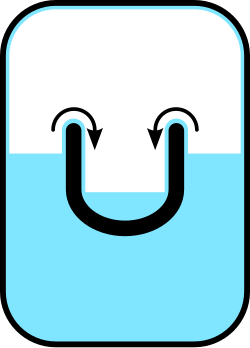
One of the defining features of superfluidity is the absence of in the superfluid component, allowing persistent flow without energy dissipation. This frictionless motion is vividly demonstrated by the , a thin layer of superfluid helium that creeps along surfaces, such as the walls of a , at speeds up to several centimeters per second, driven solely by gravitational or capillary forces without measurable viscous drag. Experiments measuring the flow rate of these films out of cylindrical vessels confirm that the transfer rate remains finite and temperature-dependent below the , highlighting the superfluid's ability to maintain coherent motion over macroscopic distances. Another hallmark is the formation of quantized vortices, where the circulation of the superfluid velocity around a closed loop is restricted to discrete multiples of the quantum of circulation, κ=h/m\kappa = h / m, with hh being Planck's constant and mm the mass of the constituent particles. These vortices possess a singular core of atomic size, approximately 1–10 Å in radius for helium, where the superfluid density vanishes, surrounded by irrotational flow that decays inversely with distance from the core. The dynamics of these vortices, including their nucleation, reconnection, and mutual interactions, govern the transition from laminar to turbulent superflow, as observed in rotating superfluids where vortex lines align into lattices. Superfluid flow remains dissipationless only below a critical , beyond which energy dissipation sets in due to the of quantized vortices. This threshold, typically on the order of 10–50 cm/s in experiments depending on and , marks the onset of vortex formation near obstacles or channel walls, leading to a cascade of vortex shedding and eventual quantum . Measurements in cylindrical channels reveal that the critical for equilibrium vortex entry scales with the container size and rotation rate, providing a direct probe of the superfluid's stability limits. The superfluid fraction, ρs/ρ\rho_s / \rho, represents the proportion of the total density ρ\rho that participates in the frictionless flow, while the remainder behaves as a viscous normal fluid. This fraction, which approaches unity at absolute zero and decreases with temperature, is quantified through torsional oscillation experiments where stacked disks immersed in the superfluid experience drag primarily from the normal component. Pioneering measurements using such oscillators demonstrated that the effective moment of inertia reflects only the normal fluid's contribution, yielding ρs/ρ1(T/Tλ)7\rho_s / \rho \approx 1 - (T / T_\lambda)^7 near the lambda transition, consistent with theoretical expectations. Thermomechanical effects arise from the coupling between gradients and differences in the two-fluid model, driving superfluid counterflow without transport by the superfluid component. The Rollin film creep exemplifies this, as the thin superfluid layer migrates to equalize across surfaces, facilitating heat transfer via film flow. The fountain effect, where superfluid emerges from a heated as a jet against , results from a induced by the difference, with the of the fountain scaling as ΔP/ρ=(S/ρs)ΔT\Delta P / \rho = (S / \rho_s) \Delta T, where SS is the per mass; this phenomenon underscores the irreversible nature of normal fluid production.

Theoretical Frameworks

Macroscopic Descriptions

The two-fluid model offers a phenomenological framework for describing the macroscopic behavior of superfluids, particularly below the lambda transition temperature, by representing the system as an intimate mixture of two interpenetrating, non-interacting fluid components in the ideal case. The normal fluid component exhibits classical properties, including , thermal conductivity, and the capacity to carry all the system's , while the superfluid component flows without or and transports no . This separation allows the model to account for the coexistence of dissipative and non-dissipative flows observed in superfluids. The model was rigorously formulated by , building on earlier ideas, and provides the foundation for understanding bulk superfluid dynamics without reference to microscopic quantum details. In the two-fluid model, the total mass density ρ\rho is given by ρ=ρn+ρs\rho = \rho_n + \rho_s, where ρn\rho_n and ρs\rho_s denote the partial densities of and superfluid components, respectively; these densities depend on temperature, with ρs\rho_s approaching ρ\rho as temperature nears . Each component possesses its own independent velocity field, vn\mathbf{v}_n and vs\mathbf{v}_s, enabling counterflow where the superfluid moves oppositely to fluid without net . The hydrodynamic description includes separate continuity equations for the components: ρst+(ρsvs)=0,\frac{\partial \rho_s}{\partial t} + \nabla \cdot (\rho_s \mathbf{v}_s) = 0, ρnt+(ρnvn)=0.\frac{\partial \rho_n}{\partial t} + \nabla \cdot (\rho_n \mathbf{v}_n) = 0. The superfluid motion, being irrotational (×vs=0\nabla \times \mathbf{v}_s = 0), follows the inviscid Euler equation in the form vst+(vs22+μ)=0,\frac{\partial \mathbf{v}_s}{\partial t} + \nabla \left( \frac{v_s^2}{2} + \mu \right) = 0, where μ\mu is the specific chemical potential (chemical potential per unit mass). The normal fluid, in contrast, obeys the full Navier-Stokes equations, incorporating pressure gradients, viscous stresses, and entropy advection, as it behaves like an ordinary fluid. These equations close with thermodynamic relations, such as the entropy density s=snρn/ρs = s_n \rho_n / \rho confined to the normal component. A key application of the two-fluid model lies in the propagation of sound waves, which reveals two distinct modes due to the decoupled components. First sound corresponds to ordinary or waves, where vn\mathbf{v}_n and vs\mathbf{v}_s oscillate in phase, compressing both fluids simultaneously and yielding a speed on the order of 200–300 m/s in helium II, akin to classical . Second , predicted within this framework, manifests as temperature or waves where the components oscillate out of phase with no net mass current; here, the normal fluid's entropy variation drives counterflow, propagating at speeds around 20 m/s in helium II at low temperatures. The existence of , experimentally confirmed shortly after the model's proposal, provides direct evidence for the two-fluid nature of superfluids. The ideal two-fluid model assumes no momentum exchange between components, but this approximation fails at high relative velocities (exceeding a critical value, typically ~10–100 cm/s in helium II channels) or near boundaries, where interactions lead to dissipation via mutual friction. This friction originates from the scattering of normal fluid excitations (like rotons) by quantized vortices in the superfluid, coupling the velocity fields and introducing dissipative terms in the momentum equations, such as a force density f=αs^×(vnvs)×s^αs^×(vnvs)\mathbf{f} = \alpha' \hat{\mathbf{s}} \times (\mathbf{v}_n - \mathbf{v}_s) \times \hat{\mathbf{s}} - \alpha \hat{\mathbf{s}} \times (\mathbf{v}_n - \mathbf{v}_s), where α\alpha and α\alpha' are temperature-dependent coefficients, and s^\hat{\mathbf{s}} relates to vortex orientation. These terms, incorporated into extended two-fluid hydrodynamics, describe phenomena like vortex motion and turbulent decay but mark the regime where the simple model requires modifications for accuracy.

Microscopic Explanations

Superfluidity arises from quantum mechanical effects in many-body systems of bosons or fermions at low temperatures, where interactions lead to a macroscopic characterized by long-range coherence. In bosonic systems, such as liquid helium-4, the phenomenon is linked to Bose-Einstein condensation (BEC), in which a significant fraction of particles occupies the , enabling coherent flow without . This idea was first proposed by , who connected the λ-transition in helium to the degeneracy predicted by Bose-Einstein statistics. For weakly interacting bosons, the dynamics of the condensate are described by the Gross-Pitaevskii equation, a that captures the mean-field effects of interparticle interactions. Independently derived by Eugene Gross and Lev Pitaevskii, the time-dependent form is iψt=22m2ψ+Vψ+gψ2ψ,i \hbar \frac{\partial \psi}{\partial t} = -\frac{\hbar^2}{2m} \nabla^2 \psi + V \psi + g |\psi|^2 \psi, where ψ\psi is the condensate wavefunction, VV is the external potential, mm is the particle mass, gg is the interaction strength proportional to the s-wave scattering length, and \hbar is the reduced Planck's constant. This equation governs the evolution of the order parameter ψ\psi, whose phase determines the superfluid velocity, and its stationary solutions yield the ground-state density ψ2|\psi|^2. The validity of this description holds in the dilute limit, where the gas parameter na31n a^3 \ll 1 (with nn the density and aa the scattering length), ensuring perturbative treatment of interactions. In fermionic systems, superfluidity emerges through the formation of Cooper pairs, bound states of opposite-spin fermions mediated by attractive interactions, as explained by . This microscopic theory, developed for but applicable to neutral fermionic superfluids like , predicts pairing in momentum space near the , leading to a gapped excitation spectrum and zero-resistance flow. The superconducting gap Δ(k)\Delta(k) satisfies the self-consistent gap equation Δ(k)=kV(k,k)ckck,\Delta(\mathbf{k}) = -\sum_{\mathbf{k}'} V(\mathbf{k}, \mathbf{k}') \langle c_{-\mathbf{k}' \downarrow} c_{\mathbf{k}' \uparrow} \rangle, where VV is the pairing potential, cc^\dagger and cc are fermionic creation and annihilation operators, and the expectation value reflects the anomalous average in the paired state. In the weak-coupling limit, the gap scales exponentially with the attraction strength, ΔωDexp(1/N(0)V)\Delta \sim \hbar \omega_D \exp(-1/N(0)V), with ωD\omega_D the Debye frequency and N(0)N(0) the density of states at the Fermi level. A unifying microscopic signature of superfluidity in both bosonic and fermionic systems is off-diagonal long-range order (ODLRO), introduced by Chen-Ning Yang, which quantifies the persistence of coherence over large distances. ODLRO is present when the one-body density matrix exhibits a non-zero eigenvalue in the limit of infinite separation, specifically limrψ(0)ψ(r)0\lim_{|\mathbf{r}| \to \infty} \langle \psi^\dagger(\mathbf{0}) \psi(\mathbf{r}) \rangle \neq 0, where ψ\psi annihilates a particle at position r\mathbf{r}. This long-range correlation implies a macroscopic eigenvalue of the , corresponding to the condensate fraction in bosons or the pair condensate in fermions, distinguishing superfluids from normal fluids. The nature of interactions profoundly influences the superfluid state, transitioning from dilute weakly interacting regimes—where mean-field approximations like the Gross-Pitaevskii equation suffice—to strongly interacting cases, such as , where correlations beyond mean-field are essential. In both limits, superfluidity involves spontaneous breaking of U(1) phase symmetry, leading to the emergence of Goldstone modes: gapless excitations with linear dispersion ω=ck\omega = c k at low momentum kk, where cc is the sound determined by the superfluid . These modes, predicted by Jeffrey Goldstone's , represent the restoring force against phase twists and underpin the rigidity of the ordered state.

Historical Development

Early Discoveries

The of helium marked a pivotal advancement in low-temperature physics, achieved by in at the University of Leiden, where he produced the first samples of at its atmospheric of 4.2 K. This breakthrough enabled systematic studies of matter near , revealing helium's unique reluctance to solidify under normal pressures and its exceptionally low even above the superfluid transition. Initial observations noted deviations from classical behavior, such as minimal , but these were not fully anomalous until further cooling experiments. Significant peculiarities emerged in the mid-1920s through measurements of 's thermodynamic properties. In , Hendrik Keesom, a successor to Onnes at , conducted specific heat experiments with collaborators, identifying a sharp peak at approximately 2.17 —later termed the λ-point—indicating a from normal I to the more exotic helium II, without but with a λ-shaped anomaly in the curve. Concurrently, studies revealed anomalous contraction below this temperature, defying expectations for most liquids and suggesting underlying quantum effects, as the volume decreased sharply while density increased. These findings, plotted as the characteristic λ-curve, highlighted helium's non-classical response to cooling. Early experimental probes in the early further illuminated these anomalies, particularly in confined geometries. Researchers observed that helium II could flow through narrow capillaries and porous media with negligible resistance, enabling persistent supercurrents that circulated indefinitely without dissipation, as demonstrated in setups using fine glass tubes and annuli. Such flows, exceeding classical hydrodynamic limits, implied a approaching zero and foreshadowed the superfluid state. The culmination came in late 1937, when Pyotr Kapitza at the Institute for Physical Problems in (having been detained in the USSR since 1934) measured the of helium II below 2.17 K and found it vanishingly small, reporting results in early 1938. Independently, John F. Allen and Don Misener at the confirmed this zero- behavior through flow experiments in fine channels, establishing superfluidity as a distinct phase. Theoretical insight followed swiftly, with proposing in March 1938 that superfluidity stemmed from Bose-Einstein condensation, wherein a macroscopic fraction of atoms occupy the ground , enabling coherent, frictionless flow. This quantum hypothesis unified the observed phenomena under wave mechanics, contrasting with classical hydrodynamics. Kapitza's pioneering work on superfluidity and related low-temperature phenomena earned him the 1978 .

Key Theoretical Advances

In 1938, proposed the two-fluid model for superfluid , describing it as a mixture of a superfluid component with zero and a normal fluid component carrying all the , which provided a phenomenological framework to explain observed transport properties like persistent flow and reduced thermal conductivity. In 1941, independently developed a similar two-fluid hydrodynamics, emphasizing the role of and introducing the concept of a superfluid tied to a macroscopic wavefunction phase, laying the groundwork for subsequent dissipative extensions. During the 1940s and 1950s, Landau advanced a phenomenological theory of superfluidity that incorporated elementary excitations to account for thermodynamic and hydrodynamic behaviors, predicting the existence of first and second sound waves in helium II. A key element was the introduction of the roton spectrum for excitations, characterized by an energy-momentum relation E(p)Δ+(pp0)22μE(p) \approx \Delta + \frac{(p - p_0)^2}{2\mu}, where Δ\Delta is the energy gap, p0p_0 the momentum at the minimum, and μ\mu an effective mass, which explained the specific heat anomaly and scattering processes at low temperatures. This spectrum, refined in later works, highlighted the gapped nature of rotons contrasting with gapless phonons, influencing calculations of superfluid density and viscosity. In 1957, , , and Robert Schrieffer formulated the , which explained through the formation of Cooper pairs of electrons mediated by phonons, establishing a microscopic mechanism for pairing in fermionic systems that directly inspired analogous descriptions of superfluidity. This pairing mechanism was crucial for understanding the superfluidity of liquid helium-3, experimentally discovered in 1972 by , David M. Lee, and Robert C. Richardson through specific heat measurements at millikelvin temperatures, for which they received the 1996 . Theoretical models extended BCS concepts to ^3He, where p-wave pairing of ^3He atoms leads to anisotropic order parameters and multiple superfluid phases (A and B), accounting for the observed transition below approximately 2.5 mK and finite-temperature properties. In the 1960s, David Feenberg pioneered microscopic calculations using correlated basis functions to describe the of liquid helium-4, incorporating strong interatomic correlations beyond simple Bose-Einstein condensation to compute binding energies, momentum distributions, and excitation spectra with improved accuracy over earlier variational methods. These approaches, building on hypernetted-chain approximations, provided quantitative insights into the depletion of the condensate fraction (around 7-10%) and the , bridging phenomenological models with quantum many-body theory. Recent advances up to 2025 have leveraged simulations, particularly path-integral Monte Carlo methods, to confirm ground-state properties of , such as the equation of state, pair correlation functions, and superfluid fraction, achieving convergence with and resolving discrepancies in earlier approximations for both bulk and confined systems. These simulations have validated the minimum parameters and condensate fraction to within 1% of experimental values, enhancing understanding of quantum coherence at zero temperature.

Superfluidity in Liquid Helium

Helium-4 Superfluidity

Liquid (^4He) exhibits superfluidity in its He II phase, which emerges below the lambda transition temperature Tλ=2.17T_\lambda = 2.17 K at saturated . This marks the onset of zero and other quantum behaviors in the bosonic fluid. The of ^4He shows the He II region extending from low pressures up to the solidification curve at approximately 25 atm, where the liquid remains stable down to without solidifying under its own . Above TλT_\lambda, the normal He I phase dominates, characterized by finite . The superfluid component is quantified by the superfluid density ρs(T)\rho_s(T), which represents the fraction of the total density that participates in frictionless flow. Near the lambda transition, ρs(T)\rho_s(T) approaches zero with a power-law dependence ρs(T)(TλT)2/3\rho_s(T) \propto (T_\lambda - T)^{2/3}, reflecting critical behavior associated with the three-dimensional XY universality class. At lower temperatures, ρs\rho_s approaches the total density ρ\rho, indicating nearly complete superfluidity. This temperature dependence has been precisely measured using techniques like torsion oscillators and second sound attenuation. Key experimental hallmarks of He II include the Kapitza resistance, a thermal boundary resistance at solid-liquid interfaces arising from mismatch between the solid and the superfluid. Discovered in 1941, this resistance leads to a jump across the interface during flow, with magnitude scaling as T3T^{-3} at low temperatures due to acoustic mismatch. Another hallmark is the persistence of supercurrents in toroidal containers, where circulation can be maintained indefinitely without energy dissipation, demonstrating the irrotational nature of superfluid flow except at singularities. In rotating containers, He II forms arrays of quantized vortices rather than classical solid-body , stabilizing the superfluid against . These vortices, predicted by Onsager and Feynman, carry quantized circulation κ=h/m=9.97×104\kappa = h / m = 9.97 \times 10^{-4} cm²/s, where hh is Planck's constant and mm the ^4He , with vortex density proportional to the rotation rate. The vortex core size is set by the healing length ξ=/2mμ\xi = \hbar / \sqrt{2 m \mu}
Add your contribution
Related Hubs
User Avatar
No comments yet.