Hubbry Logo
Superior olivary complexSuperior olivary complexMain
Open search
Superior olivary complex
Community hub
Superior olivary complex
logo
8 pages, 0 posts
0 subscribers
Be the first to start a discussion here.
Superior olivary complex
from Wikipedia
Superior olivary complex
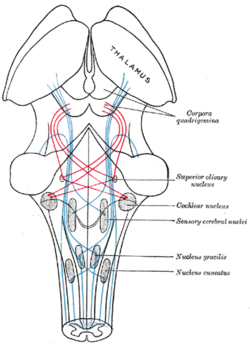
Scheme showing the course of the fibers of the lemniscus; medial lemniscus in blue, lateral in red. (Superior olivary nucleus is labeled at center right.)
Details
Identifiers
Latinnucleus olivaris superior
MeSHD065832
NeuroNames569
NeuroLex IDbirnlex_1307
TA98A14.1.05.415
TA25937
FMA72247
Anatomical terms of neuroanatomy

The superior olivary complex (SOC) or superior olive is a collection of brainstem nuclei that is located in pons, functions in multiple aspects of hearing and is an important component of the ascending and descending auditory pathways of the auditory system. The SOC is intimately related to the trapezoid body: most of the cell groups of the SOC are dorsal (posterior in primates) to this axon bundle while a number of cell groups are embedded in the trapezoid body. Overall, the SOC displays a significant interspecies variation, being largest in bats and rodents and smaller in primates.

Physiology

[edit]

The superior olivary nucleus plays a number of roles in hearing. The medial superior olive (MSO) is a specialized nucleus that is believed to measure the time difference of arrival of sounds between the ears (the interaural time difference or ITD). The ITD is a major cue for determining the azimuth of sounds, i.e., localising them on the azimuthal plane – their degree to the left or the right.

The lateral superior olive (LSO) is believed to be involved in measuring the difference in sound intensity between the ears (the interaural level difference or ILD). The ILD is a second major cue in determining the azimuth of high-frequency sounds.

Relationship to auditory system

[edit]

The superior olivary complex is generally located in the pons, but in humans extends from the rostral medulla to the mid-pons[1] and receives projections predominantly from the anteroventral cochlear nucleus (AVCN) via the trapezoid body, although the posteroventral nucleus projects to the SOC via the intermediate acoustic stria. The SOC is the first major site of convergence of auditory information from the left and right ears.[2]

Primary nuclei

[edit]

The superior olivary complex is divided into three primary nuclei, the MSO, LSO, and the Medial nucleus of the trapezoid body, and several smaller periolivary nuclei.[3] These three nuclei are the most studied, and therefore best understood. Typically, they are regarded as forming the ascending azimuthal localization pathway.

Medial superior olive (MSO)

[edit]

The medial superior olive is thought to help locate the azimuth of a sound, that is, the angle to the left or right where the sound source is located. Sound elevation cues are not processed in the olivary complex. The fusiform cells of the dorsal cochlear nucleus (DCN), which are thought to contribute to localization in elevation, bypass the SOC and project directly to the inferior colliculus. Only horizontal data is present, but it does come from two different ear sources, which aids in the localizing of sound on the azimuth axis.[4] The way in which the superior olive does this is by measuring the differences in time between two ear signals recording the same stimulus. Traveling around the head takes about 700 μs, and the medial superior olive is able to distinguish time differences much smaller than this. In fact, it is observed that people can detect interaural differences down to 10 μs.[4] The nucleus is tonotopically organized, but the azimuthal receptive field projection is "most likely a complex, nonlinear map".[5]

The projections of the medial superior olive terminate densely in the ipsilateral central nucleus of the inferior colliculus (CNIC). The majority of these axons are considered to be "round shaped" or type R. These R axons are mostly glutamatergic and contain round synaptic vesicles and form asymmetric synaptic junctions.[2]

  • This is the largest of the nuclei and in humans it contains approximately 15,500 neurons.[1]
  • Each MSO receives bilateral inputs from the right and left AVCNs.
  • The output is via the ipsilateral lateral lemniscus to the inferior colliculus.[6]
  • The MSO responds better to binaural stimuli.
  • The MSO's main function is detection of interaural time difference (ITD) cues to binaural lateralization.
  • The MSO is severely disrupted in the autistic brain.[7]

Lateral superior olive (LSO)

[edit]

This olive has similar functions to the medial superior olive, but employs intensity to localize the sound source.[8] The LSO receives excitatory, glutamatergic input from spherical bushy cells in the ipsilateral cochlear nucleus and inhibitory, glycinergic input from the medial nucleus of the trapezoid body (MNTB). The MNTB is driven by excitatory input from globular bushy cells in the contralateral cochlear nucleus. Thus, the LSO receives excitatory input from the ipsilateral ear and inhibitory input from the contralateral ear. This is the basis of ILD sensitivity. Projections from both cochlear nuclei are primarily high frequency, and these frequencies are subsequently represented by the majority of LSO neurons (>2/3 over 2–3 kHz in cat). The LSO does in fact encode frequency across the animals audible range (not just "high" frequency). Additional inputs derive from the ipsilateral LNTB (glycinergic, see below), which provide inhibitory information from the ipsilateral cochlear nucleus.[9] Another possibly inhibitory input derives from ipsilateral AVCN non-spherical cells. These cells are either globular bushy or multipolar (stellate). Either of these two inputs could provide the basis for ipsilateral inhibition seen in response maps flanking the primary excitation, sharpening the unit's frequency tuning.[10][11]

The LSO projects bilaterally to the central nucleus of the inferior colliculus (ICC). Ipsilateral projections are primarily inhibitory (glycinergic), and the contralateral projections are excitatory. Additional projection targets include the dorsal and ventral nuclei of the lateral lemniscus (DNLL & VNLL). The GABAergic projections from the DNLL form a major source of GABA in the auditory brainstem, and project bilaterally to the ICC and to the contralateral DNLL. These converging excitatory and inhibitory connections may act to decrease the level dependence of ILD sensitivity in the ICC compared to the LSO.

Additional projections form the lateral olivocochlear bundle (LOC), which innervates cochlear inner hair cells. These projections are thought to have a long time constant, and act to normalize the sound level detected by each ear in order to aid in sound localization.[12] Considerable species differences exist: LOC projection neurons are distributed within the LSO in rodents, and surround the LSO in predators (i.e. cat).

Medial nucleus of the trapezoid body (MNTB)

[edit]
  • The MNTB, in the trapezoid body, is composed of mainly neurons with round cell bodies which utilize glycine as a neurotransmitter.
  • The size of the MNTB is reduced in primates.[13][14][15]
  • Each MNTB neuron receives a large "calyx" type ending, the calyx of Held arising from the globular bushy cells in the contralateral AVCN.
  • There are two response types found: a 'chopper type' similar to spindle cells in the AVCN and a primary type which is similar to those of bushy cells in the AVCN.

Periolivary nuclei

[edit]

The SOC is composed of between six and nine periolivary nuclei, depending upon the researcher cited, typically named based upon their location with regard to the primary nuclei. These nuclei surround each of the primary nuclei, and contribute to both the ascending and descending auditory systems. These nuclei also form the source of the olivocochlear bundle, which innervates the cochlea.[16] In the guinea pig, ascending projections to the inferior colliculi are primarily ipsilateral (>80%), with the largest single source coming from the SPON. Also, ventral nuclei (RPO, VMPO, AVPO, & VNTB) are almost entirely ipsilateral, while the remaining nuclei project bilaterally.[17]

Name Cat Guinea Pig Rat Mouse
LSO X X X X
MSO X X X X*
MNTB X X X X
LNTB X X "LVPO" X
ALPO X X
PVPO X X
PPO X X "CPO"
VLPO X
DPO X X X
DLPO X X
VTB X X "MVPO" X
AVPO X
VMPO X X
RPO X X
SPN "DMPO" X X X

,[17] *The MSO appears to be smaller and disorganized in mice.[18]

Ventral nucleus of the trapezoid body (VNTB)

[edit]
  • The VNTB is a small nucleus located laterally to the MNTB, and ventral to the MSO.[19]
  • Made up of a heterogeneous population of cells, this nucleus projects to many auditory nuclei, and forms the medial olivocochlear bundle (MOC) which innervates cochlear outer hair cells.[20] These cells contain electromotile fibers, and act as mechanical amplifiers/attenuators within the cochlea.
  • The nucleus projects to both IC, with no cells projecting bilaterally.[21]
  • The VNTB also innervates the cochlear nuclei bilaterally, but mainly on the contralateral side.[20][22][23]

Lateral nucleus of the trapezoid body (LNTB)

[edit]
  • Located ventral to the LSO[19]
  • AVCN spherical bushy cells project collaterals bilaterally, and globular bushy cells project collaterals ipsilaterally to LNTB neurons.[24]
  • Cells are immunoreactive for glycine,[25] and are retrogradely labeled following injection of tritiated glycine into the LSO[9]
  • The nucleus projects to both IC, with few cells projecting bilaterally,[21] as well as the ipsilateral LSO.[9]
  • Large multipolar cells project to the cochlear nucleus, but not the IC, in both cat and guinea pig.[21][26]
  • Inputs are often via end-bulbs of Held, producing very fast signal transduction.

Superior periolivary nucleus (SPON) (dorsomedial periolivary nucleus (DMPO))

[edit]
  • Located directly dorsal to the MNTB[19]
  • In rats, SPON is a homogeneous GABAergic nucleus. These tonotopically organized neurons receive excitatory inputs from octopus and multipolar cells in the contralateral ventral cochlear nucleus,[27] a glycinergic (inhibitory) input from the ipsilateral MNTB, an unknown GABAergic (inhibitory) input, and project to the ipsilateral ICC.[28] Most neurons respond only at the offset of a stimulus, can phase lock to AM stimuli up to 200 Hz, and may form the basis for ICC duration selectivity.[29] Notably, SPON neurons do not receive descending inputs from the IC, and it does not project to the cochlea or cochlear nucleus as many periolivary nuclei do.[30]
  • In contrast, glycinergic projections to ipsilateral ICC are observed in guinea pigs and chinchillas, suggesting a species-related neurotransmitter difference.[31]
  • In guinea pigs, round to oval multipolar cells project to both IC, with many cells projecting bilaterally. The more elongated cells that project to the cochlear nucleus to not project to the ICC. There appear to be to populations of cells, one that projects ipsilaterally, and one that projects bilaterally.[21]
  • The majority of information had come from rodent SPON, due to the nucleus' prominent size in these species, with very few studies have been done in cat DMPO,[32] none of which were extensive.

Dorsal periolivary nucleus (DPO)

[edit]
  • Located dorsal and medial to the LSO[19]
  • Contains both EE (excited by both ears) and E0 (excited by the contralateral ear only) units.[33]
  • Neurons are tonotopically organized, and high frequency.
  • May belong to a single nucleus along with the DLPO[34]
  • The nucleus projects to both IC, with no cells projecting bilaterally.[21]

Dorsolateral periolivary nucleus (DLPO)

[edit]
  • Located dorsal and lateral to the LSO[19]
  • Contains both EE (excited by both ears) and E0 (excited by the contralateral ear only) units.
  • Neurons are tonotopically organized, and low frequency.
  • May belong to a single nucleus along with the DPO
  • The nucleus projects to both IC, with few cells projecting bilaterally.[21]

Ventrolateral periolivary nucleus (VLPO)

[edit]
  • Located ventral to and within the ventral hillus of the LSO[19]
  • Contains both EI (excited by contralateral and inhibited by ipsilateral ear) and E0 (excited by the contralateral ear only) units.
  • Neurons are tonotopically organized, and high frequency.
  • Subdivided into the LNTB, PPO and ALPO [35]

Anterolateral periolivary nucleus (ALPO)

[edit]
  • The nucleus projects to both IC, with no cells projecting bilaterally.[21]
  • Large multipolar cells project to the cochlear nucleus, but not the IC, in both cat and guinea pig.[21][26]

Ventromedial periolivary nucleus (VMPO)

[edit]
  • Located between the MSO and MNTB.[19]
  • Sends projections to the ICC bilaterally.[21]
  • The nucleus projects to both IC, with no cells projecting bilaterally.[21]

Rostral periolivary nucleus (RPO) (anterior periolivary nucleus (APO))

[edit]
  • Located between the rostral pole of the MSO and the VNLL[19]
  • Sometimes called the Ventral Nucleus of the Trapezoid Body (VNTB)[19]

Caudal periolivary nucleus (CPO) (posterior periolivary nucleus (PPO))

[edit]
  • Located between the caudal pole of the MSO and the facial nucleus (7N)[19]

Posteroventral periolivary nucleus (PVPO)

[edit]
  • The nucleus projects to both IC, with no cells projecting bilaterally.[21]

See also

[edit]

References

[edit]
[edit]
Revisions and contributorsEdit on WikipediaRead on Wikipedia
from Grokipedia
The superior olivary complex (SOC) is a collection of brainstem nuclei located in the caudal pons, serving as a key relay station in the auditory pathway that integrates binaural inputs from the cochlear nuclei to facilitate sound localization and other auditory processing functions. It comprises the medial superior olive (MSO), lateral superior olive (LSO), and medial nucleus of the trapezoid body (MNTB), which primarily process low-frequency sounds and interaural time differences (ITDs), high-frequency sounds and interaural level differences (ILDs), and provide inhibitory projections, respectively, along with surrounding periolivary nuclei that contribute to additional auditory modulation. Positioned near the pontomedullary junction and the middle cerebellar peduncle, the SOC receives excitatory and inhibitory inputs from both ears via the trapezoid body and ventral cochlear nucleus, enabling the first stage of binaural comparison in the central auditory system. The SOC's primary function is to compute spatial auditory cues, such as ITDs for azimuthal localization of low-frequency sounds in the MSO through coincidence detection of phase-locked inputs, and ILDs for high-frequency sounds in the LSO via glycinergic inhibition from the contralateral side. These computations create a tonotopic organization that maps sound , with outputs projecting via the to the for further processing toward the . Additionally, the SOC provides descending olivocochlear feedback to regulate cochlear sensitivity, enhancing signal-to-noise ratios during selective attention or in noisy environments. In humans, the MSO is particularly prominent due to the larger head size compared to other mammals, optimizing low-frequency localization essential for . Clinically, disruptions to the SOC, such as those observed in testing with reduced wave V amplitude, can indicate subtle deficits in and binaural processing, potentially contributing to challenges in auditory scene analysis or in conditions like autism spectrum disorder. Embryologically, the SOC develops from the rhombic lip of the alar plate in the , with its nuclei differentiating beginning around 12 weeks of to support early auditory maturation. Overall, the SOC's role underscores its evolutionary importance in mammalian hearing, bridging peripheral sensory transduction with higher-order cortical interpretation.

Overview

Definition and location

The superior olivary complex (SOC) is a cluster of interconnected nuclei located in the mammalian auditory , serving as a primary site for early binaural processing of acoustic signals from both ears. This structure integrates excitatory and inhibitory inputs to detect temporal and intensity differences in arrival, laying the foundation for auditory spatial . Composed of principal nuclei and surrounding periolivary regions, the SOC acts as a critical relay in the ascending auditory pathway, though its detailed functional roles extend beyond initial processing. Anatomically, the SOC is positioned in the dorsal of the caudal , at the level of the facial nucleus, and is embedded within the fibers of the trapezoid body—a myelinated bundle traversing the ventral . It spans the midline, with bilateral left and right complexes exhibiting symmetrical organization to support interaural comparisons. This placement positions the SOC caudal to the pontine nuclei and rostral to the medullary structures, distinguishing it clearly from the larger inferior olivary complex, which resides in the ventral medulla and serves non-auditory functions. In terms of gross morphology, the SOC comprises a compact assembly of neurons, typically extending 1–2 mm in the rostrocaudal direction across mammalian species, with variations in nuclear prominence related to auditory demands. This dense clustering near the midline facilitates rapid neural interactions essential for precise temporal coding.

Role in the auditory pathway

The superior olivary complex (SOC) serves as a critical integrative hub in the ascending auditory pathway, receiving direct projections from the cochlear nuclei and marking the initial site for binaural convergence of inputs from both ears. This position allows the SOC to compare interaural differences in sound arrival times and intensities, laying the foundation for spatial hearing without relying on prior unilateral processing in the cochlear nuclei. As the first major locus of such convergence, the SOC processes these signals to extract essential acoustic cues, distinguishing it from the primarily monaural functions of earlier pathway stages. Auditory information flows through the SOC en route to higher centers, with its outputs ascending primarily via the to the , where further integration occurs for temporal and intensity-based processing. This relay preserves precise timing information critical for sound analysis, adapting neural conduction for rapid transmission in the . The SOC thus facilitates parallel streams for monaural and binaural analysis, enabling downstream structures to build on these computations for comprehensive auditory . Evolutionarily, the SOC structure is highly conserved across mammals, reflecting its fundamental role in acoustic orientation and sound localization, with particular enhancements in species heavily dependent on auditory cues, such as bats and humans. This conservation underscores the SOC's prerequisite function in the auditory hierarchy, where its integrative capabilities support adaptive behaviors like predator detection and communication in diverse mammalian lineages.

Anatomy

Structural components

The superior olivary complex (SOC) consists of primary nuclei arranged around the fibers of the trapezoid body in the caudal , forming a core structure embedded within this major auditory fiber tract. The primary nuclei include the medial superior olive (MSO), lateral superior olive (LSO), and medial nucleus of the trapezoid body (MNTB), which are flanked by periolivary nuclei such as the superior paraolivary nucleus (SPON), ventral nucleus of the trapezoid body (VNTB), and lateral nucleus of the trapezoid body (LNTB). These primary nuclei constitute the central olivary masses, while the periolivary nuclei form accessory clusters surrounding them, contributing to the overall compact architecture of the SOC. Neuronal composition within the SOC features high-density packing in the primary nuclei, with principal cells predominating. In the MSO, principal cells are primarily bipolar with oriented dendritic fields, arranged in a narrow columnar formation; LSO principal cells are multipolar with disc-shaped somata; and MNTB principal cells are round to oval, often receiving large axosomatic synapses. Excitatory inputs to these principal cells arise from bushy cells in the , including spherical bushy cells projecting to the MSO and LSO with punctate or boutonal endings, and globular bushy cells forming the prominent calyx of Held endings on MNTB principal cells. Inhibitory neurons, which are abundant throughout the SOC, are predominantly glycinergic, particularly in the MNTB and periolivary regions, with neurons more prevalent in certain periolivary groups like the SPON.30914-0) In humans, the SOC exhibits notable inter-individual variability in nuclear size, shape, and delineation, reflecting species-specific adaptations. The MSO consistently appears as a compact column with a rostro-caudal extent ranging from 3.7 to 6.0 mm (average 4.8 mm across cases), while the LSO often presents as scattered cell clusters rather than a discrete nucleus, and the MNTB shows inconsistent grouping of neurons ventromedial to the MSO. Periolivary nuclei display even greater dispersion, with neurons variably scattered amid trapezoid body fibers.

Afferent and efferent connections

The superior olivary complex (SOC) receives primary afferent inputs from the (AVCN) via the ventral acoustic stria, consisting of excitatory projections that preserve precise timing information essential for binaural processing. Specifically, spherical bushy cells in the AVCN project bilaterally to principal cells in the medial superior olive (MSO), synapsing on dendrites to enable coincidence detection of interaural time differences, while the lateral superior olive (LSO) receives ipsilateral excitatory projections from spherical bushy cells. In contrast, globular bushy cells from the contralateral AVCN target the medial nucleus of the trapezoid body (MNTB), forming large excitatory synapses that drive inhibitory output to other SOC nuclei. These pathways exhibit contralateral dominance, particularly for MNTB inputs, which are exclusively from the opposite AVCN, ensuring robust binaural comparison. Efferent outputs from the SOC ascend primarily to the (IC) and dorsal nucleus of the (DNLL), integrating binaural cues for higher auditory processing. MSO neurons project directly to the IC, conveying interaural time difference information, while MNTB and LSO contribute inhibitory and excitatory signals to both the IC and DNLL. Descending efferents originate from periolivary regions of the SOC and modulate the through the olivocochlear bundle, providing feedback to regulate auditory sensitivity and gain control. Key synaptic specializations in these connections include the calyces of Held, large terminals on MNTB principal cells that ensure low-jitter transmission for submillisecond timing precision. Inhibitory loops are mediated by glycinergic projections from the MNTB to ipsilateral LSO and bilateral MSO neurons, creating inhibition that sharpens binaural response selectivity. Recent labeling studies using biocytin tracing and immunomarkers in mammalian models have confirmed additional afferent inputs to the SOC from nuclei of the , including excitatory and inhibitory projections from the ventral, intermediate, and dorsal nuclei that enhance reciprocal feedback loops for refined auditory integration.

Physiology

Binaural integration mechanisms

The superior olivary complex (SOC) serves as the primary site for binaural convergence in the auditory brainstem, where neurons integrate inputs from both ears to process interaural disparities. In the medial superior olive (MSO), this occurs through detection mechanisms that encode interaural time differences (ITDs) via excitatory-excitatory (EE) inputs from contralateral and ipsilateral spherical bushy cells of the . These principal neurons fire maximally when excitatory postsynaptic potentials (EPSPs) from the two sides arrive synchronously within submillisecond precision, enabling sensitivity to ITDs on the order of tens of microseconds. Seminal electrophysiological studies in cats demonstrated that MSO neurons exhibit periodic response patterns tuned to the stimulus frequency, reflecting this temporal . In contrast, the lateral superior olive (LSO) employs an excitatory-inhibitory (EI) balance to detect interaural level differences (ILDs), with ipsilateral excitation from spherical bushy cells counterbalanced by contralateral glycinergic inhibition relayed through the medial nucleus of the trapezoid body (MNTB). This configuration produces sigmoidally shaped rate-level functions, where LSO neurons respond robustly to ipsilateral sound dominance and are suppressed by stronger contralateral inputs, facilitating ILD encoding for higher-frequency sounds above 1 kHz. The MNTB's calyx of Held synapses ensure precisely timed inhibition, sharpening the of these responses. Neural coding in the SOC preserves phase-locking from the auditory nerve, allowing MSO and low-frequency LSO neurons to follow stimulus fine structure up to approximately 1-2 kHz, which is essential for ITD computation. Glycinergic inhibition from the MNTB further refines this coding by creating asymmetric delays and suppressing off-peak responses, thereby enhancing selectivity; for instance, blocking glycine receptors shifts ITD tuning curves toward zero delay. Computational models of these EE and EI circuits, inspired by the classic Jeffress delay-line hypothesis for MSO, incorporate axonal delays and inhibition to account for ITD sensitivities extending up to 500 µs, though mammalian implementations favor population-rate coding over strict topographic mapping. Modulation of binaural integration arises from peri-olivary inputs, including and projections from surrounding nuclei, which provide gain control and facilitate to noisy environments. These inputs dynamically adjust the excitatory-inhibitory balance in MSO and LSO neurons, enhancing response robustness to through mechanisms like presynaptic inhibition and receptor modulation. Such adaptations ensure stable processing of binaural cues amid varying acoustic conditions.

Sound localization processes

The superior olivary complex (SOC) plays a pivotal role in by processing interaural time differences (ITDs) primarily through neurons in the medial superior olive (MSO). MSO neurons exhibit maximal firing rates when excitatory inputs from the ipsilateral and contralateral cochlear nuclei arrive simultaneously, effectively detecting phase-locked timing disparities that arise from the of the head. This coincidence detection mechanism, first proposed in the Jeffress model, maps head-related delays to enable localization in the horizontal plane (), with sensitivity to ITDs on the order of 10-20 μs for low-frequency sounds below 1.5 kHz. Complementary to ITD processing, the lateral superior olive (LSO) within the SOC encodes interaural level differences (ILDs), which are disparities between the ears caused by head shadowing. LSO neurons integrate ipsilateral excitation with contralateral inhibition, firing preferentially to larger ipsilateral levels, which is particularly effective for high-frequency sounds above 1.5 kHz where wavelength-shortening makes ITDs ambiguous due to phase wrapping. This ILD sensitivity, with resolutions around 1 dB, supports azimuthal localization of or high-frequency stimuli, as demonstrated in early electrophysiological studies. Azimuthal position is represented in the SOC through population coding, where neurons tuned to specific ITDs and ILDs form a along the mediolateral axis, with isochronic sheets or delay lines aligning best ITDs to sound source directions. This allows distributed activation across SOC neurons to signal sound , which is then relayed to higher centers like the for integration with monaural spectral cues derived from pinna filtering. Such population responses achieve localization accuracies of 1-2 degrees in the frontal hemifield for humans and other mammals. Despite these capabilities, SOC-mediated localization faces limitations in reverberant environments, where reflected sounds distort ITDs and ILDs, leading to increased azimuthal errors of up to 10-15 degrees and reduced cue reliability. Adaptations include enhanced processing of direct-path signals via onset responses in MSO neurons, though efficacy diminishes with times exceeding 50 ms.

Primary nuclei

Medial superior olive (MSO)

The medial superior olive (MSO) is composed of a sheet-like array of bipolar neurons aligned transversely within the superior olivary complex, forming a rostrocaudally elongated structure that spans approximately 1.1 mm in length in , with a height increasing from 200–300 µm caudally to about 700 µm rostrally. These neurons feature bitufted dendrites extending medially and laterally, enabling bilateral integration, and are organized in stacked, horizontally oriented layers that facilitate precise temporal processing. Afferent connections to the MSO include excitatory inputs from spherical bushy cells in the anteroventral cochlear nuclei (AVCN) of both the ipsilateral and contralateral sides, which provide precisely timed, phase-locked signals via receptor-mediated synapses with rapid decay times around 0.74 ms. Inhibitory inputs arrive via glycinergic projections from principal neurons in the medial nucleus of the body (MNTB), primarily relaying contralateral information to sharpen timing cues, with synaptic decay times of approximately 1.68 ms. Efferent projections from MSO neurons primarily target the ipsilateral , specifically the dorsolateral region of the central nucleus, to convey ITD-encoded information upstream in the auditory pathway. The MSO serves as a primary detector for interaural time differences (ITDs), the key binaural cue for horizontal of low-frequency tones, where excitatory inputs from the two ears converge with submillisecond precision to generate spiking when temporally aligned. Its neurons exhibit peak sensitivity to ITDs in the 300–800 Hz range, corresponding to wavelengths comparable to head size in many mammals, allowing robust encoding of azimuthal positions. Recent postmortem studies highlight significant individual variability in MSO morphology, including size and shape, which may influence localization acuity across populations. At the cellular level, MSO principal neurons display broad frequency tuning curves, with characteristic frequencies spanning 3–20 kHz in some species but optimized for low-frequency phase locking below 2 kHz in others, enabling integration across a range of ITD-relevant spectra. Voltage-gated potassium conductances, particularly low-threshold Kv1 channels (current ~0.89 nA at -40 mV) and high-threshold Kv3 channels (~12.3 nA at +30 mV), play crucial roles in regulating membrane excitability, accelerating , and preserving the submillisecond temporal fidelity essential for detection.

Lateral superior olive (LSO)

The lateral superior olive (LSO) exhibits a highly organized structure characterized by a columnar of neurons, with frequency-specific bands segregated along the mediolateral axis in mammals such as mice and cats. Low frequencies are represented in the lateral regions, transitioning to high frequencies medially, forming isofrequency sheets that align orthogonally to the primary tonotopic gradient. Principal cells within these columns are or bipolar neurons with disk-shaped dendritic fields, enabling precise segregation of ipsilateral excitatory and contralateral inhibitory inputs on a frequency-matched basis. This architecture supports the LSO's role as an early site for binaural comparison in the auditory . Afferent connections to the LSO principal cells include excitatory glutamatergic inputs primarily from ipsilateral spherical bushy cells and planar multipolar cells in the anteroventral (AVCN), forming large endbulb-like synapses that preserve temporal fidelity. Contralateral inhibition arrives glycinergically via the medial nucleus of the trapezoid body (MNTB), which receives precisely matched inputs from contralateral globular bushy cells in the AVCN, ensuring frequency-specific suppression. Efferent projections from LSO principal cells target both inferior colliculi bilaterally in a tonotopic manner, with a slight ipsilateral , relaying processed binaural signals to higher auditory centers. Functionally, LSO principal cells operate as excitatory-inhibitory (EI) coincidence detectors that compute interaural level differences (ILDs), a primary cue for horizontal of high-frequency sounds (>1.5 kHz) where head shadowing generates acoustic disparities. These neurons fire maximally when ipsilateral excitation outweighs contralateral inhibition, typically peaking at ILDs of 10-20 dB favoring the ipsilateral ear, aligning with natural acoustic ILDs produced by sound sources offset from the midline. This ILD sensitivity enables the LSO to encode azimuthal position, with response rates scaling monotonically with ILD magnitude up to behavioral thresholds of 1-4 dB in some . Beyond binaural processing, the LSO contributes to monaural spectral analysis, where individual neurons encode frequency-specific intensity variations in ipsilateral stimuli, exhibiting broader tuning curves and higher thresholds at low best frequencies (<3 kHz) compared to downstream targets like the inferior colliculus. In adaptive contexts, recent imaging studies in noise-exposed rodent models reveal LSO hyperactivity, characterized by elevated calcium activity and spontaneous firing rates persisting after acoustic trauma (e.g., 110 dB SPL exposure), suggesting disrupted excitatory-inhibitory balance that may underlie conditions like hyperacusis or tinnitus.

Medial nucleus of the trapezoid body (MNTB)

The medial nucleus of the trapezoid body (MNTB) comprises a compact cluster of large, round glycinergic principal neurons positioned midline within the trapezoid body of the superior olivary complex. These principal cells, each characterized by 1–2 short dendrites and strong membrane potential rectification, receive excitatory input predominantly from a single contralateral source via the calyx of Held, an exceptionally large synaptic terminal that envelops 25–60% of the postsynaptic somatic surface. This structure ensures highly reliable, low-jitter transmission critical for temporal precision in auditory processing. Afferent connections to the MNTB arise exclusively from globular bushy cells in the contralateral ventral cochlear nucleus, forming the calyx of Held synapse through thick, myelinated axons that convey phase-locked auditory information. Efferent projections from MNTB principal neurons are glycinergic and tonotopically organized, targeting the ipsilateral lateral superior olive (LSO), medial superior olive (MSO), and select periolivary nuclei such as the superior paraolivary nucleus (SPON), with each target neuron receiving inputs from multiple MNTB axons spanning a portion of the tonotopic axis. Physiologically, the MNTB delivers precisely timed inhibitory signals that enhance the acuity of binaural cues essential for sound localization, with synaptic latencies below 1 ms enabling faithful relay of high-frequency inputs up to 1 kHz. These glycinergic inputs sharpen interaural level differences (ILDs) processed in the LSO by providing contralateral inhibition and define interaural time difference (ITD) boundaries in the MSO through coincident timing mechanisms. A hallmark of the MNTB is the calyx of Held, recognized as the largest synaptic ending in the mammalian central nervous system, which supports secure synaptic efficacy under high-demand conditions. However, the nucleus's elevated metabolic requirements render it particularly susceptible to hypoxia and ischemia, potentially mitigated by neuroglobin expression in a subset of neurons for oxygen homeostasis and neuroprotection.

Periolivary nuclei

Ventral and lateral trapezoid body nuclei

The ventral nucleus of the trapezoid body (VNTB) comprises a heterogeneous population of multipolar neurons positioned ventral to the medial nucleus of the trapezoid body (MNTB) in the (SOC). These cells include large and small cholinergic, glycinergic, and GABAergic types, with some co-expressing GABA and glycine during early postnatal stages before a transition to predominantly glycinergic transmission. In rodents, the VNTB contains approximately 4,500 neurons, while humans exhibit around 1,400, reflecting its role as a key periolivary structure embedded within the decussating fibers of the trapezoid body. The lateral nucleus of the trapezoid body (LNTB), often regarded as a lateral extension of the trapezoid body, features mixed cell types organized into a main subdivision (mLNTB) with dorsally located neurons bearing large dendritic trees that extend across the medial superior olive (MSO), and a posteroventral subdivision (pvLNTB) with ventrally positioned cells receiving prominent somatic excitatory synapses. Predominantly glycinergic, LNTB neurons exhibit sparse somatic innervation in the mLNTB and large endbulb-like terminals in the pvLNTB, supporting its integration into local SOC circuits. VNTB afferents arise from the contralateral ventral cochlear nucleus (including globular bushy, octopus, and multipolar cells), ipsilateral MNTB, and descending projections from the ipsilateral central nucleus of the inferior colliculus (CNIC), while its efferents target the CNIC and medial geniculate nucleus ascendingly, the cochlea via the medial olivocochlear bundle descendingly (primarily cholinergic), and locally to the MNTB, LNTB, and lateral superior olive (LSO). In contrast, LNTB inputs include dendritic projections from cochlear nucleus multipolar cells to the mLNTB and somatic inputs from globular bushy cells and LSO to the pvLNTB, with outputs from the mLNTB extending to the CNIC and superior paraolivary nucleus, and from the pvLNTB providing glycinergic inhibition to the MSO. These connections position the VNTB and LNTB as accessory structures to the MNTB's primary inhibitory relay, emphasizing modulatory rather than direct binaural processing. Functionally, the VNTB relays monaural information from the cochlear nuclei to higher auditory centers like the CNIC, aiding in spectral and temporal sound coding, while also contributing to efferent feedback through the medial olivocochlear system to modulate cochlear outer hair cell sensitivity and protect against acoustic overstimulation. The LNTB, particularly its pvLNTB component, delivers local glycinergic inhibition to SOC core nuclei such as the MSO, enhancing temporal precision in phase-locking and interaural time difference sensitivity for sound localization. The mLNTB supports binaural integration with enhanced temporal fidelity, whereas pvLNTB exhibits monaural primary-like responses with notches, collectively refining auditory timing across the SOC. Recent anatomical studies underscore the GABAergic diversity within the VNTB, including projections that co-release GABA and glycine to the dorsal cochlear nucleus, potentially bolstering circuit resilience in variable acoustic environments through mixed inhibitory signaling.

Dorsal and paraolivary nuclei

The dorsal periolivary nuclei (DPO and DLPO) consist of scattered neurons located dorsal to the primary nuclei of the superior olivary complex (SOC), including the lateral superior olive (LSO), forming an ill-defined group up to 200 μm from the LSO's dorsal limit. These neurons are multipolar with large somata (average area ~125-152 μm²) and exhibit dense projections from octopus cells in the posteroventral cochlear nucleus (PVCN). In contrast, the superior paraolivary nucleus (SPON, also termed dorsal medial periolivary nucleus or DMPO) forms a more distinct medial-dorsal cluster within the SOC, comprising principal cells with elongated morphologies and marginal cells that contribute to its anisotropic organization. SPON neurons are neurochemically homogeneous, often GABAergic, and span 150-380 μm mediolaterally. Inputs to these nuclei primarily arise from the cochlear nucleus, including contralateral ventral cochlear nucleus (VCN) principal, globular bushy, octopus, and multipolar cells, as well as ipsilateral medial nucleus of the trapezoid body (MNTB). The DPO and DLPO also receive projections from the ventral nucleus of the lateral lemniscus (VNLL) and medial paralemniscal region, with additional innervation from PVCN octopus neurons. Outputs from the DPO and DLPO include olivocochlear projections via the medial olivocochlear (MOC) tract to the cochlea, predominantly contralateral (~75%), and GABAergic projections to the inferior colliculus (IC) through the lateral lemniscus. SPON efferents similarly target the IC's central, dorsal, and external subdivisions ipsilaterally via thick axons (>1.2 μm) in the medial lateral lemniscus, with sparse contralateral projections via the IC commissure, and contribute to the olivocochlear system. Functionally, SPON neurons specialize in offset and onset responses, generating rebound spikes following glycinergic inhibition release from the MNTB, which aids in detecting discontinuities and potentially supports suppression in complex auditory environments. These responses vary: offset units show facilitation under forward masking (threshold reduction ~12.6 dB, spike increase ~278%), while on-offset units exhibit inhibition (threshold elevation ~12.5 dB, spike reduction ~40%). The DPO and DLPO provide through inputs to the IC, sharpening frequency tuning and enhancing contrast in auditory representations. They also enable frequency-specific modulation, contributing to tonotopic organization and adaptive processing in the ascending auditory pathway. Recent 2025 research in Mongolian gerbils has identified three distinct cell classes in the SPON, revealing specialized roles in temporal coding of complex sounds. Fast cells, with dense synaptic coverage (~67%) and rapid inhibitory postsynaptic potentials (IPSPs, peak <1 ms), produce short-latency rebound spikes for high-fidelity encoding of rapid temporal patterns, such as 50 Hz click trains, projecting primarily to the IC. Slow cells, featuring sparser innervation (8.7-35%) and prolonged IPSPs (baseline >40 ms), support duration coding via longer rebound latencies and may target the . Uninhibited cells, with minimal synaptic input (~3.5%), exhibit sustained excitation without sound-driven inhibition, underscoring the SPON's diversity in handling amplitude-modulated signals.

Development and plasticity

Embryonic development

The superior olivary complex (SOC) originates from the rhombomeres 3 through 5 during early embryonic development in mice. Neuroblasts destined for the SOC primarily arise from the ventricular zone and rhombic lip within rhombomere 5, with contributions from rhombomere 3 specifically to the medial nucleus of the body (MNTB). This segmental origin is guided by , including Hoxa2, which establishes rhombomere identity and influences the patterning of auditory brainstem structures, and signaling pathways such as FGF8, which regulates hindbrain segmentation and progenitor specification in rhombomere 5 via activation of downstream factors like Krox20 (Egr2). In humans, the SOC develops from the rhombic lip of the alar plate in the , with initial differentiation of nuclei occurring around the 7th to 8th gestational week, though detailed morphometric growth, particularly of the medial superior olive (MSO), accelerates between 16 and 21 weeks . Neuroblast migration commences around embryonic day (E) 12.5 in , with precursors expressing markers such as Wnt1 and Atoh1 migrating ventrally from the rhombic lip toward the midline to form the bilateral SOC nuclei. This migration establishes early bilateral symmetry, positioning future nuclei in the ventral . The process is tightly regulated, with disruptions in migratory cues leading to mispositioning of SOC components. By E14.5, the nuclear framework begins to emerge, reflecting the progressive birth dates of SOC neurons between E9 and E14. Differentiation of SOC nuclei follows a sequential order, with the medial superior olive (MSO) forming first around E14, identifiable by expression of MafB and positioned medially. The lateral superior olive (LSO) and MNTB differentiate subsequently, becoming distinct by E17.5, marked respectively by MafB and FoxP1 expression in the LSO and MNTB. The large calyx of Held , a hallmark of MNTB principal neurons, begins to mature perinatally, though its full refinement occurs postnatally. Genetic factors like Atoh1 are crucial for this differentiation; mutations in Atoh1, a basic helix-loop-helix , disrupt the generation and survival of rhombic lip-derived neurons, leading to severe reductions or absence of MSO and LSO formation, as observed in mice.

Postnatal maturation and variability

The superior olivary complex (SOC) undergoes significant postnatal maturation in and other mammals, with key changes occurring around the onset of hearing, typically at postnatal day 12 (P12) in rats. This period involves refinements in neuronal metabolism, electrical properties, synaptic connectivity, and to support precise binaural processing for . In the medial superior olive (MSO), lateral superior olive (LSO), and medial nucleus of the trapezoid body (MNTB), energy metabolism markers such as Na+/K+-ATPase activity and mitochondrial density increase markedly from P0 to P12, accelerating post-hearing to plateau by P25–P30, enabling higher ATP demands for temporal coding. Similarly, electrical properties in SOC neurons evolve from fetal stages through postnatal weeks, with resting potentials stabilizing and thresholds sharpening by P14–P21 in rats, coinciding with enhanced discharge precision in response to binaural inputs. Gene expression profiles reveal a dynamic transcriptional program driving this maturation, with early postnatal phases (P0–P4) dominated by transcription factors like Gata3 and Hoxa2 that regulate neuronal differentiation, transitioning to post-hearing upregulation (P16–P25) of ion channels such as Kcna1 and myelination genes like Mobp for synaptic refinement. Spontaneous electrical activity in MSO neurons ramps up progressively from P0 to P12, shifting from irregular bursts to more synchronized ensemble firing by P9–P12, which is crucial for circuit calibration before auditory experience. Microglial distribution within SOC nuclei also matures postnatally, with peak densities in the first two weeks followed by pruning, supporting synaptic remodeling in structures like the LSO and MNTB. Auditory experience further drives plasticity in the SOC during critical postnatal periods, refining binaural circuits through mechanisms such as synaptic strengthening or pruning in response to sound localization cues; for instance, deprivation studies in ferrets show altered ILD sensitivity in the LSO due to mismatched inputs. Variability in SOC maturation manifests across species, nuclei, and individuals, influencing sound localization acuity. In rats, the MNTB exhibits earlier and more robust metabolic maturation than the MSO or LSO, with Na+/K+-ATPase levels rising by P7–P10 versus P10–P14 in the latter, reflecting differential roles in inhibitory versus excitatory processing. Human SOC nuclei show pronounced inter-individual differences in adult morphology, with MSO rostro-caudal extent varying from 3.7 to 6.0 mm across cases, while LSO identification is inconsistent, appearing as discrete clusters in only about 25% of specimens, potentially linked to postnatal developmental trajectories. Perineuronal nets, which stabilize mature circuits, emerge variably in the human SOC during late postnatal stages, with components like aggrecan showing heterogeneous distribution that may contribute to individual differences in auditory temporal processing. These variations underscore the SOC's plasticity, where environmental and genetic factors during critical postnatal windows can lead to diverse functional outcomes in binaural hearing.

Clinical significance

Involvement in hearing disorders

The superior olivary complex (SOC) plays a critical role in age-related hearing loss, particularly , where degeneration begins in the calyx of Held synapses of the medial nucleus of the trapezoid body (MNTB). Volume electron studies in gerbils reveal that aging leads to deficits and demyelination in MNTB principal neurons, disrupting inhibitory inputs to the medial superior olive (MSO) and lateral superior olive (LSO). This degeneration impairs binaural processing of interaural time differences (ITD) and interaural level differences (ILD), contributing to difficulties in and speech comprehension in noisy environments characteristic of . In neurodevelopmental disorders, SOC abnormalities manifest as structural asymmetries and volume reductions, notably in autism spectrum disorder (ASD) and . Recent 2024 postmortem and imaging analyses of ASD cohorts demonstrate or dysmorphology of the SOC, which correlates with impaired binaural integration and auditory hypersensitivity. In , deficits in auditory temporal coding have been observed, with electrophysiological studies showing attenuated responses in auditory pathways that affect phonological processing. Noise-induced trauma selectively targets the LSO through mechanisms, leading to . Acoustic overexposure generates in the auditory , causing neuronal hyperexcitability in LSO circuits and heightened sensitivity without threshold shifts. Emerging 2025 animal models indicate that enhanced medial olivocochlear efferent activity from periolivary regions exhibits relative resilience to such stress, preserving feedback to the and potentially buffering against permanent binaural deficits.

Implications for auditory processing deficits

The superior olivary complex (SOC) plays a pivotal role in binaural sound processing, and its dysfunction can lead to significant auditory processing deficits, particularly in and temporal discrimination. Disruptions in SOC circuitry, such as those affecting interaural time and level differences, are implicated in central auditory processing disorder (CAPD), where individuals struggle with perceiving sounds in noisy environments or distinguishing speech from background . For instance, reduced function of the medial olivocochlear bundle, a component of the SOC, has been observed in children with CAPD, impairing in noise and contributing to broader auditory discrimination challenges. In developmental contexts, early profoundly impacts SOC maturation, leading to aberrant synaptic inhibition and disorganized inhibitory projections from the medial nucleus of the trapezoid body to the lateral and medial superior olives. This results in broadened frequency tuning curves, diminished accuracy in interaural level difference coding for horizontal , and impaired interaural time difference processing for vertical localization cues. Such deficits extend to and , with children experiencing showing delays in phonological processing and expressive language skills, potentially exacerbating learning disabilities if untreated during critical periods. SOC malformations or neuronal losses are also associated with neurodevelopmental disorders like autism spectrum disorder (ASD), where dysmorphic superior olives correlate with auditory hypersensitivity, poor , and language impairments. Prenatal valproic acid exposure in animal models, mimicking ASD risk factors, induces fewer neurons and abnormal morphology in the SOC, directly linking structural deficits to auditory processing anomalies observed in up to 80% of ASD individuals. Age-related changes in the SOC further contribute to auditory processing declines, including reduced glycinergic inhibition and altered levels, which manifest as difficulties in and binaural integration. These changes underlie hidden in older adults, where peripheral hearing thresholds remain intact but central processing falters, increasing vulnerability to CAPD symptoms like trouble following conversations in reverberant spaces. lesions affecting the SOC, seen in conditions like , disrupt approximately 57% of associated auditory disorders, often detectable via diminished wave V amplitude in testing.

References

Add your contribution
Related Hubs
User Avatar
No comments yet.