Hubbry Logo
Pontine tegmentumPontine tegmentumMain
Open search
Pontine tegmentum
Community hub
Pontine tegmentum
logo
8 pages, 0 posts
0 subscribers
Be the first to start a discussion here.
Pontine tegmentum
Pontine tegmentum
from Wikipedia
Pontine tegmentum
Brainstem -- tegmentum not labeled, but is visible near center
Details
Identifiers
Latintegmentum pontis
MeSHD065821
NeuroNames557
NeuroLex IDbirnlex_923
TA98A14.1.05.301
TA25929
FMA71108
Anatomical terms of neuroanatomy

The pontine tegmentum, or dorsal pons, is the dorsal part of the pons located within the brainstem. The ventral part or ventral pons is known as the basilar part of the pons, or basilar pons. Along with the dorsal surface of the medulla oblongata, it forms part of the rhomboid fossa – the floor of the fourth ventricle.

The pontine tegmentum is all the material dorsal from the basilar pons to the fourth ventricle, and includes the reticulotegmental nucleus, the pedunculopontine nucleus, the laterodorsal tegmental nucleus, and several cranial nerve nuclei. It also houses the pontine respiratory group of the respiratory center which includes the pneumotaxic centre, and the apneustic centre.

Anatomy

[edit]

The pontine tegmentum contains nuclei of the cranial nerves (trigeminal (5th), abducens (6th), facial (7th), and vestibulocochlear (8th) and their associated fibre tracts. The dorsal pons also contains the reticulotegmental nucleus, the mesopontine cholinergic system comprising the pedunculopontine nucleus and the laterodorsal tegmental nucleus. In the respiratory center of the dorsal pons are the pontine respiratory group and the parabrachial nuclei in the pneumotaxic centre, and the apneustic centre. Nearby important structures include the cranial nerve nuclei of the oculomotor (3rd) and trochlear (4th) nerve nuclei, which are located in the midbrain. The pontine nuclei are located within the basilar pons. Also nearby are the raphe nuclei and the locus coeruleus, nuclei of cranial nerves 9-12, and the dorsal respiratory group, which are located further caudally in the brainstem. The dorsal respiratory group are connected to the pneumotaxic and apneustic centres of the pontine tegmentum.

Function

[edit]

Thanks to the number of different nuclei located within the pontine tegmentum, it is a region associated with a range of functions including sensory and motor functions (due to the cranial nuclei and fiber tracts), control of stages of sleep and levels of arousal and vigilance (due to the ascending cholinergic systems), and some aspects of respiratory control.[1]

Functions of the cranial nerve nuclei

[edit]

The pontine tegmentum contains nuclei of several cranial nerves and consequently has a role in several groups of sensory and motor processes.

  • The principal sensory nucleus of the trigeminal nerve represents touch and position information of the head and face, but not the neck or back of the head, which are innervated by the cervical nerves. Pain and temperature information is also not represented within the principle nucleus, but rather in the spinal trigeminal nucleus, which is caudal to the pontine tegmentum in the medulla.
  • The abducens nucleus controls abduction (outward rotation) of the eye.
  • The facial motor nucleus and the superior salivary nucleus of the facial nerve are located within the pontine tegmentum. The facial motor nucleus serve motor control of the muscles of facial expression and the stapedius muscle of the ear, while the superior salivary nucleus controls the secretion of saliva and tears through parasympathetic innervation of structures including the lacrimal gland and the mucosal glands of the nose, palate, and pharynx. The facial solitary nucleus, which carries taste information from the anterior 2/3 of the tongue, is located caudal to the pontine tegmentum in the medulla.
  • The superior vestibular nucleus, one of four vestibular nuclei, is located within the pons. The vestibular nuclei process information from the ear canals regarding the orientation and acceleration of the head. The remaining nuclei are located within the medulla.
  • The two divisions of the cochlear nucleus, which process auditory input from the cochlea, lie on the border of the pons and the medulla. Some of the fibers from the cochlear nerve cross over in the pontine tegmentum, forming the trapezoid body, which is thought to help sound localisation.

Functions of the mesopontine cholinergic system

[edit]

The pontine tegmentum contains two predominately cholinergic nuclei, the pedunculopontine nucleus (PPN) and the laterodorsal tegmental nucleus, which project widely throughout the brain.[2]

The PPN is involved in many functions, including arousal, attention, learning, reward, voluntary limb movements and locomotion.[3][4] While once thought important to the initiation of movement, studies suggest a role in providing sensory feedback to the cerebral cortex.[3] Other studies have discovered that the PPN is involved in the planning of movement, and that different networks of neurons in the PPN are switched on during real and imagined movement.[4]

It is also implicated in the generation and maintenance of REM sleep.[5] In animal studies, lesions of the pontine tegmentum greatly reduce or even eliminate REM sleep. Injection of a cholinergic agonist (e.g. carbachol), into the pontine tegmentum produces a state of REM sleep in cats. PET studies seem to indicate that there is a correlation between blood flow in the pontine tegmentum and REM sleep[6]

Pontine waves, (PGO waves) or P-waves in rodents, are brain waves generated in the pontine tegmentum. They can be observed in mammals to precede the onset of REM sleep, and continue throughout its course. After periods of memory training, P-wave density increases during subsequent sleep periods in rats. This may be an indication of a link between sleep and learning.

Function of the respiratory group

[edit]

The two respiratory areas – the pneumotaxic center and the apneustic center make up the pontine respiratory group that provide antagonistic control signals to the dorsal respiratory group (DRG) located in the medulla. Increased input from the pneumotaxic center decreases the duration and increases the frequency of bursts of activity in the DRG, producing shorter and more frequent inhalations. The apneustic center delays the end of a burst in the DRG, extending periods of inhalation.

See also

[edit]

References

[edit]
[edit]
Revisions and contributorsEdit on WikipediaRead on Wikipedia
from Grokipedia
The pontine tegmentum is the dorsal subdivision of the within the , encompassing a complex array of neuronal nuclei, fiber tracts, and reticular elements that integrate sensory, motor, and autonomic signals to support essential physiological processes such as , respiration, locomotion, and sleep-wake transitions. Located ventral to the and superior to the medullary tegmentum, it extends from the base of the upward, bounded laterally by the middle cerebellar peduncle and continuous with the . This region receives corticofugal inputs and relays them via pontocerebellar pathways, facilitating coordinated motor functions while housing critical components of the ascending reticular activating system. Anatomically, the pontine tegmentum contains key structures including the (a major noradrenergic nucleus), the pedunculopontine tegmental nucleus (with cholinergic and non-cholinergic neurons), the parabrachial and Kölliker-Fuse nuclei (part of the pontine respiratory group), the trapezoid body, medial and lateral lemnisci, and nuclei associated with V (trigeminal), VI (abducens), VII (), and VIII (vestibulocochlear). These elements support auditory and vestibular processing through the cochlear and , eye movement via the abducens nucleus, and facial expression via the nucleus, with longitudinal fibers like the coordinating conjugate gaze. The within the tegmentum interconnects with medullary and counterparts, enabling diffuse modulation of cortical and spinal activity. Functionally, the pontine tegmentum plays pivotal roles in vigilance and arousal, driven by noradrenergic projections from the to widespread brain regions; respiratory rhythmogenesis, where the Kölliker-Fuse nucleus mediates inspiratory off-switching and the parabrachial complex adjusts ventilatory responses to hypoxia and via glutamatergic and noradrenergic mechanisms; and , including locomotion and action selection through pedunculopontine outputs to the , , and . Additionally, it contributes to sleep-wake regulation, particularly promoting rapid eye movement () sleep via pedunculopontine tegmental influences on thalamic and hypothalamic circuits, with neurons in the lateral pontine tegmentum integrating inputs from the and to fine-tune perceptual-motor integration during wakefulness. Lesions or dysfunctions here, often from infarcts or tumors, can manifest as cranial nerve palsies, respiratory irregularities, or disorders like , underscoring its clinical significance.

Anatomy

Location and boundaries

The pontine tegmentum constitutes the dorsal portion of the , forming the internal division of this structure and continuous superiorly with the and inferiorly with the medullary tegmentum. As part of the within the , it lies posterior to the ventral and anterior to the . Anteriorly, the pontine tegmentum is delimited by the basis pontis, the ventral region of the that encompasses pontine nuclei and descending longitudinal fascicles. Posteriorly, it forms the floor of the and is adjacent to the cerebellar peduncles. Laterally, its boundaries are defined by the middle cerebellar peduncles, which connect the to the . Medially, it abuts the midline raphe, a central seam of neural tissue running along the brainstem's longitudinal axis. In adults, the pontine tegmentum spans approximately 2-3 cm in rostrocaudal , aligning with the overall dimensions of the pons, which measures about 27 mm in height, 38 mm transversely, and 25 mm anteroposteriorly. It is positioned superior to the , inferior to the , and lateral to the central gray matter surrounding the .

Internal components

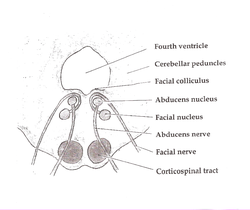
The pontine tegmentum exhibits a cytoarchitecture characterized by a predominance of gray matter, comprising neuronal clusters and nuclei, interspersed with bundles that include ascending and descending fiber tracts. This organization distinguishes it from the more compact ventral pontine basis, with the tegmentum forming the dorsal portion of the pons adjacent to the . The constitutes a diffuse network of neurons extending throughout the , organized into medial, lateral, and median (raphe) columns. Key components include the pontine reticular nuclei, specifically the nucleus reticularis pontis oralis in the rostral and the nucleus reticularis pontis caudalis in the caudal portion, along with associated structures such as the , Kölliker-Fuse nucleus, and the pedunculopontine tegmental nucleus (PPTg), located in the dorsolateral upper pontine . Cranial nerve nuclei are prominently housed within the tegmentum. The trigeminal nerve (CN V) nuclei encompass the principal sensory nucleus, located laterally in the mid-pons; the spinal trigeminal nucleus, extending caudally from the pons into the medulla; and the mesencephalic nucleus, which reaches rostrally into the midbrain. The abducens nucleus (CN VI) lies in the caudal tegmentum, deep within the facial colliculus and ventral to the medial longitudinal fasciculus. The facial nucleus (CN VII) is positioned in the lower tegmentum, ventromedial to the spinal trigeminal nucleus, with its fibers looping around the abducens nucleus. Vestibular nuclei of the vestibulocochlear nerve (CN VIII) include the superior and inferior vestibular nuclei in the dorsolateral tegmentum near the pontomedullary junction. Cochlear nuclei (CN VIII) consist of the dorsal cochlear nucleus, forming the acoustic tubercle on the lateral floor of the fourth ventricle, and the ventral cochlear nucleus, located at the pontomedullary junction. Monoaminergic nuclei are integral to the tegmental structure. The , a noradrenergic nucleus, appears as a pigmented cluster of neurons in the rostral pontine tegmentum, situated lateral to the floor of the near the pontomesencephalic junction. The , serotonergic in nature, form part of the median column of the , distributed along the midline of the tegmentum. Other notable nuclei and tracts include the pontine micturition center (also known as Barrington's nucleus), located in the medial dorsal pons adjacent to the and lateral dorsal tegmental nucleus. The is a prominent fiber bundle within the tegmentum, comprising crossed and uncrossed fibers that descend from the and , passing through the and terminating in the of the medulla. Major fiber tracts traverse the tegmentum, facilitating neural communication. The medial longitudinal fasciculus (MLF) runs near the midline, posterior to the abducens nucleus and adjacent to the raphe nuclei, serving as a conduit for coordinated eye movements. The medial lemniscus, positioned medially in the tegmentum, conveys somatosensory information from the dorsal column-medial lemniscus pathway to the thalamus. The lateral lemniscus ascends laterally in the ventral tegmentum, originating from the cochlear nuclei and trapezoid body to convey auditory information. The trapezoid body, a bundle of transverse fibers in the ventral tegmentum, contains decussating auditory fibers from the cochlear nuclei. The superior cerebellar peduncle (brachium conjunctivum) emerges from the tegmentum, carrying efferents from the cerebellar dentate nucleus toward the midbrain red nucleus and thalamus.

Vascularization

Arterial supply

The arterial supply to the pontine tegmentum is primarily derived from the , which runs along the ventral surface of the and emits multiple small perforating branches. These include paramedian branches that penetrate the midline to supply central structures, as well as short and long circumferential branches that course laterally to perfuse peripheral regions. Additionally, contributions from the (AICA) and (SCA) supplement the supply, particularly to lateral and dorsal aspects. Paramedian branches, also known as type 1 perforators, arise directly from the and supply midline structures such as the (MLF) and the abducens nucleus. These branches typically number 2–5 per vessel and are crucial for the central tegmental zone. Short circumferential branches (type 2) emerge from the , AICA, or SCA, providing blood to the lateral tegmentum, including the ; they are similarly limited to 2–5 perforators per branch. Long circumferential branches (type 4), often originating from the AICA, extend dorsally toward the floor, reaching broader lateral areas with 0–2 perforators and contributing to the supply of the and abducens nucleus. The vascular territories are thus divided into central (paramedian-supplied midline) and peripheral (circumferential-supplied lateral and dorsal) regions, with AICA involved in about 12.5% of cases for ventrointermedial areas and SCA in 2.5% for upper pontine regions. This branching pattern follows a repetitive anatomical organization, with an average of seven arteries per side observed in cadaveric studies.

Venous drainage

The venous drainage of the pontine tegmentum primarily involves a network of pontine veins, including anterior, lateral, and transverse pontine veins, which collect blood from the region and converge into the anterior pontomesencephalic vein. This vein courses superiorly along the anterior surface of the and , receiving tributaries from small pontine and mesencephalic veins before emptying into larger basal structures. Superficial drainage from the pontine tegmentum is facilitated by the transverse pontine veins, which run along the anterolateral aspect of the and primarily drain into the superior petrosal sinus. Additionally, the petrosal vein contributes to this pathway, directing flow toward the superior petrosal sinus or, less commonly, the , providing an efficient route for superficial venous return. Deeper venous outflow from the pontine tegmentum integrates with the basal vein of Rosenthal, which collects blood from the tegmental region and proceeds to join the (vein of Galen), ultimately reaching the . This deep system ensures drainage of central tegmental structures, including nuclei and tracts, into the broader deep cerebral venous network. The pontine tegmental veins form extensive anastomoses with adjacent medullary and venous networks, allowing collateral flow across segments; for instance, pontine veins connect with ventral mesencephalic and myelencephalic veins, enhancing redundancy in drainage pathways. Venous in the is notably rare compared to arterial , as involvement in cerebral is infrequently reported in clinical literature, often overshadowed by more common arterial occlusive events in the posterior circulation.

Neural connections

Afferent inputs

The pontine tegmentum receives a diverse array of afferent inputs that integrate sensory, motor, and modulatory signals essential for its role in brainstem processing. These incoming pathways originate from peripheral sensory structures, cortical regions, subcortical nuclei, and local monoaminergic systems, converging primarily on the , cranial nerve nuclei, and associated tegmental structures. Sensory afferents to the pontine tegmentum include projections via the spinotrigeminal tract, which carries somatosensory information from the ipsilateral face and oral cavity to the extending into the caudal pontine tegmentum. Additionally, vestibulocochlear inputs arrive directly through the eighth cranial nerve, terminating in the vestibular and cochlear nuclei located in the lateral pontine tegmentum; these convey balance and auditory signals for immediate reflex integration. Cortical inputs primarily consist of corticopontine fibers originating from layer V of the , particularly the frontal and temporal lobes, which project to the pontine and nuclei. Subcortical afferents encompass projections from the via the hypothalamotegmental tract, delivering autonomic regulatory signals to the pontine from posterior hypothalamic nuclei. From the , the ascends bilaterally to the pontine tegmentum, relaying nociceptive and crude touch information from laminae VII-VIII to the for arousal modulation. Cerebellar inputs arrive via the inferior cerebellar peduncle, with excitatory projections from to the reticulotegmental nucleus in the tegmentum, supporting feedback loops in . Monoaminergic modulation arises from the , providing serotonergic inputs to the pontine , including the , to influence and . The itself contributes local noradrenergic feedback within the , enhancing responsiveness to environmental stimuli. Specific pathways include the anterior spinocerebellar tract, which ascends through the pontine carrying proprioceptive information from the lower limbs en route to the , and the olivocochlear bundle, originating from neurons in the tegmentum but receiving modulatory afferents from cochlear nuclei for auditory efferent control.

Efferent outputs

The pontine tegmentum, encompassing key nuclei such as the , , , and , originates several critical efferent pathways that integrate with distant brain regions. These outputs facilitate coordination across sensorimotor, autonomic, and modulatory systems, with fibers traversing specific bundles to reach their . A prominent efferent pathway the cerebellum via pontocerebellar fibers from the nucleus reticularis tegmenti pontis (NRTP), a structure embedded in the pontine tegmentum; these axons decussate, enter the middle cerebellar peduncle, and terminate as mossy fibers in the contralateral cerebellar cortex, particularly in the layer. The NRTP thus serves as a for tegmental influences on cerebellar processing, distinct from the larger corticopontocerebellar system arising ventrally. Descending outputs to the spinal cord arise from the pontine reticular formation, forming the medial reticulospinal tract; neurons in the oral and caudal pontine reticular nuclei project bilaterally through the anterior funiculus, influencing extensor motor neurons and posture via excitatory influences on alpha and gamma motor units. The lateral reticulospinal tract, originating from the medullary reticular formation, provides more diffuse modulation to interneurons and flexor muscles, contributing to locomotor adjustments. Noradrenergic efferents from the , situated in the dorsal pontine tegmentum, ascend primarily via the dorsal tegmental bundle to innervate the diffusely, with dense projections to prefrontal, parietal, and entorhinal areas; these fibers branch extensively, releasing norepinephrine to modulate cortical excitability and networks. This pathway ensures broad, topographically organized distribution, with some commissural components crossing in the dorsal tegmentum. For ocular motor coordination, the pontine tegmentum interconnects with cranial nerve nuclei through the (MLF); fibers from the carry signals to the contralateral oculomotor (III) and abducens (VI) nuclei, enabling conjugate horizontal gaze via excitatory and inhibitory inputs. These MLF-mediated projections integrate vestibular and pursuit signals for precise eye movements. Cholinergic outputs from the (PPN), located in the caudal pontine tegmentum, project directly to the and reticulata, forming a major source of in the ; these fibers on neurons and , supporting motor initiation and pathways. The PPN's projections are topographically organized, with denser innervation to the as well. Serotonergic efferents originate from in the pontine tegmentum, including the dorsal and raphe, and target the and via ascending fibers in the medial forebrain bundle; these projections modulate thalamocortical relay neurons and hypothalamic nuclei involved in , with diffuse innervation patterns that influence sleep-wake cycles and stress responses. The dorsal raphe provides the primary serotonergic input to the , while raphe fibers more selectively innervate the .

Functions

Cranial nerve roles

The pontine tegmentum houses several key nuclei associated with V through VIII, which collectively contribute to from the face, oral cavity, and , as well as of eye and facial movements. These nuclei are embedded within the dorsal aspect of the tegmentum, facilitating integration of sensory inputs with motor outputs for essential reflexes and coordinated functions. The (CN V) nuclei in the pontine include the principal sensory nucleus, located laterally in the , which processes tactile and pressure sensations from the face, , oral and nasal cavities. The mesencephalic nucleus, extending from the into the , handles proprioceptive inputs from the and teeth muscles. Additionally, the , which begins in the caudal and descends to the upper cervical cord, mediates pain and temperature sensations from the ipsilateral face. The trigeminal motor nucleus, positioned medially adjacent to the principal sensory nucleus, provides motor innervation to the , enabling chewing and the . The abducens nucleus (CN VI), situated deep within the near the pontomedullary junction, serves as the motor center for the ipsilateral , controlling horizontal eye abduction. It also contains internuclear neurons that project via the (MLF) to the contralateral , ensuring conjugate horizontal gaze during eye movements. The (CN VII) motor nucleus lies at the pontomedullary junction, dorsal to the trapezoid body, and innervates the muscles of for actions such as smiling and frowning. Its sensory component, via the , conveys sensations from the anterior two-thirds of the to the rostral part of the nucleus of the solitary tract, which extends into the lower pontine tegmentum. The fibers loop around the abducens nucleus, forming the on the floor of the . The (CN VIII) nuclei are prominent in the pontine tegmentum: the ventral and dorsal cochlear nuclei, located at the junction with the medulla, receive auditory inputs from the and process and frequency discrimination, with axons forming the trapezoid body. The —superior, medial, lateral, and inferior—occupy the vestibular area of the in the caudal and rostral medulla, integrating balance and postural signals from the , utricle, and saccule to maintain equilibrium. These nuclei integrate to support critical reflexes, such as the vestibulo-ocular reflex (VOR), where in the caudal pontine detect head rotations and signal the abducens nucleus to generate compensatory eye movements via the MLF, stabilizing gaze during head motion. Disruptions in these pontine pathways, such as in the or MLF, can impair VOR, leading to or gaze instability.

Arousal and autonomic regulation

The pontine reticular formation serves as a critical component of the reticular activating system (RAS), a network of neurons in the brainstem that maintains wakefulness and cortical arousal by projecting diffusely to the thalamus and cerebral cortex. Within this system, pontine neurons facilitate the transition to rapid eye movement (REM) sleep through the generation of pontogeniculooccipital (PGO) waves, which are phasic bursts originating in the pontine tegmentum and propagating to the lateral geniculate nucleus and occipital cortex, marking a hallmark of REM sleep physiology. These waves contribute to the atonia and vivid dreaming associated with REM states, underscoring the tegmentum's dual role in promoting both vigilant wakefulness and restorative sleep cycles. The , located in the dorsal pontine tegmentum, comprises the principal source of noradrenergic neurons in the , modulating , stress responses, and overall vigilance through widespread projections that release norepinephrine to enhance signal-to-noise ratios in target areas like the . This noradrenergic system heightens during novel or threatening stimuli, facilitating adaptive behaviors by increasing cortical excitability and suppressing irrelevant sensory inputs. Complementing this, the pontine , part of the midline serotonergic system, regulate mood stabilization, sleep-wake transitions, and descending inhibition of pain signals via projections to the and , where serotonin promotes while dampening excessive emotional reactivity. These nuclei exert tonic control over behavioral states, with reduced activity linked to disruptions in vigilance and affective processing. The mesopontine cholinergic system, encompassing the pedunculopontine tegmental (PPT) and laterodorsal tegmental (LDT) nuclei, drives arousal and locomotion by generating theta rhythms (4-8 Hz oscillations) in the hippocampus and cortex, which synchronize neural activity during exploratory behaviors and wake-REM transitions. projections from these nuclei activate thalamic relay neurons, promoting desynchronized EEG patterns essential for conscious awareness and motor initiation. In autonomic regulation, the pontine micturition center coordinates voiding by integrating sensory inputs from the pelvic and sending excitatory signals to parasympathetic preganglionic neurons in the sacral , enabling coordinated detrusor contraction and sphincter relaxation. Additionally, pontine reticulospinal tracts influence cardiovascular reflexes by modulating sympathetic outflow to adjust and in response to postural changes or emotional stressors.

Respiratory control

The pontine tegmentum plays a pivotal role in modulating respiratory rhythm through its specialized nuclei, particularly the pneumotaxic center located in the parabrachial and Kölliker-Fuse (KF) nuclei. This center limits the duration of inspiration by facilitating the , which terminates inspiratory activity and promotes the transition to expiration, thereby fine-tuning the and preventing prolonged inspiratory phases. Neurons in the KF area exhibit phasic respiratory-modulated activity, integrating sensory inputs to adjust and rhythm, as demonstrated in studies identifying over 200 such neurons in vagus-intact rats. Complementing the pneumotaxic center, the apneustic center in the lateral tegmental field, particularly the ventrolateral including the A5 noradrenergic region, promotes and prolongs inspiratory drive when uninhibited, contributing to the maintenance of inspiratory phase duration. This center modulates phase transitions by interacting with pontine and medullary circuits, and its activity can extend expiration under certain conditions, such as through noradrenergic signaling. The pontine tegmentum interacts with medullary respiratory groups via the to coordinate rhythm generation and enable voluntary overrides of automatic breathing patterns. Projections from the KF area to medullary nuclei, such as the nucleus tractus solitarius and , form a pontomedullary circuit that drives phasic synaptic interactions essential for IOS and overall rhythm stability. These connections allow pontine influences to shape medullary outputs, facilitating adaptive responses like increased respiratory frequency during behavioral demands. Respiratory modulation in the pontine tegmentum incorporates peripheral inputs from chemoreceptors and lung stretch receptors to refine breathing patterns. The KF area processes signals from chemoreceptors detecting hypoxia and , as well as from the retrotrapezoid nucleus, adjusting inspiratory and expiratory durations accordingly. Lung stretch receptors trigger the Breuer-Hering , which the pneumotaxic utilizes to initiate IOS and prevent overinflation, with postnatal habituation of this occurring around days 13-15 in . During sleep, pontine tegmentum activity influences respiratory patterns, particularly in REM sleep where KF neuron firing decreases, leading to irregular breathing and reduced upper airway tone. This pontine modulation contributes to the variability in respiratory rate and tidal volume observed in REM states, distinct from the more stable patterns in non-REM sleep.

Clinical significance

Pathological syndromes

Locked-in syndrome (LIS) classically results from bilateral infarction of the ventral , sparing the and preserving via intact reticular activating system pathways, manifesting as quadriplegia, anarthria, and lower cranial nerve palsies with retained vertical eye movements for communication. However, extension of the into the pontine , particularly the rostral dorsolateral region, disrupts mechanisms in the , leading to or total locked-in state with loss of awareness. This tegmental involvement worsens prognosis, often resulting from occlusion or hemorrhage, and highlights the tegmentum's critical role in maintaining despite motor de-efferentation. Several lateral pontine syndromes arise from tegmental lesions, disrupting cranial nerve nuclei and fascicles along with adjacent tracts. Millard-Gubler syndrome, caused by infarction or hemorrhage in the ventral caudal pons, involves the facial (VII) and abducens (VI) nerve fascicles traversing the tegmentum, producing ipsilateral facial palsy, abducens palsy, and contralateral hemiplegia due to corticospinal tract damage. Foville syndrome, or inferior medial pontine syndrome, stems from medial tegmental infarction affecting the paramedian pontine reticular formation, facial colliculus, and abducens nucleus, yielding ipsilateral horizontal gaze palsy, facial weakness, deafness, and contralateral hemiparesis or hemisensory loss. Raymond syndrome, a rarer paramedian ventral pontine lesion, impairs the abducens fascicle and pyramidal tract, causing ipsilateral abducens palsy with contralateral hemiparesis and facial paresis, often without significant tegmental nuclear involvement but with fascicular extension. Central pontine myelinolysis (CPM), an osmotic demyelination disorder triggered by rapid correction, primarily targets the central basis pontis but can extend to adjacent tegmental tracts, including the and , exacerbating quadriparesis, mutism, and . The characteristic bat-wing or trident-shaped demyelination on MRI typically spares the pontine periphery and in classic cases, but tegmental extension correlates with more severe bulbar and autonomic dysfunction. Vascular pathologies, particularly occlusion, frequently induce tegmental ischemia via compromise of paramedian perforators, leading to acute symptoms including vertigo, , , and bilateral cranial nerve deficits from reticular and vestibular nucleus involvement. Top-of-the-basilar occlusion may selectively spare ventral structures but still cause midbrain-tegmental crossover effects, while proximal occlusions produce diffuse pontine ischemia with high mortality. Traumatic causes, such as from high-impact acceleration-deceleration forces, often target the pontine tegmentum's , shearing ascending arousal pathways and resulting in prolonged or persistent due to disrupted thalamocortical connectivity. Lesions here impair the reticular activating system's integrity, preventing recovery of despite preserved reflexes. Recent studies indicate poorer outcomes in pontine tegmental strokes compared to basis-only infarcts, with tegmental involvement linked to persistent deficits, emphasizing the need for targeted endovascular recanalization. A 2023 analysis of variants confirmed that tegmental lesions predict incomplete recovery in over 80% of patients, informing prognostic models.

Developmental anomalies

The pontine tegmentum, as part of the , develops from the alar plate of the during early embryogenesis, specifically within rhombomeres 1 and 2, where disruptions in segmentation can lead to congenital malformations affecting neuronal migration and . These anomalies arise from genetic or environmental factors interfering with patterning, resulting in structural defects that impair cranial nerve function and . Pontine tegmental cap (PTCD) represents a rare congenital malformation characterized by an ectopic dorsal "cap" of transverse pontine fibers protruding into the , accompanied by ventral pontine and middle cerebellar peduncle aplasia. Clinically, it manifests with , sensorineural hearing loss, and cranial nerve palsies involving nerves V, VII, and VIII, often leading to developmental delays and swallowing difficulties. relies on MRI, which reveals the characteristic cap-like structure and molar tooth-like superior cerebellar peduncles; a 2025 case from highlighted its rarity, reporting the first instance on the continent in a one-year-old girl with bilateral sensorineural deafness, strabismus, and vertebral anomalies, confirmed by MRI showing hypoplastic facial nerves and absent vestibulocochlear nerve components. Joubert syndrome, a ciliopathy, frequently involves the pontine tegmentum through of the pons and vermis, producing the hallmark molar tooth sign on MRI due to thickened, non-decussating superior cerebellar peduncles and disrupted decussations within the tegmentum. This leads to , abnormal breathing patterns, and ocular motor apraxia, with tegmental involvement contributing to the syndrome's neurological deficits. Dandy-Walker malformation can extend to the pontine tegmentum, featuring brainstem hypoplasia alongside vermian agenesis and cystic dilation, classified into mild or severe forms based on the degree of tegmental compression and pyramidal tract abnormalities. Genetic underpinnings of these tegmental anomalies often link to ciliopathies, with mutations in AHI1 (encoding jouberin, crucial for ciliary function and ) and NPHP1 (involved in nephrocystin-1 signaling) disrupting development and leading to variants with tegmental defects. Recent advances in 2024-2025 fetal MRI studies have enabled earlier detection of pontine tegmental anomalies, such as PTCD and Joubert-related malformations, by visualizing infratentorial structures , improving prognostic counseling through high-resolution imaging of ectopic tissues and peduncle abnormalities.

References

Add your contribution
Related Hubs
User Avatar
No comments yet.