Hubbry Logo
SyringomaSyringomaMain
Open search
Syringoma
Community hub
Syringoma
logo
8 pages, 0 posts
0 subscribers
Be the first to start a discussion here.
Syringoma
Syringoma
from Wikipedia
Syringoma
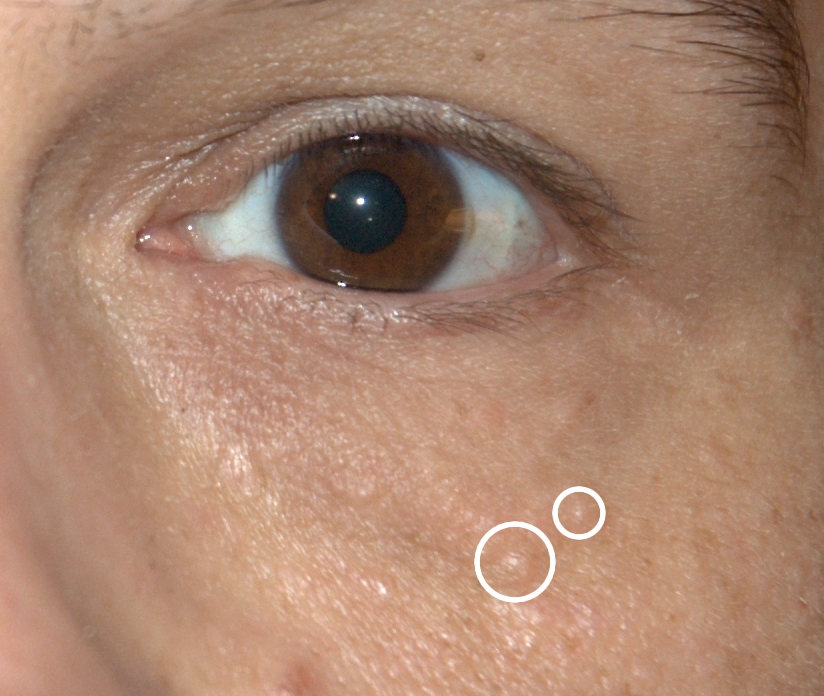
Syringomas highlighted by white circles
SpecialtyOncology Edit this on Wikidata

Syringomas are benign eccrine sweat duct tumors, typically found clustered on eyelids, although they may also be found in the armpits, abdomen, chest, neck, scalp, or groin area, including genitals, in a symmetric pattern.[1]: 663  They are skin-colored or yellowish firm, rounded bumps, 1–3 mm in diameter, and may be confused with xanthoma, milia, hidrocystoma, trichoepithelioma, and xanthelasma.[2] They are more common in women[3] and are most commonly found in middle-aged Asian women. While they can present at any time in life, they typically present during adolescence. They are usually not associated with any other symptoms, although can sometimes cause itchiness or irritation.[4]

Types

[edit]
  • The eruptive form typically presents on the anterior chest, abdomen, neck, and arms. It presents in successive crops with periods of relief in between times of active rash.
  • The milia-like type of syringoma is typically smaller lesions that have a milky white center that can look like milia.
  • The plaque type is more commonly associated with itchiness and chronic scratching that leads to epidermal thickening similar to lichen planus.
  • The familial form, in some cases of syringoma, exhibits a familial pattern in an autosomal-dominant pattern of inheritance. Chromosome 16q22 has been shown to be involved in the genetic links of syringoma.

Presentation

[edit]

Associated syndromes

[edit]

Syringomas can be found in association with other symptoms as part of a syndrome. Hailey–Hailey disease (also known as familial benign chronic pemphigus) is a blistering disease that can also include syringomas.[5]

Several systemic syndromes have also been associated with syringoma including diabetes mellitus, Down syndrome, Brooke–Spiegler syndrome, and Nicolau–Balus syndrome. Specifically, diabetes mellitus is strongly associated with clear cell syringoma consisting of nests of clear cells containing glycogen. A phosphorylase deficiency, resulting from elevated glucose levels seen in diabetes, is thought to lead to an accumulation of glycogen in the skin and within the clear cells. The incidence of syringomas has been reported in up to 40% of people with Down syndrome, and can be associated with a condition calcinosis cutis, which requires prompt medical attention. Brooke–Spiegler syndrome is a rare autosomal-dominant syndrome with cutaneous manifestations including syringomas and trichoepitheliomas. Nicolau–Balus syndrome is a rare autosomal-dominant disorder consisting of atrophoderma vermiculata and syringomas.

Pathophysiology

[edit]
Syringoma (eccrine)

The pathophysiology of syringomas remains largely unknown. Familial patterns presenting in an autosomal-dominant pattern suggest a genetic link that can result in varying genetic aberrations in lesions, specifically chromosome 16q22. The most commonly accepted theory is that syringomas are benign growths that arise from the intraepidermal portion of eccrine ducts. Another theory suggests that syringomas are a reactive hyperplasia rather than a true neoplasm resulting after inflammatory processes such as eczema. A hamartomatous process possibly could explain eruptive syringomas. A hamartoma of pluripotent stem cells could precede the pathological process. Syringomas may also be under hormonal influence, explaining the female predominance.[citation needed]

Diagnosis

[edit]

Syringomas can often be diagnosed clinically based on presentation, distribution patterns over the body, lack of associated symptoms, and family history. A definitive diagnosis requires a skin biopsy to allow the tissue to be examined under a microscope. Histologically, syringomas have a characteristic comma-shaped ("tadpole") tail of dilated, cystic eccrine ducts.

Treatment

[edit]

The goal of treatment is to improve the appearance of lesions, since they are otherwise not serious and typically do not cause symptoms. Many treatment methods have been attempted, but complete removal is uncommon. No single treatment method has been shown to work consistently. Both medical and surgical treatments have been studied, each with variable success. Common destructive treatment methods include carbon dioxide lasers, dermabrasion, surgical excision, electrocoagulation, and chemical peels. Many of these methods are very time-consuming and require multiple treatment sessions. Carbon dioxide lasers are the most commonly practiced method; they can cause thermal damage, though, leading to scarring in the area. Medical therapies include topical atropine, topical retinoids, and oral tranilast.

The most common adverse effects include redness, skin discoloration, and pain. Other side effects include blistering and scarring.

See also

[edit]

References

[edit]
[edit]
Revisions and contributorsEdit on WikipediaRead on Wikipedia
from Grokipedia
Syringoma is a benign adnexal originating from the intraepidermal portion of eccrine sweat ducts, presenting as small, firm, skin-colored or yellowish papules that typically cluster around the eyelids, cheeks, and upper lip. These lesions are non-cancerous and asymptomatic, primarily causing cosmetic concerns due to their appearance. Syringomas most commonly affect women, with a higher prevalence in individuals of Asian descent, and typically emerge during or early adulthood, though they can appear at any age. The exact etiology remains unclear, but genetic factors, hormonal influences, and associations with conditions such as or diabetes mellitus have been noted. Familial cases may follow an autosomal dominant inheritance pattern. Clinically, the papules measure 1 to 3 mm in diameter and are often multiple and symmetrical, though rarer variants include eruptive forms on the trunk or solitary lesions elsewhere on the body. is usually clinical, supported by dermoscopy revealing yellowish globules or confirmed via showing characteristic tadpole- or comma-shaped ductal structures. Treatment is elective and focuses on , with options including , , , or topical agents, though recurrence is possible and scarring may occur.

Overview

Definition

Syringoma is a benign cutaneous adnexal neoplasm that originates from the luminal cells of eccrine sweat ducts, exhibiting ductal differentiation. These tumors arise from the intraepidermal portion of the eccrine sweat duct, known as the acrosyringium, and are characterized by an overgrowth of sweat gland cells. Although primarily eccrine in nature, rare apocrine variants have been reported. Clinically, syringomas present as multiple, small (1-3 mm), firm, skin-colored or yellowish papules that typically cluster in areas rich in sweat glands, such as the lower eyelids, upper cheeks, and periorbital region. They are usually asymptomatic but can cause cosmetic concerns due to their appearance, resembling milia or . The lesions are non-cancerous and do not pose health risks, though they may occasionally itch, particularly in vulvar locations. Syringomas most commonly develop in early adulthood, with a predilection for females, and can appear in an eruptive pattern during , affecting the trunk or extremities. They are also more prevalent in individuals with , occurring in 18–40% of cases, and may be influenced by genetic, hormonal, or environmental factors.

Epidemiology

Syringomas are benign adnexal tumors of eccrine origin with an estimated prevalence of approximately 1% in the general population. They exhibit a marked female predominance, affecting women more frequently than men. The condition typically manifests during or early adulthood, though lesions may emerge or increase in number at any age thereafter. A higher incidence is observed among individuals of Asian descent, with some evidence suggesting elevated rates in Asian and African populations as well. The prevalence is substantially increased in certain genetic syndromes, notably , where it ranges from 18% to 40% and often presents periorbitally. Associations also exist with diabetes mellitus, particularly the clear cell variant of syringoma; ; and Ehlers-Danlos syndrome. Familial occurrences have been documented, sometimes following an autosomal dominant inheritance pattern.

Classification

Types

Syringomas are benign adnexal tumors classified into four principal clinical variants based on their distribution, onset, and associations, as outlined by and in 1987. These variants include localized, eruptive (or generalized), Down syndrome-associated, and familial forms, each with distinct epidemiological and clinical features. Additional histopathological and site-specific variants, such as clear cell and acral types, have been described but are less common and often overlap with the primary classifications. The localized variant is the most prevalent form, typically presenting as clusters of small (1-3 mm), firm, skin-colored to yellowish papules symmetrically distributed around the periorbital region, particularly the lower eyelids, upper cheeks, and forehead. It usually manifests during or early adulthood, predominantly in females, and remains confined to these areas without widespread dissemination. Lesions are often but can cause cosmetic concerns due to their prominence on the face. The eruptive variant, also known as generalized or disseminated syringoma, is characterized by the abrupt appearance of numerous pruritic or papules in successive crops, primarily on the anterior trunk, , axillae, and proximal extremities, though involvement can occur. This type typically emerges in or young adulthood, affects females more frequently (up to 90% of cases), and shows a predilection for individuals with darker tones. Some lesions may regress spontaneously over time, but the condition can persist for years. Down syndrome-associated syringoma occurs with increased frequency in patients with trisomy 21, where lesions are often more widespread and numerous than in the general population, involving the face, trunk, and extremities from an early age. This variant is linked to the genetic predisposition of and may appear in up to 30-40% of affected individuals, highlighting a syndromic association. The papules retain the typical benign but contribute to the dermatological burden in these patients. The familial variant follows an autosomal dominant inheritance pattern, leading to earlier onset in childhood or and bilateral, symmetric involvement of the face and extrafacial sites. members may exhibit variable expressivity, with some developing widespread lesions resembling the eruptive form. is recommended for affected families due to the heritable nature. Other recognized variants include the clear cell syringoma, a histopathological subtype featuring epithelial cells with abundant glycogen-rich clear cytoplasm, frequently associated with diabetes mellitus and more common in adult females. These lesions clinically mimic standard syringomas but show distinct microscopic features on . The acral variant is rare and confined to the palms and soles, presenting as multiple small papules of eccrine origin, potentially as part of a generalized eruptive pattern. Site-specific forms, such as vulvar syringoma, may occur in women, often during or after , and can be pruritic. These atypical presentations underscore the spectrum of syringoma diversity, though malignant transformation to syringomatous carcinoma remains exceedingly rare.

Associated Conditions

Syringomas are benign adnexal tumors that can occur in isolation but are also associated with several genetic syndromes and systemic conditions, where they may present with distinct features such as eruptive distribution or increased calcification. A prominent association exists with Down syndrome (trisomy 21), in which syringomas are observed in approximately 18% to 36% of affected individuals, often appearing as multiple periorbital lesions during adolescence or early adulthood. In this context, the tumors frequently exhibit higher rates of calcification, potentially progressing to calcinosis cutis, and eruptive variants have been reported. An established link also connects syringomas to diabetes mellitus, particularly type 2, where the tumors may erupt suddenly on the trunk or extremities in adult patients, possibly influenced by metabolic factors or . Other genetic conditions include Ehlers-Danlos syndrome and , both connective tissue disorders in which syringomas can manifest as multiple lesions, though less commonly than in Down syndrome.

Clinical Features

Presentation

Syringomas typically present as multiple, small, firm papules measuring 1 to 4 mm in diameter, which are skin-colored, yellowish, or translucent. These lesions are often discrete and may appear in clusters, giving a beaded or cobblestone-like pattern on affected areas. In eruptive variants, the papules are smaller (1 to 2 mm) and can arise suddenly in larger numbers, particularly on the trunk. The most common location is the periorbital region, especially the lower eyelids, where lesions frequently cluster bilaterally and symmetrically. Other frequent sites include the upper cheeks, forehead, and upper chest, with less common involvement of the axillae, , abdomen, genitalia, palms, or soles. Periorbital predominance is particularly noted in familial and syndromic cases, while eruptive forms may favor the trunk and extremities. Syringomas usually manifest during or early adulthood, though onset can occur in or later in life, with additional lesions developing over time. They exhibit a strong female predominance, affecting women more frequently than men, and are more prevalent in individuals of Asian or darker-skinned descent, particularly for eruptive types. Associations with conditions such as (prevalence 18-40%), diabetes mellitus (clear cell variant), , and Ehlers-Danlos syndrome are reported, often presenting earlier in these populations. The lesions are generally asymptomatic, causing no pain, itching, or functional impairment, though cosmetic concerns are common due to their facial prominence. Rarely, pruritus may occur, especially in eruptive cases, and spontaneous regression is possible in some eruptive variants after several years.

Symptoms

Syringomas are generally asymptomatic, with most patients experiencing no pain, discomfort, or other physical sensations from the lesions. In some cases, particularly with eruptive or widespread variants, mild pruritus (itching) may occur, though this is uncommon and typically self-limited. The absence of significant symptoms distinguishes syringomas from more inflammatory or pruritic skin conditions, such as milia or eczema, and underscores their benign nature. While not a true symptom, the cosmetic impact of visible papules—often clustered around the eyes or on the face—frequently prompts patients to seek or treatment due to aesthetic concerns rather than functional impairment.

Pathophysiology

Etiology and Pathogenesis

Syringomas are benign adnexal tumors primarily arising from the intraepidermal portion of eccrine sweat ducts, with the exact remaining incompletely understood. Hormonal influences are implicated, as lesions often emerge during or early adulthood, coinciding with endocrine changes. Familial occurrences follow an autosomal dominant pattern, with onset typically in or , predominantly affecting the face. Associations exist with genetic syndromes such as (prevalence of 18-40% in affected individuals, often periorbital), Ehlers-Danlos syndrome, and , as well as diabetes mellitus, particularly in the clear cell variant where altered glucose metabolism may contribute. Potential triggers include trauma, autoimmune disorders, and , as seen in eruptive variants post-liver transplant. Pathogenetically, syringomas exhibit ductal differentiation toward the dermal or intraepidermal eccrine sweat ducts, originating from luminal cells of the acrosyringium. Electron reveals characteristic features of ductal cells, including microvilli, desmosomes, tonofilaments, and lysosomes, supporting eccrine histogenesis, though occasional differentiation has been noted. Enzymatic activity, such as , aligns with eccrine origins. No specific genetic mutations have been identified, and tumorigenic pathways are not fully elucidated, but the process likely involves proliferation of pluripotential stem cells or in response to local stimuli. In eruptive syringomas, may involve a hyperplastic reaction to , potentially termed syringomatous , with higher incidence in and Asian populations. Malignant transformation to syringocarcinoma is exceedingly rare, underscoring the benign nature of most cases. Clear cell syringomas in diabetic patients demonstrate accumulation, suggesting metabolic influences on cellular morphology. Overall, while associations provide clues, the multifactorial highlights the need for further research into underlying molecular mechanisms.

Histopathology

Syringoma is characterized histologically as a benign adnexal originating from eccrine sweat ducts, presenting as a well-circumscribed proliferation of small epithelial ductules, cords, nests, and cysts embedded within a dense, sclerotic stroma in the superficial reticular . The typically measures 1-3 mm in diameter and spares the papillary and , with rare extension into deeper dermal layers. Microscopically, the ductal structures are lined by two layers of cuboidal to flattened epithelial cells, featuring an inner layer of luminal cells and an outer myoepithelial layer, often displaying a distinctive comma- or tadpole-shaped morphology due to elongated tails of epithelial cells. The lumina contain amorphous, , periodic acid-Schiff (PAS)-positive debris, representing cuticular material or , without significant cytologic or mitotic activity. A sclerotic fibrous stroma surrounds the ductal elements, contributing to the tumor's firm consistency, and may show increased deposition. In some cases, particularly in diabetic patients, clear cell variants exhibit accumulation within the epithelial cells, imparting a pale, vacuolated appearance to the . Immunohistochemically, the epithelial cells express cytokeratins consistent with sweat duct differentiation, such as CK7 and CK19, while myoepithelial markers like p63 highlight the outer layer; eccrine enzyme activity, including leucine aminopeptidase and succinic dehydrogenase, further supports the eccrine origin. These features distinguish syringoma from malignant counterparts like syringomatous carcinoma, which demonstrates infiltrative growth, , and despite minimal .

Diagnosis

Clinical Evaluation

Clinical evaluation of syringoma primarily relies on a thorough history and , as the condition is often diagnosable based on characteristic clinical features without the need for invasive procedures. Patients typically present in or early adulthood, with lesions appearing gradually and symmetrically, though eruptive variants can develop suddenly in clusters. A family history is uncommon, but associations with syndromes such as (increased prevalence of 18–39%), Marfan syndrome, or Ehlers-Danlos syndrome should be explored during history taking. Additionally, inquire about comorbidities like diabetes mellitus, particularly for clear cell variants, and any pruritus exacerbated by perspiration or heat, which occurs rarely. On , syringomas manifest as multiple, discrete, firm papules measuring 1 to 4 mm in diameter, typically skin-colored, yellowish, or translucent, with a smooth surface. They are most commonly located periorbitally, especially on the lower eyelids, but may also involve the upper cheeks, , axillae, chest, , or genitalia in symmetric clusters. Atypical presentations include unilateral, linear, annular, or plaque-like forms, as well as larger "giant" lesions exceeding 5 mm or eruptive types on the trunk that may show mild . The lesions are generally , but palpation confirms their dermal, non-tender nature, distinguishing them from more superficial or inflammatory conditions. Differential diagnosis includes milia (smaller, pearl-like cysts), trichoepitheliomas (firmer, flesh-colored nodules), angiofibromas (often reddish in ), xanthelasma (yellowish plaques on eyelids), and (may ulcerate or show ). Dermoscopy can aid by revealing monomorphic yellow-white globules or comma-shaped structures with occasional pinpoint vessels, supporting a clinical impression without in typical cases. is reserved for atypical features, such as rapid growth, asymmetry, or suspicion of , to confirm the histologically. Overall, clinical emphasizes cosmetic concerns driving presentation, as syringomas are benign and do not require intervention unless for aesthetic reasons.

Confirmatory Tests

The diagnosis of syringoma is primarily clinical, based on the characteristic appearance of small, firm, skin-colored papules, particularly around the eyelids; however, confirmatory testing is essential when the presentation is atypical, such as in eruptive, vulvar, or clear cell variants, or to differentiate from mimics like or trichoepithelioma. The gold standard confirmatory test is a , typically a punch or shave biopsy, which allows for histopathological examination to verify the . reveals a normal overlying the , where there are multiple small ducts and solid epithelial cords exhibiting a characteristic comma- or tadpole-like morphology; these structures are lined by a thin bilayer of flattened cuboidal epithelial cells, with lumina containing amorphous material representing sweat. In the clear cell variant, associated with diabetes mellitus, the cells show glycogen-induced cytoplasmic clearing. Special stains enhance diagnostic precision: periodic acid-Schiff (PAS) staining highlights the PAS-positive cuticle lining the ducts and the intraluminal material, while hematoxylin and eosin (H&E) is routine for initial assessment. Immunohistochemistry, using markers such as cytokeratins (e.g., AE1/AE3 or MNF116), can further delineate the epithelial components and aid in distinguishing syringoma from other adnexal tumors. No routine laboratory, imaging, or radiographic tests are required, as syringoma is a benign eccrine appendageal neoplasm without systemic implications beyond potential associations like diabetes in specific subtypes.

Treatment

Therapeutic Approaches

Syringomas are benign adnexal tumors that typically do not require treatment unless they cause cosmetic concerns or are symptomatic. is often recommended, particularly in cases of eruptive syringomas, as spontaneous regression may occur in adulthood. When intervention is pursued, the goal is to reduce visibility with minimal scarring, though recurrence is common due to the tumors' deep dermal location. Medical therapies include topical and systemic retinoids, which may diminish lesion size by modulating epithelial proliferation. Oral and have shown in reducing syringoma appearance, particularly in periorbital cases, but require monitoring for systemic side effects such as teratogenicity and . Topical tretinoin application has been used similarly, with variable results and potential for local irritation. (TCA) peels, applied at concentrations of 20-50%, chemically ablate superficial lesions and can improve cosmetic outcomes, though multiple sessions may be needed and hypopigmentation is a risk in darker skin types. Intradermal botulinum toxin A has emerged as an adjunctive option, promoting lesion regression in small studies, often combined with for enhanced without significant adverse events. Destructive procedures are the mainstay for definitive removal and include , , excision, and . Electrosurgical destruction via electrodesiccation and offers reliable results with low recurrence rates and no long-term complications in reported cases, making it suitable for multiple lesions. freezes lesions using , providing effective ablation but carrying risks of and blistering, especially in individuals with Fitzpatrick skin types IV-VI. Surgical excision, including snip or punch techniques, allows precise removal but may result in linear scarring, limiting its use on cosmetically sensitive areas like the eyelids. Laser therapies, particularly CO2 and Er:YAG lasers, are preferred for periorbital and eruptive syringomas due to their precision and favorable cosmetic outcomes, with studies reporting high patient satisfaction despite potential postinflammatory . mechanically resurfaces the to eliminate superficial tumors but is less commonly used owing to risks of scarring and uneven results. Post-treatment care involves wound protection, sun avoidance, and prevention to minimize complications such as scarring or pigmentary changes, with typically occurring over days to weeks. No single approach is universally superior; selection depends on location, number, skin type, and preference for invasiveness.

Prognosis and Complications

Syringomas are benign adnexal tumors with an excellent , as they pose no risk of and do not impact overall health or . These lesions typically remain stable over time without spontaneous resolution in most cases, though the eruptive variant may regress after several years. Treatment is generally unnecessary unless pursued for cosmetic reasons, and the condition carries no associated morbidity or mortality. Complications from syringomas themselves are minimal and primarily limited to aesthetic concerns, such as the visibility of multiple small papules on the face, which can cause psychological distress but no physical symptoms like or itching in the majority of cases. Development of malignant syringocarcinoma from benign syringoma is not reported and is not a clinical concern; malignant forms are exceedingly rare and arise de novo. However, interventions to remove syringomas can lead to complications including scarring, post-inflammatory or (particularly in individuals with darker skin tones), , and recurrence of lesions, which may necessitate repeated treatments. Recurrence rates vary by method but are common due to the potential for incomplete removal or new lesion development.
Add your contribution
Related Hubs
User Avatar
No comments yet.