



Community hub
Recent from talks
Contribute something
Nothing was collected or created yet.
Southeastern Anatolia Project
View on Wikipedia | This article may need to be rewritten to comply with Wikipedia's quality standards. (January 2025) |
| Economy of Turkey |
|---|
 |
 Turkey portal Turkey portal |
The Southeastern Anatolia Project (Turkish: Güneydoğu Anadolu Projesi, GAP) is a multi-sector integrated regional development project based on the concept of sustainable development for the 9 million people (2023) living in the Southeastern Anatolia region of Turkey. According to the Southeastern Anatolia Project Regional Development Administration, the aim of the GAP is to eliminate regional development disparities by raising incomes and living standards and to contribute to the national development targets of social stability and economic growth by enhancing the productive and employment generating capacity of the rural sector.The Southeastern Anatolia Region extending over wide plains in the Euphrates-Tigris Basin encompass the administrative provinces of ( Adıyaman, Batman, Diyarbakır, Gaziantep, Kilis, Siirt, Şanlıurfa, Şırnak and Mardin )which are located in the basins of the Euphrates and Tigris and in Upper Mesopotamia. The surface area of the region bordering with Syria to the south and with Iraq to the southeast is 75,193 square kilometres which corresponds to 9.7% of Turkey's total surface area.[1] Turkey has in total 8.5 million hectares of irrigable land and GAP's share in this total is 20 per cent.The total cost of the project is over 190 billion Turkish lira (TL) (2020 adjusted price).[2]
Current activities under GAP include sectors like agriculture and irrigation, hydroelectric power production, urban and rural infrastructure, forestry, education and health. Water resources development envisaged the construction of 22 dams and 19 power plants.[3]
History
[edit]
The initial idea and decision to utilize the waters of the Euphrates and Tigris rivers came from Atatürk, the founder of the Republic. During the one party era, the need for electrical energy was a priority issue. The Electricity Studies Administration was founded in 1936 to investigate how rivers in the country could be utilized for energy production. The Administration began its detailed studies with the "Keban Dam Project" and established observation stations to assess the flow and other characteristics of the Euphrates. The GAP as it is structured today, was planned in the 1970s consisting of projects for irrigation and hydraulic energy production on the Euphrates and Tigris, but transformed into a multi-sector social and economic development program for the region in the early 80s. The development program encompassed such sectors as irrigation, hydraulic energy, agriculture, rural and urban infrastructure, forestry, education and health. With the development of new GAP Administrative structure in 1988–1989, its basic objectives included the improvement of living standards and income levels of people so as to eliminate regional development disparities (economic inequality) and contributing to national goals such as social stability and economic growth by enhancing productivity and employment opportunities in the rural sector.[4]

Tensions between Turkey, Syria and Iraq were raised from time to time due to GAP. Syria and Iraq demanded more water to be released, while Turkey declined so as to form the dam reservoirs. Because of this GAP is one of the world's most well protected dam projects, especially against aircraft. GAP also almost came to a complete halt in the early 1990s due to the high level of Kurdish (PKK) activities in the region. The PKK is not only blamed for a number of funding cuts as funds were diverted to support the counter-terrorism effort, but is also blamed for damaging several dams and canals, as well as killing engineers working at the dams. A number of economic crises also played a very important part in the delays of GAP.
The UN embargo on Iraq (which was lifted after the Second Gulf War) had negative effects on development efforts and region's trade with Middle Eastern countries, which are its natural economic partners. Furthermore, imbalances in public financing delayed the financing needs of the project. Finally, a number of judicial questions needed clearing over the flooding of several historical sites as well as local residences as described in the "Social effect" section.
Strategic goal
[edit]Historically, Southeastern Anatolia was located on the trading route between East and West. The region had been an important source of cultural diversity. However the changes in the trading routes and the agricultural methods ended the old importance of the region.
-
 Irrigation in Harran
 -
 Well and a girl
._Harran_ovasi_farmland.png)
._Harran_ovasi_well.png)
The 1989 Master Plan had aimed to initiate the revitalization of the economic, social and cultural life in the region through an "integrated regional development project". The rise in the income of the region was directly transferred to restoration and revitalization of the cultural activities in the region, instead of moving into the national budget. This master plan did not reach its goals because of the issues stated under the introduction section. However, for this negative perspective, with the international community involvement, project added new dimensions and concepts to the definitions.
The concerns and concepts of the environment, sustainability and participation, which were either overlooked or totally absent in the original plan has been added with the UNDP support. The revised "GAP Regional Development Plan" with a new understanding is currently in place. The macro frame of the GAP Regional Development Plan (GAP-RDP) is drawn by 8th Five-Year Development Plan coordinated with the efforts under the "Program for Transition to a Strengthened Economy" prepared as a part of the process for Turkey's accession to the European Union.
Social effect
[edit]The project rests upon the philosophy of sustainable human development, which aims to create an environment in which future generations can benefit and develop. The basic strategies of the project include fairness in development, participation, environmental protection, jobs creation, spatial planning and infrastructure development. In reaching these goals the primary objective of GAP is to normalize levels of development, income, and living standards between the southeastern region and other regions of Turkey. GAP is transforming the region completely by creating economic and social opportunities and promoting business. Critical infrastructure, such as airports and highways, is being constructed to support the development of the region. GAP will provide jobs to an estimated 3.5 million people directly.
Economic development
[edit]Irrigation
[edit]GAP is estimated to double Turkey's irrigable farmland. The increase of agricultural activity of GAP in its incomplete state is visible clearly on the USDA graph belove. Cotton production increased from 150,000 metric tons to 400,000 metric tons, making the region the top cotton producer. But at the same time other regions declined, which means that Turkey's overall output stayed relatively steady.
-
 Cotton production
 -
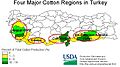 Cotton regions
 -
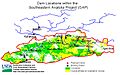 Locations of Dams
 -
 Plains irrigated by the tunnels


GAP is supposed to create 17,000 square kilometres (4.2 million acres) of farmland in the Harran plain alone, as visible on two USDA maps above.
Reports indicate that, due to irrigation from the Atatürk Dam, harvest yields of cotton, wheat, barley, lentils, and other grains in the Harran plain have tripled. A number of Agriculture Department backed initiatives are encouraging farmers to experiment with new varieties of fruits, vegetables, and nuts that did not exist in the region prior.
Imports and exports
[edit]The amount of foreign trade of the region is continuously rising since 2002. In 2002, total export from the region was 689 million $ and total imports stood at 773 million $.According to TÜİK data, GAP's total exports are In 2023, total reached 13.657 billion $, while imports reached 9.330 billion $. Since 2004 the G.A.P. region is net exporter.[5]
Fishing
[edit]GAP is being built in a region where water used to be a scarcity. With the vast number of lakes being formed, plans to use them as breeding spaces for commercial fishing are also underway. In the case of the Atatürk Dam the fishing industry in the region is already developing.
Power
[edit]The GAP also consists of 19 hydroelectric power plants. These will supply the energy equivalent of 22% of the anticipated total nationwide energy consumption in 2010. Providing 8,900 gigawatt hours (32 PJ), it is one of the largest series of hydroelectric power plants in the world.
| Physical Realization of Energy Projects as of October 2024[6] | |||
| Name | Inst Capacity (MW) | Energy Prod (GWh/yr) | Status |
|---|---|---|---|
| Karakaya Dam & HEPP | 1,800 | 7,354 | In operation since 1987 |
| Atatürk Dam & HEPP | 2,400 | 8,900 | In operation since 1993 |
| Karkamış Dam & HEPP | 189 | 652 | In operation since 1999 |
| Birecik Dam & HEPP | 672 | 2,516 | In operation since 2000 |
| Şanlıurfa HEPP | 51 | 124 | In operation since 2006 |
| Erkenek HEPP | 13 | 52 | In operation since 2010 |
| Sırımtaş Dam & HEPP | 27 | 80 | In operation since 2013 |
| Koçali Dam & HEPP | 39 | 136 | Under construction |
| Büyükçay Dam & HEPP | 30 | 84 | Master Plan |
| Kahta Dam & HEPP | 75 | 71 | Master Plan |
| Fatopaşa HEPP | 22 | 32 | Master Plan |
| Çağçağ HEPP | 14 | 42 | In operation since 1968 |
| Bulam HEPP | 7 | 33 | In operation since 2010 |
| Euphrates Basin | 5,339 | 20,076 | |
| Dicle Dam & HEPP | 110 | 298 | In operation since 1999 |
| Kralkızı Dam & HEPP | 94 | 146 | In operation since 1998 |
| Batman Dam & HEPP | 198 | 483 | In operation since 2003 |
| Garzan Dam & HEPP | 52 | 158 | In operation since 2013 |
| Ilısu Dam & HEPP | 1,200 | 3,833 | In operation since 2020 |
| Silvan Dam & HEPP | 160 | 623 | Under construction |
| Cizre Dam & HEPP | 240 | 1,208 | Under construction |
| Kayser Dam & HEPP | 90 | 341 | Final Project |
| Tigris Basin | 2,144 | 7,090 | |
| Total | 7,483 | 27,166 | |
Infrastructure
[edit]Dams
[edit]
Southeastern Anatolia Project consists of 22 Dams (year of completion):
- Euphrates Basin
- Atatürk Dam (1992)
- Birecik Dam (2000)
- Büyükçay Dam
- Çamgazi Dam (1998)
- Çetintepe Dam (2023)
- Gömikan Dam
- Hancağız Dam (1988)
- Kahta Dam
- Karakaya Dam (1987)
- Karkamış Dam (1999)
- Kayacık Dam (2005)
- Kemlin Dam
- Koçali Dam
- Sırımtaş Dam (2013)
- Tigris Basin
- Batman Dam (1998)
- Cizre Dam
- Dicle Dam (1997)
- Garzan Dam (2012)
- Kayser Dam
- Kralkızı Dam (1997)
- Ilısu Dam (2020)
- Silvan Dam
Maintenance
[edit]The reason for the sheer number of dams in the project, more than would at first appear needed, is maintenance. Dams need to be cleaned from the debris carried with the water flow. After a while the dam becomes obsolete as water flow slows down to inadequate levels. The dams will be shut down every 5 to 10 years for fall maintenance (also called fall cleanup). Water levels are normally lowest in fall. The extra dams are placed in service during this maintenance period.
In cases of natural disasters such as floods, the maintenance may be performed earlier. The plan is to have one or two dams spare in case an emergency shutdown of any dam is necessary. While shutting down a dam also shuts down irrigation channels linked to it, it can nevertheless continue providing power.
Engineering behind the project
[edit]
Providing electricity and irrigation is challenging in a region as large as the one targeted by GAP. A constant flow of water is imperative.

After a large body of water is collected behind the dam a constant flow of water is then available. The height of the dam allows the water to go at a high velocity through the turbines thus generating electricity. After the fast flowing water exits the dam it is slowed down by a concrete energy dissipator (pictured). Creation of electricity is only part of the usage of the tons of water collected at the dam.

When dealing with tons of water, it has to be distributed evenly and slowly. Occasionally main channels will need maintenance, or may be damaged due to external reasons. In order to even assess the problem, tons of water need to be removed from the main channel. The best way to do this is to slow the overall flow from the main dam and redirect all water flowing originally through the damaged channel to backup channels. Radial gates serve this purpose, they regulate the flow of water. It is imperative to keep water flowing. Lack of the flow will not only compromise all irrigation linked to that channel but also all cities linked will experience a power outage.

After leaving the energy dissipator, water flows into a set of main channels, which flow in different directions supplying water to a greater area. They are the most critical part of a dam project aside from the dam itself. This is as critical as high-voltage transmission lines in power grids.

Sluice gates regulate the flow of water. If water flows too fast it will overflow and probably damage one or more of the channels, or flood irrigation fields. Multiple sluice gates regulate the speed of the flow on different sections of the channel. They can also be used like radial gates to cut water in channels.
-
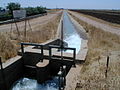 Harran canal
 -
 Flow regulator
 -
 Distribution canals


After leaving the radial gates on the main channel, water flows to canals which are smaller and can carry less water. Flow regulators divert water on canals to distribution canals. Just like radial gates and sluice gates, flow generators can stop water flow if necessary. Distribution canals are the last step as far as engineers are concerned. It delivers water to different sections of large fields, pretty much an artificial river.
-
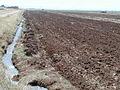 Earth distribution channel
 -
 Furrow
 -
 Drip tubes


It is up to farmers to get the water from distribution channels to their crops for irrigation. There are different methods to do this; any one or a combination of earth distribution channel, furrow, and drip tubes can be used.
Sub-projects
[edit]The latest design of the project divides the GAP into smaller projects. Each project generates its own annual reports and activity sheets.
- Management, Operation and Maintenance of GAP Irrigation Systems (GAP-MOM),
- Regulation of Water in Irrigation Canals and Methods and Technologies for Water Saving,
- Treatment of Urban Waste Water,
- Re-use of Irrigation Discharge Water,
- Protection of Biological Diversity,
- Environmental Work in the GAP Region,
- Environmental Work in the GAP Region — Tigris Basin,
- Assessment of Climatic Conditions in the Region for Present Day and Future,
- Adıyaman-Kuyulu Region Erosion Control Project,
- Adıyaman-Diran Micro-Catchment Rehabilitation Project,
- GAP Afforestation Project,
- Participation in urban planning and zoning,
- Resettlement and employment of people affected by dam lakes,
- Atatürk Dam Lake Sub-Regional Development Plan,
- Eco-city and eco-village planning and development in pilot localities.
- Establishment of Multi-Purpose Community Centers (ÇATOM) for Women,
- Improving the Income Level of People in Non-Irrigated Areas,
- GAP Entrepreneur Support and Guidance Centers (GAP-GIDEM),
- Project for On-Contract Animal Husbandry (GAP Rings Model),
- Project for Joint Machinery Use (GAP OMAK),
- Sub-Regional Development Plan Comprising Return to Villages and Rehabilitation,
- Project for the Rehabilitation of Children Working in Streets.
- Institutional Capacity Building,
- Training and Extension Services for Farmers,
- Land Consolidation,
- Social Progress for Youth,
- GAP Region Public Health Project.
Status of GAP
[edit]The water resources development component of the program envisages the construction of 22 dams and 19 hydraulic power plants and irrigation of 17,000 square kilometres of land. The total cost of the project is estimated at $32 billion USD. The total installed capacity of power plants is 7483 MW and projected annual energy production reaches 27 billion kWh.[7]
| Status of the project | |||
| Completed | Ongoing | Planned | |
|---|---|---|---|
| Power capacity as of December 2023 MW |
6,827 | 160 | 496 |
| Power production as of December 2023 GWh/yr |
24,671 | 623 | 1,872 |
| Irrigation area as of December 2023 km2 |
663,919 | 94,701 | 299,183 |
| Number of dams | 13 | 5 | 4 |
| Number of hydropower plants | 14 | 1 | 6 |
GAP contributes to the country's hydroelectric energy production. As of 2023, 91.2% physical realization of energy investments was achieved.The amount of government investment for 2023 was around 84 billion TL, which corresponds to 18.6% of Turkey's total investment for same year.[8]
Criticism of the project
[edit]Ilısu Dam
[edit]Completion of the Ilısu Dam would cause the flooding of the ancient city of Hasankeyf whose history stretches back over 10,000 years. Between 50 and 68 hamlets and villages will be flooded affecting approximately 25,000 local people. An additional 57 villages will have their land partially flooded.
Construction began on August 5, 2006, after a ceremony led by Prime Minister Recep Tayyip Erdoğan.[9] The dam entered into service in 2018.
Archaeological losses
[edit]Critics of the project say that the dam could effectively destroy the artifacts of ancient Kurdish, Armenian, and Assyrian habitation in the region.[10]
Environmental justice concerns
[edit]The environmental justice lens of the human-environment geography should determine a fair distribution of environmental benefits and burdens, especially with regard to vulnerable communities. In context of the Ilisu Dam environmental justice focuses attention on the fair treatment of different social groups and the potentially disproportionate impact of these projects on specific communities.[11]
Environmental justice, for example, would highlight how dam construction can disproportionately affect certain communities, perhaps leading to the displacement of indigenous or economically disadvantaged groups as occurred recently in Hasankeyf.[when?] It prompts us to ask whether the benefits of hydropower and economic development are distributed fairly to all communities or whether certain groups are hit hardest by the negative impacts, such as loss of land, cultural heritage or livelihoods.[12]
TRT GAP
[edit]TRT GAP, belonging to the Turkish Radio and Television Corporation, was established in 1989 to promote the Southeastern Anatolia Project in the region. In 1991, TRT GAP was put under the jurisdiction of TRT's Ankara facilities.[13] From 1989 to 2001 TRT GAP was broadcasting on TRT 2 before being revamped as a 24-hour news and culturally-oriented channel. TRT GAP's transmissions are realized through the same channel with the TRT 3 since 2001 (which broadcasts live footage of TBMM TV) on a time-share basis.
Key Information


See also
[edit]External links
[edit]- Official GAP website in English
- Official GAP website in Turkish
- Southeastern Anatolia Project, USDA
- Environmental Impact Assessment Report Introduction PDF
- Environmental Impact Assessment Report Project Background and Description PDF
- Re-Emergence of Discredited Ilısu Dam Project
- The effects and impacts of the Southeastern Anatolian Development project - a thesis by Yilmaz, Mustafa, M.A.
- TRT's Official Website
(in Turkish) - TRT Gap Broadcasting Schedule
- Watch TRT GAP/TRT 3 live Online
- TRT GAP at LyngSat Address
References
[edit]- ^ "GAP Regional Development Administration". gap.gov.tr.
- ^ "GAP Regional Development Administration". gap.gov.tr.
- ^ Dohrmann, Mark; Hatem, Robert (2014). "The Impact of Hydro-Politics on the Relations of Turkey, Iraq, and Syria". The Middle East Journal. 68 (4): 567–583. doi:10.3751/68.4.14. S2CID 144889973.
- ^ "Southeastern Anatolia Project Regional Development Administration". 22 April 2008. Archived from the original on 22 April 2008. Retrieved 20 October 2017.
{{cite web}}: CS1 maint: bot: original URL status unknown (link) - ^ "Türkiye İstatistik Kurumu (TÜİK)". www.tuik.gov.tr.
- ^ "GAP Bölge Kalkınma İdaresi Başkanlığı" (PDF).
- ^ "GAP'ta Son Durum 2023" (PDF).
- ^ "Finansman Tablosu" (PDF).
- ^ "Turkey begins controversial dam". August 5, 2006 – via news.bbc.co.uk.
- ^ Harris, Leila (2002). "Water and Conflict Geographies of the Southeastern Anatolia Project". academia.edu. Retrieved June 28, 2014.
- ^ https://www.tandfonline.com/doi/full/10.1080/00221341.2014.953978 (Bjelland, 2015)
- ^ https://www.tandfonline.com/doi/full/10.1080/00221341.2014.953978 (Bjelland, 2015)
- ^ Kuyucu, Prof Dr Michael (Mihalis). "Historical, Economic And Political Development Of Television Broadcasting In Turkey An Industry Analysis". International Journal of Management and Applied Science – via www.academia.edu.


| History |
| ||||||||||||
|---|---|---|---|---|---|---|---|---|---|---|---|---|---|
| Geography |
| ||||||||||||
| Government |
| ||||||||||||
| Economy | |||||||||||||
| Demographics | |||||||||||||
| Society |
| ||||||||||||


Southeastern Anatolia Project
View on GrokipediaHistorical Development
Inception and Early Planning
The Southeastern Anatolia Project (GAP) was conceived in the 1970s as a coordinated program to exploit the water and land resources of Turkey's southeastern region, particularly the Euphrates and Tigris river basins.[1] Initial efforts built on earlier isolated hydraulic developments, such as feasibility studies and construction starts for dams like Keban in the mid-1960s, but lacked an integrated framework until the decade's planning phase.[4] The project's core rationale centered on addressing chronic underdevelopment in the area, characterized by low agricultural yields due to arid conditions and limited irrigation, alongside insufficient energy infrastructure to support national growth.[5] In 1977, ongoing proposals for hydropower and irrigation schemes across the two basins were formally bundled and named the Southeastern Anatolia Project, marking its official inception as a unified initiative.[6] This consolidation occurred under the State Hydraulic Works (DSI), Turkey's primary agency for water resources, which outlined a scope encompassing 22 dams and 19 hydroelectric power plants.[7] Early blueprints targeted irrigation of 1.8 million hectares of arable land to enable year-round farming, primarily for crops suited to the semi-arid climate, while prioritizing hydropower generation with a projected installed capacity of 7,476 megawatts and annual output of 27 billion kilowatt-hours.[1] These targets reflected a technocratic emphasis on resource mobilization to elevate regional per capita income, which lagged significantly behind national averages, and to mitigate east-west economic disparities without broader social components at the outset.[8] Planning documents from the period stressed engineering feasibility over geopolitical implications, though downstream riparian concerns from Syria and Iraq were noted in preliminary assessments.[9] Funding was envisioned through state budgets and international loans, with construction sequencing favoring upstream Euphrates facilities to maximize storage and flow regulation.[10] By the late 1970s, pilot elements like the Şanlıurfa Tunnels' foundations underscored momentum, yet the framework remained narrowly hydraulic, evolving only later toward multisectoral integration.[7]Master Plan Formulation and Initial Implementation
The Southeastern Anatolia Project (GAP) was initially conceived in the 1970s as a water resources development program targeting the Euphrates and Tigris basins, with plans for 22 dams, 19 hydroelectric power plants generating 7,476 MW and 27 billion kWh annually, and irrigation across 1.8 million hectares of land.[1] This phase emphasized harnessing hydraulic potential for energy and agriculture in the underdeveloped southeastern region of Turkey.[11] By the late 1980s, the project evolved into a multi-sectoral initiative incorporating social, economic, and infrastructural dimensions beyond mere water management. The GAP Master Plan, prepared in 1989 by the State Planning Organization in collaboration with consultants such as Nippon Koei and Yüksel Joint Venture, established a framework for sustainable regional development, including timelines for resource utilization, agricultural modernization, and human capital investments.[8][12] The plan projected total investments exceeding $32 billion (in 1989 dollars) across irrigation, hydropower, urban infrastructure, education, and health sectors to address chronic underdevelopment.[13] In parallel, the GAP Regional Development Administration was formed in 1989 to centralize coordination, budgeting, and execution, shifting from fragmented ministry-led efforts to unified oversight.[14] Initial implementation focused on priority hydropower infrastructure to generate early economic returns and enable downstream irrigation. Construction of the Karakaya Dam on the Euphrates began in 1976—prior to the formal master plan but integrated into GAP—and concluded in 1987, yielding 1,800 MW capacity as the second-largest facility in the chain.[5] The Atatürk Dam, GAP's flagship structure, saw groundbreaking in 1983, with reservoir filling commencing in 1990 and full hydroelectric operations by 1993, providing 2,400 MW and foundational storage for regional water allocation.[15] These early dams prioritized upstream energy production, supplying power to national grids while laying groundwork for expansive irrigation networks, though progress was tempered by technical challenges and regional security issues.[16] By the early 1990s, these efforts had realized over 20% of planned hydropower capacity, marking the transition from planning to tangible infrastructure deployment.[11]Strategic Objectives
Economic and Agricultural Targets
The primary agricultural target of the Southeastern Anatolia Project (GAP) is to bring 1.8 million hectares of land under irrigation, primarily along the Euphrates and Tigris rivers, to enable intensive farming in a historically arid region reliant on rain-fed agriculture.[17] [9] This expansion is projected to increase crop yields substantially, with estimates including 104% for wheat, 69% for barley, 388% for cotton, and 556% for tomatoes, shifting production toward higher-value and export-oriented crops like cotton and supporting agro-industrial inputs.[18] Diversification of farming activities beyond traditional grains is emphasized to enhance productivity and provide raw materials for downstream manufacturing, such as textiles from increased cotton output.[19] Economically, GAP aims to elevate per capita income in the nine-province region to the national average, addressing longstanding disparities where southeastern incomes have trailed the rest of Turkey due to limited infrastructure and water scarcity.[19] [20] This involves boosting rural employment through irrigation-dependent jobs and related sectors, reducing out-migration, and fostering high-income activities to absorb urban populations and promote social stability.[19] The project integrates these goals with national export promotion, targeting foreign exchange gains from agricultural surpluses and value-added products, while coordinating irrigation with hydropower to minimize investment inefficiencies.[18] Quantitative benchmarks from the GAP Master Plan include making an additional 19.3% of Turkey's total irrigable land economically viable post-completion, positioning the southeast as a key contributor to national food security and industrial growth.[21] These targets prioritize sustainable resource use, with on-farm development services planned for 2.4 million hectares to optimize water efficiency and prevent overuse, though realization depends on phased infrastructure rollout.[11] Overall, the economic framework seeks integrated regional development, eliminating inter-provincial inequalities through agriculture-led growth rather than isolated sectoral interventions.[19]Energy, Infrastructure, and Social Goals
The energy objectives of the Southeastern Anatolia Project center on exploiting the substantial hydropower potential of the Euphrates and Tigris river basins to bolster Turkey's national electricity supply. Upon full implementation, the project envisions 22 dams equipped with 19 hydroelectric power plants generating approximately 27 billion kWh annually, representing a significant share of the country's hydroelectric output and contributing to reduced reliance on imported energy sources.[16][4] This capacity is projected to harness about 20% of Turkey's total hydropower potential concentrated in the region.[22] Infrastructure goals encompass the construction of multi-purpose dams, extensive irrigation networks, and ancillary developments such as roads, railways, and urban facilities to support regional integration and economic viability. The project plans to irrigate roughly 1.8 million hectares of arable land through canals and distribution systems, transforming arid plains into productive agricultural zones while facilitating flood control and water storage.[19][9] Supporting elements include enhancements to transportation corridors and settlement infrastructure, aimed at fostering connectivity between rural areas and urban centers across the nine provinces.[1] Social aims focus on elevating living standards and mitigating regional disparities through investments in human capital and community services, with targets to align per capita income and development indicators with national averages. Key priorities involve expanding access to education, healthcare, and housing, alongside programs for population management, vocational training, and local participation to promote sustainable human development.[19][23] The GAP Social Action Plan outlines strategies in areas such as organization, health services, and social infrastructure to address underdevelopment, including initiatives like rural development projects with explicit social dimensions.[18][24]Infrastructure and Components
Dams, Reservoirs, and Hydropower Facilities
The Southeastern Anatolia Project (GAP) includes 22 planned dams and 19 associated hydroelectric power plants (HEPPs) on the Euphrates, Tigris, and their tributaries, aimed at harnessing hydropower potential estimated at 7,476 MW installed capacity and 27 billion kWh annual production.[1] These facilities also provide reservoir storage for irrigation and flood mitigation, with total irrigable area targeted at 1.8 million hectares upon full implementation.[1] Construction prioritizes multi-purpose designs, integrating gravity, arch, and rockfill structures to optimize water management in the arid southeast region.[16] The Atatürk Dam, the project's flagship structure on the Euphrates River between Şanlıurfa and Adıyaman provinces, exemplifies large-scale engineering with a height of 169 meters, crest length of 760 meters, and structural volume of 84.5 million cubic meters.[25] Its reservoir holds 48.7 billion cubic meters, the sixth-largest globally by volume, enabling regulated flows downstream.[26] The integrated HEPP features eight 300 MW Francis turbines plus a 5 MW auxiliary unit, totaling 2,405 MW, with commercial operations commencing in 1993 after impoundment began in 1990.[26] This facility alone accounts for over 30% of GAP's hydropower target and has generated billions of kWh since activation, supporting national grid stability.[25] On the Tigris River, the Ilısu Dam, a 131-meter-high concrete-faced rockfill structure spanning 1,775 meters, was completed in 2020 with a 1,200 MW HEPP capacity.[27] Designed for power generation, flood control, and storage, it forms a reservoir affecting Batman, Siirt, and Şırnak provinces, though its filling has raised downstream flow concerns for Iraq.[28] Other completed facilities include the Batman Dam (operational since 1999, 40 MW) and Kralkızı Dam (1991, 173 MW), contributing to incremental capacity buildup.[16] As of late 2023, 18 of the 22 dams were constructed, with 14 HEPPs operational delivering 5,534 MW, representing about 74% of the hydropower target.[29] Progress continues under the 2024-2028 GAP Action Plan, focusing on remaining structures like the Cizre and Silvan Dams to achieve full integration by 2032, amid challenges including financing and regional security.[30] Reservoir operations emphasize seasonal filling to balance power demands and irrigation releases, with monitoring by the State Hydraulic Works (DSİ) ensuring structural integrity.[16]Irrigation Networks and Agricultural Systems
The irrigation networks of the Southeastern Anatolia Project deliver water from reservoirs on the Euphrates and Tigris rivers through a hierarchy of main canals, branch canals, distribution channels, and on-farm systems to support farming in the semi-arid region spanning nine provinces. These networks incorporate gravity-fed open canals, pumping stations for elevated terrains, and pressurized delivery for field application, with over 1.496 million meters of main canals constructed as of the end of 2023.[31] The master plan envisions irrigating 1.8 million hectares, equivalent to approximately 12% of Turkey's total irrigable land, to transform rainfed and marginal areas into productive farmland.[21] [31] As of December 2024, 680,000 hectares have been opened to irrigation, representing about 38% of the master plan target, with ongoing construction of networks covering an additional 94,701 hectares.[32] [31] Key schemes include the Harran Plain irrigation, which utilizes the Harran main canal to supply 98,500 hectares by gravity from the Atatürk Dam reservoir; the Şanlıurfa main canal serving 43,000 hectares by gravity and 5,000 hectares by pumping; and the Batman right bank project covering 18,193 hectares.[8] [33] The Silvan scheme, one of the largest, targets 235,000 hectares overall, including 66,122 hectares via pumped irrigation from the Silvan Dam.[34] Other significant areas encompass the Mardin-Ceylanpınar Plains (phased irrigation of over 66,000 hectares) and Suruç Plain extensions.[34]| Irrigation Scheme | Irrigated Area (hectares) | Primary Method |
|---|---|---|
| Harran Plain | 98,500 | Gravity canal |
| Şanlıurfa Main | 48,000 | Gravity and pumping |
| Silvan Pumped | 66,122 | Pumping |
| Batman Right Bank | 18,193 | Canal |
| Mardin-Ceylanpınar (phased) | ~66,100 | Mixed |
Supporting Urban and Rural Developments
The Southeastern Anatolia Project (GAP) extends beyond hydraulic infrastructure to include targeted urban and rural developments that integrate transportation, housing, and social services, aiming to reduce regional disparities and support population resettlement and economic activity across its nine provinces. Coordinated by the GAP Regional Development Administration since its establishment in 1989, these components allocate resources to sectors such as urban infrastructure, rural electrification, and community facilities, with foreign-funded initiatives like the Development of Urban and Rural Infrastructure in the GAP Region enhancing connectivity and basic services.[37] [8] [18] Urban developments prioritize improved infrastructure in key centers like Diyarbakır, Gaziantep, and Şanlıurfa, including expansions in road networks, bridges, and rail links under the GAP Regional Transportation and Infrastructural Development Project to facilitate trade and mobility. The Turkish government allocated approximately $14 billion in 2023 for GAP's completion, with portions directed toward such urban enhancements to boost real estate and economic integration.[38] [39] [40] Rural initiatives emphasize sustainable settlement and service provision, including the GAP-FAO Rural Development Program, which supports agricultural communities through improved access roads, electrification, and housing adaptations. New residential areas constructed for project-related displacements incorporate energy-efficient rural dwellings tailored to arid climates, featuring passive cooling designs like thick walls and courtyard layouts to minimize operational costs.[37] [41] Social infrastructure in rural areas is bolstered by Multi-Purpose Community Centers (ÇATOM), operational since the 1990s, which deliver vocational training, literacy programs, and health services to over 100,000 participants annually, primarily women, fostering local employment and self-sufficiency. These centers, integrated into the 1989 GAP Master Plan, address human development gaps by combining education with infrastructure like potable water systems and sanitation facilities.[42] [1]Implementation and Progress
Phased Construction and Milestones
The construction of the Southeastern Anatolia Project (GAP) has occurred in sequential phases, prioritizing upstream hydropower dams on the Euphrates River for energy production and water regulation, followed by downstream reservoirs, Tigris basin developments, and extensive irrigation networks to support agricultural expansion. Initial efforts in the 1970s focused on feasibility and early dam builds, with the project formalized as a comprehensive initiative by the 1989 Master Plan, which integrated hydropower, irrigation, and socioeconomic components across 22 planned dams and 19 hydroelectric plants.[1][5] A pivotal early milestone was the completion of the Karakaya Dam in 1987, the first major GAP-associated structure on the Euphrates, which began construction in 1976 and generated 1,800 MW of power upon operation, contributing to Turkey's national grid expansion.[43] This was followed by the Atatürk Dam, the project's centerpiece, with construction starting in 1983 and structural completion in 1990; its reservoir filling enabled irrigation for approximately 1.8 million hectares downstream while adding 2,400 MW capacity, though full hydroelectric operations extended into 1993.[44][45] Subsequent phases shifted toward irrigation and Tigris developments, including the Şanlıurfa Tunnels (completed in stages from 1995 onward) to divert Euphrates water for Harran Plain agriculture, irrigating over 240,000 hectares by the early 2000s.[16] By 2008, the GAP Action Plan marked a acceleration milestone, targeting integrated completion by emphasizing social and environmental integration alongside infrastructure, with 13 dams operational by then.[16] Later milestones include the Ilısu Dam on the Tigris, where construction resumed in 2009 after delays and reservoir filling began in 2019, yielding 1,200 MW and supporting downstream irrigation but displacing historical sites like Hasankeyf.[46][47]| Major Milestone | Date | Description |
|---|---|---|
| Karakaya Dam completion | 1987 | First Euphrates hydropower facility operational at 1,800 MW.[43] |
| Atatürk Dam completion | 1990 | Key reservoir and 2,400 MW plant enabling large-scale irrigation.[44] |
| Şanlıurfa Tunnels operational | 1995–2000s | Water diversion for 240,000+ ha irrigation in Harran.[16] |
| GAP Action Plan | 2008 | Framework for accelerated, multisectoral progress.[16] |
| Ilısu Dam filling | 2019 | Tigris hydropower addition at 1,200 MW amid regional impacts.[46] |
Current Status and Completion Metrics as of 2025
As of the end of 2023, the Southeastern Anatolia Project (GAP) had achieved approximately 91% completion in its energy facilities, encompassing dams and hydropower plants, while irrigation projects stood at around 60% completion.[48] The project's hydropower component includes 22 planned dams and 19 hydroelectric power plants (HEPPs), with 18 dams constructed and 14 HEPPs operational, yielding an installed capacity of 5,534 MW against a target of 7,490 MW.[29] These facilities have enabled significant electricity generation, contributing to Turkey's national grid, though full utilization depends on water inflows and operational efficiencies. Irrigation development, a core objective for expanding agricultural land in the Euphrates-Tigris basin, has progressed more slowly. Of the master plan's target to irrigate 1.8 million hectares, 663,919 hectares had been opened to irrigation by the end of 2023, representing operational networks in key areas like the Harran Plain.[31] Construction of main canals totaled 1,496,265 meters, with an additional 94,701 hectares under active network development and 299,193 hectares planned. This equates to 62.8% of irrigation projects being operational under the GAP Action Plan, though actual cultivated area lags due to on-farm investment needs and water distribution challenges.[31]| Component | Target | Achieved (as of end-2023) | Completion Rate |
|---|---|---|---|
| Dams | 22 | 18 constructed | ~82% |
| HEPPs | 19 | 14 operational | ~74% |
| Installed Capacity (MW) | 7,490 | 5,534 | ~74% |
| Irrigated Area (ha) | 1,800,000 | 663,919 opened | ~37% (area); 60-63% (projects) |