


Community hub
Recent from talks
Contribute something
Nothing was collected or created yet.
Tadipatri
View on Wikipedia
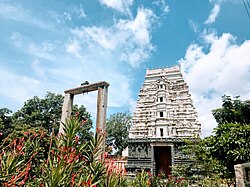
Tadipatri is a city in Anantapur district of the Indian state of Andhra Pradesh at the border of Nandyala district and Kadapa district. It is a Selection Grade Municipality City Council. Tadipatri is a headquarters of Tadipatri mandal in Anantapur revenue division.[2] The Chintala Venkataramana Temple is located on a five-acre site in Tadipatri. The Bugga Ramalingeswara Temple is located one kilometer from the city, overlooking the Penna River.[3]
Key Information

.svg)

Etymology
[edit]Tadipatri city’s name originated from Tallapalle. It was developed and renamed as Tadipatri by Pemmasani Ramalinga Nayudu I of the Pemmasani Nayaks, who made this city his seat of government and later developed as a major city in Anantapur district.[4]
Geography
[edit]Tadipatri is located at 14°55′N 78°01′E / 14.92°N 78.02°E.[5] Its average elevation is 223 metres or 731 feet. Tadipatri lies on the southern bank of Pennar River. Due to Mid Pennar Dam constructed upstream, the section of river in Tadipatri is usually dry throughout the year. Tadipatri is rich in cement grade limestone deposits. The limestone reserves are extending in a triangle from Tadipatri in Anantapur district to Kamalapuram in Kadapa district and Bethamcherla in Kurnool district.

The rocks in Tadipatri area are part of the Lower Cuddapah Supergroup. It consists of dolomite, limestone and shale.[6]
Demographics
[edit]As of 2011[update] Census of India, Tadpatri had a population of 108,171.[1]
Governance
[edit]Civic Administration
[edit]
Tadipatri municipality is the civic body of the city. It is a so-called first-grade municipality, constituted in 1920. It is spread over an area of 7.46 km2 (2.88 mi2) and has 36 election wards.[7]

The municipality of the city oversees the civic needs like, water supply, sewage, garbage collection etc. It also implements strict ban on the use of plastic.[8] In 2015, S.Shiva Ram Krishna was awarded Green Leaf Awards 2015 in the category of Best Municipal Commissioner, which was organised by Revanth Nagaruru.[9]
Population
[edit]As of the 2001 India census,[10] Tadipatri had a population of 86,641. Males constitute 51% of the population and females 49%. Tadipatri has an average literacy rate of 56%, lower than the national average of 59.5%: male literacy is 67%, and female literacy is 44%. In Tadipatri, 13% of the population is under 6 years of age.
Economy
[edit]Transport
[edit]


The Andhra Pradesh State Road Transport Corporation operates bus services from Tadipatri bus station.[12] State Highway 30 passes through Tadipatri, which connects Anantapur and Bugga.[13] Tadipatri railway station is classified as a C–category station in the Guntakal railway division of South Central Railway zone.[14]
Culture
[edit]Art and architecture

Some of the finest carvings of the early Vijayanagara period are from Tadipatri, a treasure-house of fine Vijayanagara sculpture.[15]
Education
[edit]The primary and secondary school education is imparted by government, aided and private schools, under the School Education Department of the state.[16][17] The medium of instruction followed by different schools are English, Telugu
Notable personalities
[edit]- Moola Narayana Swamy – He founded Vauhini Studios, which was a large cine studio during the 1940s.
See also
[edit]References
[edit]- ^ a b c "Municipalities, Municipal Corporations & UDAs" (PDF). Directorate of Town and Country Planning. Government of Andhra Pradesh. Archived from the original (PDF) on 7 June 2016. Retrieved 29 January 2016.
- ^ "Anantapur District Mandals" (PDF). Census of India. p. 378. Retrieved 6 June 2017.
- ^ "Anantapuramu". Archived from the original on 5 March 2017. Retrieved 13 June 2016.
- ^ Sriramamurty, Y. (1964), "History of the Pemmasani Family", Journal of the Andhra Historical Society, Volume 30, Parts 1-4, Andhra Historical Research Society, p. 92:
- ^ Falling Rain Genomics, Inc – Tadpatri
- ^ "Geological Excursion to Belum Caves & adjoining places, Kurnool District, Andhra Pradesh, India" (PDF). P.R.C Phani, Earth Science India. Andhra Pradesh, India. 1999.
- ^ "Municipalities, Municipal Corporations & UDAs" (PDF). Directorate of Town and Country Planning. Government of Andhra Pradesh. Archived from the original (PDF) on 8 August 2016. Retrieved 23 June 2016.
- ^ "Tadipatri sets a real example". The Hindu. Andhra Pradesh, India. 25 March 2006.
- ^ "TS and AP NGOs sweep Green Leaf awards". The Hans India. 8 June 2015. Retrieved 13 March 2016.
- ^ "Census of India 2001: Data from the 2001 Census, including cities, villages and towns (Provisional)". Census Commission of India. Archived from the original on 16 June 2004. Retrieved 1 November 2008.
- ^ Narasaiah, M. Lakshmi (1 January 1999). Growth And Performance Of Small Scale Industry. Discovery Publishing House. p. 50. ISBN 9788171414680.
- ^ "Bus Stations in Districts". Andhra Pradesh State Road Transport Corporation. Archived from the original on 22 March 2016. Retrieved 9 March 2016.
- ^ "Brief of Roads". Roads and Buildings Department. Government of Andhra Pradesh. Archived from the original on 10 March 2016. Retrieved 22 February 2016.
- ^ "Category of Stations over Guntakal Division". South Central Railway zone. Portal of Indian Railways. Archived from the original on 15 March 2016. Retrieved 22 February 2016.
- ^ "History and culture of the Andhras". Modali Nāgabhūṣaṇaśarma, Mudigonda Veerabhadra Sastry, Cīmakurti Śēṣagirirāvu, Telugu University (Hyderabad, India). Komarraju Venkata Lakshmana Rau Vijnana Sarvaswa Sakha. Andhra Pradesh, India. 1995. ISBN 9788186073070.
- ^ "School Education Department" (PDF). School Education Department, Government of Andhra Pradesh. Archived from the original (PDF) on 27 December 2015. Retrieved 7 November 2016.
- ^ "The Department of School Education - Official AP State Government Portal | AP State Portal". www.ap.gov.in. Archived from the original on 7 November 2016. Retrieved 7 November 2016.

Tadipatri
View on GrokipediaHistory and Etymology
Etymology
The name of Tadipatri traces its origins to the ancient settlement known as Tatipatri or Tallapalle, with local traditions linking it to episodes from the Ramayana epic. According to the Tadipatri Kaifiyat, a historical record, the name Tatipatri derives from the demoness Tataka (also spelled Tataki), who was slain by Lord Rama and his brother Lakshmana near the site of the present-day Chintala Venkataramana Swamy temple while they accompanied Sage Vishwamitra to protect his yajna. This event is said to have occurred in the vicinity, leading to the area's designation as Tatiparthi, meaning the place where Tataka fell or perished.[4] Over time, the name evolved gradually into its current form, Tadipatri, reflecting phonetic shifts in Telugu pronunciation. One folk etymology connects "Tadi" or "Tati" to the Telugu word for palm tree (tāṭi cheṭṭu, referring to the palmyra palm, Borassus flabellifer), suggesting the name may allude to the region's historical abundance of such trees, which were integral to local ecology and economy. The formal renaming and development of the town as Tadipatri occurred in the late 15th century under the Vijayanagara Empire, when Pemmasani Ramalinga Nayudu I, a prominent chieftain of the Pemmasani Nayaks and son of Timma Nayudu, transformed the village of Tallapalli into a fortified administrative center. Acting on imperial orders, Ramalinga Nayudu I changed the name to Tadiparti (later Tadipatri) and established it as his headquarters, marking the influence of regional Nayak rulers in shaping the town's identity. This transition is documented in archaeological inscriptions and historical surveys from the period.[5][6]Historical Development
Tadipatri emerged as a significant settlement during the Vijayanagara Empire in the 14th century, initially established as an agrahara under rulers Harihara and Bukka, with the first known settler Narayana Battu guided by Vidyaranya.[7] By the reign of Praudha Devaraya (1422–1446), it had developed into a regional capital governed by the Pemmasani Nayaks, a prominent Telugu warrior clan serving as generals and local chieftains; Pemmasani Timmanaidu was appointed governor, with his headquarters at nearby Yadiki.[7] In the 16th century, under Pemmasani Ramalinga Naidu—son of Timmanaidu—and his descendants, including sons Timma Nayudu (also known as Yera Timma Nayudu) and others, Tadipatri underwent substantial development as a fortified town.[7][1] Ramalinga Naidu initiated urban planning initiatives, constructing key religious structures like the Bugga Ramalingeswara Temple between 1490 and 1509, while his son Timma Nayudu built the Chintala Venkataramana Temple around 1551, incorporating advanced architectural elements such as mandapas, gopurams, and a now-closed secret passage linking to the Gooty fort for defensive purposes.[7][1] These efforts reflected the Pemmasani Nayaks' role in bolstering Vijayanagara's regional administration and military presence in Rayalaseema. Following the Vijayanagara Empire's decline after the Battle of Talikota in 1565, Tadipatri experienced instability under successive Deccan Sultanates and later Mysore rulers, including Hyder Ali and Tipu Sultan in the late 18th century, which led to damage and partial reconstructions of its structures.[1] The town was integrated into the British Madras Presidency as part of the Ceded Districts in 1800, following the Third Anglo-Mysore War, marking a shift toward colonial administration focused on revenue collection and local governance reforms.[8] In the early 20th century, Tadipatri was formally constituted as a first-grade municipality in 1920 under the Madras District Municipalities Act, enhancing local self-governance through elected bodies and expanded services like sanitation and infrastructure. Post-independence, the town grew as part of Andhra Pradesh, with a key milestone being the establishment of an industrial estate by the Andhra Pradesh Industrial Infrastructure Corporation (APIIC) in 1976 to promote manufacturing and economic diversification.[9]Geography and Climate
Location and Topography
Tadipatri is situated at coordinates 14°55′N 78°01′E in Anantapur district, Andhra Pradesh, India.[10] The town lies at an average elevation of 223 meters above sea level.[10] It occupies a municipal area of approximately 7.46 km².[11] The town is positioned on the southern bank of the Penna River, at the tri-junction of Anantapur, Nandyal, and YSR Kadapa districts.[10] This strategic location places Tadipatri within the Rayalaseema region, characterized by a semi-arid landscape featuring rocky hills and undulating terrain.[11] The area's topography includes eroded pediments and structural hills, typical of arid to semi-arid environments in the district.[12] Tadipatri's geology is notable for rich deposits of cement-grade limestone, which are part of the broader mineral resources in Anantapur district.[11] Surrounding the town are agricultural plains that benefit from irrigation drawn from the Penna River, supporting cultivation in the fluvial lowlands along the river course.[13]Climate
Tadipatri features a hot semi-arid climate, classified as BSh under the Köppen-Geiger system.[14] The annual mean temperature stands at 28.3°C, while average annual precipitation measures 691 mm, with the majority concentrated during the southwest monsoon period from June to September.[15] The summer season, spanning March to May, brings intense heat with daytime highs frequently reaching up to 40°C.[16] In contrast, the winter months from December to February offer milder conditions, with nighttime lows averaging around 16°C to 18°C.[17] The monsoon season accounts for approximately 70% of the yearly rainfall, delivering essential moisture to the region despite its overall aridity.[17] Tadipatri's climate is shaped by its position within the semi-arid upper basin of the Penna River, which experiences dry tropical monsoon conditions and contributes to moderated temperature variations through seasonal river flow.[18] However, the area remains prone to occasional droughts stemming from erratic and below-average rainfall patterns.[19] Recent climate trends indicate rising temperatures consistent with broader regional warming in India, particularly evident since the late 20th century.[20] Data from 2020 to 2025 reveal slight variability in precipitation, underscoring ongoing challenges from climate change in this drought-vulnerable district.[21]Demographics
Population Statistics
According to the 2011 Census of India, Tadipatri town had a total population of 108,171, with 54,015 males and 54,156 females.[22] The sex ratio stood at 1,002 females per 1,000 males, slightly above the state average for Andhra Pradesh.[22] The child population in the age group 0-6 years numbered 11,869, representing about 11% of the total population.[22] The decadal population growth rate for Tadipatri town between 2001 and 2011 was 24.9%, increasing from 86,641 in 2001 to 108,171 in 2011. Based on this trend and urban migration patterns, the population is projected to reach approximately 156,000 by 2025.[23] Within the municipal limits covering 7.46 square kilometers, the population density was 14,520 persons per square kilometer, reflecting a compact urban settlement.[24] Tadipatri is predominantly urban, with the town's population forming the core of the larger Tadpatri mandal, which had a total of 165,872 residents in 2011, of which about 65% were urban.[22] The literacy rate in Tadipatri town was 71.39% as per the 2011 Census, higher than the district average but indicative of gender disparities in education access.[23] Male literacy stood at 80.87%, while female literacy was 62.00%.[23] The following table summarizes key population metrics from the 2011 Census:| Metric | Value |
|---|---|
| Total Population | 108,171 |
| Males | 54,015 |
| Females | 54,156 |
| Sex Ratio (F/1000 M) | 1,002 |
| Child Population (0-6) | 11,869 |
| Literacy Rate (Overall) | 71.39% |
| Literacy Rate (Male) | 80.87% |
| Literacy Rate (Female) | 62.00% |
| Population Density | 14,520/km² |
Languages and Religion
Tadipatri's linguistic landscape is dominated by Telugu, the official language of Andhra Pradesh and the mother tongue of the vast majority of residents, reflecting the town's location in the Telugu-speaking Rayalaseema region.[25] Urdu serves as a significant minority language, primarily spoken within the Muslim communities that form a substantial portion of the urban population. English is widely used in educational institutions, government administration, and business, promoting bilingualism among the educated youth and professionals in this urban center.[26] According to the 2011 Census of India, Hinduism is the predominant religion in Tadipatri, practiced by approximately 72.20% of the city's population of 108,171 residents. Islam follows as the second-largest faith, with about 26.58% of the population identifying as Muslim, while smaller communities include Christians (around 0.8%) and negligible numbers of Jains and others. The Hindu majority is notably influenced by Vaishnava and Shaiva traditions, exemplified by prominent temples such as the Chintala Venkataramana Temple dedicated to Lord Vishnu and the Bugga Ramalingeswara Temple honoring Lord Shiva.[27][23] Tadipatri's cultural diversity stems from historical Muslim settlements dating back to the Vijayanagara Empire era (14th–16th centuries), when the region saw integration of Muslim traders, soldiers, and administrators into the multicultural fabric of the kingdom, contributing to enduring bilingualism in urban areas where Telugu-Urdu code-switching is common among Muslim households.[28]Government and Administration
Municipal Governance
Tadipatri Municipality is a Special Grade Municipality established in 1920, serving as the local civic body responsible for urban administration in the town.[29][30] It covers an area of 7.46 km² and is divided into 36 wards for electoral and administrative purposes.[29] The municipality's key functions include waste management through systems like the Online Waste Management System (OWMS), provision of drinking water supply across the town, and sanitation services encompassing solid waste handling and sanitary cleaning activities.[10] These operations aim to maintain public health and environmental standards in the urban area. The governing structure consists of an elected chairperson, deputy chairperson, and councilors representing the 36 wards, who oversee policy decisions and municipal operations. The current chairperson (as of 2025) is J.C. Prabhakar Reddy.[31][32] The annual budget, approved by the municipal council, is funded through revenue sources such as property taxes, other local levies, and government grants; for instance, the 2015-16 budget was set at ₹62 crore, while the 2017-18 budget reached ₹204 crore.[33][34] Notable initiatives include environmental and cleanliness efforts, highlighted by the Green Leaf Award 2015 bestowed upon Municipal Commissioner S. Shiva Ram Krishna for exemplary performance in municipal duties.[35][36] Civic projects focus on urban expansion, including development plans coordinated with the Andhra Pradesh Industrial Infrastructure Corporation (APIIC) to support industrial growth and infrastructure integration in the region.[37]Political Representation
Tadipatri is administratively part of Ananthapuramu district in Andhra Pradesh and serves as the headquarters of Tadipatri mandal within the Anantapur revenue division.[38] The town forms a key segment of the district's governance structure, contributing to regional administrative coordination across mandals.[39] The Tadipatri Assembly constituency, designated as number 151, is one of the 14 assembly segments in Ananthapuramu district and elects a representative to the Andhra Pradesh Legislative Assembly every five years. It is encompassed within the Anantapur Lok Sabha constituency, which covers seven assembly segments and sends a member to the national parliament.[40][41] Elections in the Tadipatri Assembly constituency have historically featured strong competition between major parties, with the Telugu Desam Party (TDP) securing notable victories. In 2014, TDP candidate J.C. Prabhakar Reddy won the seat, reflecting the party's influence in the region. The 2019 election saw a shift, with Indian National Congress candidate J.C. Diwakar Reddy emerging victorious. However, TDP reclaimed the constituency in 2024, where J.C. Ashmit Reddy defeated YSR Congress Party (YSRCP) candidate Kethireddy Pedda Reddy by a margin of over 20,000 votes, polling 113,755 votes.[42][43][41] As of 2025, J.C. Ashmit Reddy remains the sitting MLA, continuing TDP's representation at the state level.[44] Political discourse in Tadipatri often centers on industrial expansion, given the town's cement and mineral-based economy, alongside challenges in water resource management from the nearby Penna River and balancing rural-urban development needs. These issues influence campaign platforms, with candidates addressing infrastructure gaps and resource allocation to support both agricultural hinterlands and growing urban industries. Local elections have also highlighted tensions tied to municipal leadership, though broader state politics dominate assembly contests.[45] Tadipatri's position at the junction of Ananthapuramu, Nandyal (Kurnool), and YSR Kadapa districts underscores its regional significance, shaping cross-district policies on trade, minerals, and connectivity.[10]Economy
Agriculture
Tadipatri's agricultural landscape is characterized by rainfed farming supplemented by irrigation from the Penna River and its canal networks, including the Gonchi Irrigation System, which supports cultivation across the mandal. The primary crops include groundnut as the dominant oilseed, alongside sunflower, cotton, and paddy, reflecting the region's semi-arid conditions and soil types predominantly red loamy. These crops are integral to local food security and economic sustenance, with groundnut occupying the largest share of cultivated area.[46][47][48][49] Cropping follows distinct seasonal patterns, with kharif crops like groundnut, cotton, and paddy sown during the monsoon (June to September) relying on rainfall, while rabi crops such as gram and limited sunflower are grown in the winter (October to March) under residual moisture or irrigation. This dual-season approach maximizes land use in the 10.15 lakh hectares of cultivable area in Anantapur district, of which Tadipatri contributes significantly. The sector employs around 45% of the local workforce, underscoring its role as the economic backbone for rural households.[48][50][51] Annual agricultural output, particularly groundnut, is highly sensitive to monsoon variability, with district-level production reaching approximately 298,000 tons in recent years, though Tadipatri's share varies with weather patterns. The mandal's drought-prone status, marked by low annual rainfall averaging 500-600 mm, poses persistent challenges, leading to crop failures in dry years.[52][46] To mitigate water scarcity, government initiatives like the Pradhan Mantri Krishi Sinchayee Yojana and Andhra Pradesh Micro Irrigation Project have promoted drip irrigation adoption since the 2010s, subsidizing systems for small and marginal farmers and covering over 20,000 hectares in community projects. These schemes enhance water efficiency, boosting yields for water-intensive crops like paddy and cotton in irrigated pockets along the Penna River.[13][53][54]Industry and Trade
Tadipatri's industrial landscape is dominated by the cement sector, leveraging abundant local limestone deposits in areas such as Tadipatri and Rayalacheruvu. Ambuja Cements' (formerly Penna Cement Industries) facility in Talaricheruvu village, Tadipatri mandal, was established in 1994 with an initial capacity of 0.2 million tonnes per annum and has since expanded; the company was acquired by Ambuja Cements in June 2024, integrating into a group capacity of 14 million tonnes per annum.[11][55][56] In 2024, UltraTech Cement commissioned an additional 3.35 million tonnes per annum clinker line and 1.8 million tonnes grinding capacity at its Tadipatri unit, enhancing output and contributing to the area's industrial scale.[57] These operations provide direct and indirect employment to approximately 20,000 people in Tadipatri.[10] The town hosts a network of micro and small enterprises, including around 288 micro-units that generate direct employment for about 600 individuals, focusing on light manufacturing and processing activities.[58] Established under the Andhra Pradesh Industrial Infrastructure Corporation (APIIC), these units form part of broader efforts to foster non-agricultural economic activity since the 1970s. The sector has seen growth following India's economic liberalization in the 1990s and 2000s, with cement production expanding to meet national demand and ancillary industries developing in response.[11] Trade in Tadipatri centers on gold jewelry, supported by numerous local showrooms and wholesalers, alongside markets for textiles and processed agricultural products. The gold sector benefits from regional demand in Rayalaseema, with firms like Rayalaseema Bullion and Commtrade facilitating commerce in precious metals.[59][60] Granite processing also plays a role, employing around 25,000 people as of early 2025, though the industry faces challenges from rising costs.[61] Recent developments include renewable energy projects, such as a 9.375 MW captive solar installation commissioned in 2021, signaling diversification into sustainable engineering applications.[62]Infrastructure and Transport
Road and Rail Connectivity
Tadipatri is well-connected by road networks, primarily through State Highway 30 (SH-30), which runs from Anantapur in the west to Bugga in the east, passing directly through the town and facilitating links to nearby districts including Y.S.R. Kadapa.[63] This highway supports efficient intra-district travel and connects to broader regional routes. Additionally, National Highway 67 (NH-67) traverses Tadipatri, providing access to major corridors toward southern Andhra Pradesh and enhancing overall road infrastructure.[64] The Andhra Pradesh State Road Transport Corporation (APSRTC) operates a central bus station in Tadipatri, offering regular intra-state services to destinations within Anantapur district and inter-district routes to cities such as Vijayawada, Guntur, and Ongole.[65] These services include both ordinary and express buses, catering to daily commuters, traders, and long-distance travelers, with frequent departures that integrate with the state's extensive public transport network.[66] Rail connectivity is provided by Tadipatri railway station (TU), classified as an NSG-5 station under the South Central Railway zone in the Guntakal division, located on the Guntakal-Gooty Junction line.[67] The station handles multiple daily trains, including the Rayalaseema SF Express (12793) to Hyderabad and the Chennai Express (22159) to Chennai, as well as services like the Prashanti Express (18463) toward Bangalore, ensuring reliable passenger and freight movement.[68][69] This road and rail infrastructure significantly boosts Tadipatri's role in regional trade, particularly by linking to Krishnapatnam Port approximately 280 km away via NH-67, which streamlines the transport of agricultural and industrial goods to export facilities.[70][71] Ongoing developments include the four-laning of the Tadipatri Bypass (0-6.285 km) on NH-67, awarded under the Annual Plan 2022-23 on an EPC basis, aimed at reducing congestion and improving traffic flow as part of Andhra Pradesh's broader 2020-2025 infrastructure initiatives.[72] These upgrades, supported by state and national funding, are expected to enhance connectivity and support economic growth in the region.[73]Public Utilities
Tadipatri's water supply is primarily managed by the local municipality, which delivered approximately 16.2 million liters per day (MLD) across three zones connected to two intake wells as of 2022.[74] The primary source is the Penna River, from which the town draws about 3.80 MLD under a regional scheme providing 12.40 MLD total.[75] To enhance reliability and quality, a comprehensive water supply improvement project was sanctioned in 2018 under the Atal Mission for Rejuvenation and Urban Transformation (AMRUT) scheme, with a budget of Rs. 145 crores, targeting completion by 2019 and including purification infrastructure; however, the project remains ongoing as of 2025, with construction on the filtration plant instructed to begin following inspections in October 2025.[76][77][78] Electricity distribution in Tadipatri falls under the jurisdiction of the Andhra Pradesh Southern Power Distribution Company Limited (APSPDCL), which operates dedicated sections in the town to ensure supply to residential, industrial, and agricultural consumers.[79][80] The company maintains operational divisions, including AE/D-I and AE/D-II for urban areas and AE/Rurals for surrounding regions, supporting consistent power delivery amid the town's industrial growth.[80] Sanitation services in Tadipatri are overseen by the municipality as part of the Swachh Bharat Mission, with the town achieving Open Defecation Free (ODF) status in 2016 following verification by the Quality Council of India.[81] By 2024, Tadipatri advanced to ODF+ certification, indicating sustained ODF maintenance alongside improved solid and liquid waste management systems.[82] Ongoing challenges include resource strain from urban expansion and industrial demands, prompting continued investments in utility upgrades, such as treated wastewater reuse plans for local industries like the Arjas Steel plant (formerly Gerdau Steel), which anticipates 3.5 MLD from municipal sewage treatment.[83][84]Culture and Heritage
Religious Sites
Tadipatri is renowned for its cluster of Vijayanagara-era temples, which exemplify the region's rich Hindu architectural heritage and spiritual legacy. These sites, primarily dedicated to Vishnu and Shiva, feature intricate granite carvings and innovative structural elements that highlight the artistic prowess of the period. Protected by the Archaeological Survey of India (ASI), they draw tourists and pilgrims, contributing to the local economy through heritage tourism initiatives.[85] The Chintala Venkataramana Temple, a prominent Vaishnavite shrine in the town center, was constructed around 1510–1525 CE during the reign of Krishnadevaraya by Thimmanayudu (also known as Chinna Thimmanayudu), son of Pemmasani Ramalinga Naidu, a chieftain of the Vijayanagara Empire.[4] This 16th-century structure adheres to Dravidian architectural principles, measuring 225 feet in length and 135 feet in width, with 189 intricately carved granite pillars supporting its expansive halls.[4] The temple's facade boasts a towering 38-foot gopuram adorned with detailed sculptures depicting scenes from the Ramayana, alongside motifs of Hindu deities and mythological narratives, showcasing the Vijayanagara style's emphasis on narrative reliefs.[86] Key features include a unique Garuda Mandapam—a chariot-shaped hall established in 1520 CE—and subsidiary shrines dedicated to various divinities, underscoring its role as a major center for Venkateswara worship.[86] As an ASI-protected monument of national importance, it preserves elements like protective grills and lances added by the Central Archaeological Department to safeguard its sculptures.[85] Nearby, the Bugga Ramalingeswara Swamy Temple, located on the southern banks of the Penna River, was built in the late 15th century (circa 1490–1509 CE) by Pemmasani Ramalinga Naidu I during the Saluva dynasty of the Vijayanagara Empire.[87] Named after the perennial spring ("bugga" in Telugu) that flows continuously from beneath the central Shiva lingam, the temple integrates natural water elements into its Shaiva iconography, with the lingam enshrined in a sanctum where water emerges year-round.[4] Its architecture features towering gopurams, robust granite sculptures of Ugra Murthy (fierce Shiva forms), and warrior motifs that reflect the martial ethos of the era, all crafted in the Vijayanagara sculptural tradition praised by 19th-century historian James Ferguson for its maturity.[4] The site's historical inscriptions trace the Pemmasani family's rise under Praudha Devaraya (1422–1446 CE), providing early evidence of local patronage for temple construction.[7] Also designated an ASI-protected monument, it attracts visitors for its blend of hydrology and devotion, symbolizing eternal renewal in Shaivism.[85] Among other notable sites, the Aswatthanarayana Swamy Temple, situated about 16 km from Tadipatri in Chinna Pappuru village, dates to the 14th century and is associated with the Vijayanagara chieftain Errama Thimmaraju.[4] Dedicated to a form of Vishnu linked to serpent worship (naga dosha nivarana), it houses ancient stone idols of Aswatthanarayana Swamy and Shingarabhattu Munishwari, rooted in legends of sage Uttama's penance where Vishnu granted darshan. Its annual Aswattha Tirunala Brahmotsavam, observed on the third Saturday after Maghamasam midnight, emphasizes ritualistic elements for protection against serpentine afflictions.[4] The temple's modest yet evocative architecture makes it a specialized site for such devotional practices within the broader Vaishnavite tradition.Festivals and Traditions
Tadipatri's festivals and traditions reflect its rich religious heritage, influenced by both Vaishnava and Shaiva sects, as seen in its prominent temples dedicated to Lord Vishnu at Chintala Venkataramana Swamy and Lord Shiva at Bugga Ramalingeswara Swamy.[4] The annual Brahmotsavam at Chintala Venkataramana Swamy Temple is a major highlight, typically observed in September or October with elaborate rituals, processions, and gatherings of devotees that showcase the temple's Vijayanagara-era grandeur.[86] This nine-day event, starting from Aswayuja Suddha Ashtami, includes daily ceremonies following Pancharatra Agama traditions and culminates in vibrant celebrations.[88] At Bugga Ramalingeswara Swamy Temple, Maha Shivaratri in February or March draws large crowds for the Rathotsava, a spectacular chariot procession around the temple premises, emphasizing Shaiva devotion and the site's unique hot spring.[89] The festival features early morning abhishekam rituals and community participation, underscoring local customs tied to the swayambhu linga.[90] Ganesh Chaturthi is enthusiastically observed in Tadipatri, with youth unions organizing immersions and celebrations, as part of broader preparations across Anantapur district to ensure smooth festivities.[91] Sankranti involves traditional rituals like kite-flying and harvest prayers, blending agricultural customs with temple visits in the Rayalaseema style.[92] Dasara festivities incorporate community processions unique to Rayalaseema's cultural landscape, where Tadipatri residents participate in goddess idol immersions and cultural displays during Navratri.[93] These events foster interfaith harmony in the predominantly Hindu town, with modern adaptations including eco-conscious practices in immersions since the early 2020s, aligned with national guidelines.[94] Diwali markets thrive due to Tadipatri's established gold trade, where locals purchase jewellery as part of prosperity rituals, contributing to the festival's economic vibrancy.[95] Kartik Poornima includes bathing rituals at the Bugga spring, drawing pilgrims for purification in the temple's sacred waters.[96]Education
Primary and Secondary Education
Tadipatri's primary and secondary education system comprises approximately 27 government and aided schools within the urban cluster, serving students from grades 1 to 10. These institutions, managed by the Andhra Pradesh School Education Department, focus on foundational learning and are supplemented by private schools such as Sri Sai Vijetha High School, Kids Cave International School, and Pragathi High School, which offer similar grade levels with additional extracurricular options.[97][98] Enrollment in these schools spans grades 1 through 12, with instruction provided in both Telugu and English mediums to accommodate local and broader linguistic needs. Government and aided schools promote literacy and attendance through the national midday meal scheme, which provides nutritious meals to students, and state scholarships under the Jnanabhumi portal for economically disadvantaged families. Key facilities include the Government High School and municipal schools, where curricula emphasize science, technology, engineering, and mathematics (STEM) subjects. Gender parity efforts, aligned with the Right to Education Act of 2009 and subsequent state programs, have aimed to reduce disparities since 2010, contributing to Tadipatri's overall literacy rate of 71.39% as per the 2011 census, though female literacy at 62% lags behind male at 80.87%.[27] Challenges persist in extending educational outreach to rural areas surrounding Tadipatri, where lower district-level literacy in Anantapur (63.57%) highlights gaps in access compared to the urban core.[99]Higher Education
Higher education in Tadipatri primarily revolves around a few key institutions offering undergraduate and postgraduate programs in arts, commerce, sciences, and engineering, catering to the local population and surrounding rural areas. The Government Degree College, established in 1978, serves as a foundational institution, initially providing Bachelor of Arts (BA) and Bachelor of Commerce (BCom) degrees under the affiliation of Sri Krishnadevaraya University, Anantapur.[100] Over the years, it has expanded to include programs in sciences and other disciplines, emphasizing accessible education for students from agricultural backgrounds.[100] Technical education has seen significant growth since the late 2000s, with the establishment of specialized engineering colleges affiliated to Jawaharlal Nehru Technological University Anantapur (JNTUA). The Sir C.V. Raman Institute of Technology and Sciences, founded in 2009, offers B.Tech degrees in fields such as civil engineering, computer science, electronics, and mechanical engineering, focusing on practical skills relevant to regional industries.[101] Similarly, Tadipatri Engineering College, established in 2010, provides B.Tech, M.Tech, and diploma courses in engineering specializations like electrical and electronics engineering, with an emphasis on innovation and employability.[102] These institutions have contributed to the post-2010 expansion of technical education in Tadipatri, increasing access to professional training amid the town's economic shift toward manufacturing and agriculture-related technologies.[103] In the realm of teacher education, the Deekshitha Educational Development Society operates institutions such as Deekshitha B.Ed College and D.El.Ed College, offering Bachelor of Education (B.Ed) and Diploma in Elementary Education (D.El.Ed) programs with an intake of approximately 100 seats per course.[104] These programs align with state needs for qualified educators, incorporating sciences and arts components. Accessibility is enhanced by affiliations to state universities, ensuring standardized curricula and degree recognition. Local students benefit from Andhra Pradesh government scholarships, such as the Jagananna Vidya Deevena scheme, which provides full fee reimbursement for eligible economically weaker sections pursuing higher education, with applications processed through the Jnanabhumi portal.[105]Notable Individuals
Tadipatri has produced several notable figures in the fields of cinema, theatre, and film production.- K. V. Reddy (1 July 1912 – 15 July 1974) was a pioneering Telugu film director, producer, and screenwriter. Born in Tadipatri, he is renowned for directing classics such as Mayabazar (1957), Patala Bhairavi (1951), and Jagadeka Veeruni Katha (1961), which are considered landmarks in Indian cinema.[106]
- Bellary Raghava (born Tadipatri Raghavacharyulu; 2 August 1880 – 16 April 1946) was an influential Indian playwright, thespian, actor, and lawyer. His works in Telugu theatre were acclaimed by figures like Rabindranath Tagore and George Bernard Shaw, and he contributed to early Telugu films while advocating for social reforms.[107]
- Moola Narayana Swamy (c. 1912 – 20 August 1950) was an Indian film producer whose native place was Tadipatri. He founded Vauhini Studios in 1940, which became one of India's largest film production centers during the 1940s, producing numerous Telugu films.[108]