Hubbry Logo
Tampa 2Tampa 2Main
Open search
Tampa 2
Community hub
Tampa 2
logo
8 pages, 0 posts
0 subscribers
Be the first to start a discussion here.
Tampa 2
Tampa 2
from Wikipedia

The Tampa 2 is an American football defensive scheme popularized by (and thus named after) the Tampa Bay Buccaneers of the National Football League (NFL) in the mid-1990s–early 2000s. The Tampa 2 is typically employed out of a 4–3 defensive alignment, which consists of four linemen, three linebackers, two cornerbacks, and two safeties. The defense is similar to a Cover 2 defense, except the middle linebacker drops into a deep middle coverage for a Cover 3 when he reads a pass play.[1]

The term rose to popularity due to the installation and effective execution of this defensive scheme by then-head coach Tony Dungy and defensive coordinator Monte Kiffin, and the style helped the Buccaneers win Super Bowl XXXVII.

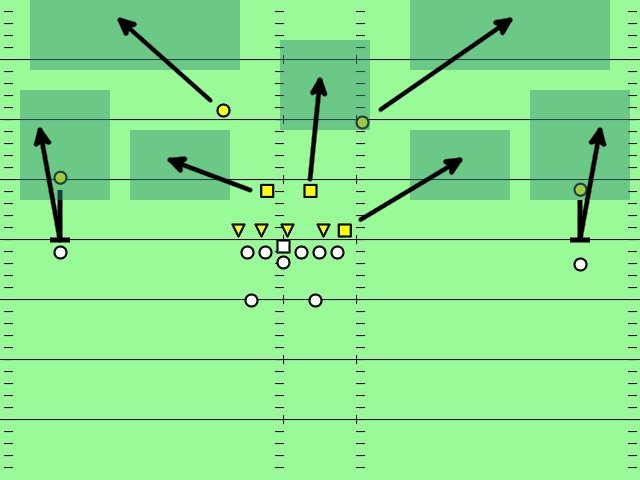
4–3 defense in a Tampa "Under" front, with back 7 falling into Tampa 2 zone coverage. Cornerbacks jam receivers before falling back into their zones. Middle linebacker ensures the deep middle is covered.

Despite being identified with Dungy and the Buccaneers, the roots of the Tampa 2 actually come from the Pittsburgh Steelers and their Steel Curtain defense of the 1970s.[2] Dungy openly admitted that it was based on concepts he'd picked up in Pittsburgh, where he'd played as a safety from 1977 to 1978. "My philosophy is really out of the 1975 Pittsburgh Steelers playbook," said Dungy during media interviews while at Super Bowl XLI. "That is why I have to laugh when I hear 'Tampa 2'. Chuck Noll and Bud Carson—that is where it came from, I changed very little."[3] Lovie Smith mentions having played the system in junior high school during the 1970s, though Carson introduced the idea of moving the middle linebacker into coverage. Carson's system became especially effective with the Steelers' addition of aggressive and athletic middle linebacker Jack Lambert.[2][4]

After Dungy became head coach of the Indianapolis Colts and Smith (linebackers coach in Tampa from 1996 to 2000) became head coach of the Chicago Bears, they installed the Tampa 2 in their respective teams. During the 2005 NFL season, the Buccaneers, still under defensive coordinator Kiffin, ranked first in the league in fewest total yards allowed, Smith's Bears ranked number two, and Dungy's Colts ranked eleventh.[5] By 2006, the Buffalo Bills, Minnesota Vikings, Kansas City Chiefs, and Detroit Lions had also adopted the defense. In college football, Gene Chizik is among the coaches that successfully implemented the Tampa 2.

The scheme is known for its simple format, speed, and the aggressive mentality of its players. Tampa 2 teams are known as gang tacklers with tremendous team speed, and practice to always run to the ball. It also requires a hard hitting secondary to cause turnovers.[citation needed]

Description

[edit]

Typically, the [Tampa 2] players don't have the prototypical size of other NFL defenders. Instead, stress is put on speed, smarts and flawless tackling. [...] A quick defensive line is a must, but the middle linebacker position is the straw that stirs the drink.

— Bryan Mullen, The Tennessean[6]

The personnel used in the Tampa 2 are specific in position and required abilities. All positions in this defense place a premium on speed, and often the result is that they are all undersized by league standards. The defensive linemen in this scheme have to be quick and agile enough to create pressure on the quarterback without the aid of a blitz from either the linebackers or the secondary, with the defensive tackle in the nose position having above-average tackling skills to help stop runs. Warren Sapp is often cited as the primary example of a defensive lineman who flourished in this scheme due to his devastating combination of size and speed; he is now considered the prototypical three-technique defensive tackle.[7]

The three linebackers, two cornerbacks and two safeties are responsible for covering the middle of the field. The outside linebackers' general zone is between the cornerbacks, covering the area of the field from the line of scrimmage to 10 yards back. The middle linebacker must have better-than-average speed, and additional skills to be able to read the play and either maintain his central position to help the outside linebackers cover short passes, drop behind the linebackers in coverage and protect the zone of the field behind the outside linebackers from 11 to 20 yards out, or run up to the line of scrimmage to help assist in stopping the runs. "It takes a special linebacker to do that, a guy with speed," wrote Pete Prisco, senior NFL writer for CBSSports.com.[6] The cornerbacks protect the sidelines of the field from the line of scrimmage to anywhere between 15 and 20 yards out. According to Prisco, they "don't have to be great man-to-man cover players, but they have to be guys who can tackle".[6] Dungy always expected his linebackers and cornerbacks to be above-average tacklers, since they are usually the primary tacklers in the defense.

The two safeties are responsible for covering their respective halves of the field from 20 yards out and more. The safeties in the system are expected to be above-average cover men with the ability to break up passes, but each safety also is expected to have additional specific skills. The strong safeties, while not expected to be great tacklers, are expected to be hard hitters. The hard hitting strong safety protects the middle of the field from being exploited by small, fast receivers, and running backs on wheel route. The free safety will be called upon to do one of two things in certain situations: either blitz the quarterback, requiring him to have the skills necessary to beat a blocking halfback or fullback, or to assume the coverage zone left by a blitzing cornerback.

The Tampa 2 is particularly effective against teams who are playing from behind, because it limits big plays. It forces offenses to be patient and to settle for short gains and time-consuming drives.[4] This may be due to the nature of the "bend-but-don't-break" 2-deep zone coverage scheme and responsibilities safeties play in the Tampa 2.

When executed properly, the Tampa 2 defense is difficult to beat, a reason for its longevity, having seen no fundamental changes since first introduced in 1996. Teams that have been successful against this defense have managed to run the ball up the middle past the defensive tackles, or throw passes in the seams between the outside linebackers and the cornerbacks (often the most effective receiver against a Tampa 2 defense is a tight end, since they often line up against this seam).

Other tactics that have shown to be effective on occasion are misdirection plays that take advantage of the defensive speed and rely on the defense 'over-running' the play (such as the middle linebacker rushing to the line of scrimmage on a play-action pass), or overloading the safeties by having multiple receivers running deep routes, creating more targets in a zone than defenders. Recently, some teams have also been able to exploit the seam between the cornerbacks and the safeties, when the quarterback can throw a pass to a receiver in that seam faster than the safety can rush up to close it and cover the receiver. A recent trend is for teams to send a receiver up the middle, creating a mismatch against the linebacker in coverage. The popularity of the Tampa 2 means that offenses are now finding it effective to exploit the deep middle, where the safeties have to cover the most ground.[8]

Run defense

[edit]

To defend running plays, the Tampa 2 is a single gap defense where each player is responsible for covering his own gap. The assigned gap changes with game conditions and personnel.

Typically this style of defense utilizes smaller but faster linemen and linebackers with above average speed. Also, the defensive backs must be above average hitters.

The key theme in stopping the run is directing traffic to the weak-side linebacker. It is therefore necessary to have a skilled tackler at the WLB position (e.g., Derrick Brooks, Lance Briggs, Sean Lee, Shaquille Leonard).

References

[edit]
[edit]
Revisions and contributorsEdit on WikipediaRead on Wikipedia
from Grokipedia
The Tampa 2 defense is a zone coverage scheme in , derived from the Cover 2 system, where two safeties each cover one half of the deep field, the middle linebacker drops into a deep middle zone to protect the "seam" between the safeties, and the remaining defenders handle underneath zones with a standard four-man , typically deployed from a 4-3 base alignment emphasizing speed and discipline over size. Developed in the 1970s under Pittsburgh Steelers head coach Chuck Noll and defensive coordinator Bud Carson as a foundational Cover 2 concept, the scheme was refined in the 1980s and 1990s by Tony Dungy—then a defensive coordinator with the Minnesota Vikings—and Monte Kiffin, who adapted it to counter the short-passing West Coast offense by requiring athletic middle linebackers to cover deep routes. Dungy brought the system to the Tampa Bay Buccaneers as head coach in 1996, with Kiffin as defensive coordinator, where it became known as the "Tampa 2" due to its prominent use and tweaks, such as funneling plays toward the middle linebacker while prioritizing edge containment and run support from the defensive line. The defense achieved its greatest success with the Buccaneers from 1997 to 2002, powering a perennial NFC contender that ranked among the NFL's top units in points allowed, culminating in a Super Bowl XXXVII victory after the 2002 season, led by Hall of Famers like Derrick Brooks, Warren Sapp, and John Lynch who exemplified the scheme's demands for versatile, quick athletes. Dungy later exported the Tampa 2 to the Indianapolis Colts, where it contributed to their Super Bowl XLI triumph in 2006, influencing other teams like the Chicago Bears under Lovie Smith and the Minnesota Vikings. By the 2010s, however, the scheme's predictability and vulnerabilities to modern spread offenses and rule changes favoring passers led to its decline as a base defense, though elements persist in hybrid coverages across the league.

Origins and Development

Creation Under Tony Dungy

began his NFL coaching career with the in 1981 as defensive backs coach, following a playing stint as a for the team from 1977 to 1979. During this period, he worked under defensive coordinator , the architect of the defense that pioneered the Cover 2 zone scheme in 1973, emphasizing two deep to cover the entire width of the field while linebackers handled underneath zones. Dungy's exposure to Carson's innovative approach, which relied on disciplined zone coverage and reads to generate turnovers, profoundly shaped his defensive philosophy, as evidenced by the Steelers' league-leading totals in the mid-1970s. Promoted to the NFL's youngest in 1984 at age 28, Dungy served in that role with the Steelers through 1988, where he refined Cover 2 principles into a more versatile hybrid . Drawing from Carson's foundations, Dungy adapted college-inspired elements of split-safety coverage to address evolving passing attacks, focusing on underneath control to disrupt short routes and force quarterbacks into predictable decisions. This mid-1980s conceptualization emphasized athletic linebackers who could read plays quickly, building on the Steel Curtain's success in generating interceptions— ranked second in the league with 31 picks in 1984 under Dungy's coordination. A pivotal innovation in Dungy's scheme was dropping the middle linebacker deep into coverage to create a five-deep zone, effectively extending the safeties' protection against seam routes while maintaining pressure up front. Dungy implemented the full hybrid version as for the Minnesota Vikings starting in 1992, where it contributed to top-ranked defenses, including allowing the fewest points in the in 1992. This foundational Tampa 2 concept, refined further upon Dungy's arrival in Tampa Bay in 1996, marked a significant evolution from traditional Cover 2 by integrating disciplined underneath coverage with deep linebacker support.

Implementation by the Tampa Bay Buccaneers

Tony Dungy was hired as head coach of the Tampa Bay Buccaneers on January 23, 1996, bringing defensive concepts he had refined during his time as defensive coordinator with the Minnesota Vikings. Working closely with newly appointed defensive coordinator Monte Kiffin, Dungy adapted the Cover 2 scheme into what became known as the Tampa 2, with Kiffin diagramming the alignments and responsibilities to leverage the speed of NFL athletes against the West Coast offense. This collaboration emphasized quick reads, disciplined zone drops, and an aggressive front to disrupt passing attacks. The Tampa 2 was deployed as ' base defense for the full 1996 season, marking its first widespread use in Tampa. The scheme contributed to an immediate defensive turnaround, with the team allowing 18.3 —down from 20.9 in 1995—ranking eighth in the for scoring defense. This improvement stemmed from the system's ability to contain short passes and force turnovers, as intercepted 24 passes that year, tying for second in the league. Central to the successful rollout were standout players who fit the scheme's demands for athleticism and range. Linebacker , drafted in 1995, served as the deep-dropping middle linebacker, using his speed to cover the seam and intercept passes in the deep middle, exemplified by his ability to patrol the critical underneath and intermediate zones. Safeties John Lynch and Damien Robinson anchored the secondary, with Lynch's sure tackling and range handling one deep half while Robinson provided complementary coverage on the opposite side, enabling the zone's integrity against vertical threats. In the late , the Tampa 2 evolved further under Dungy and Kiffin, incorporating adjustments to maximize the disruptive impact of Warren . Drafted in 1995, Sapp's quickness off the line created interior pressure that collapsed pockets and complemented the coverage shells, allowing linebackers more time to drop into zones; by 1999, this synergy helped the defense rank third in the NFL in total yards allowed. These tweaks shifted emphasis toward a more violent front seven, enhancing run stops and pass deflections without altering the core zone principles.

Core Mechanics

Base Personnel and Alignment

The Tampa 2 defense employs a standard 4-3 base personnel package, consisting of four defensive linemen (two defensive tackles and two defensive ends), three linebackers (one middle linebacker and two outside linebackers), and four defensive backs (two cornerbacks and two safeties). In pre-snap alignment, the defensive tackles are positioned as undersized penetrators, typically around pounds, to disrupt gaps rather than absorb blocks, with one aligning in a 0- to 3-technique over the center or guard and the other in a 3-technique on the outside shoulder of the guard. The defensive ends line up in a 5-technique on the outside shoulder of the offensive tackle or a 7-technique against a , emphasizing edge containment and rush opportunities while maintaining run responsibilities. The middle linebacker aligns 4 to 5 yards off the , prepared for versatile drops, while the outside linebackers position closer to the line for edge support. Cornerbacks align over wide receivers, and safeties position 12 to 15 yards deep, split wide to oversee each half of the field. This setup reflects the philosophy pioneered by and , favoring lighter, quicker players across the front seven for speed and gap penetration over traditional size to control both run and pass plays efficiently. Unlike subpackage defenses, the base Tampa 2 avoids nickel or dime personnel, relying on the core 4-3 alignment to maintain balance without additional defensive backs.

Coverage and Zone Responsibilities

The Tampa 2 defense fundamentally relies on a Cover 2 zone coverage structure, in which the two safeties position themselves to cover the deep halves of the field post-snap. Each safety is responsible for approximately 15-20 yards of depth, extending from the outside hash mark to the sideline, providing over-the-top protection against deep threats while allowing the front seven to focus on underneath routes and run support. This alignment, enabled by the pre-snap positioning of the safeties wider and deeper than in man coverage schemes, creates a balanced deep shell that limits big plays down the sidelines. Complementing the safeties, the middle linebacker (MLB) drops into the deep middle of the field, covering the hook/curl zone at about 10-15 yards deep to form a hybrid three-deep coverage in the central area. This assignment requires the MLB to read the quarterback's eyes and route combinations, walling off crossers and intermediate threats while the safeties handle the outer thirds. Meanwhile, the underneath zones are divided among the outside linebackers and cornerbacks, who cover the flats and seams typically within 5-10 yards of the ; the strong-side linebacker (Sam) often takes the flat near the , the weak-side linebacker (Will) handles the opposite flat, and the cornerbacks sink to the short seams adjacent to their side of the field. A key element of the scheme's pass defense is its approach to seam stress, where cornerbacks engage in pattern-matching on short routes—reading the number-one receiver and funneling vertical threats inside—while the safeties maintain responsibility for preventing deep posts and go routes without relying on man coverage. This pure zone philosophy emphasizes discipline and communication, as players must sort routes within their assigned areas rather than following individual receivers. To counter hot reads by the , such as quick or hitches, the safeties may rotate post-snap into a coverage adjustment, dividing the deep field into four zones, though the base commitment remains to the straightforward Cover 2 zone drops.

Defensive Strategies

Run Defense Tactics

The Tampa 2 scheme employs a disciplined approach to run defense, leveraging the front four to control interior gaps and funnel ball carriers toward pursuing linebackers. Defensive tackles operate primarily in a two-gap technique, where each DT is responsible for controlling the two gaps adjacent to their alignment—typically the A and B gaps for the nose tackle and B and C gaps for the three-technique tackle—by engaging blockers head-on and reading the play direction to clog the most immediate threat. This forces runs to bounce outside, where the defensive ends, aligned in a five-technique over the offensive tackles, slant inward to disrupt the backfield and collapse the point of attack, preventing easy cutbacks. Linebackers in the Tampa 2 maintain disciplined flow to support the front line's gap integrity. The middle linebacker (MLB) reads the guards' movement post-snap, filling the A or B gaps as needed to plug interior lanes while avoiding over-pursuit that could expose cutback opportunities. Outside linebackers (OLBs), positioned on the edges, pursue the ball carrier laterally from their C-gap responsibilities, scraping across the formation to contain the edges without vacating their zones prematurely, ensuring the run is met by multiple defenders. The secondary provides deep run support to maintain overall defensive structure, with cornerbacks funneling runners inward by jamming receivers at the line and forcing plays back toward the middle. Safeties, while primarily responsible for deep coverage, rotate forward as the last line of support to tackle ball carriers attempting cutbacks, preserving the integrity of the zone drops even against the run. This layered approach contributed to the scheme's effectiveness, as evidenced by the 1999 allowing just 1,407 total opponent rushing yards over 16 games, averaging 88 yards per game and ranking fifth in the .

Pass Rush and Blitz Integration

The Tampa 2 defense emphasizes a disciplined base four-man from the front seven, relying on the defensive line to generate pressure without overcommitting additional rushers. Defensive tackles, such as playing in a 3-technique alignment, frequently employed stunts, loops, and twists to disrupt interior offensive linemen and create lanes for the defensive ends to attack the edges. This approach allowed the defensive ends to exploit one-on-one matchups, focusing on speed and rather than consistent interior penetration. To maintain coverage integrity, blitzes were employed sparingly in situational contexts, typically comprising only 10-15% of defensive snaps under Tony Dungy's philosophy. These included targeted "" packages, such as Fire X or Fire Z, where a or would blitz from the perimeter while the secondary adjusted to preserve underneath zones. This selective aggression avoided exposing the backend to big plays, prioritizing the scheme's zone-based structure. The overall pressure philosophy aimed to collapse the within 2.5 to 3 seconds, forcing quarterbacks into hurried decisions while the underneath zones funneled short throws into tackling opportunities. This timing was critical to complement the coverage, disrupting rhythm passing without necessitating frequent blitzes. In 1999, the exemplified this efficiency, recording 43 sacks—led by Sapp's 12.5—ranking among the NFL's top defenses in pressure generation primarily through base rushes.

Impact and Evolution

Successes in the NFL

The Tampa 2 defensive scheme, implemented by the from 1996 to 2002 under coordinators and head coaches (1996–2001) and (2002), propelled the team to four appearances during this period. The Buccaneers secured two division titles in this era: the NFC Central in 1999 with a 11–5 record and the inaugural in 2002 with a 12–4 record. The defense consistently ranked among the league's elite in points allowed, finishing in the top 10 seven consecutive seasons, including top-five rankings in 1997 (second, 16.4 points per game), 1998 (fifth, 18.4), and 1999 (third, 14.7). This sustained excellence stemmed from the scheme's emphasis on disciplined zone coverage and underneath linebacker support, which limited big plays and forced opponents into predictable passing patterns. The pinnacle of these successes came in following the 2002 season, where defeated the 48–21 on January 26, 2003, in . The Tampa 2 base defense held the Raiders' offense to 15 points (one and two ), while the Raiders scored 21 total points including a blocked punt return touchdown, on five interceptions thrown by Rich , while recording five sacks. Key performers included safety Dwight Smith, who returned two interceptions for touchdowns, and linebacker , who intercepted a pass and returned it 44 yards for a score. This victory marked ' first championship and highlighted the scheme's ability to neutralize high-powered offenses through coordinated zone responsibilities and aggressive front-four pressure. Individual honors underscored the scheme's impact on player performance during this era. Linebacker Derrick Brooks earned six Pro Bowl selections from 1997 to 2002, anchoring the underneath coverage with 833 tackles and 16 interceptions. Defensive tackle Warren Sapp garnered six Pro Bowls in the same span, along with the 1999 NFL Defensive Player of the Year award after leading the league with 12.5 sacks and earning first-team All-Pro honors. Safety John Lynch received four Pro Bowl nods from 1999 to 2002, contributing 354 tackles and bolstering the deep zones with his physical play. Collectively, these defenses under Dungy and Kiffin ranked first in defensive DVOA (Defense-adjusted Value Over Average) in 2002, per Football Outsiders metrics, reflecting their efficiency against both run and pass.

Adaptations and Criticisms

The Tampa 2 defense, while effective against certain play-action and deep passing concepts, has faced significant criticism for its vulnerabilities to quick screens and underneath routes, primarily due to the soft zones inherent in its structure. The deep drops by the safeties and middle linebacker leave the short areas of the field exposed, allowing offenses to gain easy yards with short throws to the , outs, or , as the defenders are positioned to prioritize deeper threats. This softness in coverage also extends to challenges against mobile quarterbacks, who can exploit the scheme's emphasis on disciplined zone responsibilities and run support by when the collapses or using designed runs to pull linebackers out of position. Offenses with strong ground games or play-action elements, particularly those featuring elusive QBs, stress the Tampa 2 by forcing defenders into hesitant reads between run and pass, creating mismatches in pursuit. To counter these flaws, adaptations emerged in the , including hybrid versions under coordinators like that incorporated man-match elements into the base zone framework. These modifications allowed for tighter coverage on slot receivers and quicker reactions to short routes, blending the Tampa 2's deep safety help with man principles to address underneath vulnerabilities while maintaining run defense integrity. The scheme also influenced Cover 3 variants, where the middle linebacker's deep drop evolved into more flexible third coverage responsibilities, enhancing adaptability against varied route combinations. The pure Tampa 2 saw a marked decline in usage after 2002, as the NFL's rise of spread offenses—with three- or four-wide receiver sets—exposed the seams between zones, enabling teams to flood areas with crossing routes and quick releases that overwhelmed the coverage gaps. Rule changes limiting contact on receivers further diminished its physical, hard-hitting style, rendering it less viable against sophisticated passing attacks. Its last prominent pure application came with the under from 2005 to 2008, though even there the scheme was progressively diluted with added blitzes and personnel adjustments to cope with evolving offenses. In the 2020s, echoes of the Tampa 2 persist in hybrid forms across the league.

References

Add your contribution
Related Hubs
User Avatar
No comments yet.