Hubbry Logo
Astore DistrictAstore DistrictMain
Open search
Astore District
Community hub
Astore District
logo
8 pages, 0 posts
0 subscribers
Be the first to start a discussion here.
Astore District
Astore District
from Wikipedia

Astore District (Urdu: ضلع استور) is a district of Pakistan-administered Gilgit-Baltistan in the disputed Kashmir region.[1] It is one of the 14 districts of the Pakistani-administered territory of Gilgit−Baltistan.[3] Its administrative headquarters are located at Eidgah in the Astore Valley.

Key Information

Astore District is bounded by Gilgit District to the north, Roundu District to the northeast, Skardu District to the east, Kharmang District to the southeast, Diamer District to the west, the Neelum District of Azad Jammu and Kashmir to the southwest, and the Bandipore District of Indian-administered disputed Kashmir region to the south.

Geography

[edit]
Astore District within Gilgit−Baltistan

The Astore Valley has an area of 5,092 km2 and lies at an altitude of 2,600 metres (8,500 ft). The valley has approximately 250 square kilometres (97 sq mi) of glacier cover.[4] The nearest glacier after entering the valley is the Harcho Glacier,[5] and the most accessible is the Siachen Glacier.[6] Overall less than 6% of the district is covered by forests, with 43% of land consisting of alpine and winter pastures.[7]

Accessibility

[edit]
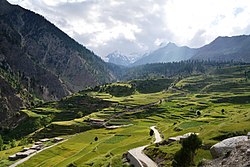
A view of the terrain on the way to Astore

Astore is connected to Gilgit, which is well connected by air with Islamabad and by road with Peshawar, Swat, Islamabad-Rawalpindi, Chitral, and Skardu. There are two ways of access to Eidgah. The first is from Skardu via the Deosai Plateau 143 kilometres (89 mi),[8] but that route cannot be used from November to June due to heavy snowfall. The second route, usable the year round, is from Gilgit via Jaglot 128 kilometres (80 mi).[9]

History

[edit]
district map of Gilgit−Baltistan

Astore was conquered by Ali Sher Khan Anchan, (ruled 1595–1633), the Maqpon ruler of Skardu. He gave it to Shah Sultan, his grandson. Shah Sultan became progenitor of the line of Astore rulers,[10] who maintained their internal independence until 1842, when it annexed by Sikh Empire.[11][12]

References

[edit]
Revisions and contributorsEdit on WikipediaRead on Wikipedia
from Grokipedia
Astore District is one of the ten districts of , a high-altitude region administered by along the frontier of the disputed territory. The district encompasses the Astore Valley, a 120-kilometer-long expanse covering approximately 5,092 square kilometers at an average elevation of 2,600 meters, with administrative headquarters in the towns of Eidgah and Gorikot. Its stood at 95,416 according to 's 2017 , predominantly comprising Shina-speaking communities engaged in , , and emerging . Renowned for its rugged Himalayan terrain and pristine ecosystems, Astore features dense coniferous forests in the Rama Valley, turquoise high-altitude lakes such as Rama Lake, and proximity to the formidable Rupal Face of , the world's ninth-highest peak. The district borders include to the north, Diamer to the west, and to the east, facilitating access via seasonal roads from (120 km) or (152 km), though heavy winter snowfall often isolates it from November to April. These geographic attributes support diverse wildlife, including brown bears in adjacent areas like , and attract trekkers to passes such as Burzil and Mazino, underscoring Astore's role as a gateway to remote alpine pastures and historical trade routes.

Geography and Environment

Location and Topography

Astore District is situated in the Diamer Division of , a region administered by , encompassing high-altitude terrain within the mountain range. It shares de facto administrative boundaries with to the north, to the west, and region to the east, and areas south of the bordering Indian-administered . The district covers approximately 5,000 square kilometers, dominated by the elongated Astore Valley, which extends about 120 kilometers in length at elevations averaging 2,600 meters above . Key topographical features include the proximity to , the ninth-highest peak globally at 8,126 meters, located on its eastern flanks, as well as glacial-fed water bodies such as Rama Lake and pathways leading to the Deosai Plains. The landscape is characterized by rugged, steep-sided valleys carved by glacial rivers, including the Astore River, a major tributary of the originating from melting glaciers in the surrounding peaks. This terrain, shaped by tectonic uplift along the collision zone of the Indian and Eurasian plates, features limited and is prone to seismic activity, rendering it largely unsuitable for extensive or infrastructure development.

Climate and Biodiversity

Astore District features a cold, semi-arid high-altitude climate characteristic of the western Himalayas, with significant seasonal variations driven by elevation and monsoon influences. Winters are severe, with temperatures frequently dropping to -15°C to -20°C or lower in higher elevations, while summer daytime highs in lower valleys can reach 20-30°C, though averages remain cooler at around 9.9°C annually at mid-altitude stations like Rattu (2,718 m). Precipitation varies by locality, averaging 500-800 mm annually at meteorological stations such as Astore and Rama, predominantly falling as snow in winter and contributing to glacial melt in summer; the broader basin estimates suggest up to 1,230 mm when accounting for orographic effects. The district's elevation gradient, spanning approximately 2,500 m in valley floors to over 8,000 m at peaks like , profoundly influences vegetation zonation. Lower elevations (below 3,000 m) support dry temperate coniferous forests dominated by species such as (blue pine), Picea smithiana (spruce), (fir), and (Chilgoza pine), interspersed with birch (Betula spp.). Above the treeline around 3,500-4,200 m, alpine meadows feature junipers (Juniperus spp.), wild roses, and herbaceous adapted to short growing seasons, transitioning to barren rock and perpetual snow at higher altitudes. Soil characteristics, including low organic matter and high alkalinity in upper zones, further limit vegetation density. Biodiversity in Astore is adapted to rugged, high-elevation habitats, supporting key ungulates such as Himalayan ibex (Capra sibirica), (Capra falconeri), and predators including snow leopards (Panthera uncia), alongside in protected zones. The Astore Wildlife Sanctuary, encompassing areas between and surrounding ranges, conserves these within approximately 1,500 km², while the adjacent Himalaya National Park (226,300 ha) targets and associated fauna. Flora diversity includes over 50 medicinal plant utilized locally, thriving in forests, meadows, and rangelands, underscoring the region's ecological value despite aridity and altitudinal stresses.

Natural Resources

The Astore District hosts several mineral deposits, including gemstones such as documented in the Drot Valley of the Astore District. reserves have been identified within the district, contributing to the broader mineral wealth of . These occurrences are part of and metallic formations typical of the region's Himalayan , though extraction remains artisanal and localized. Forest resources in the district are limited to high-altitude coniferous and sparse stands, classified into dense forests with canopy cover over 35% and open forests below that threshold. A comprehensive estimates the total growing stock at 6,010,475 cubic meters of timber, averaging 274.81 cubic meters per , primarily utilized for local fuelwood and construction. Hydrological resources derive mainly from the Astore River and its tributaries, sustained by glacial and in the surrounding mountains. Modeling of basin flows attributes approximately one-third of the river's discharge to glacier melt and 40% to , with the remainder from rainfall, enabling irrigation potential along valley corridors. These waters originate from extensive glacial systems near , providing a reliable but seasonally variable supply. Arable land is restricted to narrow valley floors, comprising a small fraction of the district's terrain due to steep topography and elevation exceeding 2,500 meters in most areas. Soils in these locales, often loamy with variable fertility influenced by altitude and erosion, support high-altitude staples like alongside fruit orchards such as apricots, adapted to the cool, short growing seasons.

History

Pre-Colonial and Early Modern Period

The Astore Valley was inhabited by the Shin people, speakers of the , whose migrations from to occurred during the first half of the second millennium BCE, with settlements in southern including Astore. These Dardic groups established pastoral communities adapted to the rugged terrain near , engaging in herding and amid the valley's isolation. Later waves of Shin migration from areas like Shinkari reached by the 10th century, contributing to local ethnic formations. Pre-Islamic religious practices among the Shin featured indigenous Dardic , deity worship, and nature spirits, with influences from introducing caste-like elements between the 9th and 10th centuries; residual Buddhist traces from earlier regional ties to the persisted in some rituals before fading. Islamicization transformed these beliefs starting in the 14th century, as Sufi orders from Persia and propagated the faith across , though Shin communities retained syncretic elements like fairy veneration into later periods. Governance remained decentralized, structured around tribal kin groups and local leaders who coordinated movements and access to high passes, without a unified state until external interventions in the ; oral traditions recount alliances and conflicts among valley clans for resource control.

Colonial Era under Dogra Rule

The Astore Valley was incorporated into the Dogra domain in the early 1840s, when troops under , then serving the , relieved Sikh garrisons at Astor (Astore) and , establishing Dogra authority over the region as part of the frontier wazarat. This annexation positioned Astore as a key outpost within the of Jammu and Kashmir following the Treaty of Amritsar in 1846, which formalized British recognition of Dogra rule over and its dependencies. Dogra governance in Astore emphasized military control to secure northern access routes, including the , which linked the valley to and served as a vital corridor against encroachments from Central Asian powers and local chieftains. Garrisons were maintained primarily for defense, with limited , as the administration prioritized extraction over development to sustain state revenues and troop logistics. The system's reliance on coercive mechanisms, such as heavy land taxes and begar (forced labor), including variants like kar-begar for transport duties, imposed severe burdens on the predominantly and agricultural population, often diverting labor from subsistence activities during critical seasons. These fiscal exactions fueled localized resistance, contributing to broader instability in the frontier; a notable revolt in saw rebels from , Hunza, and Nagar overrun the Dogra garrison in , slaughtering its troops and underscoring the fragility of rule enforced through taxation and minimal investment in local loyalty or amenities. British records of the era, while noting Dogra efforts to reassert control via punitive expeditions, highlight how such policies perpetuated cycles of rather than fostering stable administration, with Astore's remote position amplifying enforcement challenges.

Integration into Pakistan and Post-1947 Developments

In November 1947, the , a force under British command, rebelled against the Dogra administration of the of Jammu and Kashmir, overthrowing the local governor on 1 November and declaring accession to on 4 November under the leadership of Major William Brown. Astore, situated within the , experienced no notable resistance to this uprising and was incorporated into the emerging Pakistani-administered territory as part of the by early 1948, following the consolidation of control over the region amid the broader Indo-Pakistani conflict over . Administrative reorganization followed in subsequent decades. The , including Astore, was restructured into the Northern Areas in 1970, separating it from Azad Kashmir administration and placing it under direct federal oversight from . Astore initially functioned as a sub-division or within this framework during the 1970s, reflecting gradual bureaucratic upgrades to address local governance needs in the remote Himalayan terrain. By the early , it achieved full status under the Northern Areas administration, enhancing local in judicial and matters while remaining part of the federally controlled setup. Post-1947 developments included incremental infrastructure enhancements to improve accessibility. Following the 1999 Kargil conflict, which highlighted vulnerabilities in northern connectivity, road networks linking Astore to underwent upgrades in the , including paving and widening efforts that facilitated better and civilian movement despite the rugged . These improvements supported administrative integration without altering the region's strategic subordination to Pakistani central authority. By the 2017 census, Astore's population had grown to approximately 115,000, underscoring demographic expansion amid limited economic diversification.

Administration and Demographics

Administrative Structure

Astore District is administered from its headquarters in and Gorikot, within the Diamer Division of . The district's primary executive authority is the Deputy Commissioner, appointed by the government, who oversees revenue collection, , development projects, and coordination with provincial and federal entities. This structure aligns with 's district administration model, adapted for 's semi-autonomous status. The district is subdivided into tehsils, including Astore and Bunji, each managed by a under the Deputy Commissioner's supervision for local revenue and magisterial functions. Following the Gilgit-Baltistan Empowerment and Order of 2009, local governance incorporates elected district and councils, enabling community input on development priorities, though fiscal remains limited due to reliance on federal allocations channeled through the Council. Administrative functions integrate Pakistan's legal framework via extensions of federal statutes, reinforced by rulings applying to the region. In disaster management, the Deputy Commissioner coordinates GLOF risk mitigation, linking local monitoring with federal initiatives under the National Disaster Management Authority, including early warning systems and response protocols.

Population Statistics and Ethnic Composition

According to the 2017 census, Astore District had a of 95,416 residents. Covering an area of 5,411 km², the district exhibits a low of approximately 18 persons per km², attributable to its high-altitude mountainous terrain and limited suitable for habitation. The population growth rate averages around 2.8% annually, primarily fueled by high birth rates and modest internal migration patterns within . Ethnically, the district is overwhelmingly composed of the Shin (or , a Dardic subgroup of Indo-Aryan origin indigenous to the and ranges, who form the core demographic in Astore's valleys and settlements. Traces of Balti ethnic influences appear in peripheral eastern valleys near the Baltistan border, resulting from historical intermingling, though these remain marginal compared to the dominant Shin presence. More than 90% of the lives in rural settings, concentrated in dispersed villages along river valleys, with negligible urban development due to geographic constraints. The gender ratio approximates parity at roughly 1:1, consistent with broader patterns in remote northern districts where sex-selective practices are minimal. Literacy rates hover between 40% and 50% based on recent multiple indicator cluster surveys, with literacy exceeding rates amid ongoing federal and provincial efforts to expand schooling in isolated areas.

Languages, Religion, and Social Structure

The primary language in Astore District is Shina, a Dardic language belonging to the Indo-Aryan branch of the Indo-European family, spoken natively by the Shin population across valleys such as the main Astore and its tributaries. functions as the for administration, education, and inter-valley communication, supplemented by English in government and contexts. The district's population adheres almost exclusively to , with Sunni Muslims forming the clear majority, distinguishing Astore from Shia-dominant areas elsewhere in . Minority Shia Ithna Ashari communities coexist, prompting sectarian accords like the 2021 agreement between Sunni Ahl-e-Sunnat wal Jamaat and Shia leaders to curb mutual accusations of infidelity () and promote harmony. Social organization centers on patrilineal among Shin tribes, with clans tracing descent to ancestral lineages tied to specific valleys or sub-regions, shaping , marriage alliances, and communal . Sub-tribes such as CeraT and Poensa maintain distinct identities within Astore, fostering endogamous practices and minimal inter-ethnic intermarriage due to rugged terrain limiting external contacts. Tribal jirgas—councils of elders—persist as customary forums for resolving disputes over land, water rights, and family honor, often complementing state courts despite administrative overlays reducing their traditional autonomy since the mid-20th century. This structure upholds conservative norms, including gender-segregated roles and deference to patriarchal authority, reinforced by in local madrassas aligned with Deobandi Sunni traditions prevalent in Pakistan's northern regions.

Economy and Infrastructure

Primary Economic Sectors

Agriculture dominates the economy of Astore District, where the majority of residents engage in subsistence farming due to the region's rugged terrain and limited confined to river valleys. Principal crops include , , and as staples, supplemented by horticultural produce such as apricots, walnuts, and other fruits, which thrive in the irrigated areas along the Astore River. rearing, particularly , sheep, and yaks, provides essential dairy products, meat, and , supporting household needs in high-altitude pastures during summer . In as a whole, including Astore, over 90% of the participates directly or indirectly in this sector, reflecting a predominantly agrarian with minimal or surplus for large-scale markets. The subsistence nature of agriculture limits commercialization, with production primarily meeting local food security rather than export, though initiatives aim to develop value chains for high-value crops like fruits. Livestock contributes to resilience against crop failures but faces challenges from harsh winters and fodder scarcity. Small-scale, informal mining for gemstones, notably garnet deposits, offers supplementary income for some households, yet remains unregulated, low-yield, and environmentally disruptive without contributing significantly to district revenues. Overall, these sectors sustain a low-income, self-reliant economy vulnerable to climatic variability and lacking diversification beyond basic agrarian activities.

Key Development Projects and Infrastructure

The Astore Valley Road project, integrated into China-Pakistan Economic Corridor (CPEC) efforts, advanced significantly with the inauguration of Section 3 on May 30, 2023, by Chief Minister , enhancing connectivity to regions and shortening travel times to from hours of challenging mountain traversal to more efficient routes that support trade and mobility. These upgrades address longstanding isolation caused by rugged terrain, directly enabling faster access to markets and services for Astore's remote communities. Small-scale hydropower initiatives have bolstered local supply, exemplified by the 400 kW Kamri hydropower plant on the right bank of Kamri Nallah, approximately 120 km from Astore city, which utilizes Pelton turbines to generate reliable power for nearby rural areas and mitigates dependence on intermittent diesel sources. Additional micro- developments under programs like those from the Rural Support Programme contribute to cumulative capacity gains, powering households and small enterprises while harnessing the district's glacial streams for sustainable output. Federal rural development efforts post-2010 floods include irrigation canal reconstructions and lift systems across , improving water access for agriculture in flood-prone valleys like those in Astore and fostering resilience against seasonal disruptions. A scheme launched in 2015 further expanded irrigated land in northern barren areas, directly linking enhanced water infrastructure to increased crop yields and livelihood stability.

Challenges in Economic Development

The rugged terrain and high-altitude geography of Astore District constrain the development of extensive road networks, with the primary Astore comprising approximately 115 kilometers of metaled pavement linking the district to the , while secondary routes remain largely unpaved and prone to blockages from seasonal snowfalls and landslides between and May. These limitations impede reliable transportation, resulting in prolonged supply chain disruptions for agricultural produce and essential imports, which increases costs and reduces for local producers. Energy deficiencies further stifle industrialization efforts, as Astore and broader experience chronic electricity shortfalls—often exceeding 12 hours daily during winters—despite untapped hydroelectric potential from glacial rivers, leading to reliance on costly diesel generators and deterring investment in or industries. This scarcity compounds skilled labor outflows, with educated youth migrating to urban centers like for opportunities, exacerbating a regional of among the 15-24 age group. Fiscal dependence on federal transfers underscores structural vulnerabilities, as Gilgit-Baltistan's semi-autonomous framework yields a narrow local revenue base—comprising less than 10% of expenditures—leaving like Astore reliant on Islamabad's allocations amid competing national priorities and periodic cuts, such as those to provisions that have sparked local unrest. These constraints limit autonomous budgeting for upgrades, perpetuating underinvestment and hindering diversification beyond and remittances.

Tourism and Cultural Significance

Major Attractions and Activities

The Astore District features prominent natural attractions centered on high-altitude landscapes suitable for and trekking. , the ninth-highest peak at 8,126 meters, draws climbers to its Rupal Face, the world's highest mountain wall at approximately 4,500 meters. The of occurred on July 3, 1953, by Austrian climber via the Rupal Face during a German-Austrian expedition, marking a milestone in Himalayan history. Treks to base camps on this face, such as those starting from Tarashing, appeal to experienced hikers seeking remote routes, though the area requires navigation permits for expeditions targeting peaks exceeding 6,000 meters due to regulatory oversight by authorities. Rama Meadows, located at around 3,300 meters elevation, serves as a key site for and day hikes amid pine forests and glacial streams. Visitors access Rama Lake via a one-hour trek from the meadows, offering views of surrounding valleys though not directly of Nanga Parbat's summit. Fishing occurs in the Rama River, which supports local populations, while the meadows provide off-trail opportunities for independent exploration during summer months when allows access. Additional pursuits include hikes in Valley, noted for its alpine pastures and requiring special entry permits owing to its border proximity. The district's terrain also facilitates seasonal activities tied to local agrarian cycles, such as participation in the harvest festival around June 21, which involves communal celebrations of yields with traditional dances and in Shina-speaking communities. Proximity to enables wildlife viewing excursions for species like Himalayan ibex and brown bears, typically arranged as guided day trips from Astore town.

Tourism Growth and Economic Contributions

Tourism in Astore District primarily revolves around adventure activities such as trekking, drawing predominantly domestic visitors during the summer months from June to September, when accessible trails to sites like base camp see peak activity. The Tourism Development Corporation (PTDC) supports promotion through national marketing efforts highlighting northern 's mountainous regions, including Astore's valleys and peaks, via digital campaigns and partnerships with provincial tourism bodies. Visitor arrivals have shown growth trends, with domestic tourists numbering around 55,861 in 2019 before the disruptions, rising to 74,617 by 2023 amid regional recovery in . Post-pandemic rebound in the broader area has included over 986,000 domestic and 16,500 international visitors in 2024, reflecting improved infrastructure like upgraded roads and eased travel protocols. Economically, bolsters local incomes through homestays, guiding services, and portering, creating seasonal for residents in a where dominates but offers limited year-round opportunities. These activities generate revenue from visitor expenditures on accommodations, , and rentals, contributing to household livelihoods amid the region's overall tourism-driven economic uptick, valued at approximately PKR 3 billion provincially in 2024. Job roles remain concentrated in peak seasons, supporting porters and guides who earn daily wages during expeditions, though the influx strains basic services like waste handling due to inadequate facilities.

Cultural Heritage and Local Traditions

The cultural heritage of Astore District reflects the enduring Shina-speaking pastoralist traditions of , characterized by oral , seasonal migrations, and community-based customs passed down through generations. and form a core element, featuring Shina instruments and performances that accompany communal gatherings, often evoking tribal histories and pastoral life. These traditions emphasize rhythmic s and ballads narrating local lore, maintaining continuity from Dardic roots despite limited documentation. Handicrafts such as weaving, basket-making, and persist as vital expressions of tribal ingenuity, primarily practiced on a small scale by families in areas like Kala Pani, where skills are transmitted intergenerationally without widespread commercialization. Oral epics and of tribal heroes further sustain , drawing from Shina that highlights resilience in harsh Himalayan environments, though these remain largely undocumented outside community settings. Religious sites, including local mosques, serve as focal points for Sunni Islamic practices blended with pre-Islamic customs, fostering communal rituals that reinforce social cohesion. Traditional cuisine underscores self-sufficiency, with staples like bread (phitti or similar variants) baked over open fires and supplemented by dried fruits such as apricots and walnuts, harvested from valley orchards and preserved for winter. These foods, prepared using minimal processing, reflect adaptive responses to the district's high-altitude and rearing. Preservation efforts rely heavily on informal community transmission amid modernization pressures, with institutional support from entities like the focusing on broader heritage but offering limited targeted initiatives in Astore. This grassroots approach has sustained core practices, though risks from and youth migration pose ongoing challenges to their continuity.

Controversies and Geopolitical Context

Environmental and Climate Risks

The Astore District, situated in the high-altitude Karakoram-Himalaya region of , faces significant risks from glacial lake outburst floods (GLOFs) due to its numerous glaciers and proglacial lakes. These events involve sudden releases of water from lakes dammed by ice or , potentially causing downstream flooding that displaces communities and damages . In , including , GLOF vulnerabilities have been heightened by glacier melt, with incidents in nearby districts such as Ghizer in 2025 causing fatalities and extensive damage. Although specific GLOF events in Astore are less documented, the district's s, mapped via in the Astore basin, pose comparable hazards given the regional pattern of lake expansion. Glacial retreat in the Astore basin contributes to GLOF susceptibility by forming new lakes and destabilizing moraines. Satellite-based assessments of glaciers like Bazhin, Chhongpher, and Chongra in the basin reveal snout retreats ranging from 960 meters to 3,260 meters over recent decades, indicating ongoing loss amid variable Karakoram dynamics where some glaciers advance while others recede. In the nearby Astak catchment, a to the Astore River, remote from 2000 to 2020 documented glacier area reductions, exacerbating lake formation risks. These changes align with broader Upper Indus Basin trends, though precise annual retreat rates vary, with historical data near showing averages around 10 meters per year in earlier periods. Anthropogenic pressures compound natural hazards through and localized . Fuelwood collection for heating, driven by harsh winters and unreliable , has led to forest loss in dry temperate areas, with Astore exhibiting notable rates among districts, though lower than in or Darel/Tangir. Unregulated small-scale and temporary camps introduce pollutants, including and solid refuse, contaminating sources and soils in valleys like Rama. Rising temperatures amplify avalanche risks, as altered precipitation patterns lead to unstable snowpacks. A 2023 avalanche in Astore killed 11 nomads and injured 13, attributed partly to delayed snowfall patterns linked to climate variability. Projections for the region indicate warmer conditions increasing such events alongside GLOF threats. To mitigate these, the federal GLOF-II project, active since the 2020s, has deployed early warning systems—including automated weather stations, rain gauges, and water level sensors—in vulnerable Gilgit-Baltistan valleys, enhancing community preparedness.

Land Rights Disputes and Resource Exploitation

The Gilgit-Baltistan government has asserted claims over Khalisa lands—historically state-designated tracts originally under princely rule—following the 2009 Empowerment and Self-Governance Order, which aimed to devolve administrative powers but intensified litigation as locals contested reallocations to state control rather than communal or individual tenure. In Astore District, these disputes have fueled protests and court cases, with communities arguing that such lands, used for and , predate modern boundaries and should remain under customary systems, leading to ongoing resistance against government surveys and acquisitions in the . Local groups, including village councils, have filed suits claiming ancestral rights, viewing state assertions as exploitative amid the region's disputed status, though government officials rationalize them as necessary for infrastructure and revenue. Resource extraction in Astore has exacerbated tensions, particularly through mining leases granted to non-local firms, including Chinese companies targeting high-quality deposits since the early 2020s, often with minimal local input on compensation. Residents allege unfair deals, where royalties bypass communities and payouts undervalue displaced lands, prompting campaigns for prioritizing communal tenure over external concessions; for instance, elders in mining-prone areas have demanded cancellation of outsider to enforce regional policies favoring locals. These movements highlight a pattern where state facilitation of leases prioritizes national economic goals, such as revenues, over equitable local benefits, with reports documenting inadequate consultations and disputes over lease durations extending up to 30 years. Hydropower development offers counterpoints, with small-scale projects like the 4 MW Pakora Gudai initiative approved in the late 2000s providing reliable local electricity to remote Astore villages, reducing outages and supporting agro-processing by harnessing glacial melt streams. Proponents cite these as successes in energy self-sufficiency, generating up to 20-30% more power for districts like Astore compared to grid dependency, yet critics among locals decry land inundation from reservoirs displacing herders without proportional royalties or resettlement, fueling litigations over uncompensated communal pastures. While such dams have boosted household electrification rates in project vicinities to over 70% in operational cases, resistance persists due to perceived favoritism toward federal contractors, underscoring clashes between development imperatives and tenure security.

Territorial Disputes and Regional Stability

Astore District has been administered by as part of since November 1947, following the Gilgit Agency's revolt against the of Jammu and Kashmir and subsequent accession to amid the partition chaos. India claims the district as integral to its union territory of , designating 's control as unlawful occupation without legal basis in the . This stems from the broader dispute, where both nations assert sovereignty over territories divided by the (LoC) established after the 1947-1948 Indo-Pakistani War. United Nations Security Council Resolution 47, adopted on April 21, 1948, called for a plebiscite to resolve Jammu and Kashmir's accession after Pakistani withdrawal of forces and tribal militias, alongside Indian troop reductions, but implementation stalled over mutual non-compliance with sequencing and demilitarization. The unresolved framework perpetuates claims, though de facto control lines have held since the 1972 formalized the LoC. In Astore, local Shina-majority populations exhibit pro-Pakistan orientation, as evidenced by electoral support for in 2020 Gilgit-Baltistan assembly polls, where integrationist platforms prevailed over independence advocates. Astore has avoided the Islamist insurgencies plaguing the since 1989, with no recorded major militant operations or anti-Pakistan uprisings, due to ethnic homogeneity, historical loyalty post-1947, and rugged terrain deterring infiltration. The 1999 Kargil conflict involved Pakistani Infantry infiltrating across the LoC from sectors adjacent to Astore, aiming to sever India's Srinagar-Leh highway, but Astore's northern isolation limited direct engagements there. An informal ceasefire along the LoC, initiated in November 2003 after Pakistani overtures and Indian reciprocation, reduced cross-border skirmishes in fronts, including Astore's peripheries, fostering empirical stability despite sporadic violations post-2006. This arrangement, renewed in 2021, underscores de facto peace under Pakistani administration, contrasting Indian portrayals of the region as oppressed, while Pakistani integration has sustained order without the violence seen elsewhere in the dispute.

References

Add your contribution
Related Hubs
User Avatar
No comments yet.