


Community hub
Recent from talks
Contribute something
Nothing was collected or created yet.
Implementation Force
View on Wikipedia
| Implementation Force | |
|---|---|
 Pocket badge of the IFOR | |
| Active | 1995–1996 |
| Country | 32 countries |
| Type | Command |
| Part of |  NATO NATO |
| Nickname | "IFOR" |
The Implementation Force (IFOR) was a NATO-led multinational peace enforcement force in Bosnia and Herzegovina under a one-year mandate from 20 December 1995 to 20 December 1996 under the codename Operation Joint Endeavour.
Background
[edit]
In 1995, NATO was tasked by the United Nations (UN) to carry out the provision of the Dayton Peace Accords ending the Bosnian War. The Dayton Peace Accords were started on 22 November 1995 by the presidents of Bosnia, Croatia, and Serbia, on behalf of Serbia and the Bosnian Serb Republic. The actual signing happened in Paris on 14 December 1995. The peace accords contained a General Framework Agreement and eleven supporting annexes with maps. The accords had three major goals: ending of hostilities, authorization of military and civilian program going into effect, and the establishment of a central Bosnian government while excluding individuals who are serving sentences or under indictment by the International War Crimes Tribunals from taking part in the running of the government. IFOR's specific role was to implement the military Annexes of The General Framework Agreement for Peace (GFAP) in Bosnia and Herzegovina.[1]
IFOR relieved the UN peacekeeping force UNPROFOR, which had originally arrived in 1992, and the transfer of authority was discussed in Security Council Resolution 1031. Almost 60,000 NATO soldiers in addition to forces from non-NATO nations were deployed to Bosnia. Operation Decisive Endeavor (SACEUR OPLAN 40105), beginning 6 December 1995, was a subcomponent of Joint Endeavor.[2] IFOR began operations on 20 December 1995.[3]
The Dayton Agreement resulted from a long series of events, notably, the failures of EU-led peace plans, the August 1995 Croat Operation Storm and fleeing of 200,000 Serb civilians, the Bosnian Serb war crimes, in particular the Srebrenica massacre, and the seizure of UNPROFOR peace-keepers as human shields against NATO's Operation Deliberate Force.[4]
U.S. Secretary of Defense William Perry and his Russian counterpart, Pavel Grachev agreed on 8 October that the peacekeeping operation name will be Implementation Force of the Peace Agreement on Bosnia-Herzegovina, that is without reference to NATO; other differences were unresolved at that time (chain of command, area of command and control).[5] On 27 October they agreed that "the Russian unit will not be part of the NATO peacekeeping force, but will perform special engineering, transport and construction activites [sic]".[6]
Admiral Leighton W. Smith Jr., Commander in Chief Allied Forces Southern Europe (CINCSOUTH), served as the first Joint Force Commander for the operation, also known as Commander IFOR (COMIFOR). He commanded the operation from IFOR's deployment on 20 December 1995 from headquarters in Zagreb, and later from March 1996 from the Residency in Sarajevo.[7] Admiral Thomas J. Lopez commanded the operation from 31 July to 7 November 1996, followed by General William W. Crouch until 20 December 1996.[3] Lt Gen Michael Walker, Commander Allied Rapid Reaction Corps (ARRC), acted as Land Component Commander for the operation, commanding from HQ ARRC (Forward) based initially in Kiseljak, and from late January 1996 from HQ ARRC (Main) in Ilidža. This was NATO's first ever out-of-area land deployment. The Land Component's part of the operation was known as Operation Firm Endeavour.[8]
At its height, IFOR involved troops from 32 countries and numbered some 54,000 soldiers in-country (BiH) and around 80,000 involved soldiers in total (with support and reserve troops stationed in Croatia, Hungary, Germany, and Italy and also on ships in the Adriatic Sea). In the initial phases of the operation, much of the initial composition of IFOR consisted of units which had been part of UNPROFOR but remained in place and simply replaced their United Nations insignia with IFOR insignia.[citation needed]
Components
[edit]
NATO member states that contributed forces included Belgium, Canada, Denmark, France, Germany, Italy, Luxembourg, the Netherlands, Norway, Portugal, Spain, Turkey, the United Kingdom, and the United States. Non-NATO nations that contributed forces included; Australia, Austria, Bangladesh, the Czech Republic, Egypt, Estonia, Finland, Hungary, Latvia, Lithuania, Malaysia, Morocco, New Zealand, Pakistan, Poland, Romania, Slovakia, Sweden, Russia, and Ukraine.[9]
The tasks of the Land Component were carried out by three Multi National Divisions:[10]
- Multi-National Division (South-East), Mostar – French led. Also known as the 'Division Salamandre.'[11][12] The divisional headquarters was provided by 6th Light Armored Division then 7th Armoured Division.
- French Brigade Alpha,[13] Jablanica
- 2nd Foreign Parachute Regiment[14]
- Moroccan Battalion[15] - Igman
- French Brigade Bravo, Sarajevo
- 6th Marine Infantry Parachute Regiment[16]
- 21st Marine Infantry Regiment[17]
- Ukrainian Battalion[18]
- Italian Bersaglieri Brigade "Garibaldi", Sarajevo
- 8th Bersaglieri Regiment[19]
- Portuguese Battalion
- Egyptian Battalion
- 42nd Spanish Mountain Brigade,[20] Medjugorje - Col Julio López-Guarch Muro
- French Brigade Alpha,[13] Jablanica
- Multi-National Division (South-West), Banja Luka – British led. The British codename for their armed forces' involvement in IFOR was Operation Resolute.[23] Division headquarters was provided by 3 (UK) Division[24] then 1st (UK) Armoured Division.[25]
- 4th UK Armoured Brigade, Šipovo - Brig Richard Dannatt
- 2nd Bn, The Light Infantry[26]
- 1st Bn, Royal Regiment of Fusiliers[27]
- Dutch Battalion[28] - Šišava
- Malaysian Battalion - Livno
- 2nd Canadian Mechanized Brigade, Ćoralići - Brig Gen Bruce Jeffries
- Canadian Battalion
- Queen's Royal Hussars[29] - Mrkonjić Grad
- Czech Battalion[30] - Ljubija
- 4th UK Armoured Brigade, Šipovo - Brig Richard Dannatt
- Multi-National Division (North), Camp Eagle at Tuzla – US led. Task Force Eagle. The US Army 1st Armored Division under the command of Major General William L. Nash, constituted the bulk of the ground forces for Task Force Eagle. They began to deploy on 18 December 1995 and would return to Germany in late 1996.
- 1st Brigade, 1st Armored Division,[31] Camp Kime - Col Gregory Fontenot.
- 1st Sqdn, 1st Cavalry - Camp Gentry
- 3rd Bn, 5th Cavalry - Camp McGovern
- 4th Bn, 67th Armor - Camp Stephens
- 2nd Brigade, 1st Armored Division,[32] Camp Lisa - Col John Batiste
- 3rd Sqdn, 4th Cavalry - Camp Molly, Camp Alicia
- 4th Bn, 12th infantry - Camp Demi, Camp Pat
- 2nd Bn, 68th Armor - Camp Linda
- 1st Russian Separate Airborne Brigade,[33] Camp Ugljevik - Col Alexander Ivanovich Lentsov[34]
- Nordic-Polish Brigade,[32] Doboj - Danish Brigadegeneral Finn Særmark-Thomsen
- Danish Battalion[35] (Estonia, Latvia and Lithuania each provided a platoon size element to reinforce the battalion) - Camp Dannevirke, Camp Valhalla
- Swedish Battalion - Camp Oden
- Polish Battalion - Teslić, Žepče
- Finnish Engineer Battalion - Camp Jussi
- Norwegian Logistics Battalion - Modrica
- Turkish Brigade,[36] Zenica - Col Ahmet Berberoglu
- Turkish Battalion
- Romanian Engineer Battalion[37]
- 1st Brigade, 1st Armored Division,[31] Camp Kime - Col Gregory Fontenot.
On 20 December 1996, the task of IFOR was taken over by SFOR.[38] In turn, SFOR was replaced by the European EUFOR Althea force in 2004.[39]
NATO began to create service medals once it began to support peacekeeping in the former Yugoslavia, which led to the award to IFOR troops of the NATO Medal.[40]
Gallery
[edit]-

-
 An American M2 Bradley and a Russian BTR-80 during a patrol near Zvornik
 -
 An Italian Army B1 Centauro during a patrol in Bosnia-Herzegovina as part of IFOR during 1996
 -
 A Swedish soldier manning a civilian checkpoint leading to the Joint Civilian Commission meeting in Doboj
 -
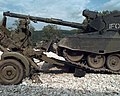 A Danish Leopard 1 preparing to drive over and crush a Serbian Zastava M55 anti-air gun
 -
 The crew of an Italian B1 Centauro deployed as part of IFOR
 -

-
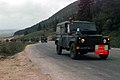 A British convoy passing through Kupres
 -
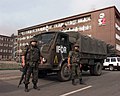 Greek soldiers guarding a truck carrying polling equipment for the 1996 Bosnian general election in Zenica


See also
[edit]Notes
[edit]- ^ The General Framework Agreement for Peace (GFAP) in Bosnia and Herzegovina
- ^ "Appendix C: References", Federation of American Scientists Archived 26 September 2008 at the Wayback Machine
- ^ a b "Peace support operations in Bosnia and Herzegovina". NATO. Retrieved 18 December 2020.
- ^ "NATO AIRCRAFT ATTACK BOSNIAN-SERB TANK" (Press release). NATO. 22 September 1994.
- ^ "The United States and Russia failed Sunday to resolve..." UPI. 8 October 1995.
- ^ "Russia-U.S. agreement on Balkans reached". UPI. 27 October 1995.
- ^ SFOR leaves Residency Compound
- ^ Operational Analysis Support to NATO IFOR/SFOR Operations
- ^ Clark, A.L. (1996). Bosnia: What Every American Should Know. New York: Berkley Books.
- ^ McGrath, John J. "Boots on the Ground: Troop Density in Contingency Operations" (PDF). Fort Leavenworth, Kansas: Combat Studies Institute Press.
- ^ The Multinational Division South-East in Bosnia Archived 28 June 2013 at the Wayback Machine
- ^ "Nº 672 1996 Mayo" (PDF). publicaciones.defensa.gob.es (in Spanish). 1996. Retrieved 12 March 2025.
- ^ "Recap6-opex".
- ^ "History: 2nd Foreign Parachute Regiment | French Foreign Legion Information". Retrieved 19 December 2023.
- ^ "Independence and restoration". Royal Moroccan Armed Forces. 18 September 2013. Retrieved 19 December 2023.
- ^ "Recap6-opex".
- ^ "Recap6-opex".
- ^ "Nº 675 1996 Septiembre" (PDF). publicaciones.defensa.gob.es (in Spanish). September 1996. Retrieved 12 March 2025.
- ^ "The medal collection - Esercito Italiano". www.esercito.difesa.it. Retrieved 19 December 2023.
- ^ "SPABRI I - Spanish army". ejercito.defensa.gob.es. Retrieved 19 December 2023.
- ^ "Contenido - Ejército de tierra". ejercito.defensa.gob.es. Retrieved 19 December 2023.
- ^ "Contenido - Ejército de tierra". ejercito.defensa.gob.es. Retrieved 19 December 2023.
- ^ "British Forces Bosnia". Parliamentary Debates (Hansard). 18 July 1996. Retrieved 13 April 2013.
- ^ "Army senior appointments". United Kingdom Government News. 23 July 2002. Archived from the original on 26 July 2011. Retrieved 13 April 2013.
- ^ Lord, p. 304
- ^ 2nd Battalion The Light Infantry Bosnia 1995 - 96 Op Grapple 7, 28 October 2018, retrieved 19 December 2023
- ^ 1 RRF Bosnia, 6 June 2015, retrieved 19 December 2023
- ^ "The Dutch contribution to Implementation Force (IFOR), Stabilization Force (SFOR) and European Force (EUFOR) - Historical missions - Defensie.nl". english.defensie.nl. 8 September 2017. Retrieved 19 December 2023.
- ^ "Commonwealth & Foreign Honours to Members of Her Majesty's Canadian Armed Forces" (PDF). www.canada.ca. 2017. ISBN 978-0-660-08826-6. Retrieved 12 March 2025.
- ^ "ARMED FORCES OF THE CZECH REPUBLIC: A symbol of democracy and state sovereignty" (PDF). www.army.cz. Retrieved 12 March 2025.
- ^ Fontenot, Gregory (2007). "Peace in the Posavina, or Deal with Us!" (PDF). www.armyupress.army.mil. Retrieved 12 March 2025.
- ^ a b Bilski, Artur O. (March 2001). "War and Peacekeeping Mission of the Nordic-Polish Brigade in Bosnia-Herzegovina" (PDF). apps.dtic.mil. Archived from the original (PDF) on 31 January 2025. Retrieved 12 March 2025.
- ^ Mackinlay, John; Cross, Peter, eds. (2003). Regional peacekeepers: The paradox of Russian peacekeeping (PDF). United Nations University Press. ISBN 92-808-1079-0.
- ^ Nelson, James (2005). Bosnia Journal: An American Civilian's Accountof His Service. Infinity Publishing. ISBN 978-0-7414-2321-4.
- ^ "RKK Apprenticeship Partnership Membership" (PDF). icds.ee. May 2018.
- ^ Bishop, Rob (19 April 1996). "Earth moving platoon forms roads out of mud" (PDF). ufdcimages.uflib.ufl.edu. Retrieved 12 March 2025.
- ^ "Changing Security Paradigms in Romania and South Africa after the Cold War" (PDF). ispaim.mapn.ro. Bucharest: Military Publishing House. 2011. Archived (PDF) from the original on 31 January 2025. Retrieved 12 March 2025.
- ^ "History of the NATO-led Stabilisation Force (SFOR) in Bosnia and Herzegovina". NATO. Retrieved December 18, 2018.
- ^ Hawton, Nick (October 23, 2004). "EU troops prepare for Bosnia swap". BBC News. Retrieved December 18, 2018.
- ^ "NATO Medal for Former Yugoslavia (NATO-FY)". National Defence and the Canadian Armed Forces. July 22, 2015. Archived from the original on June 12, 2017. Retrieved December 18, 2018.
Further reading
[edit]- Charles Bertin, A Summer in Mostar: 50 days with the Salamander Division, January – June 1996
- Lord, Cliff (2004). Royal Corps of Signals: Unit Histories of the Corps (1920–2001) and its Antecedents. Helion & Company. ISBN 978-1-874622-92-5.
- Phillips, R. Cody. Bosnia-Herzegovina: The U.S. Army's Role in Peace Enforcement Operations 1995–2004. Washington, D.C.: United States Army Center of Military History. CMH Pub 70-97-1. Archived from the original on 9 December 2013.
- Siegel, Pascale (1998). Target Bosnia (PDF). Archived from the original (PDF) on 28 June 2015. Retrieved 19 January 2007.
- Wentz, Larry (1998). Lessons from Bosnia: The IFOR Experience (PDF).
- Lambert, Nicholas (2002). Measuring the Success of the North Atlantic Treaty Organisation (NATO) Operation in Bosnia and Herzegovina 1995 – 2000. Issue 140/2, pp. 459–481. European Journal of Operations Research, Special 2000 Edition. doi:10.1016/S0377-2217(02)00083-8.
External links
[edit] Media related to IFOR at Wikimedia Commons
- CCRP Bosnia Research and Publications
- Information on Operation Joint Endeavour on the NATO Website
| International | |
|---|---|
| National | |
| Other | |

Implementation Force
View on GrokipediaHistorical Context and Formation
Yugoslav Wars and Preceding Interventions
The dissolution of Yugoslavia following the death of Josip Broz Tito in 1980 exacerbated long-suppressed ethnic tensions, fueled by irredentist nationalism particularly among Serb leaders seeking a Greater Serbia that incorporated territories with Serb populations in Bosnia-Herzegovina.[11] Bosnia declared independence on March 3, 1992, after a referendum boycotted by Serbs, triggering the Bosnian War from April 1992 to December 1995, characterized by multi-sided ethnic cleansing campaigns aimed at demographic homogenization through forced expulsions, mass rapes, and killings perpetrated by Bosnian Serb, Croat, and Bosniak forces.[12] The conflict resulted in approximately 100,000 deaths and displaced over 2 million people, with Bosniaks comprising the majority of civilian victims.[13] A prominent example was the siege of Sarajevo, initiated on April 5, 1992, by Bosnian Serb forces under the Army of Republika Srpska (VRS), which subjected the city to artillery bombardment and sniper fire, killing over 11,000 civilians including 1,600 children by the war's end.[14] The United Nations Protection Force (UNPROFOR) was deployed on February 28, 1992, under Security Council Resolution 743, initially to ensure the withdrawal of Yugoslav People's Army units from Croatia and facilitate humanitarian aid delivery in Bosnia, later expanded to protect designated "safe areas" via Resolution 836 in June 1993.[15] However, UNPROFOR's mandate was constrained by rules of engagement permitting force only in self-defense or to protect mission essentials, rendering it ineffective against sustained aggression amid political divisions, including Russian and Chinese vetoes in the Security Council that blocked robust enforcement measures. This weakness allowed belligerents to exploit UN forces as human shields or ignore ultimatums, as UNPROFOR lacked the authority or resources for offensive operations, contributing to repeated mission failures in deterring attacks on civilians.[16] The Srebrenica enclave, declared a UN safe area in 1993, exemplified these shortcomings when VRS forces under General Ratko Mladić overran it from July 6 to 11, 1995, systematically executing approximately 8,000 Bosniak men and boys in the largest massacre in Europe since World War II, while Dutch UNPROFOR troops (Dutchbat), lightly armed and outnumbered, failed to mount effective resistance due to denied close air support requests and command hesitancy to escalate.[16] The incident, rooted in the enclave's untenable isolation and UNPROFOR's defensive posture, prompted a shift toward coercive diplomacy. Following a VRS mortar attack on Sarajevo's Markale market on August 28, 1995, that killed 43 civilians, NATO launched Operation Deliberate Force on August 30, conducting over 3,500 sorties and striking 338 Bosnian Serb targets, which compelled VRS withdrawals and a ceasefire on October 12, demonstrating that credible military deterrence, absent in prior UN efforts, was essential to halting the violence and enabling negotiations.[17][1]Dayton Peace Agreement Negotiations
The Dayton Peace Agreement negotiations commenced on November 1, 1995, at Wright-Patterson Air Force Base in Dayton, Ohio, under U.S. auspices following the failure of prior European-led efforts and amid the momentum from NATO's Operation Deliberate Force air campaign, which had pressured Bosnian Serb forces into a temporary ceasefire on October 5.[18][19] U.S. Assistant Secretary of State Richard Holbrooke led the American delegation, employing coercive diplomacy that included threats of resumed airstrikes and isolation of non-compliant parties to compel concessions from Bosnian President Alija Izetbegović, Croatian President Franjo Tuđman, and Serbian President Slobodan Milošević, who represented the Bosnian Serbs.[20][21] This approach reflected a realpolitik recognition that fully reversing wartime ethnic displacements—estimated at over 2 million people—would require indefinite military occupation and risked reigniting conflict, prioritizing instead a cessation of hostilities through pragmatic territorial compromises.[19] The talks, lasting until November 21, produced the General Framework Agreement for Peace, which preserved Bosnia and Herzegovina's formal sovereignty while institutionalizing de facto partitions into two entities: the Muslim-Croat Federation of Bosnia and Herzegovina (51% of territory) and the Serb-dominated Republika Srpska (49%), acknowledging the entrenched ethnic separations forged by three years of warfare rather than enforcing a unitary state that empirical evidence suggested was unattainable without coercion beyond U.S. willingness.[22] Annex 1A detailed military provisions, mandating the separation of forces by a 2-kilometer zone, demobilization of excess personnel, and withdrawal of all heavy weapons—such as tanks, artillery over 100mm, and combat aircraft—to IFOR-monitored cantonments or barracks within 120 days of IFOR's authority transfer.[23][24] These timelines were enforced through U.S.-orchestrated pressure, including Milošević's inducements to Bosnian Serb leader Radovan Karadžić's compliance despite his indictment, underscoring the negotiations' reliance on leverage over consensus.[19] The agreement received initial signatures in Dayton on November 21 and a formal ceremony in Paris on December 14, 1995, by representatives of Bosnia and Herzegovina, Croatia, and the Federal Republic of Yugoslavia.[25] United Nations Security Council Resolution 1031, adopted December 15, authorized NATO's Implementation Force (IFOR) to enforce the military annexes under Chapter VII, establishing a one-year mandate effective from the transfer of authority on December 20, 1995, to deter violations without broader reconstruction responsibilities.[5][26] This framework halted active combat, which had claimed approximately 100,000 lives, by codifying partitions as a stabilizing expedient amid the parties' mutual exhaustion and external deterrence, though it deferred deeper integration amid persistent ethnic animosities.[27]Establishment of IFOR
The Implementation Force (IFOR) was formally authorized by United Nations Security Council Resolution 1031 on December 15, 1995, which endorsed a NATO-led multinational force to enforce the military provisions of the General Framework Agreement for Peace in Bosnia and Herzegovina (Dayton Agreement), signed four days earlier.[28] This followed the termination of the United Nations Protection Force (UNPROFOR), whose consensus-based peacekeeping approach had proven inadequate in preventing widespread violations and enabling effective deterrence during the Bosnian conflict.[1] IFOR operated under a Chapter VII mandate, permitting the use of "all necessary measures" to ensure compliance, thereby prioritizing robust force projection to separate warring parties and oversee demilitarization rather than relying on negotiated restraint.[6] On December 16, 1995, NATO's North Atlantic Council approved the operational concept for IFOR, initiating preparations for deployment under the overall command of Admiral Leighton W. Smith Jr., who held dual roles as Supreme Allied Commander Atlantic and IFOR Commander.[2] [29] The force was planned to total approximately 60,000 troops, with the United States contributing about one-third, structured to project overwhelming military capability for a one-year mandate commencing December 20, 1995, when authority transferred from UNPROFOR.[30] Initial deployment began in mid-December 1995, with staging from bases in Italy for airlift operations, and overland routes through Croatia and Hungary to facilitate rapid entry into Bosnia-Herzegovina, underscoring an emphasis on swift deterrence signaling to the former belligerents.[31] [32] Advance elements crossed into the theater via air and sea from Italian ports, despite weather delays, to establish command posts and secure key infrastructure ahead of main force arrivals.[33] To broaden participation and signal post-Cold War alignment, IFOR integrated non-NATO contributors, including a Russian brigade of roughly 1,000-1,500 troops attached to the U.S. 1st Armored Division sector under a bilateral U.S.-Russia agreement finalized in late 1995, allowing operational coordination while preserving NATO's unified command.[2] [34] This arrangement exemplified pragmatic power balancing, enabling Russia to engage without formal subordination to NATO structures.[35]Mandate and Structure
Core Military Objectives
The core military objectives of the Implementation Force (IFOR) were outlined in Annex 1A of the Dayton Peace Agreement, focusing on enforcing the military provisions to separate warring parties and prevent renewed hostilities through physical division of forces and control of armaments.[24] IFOR's mandate emphasized monitoring and enforcing the ceasefire, which became effective on November 21, 1995, by supervising the cessation of hostilities and prohibiting offensive operations or unauthorized arming.[24] This separation aimed to create buffer zones that causally reduced the immediate risk of combat by enforcing geographic distance between opposing armies. A primary task was supervising the withdrawal of forces to the Zone of Separation, extending approximately two kilometers on either side of the Agreed Cease-Fire Line, with no forces or heavy weapons permitted except under IFOR approval.[24] This process occurred in phases: Phase I required withdrawal within 30 days of IFOR's Transfer of Authority on December 20, 1995; subsequent phases oversaw redeployments to final positions over 45 to 120 days.[1] IFOR also directed the marking of all known minefields within 30 days to mitigate hazards during redeployments and patrols.[24] IFOR enforced the collection of heavy weapons—defined as tanks, artillery of 75mm or larger, and other specified systems—into designated cantonment areas or supervised storage sites within 120 days, enabling oversight to prevent their use in violations.[24] To facilitate these objectives, IFOR maintained freedom of movement throughout Bosnia and Herzegovina, treating obstructions as breaches enforceable by necessary force.[24] Rules of engagement permitted IFOR to use force in self-defense or to ensure mission accomplishment, including compelling compliance with withdrawals and weapons control, while upholding impartial enforcement across all parties.[24]Command and Control Framework
The Implementation Force (IFOR) operated under a unified NATO command structure delegated by the Supreme Allied Commander Europe (SACEUR) to Admiral Leighton W. Smith Jr., who served dually as Commander-in-Chief Allied Forces Southern Europe (CINCSOUTH) and Commander IFOR (COMIFOR) from the operation's inception on December 20, 1995.[1][36] This dual-hatting integrated IFOR seamlessly with U.S. European Command (EUCOM) assets, enabling streamlined decision-making and resource allocation that contrasted with the fragmented national contingents and veto-prone consensus model of prior UNPROFOR operations, which had hindered decisive action.[7] Operational control devolved to the land component under Lieutenant General Sir Michael Walker, Commander of the Allied Command Europe Rapid Reaction Corps (ARRC), who directed three multinational divisions (MND North, MND West, and MND South) structured as combined joint task forces responsible for geographic sectors across Bosnia-Herzegovina.[1][7] The ARRC headquarters facilitated sector-specific enforcement while maintaining centralized oversight, supported by command, control, communications, computers, intelligence, surveillance, and reconnaissance (C4ISR) systems that provided real-time intelligence sharing among multinational forces, enhancing situational awareness and response times over the ad hoc communications of UN missions.[37] IFOR's military autonomy was preserved through limited coordination with the UN High Representative, initially Carl Bildt, appointed on December 8, 1995, to oversee civilian implementation of the Dayton Agreement; IFOR provided military advice on request but avoided entanglement in political tasks to focus on enforcement, a deliberate separation that prioritized operational coherence against the integrated but often paralyzed civil-military UN framework.[28][2] This structure's emphasis on robust rules of engagement under NATO authority enabled IFOR to compel compliance more effectively than UNPROFOR's restrictive mandate had allowed.[7]Operational Limitations
The Implementation Force (IFOR) operated under a strictly limited one-year mandate, commencing on December 20, 1995, and scheduled to terminate in December 1996, as stipulated in Annex 1A of the Dayton Agreement and authorized by UN Security Council Resolution 1031.[1][24] This temporal constraint was designed to enforce a finite commitment, preventing mission creep into prolonged occupation while compelling the parties to assume responsibility for sustained compliance with military provisions post-withdrawal.[2] IFOR's authority extended solely to military enforcement, excluding any proactive pursuit or arrest of individuals indicted for war crimes by the International Criminal Tribunal for the former Yugoslavia (ICTY); detention was permitted only if incidental to other operations, such as encounters during routine patrols or voluntary surrenders. This deliberate restraint reflected North Atlantic Council directives prioritizing de-escalation and securing initial buy-in from recalcitrant entities, including Bosnian Serb forces, over immediate justice measures that risked derailing force separation and ceasefire adherence.[38] Civilian policing of internal affairs fell outside IFOR's purview, with responsibilities delegated to the separate UN International Police Task Force (IPTF) established under Annex 11 of the Dayton Agreement for monitoring and advising local law enforcement.[39] Similarly, economic reconstruction and broader civilian implementation were excluded from IFOR's tasks, confined instead to supportive roles ancillary to military objectives and subject to resource availability, underscoring a division of labor that insulated the force from non-military entanglements.[24][40]Composition and Deployment
Contributing Nations and Forces
The Implementation Force (IFOR) consisted of approximately 60,000 troops drawn from 32 nations, with NATO members providing the core of around 50,000 personnel and non-NATO partners contributing the remainder.[1][2] This multinational composition underscored U.S. leadership in catalyzing post-Cold War alliance burden-sharing, as American forces formed the largest contingent and enabled significant European participation despite varying national caveats on combat roles.[30] The United States deployed about 20,000 troops, primarily in the U.S.-led Multinational Division North (MND-N), responsible for sectors including northern areas around Sarajevo-Ilidza, Tuzla, and Brčko; these units included heavy armor such as M1 Abrams tanks for deterrence against violations.[30] Key European NATO allies followed with substantial forces: the United Kingdom contributed around 10,000 troops leading MND-Southwest, covering Gornji Vakuf and western Bosnia; France provided a similar number in MND-Southeast, overseeing Sarajevo and eastern sectors; and Germany deployed several thousand in support roles within MND-Southeast, constrained by constitutional limits on offensive operations.[1] Non-NATO participants added diverse capabilities, including Russia with 1,500 troops integrated into MND-N patrols alongside U.S. units, Sweden with Nordic contingents for checkpoint and observation duties, and Jordan with Arab liaison elements to facilitate regional acceptance.[2] IFOR's equipment emphasized robust deterrence, blending U.S. and allied heavy assets like British Challenger tanks, French Leclerc prototypes, and German Leopard vehicles, backed by NATO air support from Aviano Air Base in Italy.[1]| Major Contributor | Approximate Troop Strength | Primary Sector/Role |
|---|---|---|
| United States | 20,000 | MND-N leadership; heavy armor deterrence[30] |
| United Kingdom | ~10,000 | MND-SW leadership; western patrols[1] |
| France | ~10,000 | MND-SE leadership; Sarajevo oversight[1] |
| Germany | Several thousand | MND-SE support; logistics/reconstruction[1] |
| Russia | 1,500 | MND-N patrols; multinational integration[2] |