


Community hub
Recent from talks
Contribute something
Nothing was collected or created yet.
Operation Sharp Guard
View on Wikipedia| Operation Sharp Guard | |
|---|---|
| Part of NATO intervention in Bosnia | |
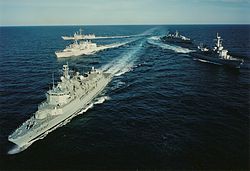
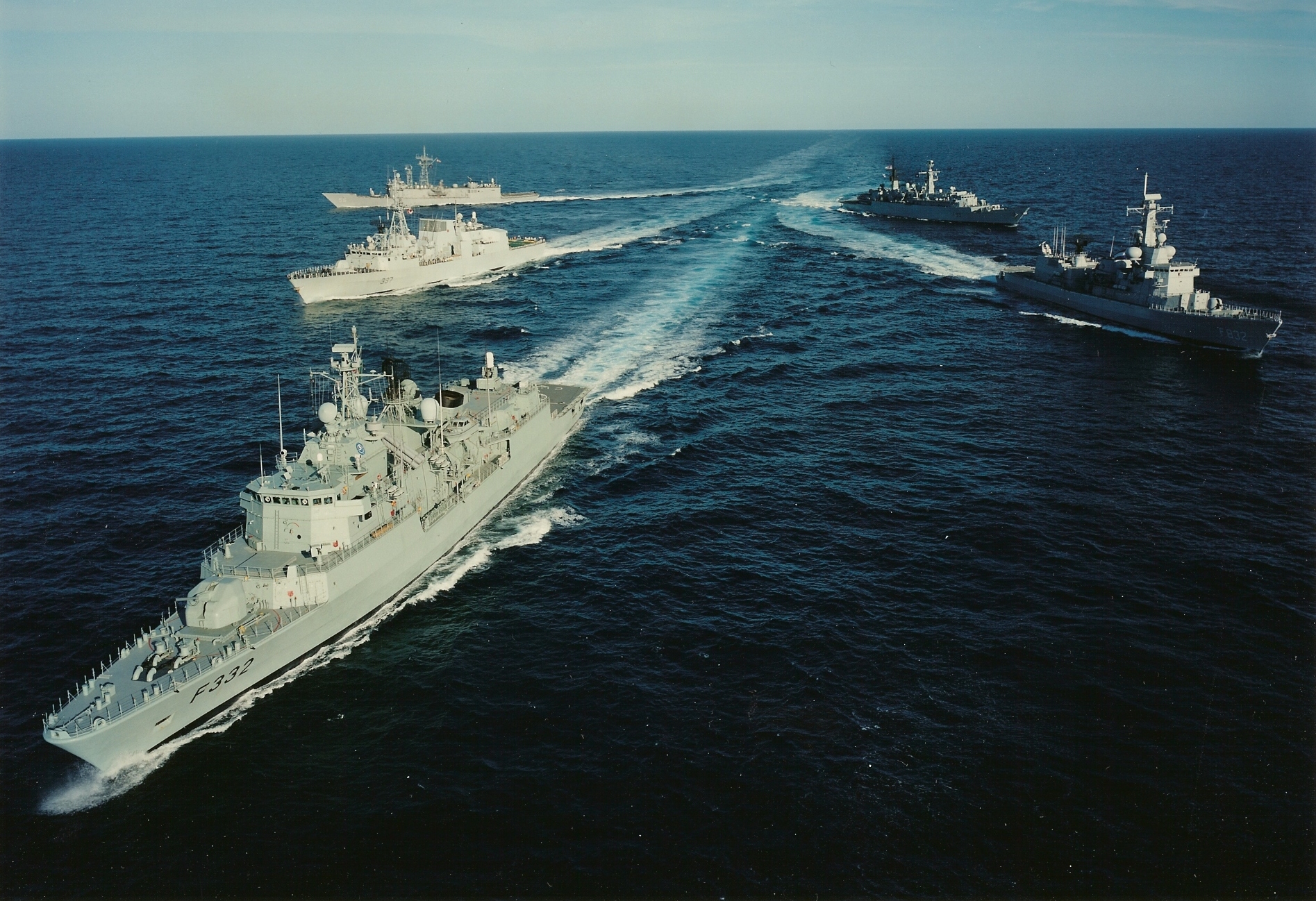
 NATO ships enforcing the blockade | |
| Objective | Blockade former Yugoslavia |
| Date | 15 June 1993 – 2 October 1996 |
| Executed by | .svg) Western European Union Western European Union NATO NATO |
Operation Sharp Guard was a multi-year joint naval blockade in the Adriatic Sea by NATO and the Western European Union on shipments to the former Yugoslavia.[1][2][3][4] Warships and maritime patrol aircraft from 14 countries were involved in searching for and stopping blockade runners. The operation began on 15 June 1993. It was suspended on 19 June 1996, and was terminated on 2 October 1996.
Background
[edit]The operation replaced naval blockades Operation Maritime Guard (of NATO; begun by the U.S. in November 1992) and Sharp Fence (of the WEU).[5] It put them under a single chain of command and control (the "Adriatic Military Committee", over which the NATO and WEU Councils exerted joint control), to address what their respective Councils viewed as wasteful duplication of effort.[1][2][6][7] Some maintain that despite the nominal official joint command and control of the operation, in reality it was NATO staff that ran the operation.[8][9]
Purpose
[edit]The operation's purpose was, through a blockade on shipments to the former Yugoslavia,[10] to enforce economic sanctions and an arms embargo of weapons and military equipment against the former Federal Republic of Yugoslavia, and rival factions in Croatia and Bosnia.[11][12][13] The Yugoslav Wars were being waged, and the participants of the blockade hoped to limit the fighting and destruction by limiting supplies being imported into the area.
Blockade
[edit]Fourteen nations contributed ships and patrol aircraft to the operation. At any given time, 22 ships and 8 aircraft were enforcing the blockade, with ships from Standing Naval Force Atlantic and Standing Naval Force Mediterranean establishing a rotating duty.[14] (Belgium, Canada, Denmark, France, Germany, Greece, Italy, the Netherlands, Norway, Portugal, Spain, Turkey, the U.K., and the U.S.),[11] and eight maritime patrol aircraft, were involved in searching for and stopping blockade runners.[2][15][16][17][18][19] Most contributors to the operation supplied one or two ships.[17] The Turkish Navy, for example, participated with frigates, submarines, and tankers.[20][21]
_Beirut.jpg)
The operational area was divided into a series of "sea boxes", each the responsibility of a single warship.[11] Each boarding team was composed of a "guard team" to board and wrest control of the target ship, and a "search team", to conduct the search.[11]
The ships were authorized to board, inspect, and seize both ships seeking to break the blockade and their cargo.[22] The Combined Task Force 440 was commanded by Admiral Mario Angeli of Italy.[2] It marked the first time since its founding in 1949 that NATO was involved in combat operations.[4]
Jadran Express incident
[edit]On 11 March 1994, a combined British and Italian intelligence operation led to the capture of the Maltese merchant ship Jadran Express by the Italian frigate Zeffiro, which forced the freighter into the port of Taranto. The ship had departed from Odessa bound to Venice with a cache of 2,000 tons of Soviet-designed weaponry, valued at US$200 million. Manned by a boarding party of Italian marines from the San Marco battalion, the Jadran Express was eventually escorted by Zeffiro to the naval base of La Maddalena, where her cargo was unloaded under heavy security.[23]
Lido II incident
[edit].jpg)
The issue of differing views among nations in the coalition as to the use of force authorized by rules of engagement arose in April 1994.[24] Faced with the Maltese tanker Lido II making its way towards a Montenegrin port with 45,000 tons of fuel oil, the American cruiser USS Philippine Sea asked the NATO commander (a British Commodore) for guidance, and received authorization to use "disabling fire" to stop the tanker, if necessary.[24] He received confirmation that he should follow the British commodore's guidance from his own higher authority.[24] Under U.S. Navy standards, "disabling fire" means firing rounds into the ship's engineering space. The U.S. cruiser was about to pass the order along to the Dutch Kortenaer-class frigate HNLMS Van Kinsbergen. However, the fact that the Dutch definition of "disabling fire" involves launching rounds into the bridge of the target ship, with an increased risk of loss of life, became important.[24] The ship was boarded by Dutch Marines inserted by helicopter from HNLMS Van Kinsbergen and eventually stopped without firing a shot on the first of May.[24] Three Yugoslav Navy Končar-class corvettes challenged the NATO operation and one of them tried to ram the British frigate HMS Chatham as it was assisting Van Kinsberger. The corvettes eventually fled following the reaction of the British warship, supported by Italian Tornado aircraft which scrambled from an airbase at Gioia Del Colle. Lido II had to undergo repairs before being diverted to Italy, since the crew had sabotaged the ship's engine room. The leaking was contained by an engineer party from HMS Chatham. Seven Yugoslav stowaways,[25][26] all of them members of the special forces of the Yugoslav Navy,[27] were found on board.[25][26] A similar incident had taken place off Montenegro a year before, on 8 February 1993, when a boarding party from the Italian frigate Espero forcibly seized the Maltese freighter Dimitrakis, which feigned an emergency in order to divert her route to the port of Bar. The merchant was smuggling coal to the Serbs from Romania.[27]
Suspension
[edit]
The blockade was suspended following a UN decision to end the arms embargo, and NATO's Southern Command said that: "NATO and WEU ships will no longer challenge, board or divert ships in the Adriatic".[2] The Independent warned at the time that "In theory, there could now be a massive influx of arms to Bosnia, Croatia and the Federal Republic of Yugoslavia (Serbia and Montenegro), although senior military and diplomatic sources yesterday said that they thought this would be unlikely."[2]
NATO naval forces inspected 5800 ships at sea . Of them, 1400 were diverted and inspected in port. No vessels were reported as having broken the embargo, although six were seized while attempting to do so.[28]
Applicable UN resolutions
[edit]The blockade was conducted in accordance with numerous United Nations Security Council Resolutions: UNSCR 713,[29] UNSCR 757,[30] UNSCR 787[31] UNSCR 820,[32] and UNSCR 943.[33] Resolution 787 authorized participating states to "use such measures ... as may be necessary ... to halt all inward and outward maritime shipping ... to insure strict implementation of" the arms embargo and economic sanctions against the former Yugoslavia.[1] Over the course of the operation, the blockade was redefined in accordance with UNSCR 1021[34] and UNSCR 1022.[35]
Ships participating (Extract)
[edit]- Belgian Navy:
- Canadian Forces Maritime Command:
- Royal Danish Navy:
- French Navy:[37]
- German Navy:
- Hellenic Navy:
- Italian Navy:
- Royal Netherlands Navy:[37]
- Portuguese Navy:
- Spanish Navy:
- Royal Norwegian Navy:
- Turkish Navy:
- Royal Navy:[2]
- U.S. Navy:
- USS America
- USS Anzio
- USS Arthur W. Radford[38]
- USS Bainbridge
- USS Boone
- USS Boston
- USS Cincinnati
- USS Cape St. George
- USS Comte de Grasse
- USS Conolly[39]
- USS Dale
- USS Deyo
- USS Dwight D. Eisenhower
- USS Edenton
- USS Elrod
- USS Groton
- USS John Rodgers
- USS Josephus Daniels
- USS Hue City
- USS Kauffman
- USS Kidd
- USS Mississippi
- USS Mitscher
- USS Monterey
- USS Nassau
- USS Nicholas
- USS Normandy[13]
- USS Pensacola
- USS Peterson
- USS Ponce
- USS Saipan
- USS Samuel B. Roberts[37]
- USS Scott[40]
- USS Simpson
- USS South Carolina
- USS Thomas S. Gates
- USS Ticonderoga
- USS Trepang (SSN-674)
- USS Theodore Roosevelt
- USS Thorn
- USS Vicksburg
- USS Yorktown
- USNS Kanawha
See also
[edit]

References
[edit]- ^ a b c Bruce A. Elleman; S. C. M. Paine (2007). Naval coalition warfare: from the Napoleonic War to Operation Iraqi Freedom. Routledge. ISBN 978-0-415-77082-8. Archived from the original on March 20, 2022. Retrieved June 7, 2010.
- ^ a b c d e f g Christopher Bellamy (June 20, 1996). "Naval blockade lifts in Adriatic". The Independent. Archived from the original on November 8, 2012. Retrieved June 7, 2010.
- ^ "U.S. Draws Criticism for Drawing out of Bosnia Blockade" Archived 2022-03-07 at the Wayback Machine, NPR, November 13, 1994
- ^ a b Peter L. Hays; Brenda J. Vallance; Alan R. Van Tassel (1997). American Defense Policy. JHU Press. p. 533. ISBN 0-8018-5473-3. Retrieved June 7, 2010.
operation sharp guard.
- ^ Carla Norrlof (2010). America's Global Advantage: US Hegemony and International Cooperation. Cambridge University Press. ISBN 978-0-521-74938-1. Archived from the original on March 20, 2022. Retrieved June 7, 2010.
- ^ Trevor Findlay (1996). Challenges for the new peacekeepers. Oxford University Press. ISBN 0-19-829199-X. Archived from the original on March 20, 2022. Retrieved June 7, 2010.
- ^ Simon Duke (2000). The elusive quest for European security: from EDC to CFSP. Palgrave Macmillan. ISBN 0-312-22402-8. Archived from the original on March 20, 2022. Retrieved June 7, 2010.
- ^ Giovanna Bono (2003). NATO's 'peace-enforcement' tasks and 'policy communities,' 1990-1999. Ashgate Publishing, Ltd. ISBN 0-7546-0944-8. Archived from the original on March 20, 2022. Retrieved June 7, 2010.
- ^ Volker Rittberger (2001). German foreign policy since unification: theories and case studies. Manchester University Press. ISBN 0-7190-6040-0. Archived from the original on March 20, 2022. Retrieved June 8, 2010.
- ^ Judy Woodruf (June 2, 2010). "As Flotilla Inquiry Calls Grow Louder, Legality of Gaza Blockade Examined". PBS NewsHour. Archived from the original on June 18, 2011. Retrieved June 7, 2010.
- ^ a b c d Kathleen M. Reddy, "Operation Sharp Guard: Lesson Learned for the Policymaker and Commander" Archived 2012-10-02 at the Wayback Machine, June 13, 1997, retrieved June 7, 2010
- ^ "Analysis: NATO's predecessor about to go out of business". United Press International. November 20, 2000. Retrieved June 7, 2010.[dead link]
- ^ a b Jack Sweetman (2002). American naval history: an illustrated chronology of the U.S. Navy and Marine Corps, 1775-present. Naval Institute Press. p. 292. ISBN 1-55750-867-4. Retrieved June 7, 2010.
operation sharp guard.
- ^ Vaughan Lowe; Adam Roberts; Jennifer Welsh (2008). The United Nations Security Council and war: the evolution of thought and practice since 1945. Oxford University Press US. ISBN 978-0-19-953343-5. Archived from the original on March 20, 2022. Retrieved June 9, 2010.
- ^ Michael Brzoska; George A. Lopez (2009). Putting teeth in the tiger: improving the effectiveness of arms embargoes. Emerald Group Publishing. ISBN 978-1-84855-202-9. Archived from the original on March 20, 2022. Retrieved June 8, 2010.
- ^ Anja Dalgaard-Nielsen (2006). Germany, pacifism and peace enforcement; Europe in change. Manchester University Press. ISBN 0-7190-7268-9. Archived from the original on March 20, 2022. Retrieved June 8, 2010.
- ^ a b G. C. de Nooy (1996). The role of European naval forces after the Cold War. Martinus Nijhoff Publishers. ISBN 90-411-0227-2. Archived from the original on March 20, 2022. Retrieved June 7, 2010.
- ^ Ronald M. Williamson (2000). Naval Air Station Jacksonville, Florida, 1940-2000: An Illustrated History. Turner Publishing Company. ISBN 1-56311-730-4. Archived from the original on March 20, 2022. Retrieved June 7, 2010.
- ^ Bernd Horn (2006). The Canadian way of war: serving the national interest. Dundurn Press Ltd. ISBN 1-55002-612-7. Archived from the original on March 20, 2022. Retrieved June 7, 2010.
- ^ Brad K. Blitz (2006). War and change in the Balkans: nationalism, conflict and cooperation. Cambridge University Press. ISBN 0-521-67773-4. Archived from the original on March 20, 2022. Retrieved June 8, 2010.
- ^ Nurşin Ateşoğlu Güney (2007). Contentious issues of security and the future of Turkey. Ashgate Publishing, Ltd. ISBN 978-0-7546-4931-1. Archived from the original on March 20, 2022. Retrieved June 8, 2010.
- ^ William J. Durch (1996). UN peacekeeping, American politics, and the uncivil wars of the 1990s. Palgrave Macmillan. ISBN 0-312-16075-5. Archived from the original on March 20, 2022. Retrieved June 8, 2010.
- ^ "Le armi di Zhukov in un deposito a Santo Stefano Erano a bordo della nave Jadran Express fermata nel 1994 nel canale di Otranto - La Nuova Sardegna". Archivio - La Nuova Sardegna (in Italian). Archived from the original on 2018-09-02. Retrieved 2018-09-02.
- ^ a b c d e Stacey A. Poe, "Rules of Engagement: Complexities of Coalition Interaction in Military Operations Other than War" Archived 2017-02-02 at the Wayback Machine, Faculty of the Nava War College, February 13, 1995
- ^ a b "NATO and WEU ships encounter Yugoslav Navy while preventing violation of UN embargo". Press Release by NATO/WEU force conducting the Operation Sharp Guard in the Adriatic Sea, 1 May 1994. Release 94/13
- ^ a b McLaughlin, Rob (2009). United Nations Naval Peace Operations in the Territorial Sea. Martinus Nijhoff Publishers, p. 42, note 81. ISBN 90-04-17479-6
- ^ a b Giorgerini, Giorgio (2006). La guerra asimmetrica. Impiego delle forze aeronavali italiane nell'ambito di dispositivi joint & combined proiettati in teatri operativi lontani; composizione, sostenibilità logistica di un"Expeditionary Group" (PDF) (in Italian). Centro Militare di Studi Strategici. p. 52. Archived (PDF) from the original on 2022-03-20. Retrieved 2018-09-04.
- ^ NATO. "Operation Sharp Guard: Suspension of enforcement operations". NATO. Retrieved 2024-04-12.
- ^ "NATO/IFOR: UN Resolution S/RES/713 (1991)". NATO. Archived from the original on January 25, 2010. Retrieved June 7, 2010.
- ^ "NATO/IFOR: UN Resolution S/RES/757 (1992)". NATO. Archived from the original on March 29, 2017. Retrieved June 7, 2010.
- ^ "NATO/IFOR: UN Resolution S/RES/787 (1992)". NATO. Archived from the original on January 25, 2010. Retrieved June 7, 2010.
- ^ "NATO/IFOR: UN Resolution S/RES/820 (1993)". NATO. Archived from the original on January 24, 2010. Retrieved June 7, 2010.
- ^ "NATO/IFOR: UN Resolution S/RES/943 (1994)". NATO. September 23, 1994. Archived from the original on January 17, 2010. Retrieved June 7, 2010.
- ^ "NATO/IFOR: UN Resolution S/RES/1021 (1995)". NATO. Archived from the original on January 25, 2010. Retrieved June 7, 2010.
- ^ "NATO/IFOR: UN Resolution S/RES/1022 (1995)". NATO. Archived from the original on January 26, 2010. Retrieved June 7, 2010.
- ^ Frank Gale (January 4, 2008). "Stephenville native appointed commander of HMCS Calgary". The Western Star. Archived from the original on February 4, 2013. Retrieved June 9, 2010.
- ^ a b c d e "Factsheets : Operation Sharp Guard". Air Force Historical Studies Office. Archived from the original on July 22, 2011. Retrieved June 8, 2010.
- ^ "Destroyer Joins Operation Sharp Guard". CINCUSNAVEUR - Commander in Chief, US Naval Forces, Europe. 23 May 1996. Archived from the original on 4 March 2014. Retrieved 7 September 2018.
- ^ John Pike. "DD 979 Conolly". Globalsecurity.org. Archived from the original on September 12, 2009. Retrieved June 9, 2010.
- ^ "Military News" Archived 2016-07-30 at the Wayback Machine, Pittsburgh Post-Gazette, January 6, 1994, retrieved June 8, 2010
External links
[edit]
- Security Council resolutions
- UN Security Council Official Website, including all resolutions
- NATO Regional HQ Allied Forces Southern Europe Fact Sheet on Operation Sharp Guard
- Update on Operation Sharp Guard, December 1995
- General Framework Agreement
- "Evolution of the Conflict", NATO Handbook, December 18, 2002
- "Operation Sharp Guard: the sea embargo of Serbia and Montenegro", Barberan, J. F., Revista de Aeronáutica y Astronáutica, no. 727, pp. 750–57. October 2003
Operation Sharp Guard
View on GrokipediaHistorical Context
Dissolution of Yugoslavia and Bosnian War
The Socialist Federal Republic of Yugoslavia, formed after World War II under Josip Broz Tito, maintained unity through a federal system balancing ethnic groups including Serbs, Croats, Slovenes, Bosniaks, and others, but underlying tensions from World War II-era atrocities and regional inequalities persisted.[7] Tito's death in 1980 exacerbated economic stagnation, hyperinflation exceeding 2,500% annually by 1989, and mounting foreign debt surpassing $20 billion, fueling resentment in wealthier republics like Slovenia and Croatia toward perceived Serbian dominance in federal institutions.[7] Slobodan Milošević's ascent in Serbia in 1987, marked by his 1989 Kosovo speech invoking Serb victimhood, intensified nationalist mobilization, while multi-party elections in 1990 in Slovenia, Croatia, and Bosnia shifted power toward secessionist parties.[7][8] On June 25, 1991, Slovenia and Croatia declared independence, prompting the Yugoslav People's Army (JNA), predominantly Serb-led, to intervene; Slovenia's Ten-Day War ended with JNA withdrawal after minimal casualties, securing de facto independence, while Croatia faced a prolonged conflict with Serb rebels in Krajina and Slavonia, resulting in the siege of Vukovar in November 1991 where over 200 patients and staff were killed in a hospital massacre.[9][7] By early 1992, the European Community recognized Slovenia and Croatia's independence on January 15, amid JNA redeployments that armed local Serb militias.[7] Bosnia and Herzegovina, with its fragile multi-ethnic composition—43% Bosniak, 31% Serb, 17% Croat—held an independence referendum in February-March 1992, boycotted by most Serbs, leading to a 99% approval among participants and declaration of sovereignty on March 3, followed by international recognition in April.[10] Bosnian Serbs, led by Radovan Karadžić, rejected this and proclaimed Republika Srpska, seizing over 60% of territory with JNA support before its formal withdrawal.[10][8] War erupted in Bosnia on April 6, 1992, with Bosnian Serb forces, reorganized as the Army of Republika Srpska (VRS), initiating sieges and ethnic cleansing campaigns targeting Bosniaks and Croats to create contiguous Serb-held areas; Sarajevo came under blockade from May 1992, enduring shelling that killed over 10,000 civilians by war's end.[10] Croat-Bosniak alliances fractured by mid-1993 into the Croat-Bosniak War, with mutual atrocities including the Ahmići massacre of 116 Bosniaks by Croat forces in April 1993, though Serb actions dominated territorial gains and systematic expulsions displacing over 2 million people.[10] The Federal Republic of Yugoslavia (FRY, comprising Serbia and Montenegro), formed in April 1992 after other republics seceded, continued covertly supplying the VRS with fuel, arms, and personnel, circumventing UN arms embargoes initially imposed via Security Council Resolution 713 in September 1991.[11][12] In response, the UN Security Council expanded sanctions against the FRY in May 1992 through Resolution 757, prohibiting trade in most goods except humanitarian aid and targeting oil imports to pressure Belgrade to cease support for Bosnian Serbs, whose non-compliance prolonged the conflict marked by events like the Srebrenica enclave fall in July 1995 where over 8,000 Bosniak men and boys were executed.[11][10] These measures aimed to isolate the FRY economically, reducing GDP by an estimated 30% in 1992-1993, but evasion via Adriatic smuggling routes underscored enforcement challenges that later necessitated multinational naval operations.[11] The war's ethnic fragmentation, rooted in competing claims to historic homelands rather than solely external aggression, defied simple narratives of victimhood, as documented in International Criminal Tribunal for the former Yugoslavia indictments against leaders from all major factions for crimes including forced deportations and unlawful killings.[8]Imposition of UN Sanctions on FRY
The United Nations Security Council imposed an initial arms embargo on the Socialist Federal Republic of Yugoslavia (SFRY) through Resolution 713 on September 25, 1991, in response to escalating ethnic violence and the threat of widespread conflict following Slovenia and Croatia's declarations of independence, aiming to prevent further arms inflows that could intensify hostilities.) This measure was extended by subsequent resolutions, including 724 on December 15, 1991, amid the SFRY's disintegration into successor states, with the Federal Republic of Yugoslavia (FRY, comprising Serbia and Montenegro) emerging as the primary entity continuing aggressive policies.) Following the recognition of Bosnia and Herzegovina's independence and reports of FRY support for Bosnian Serb forces, including military aid and personnel, the Security Council adopted Resolution 757 on May 30, 1992, targeting comprehensive economic sanctions specifically against the FRY to compel cessation of interference in Bosnia.) These sanctions prohibited the import and export of goods (except medical supplies and foodstuffs in humanitarian quantities), banned financial transfers to or from the FRY, restricted air traffic, and suspended membership privileges in international organizations, reflecting the Council's determination that FRY leadership under Slobodan Milošević bore responsibility for fueling the Bosnian War through proxy aggression.[11] Resolution 820 on April 17, 1993, further intensified enforcement by declaring the Danube River closed to FRY-registered vessels and authorizing member states to halt and inspect maritime traffic to and from FRY ports, directly setting the stage for naval interdiction operations like Sharp Guard to curb sanctions evasion via Adriatic shipping routes.) These measures were justified by documented FRY violations, including arms supplies to Bosnian Serbs rejecting the Vance-Owen peace plan, though critics noted uneven implementation due to smuggling and selective enforcement influenced by geopolitical interests among permanent Council members. The sanctions remained in effect until partial suspensions in 1995 following the Dayton Accords, with full termination via Resolution 1074 on October 1, 1996, after FRY compliance with election-related conditions in Bosnia.[13]Establishment and Mandate
Coordination Between NATO and WEU
Operation Sharp Guard represented the first joint naval operation between NATO and the Western European Union (WEU), initiated on 15 June 1993 to enforce United Nations sanctions against the Federal Republic of Yugoslavia through a unified maritime interdiction in the Adriatic Sea.[2][1] This merger replaced NATO's Operation Maritime Guard, which monitored shipping, and the WEU's Operation Sharp Fence, which conducted actual boardings and inspections, thereby streamlining efforts under a single framework to enhance efficiency and reduce duplication.[5][14] The command structure emphasized NATO's operational control, with WEU providing augmenting staff officers to integrate European defense perspectives into the decision-making process.[2] A Combined Task Force 440 oversaw the dual naval elements—one led by NATO and the other by WEU—enabling coordinated challenges, boardings, and verifications of suspect vessels.[2] NATO assets, including maritime patrol aircraft conducting surveillance over the Otranto Strait, complemented WEU surface units, ensuring comprehensive coverage of embargoed routes.[2] Joint planning occurred through parallel NATO and WEU councils, which synchronized policy adaptations, such as the suspension of enforcement on 1 October 1996 following UN Security Council Resolution 1071.[6][15] This coordination demonstrated effective interoperability between the transatlantic alliance and the emerging European defense pillar, with NATO's established command infrastructure facilitating WEU's operational debut in crisis management.[5] Over the operation's duration, the partnership intercepted more than 29,000 vessels, diverting around 1,000 for inspection, underscoring the viability of dual-led enforcement without significant friction.[5] Post-operation assessments highlighted the model's success in building trust and procedural alignment, influencing subsequent NATO-WEU collaborations in the Balkans.[5]Legal Framework from UN Security Council Resolutions
The legal framework for Operation Sharp Guard derived from United Nations Security Council resolutions enacted under Chapter VII of the UN Charter, which authorized coercive measures to address threats to international peace posed by the Federal Republic of Yugoslavia (FRY). These resolutions progressively imposed an arms embargo, comprehensive economic sanctions, and specific maritime interdiction authorities to prevent the supply of prohibited goods to the FRY and Bosnian Serb forces.[5][16] United Nations Security Council Resolution 713, adopted unanimously on 25 September 1991, established the initial arms embargo on all deliveries of weapons and military equipment to the Socialist Federal Republic of Yugoslavia amid the outbreak of inter-republic violence. This measure aimed to curb escalation but proved insufficient as conflict intensified, leading to further resolutions targeting the FRY (Serbia and Montenegro) after the international recognition of other Yugoslav republics. Resolution 757, passed on 30 May 1992, expanded sanctions to include prohibitions on trade in most commodities, financial transfers, and scientific or technical services with the FRY, explicitly linking these to demands for withdrawal of FRY forces from Croatia and Bosnia-Herzegovina.[5][17] Resolution 787, adopted on 16 November 1992, provided early maritime enforcement authority by permitting states to inspect vessels suspected of carrying sanctioned goods to or from the FRY or Bosnian Serb territories, including the use of "all necessary measures" commensurate with circumstances to halt such shipping. However, the pivotal resolution for Operation Sharp Guard was Resolution 820, enacted on 17 April 1993, which declared the ports, internal waters, and territorial sea of the FRY closed to all maritime traffic carrying unauthorized cargoes and explicitly authorized UN member states, acting nationally or through regional organizations, to halt, board, and inspect inward or outward vessels for verification, diversion, or seizure of prohibited items. This effectively legalized a blockade of the Adriatic Sea approaches to FRY ports, addressing gaps in prior enforcement and responding to reports of sanctions evasion via maritime routes. NATO and the Western European Union cited Resolution 820 as the primary mandate for combining their respective operations (Maritime Guard and Sharp Fence) into Sharp Guard on 15 July 1993, ensuring coordinated interdiction under unified command.[2][18][16] Subsequent resolutions refined the framework without altering the core maritime mandate; for instance, Resolution 943 of 23 September 1994 allowed limited sanctions relief for FRY cooperation on oil deliveries to Macedonia, while Resolutions 1021 and 1022 of 22 November 1995 suspended broader economic sanctions and terminated the arms embargo following the Dayton Agreement, leading to Sharp Guard's suspension on 1 October 1996. These measures collectively provided the binding international authority for the operation, with participating states acting on the understanding that non-compliance could justify resumption if violations recurred.[2][6][19]Operational Execution
Participating Naval Forces and Assets
Combined Task Force 440 (CTF 440) oversaw the maritime interdiction efforts, merging NATO's Standing Naval Force Mediterranean with Western European Union (WEU) elements under unified command from Naples, Italy.[5] Fourteen nations provided surface vessels, submarines, and auxiliary ships on rotational deployments: Belgium, Canada, Denmark, France, Germany, Greece, Italy, the Netherlands, Norway, Portugal, Spain, Turkey, the United Kingdom, and the United States.[5] At peak operational tempo, approximately 22 warships maintained continuous presence in the Adriatic, enforcing the blockade through challenges, boardings, and diversions of suspect vessels.[2] Surface combatants dominated the fleet, including frigates, destroyers, and corvettes equipped for anti-surface warfare, boarding operations, and helicopter deployment. Canada contributed 11 destroyer and frigate rotations, beginning with HMCS Algonquin in July 1993, alongside auxiliary oiler HMCS Protecteur for logistics support.[2] The United Kingdom deployed Type 22 frigates such as HMS Chatham (F87) and Type 42 destroyers like HMS Nottingham (D91) for escort and interdiction duties.[1] Italy provided Maestrale-class frigates, including ITS Zeffiro (F577), leveraging its strategic Adriatic basing at Taranto and Brindisi. France and Germany rotated Cassard-class and Lütjens-class vessels, respectively, emphasizing multinational interoperability under NATO protocols.[5] Air assets augmented naval surveillance with up to eight maritime patrol aircraft (MPA) on station daily, drawn from nine NATO contributors: France, Germany, Italy, the Netherlands, Portugal, Spain, Turkey, the United Kingdom, and the United States.[20] Platforms included French Atlantique, German P-3 Orion variants, and U.S. P-3C aircraft operating from bases in Sigonella, Italy, providing overflight intelligence and real-time targeting data to surface units; U.S. Navy P-3s alone accounted for 51% of patrol sorties during the operation.[21] Auxiliary support encompassed replenishment ships for at-sea refueling and mine countermeasures vessels from Italy to clear potential threats in littoral zones.[1] No fixed-wing carrier operations were central, though U.S. carriers like USS Theodore Roosevelt (CVN-71 provided intermittent air cover during heightened tensions.[22]Enforcement Procedures and Rules of Engagement
Operation Sharp Guard's enforcement procedures centered on maritime interdiction to implement United Nations Security Council Resolution 820 (1993), which mandated comprehensive sanctions against the Federal Republic of Yugoslavia (FRY), including the closure of its territorial waters to maritime traffic and authorization for inspections and seizures of violating cargoes.[23][5] Under Combined Task Force (CTF) 440, NATO-led with Western European Union (WEU) integration, operations divided the Adriatic into task groups: TG 440.01 for the northern Adriatic and Albanian coast, TG 440.02 for the Strait of Otranto, and TG 440.03 for training and logistics support.[5] Systematic challenges occurred within designated "sea boxes" for vessel tracking, with over 74,000 ships hailed by radio to verify manifests and destinations; approximately 6,000 received at-sea inspections, and 1,400 were diverted to ports like Bari, Italy, for thorough examination.[5] Suspect vessels underwent visit, board, search, and seizure (VBSS) operations by specialized teams comprising guard units for control and search units for cargo verification, often augmented by U.S. Coast Guard training.[5][24] Only six ships were interdicted for attempted violations, with no successful sanctions breaches recorded due to the operation's deterrent effect.[5] Rules of engagement (ROE) derived from NATO standing naval ROE, with mission-specific addenda to authorize coercive measures for embargo enforcement as a peace-enforcement operation, compelling compliance without requiring a formal belligerency declaration.[5][25] The unified command adopted NATO ROE to streamline procedures across NATO and WEU forces, mitigating interoperability issues despite national variations—U.S. ROE permitted broader mission accomplishment authority, while some European allies imposed restrictions limiting force to immediate self-defense against hostile acts or intent.[25][26] Force escalation followed proportionality principles: warnings via signal or shot across the bow for non-compliance, disabling fire if resistance persisted, and lethal force only for self-defense or imminent threats, though no major use-of-force incidents occurred owing to high vessel compliance rates.[25] Coordination emphasized deconfliction through shared recognized maritime pictures and joint planning, with air assets logging 62,300 flight hours for surveillance support from 14 participating nations.[5] Challenges arose in the Lido II incident of April 1994, where coalition divergences on ROE interpretation highlighted tensions between permissive and restrictive national policies during a potential boarding refusal.[27] Overall, the ROE framework prioritized deterrence and minimal escalation, aligning with the operation's non-combatant enforcement mandate.[25]Key Incidents and Interdictions
Throughout Operation Sharp Guard, forces challenged approximately 75,000 merchant vessels, boarded and inspected over 5,900 at sea, and diverted about 1,400 to port for further examination.[26] Despite this extensive enforcement, only six ships were intercepted while attempting to violate the UN embargo on deliveries to the Federal Republic of Yugoslavia and Bosnian Serbs, with none succeeding in breaching the blockade.[6][5] The most prominent incident occurred in April 1994 involving the Maltese-registered tanker Lido II, which was en route to a Montenegrin port with a cargo of fuel oil in contravention of sanctions.[28] British frigate HMS Chatham challenged the vessel, leading to resistance from the crew, who sabotaged the engine room, causing a fuel leak that was contained by an embarked engineer.[28] After repairs, Lido II was diverted to Italy for inspection, marking a successful interdiction that tested rules of engagement without escalation to force.[28] This event underscored the operation's deterrent effect and the coalition's coordinated response to potential violations. Other interdictions involved similar diversions of suspect vessels, including around a dozen by Canadian forces through hails, boardings, and inspections, though specific details on additional named ships remain limited in declassified records.[2] Yugoslav naval elements occasionally challenged enforcing ships, but no collisions or shots were exchanged, maintaining the operation's non-kinetic nature.[5] These rare attempts highlighted the blockade's efficacy in preventing sanctions evasion via maritime routes.Termination and Immediate Outcomes
Decision to Suspend Enforcement
The suspension of enforcement in Operation Sharp Guard occurred on 19 June 1996, following the United Nations Security Council's termination of the arms embargo against the Federal Republic of Yugoslavia (FRY) on 18 June 1996. This decision aligned with the broader lifting of UN sanctions, prompted by progress toward peace in Bosnia and Herzegovina after the Dayton Agreement, which had been initialed in November 1995 and formally signed in December 1995. The NATO and Western European Union (WEU) Councils directed the suspension, instructing participating naval forces to cease challenging or inspecting suspect vessels in the Adriatic Sea, thereby ending the active maritime interdiction regime.[6][29] The rationale for suspension stemmed from the diminished necessity of the blockade once the UN sanctions regime began to unwind. UN Security Council Resolution 1022 (22 November 1995) had already outlined a phased approach to easing sanctions contingent on compliance with the Dayton Accords, including the holding of elections in Bosnia. By mid-1996, with the arms embargo lifted and no further violations requiring enforcement, NATO and WEU assessed that continued operations were redundant, allowing assets to redirect toward post-conflict stabilization efforts under Implementation Force (IFOR). This move reflected a strategic pivot from containment to reconstruction, though full operational termination followed later on 2 October 1996, coinciding with the complete UN revocation of outer sanctions via Resolution 1074.[29][20] No significant opposition or debate within NATO or WEU delayed the suspension, as it mirrored the UN's policy shift and avoided prolonging a mission that had intercepted over 29,000 vessels without major incidents. Critics later questioned whether earlier suspension might have pressured FRY compliance more aggressively, but contemporaneous assessments by alliance leadership emphasized the operation's success in maintaining sanction integrity until diplomatic breakthroughs rendered it obsolete.[4]Statistical Summary of Blockade Activities
Over the course of Operation Sharp Guard, from 15 July 1993 to 1 October 1996, NATO and WEU naval forces challenged approximately 74,000 merchant vessels in the Adriatic Sea to enforce UN sanctions against the Federal Republic of Yugoslavia.[6] Of these, more than 5,800 were boarded and inspected at sea, while nearly 1,400 were diverted to port for thorough examination.[6] [5] These activities yielded six confirmed interdictions of ships attempting to breach the embargo, with no vessels successfully evading enforcement and delivering prohibited cargo.[6] [5] The operation's enforcement metrics reflect a high volume of routine compliance checks, as the vast majority of challenged ships carried legitimate cargoes unrelated to sanctions. Detailed tallies from NATO records indicate precise figures as follows:| Metric | Total |
|---|---|
| Ships challenged | 74,192 |
| Boardings and inspections at sea | 5,951 |
| Ships diverted to port | 1,480 |
| Sanctions violators intercepted | 6 |