Hubbry Logo
Teres major muscleTeres major muscleMain
Open search
Teres major muscle
Community hub
Teres major muscle
logo
8 pages, 0 posts
0 subscribers
Be the first to start a discussion here.
Teres major muscle
Teres major muscle
from Wikipedia

Teres major muscle
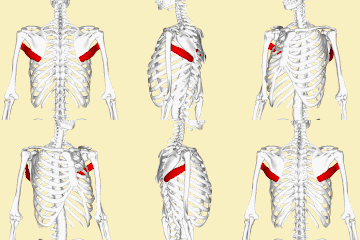
Posterior view showing the relations between teres major muscle (in red) and the other muscles connecting the upper extremity to the vertebral column.
Teres major muscle (in red) seen from back (posterior to anterior perspective).
Details
OriginPosterior aspect of the inferior angle of the scapula
InsertionMedial lip of the intertubercular sulcus of the humerus
ArterySubscapular and circumflex scapular arteries
NerveLower subscapular nerve (segmental levels C5 and C6)
ActionsAdduct the humerus, internal rotation (medial rotation) of the humerus, extend the humerus from flexed position
Identifiers
Latinmusculus teres major
TA98A04.6.02.011
TA22462
FMA32549
Anatomical terms of muscle

The teres major muscle is a muscle of the upper limb. It attaches to the scapula and the humerus and is one of the seven scapulohumeral muscles. It is a thick but somewhat flattened muscle.

The teres major muscle (from Latin teres, meaning "rounded") is positioned above the latissimus dorsi muscle and assists in the extension and medial rotation of the humerus. This muscle is commonly confused as a rotator cuff muscle, but it is not, because it does not attach to the capsule of the shoulder joint, unlike the teres minor muscle, for example.

Structure

[edit]

The teres major muscle originates on the dorsal surface of the inferior angle and the lower part of the lateral border of the scapula.

The fibers of teres major insert into the medial lip of the intertubercular sulcus of the humerus.[1]

Relations

[edit]

The tendon, at its insertion, lies behind that of the latissimus dorsi, from which it is separated by a bursa, the two tendons being, however, united along their lower borders for a short distance. The fibers of these two muscles run parallel to each other, and both muscles insert at the crest of the lesser tubercle of the humerus (also described as the medial lip of the intertubercular sulcus).

Together with teres minor muscle, teres major muscle forms the axillary space, through which several important arteries and veins pass.[2][3]

Innervation

[edit]

Teres major is supplied primarily by the lower subscapular nerve[4] and additionally by the thoracodorsal nerve (middle subscapular nerve). These are distal to the upper subscapular nerve. These three nerves branch off the posterior cord of the brachial plexus. The nerves that innervate teres major consist of fibers from spinal nerves C5-C8.[4]

Function

[edit]

The teres major is a medial rotator and adductor of the humerus and assists the latissimus dorsi in drawing the previously raised humerus downwards and backwards (extension, but not hyperextension). It also helps stabilise the humeral head in the glenoid cavity.

Injury

[edit]

Isolated teres major injuries are rare. They are almost exclusively encountered in professional and high-level recreational athletesbaseball pitchers in particular. These injuries can be debilitating, requiring lengthy rehabilitation periods and missed seasons of athletics. No clear indications for surgical treatment exist. Outcomes have been generally good after both nonoperative and operative treatment.[5]

Additional images

[edit]

See also

[edit]

References

[edit]
[edit]
Revisions and contributorsEdit on WikipediaRead on Wikipedia
from Grokipedia
The teres major muscle is a thick, flattened, rectangular muscle in the that originates from the posterior surface of the inferior angle of the and inserts onto the medial lip of the intertubercular groove of the . It lies deep to the and contributes to the posterior wall of the alongside the latissimus dorsi and subscapularis muscles. Innervated by the (arising from spinal levels C5, C6, and C7), the teres major receives its blood supply primarily from the posterior circumflex humeral artery and the thoracodorsal branch of the . Functionally, the teres major acts to extend, adduct, and medially rotate the at the , often working synergistically with the latissimus dorsi to facilitate powerful movements such as pulling the arm downward and backward. It also helps stabilize the humeral head within the during these actions. Although not part of the , its proximity to the makes it relevant in clinical contexts, where isolated injuries are rare but can occur in overhead athletes or through trauma, leading to , weakness in adduction and extension, and potential swelling. Combined tears with the latissimus dorsi may require surgical intervention, such as tendon transfers, while the muscle's anatomical position near the can contribute to compression syndromes affecting nearby neurovascular structures. Embryologically, the teres major develops from the paraxial during the fourth to fifth weeks of , with its muscular framework established by the eighth week.

Anatomy

Origin and insertion

The teres major muscle originates from the posterior surface of the inferior of the and the adjacent lower portion of the lateral border of the , where the muscle fibers arise as a broad, flat that narrows into a thick . This origin site provides a stable base on the for the muscle's attachment. The muscle inserts via its onto the medial lip of the intertubercular (bicipital) sulcus of the proximal , typically blending with the of the in this region to form a common insertion structure. The insertion footprint measures approximately 50 mm in length and 7 mm in width on average. Morphologically, the teres major is a thick, flattened, and somewhat rectangular muscle with fibers oriented parallel to those of the latissimus dorsi; it spans about 12 cm in length from origin to insertion in adults, enabling effective force transmission across the . Anatomical variations are uncommon but include differences in the degree of tendon fusion with the latissimus dorsi at the insertion and occasional accessory muscular slips extending from the inferior angle of the or connecting the teres major to the long head of the triceps brachii.

Relations

The teres major muscle is positioned anterior to the long head of the triceps brachii, while lying deep to the latissimus dorsi. Its anterior aspect relates to the . In the axillary region, the teres major forms part of the posterior wall of the , along with the latissimus dorsi and subscapularis muscles. A subtendinous lies between the tendon of the teres major and that of the latissimus dorsi, facilitating smooth gliding and reducing friction between these structures during shoulder movement. At its insertion on the medial lip of the intertubercular sulcus of the , the teres major is continuous with the latissimus dorsi, forming a functional unit commonly referred to as the latissimus-teres complex. Pathologically, or injury to the teres major can lead to compression of neurovascular structures in the , such as the .

Innervation

The teres major muscle receives its primary motor innervation from the , which originates as the third branch of the of the and derives its fibers from the C5, C6, and C7 spinal nerve roots. This nerve provides exclusive motor supply to facilitate , with no significant cutaneous sensory distribution. The emerges in the near the second part of the , courses inferiorly along the posterior aspect of the —giving off a branch to its inferior portion—before continuing to enter the teres major muscle on its deep medial surface, typically at about 30% of the muscle's length from its humeral insertion. In variant anatomy, observed in approximately 13% of cases, the (arising from C6-C8 roots) supplies the teres major either independently or in conjunction with the , potentially altering surgical considerations in the . Proprioceptive sensory fibers travel within the same motor nerves, relaying feedback from muscle spindles and Golgi tendon organs to contribute to overall proprioception and coordinated movement. This neural arrangement underscores the teres major's integration with adjacent structures like the subscapularis for medial rotation stability.

Blood supply

The teres major muscle receives its primary arterial blood supply from the , a major branch of the , which arises from the third part of the and provides nourishment to the lower portion of the muscle, especially near its insertion on the . The itself, the largest branch of the , further contributes through its circumflex scapular branch, which delivers perforating branches to the muscle belly along its course around the lateral border of the . Additionally, the posterior circumflex humeral artery, originating directly from the and passing through the , supplies the upper aspects of the teres major, as well as adjacent structures like the deltoid and teres minor. Venous drainage of the teres major parallels its arterial supply, with accompanying veins collecting deoxygenated blood from the muscle and draining into the subscapular vein, which then joins the to return blood to the heart. Vascular variations in the supply to the teres major are uncommon but can include anomalies such as the absence of the , in which case the circumflex scapular and thoracodorsal arteries may arise independently from the , potentially compensated by collateral branches from adjacent vessels like the .

Function

Primary actions

The teres major muscle serves as a primary mover in shoulder adduction, drawing the humerus toward the body's midline at the glenohumeral joint. This action is facilitated by its insertion on the medial lip of the intertubercular sulcus of the , allowing efficient pull when the arm is elevated. Adduction is particularly forceful when starting from a position of about 90 degrees of abduction, where the muscle's line of pull aligns optimally with the joint's mechanics. In extension, the teres major extends the posteriorly at the glenohumeral , especially effective from flexed arm positions such as those encountered in pulling or motions. This movement synergizes with the latissimus dorsi, enhancing overall posterior displacement of the arm. The muscle's extension peaks in mid-range positions, contributing to deceleration in overhead activities. The teres major also drives medial (internal) of the , rotating the inward toward the trunk. It works in concert with the subscapularis to produce this inward , which is most pronounced when the is in a neutral or slightly abducted position. This rotational action supports combined movements like adduction with internal , common in functional tasks such as reaching across the body.

Stabilizing role

The teres major muscle contributes to the stability of the glenohumeral joint by compressing the humeral head against the during arm elevation, thereby preventing superior migration that could lead to . This compressive action supports the concavity-compression mechanism essential for joint integrity, particularly as the deltoid's upward pull increases during overhead motions. As an accessory stabilizer, the teres major synergizes with the muscles—supraspinatus, infraspinatus, teres minor, and subscapularis—to enhance overall stability, especially during resisted adduction. Its line of action aligns closely with the subscapularis, allowing coordinated internal rotation and compression that reinforces the 's dynamic support without being a primary member of the group. This synergy is particularly evident in activities involving adduction against resistance, where the teres major helps secure the humeral head while the rhomboids stabilize the scapula on the thoracic wall. In postural contexts, the teres major integrates with the latissimus dorsi to maintain scapulohumeral rhythm during upright positions, ensuring smooth coordination between humeral and scapular movements for balanced function. This partnership facilitates extension and adduction while preserving alignment, contributing to overall upper body posture and preventing compensatory deviations in the scapulothoracic articulation.

Clinical significance

Injuries

Injuries to the teres major muscle primarily involve at the musculotendinous junction or tendon-bone interface, classified as partial (grade II, with and partial fiber disruption) or complete (grade III, with full discontinuity and possible retraction). These can arise acutely from traumatic overload or chronically from repetitive microtrauma in overhead activities. Common mechanisms include sudden forceful eccentric contractions during throwing motions, as seen in pitchers, or resisted arm extension in sports like , waterskiing, or . Additional triggers encompass heavy (e.g., ) and falls with the arm in extension or abduction, exploiting the muscle's vulnerability near its humeral insertion. Isolated teres major tears are infrequent due to its synergistic action with the latissimus dorsi, often resulting in combined injuries. Recent examples include pitchers such as Pablo López (2025) and Joe Ryan (2024), who suffered Grade 2 strains requiring 8-12 weeks recovery. Symptoms typically manifest as acute, sharp pain in the posterior and , radiating to the upper , accompanied by localized swelling, ecchymosis, and tenderness along the muscle belly. Patients often report during adduction, internal , or extension of the , with possible visible from muscle retraction; pain intensifies with resisted movements or overhead positioning. Due to functional overlap with adjacent muscles, isolated teres major injuries may present subtly, mimicking other . Teres major injuries are uncommon, predominantly affecting males aged 20-40 in athletic populations engaged in overhead or contact sports. Case reports highlight their rarity, with only a handful of isolated ruptures documented, such as 4 among 10 pitchers in one series, underscoring underreporting due to conservative management and rapid recovery in mild cases.

Surgical and therapeutic considerations

Diagnosis of teres major muscle injuries typically involves a combination of clinical examination and . Clinical tests, such as resisted adduction of the , can elicit or indicative of a tear by palpating the muscle's contraction in the posterior axillary fold. For confirmation, (MRI) is the gold standard, revealing muscle , discontinuity, and retraction distance in acute tears, while provides dynamic assessment for partial tears and is useful for initial evaluation. (EMG) is employed to assess nerve involvement, particularly lower subscapular nerve lesions affecting the teres major, by evaluating patterns alongside the latissimus dorsi. Nonoperative management is the initial approach for most teres major injuries, especially partial tears, emphasizing rest, ice application, nonsteroidal anti-inflammatory drugs (NSAIDs) for and control, and . focuses on restoring and strengthening synergist muscles like the latissimus dorsi and to compensate for deficits. This conservative strategy yields success rates of 80-90% for partial tears, with many patients, including athletes, returning to prior activity levels without . Surgical intervention is reserved for complete , failed nonoperative treatment, or high-demand athletes, involving repair through open or arthroscopic techniques to reattach the teres major to the . For chronic or irreparable cases, tenodesis or transfer procedures, such as combined latissimus dorsi and teres major transfer, are utilized to restore function. Outcomes are generally favorable, with return-to-sport rates around 75% in professional athletes and low re-rupture rates when repair is performed acutely. Rehabilitation following either nonoperative or surgical treatment follows a phased 3-6 month protocol to ensure safe progression. Initial immobilization in a sling for 4-6 weeks protects the repair or injury site, followed by passive range-of-motion exercises. Subsequent phases introduce active strengthening of the rotator cuff and scapular stabilizers, advancing to functional and sport-specific training by 4-6 months, with full return to activity typically at 6 months. This structured approach minimizes complications and optimizes long-term shoulder stability.

References

Add your contribution
Related Hubs
User Avatar
No comments yet.