Hubbry Logo
ThandianiThandianiMain
Open search
Thandiani
Community hub
Thandiani
logo
8 pages, 0 posts
0 subscribers
Be the first to start a discussion here.
Thandiani
Thandiani
from Wikipedia

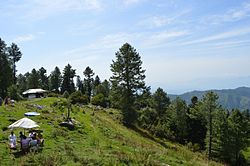
Thandiani is a hill station in the Galyat area of the Khyber Pakhtunkhwa Province of Pakistan, about 37.5 kilometres (23.3 mi) northeast of Abbottabad District in the foothills of the Himalayas[1][2] and about 2,750 metres (9,020 ft) above sea level.

Key Information

History

[edit]

Thandiani was originally granted as a lease to some members of the Battye family[3] in British India, who were Christian missionaries and also worked in the British civil service and military.[citation needed] The Battyes subsequently gave the site to the Anglican church, where a sanatorium and various other facilities were set up during the British rule. It also contained some private European houses, a camping ground, a small bazaar, and a small seasonal church of Francis Xavier in the Wilderness which were occupied only during the summer months.[4]

Forests and wildlife

[edit]

The mountains around Thandiani are more thickly forested than most other hill stations in the area, which have undergone more deforestation. The local wildlife includes leopards, monkeys, several kinds of pheasants and the rarer flying squirrel and pine marten.[5]

2005 earthquake

[edit]

The area and its surrounding villages were damaged by the 2005 Kashmir earthquake.

References

[edit]
[edit]
Revisions and contributorsEdit on WikipediaRead on Wikipedia
from Grokipedia
Thandiani is a serene in the of province, , situated approximately 30 kilometers northeast of at an elevation of 2,700 meters above sea level. Renowned for its cool, refreshing climate—reflected in its name, meaning "cool air" in the local dialect—the area features dense forests, natural springs, and breathtaking panoramic views of surrounding mountain ranges, including the Pir Panjal and distant glimpses of . It serves as a peaceful summer retreat and gateway to the Galyat region, offering respite from the heat with lush greenery, wildlife, and minimal commercialization. Established during the British colonial era in the , Thandiani was developed as a and summer escape for British officers, missionaries, and their families, initially leased to members of the Battye family who were Christian missionaries involved in civil and military roles. The site was later gifted to church authorities, leading to the construction of facilities like St. Xavier's Church in 1874, a timbered structure that catered to and remains a historical landmark amid British-era ruins and bungalows. The 2005 earthquake impacted the area, but it has since recovered, preserving its colonial heritage alongside natural beauty. Key attractions include expansive coniferous forests ideal for and spotting—such as leopards, monkeys, and pheasants—and eco-friendly initiatives like the Thandiani Camping Pods project, which provides modern lodging with allied facilities in a sustainable manner. A forest rest house along trails offers basic accommodations, while the plateau's small size and lack of extensive infrastructure, including intermittent electricity and water supply, maintain its tranquil, underdeveloped appeal compared to busier hill stations like . Summers bring pleasant temperatures of 10–23°C during the day, cooling significantly at night, while winters feature snowfall and lows around -5°C, with the best visiting period from to September. Access is primarily by road, taking about 45–60 minutes from via a winding route through forests.

Geography and Climate

Location and Access

Thandiani is situated at coordinates 34°14′N 73°21′E in the Galyat range, within of Province, . This lies approximately 30 kilometers northeast of city, at the foothills of the , and reaches an of 2,700 meters (8,860 feet) above sea level. Administratively, it falls under , with connections to the broader Galyat area that encompasses several interconnected hill stations. Nearby villages include —the closest, within whose boundaries Thandiani is located—along with Chamiyali, Kotla, Basali, and Pattan Kallan. The name Thandiani derives from the Urdu and Pashto word "thandi," meaning "cold," which aptly describes its perpetually cool environment. This etymology highlights the area's appeal as a retreat from warmer lowlands, a characteristic noted in early accounts of the region. Access to Thandiani primarily occurs via Thandiani Road from Abbottabad, a scenic route spanning about 30 kilometers that typically takes 45 to 60 minutes by car, passing through points like Dagri Naka. Secondary paths link it to surrounding Galyat locales, such as Nathia Gali, allowing for alternative approaches from the east. The roads are winding and traverse hilly terrain, presenting challenges like steep gradients and occasional rough patches, though government efforts have improved connectivity in recent years.

Topography and Geology

Thandiani features a hilly terrain characteristic of the , situated within the Galyat sub-mountains of the Lesser Himalayan range. The landscape consists of undulating slopes and a small central plateau at an of approximately 2,700 meters above sea level, with surrounding peaks reaching up to 2,700 meters. These slopes are densely covered in pine forests, creating a verdant backdrop, while the higher elevations provide panoramic views of adjacent valleys and distant mountain ranges, including the Pir Panjal to the north. Geologically, the region derives its name from the Thandiani Group, a stratigraphic unit spanning the Early to Middle Oxfordian stages, first described by Charles Stewart Middlemiss in 1896 as part of the "Triassic series" but later refined to its affinity. This group, recognized for its maximum development near Thandiani, overlies the Group with a depositional hiatus and comprises the Maira Formation at its base—consisting of quartzites, shales, marls, and thin bands indicative of shallow marine to nearshore environments—and the overlying Sikhar , formed by massive grey, oolitic, and arenaceous limestones with marly intercalations. These sedimentary rocks, including limestones and shales, reflect deposition in ancient shallow water settings during the period. Key topographical features include elevation-driven escarpments resulting from tectonic uplift and , which form steep gradients across the , alongside seasonal streams that carve narrow valleys during monsoons. The composition, typically comprising sedimentary derivatives with loamy textures and adequate moisture retention at mid-elevations, supports the growth of coniferous on the slopes. Positioned within the Northwest Himalayan Fold-and-Thrust Belt, Thandiani exhibits vulnerability to seismic activity due to its location in a tectonically active zone south of the and north of the Main Boundary Thrust, where ongoing convergence of the Indian and Eurasian plates generates moderate to high .

Climate

Thandiani exhibits a temperate highland , marked by cold winters and mild summers, owing to its elevation of approximately 2,700 meters above . The average annual temperature is around 12–15°C (54–59°F), providing a respite from the heat of surrounding lowlands. This is shaped by seasonal influences, including the southwest summer and winter westerly disturbances that bring and cold fronts from the Mediterranean region. Summers, spanning June to August, remain cool with daytime temperatures typically ranging from 15°C to 25°C (59°F to 77°F), fostering lush greenery amid rains. Winters from December to February are harsh, with temperatures often falling below freezing—reaching as low as -5°C (23°F) in January—and heavy snowfall accumulating up to 1 meter (3 feet) in severe events. Transitional spring (March to May) and autumn (September to November) periods feature moderate temperatures, persistent , and rainfall, contributing to the area's annual of approximately 1,200–1,500 mm, concentrated mainly in the season. Recent climate trends indicate increased variability in snowfall and patterns. The high elevation induces microclimate effects such as temperature inversions, where cooler air traps warmer layers above, leading to frequent and enhanced moisture retention. These factors result in relatively low levels and pristine air quality, free from urban pollutants. Historically, Thandiani's name derives from the local language, meaning "very cold," reflecting its consistently chilly conditions; it is renowned for the "dancing clouds" during monsoons, a mesmerizing sight of swirling low clouds enveloping the hills. This invigorating climate draws visitors seeking relief from Pakistan's summer heat.

History

Colonial Era

Prior to the arrival of the British, the Thandiani area featured sparse indigenous settlements, primarily used by local Pashtun communities for seasonal grazing of livestock during summer months. During the late , under British rule in , Thandiani was leased to members of the Battye family, who were Christian missionaries as well as participants in British civil and military services. The Battyes utilized the elevated, cooler location as a summer retreat to escape the intense heat of the plains, establishing it as an early outpost. The lease was later gifted to the Anglican Church authorities, who developed the site further by expanding facilities there. Key constructions included a leveraging the fresh mountain air for recovery, along with St. Xavier's Church—a timber structure on a stone foundation and seasonal place of worship—and several residential bungalows for European residents. Thandiani thus functioned as both a health resort and an administrative base until India's partition in 1947. Socially, the hill station attracted British officials, military personnel from the nearby , and their families during the hot season, fostering a small European with amenities like a ground and a modest . Early infrastructure developments under British oversight included rudimentary roads connecting to and basic water supply systems to support the and bungalows.

Post-Independence Developments

Following Pakistan's independence in 1947, Thandiani, previously a British colonial summer retreat, was integrated into the newly formed within the (now ). The area's abandoned cantonments and sanatorium structures fell under provincial government oversight, with initial post-partition efforts emphasizing the management of local and resources. Thandiani's forests, part of the Gallies Forest Division, were placed under state control to support timber production and watershed protection, reflecting broader national priorities for resource utilization in the Himalayan foothills. In the mid-20th century, redevelopment initiatives marked a shift toward and . The and Hazara Hill Tract Improvement Trust (HHTIT), established in 1961, took responsibility for revitalizing the abandoned British-era sites in the Galliyat region, including Thandiani, through plot auctions, road construction, and basic amenities to attract visitors. This effort laid the groundwork for modest growth, with the Tourism Development Corporation (PTDC), formed in 1970, contributing to the establishment of rest houses such as the Forest Rest House in Thandiani during the 1970s and 1980s. These facilities catered to seasonal escapes, blending the site's colonial remnants—like St. Xavier's Church, built in 1874—with emerging local uses, while road improvements, including the approximately 30 km Abbottabad-Thandiani route, enhanced accessibility. Administrative and social transformations accompanied these changes, driven by population influx from nearby Pashtun valleys into . Post-1947 migration increased the Pathan demographic, fostering a blend of colonial architectural legacies with local Pashtun traditions in community life. Basic infrastructure expanded district-wide, with schools and health posts established to serve growing rural populations; by 2000, had over 1,500 primary schools and 110 health facilities, benefiting remote areas like Thandiani through provincial outreach. By the early 2000s, Thandiani had emerged as a quieter, budget-friendly alternative to the more commercialized , drawing steady summer visitors for its cooler climate and forested seclusion. Local hotels and rest houses supported modest , though the area remained underdeveloped compared to neighboring Galliyat sites, with annual influxes peaking during vacation seasons.

Natural Environment

Forests and Vegetation

Thandiani's forests are predominantly moist temperate coniferous ecosystems, forming a key part of the Galyat range's . The dominant tree species include chir pine (), which prevails on lower slopes and drier aspects, and blue pine (), which becomes more abundant at higher elevations above 2,000 meters. These conifers constitute the primary canopy, with exhibiting the highest importance value index (IVI) in several communities, reaching up to 43.1 in sampled sites. Mixed elements on the lower slopes feature oak species such as Quercus incana and walnut (), contributing to diverse layers alongside shrubs and herbs. The Thandiani Sub Forests Division spans approximately 24,987 hectares, with dense forest cover characterizing much of the landscape and integrating into the larger Galyat forest system. Vegetation distribution follows elevation gradients from around 1,200 meters, where subtropical influences appear, to over 2,600 meters in temperate coniferous zones, supporting five major plant associations such as Abies-Daphne-Potentilla at the highest altitudes. Overall is substantial, with studies documenting 252 plant species across 97 families in the area, including 23 tree species that form the structural backbone of these ecosystems. However, recent reports indicate due to and , with continued under the Ten Billion Tree Tsunami Programme. Ecologically, these forests regulate local microclimates by moderating temperature extremes and humidity, prevent on steep Himalayan slopes through root networks, and aid in by facilitating rainfall infiltration into aquifers that supply regional water sources. Historical and have diminished forest density in lower, more accessible zones, leading to increased erosion and reduced regeneration rates for species like . efforts, bolstered by the government's project initiated in 2014, have planted millions of saplings across the province, including in Galyat areas, to restore canopy cover and enhance resilience. Unique aspects of Thandiani's vegetation include its rich ethnobotanical diversity, with 47 medicinal plant species identified for traditional uses in treating ailments like respiratory issues and digestive disorders, primarily from families such as and . Herbs and shrubs like those in the Ranunculaceae family add to this repertoire. Seasonally, the forests display lush green foliage and blooming in summer, transitioning to under heavy snowfall in winter, which limits growth but preserves seed banks for spring regeneration.

Wildlife

Thandiani's wildlife is primarily supported by its moist temperate forests on the Himalayan foothills, where species inhabit the densely wooded slopes and seasonal streams. Mammalian diversity includes elusive predators and arboreal species adapted to coniferous and oak-dominated environments. The common leopard (Panthera pardus) is rarely sighted in these forests, with estimates of 30 to 35 individuals reported across the broader Galyat and Thandiani areas as of 2009, though sightings are infrequent due to the animal's nocturnal habits. Rhesus monkeys (Macaca mulatta) are more commonly observed, with small troops of 40 to 45 individuals noted in nearby , foraging in subtropical scrub and moist temperate zones. The (Martes flavigula), an agile mustelid, inhabits the of these forests, preying on small mammals and birds, while the endangered woolly (Eupetaurus cinereus) glides between high-altitude , with an estimated population of 500–600 individuals (>300 mature) as of 2003, threatened by habitat loss and hunting. Smaller mammals, such as the Himalayan field mouse (Apodemus pallipes), are widespread in grassy clearings and forest edges, serving as prey for larger carnivores. Avian species thrive in Thandiani's varied elevations, with pheasants favoring the undergrowth and s utilizing the canopy. The (Lophophorus impejanus), 's national bird, occupies coniferous forests in the , including Galyat regions, displaying iridescent plumage during breeding displays. Koklass pheasants (Pucrasia macrolopha) are ground-dwelling residents in , with recent sightings confirming their presence in dense understory habitats up to 3,000 meters. Various s, such as the buff-barred warbler (Phylloscopus pulcher), migrate to these slopes in winter, joining resident populations in mixed oak-rhododendron forests for insect foraging. These birds exhibit seasonal movements, with migratory influxes peaking from to March, enhancing during cooler months. Wildlife in Thandiani is concentrated along forested slopes and perennial streams, where dense cover provides shelter from predators and harsh weather. Primary threats include poaching for skins and trophies, as well as habitat fragmentation driven by expanding tourism infrastructure, which disrupts migration corridors and breeding sites. Species are protected under the Khyber Pakhtunkhwa Wildlife and Biodiversity (Protection, Preservation, Conservation and Management) Act of 2015, which prohibits hunting of scheduled animals and mandates habitat restoration in notified areas. Thandiani lacks dedicated large-scale sanctuaries, but falls within the broader Galyat protected landscape, including Ayubia National Park, encompassing over 3,312 hectares of conserved habitat. Optimal wildlife observations occur at dawn and dusk, when activity peaks along trails and water sources, though encounters remain unpredictable due to the terrain's remoteness and species' elusive nature.

Tourism and Economy

Attractions and Activities

Thandiani offers visitors a range of scenic sites that highlight its natural and historical charm. St. Xavier's Church, a colonial-era Gothic structure built in 1874, showcases preserved British architectural elements and serves as a quiet retreat amid the hills. The Thandiani Forest Reserve features well-maintained trails through dense pine forests, allowing exploration of the region's lush greenery and elevated ridges. Recreational activities in Thandiani emphasize its outdoor appeal, with on marked paths such as the Trek, which winds through forests to elevated overlooks with expansive views. is particularly rewarding in the reserve, where diverse species inhabit the woodlands, while is available in designated areas equipped for stays. In winter, the snowfall transforms the landscape, enabling light snow sports like on gentle slopes for visitors seeking seasonal adventure. Cultural experiences blend local traditions with historical sites, including participation in Pashtun cultural events that celebrate regional heritage through music and dance, often held during community gatherings. Church events at St. Xavier's provide insights into colonial legacy, with occasional services and open days. Nearby villages offer homestays for immersive stays, where guests can sample traditional cuisine such as , a spiced minced meat dish grilled to perfection. The area's seasonal draw enhances its potential, with summers providing a cool escape from lowland heat through forest walks and picnics, while winters attract snow enthusiasts to snow-draped hills. Post-2010 developments, including the Integrated Tourism Development Project, have promoted eco- via sustainable facilities like picnic lawns and wellness villages in the Integrated Tourism Zone, ensuring environmental preservation alongside visitor access.

Local Economy and Infrastructure

Thandiani's local economy relies on a mix of tourism-related services, , and activities. Employment is distributed across wage labor and farming (41%), business ventures (33.7%), and private services, with tourism driving jobs in hotels, guiding, and that support roughly one-third of local livelihoods. centers on staple crops like (average yield of 2 maunds per kanal) and (1.4 maunds per kanal) as of 2021, providing essential for households amid limited . contributes through timber harvesting from reserve forests such as Chatri and Location Forest, alongside non-timber products like collection, bolstering rural incomes in this forested hill region. Infrastructure in Thandiani remains basic, supporting daily life and economic activities with some limitations. is supplied via the national grid to all villages, ensuring reliable access for households. Water is drawn from local springs and distributed through pipelines. Educational facilities include primary and secondary schools, but they are inadequate, prompting residents to seek advanced services in nearby (9-33 km away); a small health center serves basic medical needs in the area. coverage is available, enabling communication, though remains limited and unreliable as of recent assessments. Roads, including the 24.4 km Thandiani Road (currently 5-7 m wide, slated for upgrade to 20 m right-of-way), connect the area to markets for trade. Economic challenges include seasonal fluctuations in employment, leading to income instability, and heavy dependence on for marketing agricultural and products. Monthly incomes often range from Rs. 10,000 to 15,000, with 6% below Rs. 17,500, exacerbating vulnerability among affected families. Youth migration to urban centers for better job prospects is common, driven by limited local opportunities in rural . interventions, such as subsidies under the Integrated Development Project for road rehabilitation and in Thandiani ranges (including planting 10 s per removed), aim to mitigate these issues and promote sustainable growth. As of 2025, the Integrated Development Project continues with road rehabilitation and promotes investment in the 600-kanal Thandiani Integrated Zone, despite some delays in construction. The community comprises a small population of several hundred households, predominantly Pashtun, living in joint family structures (96.4%) with a sex ratio of 106 males per 100 females.

2005 Kashmir Earthquake

Immediate Impact

The 2005 Kashmir earthquake, which occurred on October 8, 2005, at 8:50 a.m. local time, registered a magnitude of 7.6 on the moment magnitude scale and was centered near Muzaffarabad in Azad Jammu and Kashmir, approximately 80 km southwest of Thandiani. The epicenter's location in a seismically active Himalayan thrust fault zone amplified shaking across northern Pakistan, including the Abbottabad district where Thandiani is situated, one of eight districts in the North-West Frontier Province (now Khyber Pakhtunkhwa) classified as severely affected. In Thandiani and surrounding villages, the quake triggered structural damage to residential homes and colonial-era remnants, including cracks in historic buildings and partial collapses that exacerbated the vulnerability of the hill station's aging infrastructure. Landslides on the steep, forested slopes buried sections of local paths and access routes, while the main Thandiani-Muzaffarabad road suffered severe cracking and blockages from debris, isolating communities and complicating immediate evacuation. Disruptions to lines and power grids left residents without essential services for days, compounding the chaos in this remote area. The human toll in Thandiani was relatively contained compared to the epicentral zones, with reports of injuries from falling debris and structural failures among the local population; the broader recorded approximately 34 deaths and over 200 injuries, leading to displacement of families to temporary camps in nearby city. Dozens of homes collapsed across the broader , contributing to regional displacement of thousands and straining local resources. The responded swiftly, deploying helicopters for over 125 rescue sorties, distributing 350,000 tents, and providing medical teams to affected areas including . International NGOs, such as the International Committee of the Red Cross, delivered emergency aid including blankets, food, and temporary shelters to support the initial relief efforts in the province.

Recovery and Long-Term Effects

Following the , reconstruction in Thandiani formed part of the national recovery program led by Pakistan's Earthquake Reconstruction and Rehabilitation Authority (ERRA), established in October 2005 to coordinate rebuilding across affected areas including . The , in partnership with international donors, allocated significant funds for and ; USAID contributed $200 million through a 2006 agreement focused on and Bagh districts, supporting quake-resistant reconstruction from 2006 to 2010, with $114 million expended by 2012 on facilities such as schools and health centers. New homes in the region were built to seismic standards, incorporating and improved foundations as mandated by the Building Code of Pakistan - Seismic Provisions 2007, introduced post-earthquake to enhance structural resilience. Road reinforcements targeted key access routes, though progress was uneven due to logistical challenges in hilly terrain. Persistent challenges have lingered into the , including inadequate maintenance of damaged in the quake. As of 2020, Thandiani residents demanded full of the Thandiani-Muzaffarabad road, citing ongoing neglect by authorities despite partial repairs, which had left the route hazardous and isolated during monsoons; as of November 2025, no full reconstruction of this specific road has been reported. The earthquake heightened seismic awareness among locals, leading to broader adoption of updated building codes in new constructions and retrofits, though enforcement remains inconsistent in rural areas like Thandiani. Long-term changes include a recovery-driven boost to , with Thandiani promoted as a resilient featuring restored natural beauty and safer access, attracting visitors post-rebuilding and contributing to economic revival in . Environmental efforts focused on to stabilize earthquake-vulnerable slopes in Khyber Pakhtunkhwa's northern forests, including plantations by the provincial forest department in areas like Thandiani. By 2025, infrastructure in Thandiani has seen developments like the World Bank-supported rehabilitation of a 24 km road under the Integrated Tourism Development , enhancing connectivity through environmental safeguards such as an Environmental and Social Management . However, the area faces continued vulnerability to earthquakes and landslides, integrated into Pakistan's National Disaster Risk Reduction Strategy 2025–2030, which emphasizes early warning systems and resilient planning for high-risk northern regions.

References

Add your contribution
Related Hubs
User Avatar
No comments yet.