


Community hub
Recent from talks
Contribute something
Nothing was collected or created yet.
The Most Beautiful
View on Wikipedia| The Most Beautiful | |
|---|---|
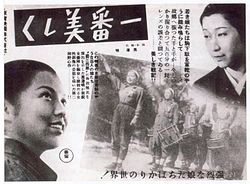
 Theatrical release poster | |
| Directed by | Akira Kurosawa |
| Screenplay by | Akira Kurosawa |
| Produced by | Motohiko Ito Jin Usami |
| Starring | Takashi Shimura Yoko Yaguchi Ichiro Sugai Takako Irie |
| Cinematography | Joji Ohara |
| Music by | Sei'ichi Suzuki |
Production company | |
| Distributed by | Toho Company |
Release date |
|
Running time | 85 minutes |
| Country | Japan |
| Language | Japanese |
The Most Beautiful (Japanese: 一番美しく, Hepburn: Ichiban Utsukushiku) is a 1944 Japanese drama and propaganda film written and directed by Akira Kurosawa. The semidocumentary film follows a group of female volunteer workers at an optics factory during the Second World War, during which the film was produced.
Plot
[edit]Set during World War II, the film depicts the struggle of female volunteer workers to meet production targets at a precision optics factory in Hiratsuka. They drive themselves, individually and collectively, to exceed the targets set for them by the factory directors. The factory directors push them to be their best for their country.
The young women live in a dormitory, under the leadership of Watanabe. Every day they march and sing songs about Japan's greatness while on the way to work. They live away from their parents but are happy to do so to serve their country. Every morning before work, they pledge that they will be loyal to Japan and will work to destroy the U.S. and Britain. There are encouraging signs posted everywhere about working hard for one's country in the factory.
One of the young women becomes ill and has to return home, and is upset about missing work; she cries because of the tremendous guilt she feels. She begs not to be sent home because she wants to keep working. Later on, a girl falls off the roof and gets badly injured, yet she says she is delighted that she did not harm her hands and will come to work on crutches.
The young women become tired and their productivity decreases. They know their reputation is at stake, and they must work harder. One of them says that "one can't improve productivity without improving one's character." Watanabe's mother becomes ill, but her father writes that under no circumstance should she come home, and her mother wants her to keep working, saying that her job is too important to leave. One of the young women gets a high temperature and tries to ignore it because she does not want to get sent home or stop working.
Watanabe accidentally misplaces an uncalibrated lens and spends the entire night looking for it, worried her mistake will cost a soldier their life. The film ends with Watanabe's mother dying and her father telling her to stay at work. The factory directors ask her to go home. She refuses to go and cries while continuing her work.
Cast
[edit]- Takashi Shimura as Chief Goro Ishida
- Soji Kiyokawa as Soichi Yoshikawa
- Ichiro Sugai as Ken Sanada
- Takako Irie as Noriko Mizushima
- Sayuri Tanima as Yuriko Tanimura
- Sachiko Ozaki as Sachiko Yamazaki
- Asako Suzuki as Asako Suzumura
- Haruko Toyama as Masako Koyama
- Yoko Yaguchi as Tsuru Watanabe
Production
[edit]According to Stephen Prince, Akira Kurosawa had been chosen by the navy to direct an action film about Zero fighter planes, but by 1943 he thought it unlikely that the navy would spare planes for a film as it was becoming clear that Japan would lose the war. Instead Kurosawa made this "patriotic morale booster".[1] The director shot The Most Beautiful with a "semidocumentary approach." It was filmed on-location at the Nippon Kogaku factory in Hiratsuka, where he had the actresses live, work, and form a fife and drum corps.[1]
Actress Yoko Yaguchi clashed over the alleged ways Kurosawa treated the actors. However, the pair found a connection, despite these clashes, and married in 1945.[2] Although Prince writes that Kurosawa later chastised himself for doing so little to resist Japan's descent into militarism, the director also remarked that, of all his films, The Most Beautiful was dearest to him.[1]
Reissues
[edit]The Criterion Collection has released The Most Beautiful on DVD in North America as part of two 2009 Kurosawa-centered box sets; The First Films of Akira Kurosawa, the 23rd entry in their Eclipse series, and AK 100: 25 Films by Akira Kurosawa.[3]
Critical reception
[edit]Paul Anderer of Columbia University has commented on the subtext of the film having been released during the war years for Japan. Anderer said, "It is as if Kurosawa himself were in this lineup (of directors under state scrutiny), frozen inside wartime, when any significant movement or resistance to the authority would be stillborn. Surrounded by a censorship apparatus far more resourceful and intimidating, he would later claim, than anything the American Occupation threw his way, he had few thematic or tonal options: historical tributes to Japanese spiritual and martial values (like Sanshiro Sugata and its weaker sequel), or patriotic odes to factory production and sacrificial domesticity (e.g., The Most Beautiful, 1944)".[4]
Critics like Stephen Prince, Kurosawa translator Audie Bock, and historian David Conrad have argued that what is most striking about The Most Beautiful and Kurosawa's other wartime productions is the extent to which they complicate and even undercut the government's desired message. The Most Beautiful "dutifully praises sacrifice but shrouds it in an air of futility" by focusing on "the individual emotional costs of war."[5]
References
[edit]- ^ a b c Prince, Stephen (2010-08-03). "Eclipse Series 23: The First Films of Akira Kurosawa". Criterion Collection. Retrieved 2022-11-24.
- ^ San Juan, Eric (2018). Akira Kurosawa: A Viewer's Guide. Rowman & Littlefield. p. 12. ISBN 9781538110904.
- ^ "The Most Beautiful". Criterion. Retrieved 2022-11-24.
- ^ Anderer, Paul (2016). Kurosawa's Rashomon. Pegasus Books.
- ^ Conrad, David A. (2022). Akira Kurosawa and Modern Japan. McFarland & Co.
External links
[edit]- The Most Beautiful at IMDb
- The Most Beautiful (in Japanese) at the Japanese Movie Database
| International | |
|---|---|
| National | |

The Most Beautiful
View on GrokipediaHistorical and Production Context
Wartime Japan and Propaganda Mandate
Japan's entry into the Pacific War on December 7, 1941, following the attack on Pearl Harbor, escalated the nation's commitment to total war, building on the ongoing conflict with China since 1937. This period saw severe labor shortages as millions of men were conscripted into the military, prompting the government to mobilize women, students, and other non-combatants into essential industries such as munitions and optical manufacturing. Propaganda efforts emphasized the duty of these groups to increase production quotas, portraying their contributions as vital to national victory and imperial honor.[3] The Cabinet Information Bureau, founded in October 1940 under Prime Minister Fumimaro Konoe, emerged as the primary organ for coordinating propaganda and censoring media to align with state objectives. By early 1941, it exerted significant control over print, radio, and film sectors, mandating that content foster public support for the war, suppress dissent, and promote ideological conformity. In the film industry, this translated to requirements for productions to depict heroic sacrifice, collective effort, and unwavering loyalty to the Emperor, with scripts subject to pre-approval and distribution centralized under government oversight by 1942 through the establishment of a monopoly distributor, Eiga Haikyosha.[4][5][6] This propaganda mandate was reinforced by the National Mobilization Law of 1938, which empowered the government to direct economic resources and labor toward military needs, including ideological campaigns to sustain worker morale amid rationing and air raids. Films, as a popular medium, were leveraged to model ideal behaviors, such as enduring hardship without complaint and exceeding production targets, thereby serving as tools for both motivation and surveillance of public sentiment. Non-compliant works faced bans or revisions, ensuring the industry's output prioritized national resilience over entertainment or criticism.[7][8]
Commissioning and Kurosawa's Involvement
Following the commercial success of his directorial debut Sugata Sanshiro in 1943, Akira Kurosawa was commissioned by the Japanese Navy's Information Section, in collaboration with Toho Studios, to produce a propaganda film glorifying the Zero fighter aircraft amid escalating wartime demands.[9] [10] This project, however, was abandoned due to resource shortages, including the unavailability of aircraft for filming, prompting a pivot to an alternative subject aligned with government mandates for morale-boosting content focused on civilian contributions to the war effort.[1] [10] Kurosawa, then 33 years old, conceived The Most Beautiful (Ichiban utsukushiku) as a replacement, scripting a narrative centered on young female volunteer workers in an optics factory producing military lenses, a theme that conformed to the era's censorship requirements emphasizing duty and productivity on the home front.[1] [10] He directed the film, which began principal photography in late 1943 and premiered on April 13, 1944, marking his second feature as director.[11] In his autobiography, Kurosawa recounted being "suddenly ordered to make a film called The Most Beautiful, replacing another project that had been planned," reflecting the directive nature of wartime assignments from state-linked entities like Toho under government oversight.[10] Kurosawa's involvement extended beyond direction to a commitment to authenticity, adopting a semi-documentary style to depict the workers' resolve without overt theatricality, as he sought to capture "the spirit of these girls who were working so hard for the war effort."[10] This approach stemmed from his immersion in the subject, including residing briefly with actual factory workers to inform the portrayal, though he navigated strict propaganda guidelines by emphasizing human perseverance over explicit militarism.[9] Despite the constraints, Kurosawa later described the film as "the one dearest to [his] heart," valuing its emotional depth amid the era's ideological impositions.Pre-Production and Factory Selection
Pre-production for The Most Beautiful (Ichiban utsukushiku) commenced in early 1944 following the film's approval under Japan's wartime propaganda guidelines, with Akira Kurosawa authoring the screenplay to portray female volunteer workers exceeding production quotas in a precision optics facility amid labor shortages.[1] The script emphasized themes of diligence and self-sacrifice, drawing from real wartime conditions where young women filled roles vacated by conscripted men, targeting an output increase of 50% for female laborers compared to 100% for males.[1] To capture authentic semi-documentary footage, the production selected the Nippon Kogaku K.K. factory in Tokyo, a major producer of military optical instruments such as lenses and rangefinders essential to the war effort.[12] This choice facilitated on-location shooting with actual workers and machinery, enhancing realism while aligning with propaganda aims to showcase industrial contributions; Nippon Kogaku's expertise in high-precision glasswork made it ideal for depicting the meticulous inspection and assembly processes central to the narrative.[13] Preparations included coordinating with factory management to minimize disruptions, as production wrapped swiftly for a release on April 13, 1944.[1]Plot Summary
The film depicts a group of young female volunteers, primarily teenagers, residing in a dormitory and laboring at a precision optics factory in wartime Japan, where they manufacture lenses for military binoculars, artillery sights, and aircraft instruments to support the national war effort.[1] Led by the determined Tsuru Watanabe, the women face heightened production quotas after factory management raises targets by 100% for male workers and 50% for females; Watanabe rallies her group to pledge a 66% increase, matching the men's relative effort despite grueling conditions, including long shifts, strict inspections, and physical strain from inspecting tiny lenses under magnification.[1][14] As morale wanes amid reports of Japanese setbacks in the Pacific theater during 1943–1944, interpersonal tensions arise, such as a brawl following the departure of the dorm mother, which jeopardizes group unity and quota attainment; individual hardships compound the pressure, with workers concealing illnesses or injuries—like one girl hiding sickness and another recovering from a fall—to avoid reducing output.[1][14] A critical error occurs when Watanabe misplaces a defective lens, potentially endangering soldiers' lives if undetected, prompting her to rectify it through rigorous self-inspection.[1] In the climax, with only 15 days remaining to meet the quota, renewed determination surges among the women, exemplified by Watanabe forgoing attendance at her mother's funeral to prioritize factory duties, underscoring their collective sacrifice and resolve to exceed targets as an act of patriotic service.[1] The narrative culminates in their success, framed through a semi-documentary lens that intercuts staged scenes with real worker testimonies and factory footage to emphasize discipline and national contribution.[1][14]Cast and Characters
The principal cast of The Most Beautiful features Takashi Shimura as Goro Ishida, the factory superintendent who motivates the workers and enforces strict production standards amid wartime pressures.[15][11] Sôji Kiyokawa plays Soichi Yoshikawa, a supervisory figure involved in quality control and inspections.[16] Ichirô Sugai portrays Ken Sanada, another manager focused on operational efficiency.[16][17] The female leads, representing the volunteer workers assembling precision optical instruments for military aircraft, include professional and amateur performers selected to reflect real-life factory conditions. Takako Irie stars as Noriko Mizushima, the group leader committed to surpassing quotas despite personal hardships.[16] Yôko Yaguchi, who later married director Akira Kurosawa, appears as Tsuru Horie, one of the diligent assemblers.[16][18] Sayuri Tanima plays Shoko Sugiyama, Sachiko Ozaki as Chieko, and Shizuko Nishigaki as Miyoko, with additional roles filled by actual volunteers to emphasize authenticity in portraying collective labor.[16][19]| Actor | Character | Role Description |
|---|---|---|
| Takashi Shimura | Goro Ishida | Factory superintendent overseeing production and worker morale.[15] |
| Sôji Kiyokawa | Soichi Yoshikawa | Supervisor handling inspections and quotas.[16] |
| Ichirô Sugai | Ken Sanada | Manager enforcing operational standards.[16] |
| Takako Irie | Noriko Mizushima | Lead volunteer worker exemplifying sacrifice.[16] |
| Yôko Yaguchi | Tsuru Horie | Assembler committed to group goals.[16] |
| Sayuri Tanima | Shoko Sugiyama | Precision worker facing defects and fatigue.[16] |