



Community hub
Recent from talks
Contribute something
Nothing was collected or created yet.
Thiazole
View on Wikipedia
| |||
| |||
| Names | |||
|---|---|---|---|
| Preferred IUPAC name
1,3-Thiazole | |||
| Other names
Thiazole
| |||
| Identifiers | |||
3D model (JSmol)
|
|||
| ChEBI | |||
| ChEMBL | |||
| ChemSpider | |||
| ECHA InfoCard | 100.005.475 | ||
PubChem CID
|
|||
| UNII | |||
CompTox Dashboard (EPA)
|
|||
| |||
| |||
| Properties | |||
| C3H3NS | |||
| Molar mass | 85.12 g·mol−1 | ||
| Boiling point | 116 to 118 °C (241 to 244 °F; 389 to 391 K) | ||
| Acidity (pKa) | 2.5 (of conjugate acid) [1] | ||
| −50.55·10−6 cm3/mol | |||
Except where otherwise noted, data are given for materials in their standard state (at 25 °C [77 °F], 100 kPa).
| |||


Thiazole (/ˈθaɪ.əzoʊl/), or 1,3-thiazole, is a 5-membered heterocyclic compound that contains both sulfur and nitrogen. The term 'thiazole' also refers to a large family of derivatives. Thiazole itself is a pale yellow liquid with a pyridine-like odor and the molecular formula C3H3NS.[2] The thiazole ring is notable as a component of the vitamin thiamine (B1).
Molecular and electronic structure
[edit]Thiazoles are members of the azoles, heterocycles that include imidazoles and oxazoles. Thiazole can also be considered a functional group when part of a larger molecule.
Being planar, thiazoles are characterized by significant pi-electron delocalization and exhibit a degree of aromaticity greater than that of corresponding oxazoles. This aromaticity is evidenced by the 1H NMR chemical shift of the ring protons, which display resonances between 7.27 and 8.77 ppm, indicating a strong diamagnetic ring current. The calculated pi-electron density marks C5 as the primary site for electrophilic substitution, and C2-H as susceptible to deprotonation.
Occurrence of thiazoles and thiazolium salts
[edit]
Thiazoles are found in a variety of specialized products, often fused with benzene derivatives, the so-called benzothiazoles. In addition to vitamin B1, the thiazole ring is found in epothilone. Other important thiazole derivatives are benzothiazoles, for example, the firefly chemical luciferin. Whereas thiazoles are well represented in biomolecules, oxazoles are not. It is found in naturally occurring peptides, and utilised in the development of peptidomimetics (i.e. molecules that mimic the function and structure of peptides).[3]
Commercial significant thiazoles include mainly dyes and fungicides. Thifluzamide, Tricyclazole, and Thiabendazole are marketed for control of various agricultural pests. Another widely used thiazole derivative is the non-steroidal anti-inflammatory drug Meloxicam. The following anthroquinone dyes contain benzothiazole subunits: Algol Yellow 8 (CAS# [6451-12-3]), Algol Yellow GC (CAS# [129-09-9]), Indanthren Rubine B (CAS# [6371-49-9]), Indanthren Blue CLG (CAS# [6371-50-2], and Indanthren Blue CLB (CAS#[6492-78-0]). These thiazole dye are used for dyeing cotton.
Synthesis
[edit]Various laboratory methods exist for the organic synthesis of thiazoles. Prominent is the Hantzsch thiazole synthesis, which is a reaction between haloketones and thioamides. For example, 2,4-dimethylthiazole is synthesized from thioacetamide and chloroacetone.[4] In the Cook-Heilbron synthesis, thiazoles arise by the condensation of α-aminonitrile with carbon disulfide. Thiazoles can be accessed by acylation of 2-aminothiolates, often available by the Herz reaction.
Biosynthesis
[edit]Thiazoles are generally formed via reactions of cysteine, which provides the N-C-C-S backbone of the ring. Thiamine does not fit this pattern however. Several biosynthesis routes lead to the thiazole ring as required for the formation of thiamine.[5] Sulfur of the thiazole is derived from cysteine. In anaerobic bacteria, the CN group is derived from dehydroglycine.
Reactions
[edit]With a pKa of 2.5 for the conjugate acid, thiazoles are far less basic than imidazole (pKa =7).[6]
Deprotonation with strong bases occurs at C2-H. The negative charge on this position is stabilized as an ylide. Hauser bases and organolithium compounds react at this site, replacing the proton. 2-Lithiothiazoles are also generated by metal-halogen exchange from 2-bromothiazole.[7]

Electrophilic aromatic substitution at C5 but require activating groups such as a methyl group, as illustrated in bromination:

Thiazole bromination 
Thiazole Nucleophilic Aromatic Substitution


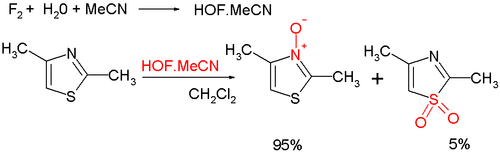
Nitrogen oxidation gives the aromatic thiazole N-oxide; many oxidizing agents exist, such as mCPBA; a novel one is hypofluorous acid prepared from fluorine and water in acetonitrile; some of the oxidation takes place at sulfur, leading to non-aromatic sulfoxide/sulfone:[8] Thiazole N-oxides are useful in Palladium-catalysed C-H arylations, where the N-oxide is able to shift the reactivity to reliably favor the 2-position, and allows for these reactions to be carried out under much more mild conditions.[9]
Thiazole oxidation

- Thiazoles are formyl synthons; conversion of R-thia to the R-CHO aldehyde takes place with,[7] respectively, methyl iodide (N-methylation), organic reduction with sodium borohydride, and hydrolysis with Mercury(II) chloride in water.
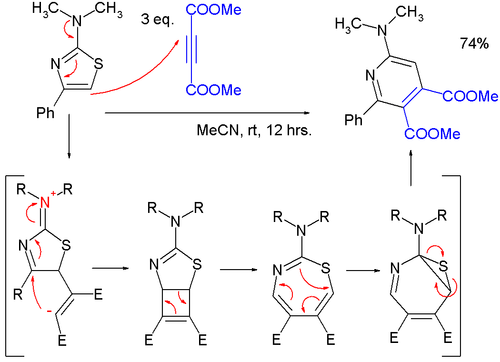
- Thiazoles can react in cycloadditions, but in general at high temperatures due to favorable aromatic stabilization of the reactant; Diels-Alder reactions with alkynes are followed by extrusion of sulfur, and the endproduct is a pyridine; in one study,[10] a very mild reaction of a 2-(dimethylamino)thiazole with dimethyl acetylenedicarboxylate (DMAD) to a pyridine was found to proceed through a zwitterionic intermediate in a formal [2+2]cycloaddition to a cyclobutene, then to a 1,3-thiazepine in a 4-electron electrocyclic ring opening and then to a 7-thia-2-azanorcaradiene in a 6-electron electrocyclic ring, closing before extruding the sulfur atom.
Thiazole cycloaddition

Thiazolium salts
[edit]Alkylation of thiazoles at nitrogen forms a thiazolium cation. Thiazolium salts are catalysts in the Stetter reaction and the Benzoin condensation. Deprotonation of N-alkyl thiazolium salts give the free carbenes[11] and transition metal carbene complexes.

Structure of thiazoles (left) and thiazolium salts (right)

Alagebrium is a thiazolium-based drug.
References
[edit]- ^ Zoltewicz, J. A.; Deady, L. W. (1978). "Quaternization of Heteroaromatic Compounds: Quantitative Aspects". Advances in Heterocyclic Chemistry Volume 22. Vol. 22. pp. 71–121. doi:10.1016/S0065-2725(08)60103-8. ISBN 9780120206223.
- ^ Eicher, T.; Hauptmann, S. (2003). The Chemistry of Heterocycles: Structure, Reactions, Syntheses, and Applications. Wiley. ISBN 978-3-527-30720-3.
- ^ Mak, Jeffrey Y. W.; Xu, Weijun; Fairlie, David P. (2015-01-01). Peptidomimetics I (PDF). Topics in Heterocyclic Chemistry. Vol. 48. Springer Berlin Heidelberg. pp. 235–266. doi:10.1007/7081_2015_176. ISBN 978-3-319-49117-2.
- ^ George Schwarz (1945). "2,4-Dimethylthiazole". Organic Syntheses. 25: 35. doi:10.15227/orgsyn.025.0035.
- ^ Kriek, M.; Martins, F.; Leonardi, R.; Fairhurst, S. A.; Lowe, D. J.; Roach, P. L. (2007). "Thiazole Synthase from Escherichia coli: An Investigation of the Substrates and Purified Proteins Required for Activity in vitro" (PDF). J. Biol. Chem. 282 (24): 17413–17423. doi:10.1074/jbc.M700782200. PMID 17403671.
- ^ Thomas L. Gilchrist (1997). Heterocyclic Chemistry (3 ed.). Essex, England: Addison Wesley. p. 414. ISBN 0-582-27843-0.
- ^ a b Dondoni, A.; Merino, P. (1995). "Diastereoselective Homologation of D-(R)-Glyceraldehyde Acetonide using 2-(Trimethylsilyl)thiazole". 72: 21. doi:10.15227/orgsyn.072.0021.
{{cite journal}}: Cite journal requires|journal=(help) - ^ Amir, E.; Rozen, S. (2006). "Easy Access to the Family of Thiazole N-oxides using HOF·CH3CN". Chemical Communications. 2006 (21): 2262–2264. doi:10.1039/b602594c. PMID 16718323.
- ^ Campeau, Louis-Charles; Bertrand-Laperle, Mégan; Leclerc, Jean-Philippe; Villemure, Elisia; Gorelsky, Serge; Fagnou, Keith (2008-03-01). "C2, C5, and C4 Azole N -Oxide Direct Arylation Including Room-Temperature Reactions". Journal of the American Chemical Society. 130 (11): 3276–3277. doi:10.1021/ja7107068. ISSN 0002-7863. PMID 18302383.
- ^ Alajarín, M.; Cabrera, J.; Pastor, A.; Sánchez-Andrada, P.; Bautista, D. (2006). "On the [2+2] Cycloaddition of 2-Aminothiazoles and Dimethyl Acetylenedicarboxylate. Experimental and Computational Evidence of a Thermal Disrotatory Ring Opening of Fused Cyclobutenes". J. Org. Chem. 71 (14): 5328–5339. doi:10.1021/jo060664c. PMID 16808523.
- ^ Arduengo, A. J.; Goerlich, J. R.; Marshall, W. J. (1997). "A Stable Thiazol-2-ylidene and Its Dimer". Liebigs Annalen. 1997 (2): 365–374. doi:10.1002/jlac.199719970213.
| Authority control databases: National |
|---|
Thiazole
View on GrokipediaStructure and Properties
Molecular Structure
Thiazole is a five-membered heterocyclic aromatic compound with the molecular formula C₃H₃NS, consisting of three carbon atoms, one sulfur atom, and one nitrogen atom arranged in a planar ring.[1] The ring features sulfur at position 1 and nitrogen at position 3 according to the standard numbering system established by the International Union of Pure and Applied Chemistry (IUPAC), with the remaining positions (2, 4, and 5) occupied by carbon atoms.[1] This arrangement positions the sulfur and nitrogen in a 1,3-relationship, distinguishing thiazole from related azoles such as isothiazole, which has adjacent sulfur (position 1) and nitrogen (position 2) atoms in a 1,2-configuration, and from oxazole, which replaces sulfur with oxygen.[1][4] The basic structural formula of thiazole can be represented in its Kekulé form as a ring with a C=N double bond between positions 2 and 3 and a C=C double bond between positions 4 and 5, connected by single bonds involving the sulfur at position 1.[5] However, thiazole exhibits significant resonance delocalization, with multiple contributing structures that distribute the π electrons across the ring, including forms where the double bonds shift to involve the sulfur-nitrogen linkage.[6] This resonance is key to its aromatic character, as the system satisfies Hückel's rule with 6 π electrons: four from the two localized double bonds and two from the lone pair on sulfur occupying a p-orbital perpendicular to the ring plane.[5][6] The nitrogen lone pair resides in an sp² orbital in the molecular plane and does not contribute to the π system, making it available for protonation or coordination.[5] Unsubstituted thiazole does not undergo significant tautomerism under standard conditions, as its aromatic stability favors the neutral ring form without proton migration between heteroatoms or adjacent carbons.[1]Electronic Structure
Thiazole exhibits aromatic character as a five-membered heterocyclic compound, satisfying Hückel's rule (4n + 2 π electrons, where n = 1) through a conjugated, planar π-system containing exactly six delocalized π electrons. These electrons arise from the contributions of the C4=C5 double bond (two electrons), the C2=N3 imine bond (two electrons), and the sulfur atom's perpendicular p-orbital housing a lone pair (two electrons), enabling full cyclic conjugation across the ring. The nitrogen lone pair occupies an sp² hybrid orbital in the molecular plane, akin to pyridine, and does not participate in the π-system, preserving the aromatic sextet while allowing the nitrogen to act as a basic site. This electron distribution imparts stability and influences thiazole's reactivity, with the delocalized system evidenced by equalized bond orders throughout the ring.[2] Structural data from microwave spectroscopy confirm the aromatic delocalization, revealing bond lengths indicative of partial double-bond character: the C-S bonds measure approximately 1.724 Å (S-C2) and 1.713 Å (C5-S), the C2-N bond is 1.304 Å, the N-C4 bond is 1.372 Å, and the C4-C5 bond is 1.367 Å. These values, shorter than typical single bonds but longer than pure double bonds, reflect the resonance stabilization of the aromatic system, with no significant deviations from planarity (all atoms sp² hybridized). Computational methods, such as density functional theory (DFT), reproduce these geometries closely, further validating the electronic delocalization.[7] Quantum chemical analyses of thiazole's molecular orbitals highlight the heteroatoms' roles in electron distribution. The highest occupied molecular orbital (HOMO) features substantial density on the sulfur and nitrogen atoms, particularly along the S-C2-N segment, rendering it electron-rich and susceptible to electrophilic attack at C2. In contrast, the lowest unoccupied molecular orbital (LUMO) is predominantly localized on the carbon atoms (C4 and C5), facilitating electron acceptance and explaining thiazole's behavior in donor-acceptor systems. This HOMO-LUMO configuration underscores the molecule's polarity and reactivity patterns. The electronic asymmetry due to the electronegative nitrogen and sulfur imparts a permanent dipole moment of approximately 1.70 D to thiazole, with components μ_a ≈ 1.55 D and μ_b ≈ 0.70 D along the principal inertial axes, as determined from microwave spectroscopy. This polarity arises from charge separation, with the nitrogen pulling electron density toward itself and the sulfur contributing to the overall vector. The weak basicity of the nitrogen is quantified by the pK_a of 2.5 for the thiazolium conjugate acid, indicating that protonation disrupts aromaticity less severely than in more basic heterocycles, owing to the pyridine-like nitrogen and the stabilizing π-system.[8][9]Physical Properties
Thiazole is a colorless to pale yellow liquid at room temperature, characterized by a distinctive sulfurous or foul odor.[1] With the molecular formula C₃H₃NS, it has a molecular weight of 85.13 g/mol.[1]Key Physical Properties
| Property | Value | Conditions | Source |
|---|---|---|---|
| Melting Point | -33 °C | - | https://www.chemicalbook.com/ProductChemicalPropertiesCB7853436_EN.htm |
| Boiling Point | 117–118 °C | 760 mmHg | https://www.sigmaaldrich.com/US/en/product/aldrich/151645 |
| Density | 1.2 g/cm³ | 25 °C | https://www.sigmaaldrich.com/US/en/product/aldrich/151645 |
| Refractive Index | 1.538 | 20 °C (n₂₀/D) | https://www.sigmaaldrich.com/US/en/product/aldrich/151645 |
| Solubility in Water | Slightly soluble | 20 °C | https://pubchem.ncbi.nlm.nih.gov/compound/Thiazole |