Hubbry Logo
BenzothiazoleBenzothiazoleMain
Open search
Benzothiazole
Community hub
Benzothiazole
logo
8 pages, 0 posts
0 subscribers
Be the first to start a discussion here.
Benzothiazole
Benzothiazole
from Wikipedia
Benzothiazole
Space filling model of benzothiazole
Ball-and-stick model of benzothiazole
Names
Preferred IUPAC name
1,3-Benzothiazole
Identifiers
3D model (JSmol)
ChEBI
ChEMBL
ChemSpider
ECHA InfoCard 100.002.179 Edit this at Wikidata
UNII
  • InChI=1S/C7H5NS/c1-2-4-7-6(3-1)8-5-9-7/h1-5H checkY
    Key: IOJUPLGTWVMSFF-UHFFFAOYSA-N checkY
  • InChI=1/C7H5NS/c1-2-4-7-6(3-1)8-5-9-7/h1-5H
    Key: IOJUPLGTWVMSFF-UHFFFAOYAC
  • n1c2ccccc2sc1
Properties
C7H5NS
Molar mass 135.1863 g/mol
Appearance colorless liquid
Density 1.238 g/mL
Melting point 2 °C (36 °F; 275 K)
Boiling point 227 to 228 °C (441 to 442 °F; 500 to 501 K)
Except where otherwise noted, data are given for materials in their standard state (at 25 °C [77 °F], 100 kPa).

Benzothiazole, or more specifically 1,3-benzothiazole, is an aromatic heterocyclic compound with the chemical formula C
7
H
5
NS
. It is colorless, slightly viscous liquid. Although the parent compound, benzothiazole is not widely used, many of its derivatives are found in commercial products or in nature. Firefly luciferin can be considered a derivative of benzothiazole.[1] It has a sulfurous odor and meaty flavor.[2]

The three structural isomers of benzothizaole are 1,3-benzothiazole, 1,2-benzothiazole and 2,1-benzothiazole.

Structure and reactivity

[edit]

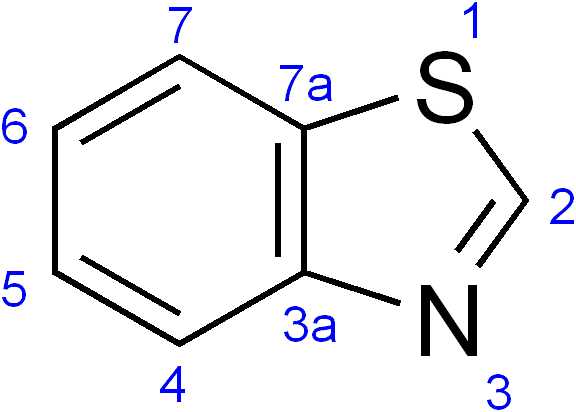
Benzothiazoles consist of a 5-membered 1,3-thiazole ring fused to a benzene ring. The nine atoms of the bicycle and the attached substituents are coplanar. The heterocyclic core of the molecule is readily substituted at the methyne (CH) centre in the thiazole ring. Thiazole is electron-withdrawing.

Synthesis and biosynthesis

[edit]

Benzothiazoles are typically prepared by treatment of 2-mercaptoaniline.[3] For example, acid chlorides are effective:[4]

C6H4(NH2)SH + RC(O)Cl → C6H4(N)SCR + HCl + H2O

Many other precursors have been used, commonly aldehydes in the presence of oxidants. In some cases, benzothiazoles are prepared directly from anilines, a process that entails ortho functionalization.[5]

Naturally occurring benzothiazoles are proposed to arise by condensation of cysteine with quinones.[1]

Uses

[edit]

Dyes

[edit]

The dye thioflavin is a benzothiazole derivative.[6]

Food additives

[edit]

Benzothiazole occurs naturally in some foods but is also used as a food additive.[1] It has a sulfurous odor and meaty flavor.[7] The European Food Safety Authority assessment had "no safety concern at estimated levels of intake as a flavouring substance".[8]

Rubber additive

[edit]

Accelerators for the sulfur vulcanization of rubber are based on 2-mercaptobenzothiazoles.[9]

Pharmacology

[edit]
Ziprasidone is used to treat schizophrenia and bipolar disorder.

Benzothiazoles have been widely investigated for their bioactivity.[10][11] The benzothiazole moiety is, for example, seen in certain dopamine-acting drugs, e.g. riluzole and pramipexole. Moreover, benzothiazole derivatives act as monoamine oxidase inhibitors or dopamine antagonists:

See also

[edit]

Safety and environmental considerations

[edit]

Benzothiazoles are widely used in the vulcanization of rubber, so their possible role in the environment has attracted attention. Evidence suggests that they biodegrade readily.[17]

References

[edit]
[edit]
Revisions and contributorsEdit on WikipediaRead on Wikipedia
from Grokipedia
Benzothiazole is an aromatic with the molecular formula C₇H₅NS, consisting of a ring fused to a ring at the 4- and 5-positions of the thiazole. It exists as a pale yellow to colorless liquid at , with a of approximately 2°C, a of 224–227°C, and a of 1.238 g/mL at 25°C. Slightly soluble in (4.3 g/L at 25°C), it possesses a characteristic reminiscent of and is known for its stability under neutral conditions but reactivity in electrophilic substitutions at the 2-position of the thiazole ring. The compound is typically synthesized through the of 2-aminothiophenol with aldehydes, carboxylic acids, or their derivatives, often under acidic or oxidative conditions to facilitate cyclization. Alternative green methods include metal-catalyzed couplings or microwave-assisted reactions to improve yield and reduce environmental impact. These synthetic routes highlight benzothiazole's role as a versatile scaffold in , enabling the preparation of numerous derivatives. Benzothiazole and its derivatives find extensive applications across industries and medicine due to their diverse properties. In the rubber industry, they serve as vulcanization accelerators to enhance polymer cross-linking and material durability. They are also employed as inhibitors, intermediates in dyes and photographic materials, and components in agrochemicals like fungicides and herbicides. In , benzothiazole scaffolds exhibit potent biological activities, including anticancer effects through inhibition of polymerization, antimicrobial action against and fungi, and anti-inflammatory properties via modulation of pathways, with several derivatives advancing to clinical trials for cancer and infectious diseases.

Chemical Properties

Molecular Structure

Benzothiazole has the molecular formula C₇H₅NS and a of 135.186 g/mol. It is a bicyclic consisting of a six-membered ring fused to a five-membered ring, where the thiazole is a heterocycle containing at position 1 and at position 3. The fusion occurs between the 4 and 5 positions of the thiazole ring and the adjacent carbons of the benzene ring, forming a planar bicyclic system. The nine atoms comprising the bicyclic core—six from the ring and five from the ring, sharing two fusion atoms—are arranged in a coplanar configuration, which facilitates extended π-conjugation across the . The ring imparts an electron-withdrawing character to the overall structure due to the electronegative and heteroatoms, influencing the distribution and making certain positions susceptible to . In the standard IUPAC numbering system for benzothiazole, numbering begins at the atom as position 1, proceeds to the carbon between and as position 2, as position 3, and continues through the fused ring at positions 4 through 7, with fusion points denoted as 7a and 3a. Substituents are commonly referenced relative to this system, particularly at position 2 on the ring. The structural diagram of benzothiazole depicts the ring fused linearly to the , with the heteroatoms positioned to maintain in both rings:

4 5 / \ / \ 3a 6 7 | \ / 7a S(1)-C(2)=N(3)

4 5 / \ / \ 3a 6 7 | \ / 7a S(1)-C(2)=N(3)

This representation highlights the fused bicyclic framework without additional substituents.

Physical Properties

Benzothiazole appears as a colorless to yellow viscous liquid at , characterized by a distinctive sulfurous and a meaty flavor profile. Its is 1.238 g/mL at 25 °C, reflecting its relatively high mass due to the fused heterocyclic structure. The compound has a low of 2 °C and a boiling point of 231 °C at standard atmospheric pressure, indicating it remains liquid over a wide temperature range relevant to many industrial handling processes. Regarding solubility, benzothiazole is sparingly soluble in , with a solubility of approximately 4.3 g/L at 25 °C, which stems from the hydrophobic nature of its ring fused to the polar moiety. In contrast, it displays high solubility in common organic solvents, including , acetone, and , facilitating its use in non-aqueous formulations. Spectroscopically, benzothiazole shows UV-Vis absorption maxima at approximately 220 nm, 250 nm, and 285 nm, arising from π-π* transitions in its aromatic system. reveals characteristic bands for the C-N stretch around 1500 cm⁻¹ and the C-S stretch near 750 cm⁻¹, confirming the presence of the ring. Under standard ambient conditions, benzothiazole is chemically stable, but it undergoes at temperatures exceeding 250 °C, potentially releasing carbon oxides and sulfur-containing gases.

Reactivity

Benzothiazole exhibits characteristic reactivity influenced by the electron-deficient ring fused to the moiety. The ring withdraws electron density from the ring, deactivating it overall toward (EAS) but directing incoming electrophiles preferentially to positions 6 and 7. For instance, of unsubstituted benzothiazole yields primarily 6-nitrobenzothiazole (62%) along with 7-nitrobenzothiazole, while bromination and sulfonation follow similar under forcing conditions such as acetic acid at 100°C or at 100°C, respectively. The C2 position in the ring is particularly susceptible to due to its partial imine-like character from the adjacent (N3), rendering it electron-deficient. Nucleophiles such as Grignard reagents add to C2, forming 2-substituted benzothiazoline intermediates that can be further processed to stable 2-substituted derivatives; this reactivity is enhanced under acidic conditions, increasing the rate by a factor of 20. The atom in the ring displays sensitivity to oxidation, readily forming benzothiazole S-oxides (s) upon treatment with mild oxidants like . This transformation proceeds selectively to the sulfoxide stage under controlled conditions, avoiding over-oxidation to sulfones, and is commonly employed in synthetic modifications. A notable reaction involves the of 2-acylbenzothiazoles, which serves as a deprotective step to regenerate o-aminothiophenols. Under basic aqueous conditions, these derivatives undergo ring opening via nucleophilic attack at the carbonyl, yielding the corresponding and 2-aminothiophenol: C6H4(N)SCOR+H2OC6H4(NH2)SH+RCOOH\text{C}_6\text{H}_4(\text{N}) \text{SCOR} + \text{H}_2\text{O} \rightarrow \text{C}_6\text{H}_4(\text{NH}_2)\text{SH} + \text{RCOOH} This process is efficient for R = alkyl or aryl groups and highlights the reversibility of benzothiazole formation from o-aminothiophenols. Benzothiazole demonstrates stability toward basic conditions, resisting hydrolysis or ring opening with alkoxides or under mild circumstances. However, it reacts with strong acids via at N3, forming the benzothiazolium cation, which alters the and enhances reactivity at C2 for subsequent nucleophilic attacks. This site has been confirmed through computational and spectroscopic studies of the parent heterocycle.

Synthesis

Laboratory Methods

One of the classical laboratory methods for synthesizing benzothiazoles involves the Jacobson condensation, where o-aminothiophenol reacts with carboxylic acids or their derivatives, such as acyl chlorides or anhydrides, to form an intermediate thioamide, followed by oxidative cyclization under acidic conditions. The general reaction is represented as: C6H4(NH2)SH+RCOOHC6H4(NS)CR+H2O\mathrm{C_6H_4(NH_2)SH + RCOOH \rightarrow C_6H_4(NS)CR + H_2O} This process typically employs oxidants like or in aqueous alkaline media, achieving yields of 70–95% for 2-substituted benzothiazoles, depending on the R group and reaction conditions. The method is versatile for introducing alkyl or aryl substituents at the 2-position and remains a staple in research laboratories for preparing benzothiazole precursors. Another established route utilizes the oxidative cyclization of 2-aminothiophenol with aldehydes to afford 2-arylbenzothiazoles. In this approach, the and groups of 2-aminothiophenol condense with ArCHO to form an imine-thiol intermediate, which undergoes intramolecular cyclization facilitated by mild oxidants such as molecular iodine in DMF at 100°C or air in DMSO. Yields often exceed 80% for aromatic aldehydes, with the iodine-mediated variant providing a simple, one-pot procedure suitable for small-scale synthesis without additional catalysts. Post-2020 advancements have emphasized protocols, including microwave-assisted or solvent-free of 2-aminothiophenol with aldehydes or ketones, often yielding over 90% in minutes under mild heating. For instance, ZnO nanoparticles serve as an efficient, recyclable nano-catalyst for the room-temperature reaction of 2-aminothiophenol and aldehydes in or solvent-free conditions, promoting the and cyclization while avoiding harsh oxidants and minimizing waste. These methods align with sustainable chemistry principles, offering high selectivity and short reaction times for diverse 2-substituted benzothiazoles. An alternative laboratory strategy involves the cyclization of o-haloaryl thioamides using sources under catalysis. o-Iodo- or o-bromo-substituted thioamides react with metal sulfides, such as potassium sulfide, in the presence of CuI and a base like K2CO3 in DMSO at 80–100°C, facilitating and ring closure to form substituted benzothiazoles with yields typically in the 70–90% range. This approach is particularly useful for introducing substitutions on the ring and avoids the need for pre-formed o-aminothiophenols.

Industrial Production

The primary industrial route for benzothiazole production begins with the reduction of 2-chloronitrobenzene to o-aminothiophenol, followed by cyclization through reaction with or . This process leverages readily available derivatives as starting materials, enabling efficient large-scale synthesis for commercial applications. A high-throughput alternative is continuous flow synthesis, where o-aminothiophenol reacts with aldehydes under conditions, allowing scaled production exceeding tons per year to meet demand in dyes and rubber sectors. factors are influenced by raw materials derived from , with post-2015 energy-efficient processes incorporating green methodologies that reduce solvent use significantly. Industrial grades of benzothiazole are purified by to achieve >99% purity, ensuring suitability for high-value applications. Byproducts such as H₂S, generated during sulfur-involving steps, are managed through systems to comply with environmental standards. Benzothiazole is produced on an industrial scale, predominantly in to support rubber accelerators and dye manufacturing.

Biosynthesis

Benzothiazole and its derivatives occur naturally in various food products, including roasted and cocoa, where they form through the during thermal processing. This non-enzymatic reaction between and reducing sugars generates these sulfur-containing heterocycles as volatile aroma compounds in trace quantities. Similar formation has been observed in fermented foods, such as during the microbial of , contributing to sensory profiles. Additionally, benzothiazole derivatives are reported by marine bacteria, with 2-mercaptobenzothiazole noted as a rare in these organisms, though evidence is limited. The of benzothiazole derivatives in bioluminescent like fireflies for production involves the condensation of L-cysteine with o-s derived from oxidation, leading to a thioamide intermediate that undergoes and cyclization to form the benzothiazole ring. This pathway relies on enzymatic steps, including those catalyzed by thiazole synthases that facilitate ring closure. The reaction highlights biological specificity, with ensured by enzymes and cofactors such as pyridoxal 5'-phosphate (PLP), which activates cysteine for nucleophilic attack on the quinone. A simplified outline of the key biosynthetic steps is: L-Cys+o-quinone (from Tyr)thioamide intermediatebenzothiazole+CO2\text{L-Cys} + o\text{-quinone (from Tyr)} \rightarrow \text{thioamide intermediate} \rightarrow \text{benzothiazole} + \text{CO}_2 In plants, benzothiazole plays a minor role in defense-related metabolites, particularly as sulfur-containing volatile compounds emitted by species in the genus, such as , where it contributes to aroma profiles and potential pest deterrence. Natural yields of benzothiazole derivatives are typically trace, occurring at parts-per-million (ppm) levels in biological matrices like roasted foods and plant volatiles, reflecting their role as minor secondary metabolites rather than primary products.

Applications

Dyes and Pigments

Benzothiazole derivatives play a significant role in the development of , particularly through their incorporation into fluorescent and chromophoric structures that enhance . One prominent example is Thioflavin T, chemically known as 2-[4-(dimethylamino)phenyl]-3-methylbenzothiazolium, a cationic benzothiazole that exhibits dramatically increased upon binding to . This property makes it a standard tool for detecting and quantifying structures in biological samples, with excitation maxima shifting from approximately 385 nm in free form to 450 nm when bound. Benzothiazole-based dyes are valued for their near-infrared (NIR) absorption capabilities, achieved through extended conjugation in structures such as heptamethine chains, which enable maximum absorption wavelengths (λ_max) exceeding 700 nm. These dyes are synthesized by first quaternizing nitrogen-containing heterocycles like 2-methylbenzothiazole with alkyl halides to form reactive salts, followed by reactions to build the polymethine bridge; a related approach involves intermediates derived from 2-mercaptobenzothiazole quaternized similarly to introduce sulfur-linked chromophores. Such dyes demonstrate high tinctorial strength and moderate to good , making them suitable for applications requiring durable coloration and , including NIR-absorbing agents in textiles and inks where benzothiazole variants contribute to vibrant, stable hues on fabrics like . Recent advances in have expanded the utility of NIR dyes for bio, particularly in visualization, as highlighted in a at the Southeastern Regional Meeting of the (SERMACS). Researchers led by M. Henary described dimeric heptamethine fluorophores with tailored optical properties for enhanced biomedical imaging. These developments underscore the ongoing refinement of structural modifications to optimize chromophoric performance in diagnostic dyes.

Food Additives

Benzothiazole serves as a flavoring agent in various foods and beverages, contributing sulfurous, rubbery, and meaty notes with undertones of cooked vegetables, nuts, and coffee. At concentrations of 0.5 ppm, it imparts a beefy, brown, and roasted taste profile, enhancing savory characteristics in products such as baked goods, gravies, meat preparations, and soups. Naturally occurring traces of benzothiazole have been identified in coffee at levels up to 0.5 mg/kg and in seafood species like fish and shellfish, typically at low concentrations in the range of ng/g wet weight, arising from environmental exposure or biosynthetic processes in fermented products. The regulatory status of benzothiazole as a food additive is affirmed as Generally Recognized as Safe (GRAS) by the U.S. Food and Drug Administration through FEMA assessments for use in flavoring at specified levels up to 0.5 ppm across food categories. In the European Union, the European Food Safety Authority (EFSA) evaluated benzothiazole within Flavouring Group Evaluation 21 (FGE.21, Revision 2, 2011), concluding no safety concerns at estimated dietary intakes based on the Maximised Survey-derived Intake (MSDI) approach, with levels below 0.1 mg/kg body weight per day; subsequent revisions up to 2023 maintained this assessment without updates altering the safe intake threshold. Synthetic derivatives, such as 2-methylbenzothiazole, are added as aroma compounds in processed foods to replicate natural roasted flavors, often at trace levels to avoid overpowering sensory profiles. For food-grade applications, benzothiazole undergoes high-purity to meet additive standards, ensuring removal of impurities and stability during high-heat processing like or cooking, where it retains its volatile aromatic properties without degradation. Detection of benzothiazole in s, whether natural or added, commonly employs gas chromatography-mass spectrometry (GC-MS) techniques, including for trace-level analysis in complex matrices like and beverages, enabling quantification at ppm or lower concentrations. No studies on allergenicity specific to benzothiazole in food contexts were identified from 2020 to 2025.

Rubber Accelerators

Benzothiazole derivatives, particularly 2-mercaptobenzothiazole (MBT), serve as primary accelerators in the sulfur vulcanization of natural and synthetic rubbers, facilitating the formation of crosslinks that enhance mechanical properties such as elasticity and durability. MBT operates by forming a zinc complex in the presence of zinc oxide (ZnO), typically added to rubber compounds, which activates the accelerator and promotes efficient sulfur incorporation. The complexation reaction is represented as: Zn2++2MBT[Zn(MBT)2]\text{Zn}^{2+} + 2\text{MBT} \rightarrow [\text{Zn(MBT)}_2] This zinc-MBT complex interacts with elemental sulfur to generate active polysulfide species that bridge rubber polymer chains. The vulcanization mechanism involves the zinc-activated MBT reacting with sulfur (S) to produce polysulfides, such as MBT polysulfides (MBTPs), which subsequently add across the carbon-carbon double bonds in the rubber backbone, forming polysulfidic crosslinks. These initial long-chain polysulfides undergo desulfuration during curing to yield more stable mono- and disulfidic links, reducing the overall activation energy of the process compared to unaccelerated sulfur vulcanization and enabling lower curing temperatures. This pathway contrasts with slow, unaccelerated vulcanization, where sulfur alone reacts inefficiently at allylic positions without such intermediates. In practical applications, MBT is incorporated at dosages of 0.5–2 parts per hundred rubber (phr) in formulations for tires, conveyor belts, and other rubber products, often alongside 2–3 phr and ZnO, resulting in significantly shorter cure times—typically reducing them from hours to minutes at 140–160°C—while improving scorch safety and efficiency. A key derivative, 2,2'-dibenzothiazole (MBTS), the dithio form of MBT, provides delayed action by slowly decomposing to MBT during processing, offering better control over premature curing in heat-sensitive compounds. Benzothiazole-based accelerators, including MBT and MBTS, account for a substantial portion of global rubber accelerator consumption, driven by their versatility in high-performance applications. Since 2020, industry trends have emphasized low-sulfur variants and zinc-reduced systems to mitigate environmental impacts from tire wear particles and emissions, aligning with regulations.

Pharmaceuticals

Benzothiazole derivatives have emerged as important scaffolds in pharmaceutical development, particularly for treating neurological disorders. , chemically 2-amino-6-(trifluoromethoxy)benzothiazole, is the only FDA-approved drug for (), where it functions as a glutamate modulator by inhibiting excessive glutamate release and blocking voltage-gated sodium channels to reduce in motor neurons. This compound features a key 6-trifluoromethoxy substitution on the benzothiazole core, enhancing its neuroprotective effects and extending patient survival by several months. Pramipexole, a (S)-2-amino-4,5,6,7-tetrahydro-6-(propylamino)benzothiazole , acts as a selective D2/D3 receptor for the symptomatic treatment of , alleviating motor symptoms like bradykinesia and rigidity by mimicking endogenous in the . The partially saturated benzothiazole ring with C6 propylamino modification improves its selectivity and blood-brain barrier penetration compared to ergot-derived . These agents exemplify how modifications at C2 and C6 positions of the core optimize receptor binding and therapeutic efficacy. Beyond , benzothiazole derivatives show promise in infectious diseases and . For instance, benzothiazole hydrazones and related analogs exhibit antimalarial activity by inhibiting growth, likely through interference with detoxification pathways in the parasite. Structure-activity relationship (SAR) analyses reveal that the and sulfur heteroatoms in the ring are essential for target binding, enabling coordination with enzymatic active sites and enhancing potency against resistant strains. In cancer therapy, recent advances focus on benzothiazole-based (HDAC) inhibitors, addressing gaps in targeting epigenetic dysregulation. A 2024 comprehensive review highlights derivatives with IC₅₀ values below 1 μM in various cancer cell lines, such as and colon, by promoting hyperacetylation, arrest at G2/M phase, and induction without significant off-target effects on normal cells. These compounds often incorporate C2 amide or hydroxamic acid groups for zinc-binding in the HDAC catalytic pocket, outperforming in selectivity for HDAC6 isoforms. By 2025, several benzothiazole derivatives, including quizartinib (approved in 2023 for ), have achieved FDA approval or advanced clinical status, reflecting their broad therapeutic impact across multiple indications.

Emerging Uses

Benzothiazole derivatives are gaining prominence in , particularly as components in organic light-emitting diodes () for blue emission applications. Recent research has focused on benzothiazole-based bipolar host materials linked via phenyl bridges to electron-donor moieties, enabling tandem OLED architectures with enhanced efficiency and color purity. These materials contribute to external quantum efficiencies exceeding 20% in blue-emitting devices, as demonstrated in 2023 studies on ultra-high efficiency tandem structures. In catalysis, benzothiazole acts as a ligand in complexes for Suzuki-Miyaura cross-coupling reactions, facilitating efficient C-C bond formation under mild conditions. Benzothiazole-derived Pd(II) complexes have shown high catalytic activity for coupling aryl bromides and boronic acids in aqueous media, with turnover numbers surpassing 10^4 in optimized systems reported in post-2020 investigations. Emerging applications involve benzothiazole quaternary salts targeting methicillin-resistant Staphylococcus aureus (MRSA). Post-2022 studies highlight derivatives such as benzothiazole-thiazolidinone hybrids exhibiting minimum inhibitory concentrations (MICs) of 4–16 μg/mL against MRSA strains, attributed to disruption of bacterial cell membranes and formation. Benzothiazole-based fluorescent probes are being developed for heavy metal detection, particularly mercury ions (Hg²⁺). These probes often incorporate C2-thioether linkages that undergo selective disruption upon Hg²⁺ coordination, leading to quenching or ratiometric shifts for sensitive . A thioether-linked benzothiazole , for instance, achieves detection limits in the nanomolar range via this mechanism. Looking toward 2025 trends, benzothiazole-conjugated are advancing systems, such as liposomes decorated with 2-(4'-aminophenyl)benzothiazole for targeted therapy in neurodegenerative diseases. These formulations enhance Aβ fibril inhibition and crossing the blood-brain barrier, with ongoing research emphasizing pH-responsive release for improved . Building on pharmaceutical scaffolds, such constructs show promise in theranostic applications without overlapping established therapeutic roles.

Safety and Environmental Impact

Toxicity and Health Effects

Benzothiazole demonstrates moderate via oral exposure, with an LD50 value of 493 mg/kg body weight in rats, indicating potential harm following ingestion at relatively low doses. Dermal and routes also pose risks, with an LD50 of 933 mg/kg in rats for dermal exposure and an LC50 of 5 mg/L for 4-hour in rats. The compound is reported as a mild irritant to , based on historical studies. In chronic exposure scenarios, benzothiazole exhibits potential as a thyroid hormone disruptor, inhibiting thyroxine (T4) release in ex vivo assays and interfering with thyroid peroxidase activity, possibly due to the sulfur and nitrogen atoms in its heterocyclic ring structure. This disruption can lead to altered thyroid hormone levels, with prenatal exposure linked to maternal free T4 reduction and neonatal TSH elevation in cohort studies. Prenatal exposure to benzothiazoles, particularly 2-hydroxybenzothiazole, may impair early childhood growth by disrupting thyroid hormone homeostasis, as reported in a 2025 cohort study. The International Agency for Research on Cancer (IARC) has not classified benzothiazole regarding carcinogenicity, placing it effectively as not classifiable to humans (Group 3 equivalent based on lack of sufficient data). No evidence of carcinogenicity was found in available long-term rodent bioassays, though dedicated 2-year studies specific to benzothiazole are limited. Occupational exposure, particularly in rubber manufacturing where benzothiazole serves as an intermediate, can cause symptoms such as , , and among workers, with skin sensitization reported in case studies of accelerator-related exposures. No (TLV) has been established by ACGIH for airborne concentrations. Benzothiazole metabolism involves ring-cleavage, producing metabolites such as 2-methyl-mercaptoaniline, as observed in guinea pigs. Regarding reproductive and developmental effects, a 2021 doctoral on exposure to benzothiazoles reported low potential and no observable developmental from prenatal levels below 1 μg/L in , though associations with neurodevelopmental alterations via pathway warrant further investigation. Prenatal exposure has been correlated with potential reproductive risks, including thyroid-mediated growth impairments in offspring, based on cohort data showing altered hormone profiles at environmental doses.

Environmental Persistence and Regulations

Benzothiazole is released into the environment primarily through industrial effluents from rubber and manufacturing processes, where it serves as an intermediate or additive. High concentrations, such as 20 mg/L for benzothiazole and 1.1 mg/L for related 2-mercaptobenzothiazole, have been reported in from rubber additive production facilities. In municipal plants, benzothiazole concentrations typically range from 0.85 to 3.4 μg/L, with global detection frequencies exceeding 90% in influents across and other regions. These levels reflect diffuse inputs from urban and industrial discharges, contributing to its presence in surface waters at trace concentrations (0.1–10 μg/L). In aquatic environments, benzothiazole exhibits moderate , subject to both photolytic and biotic degradation pathways. Aerobic is feasible in systems, where benzothiazole achieves substantial removal (up to 60% or more within 28 days under 301-like conditions), though it does not always meet the "ready biodegradability" threshold due to adaptation lags in microbial communities. Modeled half-lives exceed 182 days in , , and , indicating under the Canadian Environmental Protection Act criteria, though empirical estimates suggest 15–60 days under favorable conditions. Bioaccumulation potential is low, with an experimental log Kow of 2.01 indicating moderate hydrophobicity and limited partitioning into biota. Estimated factors (BCF) in are below 100 (approximately 20), suggesting negligible uptake in aquatic organisms; instead, benzothiazole preferentially sorbs to sediments via runoff from contaminated sites. Regulatory frameworks address benzothiazole as a potential environmental contaminant. , it is listed on the Toxic Substances Control Act (TSCA) inventory as an active substance, subjecting it to reporting requirements, though no specific discharge limits exist; monitoring occurs under the Clean Water Act for industrial effluents to prevent aquatic releases. In the , benzothiazole is registered under REACH (EC 202-396-2), with Annex XVII restrictions applying to related benzothiazoles like 1,2-benzisothiazol-3(2H)-one in toys (limited to 5 mg/kg in aqueous materials), but no direct toy-specific limits for benzothiazole itself. As of 2025, it has emerged as a concern in tire-derived , where accelerators release benzothiazole during abrasion, contributing to persistent micropollutant loads in and sediments. Remediation strategies focus on adsorption technologies, with proving effective for ; removal efficiencies exceed 80% for benzothiazole and analogs in combined adsorption-oxidation systems, outperforming standalone ozonation. Mitigation efforts include greener synthetic routes, such as catalyst-free or microwave-assisted methods using 2-aminothiophenols and aldehydes, which minimize use and reduce overall emissions compared to traditional high-temperature processes by up to 40% through lower energy input and waste generation.

References

Add your contribution
Related Hubs
User Avatar
No comments yet.