


Community hub
Recent from talks
Contribute something
Nothing was collected or created yet.
Ottan Thullal
View on Wikipedia | This article needs additional citations for verification. (February 2014) |

Ottan Thullal (or Ottamthullal) is a recite-and-dance art-form of Kerala, India. It was introduced in the eighteenth century by Kunchan Nambiar, one of the Prachina Kavithrayam (three famous Malayalam-language poets). The folksy performance, often laced with humour intended at criticism of society, is accompanied by a mridangam (a barrel-shaped double-headed drum) and/or the handy idakka besides a pair of ilathalam cymbals.
History
[edit]


Like most Indian performing art forms, Ottamthullal has its principles influenced by the Natya Shastra (c. 2nd century BCE). The word Thullal means "to jump" or "leap about" in the Malayalam language.[1] Legend has it that Nambiar, the poet, fell asleep while playing the mizhavu drum for a Chakyar Koothu performance, inviting ridicule from the chakyar. In response, Nambiar developed Ottamthullal, which raised prevalent sociopolitical questions and made a satire of human pedigrees and prejudices. The chakyar complained about Nambiar's production to the king of Chembakassery. The king banned performances of Ottamthullal from the Ambalapuzha temple complex. Closely related art forms are Seethankan thullal and Parayan thullal. Mathur Panikkar popularized Ottamthullal for modern audiences. Ottamthullal competitions are held[2] and the art form may be used to spread a social message.[3]
Performers
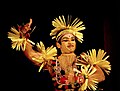
[edit]In Ottamthullal, a solo performer, with green makeup and a colourful costume (decorated with a long red and white band and painted wooden ornaments), acts and dances while reciting dance (Thullal) (lyrics).[4] A chorus or one or more artists repeats each sentence as it is completed. More recently, Ottamthullal has been performed with a solo female actor and with an ensemble cast.
Theme
[edit]Nambiar parodies the ways of landlords and other prominent citizens, sometimes even the king. For example, the character of Bhima from the epic the Mahabharata is portrayed as an oaf. Higher castes including Brahmin are not spared.
Language
[edit]Ottan thullal is performed in Malayalam, which pleases local audiences. Old sayings and elements of folklore are used.
Works
[edit]There may be 64 or more Ottamthullal works. Examples include:
- Kallyana Sougandhikam (a rare flower), Bhima is searching for the flower and has a long conversation with his older brother, Hanuman.
- Kiratham, rukmini swayamvaram, keechakavadham, Garudagarva bhangam, Santhanagopalam, Ghoshayathra etc...
Related images
[edit]-
 Chakyar koothu
 -
 Sheethankan Thullal
 -
 Make-up


See also
[edit]
References
[edit]- ^ "Thullal." Archived 15 June 2012 at the Wayback Machine Malayalam Resource Centre website. Accessed 27 February 2014.
- ^ Nidheesh M. K. "Sunny brothers outshine in Ottamthullal." The New Indian Express. 8 January 2014. Accessed 27 February 2014.
- ^ "Spreading the goodness of ayurveda through Kerala's performing art, ottamthullal." Ithoozhiay website. 29 September 2012. Accessed 27 February 2014.
- ^ "Ottan thullal". Kerala's 64 Art Forms website. Accessed 27 February 2014.


Ottan Thullal
View on GrokipediaOrigins and Historical Development
Creation by Kunchan Nambiar
Kalakkath Kunchan Nambiar, born around 1705 and active in the 18th century, served as a mizhavu percussionist accompanying Chakyar Koothu performances in Kerala temples, a role tied to the Nambiar community's traditional duties in ritual arts.[1][4] As a member of the Ambalavasi caste, Nambiar operated within the hierarchical structure of temple performances, where drummers supported elite reciters but faced social constraints limiting their prominence.[5] During a Chakyar Koothu show, likely in the mid-18th century, Nambiar dozed off while beating the mizhavu, prompting the performing Chakyar to publicly ridicule him before the audience, highlighting the performer's momentary lapse amid the demanding nocturnal rituals.[1][6] Enraged by this humiliation, Nambiar vowed to devise an alternative art form, composing verses and choreography overnight to challenge the exclusivity and formality of Chakyar Koothu with a more direct, satirical solo performance accessible to lower strata.[1] Nambiar premiered Ottan Thullal at the Ambalapuzha Sri Krishna Temple, where he enacted the new style—marked by vigorous dance, humorous critique, and rhythmic poetry—drawing immediate crowds from common folk who appreciated its participatory energy and departure from elite Sanskrit monologues.[7] The form's rapid adoption stemmed from its use of vernacular Malayalam, exaggerated costumes, and social commentary, contrasting the rigid, caste-bound temple arts and appealing to audiences excluded from traditional venues.[1][6]Socio-Cultural Context in 18th-Century Kerala
In 18th-century Kerala, under the princely states of Travancore and Cochin, society was characterized by a rigid feudal hierarchy dominated by Brahmin priests, Nair warrior elites, and subordinate castes, with severe restrictions on social mobility and ritual participation. The caste system enforced unseeability and untouchability practices, particularly in Travancore, where lower castes were barred from temple entry and public spaces, reinforcing Brahminical orthodoxy and royal authority.[8][9] This structure privileged upper-caste control over cultural and religious institutions, limiting artistic expression to elite domains while folk traditions persisted among lower strata as outlets for critique. Temple-based performing arts such as Chakyar Koothu and Koodiyattam exemplified this exclusivity, performed solely by Chakyar Brahmins—elite temple servants of Aryan-Brahmin descent—in sacred Koothambalams accessible primarily to upper-caste audiences during ritual festivals. These Sanskrit-language monologues and dramas, rooted in Hindu epics, adhered to ritualistic norms and avoided overt social satire, serving devotional and hierarchical reinforcement rather than broad accessibility.[10][11] Lower-status Ambalavasi communities, including Nambiars who assisted in temple rituals and music, were confined to supportive roles without performative agency, highlighting caste-based barriers to artistic innovation.[12] The Bhakti movement's emphasis on personal devotion over priestly mediation, alongside enduring folk traditions of rhythmic dances and vernacular storytelling, fostered a cultural undercurrent receptive to satirical forms challenging orthodoxy. In this milieu, Thullal emerged as a counterpoint, utilizing Malayalam for mass appeal, incorporating humor to lampoon feudal excesses and ritual rigidity, thus democratizing performance spaces beyond temple confines and elite patronage.[13] This shift reflected broader tensions between entrenched hierarchies and devotional-folk impulses, enabling accessible critique without direct confrontation of royal or Brahmin authority.Evolution and Institutional Responses
Following its creation in the early 18th century, Ottan Thullal rapidly spread through temple festivals and village gatherings in Kerala, becoming a staple performance during religious and cultural events by the mid-1700s.[14] Kunchan Nambiar composed over 40 works specifically for the form, enabling its adaptation across diverse locales and contributing to its enduring appeal among common audiences.[15][16] Royal patronage initially bolstered the art's prominence, particularly under Marthanda Varma of Travancore (r. 1729–1758), who supported temple-based performing arts including Thullal as court poet Nambiar contributed verses and innovations during his time in the region.[17][18] However, its satirical content, which often lampooned societal hierarchies and elite cultural forms like Chakyar Koothu, prompted institutional backlash; performances were banned at the Ambalapuzha Sri Krishna Temple around the mid-18th century, reportedly after Nambiar's improvisations mocked traditional performers, leading to complaints to the Maharaja.[18][19] Despite such suppressions, Ottan Thullal endured into the 19th and 20th centuries via oral transmission among hereditary performers and informal adaptations in folk settings, outlasting resistance from upper-caste elites who favored more orthodox Sanskrit-based arts.[4] This resilience stemmed from its roots in lower-caste mimicry traditions and broad accessibility, allowing it to evolve beyond courtly constraints while retaining core narrative and gestural elements.[1]Variants and Characteristics
Distinct Features of Ottan Thullal
Ottan Thullal derives its name from "ottan," associated with running or a hunter's pursuit, reflected in its defining vigorous and frenzied dance movements that simulate rapid running.[20] The performer executes quick, energetic footwork combined with expansive, expressive gestures to convey action and emotion, establishing it as the fastest-paced variant among Thullal forms.[1] The facial makeup features prominent green coloring on the face, symbolizing rustic or hunter-like characters, with red lips, black-outlined eyes, and a white base for contrast.[21] Costumes consist of elaborate, colorful elements including a knee-length skirt in red and white stripes, a long draped band of red and white cloth, wooden ornaments, and tinkling bells attached to the legs for rhythmic accentuation during movements.[21][22] A vibrant headgear completes the attire, enhancing the visual dynamism.[22] As a solo performance, the artist embodies multiple characters through swift transitions in posture, voice, and gesture, sustaining a continuous narrative flow without ensemble support.[23] Typical presentations last approximately two hours, demanding high stamina to maintain the intense physicality throughout.[24]Comparison with Seethankan and Parayan Thullal
Ottan Thullal, the prototypical form among the Thullal variants devised by Kunchan Nambiar in the 18th century, distinguishes itself through its rapid pace and vigorous physicality, contrasting with the more measured styles of Seethankan and Parayan Thullal.[1] While all three share roots in satirical commentary on social norms, Ottan emphasizes dynamic audience engagement via fast mizhavu-driven rhythms, whereas Seethankan prioritizes graceful gestures accompanied by slower idakka beats, and Parayan focuses on contemplative recitation with subdued tempo.[2][25] Costume and makeup further delineate the forms: Ottan performers don colorful attire with blackened faces to evoke tribal motifs and energetic satire, Seethankan artists apply white paint for an ethereal, elegant aesthetic suited to refined narratives, and Parayan features simpler red-tinged makeup reflecting spiritual introspection.[26] These visual elements align with thematic emphases—Ottan's boisterous physical exertion critiques everyday follies through accessible verse, Seethankan's slower elegance explores mythological poise, and Parayan's meditative delivery delves into devotional themes with classical restraint.[1]| Aspect | Ottan Thullal | Seethankan Thullal | Parayan Thullal |
|---|---|---|---|
| Pace and Style | Fast, vigorous dance with high exertion | Slow, graceful gestures emphasizing poise | Contemplative, static recitation |
| Rhythm/Instruments | Rapid mizhavu beats for intensity | Varied idakka for measured flow | Subdued idakka emphasis for reflection |
| Costume/Makeup | Colorful skirt, black face paint | White attire and face paint | Simple costume, red face accents |
| Thematic Focus | Satirical social critique, simple language | Elegant mythological narratives | Spiritual and devotional recitations |