Hubbry Logo
Topological sortingTopological sortingMain
Open search
Topological sorting
Community hub
Topological sorting
logo
7 pages, 0 posts
0 subscribers
Be the first to start a discussion here.
Topological sorting
Topological sorting
from Wikipedia

In computer science, a topological sort or topological ordering of a directed graph is a linear ordering of its vertices such that for every directed edge (u,v) from vertex u to vertex v, u comes before v in the ordering. For instance, the vertices of the graph may represent tasks to be performed, and the edges may represent constraints that one task must be performed before another; in this application, a topological ordering is just a valid sequence for the tasks. Precisely, a topological sort is a graph traversal in which each node v is visited only after all its dependencies are visited. A topological ordering is possible if and only if the graph has no directed cycles, that is, if it is a directed acyclic graph (DAG). Any DAG has at least one topological ordering, and there are linear time algorithms for constructing it. Topological sorting has many applications, especially in ranking problems such as feedback arc set. Topological sorting is also possible when the DAG has disconnected components.

Examples

[edit]
This graph has many valid topological sorts, including:
  • 5, 7, 3, 11, 8, 2, 9, 10 (visual left-to-right, top-to-bottom)
  • 3, 5, 7, 8, 11, 2, 9, 10 (smallest-numbered available vertex first)
  • 3, 5, 7, 8, 11, 2, 10, 9 (lexicographic by incoming neighbors)
  • 5, 7, 3, 8, 11, 2, 10, 9 (fewest edges first)
  • 7, 5, 11, 3, 10, 8, 9, 2 (largest-numbered available vertex first)
  • 5, 7, 11, 2, 3, 8, 9, 10 (attempting top-to-bottom, left-to-right)
  • 3, 7, 8, 5, 11, 10, 2, 9 (arbitrary)

The canonical application of topological sorting is in scheduling a sequence of jobs or tasks based on their dependencies. The jobs are represented by vertices, and there is an edge from x to y if job x must be completed before job y can be started (for example, when washing clothes, the washing machine must finish before we put the clothes in the dryer). Then, a topological sort gives an order in which to perform the jobs. A closely related application of topological sorting algorithms was first studied in the early 1960s in the context of the PERT technique for scheduling in project management.[1] In this application, the vertices of a graph represent the milestones of a project, and the edges represent tasks that must be performed between one milestone and another. Topological sorting forms the basis of linear-time algorithms for finding the critical path of the project, a sequence of milestones and tasks that controls the length of the overall project schedule.

In computer science, applications of this type arise in instruction scheduling, ordering of formula cell evaluation when recomputing formula values in spreadsheets, logic synthesis, determining the order of compilation tasks to perform in makefiles, data serialization, and resolving symbol dependencies in linkers. It is also used to decide in which order to load tables with foreign keys in databases.

Algorithms

[edit]

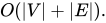
The usual algorithms for topological sorting have running time linear in the number of nodes plus the number of edges, asymptotically,
Kahn's algorithm

[edit]

One of these algorithms, first described by Kahn (1962), works by choosing vertices in the same order as the eventual topological sort.[2] First, find a list of "start nodes" that have no incoming edges and insert them into a set S; at least one such node must exist in a non-empty (finite) acyclic graph. Then:

L ← Empty list that will contain the sorted elements
S ← Set of all nodes with no incoming edge

while S is not empty do
    remove a node n from S
    add n to L
    for each node m with an edge e from n to m do
        remove edge e from the graph
        if m has no other incoming edges then
            insert m into S

if graph has edges then
    return error   (graph has at least one cycle)
else 
    return L   (a topologically sorted order)

If the graph is a DAG, a solution will be contained in the list L (although the solution is not necessarily unique). Otherwise, the graph must have at least one cycle and therefore a topological sort is impossible.

Reflecting the non-uniqueness of the resulting sort, the structure S can be simply a set or a queue or a stack. Depending on the order that nodes n are removed from set S, a different solution is created. A variation of Kahn's algorithm that breaks ties lexicographically forms a key component of the Coffman–Graham algorithm for parallel scheduling and layered graph drawing.

[edit]

An alternative algorithm for topological sorting is based on depth-first search. The algorithm loops through each node of the graph, in an arbitrary order, initiating a depth-first search that terminates when it hits any node that has already been visited since the beginning of the topological sort or the node has no outgoing edges (i.e., a leaf node):

L ← Empty list that will contain the sorted nodes
while exists nodes without a permanent mark do
    select an unmarked node n
    visit(n)

function visit(node n)
    if n has a permanent mark then
        return
    if n has a temporary mark then
        stop   (graph has at least one cycle)

    mark n with a temporary mark

    for each node m with an edge from n to m do
        visit(m)

    mark n with a permanent mark
    add n to head of L

Each node n gets prepended to the output list L only after considering all other nodes that depend on n (all descendants of n in the graph). Specifically, when the algorithm adds node n, we are guaranteed that all nodes that depend on n are already in the output list L: they were added to L either by the recursive call to visit() that ended before the call to visit n, or by a call to visit() that started even before the call to visit n. Since each edge and node is visited once, the algorithm runs in linear time. This depth-first-search-based algorithm is the one described by Cormen et al. (2001);[3] it seems to have been first described in print by Tarjan in 1976.[4]

Parallel algorithms

[edit]

On a parallel random-access machine, a topological ordering can be constructed in O((log n)2) time using a polynomial number of processors, putting the problem into the complexity class NC2.[5] One method for doing this is to repeatedly square the adjacency matrix of the given graph, logarithmically many times, using min-plus matrix multiplication with maximization in place of minimization. The resulting matrix describes the longest path distances in the graph. Sorting the vertices by the lengths of their longest incoming paths produces a topological ordering.[6]

An algorithm for parallel topological sorting on distributed memory machines parallelizes the algorithm of Kahn for a DAG .[7] On a high level, the algorithm of Kahn repeatedly removes the vertices of indegree 0 and adds them to the topological sorting in the order in which they were removed. Since the outgoing edges of the removed vertices are also removed, there will be a new set of vertices of indegree 0, where the procedure is repeated until no vertices are left. This algorithm performs iterations, where D is the longest path in G. Each iteration can be parallelized, which is the idea of the following algorithm.

In the following, it is assumed that the graph partition is stored on p processing elements (PE), which are labeled . Each PE i initializes a set of local vertices with indegree 0, where the upper index represents the current iteration. Since all vertices in the local sets have indegree 0, i.e., they are not adjacent, they can be given in an arbitrary order for a valid topological sorting. To assign a global index to each vertex, a prefix sum is calculated over the sizes of . So, each step, there are vertices added to the topological sorting.

Execution of the parallel topological sorting algorithm on a DAG with two processing elements.

In the first step, PE j assigns the indices to the local vertices in . These vertices in are removed, together with their corresponding outgoing edges. For each outgoing edge with endpoint v in another PE , the message is posted to PE l. After all vertices in are removed, the posted messages are sent to their corresponding PE. Each message received updates the indegree of the local vertex v. If the indegree drops to zero, v is added to . Then the next iteration starts.

In step k, PE j assigns the indices , where is the total number of processed vertices after step . This procedure repeats until there are no vertices left to process, hence . Below is a high level, single program, multiple data pseudo-code overview of this algorithm.

Note that the prefix sum for the local offsets can be efficiently calculated in parallel.

p processing elements with IDs from 0 to p-1
Input: G = (V, E) DAG, distributed to PEs, PE index j = 0, ..., p - 1
Output: topological sorting of G

function traverseDAGDistributed
    δ incoming degree of local vertices V
    Q = {vV | δ[v] = 0}                     // All vertices with indegree 0
    nrOfVerticesProcessed = 0

    do
        global build prefix sum over size of Q     // get offsets and total number of vertices in this step
        offset = nrOfVerticesProcessed + sum(Qi, i = 0 to j - 1)          // j is the processor index
        foreach u in Q
            localOrder[u] = index++;
            foreach (u,v) in E do post message (u, v) to PE owning vertex v
        nrOfVerticesProcessed += sum(|Qi|, i = 0 to p - 1)
        deliver all messages to neighbors of vertices in Q
        receive messages for local vertices V
        remove all vertices in Q
        foreach message (u, v) received:
            if --δ[v] = 0
                add v to Q
    while global size of Q > 0

    return localOrder

The communication cost depends heavily on the given graph partition. As for runtime, on a CRCW-PRAM model that allows fetch-and-decrement in constant time, this algorithm runs in , where D is again the longest path in G and Δ the maximum degree.[7]

Application to shortest path finding

[edit]

The topological ordering can also be used to quickly compute shortest paths through a weighted directed acyclic graph. Let V be the list of vertices in such a graph, in topological order. Then the following algorithm computes the shortest path from some source vertex s to all other vertices:[3]

  • Let d be an array of the same length as V; this will hold the shortest-path distances from s. Set d[s] = 0, all other d[u] = ∞.
  • Let p be an array of the same length as V, with all elements initialized to nil. Each p[u] will hold the predecessor of u in the shortest path from s to u.
  • Loop over the vertices u as ordered in V, starting from s:
    • For each vertex v directly following u (i.e., there exists an edge from u to v):
      • Let w be the weight of the edge from u to v.
      • Relax the edge: if d[v] > d[u] + w, set
        • d[v] ← d[u] + w,
        • p[v] ← u.

Equivalently:

  • Let d be an array of the same length as V; this will hold the shortest-path distances from s. Set d[s] = 0, all other d[u] = ∞.
  • Let p be an array of the same length as V, with all elements initialized to nil. Each p[u] will hold the predecessor of u in the shortest path from s to u.
  • Loop over the vertices u as ordered in V, starting from s:
    • For each vertex v into u (i.e., there exists an edge from v to u):
      • Let w be the weight of the edge from v to u.
      • Relax the edge: if d[u] > d[v] + w, set
        • d[u] ← d[v] + w,
        • p[u] ← v.

On a graph of n vertices and m edges, this algorithm takes Θ(n + m), i.e., linear, time.[3]

Uniqueness

[edit]

If a topological sort has the property that all pairs of consecutive vertices in the sorted order are connected by edges, then these edges form a directed Hamiltonian path in the DAG. If a Hamiltonian path exists, the topological sort order is unique; no other order respects the edges of the path. Conversely, if a topological sort does not form a Hamiltonian path, the DAG will have two or more valid topological orderings, for in this case it is always possible to form a second valid ordering by swapping two consecutive vertices that are not connected by an edge to each other. Therefore, it is possible to test in linear time whether a unique ordering exists, and whether a Hamiltonian path exists, despite the NP-hardness of the Hamiltonian path problem for more general directed graphs (i.e., cyclic directed graphs).[8]

Relation to partial orders

[edit]

Topological orderings are also closely related to the concept of a linear extension of a partial order in mathematics. A partially ordered set is just a set of objects together with a definition of the "≤" inequality relation, satisfying the axioms of reflexivity (x ≤ x), antisymmetry (if x ≤ y and y ≤ x then x = y) and transitivity (if x ≤ y and y ≤ z, then x ≤ z). A total order is a partial order in which, for every two objects x and y in the set, either x ≤ y or y ≤ x. Total orders are familiar in computer science as the comparison operators needed to perform comparison sorting algorithms. For finite sets, total orders may be identified with linear sequences of objects, where the "≤" relation is true whenever the first object precedes the second object in the order; a comparison sorting algorithm may be used to convert a total order into a sequence in this way. A linear extension of a partial order is a total order that is compatible with it, in the sense that, if x ≤ y in the partial order, then x ≤ y in the total order as well.

One can define a partial ordering from any DAG by letting the set of objects be the vertices of the DAG, and defining x ≤ y to be true, for any two vertices x and y, whenever there exists a directed path from x to y; that is, whenever y is reachable from x. With these definitions, a topological ordering of the DAG is the same thing as a linear extension of this partial order. Conversely, any partial ordering may be defined as the reachability relation in a DAG. One way of doing this is to define a DAG that has a vertex for every object in the partially ordered set, and an edge xy for every pair of objects for which x ≤ y. An alternative way of doing this is to use the transitive reduction of the partial ordering; in general, this produces DAGs with fewer edges, but the reachability relation in these DAGs is still the same partial order. By using these constructions, one can use topological ordering algorithms to find linear extensions of partial orders.

Relation to scheduling optimisation

[edit]

By definition, the solution of a scheduling problem that includes a precedence graph is a valid solution to topological sort (irrespective of the number of machines), however, topological sort in itself is not enough to optimally solve a scheduling optimisation problem. Hu's algorithm is a popular method used to solve scheduling problems that require a precedence graph and involve processing times (where the goal is to minimise the largest completion time amongst all the jobs). Like topological sort, Hu's algorithm is not unique and can be solved using DFS (by finding the largest path length and then assigning the jobs).

See also

[edit]

References

[edit]

Further reading

[edit]
[edit]
Revisions and contributorsEdit on WikipediaRead on Wikipedia
from Grokipedia
Topological sorting, also known as a , is a linear ordering of the vertices in a directed acyclic graph (DAG) such that for every directed edge from vertex uu to vertex vv, uu appears before vv in the ordering. This arrangement respects the partial order imposed by the graph's edges, ensuring that no cycles exist to violate the precedence relationships. Only DAGs admit a topological sort, as cycles would prevent a valid of the dependencies. The concept finds applications in various domains requiring precedence resolution, such as scheduling tasks with dependencies, where nodes represent jobs and edges indicate prerequisites. For instance, in systems, it determines the order of compiling modules to ensure dependencies are resolved first; in academic planning, it sequences courses based on prerequisites; and in package management, it resolves installation orders to avoid circular dependencies. Additionally, it supports deadlock detection in operating systems by identifying cyclic dependencies in graphs. Two primary algorithms compute a topological sort efficiently. Kahn's algorithm, a (BFS)-based approach, starts with nodes of indegree zero, iteratively removes them, and updates indegrees of neighbors until all vertices are ordered or a cycle is detected. Alternatively, a (DFS)-based method performs a post-order traversal, reversing the finishing times to yield the , which also runs in linear time relative to the graph size. Both algorithms achieve O(V+E)O(|V| + |E|) , where V|V| is the number of vertices and E|E| is the number of edges, making topological sorting practical for large graphs.

Fundamentals

Definition

In , a topological ordering of a G=(V,E)G = (V, E) is a linear ordering of its vertices such that for every directed edge (u,v)E(u, v) \in E, vertex uu comes before vertex vv in the ordering. This ordering respects the directionality of all edges, ensuring that dependencies or precedences implied by the graph are preserved in a sequential manner. Such an ordering exists if and only if the graph is a (DAG), meaning it contains no directed cycles. The presence of a directed cycle prevents a valid topological ordering, as it would require at least one vertex to precede itself in the linear sequence, which violates the irreflexive nature of a strict . The concept is formally denoted by a bijective function σ:V{1,2,,V}\sigma: V \to \{1, 2, \dots, |V|\}, where σ(u)<σ(v)\sigma(u) < \sigma(v) for every directed edge (u,v)E(u, v) \in E. This notation captures the topological ordering as a permutation of the vertices indexed from 1 to n=Vn = |V|, with lower indices indicating earlier positions. The term "topological sorting" was coined by Arthur B. Kahn in his 1962 paper on ordering large networks, though the underlying idea relates to linear extensions of partial orders in earlier graph-theoretic contexts.

Directed Acyclic Graphs

A directed acyclic graph (DAG) is a directed graph composed of a finite set of vertices and directed edges such that there is no directed cycle, meaning no path exists from any vertex to itself. Formally, in a DAG G=(V,E)G = (V, E), for every vertex vVv \in V, there does not exist a sequence of edges forming a closed walk that returns to vv. A directed graph admits a topological ordering if and only if it is a DAG. To see this, first suppose a graph has a topological ordering; if it contained a cycle v1v2vkv1v_1 \to v_2 \to \cdots \to v_k \to v_1, then the ordering would require v1v_1 before v2v_2, v2v_2 before v3v_3, and so on, up to vkv_k before v1v_1, leading to a contradiction since no vertex can precede itself in a linear order. Conversely, every DAG possesses at least one topological ordering, as demonstrated constructively by algorithms that iteratively select vertices with no incoming edges. The acyclicity of a DAG ensures that all paths between vertices are finite and of bounded length, preventing infinite traversals. Moreover, every nonempty finite DAG contains at least one source vertex, defined as a vertex with in-degree zero (no incoming edges), and at least one sink vertex, defined as a vertex with out-degree zero (no outgoing edges). These sources and sinks play a key role in processing the graph, as removing a source iteratively reduces the graph while preserving acyclicity. Simple DAGs can be constructed or recognized through structures that inherently avoid cycles. For instance, a transitive tournament—a complete directed graph where edges respect a total order (if uvu \to v and vwv \to w, then uwu \to w)—forms a DAG, as transitivity eliminates cycles by enforcing a linear hierarchy. Similarly, Hasse diagrams represent partially ordered sets (posets) as DAGs by drawing only covering relations (direct successors without intermediates), ensuring no cycles since the partial order is reflexive, antisymmetric, and transitive. To build such a diagram for a poset, start with the elements as vertices and add directed edges from aa to bb only if bb covers aa (i.e., a<ba < b and no cc with a<c<ba < c < b), verifying acyclicity by the poset's properties.

Illustrative Examples

Graph-Based Examples

A simple example of a directed acyclic graph (DAG) suitable for topological sorting consists of four vertices labeled A, B, C, and D, with directed edges A → B, A → C, B → D, and C → D. This structure represents a basic precedence relationship where A precedes both B and C, and both B and C precede D. The graph can be represented using an adjacency list as follows:

A: [B, C] B: [D] C: [D] D: []

A: [B, C] B: [D] C: [D] D: []

Valid topological orderings respect the edge directions, ensuring that for every edge u → v, u appears before v in the sequence. Examples include A, B, C, D and A, C, B, D. In contrast, the ordering B, A, C, D is invalid because B precedes A, violating the edge A → B. For a larger illustration, consider a 5-vertex DAG modeling a project timeline with vertices labeled P (planning), Q (design), R (development), S (testing), and T (deployment), and edges P → Q, P → R, Q → S, R → S, R → T. This graph captures dependencies where planning must precede design and development, design and development precede testing, and development precedes deployment. The adjacency list representation is:

P: [Q, R] Q: [S] R: [S, T] S: [] T: []

P: [Q, R] Q: [S] R: [S, T] S: [] T: []

Multiple valid topological orderings exist, such as P, Q, R, S, T and P, R, Q, T, S, demonstrating the non-uniqueness of topological sorts in DAGs with parallel paths.

Dependency-Based Examples

Topological sorting finds extensive application in scenarios involving dependencies, where tasks or components must be ordered such that prerequisites are satisfied before dependents, typically modeled using directed acyclic graphs (DAGs). A common example arises in academic task scheduling, such as ordering university courses based on prerequisites. Consider a set of courses where Calculus I is a prerequisite for Calculus II, and Calculus II is required for Linear Algebra, while Physics has no prerequisites. The dependency graph has directed edges from Calculus I to Calculus II and from Calculus II to Linear Algebra. A valid topological order might be Calculus I, Physics, Calculus II, Linear Algebra, ensuring no course is taken before its prerequisites. This approach allows students to complete programs efficiently without violations. In software development, topological sorting underpins build systems for compiling interdependent modules. For instance, if library A depends on library B, the graph includes a directed edge from B to A, indicating B must be built before A. The topological order determines the compilation sequence, such as building B first, then A, preventing errors from unresolved dependencies during linking. Build systems like Make or Bazel rely on this to automate the process across large projects. Similarly, in game development, topological sorting manages asset loading to resolve dependencies among resources like textures, models, and shaders. Textures must load before the models that reference them, and models before shaders that apply to rendered scenes; the graph directs edges accordingly (e.g., texture to model). A topological order ensures assets are loaded sequentially without runtime failures, such as missing references during gameplay initialization. Violating this order, particularly through circular dependencies (e.g., A requires B and B requires A), renders the graph cyclic and prevents a valid topological sort, leading to errors like compilation failures in builds or crashes in asset loading. Detection of such cycles during sorting is crucial for debugging dependency issues.

Algorithms

Kahn's Algorithm

Kahn's algorithm is an iterative method for computing a topological ordering of a directed acyclic graph (DAG), introduced by Arthur B. Kahn in 1962 for efficiently sorting large networks. The approach uses a breadth-first search strategy based on tracking the in-degrees of vertices, starting from sources and progressively removing dependencies. This non-recursive procedure is particularly noted for its straightforward implementation and its inherent suitability for explicit cycle detection and parallel extensions. The algorithm proceeds in the following steps: First, compute the in-degree (number of incoming edges) for each vertex in the graph. Initialize a queue with all vertices that have an in-degree of zero, as these are the starting points with no dependencies. Then, while the queue is not empty, dequeue a vertex, add it to the topological ordering, and decrease the in-degrees of all its neighboring vertices. If a neighbor's in-degree reaches zero after this reduction, enqueue it, indicating that its dependencies have been satisfied. This process continues until the queue is exhausted. The full pseudocode for Kahn's algorithm, assuming a graph represented as an adjacency list and vertices numbered from 0 to |V|-1, is as follows:

function kahnTopologicalSort(graph, V): indegree = array of size V initialized to 0 for each vertex u in 0 to V-1: for each neighbor v of u in graph[u]: indegree[v] += 1 Q = empty queue for i in 0 to V-1: if indegree[i] == 0: Q.enqueue(i) order = empty list while Q is not empty: u = Q.dequeue() order.append(u) for each neighbor v of u in graph[u]: indegree[v] -= 1 if indegree[v] == 0: Q.enqueue(v) if length of order == V: return order // Valid topological sort else: error: "Graph contains a cycle" // Fewer than |V| vertices ordered

function kahnTopologicalSort(graph, V): indegree = array of size V initialized to 0 for each vertex u in 0 to V-1: for each neighbor v of u in graph[u]: indegree[v] += 1 Q = empty queue for i in 0 to V-1: if indegree[i] == 0: Q.enqueue(i) order = empty list while Q is not empty: u = Q.dequeue() order.append(u) for each neighbor v of u in graph[u]: indegree[v] -= 1 if indegree[v] == 0: Q.enqueue(v) if length of order == V: return order // Valid topological sort else: error: "Graph contains a cycle" // Fewer than |V| vertices ordered

This implementation processes each vertex and edge exactly once when using adjacency lists for the graph representation, yielding a time complexity of O(|V| + |E|), where |V| is the number of vertices and |E| is the number of edges. The space complexity is O(|V|) for the queue, in-degree array, and output list. The algorithm outputs a valid topological ordering if the graph is a DAG, placing each vertex after all its predecessors. If the final ordering contains fewer than |V| vertices, it indicates the presence of a cycle, as some vertices remain with positive in-degrees and cannot be ordered. This explicit cycle detection is a key advantage, allowing immediate identification of invalid graphs without additional traversal. Additionally, the level-by-level processing facilitates parallelization by enabling concurrent handling of independent vertices at each iteration. This property makes Kahn's algorithm particularly relevant for optimized CI/CD systems, where it supports the minimum required ordering of dependencies while enabling maximized parallel throughput of independent software packages.

Depth-First Search Algorithm

The depth-first search (DFS) algorithm for topological sorting performs a traversal of the directed acyclic graph (DAG), recording vertices in the order they finish processing, and then reverses this finishing order to obtain the topological sequence. This approach leverages the property that in a DAG, a vertex must appear after all its successors in the topological order, which aligns with the post-order finishing times produced by DFS. The algorithm assumes the input is a DAG; if cycles are present, they can be detected during traversal, preventing a valid topological sort. The steps of the algorithm are as follows: first, initialize a visited array to track processed vertices and an empty list to store the finishing order. Then, for each vertex in the graph, if it has not been visited, invoke the recursive DFS procedure starting from that vertex. During the DFS traversal from a given vertex uu, mark uu as visited, and for each unvisited neighbor vv of uu, recursively perform DFS on vv. Upon completing all recursive calls from uu, append uu to the front of the finishing list (or equivalently, record it in post-order and reverse the list at the end). The resulting reversed finishing order yields a valid topological sort, as vertices with no outgoing dependencies finish first in the reversed sense. To handle graphs with multiple connected components, the algorithm iterates over all vertices and initiates a separate DFS call on any unvisited vertex, ensuring the entire graph is traversed. This is necessary because DFS from a single starting point may not reach all components in a disconnected graph. The following pseudocode illustrates a recursive implementation that also incorporates cycle detection using a recursion stack (or color states: white for unvisited, gray for in-stack, black for finished). If a back edge to a gray vertex is encountered, a cycle exists, and topological sorting is impossible.

function topologicalSort(G): visited = array of false for all vertices recStack = array of false for all vertices // for cycle detection order = empty list for each vertex u in G: if not visited[u]: if DFS(u, visited, recStack, order): return null // cycle detected reverse(order) return order function DFS(u, visited, recStack, order): visited[u] = true recStack[u] = true for each neighbor v of u: if not visited[v]: if DFS(v, visited, recStack, order): return true // cycle else if recStack[v]: return true // back edge to in-stack vertex recStack[u] = false order.append(u) // post-order addition return false

function topologicalSort(G): visited = array of false for all vertices recStack = array of false for all vertices // for cycle detection order = empty list for each vertex u in G: if not visited[u]: if DFS(u, visited, recStack, order): return null // cycle detected reverse(order) return order function DFS(u, visited, recStack, order): visited[u] = true recStack[u] = true for each neighbor v of u: if not visited[v]: if DFS(v, visited, recStack, order): return true // cycle else if recStack[v]: return true // back edge to in-stack vertex recStack[u] = false order.append(u) // post-order addition return false

This pseudocode uses post-order addition to the list, followed by reversal in the main function. The time complexity of the DFS-based topological sort is O(V+E)O(|V| + |E|), where V|V| is the number of vertices and E|E| is the number of edges, as it performs a single pass equivalent to standard DFS traversal. Space complexity is O(V)O(|V|) for the visited array, recursion stack, and output list, with additional stack space up to O(V)O(|V|) in the worst case for recursion depth. Advantages of the DFS approach include its simpler implementation in languages supporting recursion, as it avoids explicit computation of vertex degrees or maintenance of queues, and its natural integration of cycle detection through back-edge identification during traversal. This contrasts with iterative methods that require preprocessing incoming edges. The DFS-based method for topological sorting was popularized in Robert Tarjan's seminal 1972 paper on depth-first search and linear graph algorithms, which demonstrated its efficiency for solving problems on directed graphs.

Parallel Algorithms

Parallel adaptations of topological sorting algorithms enable efficient processing of directed acyclic graphs (DAGs) in concurrent, distributed, or multi-processor environments, where multiple nodes can be handled simultaneously to reduce execution time. These methods extend sequential approaches like Kahn's algorithm and by distributing computations across threads or processors while preserving the topological order. Key challenges include ensuring synchronization to maintain correctness, such as avoiding inconsistent in-degree calculations during concurrent updates. A parallel variant of Kahn's algorithm uses a shared worklist, often implemented as a queue or priority queue, to manage nodes with zero in-degree. Multiple threads or processors simultaneously dequeue such nodes, add them to the topological order, and decrement the in-degrees of their successors; if a successor's in-degree reaches zero, it is enqueued. Synchronization is achieved via locks on shared in-degree arrays to prevent race conditions where concurrent decrements could lead to incorrect zero detections or lost updates. This approach allows independent processing of ready nodes, achieving load balancing in systems with varying node dependencies. In DFS-based parallelization, the graph is partitioned into independent components or subgraphs, on which separate DFS traversals are performed concurrently to compute local post-orderings. These post-order lists are then merged into a global topological order, leveraging the fact that components have no interdependencies. This method suits graphs with natural parallelism, such as weakly connected DAGs, and can be implemented on GPUs or multi-core systems for fine-grained parallelism. Seminal work on parallel topological sorting includes algorithms that combine in-degree reduction with parallel prefix computations for efficient zero-detection across processors. For instance, an efficient parallel algorithm on a concurrent-read exclusive-write (CREW) parallel random-access machine (PRAM) model computes a topological order in O(log2n)O(\log^2 n) time using O(n+m)O(n + m) processors, where nn is the number of vertices and mm the number of edges, by iteratively selecting and removing sets of zero in-degree nodes in parallel phases. Similar techniques extend to distributed settings, achieving O(D)O(D) rounds where DD is the graph diameter, with O(n)O(n) messages total. In terms of complexity, these parallel algorithms achieve near-linear work in models like PRAM, with time O(logn)O(\log n) using V|V| processors for balanced workloads, enabling scalability for large graphs. For example, the PRAM algorithm mentioned above provides optimal speedup for dense graphs by minimizing communication overhead in in-degree updates. In big data frameworks, parallel topological sorting is applied in 's DAG execution plans, where the DAGScheduler constructs a DAG of computation stages and schedules them in topological order to optimize task distribution across a cluster, ensuring dependencies are resolved before execution. This facilitates fault-tolerant processing of massive datasets by pipelining independent stages concurrently. A primary challenge in these parallel methods is handling race conditions during shared in-degree updates, where unsynchronized access by multiple threads can cause over- or under-decrementing, leading to invalid orders or missed nodes. Solutions often involve atomic operations or fine-grained locking, though these introduce overhead that must be balanced against parallelism gains, particularly on architectures like GPUs where global synchronization is costly.

Key Properties

Uniqueness Conditions

A directed acyclic graph (DAG) has a unique topological ordering if and only if it contains a , which is a directed path that visits every vertex exactly once. In such a graph, the topological order must strictly follow the sequence of vertices along this path, as any deviation would violate the direction of at least one edge in the path. Conversely, if no exists, the partial order imposed by the DAG allows for multiple valid linear extensions, leading to more than one topological ordering. To see why the presence of a Hamiltonian path ensures uniqueness, consider that the path's edges force a total precedence among all vertices: for vertices viv_i and vi+1v_{i+1} in the path order, viv_i must precede vi+1v_{i+1} in any topological sort. Since the path covers all vertices, no other ordering can satisfy all edges without contradicting this sequence. For the converse, suppose a DAG has a unique topological ordering v1,v2,,vnv_1, v_2, \dots, v_n. For this order to be the only possible one, swapping any adjacent pair viv_i and vi+1v_{i+1} must create a violation, which requires a direct edge from viv_i to vi+1v_{i+1} (as any longer forcing path would involve intermediate vertices placed between them, which is impossible in the linear order). Thus, the edges v1v2vnv_1 \to v_2 \to \dots \to v_n form a . This equivalence can be established by induction on the number of vertices: for n=1n=1, the single vertex is trivially unique; assuming it holds for smaller graphs, the unique source in a path-like DAG leads to a unique extension. For example, consider a linear chain graph with vertices A, B, C and edges A → B → C; this forms a , yielding the unique topological order A, B, C. In contrast, a fork graph with vertices A, B, C and edges A → B, A → C has no covering all vertices without repetition, allowing two topological orders: A, B, C or A, C, B. These cases illustrate how branches or multiple sources introduce ordering flexibility. The existence of a unique topological ordering simplifies dependency resolution in applications like task scheduling, as it eliminates choices and guarantees a fixed sequence without backtracking. Determining uniqueness is computable efficiently by first performing a topological sort (in linear time) and then verifying if direct edges exist between every pair of consecutive vertices in that order, which confirms the presence of a . Notably, finding a in a is solvable in polynomial time—specifically, O(V + E)—unlike the NP-complete version for general graphs, making uniqueness checks practical for moderate-sized .

Cycle Detection Role

Topological sorting algorithms are widely utilized for cycle detection in directed graphs because a cycle precludes the existence of a valid topological order, allowing these methods to efficiently verify acyclicity. In Kahn's algorithm, which relies on breadth-first search and in-degrees, the process begins by enqueueing all nodes with zero in-degree and iteratively removing them while updating the in-degrees of neighbors. If the final ordering does not include all vertices after this process, the graph contains a cycle, as the remaining nodes form a subgraph where every node has a positive in-degree. The depth-first search (DFS) variant integrates cycle detection by tracking the traversal state of nodes using a three-color scheme: white for unvisited, gray for currently visiting (active in the recursion stack), and black for fully visited. During DFS, an edge to a gray node constitutes a back edge, confirming a cycle in the graph. This approach not only detects cycles but also produces a topological order by appending nodes to the front of a list upon finishing their DFS traversal, provided no cycles are found. For dedicated cycle detection without needing the full ordering, executing a topological sort and verifying if the output length equals the number of vertices |V| suffices; a shorter ordering implies a cycle, and the unprocessed subgraph can be analyzed to recover the cyclic components. This technique maintains the linear time complexity O(|V| + |E|) of topological sorting itself. Advanced extensions, such as , enhance detection by identifying all cycles within SCCs—subgraphs where every pair of nodes is mutually reachable—using a single DFS pass with low-link values to pinpoint non-trivial components containing cycles. Cycle detection via topological sorting is essential as a preprocessing step for algorithms assuming directed acyclic graphs (DAGs), ensuring correctness in applications like scheduling and ordering. In practical systems, it prevents errors such as deadlocks in resource allocation, where cycles in wait-for graphs indicate irresolvable contention among processes.

Applications

Shortest Path Finding

Topological sorting facilitates the computation of single-source shortest paths in directed acyclic graphs (DAGs) with non-negative edge weights by enabling a dynamic programming approach that processes vertices in a linear order where all predecessors precede each vertex. The method involves first obtaining a topological ordering of the vertices, then relaxing all outgoing edges from each vertex in that order to update the shortest path distances from the source. This relaxation step uses the recurrence relation for the distance to a vertex vv: d=min(d,d+w(u,v))d = \min(d, d + w(u, v)) where uu is a predecessor of vv in the topological order, d[]d[\cdot] denotes the shortest path distance, and w(u,v)w(u, v) is the weight of the edge from uu to vv. The algorithm proceeds as follows: perform a topological sort on the DAG using any standard method; initialize the distance from the source ss to itself as 0 and to all other vertices as infinity; then, iterate through the vertices in topological order, relaxing all edges outgoing from the current vertex uu by updating dd for each neighbor vv. This single linear pass ensures that when a vertex is processed, its shortest path distance is finalized. The time complexity of this approach is O(V+E)O(|V| + |E|), matching the cost of the topological sort and edge relaxations, which is more efficient than the Bellman-Ford algorithm's O(VE)O(|V||E|) for the same problem. Correctness relies on the acyclicity of the DAG: the topological order guarantees that all predecessors of a vertex are processed before it, ensuring that incoming relaxations are complete when dd is used for outgoing edges. For example, consider a weighted DAG representing project tasks where edges indicate dependencies with costs as durations; starting from the initial task as the source, the algorithm computes the earliest completion time for each subsequent task by accumulating minimum path costs along dependency chains. This single-source method extends to all-pairs shortest paths in the DAG by repeating the procedure for each vertex as the source, yielding a total complexity of O(V(V+E))O(|V|(|V| + |E|)).

Scheduling Optimization

In scheduling optimization, projects with precedence constraints are modeled as directed acyclic graphs (DAGs), where vertices represent tasks and directed edges denote precedence relationships from predecessor to successor tasks. Topological sorting yields a linear ordering of tasks that ensures no task begins before its dependencies are completed, facilitating the assignment of start times while incorporating resource constraints such as limited labor, equipment, or materials. This approach allows project managers to minimize delays and optimize resource allocation across the timeline. The Critical Path Method (CPM), developed in the late 1950s by James E. Kelley of Remington Rand and Morgan R. Walker of DuPont to improve plant maintenance scheduling, integrates topological sorting with forward and backward passes over the DAG. After obtaining a topological order, the forward pass computes the earliest start (ES) and earliest finish (EF) times for each task, where ES of a task is the maximum EF of its predecessors, and EF = ES + duration. The backward pass then determines the latest start (LS) and latest finish (LF) times, starting from the project's end and working reversely, with LS = LF - duration and LF as the minimum LS of successors. The critical path emerges as the sequence of tasks with zero slack (LS - ES = 0), representing the longest path through the graph and thus the minimum project duration; any delay on this path extends the overall timeline. Consider a construction project with six tasks: site preparation (A, 2 days), foundation (B, 4 days, after A), framing (C, 5 days, after B), roofing (D, 3 days, after C), electrical wiring (E, 2 days, after B), and interior finishing (F, 2 days, after D and E). A topological sort yields the order A, B, E, C, D, F. In the forward pass: ES_A = 0, EF_A = 2; ES_B = 2, EF_B = 6; ES_E = 6, EF_E = 8; ES_C = 6, EF_C = 11; ES_D = 11, EF_D = 14; ES_F = 14, EF_F = 16. The backward pass, assuming project end at day 16: LF_F = 16, LS_F = 14; LF_D = 14, LS_D = 11; LF_E = 14, LS_E = 12; LF_C = 11, LS_C = 6; LF_B = 6, LS_B = 2; LF_A = 2, LS_A = 0. The critical path is A-B-C-D-F with total duration 16 days and zero slack; task E has 6 days of slack (LS_E - ES_E = 6), allowing flexibility in scheduling. Optimizations often involve resource leveling, which delays non-critical tasks to smooth resource demand without extending the critical path, thereby minimizing makespan—the total project completion time—under constraints like a fixed number of workers. For instance, if electrical wiring (E) requires the same crew as framing (C), leveling shifts E later within its slack to avoid peaks. In multiprocessor environments, topological sorting guides parallel assignment, where tasks without immediate dependencies are allocated to available processors to reduce idle time while preserving order. The computational complexity of CPM is linear after topological sorting, at O(V + E) where V is the number of tasks (vertices) and E the number of precedence relations (edges), making it efficient for large projects. An extension, the Program Evaluation and Review Technique (PERT), developed in 1958 for the U.S. Navy's Polaris missile program, applies topological sorting to graphs with probabilistic task durations modeled via beta distributions; it computes expected times and path variances to estimate project completion probabilities. In real-world applications, such as manufacturing assembly lines, topological sorting sequences operations like part fabrication and assembly to optimize throughput while respecting material flow dependencies. Tools like Microsoft Project automate this process, using CPM with topological ordering to generate optimized schedules for construction and engineering projects.

Build Systems and Dependencies

In software build systems, dependencies between targets are modeled as a directed acyclic graph (DAG), where each target points to its prerequisites. GNU Make processes this graph by recursively building prerequisites before targets, effectively performing a topological sort to ensure correct build order without unnecessary recompilations. Package managers like NPM and APT construct dependency graphs from package metadata and apply topological sorting to determine installation sequences, guaranteeing that lower-level dependencies are resolved and installed prior to higher-level packages that rely on them. For instance, in APT, after initial dependency resolution, a topological sort over the graph guides the dpkg installer to apply changes in a valid order. Consider building a C++ project where source files depend on header files and libraries; the build system must compile headers and link libraries before assembling the final executable. If circular dependencies exist—such as module A requiring B and B requiring A—the graph contains a cycle, rendering topological sorting impossible and triggering build errors to alert developers. Advanced features in build systems leverage topological sorting for efficiency. Incremental builds identify changed files and perform a localized topological sort on the affected subgraph, rebuilding only dependent targets while skipping unchanged ones; this is crucial for handling versioned dependencies in evolving projects. Tools like Bazel explicitly model builds as DAGs, using topological ordering to enforce reproducible execution sequences across distributed environments; integrated cycle detection aborts builds upon discovering loops, preventing infinite recursion. In large-scale monorepos, where dependency graphs can encompass millions of nodes, topological sorting faces scalability challenges due to computation time and memory usage, often mitigated by parallel algorithms that distribute the sorting process. This approach is particularly relevant in optimized CI/CD systems, where Kahn's algorithm supports both the minimum required ordering of dependent tasks and maximized parallel throughput of independent software packages, enabling efficient build and deployment pipelines.

Mathematical Connections

Partial Orders

A partially ordered set (poset) consists of a nonempty set PP equipped with a binary relation \leq that is reflexive (for all aPa \in P, aaa \leq a), antisymmetric (if aba \leq b and bab \leq a, then a=ba = b), and transitive (if aba \leq b and bcb \leq c, then aca \leq c). This relation defines a partial order on the elements of PP, where not all pairs need to be comparable. The Hasse diagram of a poset visualizes this structure as the transitive reduction of the corresponding directed acyclic graph (DAG), retaining only the minimal edges (cover relations) where aa covers bb if a>ba > b and no element cc satisfies b<c<ab < c < a. Topological sorting relates directly to posets by producing a linear extension, which is a total ordering of the elements that preserves the partial order: if a<ba < b in the poset (where << denotes the strict order), then aa precedes bb in the sequence. In graph-theoretic terms, the poset can be represented by a DAG whose edges indicate the strict partial order, with the transitive closure of the DAG yielding the full comparability relation between elements. For instance, consider the divisibility poset on the set {1,2,3,6}\{1, 2, 3, 6\}, where aba \leq b if aa divides bb: 11 divides all elements, 22 divides 66, and 33 divides 66, but 22 and 33 are . Valid linear extensions include the sequences 1,2,3,61, 2, 3, 6 and 1,3,2,61, 3, 2, 6, both respecting the divisibility constraints. A fundamental result establishes that every finite poset corresponds to a unique DAG (up to ), where the DAG's vertices are the poset elements and edges represent the cover relations, and conversely, the of any DAG induces a partial order on its vertices; topological sorts of such DAGs precisely enumerate the linear extensions of the poset. In , topological sorting via finds applications in linearizing for design, where it resolves inter-table dependencies to determine creation order, and in ranking systems, where it extends partial preference orders into while preserving comparabilities.

Linear Extensions

A of a (poset) PP is a on the elements of PP that preserves all the comparability relations of PP, equivalent to a topological sorting of the (or any DAG representation) of PP. This means that if xyx \leq y in PP, then xx precedes yy in the linear extension. The number of linear extensions of a poset PP, denoted e(P)e(P), is a key combinatorial invariant. Computing e(P)e(P) exactly is #P-complete, even for restricted classes of posets such as those of height two. However, for small posets with up to around 20 elements, dynamic programming or inclusion-exclusion algorithms can compute e(P)e(P) tractably in exponential but feasible time. Algorithms for generating all linear extensions typically employ backtracking over possible topological sorts, pruning branches that violate poset relations by maintaining indegree counts or using recursive enumeration of minimal elements. For specific posets like those corresponding to Young diagrams (partitions represented as Ferrers diagrams with the natural order), e(P)e(P) is given exactly by the hook-length formula: if λ\lambda is a partition of nn with Young diagram shape, then e(P)=n!/(i,j)λh(i,j)e(P) = n! / \prod_{(i,j) \in \lambda} h(i,j), where h(i,j)h(i,j) is the hook length at position (i,j)(i,j), the number of cells to the right and below plus one. Properties of linear extensions are closely tied to poset structure. By , the width w(P)w(P) of PP—the size of the largest —equals the minimum number of chains needed to cover PP. If PP decomposes into ww chains of sizes n1,,nwn_1, \dots, n_w, then e(P)n!/(n1!nw!)e(P) \leq n! / (n_1! \cdots n_w!), with equality if the chains are disjoint and incomparable across chains. Thus, the width provides an upper bound on e(P)e(P); in particular, if w(P)=nw(P) = n (an ), then e(P)=n!e(P) = n!, while if w(P)=1w(P) = 1 (a or chain), then e(P)=1e(P) = 1, the unique extension being the order itself. For example, consider the poset on four elements {1,2,3,4}\{1,2,3,4\} with relations 1<31 < 3 and 2<32 < 3, and 4 to all; its linear extensions are 1234, 2134, 1243, 2143, and 2413, totaling five. Linear extensions find applications in preference aggregation within , where partial preference orders from voters are extended to total rankings, and e(P)e(P) measures the number of consistent individual preferences for a given partial order. In theory, the volume of the order O(P)\mathcal{O}(P) associated with PP equals e(P)/n!e(P)/n!, linking enumeration to geometric computations.

References

Add your contribution
Related Hubs
User Avatar
No comments yet.