


Community hub
Recent from talks
Contribute something
Nothing was collected or created yet.
Moorish Castle
View on Wikipedia
The Moorish Castle is the name given to a medieval fortification in Gibraltar comprising various buildings, gates, and fortified walls, with the dominant features being the Tower of Homage and the Gate House. Part of the castle itself also housed the prison of Gibraltar until it was relocated in 2010.[1] The Tower of Homage is clearly visible to all visitors to Gibraltar; not only because of its striking construction, but also because of its dominant and strategic position. Although sometimes compared to the nearby alcazars in Spain, the Moorish Castle in Gibraltar was constructed by the Marinid dynasty, making it unique in the Iberian Peninsula.[2]
Key Information


History
[edit]

Gibraltar has always been of special significance to the numerous peoples and civilisations that have visited or occupied it over the ages, from the Neanderthal period, through the Classical and on to Moorish, Spanish, and the current British rule.
The Moorish occupation is by far the longest in Gibraltar's recorded history, having lasted from 711 to 1309 and then again from 1333 to 1462, a total of 727 years.[3]
The Moorish conquest of Iberia was led by Tarik ibn Ziyad and Musa ibn Nusayr, who may have landed in Europe at or near Gibraltar. Gibraltar thus became the stepping-stone to the Moorish conquests of most of Iberia and part of France. This spectacular feat of arms took a mere twenty-one years, no mean task considering the distances and terrain involved, and the fact that mechanical transport on land was not then in use.[4] The strategic importance of Gibraltar rose in the last years of the Moorish rule, when, after the successful Spanish reconquest of the entire Guadalquivir valley, Gibraltar became one of the key elements in communication between the Emirate of Granada and Moorish domains in northwestern Africa.
Construction of the Moorish Castle commenced in the 8th century AD (possibly AD 711);[dubious – discuss] the date of its completion is not recorded. Its walls enclosed a considerable area, reaching down from the upper part of the Rock of Gibraltar to the sea. The most conspicuous remaining parts of the Castle are the upper tower, or Tower of Homage, together with various terraces and battlements below it, and the massive Gate House, with its cupola roof.[5]
The Tower of Homage
[edit]The Tower of Homage is the highest tower of the period of Islamic rule in the Iberian Peninsula, and the Qasbah of the Castle is the largest in the area. The Castle itself played a prominent part in the Muslim invasion of the Iberian Peninsula, with Muslim forces overrunning a large portion of it in two years – an invasion which led to Islamic domination of parts of western Europe for more than seven centuries. It is therefore of historic significance not only for Gibraltar and Iberia, but also for all of western Europe.
The present Tower of Homage, and most of what is visible today of the Castle, was rebuilt during the second Moorish period of occupation in the early 14th century, after its near destruction during a reconquest of Gibraltar by the Moors following a re-occupation by Spanish forces from 1309 to 1333.[5]
Present day
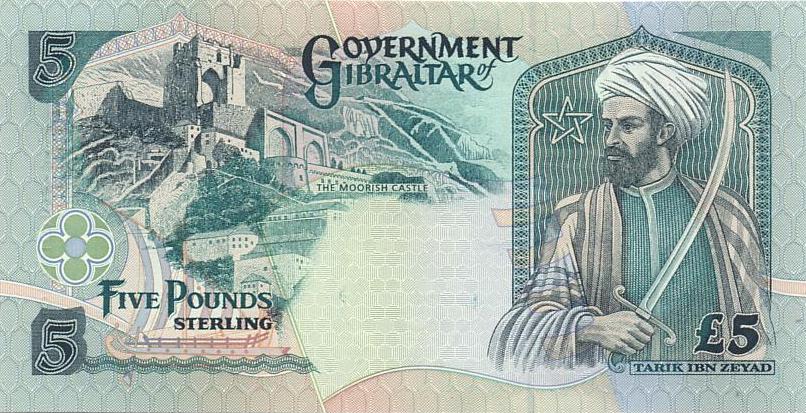
[edit]Today the Moorish Castle is one of the major tourist attractions of Gibraltar, and it is shown on the reverse of the 1995 design (still in circulation) of the Gibraltar five-pound banknote.[6]
The name "Moorish Castle" (or "El Castillo" in Spanish) is also used locally when referring to the residential area surrounding the Castle, location of the Moorish Castle Estate.
Part of the castle itself housed the prison of Gibraltar until the prison was relocated in 2010.[1]
See also
[edit]
References
[edit]- ^ a b Mascarenhas, Alice (1 September 2010). "GATES CLOSE, 'WINDY' PRISON OPENS FOR BUSINESS". The Gibraltar Chronicle. Archived from the original on 12 March 2012. Retrieved 1 September 2010.
- ^ "The Heritage of Gibralter: A Reply". CAM Bulletins. Commonwealth Association of Museums. May 1998. Archived from the original on 4 March 2012. Retrieved 10 September 2012.
- ^ "Moorish Castle". Guide to the Castles of Europe. Retrieved 13 September 2012.
- ^ "Information on the Moorish Castle Complex". Government of Gibraltar. Retrieved 13 February 2007.
- ^ a b "Gibraltar Heritage Trust History of The Moorish Castle". Archived from the original on 6 February 2007. Retrieved 13 February 2007.
- ^ "World Paper Money – Image of the reverse of a 1995 £5 Gibraltar banknote" (JPEG). Will's Online World Paper Money Gallery. Retrieved 13 September 2012.
External links
[edit]
Gibraltar topics | |||||||||||||||||||||||
|---|---|---|---|---|---|---|---|---|---|---|---|---|---|---|---|---|---|---|---|---|---|---|---|
| |||||||||||||||||||||||
| |||||||||||||||||||||||
| |||||||||||||||||||||||
| |||||||||||||||||||||||


Moorish Castle
View on GrokipediaOverview and Significance
Location and Strategic Role
The Moorish Castle is situated in the Upper Rock Nature Reserve of Gibraltar, on the northern cliffs of the Rock of Gibraltar, a prominent limestone promontory at the southeastern extremity of the Iberian Peninsula.[6] [7] This positioning places the castle at an elevated vantage point, approximately midway up the Rock's northern face, providing extensive oversight of the isthmus connecting Gibraltar to the Spanish mainland and the adjacent Bay of Gibraltar.[6] Strategically, the castle's location endowed it with critical defensive advantages, enabling surveillance and control over landward approaches from the north and maritime movements in the Strait of Gibraltar, the gateway between the Atlantic Ocean and the Mediterranean Sea.[7] [6] Fortifications at the site, initially constructed around 1160 and significantly reinforced in 1333 following the recapture by the Marinid ruler Abu al-Hasan, formed a robust stronghold for repelling invasions during the Moorish era.[8] The elevated terrain facilitated early warning of threats, enfilade fire on assailants, and sustained resistance during prolonged sieges, underscoring its role as a pivotal element in safeguarding the territory's sovereignty and trade routes.[7] In subsequent periods, including Spanish and British occupations, the castle retained its military utility, notably contributing to defenses during the Great Siege of 1779–1783 against combined Spanish-French forces, where its commanding height integrated into broader fortification networks to protect the harbor and peninsula.[7]Architectural Characteristics
The Moorish Castle represents medieval Islamic military architecture, emphasizing defensive fortifications suited to Gibraltar's steep limestone ridge. Its core structures, including the Tower of Homage and encircling walls, were constructed using tapia, a rammed-earth technique involving lime mixed with red sand, reinforced by limestone blocks and bricks for durability against sieges and later artillery.[9] This method, common in Al-Andalus, allowed for thick, earthquake-resistant walls that have withstood centuries of conflict, including Spanish cannon fire during the Great Siege of 1779–1783.[10] The Tower of Homage, the complex's dominant feature, is a square-based keep rising 23 meters high and spanning 320 square meters at its base, positioned 100 meters above sea level for commanding views.[11] Crenellated battlements crown the tower, providing cover for archers, while its massive scale—among the largest of its type in Iberian Islamic fortifications—underscores its role as a last-stand refuge.[12] Horseshoe arches frame doorways and windows throughout the castle, evoking broader Moorish aesthetic influences from North Africa and the Iberian taifas, though subordinated here to utilitarian defense rather than ornamentation.[7] Defensive elements include multi-layered walls with integrated towers and gates, such as the 14th-century Gate House featuring a barbican and machicolations for dropping projectiles on attackers.[10] Muqarnas corbels support upper levels, blending structural support with subtle decorative motifs typical of Islamic engineering, while the overall layout exploits the terrain's natural cliffs for enhanced impregnability without excessive material use.[13] Subsequent Christian and British modifications, like added embrasures for gunports, overlay but do not obscure the original Moorish typology of compact, vertically oriented strongholds.[14]Historical Development
Origins and Moorish Construction
The Moorish Castle in Gibraltar traces its origins to the Muslim conquest of the Iberian Peninsula, initiated by the Umayyad general Tariq ibn Ziyad, who landed near the Rock in 711 AD and renamed it Jabal Ṭāriq (Mount of Tariq), from which "Gibraltar" derives.[15] Although early fortifications are referenced as early as 1067, substantial construction of the castle complex did not occur until 1160 AD, when Almohad Sultan Abd al-Mu'min ordered its erection in response to threats from the Christian kingdoms of Aragon and Castile.[16] [15] This phase established Gibraltar as Madinat al-Fath (City of Victory), a fortified settlement divided into four precincts: the Kasbah citadel, Villa Vieja (Old Town), La Barcina port area, and La Turba suburbs, each secured by gates.[15] The core structure, including the Tower of Homage—known in Arabic as Calahorra and the tallest surviving tower from the Islamic era on the Iberian Peninsula—was built using tapia, a rammed-earth technique involving layers of lime mortar mixed with crushed pottery, pumice, limestone, marble, and red sand, often finished with white lime wash for visibility and defense.[15] The tower featured defensive elements such as a sally port on its eastern wall, allowing surprise sorties against attackers.[15] Following a brief Spanish occupation from 1309 to 1333, the Marinid dynasty under Sultan Abu al-Hasan Ali ibn Othman recaptured Gibraltar in 1333 through Governor Abd’l Malik's forces of 7,000 troops, prompting a major rebuild and strengthening of the castle's walls and defenses to restore its strategic role overlooking the Strait.[16] [15] This Marinid reconstruction forms the basis of the surviving fortifications, distinguishing the castle architecturally from contemporaneous alcazars in Spain due to its North African Berber influences.[16]Reconquista Era and Christian Modifications
The Moorish Castle in Gibraltar withstood repeated assaults during the Reconquista, the prolonged campaign by Christian kingdoms to reclaim the Iberian Peninsula from Muslim rule, serving as a key defensive outpost monitoring the Strait of Gibraltar.[7] Initially captured by Castilian forces under Ferdinand IV in 1309 after a prolonged siege, the fortress was held for 24 years before being recaptured by the Marinid Sultanate in 1333, prompting Moorish reinforcements to the structure.[7] This period highlighted the castle's strategic vulnerability and resilience amid oscillating control.[16] Moorish dominion ended definitively during the eighth siege on August 20, 1462, when a small Castilian contingent of approximately 200–300 men, commanded by Alonso de Arcos—the governor of Tarifa—executed a nocturnal surprise scaling of the walls, overwhelming the defenders and securing the Rock with minimal casualties.[16] This victory, occurring under the auspices of the Kingdom of Castile amid the broader Reconquista offensives toward Granada, marked the castle's transition to permanent Christian control, expelling or converting the remaining Muslim population and repurposing the site as a forward base against lingering Nasrid forces.[17] The conquest aligned with Castile's strategic encirclement of the Emirate of Granada, the last Muslim stronghold, which fell in 1492.[7] Under Spanish administration from 1462 onward, the Moorish Castle underwent adaptations to counter evolving threats, including the advent of gunpowder artillery, which necessitated thickening defensive walls and constructing large bastions to withstand cannon fire.[17] These modifications transformed the medieval Islamic design—centered on the 11th–12th-century Tower of Homage—into a hybrid fortress blending Moorish cores with early modern Christian engineering principles.[16] By the mid-16th century, intensified Barbary corsair raids prompted Holy Roman Emperor Charles V (also King Charles I of Spain) to order a new encircling defensive wall in 1540, later extended along the Rock's ridge as the Charles V Wall, enhancing the castle's integration into broader Spanish fortifications.[16] Such enhancements reflected causal adaptations to naval and raiding perils rather than wholesale reconstruction, preserving much of the original Almohad-era layout while prioritizing functionality over symbolic overhaul.[17]British Acquisition and Military Use
Gibraltar, encompassing the Moorish Castle, was seized by an Anglo-Dutch fleet commanded by Admiral Sir George Rooke on 4 August 1704 during the War of the Spanish Succession.[18] The operation involved a naval bombardment followed by an amphibious assault, leading to the capitulation of the Spanish garrison after minimal resistance in the town, though the castle's defenses were subdued shortly thereafter.[18] British possession was formalized under Article X of the Treaty of Utrecht signed on 13 July 1713, which ceded Gibraltar to Great Britain in perpetuity, subject to certain conditions regarding religion and commerce.[18] Following acquisition, the Moorish Castle was integrated into British military infrastructure as a key defensive element atop the Rock. It functioned primarily as a garrison post for troops, a lookout station leveraging its elevated position for surveillance over the Strait of Gibraltar, and a military prison housing local offenders, colonial rebels, and enemy combatants through the 18th and 19th centuries.[13] [7] British modifications included the addition of barred windows, reinforced prison doors, and wooden staircases within the Tower of Homage and surrounding structures to adapt medieval fortifications for penal use.[13] Graffiti etched by British soldiers and prisoners remains visible on interior walls, attesting to prolonged occupation.[13] The castle played a supportive role in major conflicts, including the Great Siege of Gibraltar from 1779 to 1783, where it contributed to the extended network of fortifications repelling Spanish and French assaults.[7] The prison facilities persisted into the 20th century, with the complex serving detention purposes until the Gibraltar Prison's relocation to a modern facility in 2010.[19] Throughout British rule, the site's strategic vantage ensured its enduring military relevance, though primary defensive emphasis shifted to newer bastions and batteries lower on the Rock over time.[7]