


Community hub
Recent from talks
Contribute something
Nothing was collected or created yet.
Trainkos
View on Wikipedia
Key Information


Trainkos is a private railway company based in Kosovo that also serves as the national rail carrier of the country. Established in 2011 alongside Infrakos, the two companies are the successors of Kosovo Railways, a public company that was split up and privatized. Trainkos offers rail service for both passengers and freight.[1]
History
[edit]The first railway line in Kosovo was built in 1873 under Turkish guidance for the Compagnie des Chemins de Fer Orientaux (CO), led by Maurice de Hirsch. It started in Thessaloniki, went on north to Skopje and reached Mitrovica.
The railway was used by the Ottomans until 1912, and after the Balkan Wars, it was used by the Serbian Railways until 1918, and then the Yugoslav Railways between 1918 and 1992. Serbian Railways stopped their operations in Kosovo after the Kosovo War in 1999 and then UNMIK established the public company Kosovo Railways.[2]
After Kosovo's declaration of independence, Kosovo Railways came under management by the Government of Kosovo, which split up the company in order to avoid monopoly and privatized it in 2011. Now Trainkos manages passenger and freight travel, while Infrakos manages the rail network.
Rail network
[edit]
Trainkos operates 430 km (267 mi) of railway in Kosovo, of which 333 km (207 mi) serve both freight and passenger and 97 km (60 mi) only serve freight traffic. The non-electrified network originally consisted of two lines crossing at Fushë Kosovë railway station in Fushë Kosovë: A main line going from Kraljevo in western Serbia via Mitrovicë and Fushë Kosovë to Skopje in North Macedonia, and a branch line in east-west direction from Niš in southern Serbia via Pristina railway station in the capital Pristina and Fushë Kosovë with one branch leading to Peja and the other one to Prizren. Of these lines, the one from Pristina to Peja is still served by passenger trains, while the one from Fushë Kosovë to North Macedonia is currently inoperational as of August 2025 due to severely delayed construction on the route.[3] Some other parts of the network are occasionally served by freight trains, like Fushë Kosovë - Obiliq; the other parts of the network are currently unused. For years, there have been plans to extend the branch to Prizren across the border to Albania, to create a link to the network of the Albanian Railways. However, these projects are no more than letters of intent.
Rail links with adjacent countries
[edit] Albania - no connection
 Montenegro - no connection
 North Macedonia - open
 Serbia - open in Zvečan/Lešak (though not connected to the main Trainkos network) and closed in Merdare


Recent investments in infrastructure
[edit]Since February 2019, the government of Kosovo has taken steps to rehabilitate and upgrade rail infrastructure in the country. Particular attention is being paid to the mainline route between Hani i Elezit and Leshak which constitutes part of Pan-European Corridor X and is the backbone of the TrainKos network.
Work has been split into 3 sections, beginning with the Hani i Elezit-Fushë Kosovë section (67 km), continuing with the Fushë Kosovë-Mitrovicë section (34 km) and finally being completed with the Mitrovicë-Leshak section (46 km).
In 2022 the European Investment Bank (EIB) provided funds of EUR 84.8 million for the first phase of the modernisation (Fushë Kosovë/Kosovo Polje – border with North Macedonia) for which EUR 43 million comes from grants, while EUR 40.8 million from loans.[4] Work on two collapsed tunnels was completed in November 2023 enabling trains to travel again between Hani i Elezit and Fushë Kosovë connecting Prishtina directly to Skopje and Thessaloniki, on the 10th corridor.[5]
For Phase 2, needed EUR 51.1 million for the 35 km Fushë Kosovë/Kosovo Polje – Mitrovicë / Mitrovica section including five stations to allow passenger and freight trains to run at 100 km/h and a freight axle load of 22.5 tonnes. This project section received EUR 18.58 million in grants and EUR 29.3 million in loans.[4]
Phase 3 saw the funds drive for the modernisation of 47 km of tracks and the associated railway stations between Mitrovicë/Mitrovica and the border with Serbia. The project received a total financing of EUR 100.9 million, of which EUR 1.3 million from grants (EBRD and WBIF) and EUR 25.1 million from loans (from EBRD and EIB).[4]
The works include improvements to 32 level crossings, 18 km of road, and refurbishment of the stations in Fushë Kosovë, Mitrovicë, Vushtri, Druar, Prelluzhe and Obiliq-Kastriota. Alongside construction work on the Mitrovicë-Leshak section, the third phase of modernisation also includes improvement of signalling, telecommunication, and electrification. Altogether, the modernisation of the line from the Macedonian border to the Serbian border is €208 million. The project is expected to be complete in 2023.[6][7]
Operations
[edit]Passenger traffic
[edit]Trainkos operates three services: Local train, Freedom of Movement and InterCity. Usually, the trains consist of either two former SJ Y1 DMUs or a former NSB Di 3 with former SJ coaches. The InterCity trains usually consist of a Di 3 locomotive, one former SJ coach of Trainkos and one Macedonian coach.
Between Pristina and Peja there are two daily local train pairs, with the train staying in Peja overnight. One trip takes close to two hours.
Between Fushë Kosovë and Hani i Elezit (border of North Macedonia), there are two Freedom of Movement train pairs and one local train pair. As the only international train connection there is also the InterCity train pair (IC 891/892) from Pristina via Fushë Kosovë to Skopje and back. In direction of Fushë Kosovë, all trains stop at all stations; in the other direction the trains skip various stations, only the local train in the evening stops everywhere. The trains need close to one and a half hours for the trip from Fushë Kosovë to Hani i Elezit.
Until March 2008 there were two more Freedom of Movement train pairs from Fushë Kosovë to Leshak, but this traffic had to be discontinued until further notice due to ongoing tensions with Serbia.
Freight traffic
[edit]National freight traffic is of importance, as it serves various industries such as calcium carbonate plants throughout the country. International freight traffic is handled via Hani i Elezit, and the container terminal is close to Pristina airport, near the Miradi station.
Incomplete list of regular freight services:
- Coal from Obilić (Kastriot) to the NewCoFerronikeli plant near Glogovac. The coal cars are pulled to Obilić station by a steam locomotive operated by the coal mine. Usually runs every second day.
- Ore trains from the Golesh mine (south-west of Pristina airport) to the NewCoFerronikeli plant. Usually daily.
- Several types of freight (containers, cisterns, bulk goods) between Hani i Elezit (from/to North Macedonia) and Miradi, serving several private sidings en route. Usually daily.
Northern Kosovo
[edit]On 3 March 2008 (three weeks after the declaration of independence of Kosovo), the Serbian railways ŽS (successor of Yugoslav Railways) announced that they would seize control over the railway infrastructure lying in the northern part of Kosovo, including all personnel, and would resume traffic after having assured compliance to Serbian safety standards.
As of 2009[update], ŽS (Srbija Voz) runs trains between Kraljevo and North Kosovska Mitrovica. There is both freight and passenger traffic, but without border control, since Serbia considers Kosovo to be part of its own territory. This leads to the situation that, for instance, fuel is transported into Kosovo territory, without toll being paid to the Kosovarian state.[8] The political situation prevents any train services between Zvečan and Kosovska Mitrovica (the line would be in operating condition). From Kosovska Mitrovica, the line is, in principle, controlled by Kosovo Railways, but there is no regular freight or passenger traffic until Obiliq (freight) or Fushë Kosovë (passengers) respectively.
On January 13, 2017 ŽS announced that North Kosovska Mitrovica – Kraljevo line will be extended to run as an express train directly to Belgrade. This line would connect North Kosovska Mitrovica with Belgrade via Raška, Kraljevo, Kragujevac, Lapovo and Mladenovac. This was first time since Kosovo war that direct express train service was established between Belgrade and Kosovo. A diplomatic incident ensued, which led to the train returning to Belgrade without reaching Kosovo; the direct connection to Belgrade has not been reestablished since.
Rolling stock
[edit]The rolling stock partly stems from the former Yugoslav Railways, and was partly imported from various European countries, such as via the Kosovo Train for Life charter train that arrived in Pristina on 7 September 1999 bringing aid and rolling stock from the United Kingdom and Germany in connection with the Kosovo Force peace-keeping efforts.[9]
Locomotives
[edit]Five types of locomotives are in use. There are former Yugoslav diesel-electric class 661 locomotives built by General Motors, former NSB Di 3 locomotives ("NOHABs") imported from Norway (also a construction by General Motors, but built in Sweden by the NoHAB works), a single Vossloh G1700-2 BB a single General Motors JT38CW-DC built mainly from new parts using parts from 661-203 (Bogies) and 661-261 (Compressor and some ancillarys) and a single EMD GT22HW-2, a custom-designed EMD A1A-A1A diesel-electric locomotive built by Đuro Đaković for Yugoslavia. While all types of locomotives are used for freight trains, only the NoHABs and GT22HW-2 are used to pull passenger trains, usually all trains between Fushë Kosovë and Peja, and rarely trains between Fushë Kosovë and Hani i Elezit.
| Number | Type | Status |
|---|---|---|
| 001 | Former HŽ 2044-031 | Operational passenger traffic |
| 002 | Former JŽ 661 132 | Non Operational |
| 003 | Former JŽ 661 228 | Operational, freight traffic |
| 004 | Former JŽ 661 231 | Non Operational |
| 005 | Former NSB Di3a 619 | Non Operational, passenger and freight traffic |
| 006 | Former NSB Di3a 633 | Broken electrical generator, in repair (July 2009) Scrapped |
| 007 | Former NSB Di3b 641 | Operational, passenger and freight traffic — scrapped |
| 008 | Former NSB Di3b 643 (VR KDs1 2402) | Non Operational, Brake fault — scrapped |
| 009 | Vossloh G 1700-2 BB | Operational, freight traffic |
| 010 | JT38CW-DC Gredelj-Croatia | Operational, freight traffic |
| Former HŽ 2061-501 |
Diesel railcars
[edit]Normally, all trains between Fushë Kosovë and Peja are run with former SJ class Y1 diesel railcars built by Fiat. Sometimes, the Y1 are also used on the line to Hani i Elezit. There are also some former FS class ALn 668 railcars available, but these are not needed any more since the delivery of the Y1 and are currently parked at Fushë Kosovë.
| Class | Image | Type | Top speed | Number | Built | Builder | Notes | |
|---|---|---|---|---|---|---|---|---|
| mph | km/h | |||||||
| 5800 | 
|
Y1 | 81 | 130 | 4 | 1979-1981 | Fiat, Kalmar Verkstad | Former SJ 1281, 1304, 1306, 1313). Were sold in 2007 to Kosovo[10] for local trains between Pristina and Peja. The railcars were renumbered 01, 02, 03, 04 (but still carry their old numbers below the new numbers) and have a red and yellow livery. |
| FS ALn 668 | 
|
ALn 668 | 67 | 110 | 3 | 1966 | Fiat | Former Italian Railways 1528, 1531, 1534. In principle operational, small defects, currently not needed |
Carriages
[edit]Both carriages from the former Yugoslav Railways as well as second-hand carriages from all over Europe are available, however many of them not in operating condition. At the moment, all locomotive hauled passenger trains use former SJ coaches and, in the case of the InterCity, one carriage of Makedonski Železnici.
| Description | Image | Type | Number | Built | Builder | Notes |
|---|---|---|---|---|---|---|
| ex DB n-Wagen | Silberling | 10 | Former DB, refurbished by Šinvoz in 2017. UIC-numbering:
AB 50 80 31-35 114-3
| |||
| Schlierenwagen | 
|
Bpz | 7 | 1977-1980 | SGP, JW | Former ÖBB. Acquired in 2009/2011. UIC-numbering:
50 81 29-35 411-6, 507-1, 535-2, 548-5, 675-6, 714-3, 749-9 |
| Schlierenwagen | 
|
BDpz | 3 | 1978 | JW | Former ÖBB. Acquired in 2009/2011. UIC-numbering:
50 81 82-35 421-9, 426-8, 428-4 |
| B1 | 
|
B1 | 10 | 1960-1968 | Kalmar Verkstad | Former SJ. 62 seats. Acquired in 2004. (UIC-)numbering:
B1KU 5096 UIC 50 00 20-76 307-3
|
| UIC-Y Bl | 
|
B1 | 10 | GOŠA | Former JŽ.
UIC 50 72 20-10 513-8, 520-3, 541-0, 554-1, 555-8, 635-0, 737-3, 743-1
|
Pictures
[edit]Locomotives
[edit]-
 001, HŽ 2044-031
 -
 001, JŽ 661 128
 -
 002, JŽ 661 132
 -
 003, JŽ 661 228
 -
 004, JŽ 661 231
 -
 005, NSB Di 3a 619
 -
 006, NSB Di 3a 633
 -
 007, NSB Di 3b 641
 -
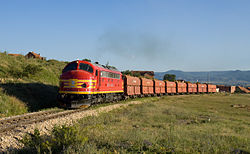 008, NSB Di 3b 643
 -
 009, Vossloh G 1700
 -


See also
[edit]References
[edit]- ^ "Shërbimet" [Services] (in Albanian). Trainkos. Retrieved 2024-06-07.
- ^ Journey by Freedom of Movement Train
- ^ "Raport Janar-Mars 2025" (PDF). Trainkos (in Albanian). May 23, 2025. p. 3. Archived (PDF) from the original on August 3, 2025. Retrieved August 3, 2025.
- ^ a b c "Kosovo obtains EIB loan for rail modernisation". 21 February 2023.
- ^ "The railway line that connects Pristina with Skopje is reopened". 4 November 2023.
- ^ "RailwayGazette International". RailwayGazette. 5 January 2022.
- ^ "Generale Costruzioni Ferroviarie". Generale Costruzioni Ferroviarie.
- ^ Travel report "Balkan-Express" Archived 2010-12-08 at the Wayback Machine (German)
- ^ "Kosovo aid train gets through". BBC News Online. 27 September 1999. Retrieved 17 October 2014.
- ^ Access my library [dead link]
External links
[edit]- Trainkos Official Website
- Infrakos Official Website
- Eisenbahn im Kosovo 1874 bis heute (Kosovo Railways Fanpage, German)

Trainkos
View on GrokipediaTrainkos J.S.C. (Albanian: Hekurudhat e Kosovës) is the state-owned railway operating company of the Republic of Kosovo, specializing in passenger and freight transportation services across the country's rail network.[1][2]
Established on 16 August 2011 following the division of the former Kosovo Railways (Hekurudhat e Kosovës, HK) into separate entities for train operations (Trainkos) and infrastructure management (Infrakos), both wholly owned by the Kosovo government, Trainkos assumed responsibility for rolling stock utilization, ticketing, and commercial rail services.[1][3] The company operates on a single-track network totaling 333.9 kilometers, primarily serving domestic routes with limited cross-border connections to neighboring states amid ongoing regional tensions.[4] As Kosovo's leading container transport provider, Trainkos handles both conventional cargo and intermodal shipments, though it has encountered financial challenges including revenue shortfalls from delayed industrial partnerships and operational disruptions.[2][5]
History
Yugoslav Era and Pre-Independence Operations
During the Socialist Federal Republic of Yugoslavia, Kosovo's railway infrastructure formed an integral part of the national network operated by Jugoslovenske Železnice (JŽ), comprising approximately 333 km of single-track, unelectrified, standard-gauge lines radiating from the central junction at Fushë Kosovë.[6] These lines connected key locations including Pristina, Pejë, Mitrovica, and border crossings to Serbia and North Macedonia, supporting both passenger services to other republics and freight transport, particularly from Trepča lead-zinc mines to industrial centers in Serbia.[7] Fushë Kosovë served as the primary depot and operational hub, handling locomotive maintenance and train formations within the unified JŽ system, where rolling stock procurement occurred at the federal level without republic-specific allocations.[8] To address capacity constraints in this underdeveloped segment of the JŽ network, the World Bank financed the Kosovo Railway Project from 1981 to 1983, which included reconstruction of the Fushë Kosovë junction, installation of modern signaling and telecommunications along the Lesak-Djeneral Janković main line, and acquisition of additional rolling stock to enhance efficiency and integrated transport.[9] Following the dissolution of JŽ in 1992 amid Yugoslavia's breakup, operations in Kosovo transitioned to the Serbian Railways successor entity (Železnice Srbije, ŽS), maintaining similar passenger and freight services despite rising ethnic tensions and economic sanctions in the 1990s, with diesel locomotives such as the JŽ 661 class handling duties on unelectrified routes.[10] The 1998–1999 Kosovo War severely disrupted services, with NATO airstrikes targeting bridges and tracks for strategic reasons, alongside Serbian forces using trains for civilian deportations from cities like Pristina and Ferizaj.[11] Post-war, the Kosovo Force (KFOR) assumed control in June 1999, with British and Italian military units repairing lines for humanitarian aid; civilian passenger operations resumed by December 1999 using surviving ex-JŽ locomotives and donated equipment, including three British Rail Class 20 diesels and Norwegian Di 3 units.[8] Management shifted to the United Nations Interim Administration Mission in Kosovo (UNMIK) Railways in March 2001, facilitating basic domestic services on repaired segments while freight remained limited due to widespread damage.[12] By the mid-2000s, operations stabilized under the locally managed Hekurudhat e Kosovës (HK), which inherited UNMIK assets and focused on passenger routes from Fushë Kosovë to Pejë and Hani i Elezit, alongside mine freight, until Kosovo's 2008 independence declaration prompted further restructuring.[13]Post-1999 War Reconstruction
Following the 1998–1999 Kosovo War, the railway network suffered extensive damage, including destroyed tracks, bridges, stations, and much of the rolling stock, which had been neglected or deliberately sabotaged amid the conflict's strategic importance for military logistics.[8][14] The NATO-led Kosovo Force (KFOR) assumed initial responsibility for repairs to enable humanitarian aid delivery and troop transport, with the British Army's 79 Railway Squadron overseeing early operations on key lines.[8] In September 1999, the Italian Railway Regiment replaced British forces, deploying 120 personnel and a rapid reaction train to accelerate restoration, supported by local former Yugoslav Railways (JŽ) staff from both Albanian and Serb communities working voluntarily.[8] On 27 September 1999, the "Kosovo Train for Life" aid convoy—comprising donated British locomotives and wagons loaded with supplies—arrived in Pristina, highlighting international efforts to revive the network for relief purposes.[8] Civilian passenger services recommenced in December 1999 without charge, transporting 20,000 passengers in the first three months as lines like Pejë were progressively reopened.[8] Under United Nations Interim Administration Mission in Kosovo (UNMIK) oversight, workforce reintegration advanced, with 350 Serb employees rejoining the Kosovo Railway Enterprise by mid-September 1999.[15] Control fully transferred from KFOR to UNMIK Railways in March 2001, shifting focus to sustained civilian operations amid ongoing donations of locomotives from countries including the UK, France, Italy, Germany, Norway, and Sweden.[8]Establishment of Trainkos in 2011 and Subsequent Evolution
Trainkos J.S.C. was established on September 1, 2011, as part of the restructuring of Kosovo Railways J.S.C., which was divided into two separate state-owned joint-stock companies to unbundle infrastructure management from train operations, in line with South East European railway reforms.[16][17] Infrakos took responsibility for railway infrastructure maintenance and development, while Trainkos assumed operational duties for passenger and freight services across Kosovo's network.[18][19] This separation aimed to enhance efficiency and attract investment, though both entities remained under full state ownership.[3] Following its inception, Trainkos encountered persistent financial difficulties, relying on internal funds to sustain operations amid subsidies shortfalls from the government. By August 2017, cumulative losses exceeded €5 million since 2011, prompting a temporary halt of domestic passenger services due to inability to cover escalating deficits.[20] Services were reinstated after government budget adjustments addressed the funding gap, allowing resumption of limited passenger and freight activities.[21] Freight forwarding development stagnated at preparatory stages, with operations focused primarily on regional cargo transport, including limited international links.[19] In subsequent years, Trainkos approved a Medium-Term Investment Strategy for 2020–2024 in 2019 to prioritize rolling stock modernization and service expansion.[19] By 2023, the company transported 195,670 tons of freight and 70,517 passengers, though both fell short of targets, generating €2.19 million in revenue against a €273,000 loss.[19] Operational disruptions occurred, such as the full suspension of the Hani i Elezit line for modernization works on Railway Line 10, while collaborations, including equipment donations from Swiss Railways valued at €9,052, supported maintenance efforts.[19] Despite these initiatives, Trainkos continued to face revenue shortfalls and dependency on state support for sustainability.[19]Governance and Ownership
Legal Status and State Ownership
Trainkos, officially known as Kosovo Railways - Trainkos J.S.C., is a publicly owned joint-stock company (Sh.A.) that functions as the national railway operator in Kosovo.[5] It is 100% owned by the Republic of Kosovo, with the government serving as the sole shareholder and exercising oversight through ministerial coordination and board appointments.[5] This structure positions Trainkos as a strategic state enterprise responsible for rail transport services, distinct from infrastructure management handled by the separate public entity Infrakos.[22] The company was established in 2011 through the restructuring of the predecessor Kosovo Railways public enterprise, aligning with European standards for separating infrastructure from operations to foster competition and efficiency.[22] This division was formalized under Law No. 04/L-063 on Kosovo Railways, adopted by the Assembly of Kosovo on November 14, 2011, and published in the Official Gazette on December 16, 2011.[23] [24] The law designates Trainkos as the incumbent railway undertaking, granting it initial operational privileges such as a six-month grace period without a full license and a two-year exemption from certain safety authorizations post-creation, while requiring eventual compliance with licensing, safety certification, and market-based operations.[22] Trainkos operates under commercial principles in a competitive market unless specified otherwise, fulfilling public service obligations for passenger and freight transport with potential state compensation for unprofitable routes.[22] Its governance adheres to Law No. 03/L-087 on Public Enterprises and Law No. 06/L-016 on Commercial Companies, ensuring state assets remain under government management while pursuing financial sustainability.[5] The Republic of Kosovo provides direct financial support, such as €489,275 allocated from the national budget in 2024 for capital investments, reflecting ongoing state commitment to the entity's viability amid inherited debts and legal disputes from prior operations.[5] The Board of Directors, appointed via Government Decision No. 02/182 on January 10, 2024, reports to the shareholder assembly and coordinates with regulatory bodies like the Railway Regulatory Authority.[5]Management Structure and Regulatory Oversight
Trainkos operates as a publicly owned joint-stock company under Kosovo's Law on Publicly Owned Enterprises, with its Board of Directors appointed by the Government of the Republic of Kosovo to oversee strategic governance and executive appointments.[22][5] The Board, typically comprising members selected for expertise in transport and related fields, nominates and supervises the chief executive officer, who manages day-to-day operations through specialized departments including passenger transport, freight services, business development, finance, and safety.[22] As of 2024, the Board was reappointed via Government Decision No. 02/182, reflecting periodic governmental involvement in leadership transitions to align with national infrastructure priorities.[5] The Railway Regulatory Authority of Kosovo (Autoriteti Rregullativ i Hekurudhave, ARH) serves as the independent regulatory body overseeing Trainkos, responsible for issuing operating licenses—valid for five years and subject to renewal—and safety certificates to ensure compliance with national and EU-aligned standards.[25][22] ARH conducts inspections of rolling stock and operations, enforces non-discriminatory access to infrastructure, resolves disputes on capacity allocation and charges, and monitors market competition, with authority to impose prescriptions for safety deficiencies or interoperability issues.[25][22] Established under the Law on Kosovo Railways, ARH maintains operational independence in decision-making, funding, and appointments, submitting annual reports to the Kosovo Assembly on sector performance and regulatory enforcement.[22] Trainkos received its safety certificate from ARH following infrastructure separation reforms, enabling certified operations amid ongoing alignment with European railway directives.[22]Rail Network
Domestic Track Layout and Specifications
The domestic rail network in Kosovo, infrastructure managed by Infrakos and operations handled by Trainkos, encompasses 335.079 km of single-track public railway lines with a uniform standard gauge of 1,435 mm.[26] The entire network remains unelectrified, necessitating diesel-powered locomotives for all services.[27] Additionally, approximately 103 km of industrial sidings support freight activities, particularly in mining regions.[23] The layout centers on a north-south mainline designated as Route 10, extending roughly 200 km from the northern border crossing at Leshak near Mitrovicë southward through Fushë Kosovë—the principal junction—to Prishtinë and onward to Hani i Elezit at the southern border with North Macedonia.[28] This corridor facilitates both passenger and freight movement along Kosovo's longitudinal axis. At Fushë Kosovë, a key western branch diverges approximately 114 km to Pejë, providing connectivity to the region's western municipalities.[29] Eastern extensions from the mainline include a spur to Podujevë, linking to Serbian territory, alongside various freight-only branches and yards serving industrial sites such as coal mines near Obiliq and Trepča.[30] Track conditions generally permit maximum speeds of 60-80 km/h for passenger trains, though ongoing rehabilitation efforts under EU-supported projects aim to elevate sections to 100 km/h compliance with TEN-T standards.[31] All lines are single-track without centralized signaling, relying on token block systems for train spacing.[26]Cross-Border Links and Political Barriers
The Kosovo rail network, managed by Infrakos for infrastructure and Trainkos for operations, includes cross-border connections primarily along Railway Route 10, which spans 256 km from the Serbian border in the north through Mitrovica and Pristina to the North Macedonian border in the south, with 148 km within Kosovo.[32][28] This route represents the country's sole international rail corridor, facilitating potential freight and passenger flows toward Serbia and North Macedonia, while no direct rail infrastructure exists to Albania or Montenegro due to geographical and historical development gaps.[33][34] As of 2025, no regular cross-border passenger services operate under Trainkos, with domestic operations limited to the Pristina-Pejë line; freight movements occur sporadically, constrained by border infrastructure limitations such as repaired but partially obstructed wagons at Hani i Elezit on the North Macedonian border since 2024.[3][35] A 2016 bilateral agreement between Kosovo Railways (HK) and Macedonian Railways (MZ) enables cross-border carriage of passengers and goods at the Volkovo-Hani i Elezit border, but implementation remains intermittent due to technical bottlenecks rather than formal political disputes.[36] Political barriers, rooted in Serbia's non-recognition of Kosovo's 2008 independence, severely impede rail integration with Serbia, despite physical track continuity via Zvečan/Lešak and Merdare crossings; Serbia treats Kosovo as its southern province, complicating customs, licensing, and operational coordination.[37] A February 2020 economic normalization agreement, mediated by U.S. envoy Richard Grenell, committed both parties to restoring the dormant Serbia-Mitrovica rail link—including potential passenger service resumption—but progress stalled amid mutual non-compliance accusations and lack of EU-brokered enforcement.[37] Ongoing modernization of the Fushë Kosovë-Mitrovica segment, initiated in December 2022 with EU funding, aims to upgrade this link for interoperability with Serbian and North Macedonian networks, yet Serbia's parallel claims over northern Kosovo's rail assets, including Serb-majority areas with de facto separate administration, perpetuate access disputes and sabotage risks.[34][32] Relations with North Macedonia face fewer ideological hurdles, given mutual recognition, but practical barriers arise from underinvestment and gauge compatibility issues on connecting lines; EU-backed rehabilitation of 64 km of Route 10 track since the 2010s has improved freight potential, though volumes remain low without dedicated cross-border timetables.[38] Albania and Montenegro lack rail borders entirely, with proposals for new lines—such as a Pristina-Tirana connection—stymied by funding shortages and terrain challenges, redirecting trade to road alternatives.[39] These constraints reflect broader Balkan fragmentation, where Kosovo's disputed status amplifies infrastructural isolation despite regional integration pledges under frameworks like the Transport Community Treaty.[40]Infrastructure Investments
Post-War Rehabilitation Efforts
Following the conclusion of the Kosovo War in June 1999, assessments revealed that the railway infrastructure had sustained significant neglect and severance along multiple lines during the 1998–1999 conflict, though heavy structural damage was limited primarily to strategic targets such as bridges and tunnels affected by NATO precision strikes.[12][8] The Kosovo Force (KFOR), under NATO auspices, assumed control of rail operations to facilitate humanitarian supply transport, with the British Army's 79 Railway Squadron initially overseeing repairs and logistics, succeeded by the Italian Railway Regiment in September 1999, which deployed the Rapid Reaction Train for reconstruction tasks.[8] Rehabilitation commenced immediately under United Nations Interim Administration Mission in Kosovo (UNMIK) oversight, establishing Kosovo Railways (KSHT) to coordinate efforts; local ethnic Albanian and Serb railway workers provided free labor to repair severed tracks piece by piece, prioritizing lines for aid delivery and civilian access.[8] A notable early initiative was the Kosovo Train for Life, which arrived in Pristina in September 1999 carrying 15 carriages of humanitarian aid from the United Kingdom, symbolizing the resumption of rail functionality amid ongoing recovery.[8] By December 1999, civilian passenger services reopened across repaired sections, transporting approximately 20,000 passengers in the initial three months without charge, while key routes like the line to Pejë station were restored to boost public morale and connectivity.[8] International donors played a critical role in bolstering capacity, donating motive power and rolling stock—including three ex-British Rail Class 20 locomotives in September 1999 and four Norwegian Di3 locomotives in 2001—to address shortages in operational assets.[8] The European Agency for Reconstruction allocated 4.9 million Deutsche Marks in 2000 specifically for network repairs, complementing support from entities like Swedish SIDA, German GTZ, and Norway to rehabilitate tracks and stations.[41][42] Full handover to local civilian management occurred in March 2001, marking the transition from military-led stabilization to sustained domestic oversight of the rehabilitated system, which by then supported essential freight for reconstruction materials and passenger mobility across Kosovo's approximately 430 km of track.[8]Recent Upgrades and Funding Sources (2010s-2020s)
In the 2010s, Kosovo initiated a multi-phase rehabilitation of Railway Route 10, its primary international corridor spanning approximately 149 km from the Serbian border in the north to the North Macedonian border in the south, with funding primarily from international lenders and grants aimed at aligning the network with Trans-European Transport Network (TEN-T) standards.[43] Phase 1, targeting the southern section from Fushë Kosovë to Hani i Elezit, received initial loans of €39.9 million from the European Bank for Reconstruction and Development (EBRD) and €42 million from the European Investment Bank (EIB) in 2015, supplemented by European Union (EU) grants via the Western Balkans Investment Framework (WBIF).[44] These upgrades included track refurbishment to support passenger speeds up to 100-120 km/h and axle loads up to 22.5 tons for freight, addressing post-war deterioration and enabling better regional connectivity.[33] Phase 2, covering the 35 km northern segment from Fushë Kosovë to Mitrovicë/Mitrovica, advanced in the early 2020s with an EBRD loan of €40 million, an EIB loan of €42 million, and €83-91 million in EU grants channeled to Infrastruktura e Hekurudhave të Kosovës (Infrakos), the state-owned infrastructure manager whose upgrades directly benefit Trainkos operations.[43][45] Works encompassed track renewal, upgrades to five stations, construction of 13 new bridges, and reconstruction of seven tunnels, with key milestones including the November 2023 inauguration of two tunnels enhancing safety and capacity.[46] Phase 3, focusing on the northernmost section from Mitrovicë to Leshak near the Serbian border, continued into the mid-2020s, supported by additional EU co-financing of €38.5 million announced in 2017 and ongoing technical assistance.[47] Overall, the Route 10 project represented Kosovo's largest rail investment in decades, totaling over €200 million across phases, with EU contributions exceeding €330 million when combined with bilateral donors.[48] Trainkos, as the operator, has pursued limited upgrades to rolling stock and safety amid these infrastructure works, including a 2023 government allocation of €1.77 million shared among rail entities for repairs, machine acquisitions, and safety enhancements, though requests for broader fleet modernization remained unfulfilled per Trainkos's 2023 annual report.[49][19] These efforts were constrained by operational disruptions from construction, which paralyzed international freight in 2024, underscoring reliance on external funding for sustained improvements.[5] Domestic funding from the Kosovo budget supplemented international sources but prioritized subsidies over capital upgrades, reflecting fiscal limitations in a network serving low-traffic routes.[34]Operations
Passenger Services and Usage Patterns
Trainkos provides passenger rail services exclusively on the Pristina–Pejë line, the sole operational route for passengers as of 2023, featuring four daily trains with two running in each direction.[19] This route spans approximately 140 kilometers through western Kosovo, serving local communities and connecting the capital to the Pejë region. Services utilize diesel locomotives hauling conventional passenger carriages, reflecting the network's reliance on non-electrified tracks.[19] Other potential passenger routes, including those to Hani i Elezit near the North Macedonian border, remain suspended due to rehabilitation efforts on Railway Line 10, limiting connectivity and contributing to reduced service scope.[19] No international passenger trains operate under Trainkos management currently, though historical extensions to Skopje have been noted in prior years; cross-border links face ongoing infrastructural and political constraints.[3] In 2023, Trainkos carried 70,517 passengers, marking a 1.64% decline from 71,696 in 2022 and falling 11.85% short of the targeted 80,000.[19] This equates to an average of about 193 passengers per day across the limited services, underscoring persistently low utilization rates amid Kosovo's population of over 1.7 million.[50] Usage patterns indicate sporadic demand, influenced by factors such as outdated rolling stock, infrequent schedules, and competition from road transport, with no comprehensive tracking of exempt or informal passengers available.[19] Recent monthly data show variability, with August 2025 recording 7,732 passengers—a 54.8% increase from the prior year—suggesting potential recovery amid infrastructural improvements, though annual figures remain subdued compared to pre-2010 levels exceeding 100,000.[51] Overall, passenger rail accounts for a marginal share of Kosovo's transport, with trends reflecting infrastructural limitations and economic priorities favoring roadways over rail revival.[50]Freight Transport and Trade Routes
Trainkos operates freight services focused on domestic industrial cargo, with international routes limited by infrastructure upgrades and geopolitical tensions. In 2023, the company transported 195,670 net tons of freight, marking a significant increase from 22,340 net tons in 2022 but falling short of the planned 575,000 net tons.[19] This volume generated €466,594 in revenue, primarily from domestic shipments.[19] Primary cargo includes nickel ore, which accounted for 98% of 2023 freight, transported from facilities like NewCo Ferronikeli in Medveçë. Other types encompass coal from Kosovo Energy Corporation (KEK) mines to power plants at Obilić, lead-zinc ore concentrate and waste from Trepča, and occasional railway tracks or construction materials.[19] Domestic freight utilizes the 333 km of mixed-use track, serving mining regions such as Golesh and Obilić via dedicated branch lines.[52] Trade routes align with Railway Line 10, extending from the Serbian border near Mitrovica southward to Hani i Elezit on the North Macedonian border, facilitating potential exports to Skopje and beyond. Historically, two daily freight trains operated to North Macedonia, handling import-export traffic, though international services were suspended in 2023 due to Line 10 modernization works.[19] [53] Connections to Serbia remain constrained by political disputes over northern Kosovo access, limiting cross-border freight despite signed contracts with Serbian logistics firms like NAVICO SHIPPING DOO.[19] No direct rail links exist to Albania, with future integration dependent on regional corridor developments under the Multimodal Transport Strategy 2023–2030, aiming for approximately 0.5 million tons annually through enhanced interoperability.[52]Operations in Northern Kosovo and Parallel Administrations
Trainkos conducts no regular passenger or freight operations in Northern Kosovo, encompassing the Serb-majority municipalities of Leposavić, Zvečan, Zubin Potok, and North Mitrovica, due to the effective control exerted by parallel Serbian institutions over railway infrastructure and services in the region.[54][27] The northern line, spanning approximately 40 km from the administrative boundary near Rudnica to Leshak, Zvečan, and North Mitrovica, remains outside Trainkos's operational scope, with company locomotives, coaches, and diesel railcars stored at facilities there but not deployed in service.[27] Instead, Železnice Srbije (Serbian Railways) maintains passenger and freight services on this segment, running two daily passenger trains from Kraljevo in Serbia to Kosovska Mitrovica (North Mitrovica), with departures at 06:50 and 14:40 and arrivals at 10:22 and 18:22, treating the route as a domestic extension despite its location in Kosovo.[54][55] This service resumed in 2009 following a post-war hiatus and continues without interruption from Trainkos or Kosovo authorities.[56] The division arises from the failure to transfer administrative authority over northern railways after Kosovo's 2008 declaration of independence, with Serbia and affiliated parallel structures in North Mitrovica retaining de facto management, including signaling, maintenance, and ticketing aligned with Serbian standards.[57][58] Kosovo's Ministry of Infrastructure and Trainkos assert legal jurisdiction over the entire 430 km network, but practical enforcement halts at the ethnic division line near the Ibar River bridge in Mitrovica, reflecting Serb non-recognition of Pristina's sovereignty and ongoing political impasse.[57] No Trainkos incursions or joint operations have occurred, and attempts at cross-border rail normalization, such as under EU-mediated dialogues, have not altered the status quo as of 2025.[54]Rolling Stock
Locomotives and Motive Power Units
Trainkos's motive power consists exclusively of diesel locomotives and shunting units, as the Kosovo rail network remains unelectrified. The fleet, numbering around nine primary traction units as of 2024, comprises aging second-hand diesel-electric locomotives sourced from former Yugoslav operators, neighboring countries, and international donations following the 1999 conflict. These units handle both passenger and freight duties, with maintenance focused on repairs and inspections to sustain operations amid high costs and outdated equipment.[5] Key locomotive classes include the EMD Class 661 series, originally constructed by General Motors Electro-Motive Division as G16 models for Jugoslovenske Železnice in the 1960s and 1970s. These Co'Co' diesel-electric units, producing approximately 1,800 hp, were inherited post-dissolution and several have undergone modernization, such as units 2640 007 (ex-661 228) and 2640 008 (ex-661 231), rebuilt in Croatia for enhanced reliability in freight service.[59][60] In 2009, an additional Class 661 was heavily rebuilt and re-engined by TZV Gredelj under a €2.5 million contract to bolster capacity.[61] Other notable types encompass Class 645/2044 variants, such as 2620 005 (ex-HŽ 2044-031) and 2620 016 (GT22HW-2 subclass), employed for passenger workings.[5] Norwegian State Railways Di 3 class locomotives, built to a NOHAB design with A1A-A1A arrangement and 1,750 hp output, were donated in 2001; unit 2640 008 exemplifies this group, used for heavy freight like nickel ore transport to processing facilities.[54] Specialized rebuilds, including JT38CW-DC variants derived from upgraded G16 platforms, supplement the fleet for freight demands.[5] Shunting operations rely on smaller diesel-hydraulic units like the DAL 3180 class, supporting yard maneuvers at depots such as Fushë Kosovë.[62] Overall fleet maintenance in 2024 involved 390 servicings and 51 repairs for freight locomotives, alongside periodic inspections, underscoring the emphasis on extending service life without new acquisitions. The average age exceeds 37 years, contributing to elevated operational costs and intermittent availability issues.[5][63]Railcars, Carriages, and Maintenance Practices
Trainkos maintains a small fleet of diesel multiple units (DMUs), primarily second-hand acquisitions suited for lighter passenger services on Kosovo's network. These include Swedish Y1 railcars and Italian ALn 668 units, inherited or donated post-1999 conflict to restore basic operations. As of 2009, the inventory comprised four DMU cars, though their current operational status is limited amid broader fleet aging and service constraints.[1] Passenger carriages are predominantly locomotive-hauled and consist of donated or surplus stock from European donors, such as 1960s-era Swedish SJ express coaches and German N-wagen types. The 2009 fleet included nine such coaches, enabling short formations for the primary Pristina–Pejë route, but overall capacity remains low due to the absence of newer acquisitions. Recent services, limited to four daily trains, typically feature two to three carriages per consist, reflecting underutilization and reliance on aging, non-standardized equipment.[1][64][65] Maintenance practices are centralized at the Fushë Kosovë depot workshops, which handle inspections, repairs, and overhauls for both self-propelled railcars and hauled carriages, including wagon servicing for associated equipment. Operations emphasize reactive upkeep given chronic underfunding, resulting in deteriorated rolling stock conditions that hinder reliability and safety. Trainkos's 2023 annual report attributes fleet degradation to insufficient budgets for preventive maintenance and modernization, while 2024 assessments underscore the need for targeted investments to address obsolescence and extend asset life.[66][19][5][64]Financial Performance
Revenue, Subsidies, and Operational Costs
Trainkos generates revenue primarily from passenger ticket sales, freight transport, and ancillary services, though these sources consistently fall short of operational needs. In 2023, passenger ticket revenue amounted to €61,356.49, while freight transport contributed €466,594.48; combined with minor other revenues of €41,021.25, total non-subsidy income was approximately €568,972.22.[19] By 2024, freight revenue plummeted to €10,704.61 due to the closure of Line 10, and passenger tickets yielded €59,396.71, with other revenues adding €63,516.43, resulting in non-subsidy income of roughly €133,617.75.[5] These figures represent only a fraction of planned targets, achieving 32.18% for 2023 freight and a mere 0.93% for 2024 freight, underscoring limited commercial viability amid low ridership and freight volumes.[19][5] Government subsidies constitute the bulk of Trainkos's funding, allocated by ministries to offset deficits and sustain public service obligations. In 2023, subsidies totaled €1,623,177.63, including €967,902.63 from the Ministry for Economy, Spatial Planning, and Infrastructure (MESPI) and €655,275 from the Ministry of Economy (ME), enabling continued operations despite inadequate ticket income.[19] For 2024, passenger-related subsidies reached €1,611,512.51 (€1,000,787.51 from MESPI and €610,725 from ME), supplemented by €309,976.14 in grants, though overall realization lagged plans due to infrastructure disruptions.[5] These transfers, formalized via agreements like the 2023 economy ministry pact, reflect statutory requirements for subsidizing uneconomic rail services, but delays in disbursement have periodically threatened service continuity.[67][19] Operational costs, dominated by personnel and fuel, exceed revenues and necessitate subsidy dependence. Staff expenses in 2023 totaled €1,529,164.07 (89.95% of plan), rising slightly in context of 2024's €1,387,017.68 (81.59% of plan), reflecting Kosovo's labor-intensive rail model with limited automation.[19][5] Fuel and lubricants cost €415,518.71 in 2023 and €316,541.40 in 2024, comprising a significant variable expense tied to aging rolling stock and route inefficiencies.[19][5] Service costs, including maintenance like €129,497.72 for wheel replacements in 2024, reached €729,292.41 in 2023 and €575,602.67 in 2024, both under planned levels due to reduced activity but still driving operating losses of €272,964.62 in 2023 and €488,629.82 in 2024.[19][5]| Year | Total Revenue (incl. Subsidies, €) | Total Expenses (€) | Operating Loss (€) | Key Subsidies (€) |
|---|---|---|---|---|
| 2023 | ~2.14m (est.) | 2,414,986.44 | 272,964.62 | 1,623,177.63 |
| 2024 | ~1.80m (est.) | 2,186,579.99 | 488,629.82 | 1,921,488.65 |