


Community hub
Recent from talks
Contribute something
Nothing was collected or created yet.
Trans-Oceanic
View on Wikipedia
The Trans-Oceanic (abbreviated T/O) was a brand of portable radios produced from 1941 to 1981 by Zenith Radio. They were characterized by heavy-duty, high-quality construction and their performance as shortwave receivers.[1][2]
History
[edit]Zenith's founder, Lieutenant Commander Eugene F. McDonald, was a great admirer of advancing technology and believed that his company should include the latest, most practical advances in a sturdy product that would enhance the company's reputation. Of the many products of Zenith Radio, the 'Trans-Oceanic' series of portable radios were among the most famous.[2]
McDonald was a keen yachtsman and outdoorsman and wished for a portable radio that would provide entertainment broadcasts as well as being able to tune into weather, marine and international shortwave stations. He asked his company's engineers to develop prototypes to meet his criteria and by 1940 they had concept sets that were ready for production.[2]
The Trans-Oceanic remains popular among collectors and non-collectors alike.[3][4] A cult-like following[5] has developed around the receivers, with earlier tube or valve versions prized by radio collectors, resulting in the availability of many working models and replacement parts.[6]
7G605/8G005Y series
[edit]
The Zenith 'T/O' began life in October 1941 with the production of the Model 7G605 'Trans-ocean Clipper'. Priced at $75, it was introduced in January 1942 but ceased production in April 1942 as Zenith shifted their production to war-related equipment. During this short production run, some 35,000 units were produced and sales data showed that many were sold to customers in the 'above average' income group. However, many also found their way into various theatres of war and in to the hands of appreciative servicemen—demand for a resumption of production at war's end was kept high. The first run of approximately 10,000 units had a sailboat-embroidered speaker grille, but after the Pearl Harbor attack, the patriotic Commander ordered the grille cloth changed to depict a bomber vaguely resembling a Boeing B-17 bomber. The T/O was a dual-powered radio receiver; it could operate from electrical service AC or DC and via a pair of "A" and "B" dry cell batteries for portability. The batteries are obsolete but the early T/O models live on either due to the ability to use AC line or a battery made of modern cells (6 Ds for the "A" power and 10 9 volt transistor batteries for "B") or an inverter. The 7G605 used seven tubes: 117ZG6, 3Q5, 1LE3, 1LN5, 1LA6, 1LN5, and 1LD5.[7] Zenith used a selenium rectifier on later versions of the T/O, replacing rectifier tubes used on the earlier models. Inserting the power plug into a socket on the chassis or the side of the radio (depending on model) switched the T/O to battery operation.
The first post-war T/O was the 8G005Y, designed by Robert Davol Budlong, an industrial design consultant responsible for many of the Zenith radio products. Priced at $125, it was in production from 1946 to 1949 in several variants. Total produced, 110,000. The 8G005Y used eight tubes, (2) 1LN5, 1LA6, 1LD5, 1LE3, (2) 1LB4, and 117Z6.[7]
500 series
[edit].jpg)
The 8G005Y was replaced in December 1949 by the G500—a 'changeover' model that had updated electronics using miniature tubes but the same appearance. The G500 held its price at less than $100 until it was withdrawn in mid-1951. Total production for the G500 was 90,000. The H500 'Super Trans-Oceanic' was introduced in May 1951 at an initial price of $99.95. It had a redesigned front face and incorporated many frequency coverage and electronic changes ordered by McDonald. There were 245,000 H-500s sold. The 500 series models used five tubes: a 3V4, 1U5, (2) 1U4, and 1L6.
There also was a production run in 1953-54, of 27,218 "militarized" H-500's, designated R-520/URR, ordered by the U.S. government for the Korean conflict. This set added a sixth tube, the 50A1, to eliminate power fluctuations.
600 series
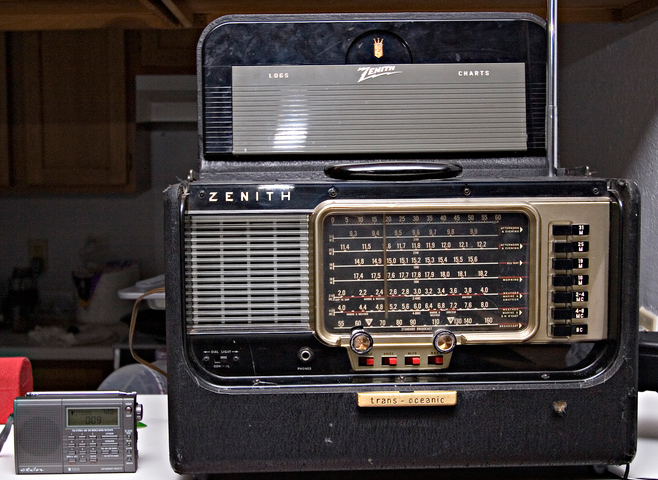
[edit]After 1953, there was competition to the Trans-Oceanic from both Hallicrafters, with their 'Trans-World' series sets, and RCA, with their 'Strato-World' models. In the spring of 1954, the 600 series was introduced with its 'slide-rule' type dial and a mains supply cord which coils inside the set on a spring-loaded reel. This model stayed in production, with minor changes, until the end of the T/O tube era in 1962. This "600" series used several letters to denote minor changes: L600 in 1954, R600 in 1955, T600 for 1955-56, Y600 for 1956-57, A600 for 1958, and B600 for 1959-62. Production for the 600 series was 270,000. The 600 series used six tubes: (2) 1U4, 1L6, 1L5, 3V4, and 50A1.[8]
For a second time, there was a very small production run in 1956-57, of 2,973 "militarized" 600's, designated R-520A/URR, ordered by the U.S. government. Some of these were reportedly air dropped in small numbers during the Bay of Pigs invasion. Zenith was contracted to build 250 containers for this purpose. It is rumored that Fidel Castro made one his personal radio for years afterwards.
During the tube or valve T/O model run, this receiver did not include an 88-108 MHz FM radio band. Eugene McDonald died in 1958, but he was personally involved in the design changes to 'his' radio to the very end. In November 1957, Zenith introduced the all-new, nine transistor solid state Trans-Oceanic. The older tube-based Trans-Oceanic was continued in production until 1962.
Royal 1000/3000 series
[edit]In November 1957 the first of several transistorized Trans-Oceanics was introduced, the Royal 1000. As had always been the case, Commander E. McDonald helped in the design of the 1000. This was his last endeavor in the Trans-Oceanic radio before he died soon after its introduction. The Royal 1000 had the same frequency coverage as the A/B 600 series tube Trans-Oceanics with the addition of the 13/meter band. The new Royal 1000 also had an all-metal cabinet design with the front cover opening to the down position. The log chart was located inside the flip-down door. Very early Royal 1000s sported a genuine leather covering marked as such. Another first for portable radios was the unique dial scale used in the 1000 and later series of Trans-Oceanics. The 1000 was designed with a cylinder dial scale that would rotate with the band switch allowing only that particular band scale to show.[9]
.jpg)
Soon after the introduction of the 1000 model, a second model, the Royal 1000D, added the LW band covering 150 kHz through 405 kHz just below the AM broadcast band. There were also slight cosmetic differences to distinguish the two models. Production totals for the Royal 1000 are estimated at 170,000. Anthony J. Cascarano was the primary designer of the Royal 1000/1000D cabinets.[2] In 1962 the Royal 3000 was added and the 1000D eliminated while the 1000 remained in production through the 1968 model year. The 3000 added the FM broadcast band and eliminated the 13-meter band. Along with a few cosmetic differences, there wasn't much difference electrically between the new model and earlier 1000 series models aside from the addition of the FM subchassis and IF transformers. The 3000 used many of the same cabinet parts as the 1000/1000D, but required a bulging back cover to accommodate the additional parts used for FM.
Early 1000s and 1000Ds were battery-only with no provision for external power. This was considered acceptable because the battery life was much better than the tube-type models. 8 ordinary D cells would operate the radio for >500 hours, as opposed to ~150 hours for the tube models and their massive A/B battery. The 3000 was also introduced as battery-only. Later the 1000-1 and 3000-1 models were introduced with provision for an external power using what was one of the first "wall wart" type power supplies - a transformer, rectifier, and filter capacitor in a box with AC line connector that plugged into and hung from the wall socket. Estimated production for the Royal 3000 is 150,000.
Zenith introduced the Royal 2000 Trans-Symphony in 1960, the first AM/FM portable model. In 1963, it introduced the Royal 3000, a Trans-Oceanic with an added FM band.[9]
Royal 7000 series
[edit]_Radio,_Chassis_18ZT40Z3,_Made_in_the_USA_(12125483556).jpg)
In 1968 the Royal 7000 series Trans-Oceanic was introduced. The new model sported a completely new look and many improvements over the weaknesses of the earlier 1000/3000 series models. Besides a new look, a BFO was added for SSB/CW reception. Also a wide/narrow filter switch was added for increased selectivity. The 13-meter band was re-introduced along with extended coverage from 1620 kHz through 2000 kHz and the VHF weather band. The electrical design was an improvement in both selectivity and sensitivity, and used modern silicon NPN transistors rather than the previous germanium types. Sound quality was much improved. The internal mechanical design was quite similar to the earlier models, and still used a steel chassis and point-to-point wiring, rather than PC boards. Production of the Royal 7000 is estimated at 130,000.
The last model Trans-Oceanic was the R7000 series introduced in 1979. This model now had complete coverage from 150 kHz through 30 MHz. Gone was the electrical band spread for improved tuning. The R7000 sported a new electrical design using modular circuit boards instead of the point to point hard wired chassis of all previous models. There were many other new features also such as dual tuning meters, squelch and several more bands such as Air, VHF 144 MHz through 175 MHz. The R7000 was built in Chicago for the first year but production was moved to Taiwan for the final two years, while all prior models had been made in the USA.
The new Royal line sold well, around 10,000 per year for the 3 year run but Zenith's lead was steadily eroded. By the time of the release of the 'R7000' in 1979, fierce competition from Sony in Japan—who, with their digital readout tuning dial had, in many ways, a superior product—meant the end of a famous product line.
Photo gallery
[edit]-
 Zenith Royal 1000 Operating Guide
 -
 Zenith Royal 2000 Trans-Symphony AM/FM radio
 -
 Zenith Transoceanic, Brown Leather, Model L600
 -
 Zenith Trans-Oceanic, Model Y600, rear chassis
 -
 Zenith Royal 2000 Trans-Symphony, rear chassis
.jpg)
.jpg)
.jpg)
.jpg)
.jpg)
See also
[edit]References
[edit]- ^ Litwinovich, Paul (27 March 2015). "Zenith Trans-Oceanic, The "Royalty of Radios"". wshu.org. WSHU Public Radio Group. Retrieved 6 June 2016.
- ^ a b c d John H. Bryant; Harold N. Cones (2008). Zenith Trans-Oceanic: The Royalty of Radios. Schiffer Publishing, Limited. ISBN 978-0-7643-2838-1.
- ^ Zenith Trans-Oceanic, The Royalty of Portables Zenithtrans-oceanic.portabletubes.co.uk
- ^ Jerome S. Berg (1 October 2008). Listening on the Short Waves, 1945 to Today. McFarland. pp. 314–. ISBN 978-0-7864-5199-9.
- ^ Goffe, Marty. "A Zenith Trans-Oceanic Radio Family". greaternewyorkregion.org. Greater New York Region of the Antique Automobile Club of America. Retrieved 8 January 2018.
- ^ MacArthur, Phil. "The Zenith Royal 1000 Trans-Oceanic". Antique Radio Classified--The International Publication For Buyers And Sellers Of Old Radios And Related Items. Vintage Radio Publishing LLC. Retrieved 8 January 2018.
- ^ a b Nelson, Philip. "Zenith Model H500 TransOceanic Radio (1951)". Phil's Old Radios. Philip I. Nelson. Retrieved 15 January 2018.
- ^ Miller, Jeffrey. "Zenith "Super De Luxe Trans-Oceanic Portable" Model B600 / Chassis 6A40 Shortwave Radio Restoration". Radio World. Black Sparrow Photography / Jeffrey P. Miller. Retrieved 15 January 2018.
- ^ a b Michael B. Schiffer (1991). The Portable Radio in American Life. University of Arizona Press. pp. 128–. ISBN 978-0-8165-1284-3.
General references
[edit]- Bryant, John H. & Harold N. Cone (1995). The Zenith Trans-Oceanic: The Royalty of Radios. Atglen, Penn.: Schiffer Publishing. ISBN 9780887407086. OCLC 31708157.
External links
[edit]
Trans-Oceanic
View on GrokipediaOverview
Brand Origins
Zenith Radio Corporation traces its roots to 1918, when it was established as the Chicago Radio Laboratory by amateur radio enthusiasts Karl Hassel and Ralph H.G. Mathews in Chicago, initially operating from a modest kitchen-table setup to produce radio components.[4] Eugene F. McDonald Jr., a naval officer, entrepreneur, and avid yachtsman, joined the company in 1921 as general manager and played a pivotal role in its growth, leading to its formal incorporation as Zenith Radio Corporation in 1923, with the name derived from the founders' amateur radio call letters "9ZN."[4] Under McDonald's leadership, Zenith evolved from early radio ventures into a prominent manufacturer, emphasizing innovation and quality amid the economic challenges of the post-Depression era, where the company focused on durable consumer electronics as symbols of American engineering resilience.[5] The Trans-Oceanic brand emerged in 1941, driven by McDonald's personal frustrations with the limitations of existing portable radios during his ocean voyages, prompting Zenith to develop a rugged, multi-band receiver capable of reliable shortwave reception for international broadcasts.[6] This initiative responded to increasing public demand for portable devices that could access global news and entertainment amid escalating international tensions in the late 1930s and early 1940s, as listeners sought real-time information from overseas stations.[1] Zenith positioned the Trans-Oceanic as an accessible yet premium product for discerning consumers, highlighting its "world-band" portability and engineering excellence to appeal to a recovering economy eager for symbols of technological progress.[7] The inaugural model, the 7G605 "Clipper," was launched in January 1942, featuring a suitcase-style design with coverage of broadcast and multiple shortwave bands, priced at $75 to target hobbyists and travelers interested in shortwave listening for both informational and recreational purposes.[7][8] Marketed aggressively as the "Transocean Clipper," it underscored Zenith's commitment to high-fidelity performance in a compact form, reflecting the company's post-Depression strategy of blending luxury with practicality in American-made goods.[9] The line would continue production until 1982, establishing Trans-Oceanic as an enduring icon of portable radio innovation.[1]Key Innovations
One of the defining innovations in the Trans-Oceanic line was the introduction of the telescoping "Waverod" antenna in 1942 with the debut of the 7G605 model, which allowed for extensible vertical deployment to capture shortwave signals effectively without relying on cumbersome external wires.[1][7] This design complemented the built-in Wave Magnet loop antenna, providing users with versatile options for optimal reception in diverse settings, from urban environments to remote locations.[1] The use of miniature vacuum tubes, such as the 1R5 converter and 1T4 amplifier, represented a significant advancement in achieving compact, battery-powered portability while maintaining robust performance across frequencies.[1] These low-voltage, subminiature tubes, integrated starting with models like the H500 in 1951, reduced the overall size and power demands, enabling the radio to operate efficiently on standard batteries in a form factor weighing approximately 19 pounds.[1][10] Trans-Oceanic radios pioneered multi-band coverage in portables, encompassing the standard AM broadcast band alongside five dedicated shortwave bands—49 meters, 31 meters, 25 meters, 19 meters, and 16 meters—which facilitated global signal reception for international broadcasts and communications.[1] This configuration, later expanded in subsequent models to include additional shortwave ranges such as the 13-meter band, leveraged high-quality variable capacitors and tuning mechanisms for precise and stable shortwave performance.[1] Enhancing field usability, the Trans-Oceanic came standard with a leather carrying case featuring a shoulder strap, allowing easy transport by travelers, adventurers, and military users during the post-World War II era.[1] The durable black leatherette construction protected the unit while its ergonomic design supported on-the-go operation, aligning with Zenith's early emphasis on rugged, portable radio development.[1]Historical Development
World War II Era
The introduction of the Trans-Oceanic radio coincided with the United States' entry into World War II, with production beginning in late 1941 and the first units available for sale in January 1942. Despite impending material shortages due to wartime priorities, Zenith ramped up manufacturing, producing approximately 35,000 units of the initial model before civilian production was mandated to halt in April 1942 to redirect resources toward military electronics. This short run left over 100,000 customer orders unfulfilled, highlighting the radio's immediate appeal amid growing global tensions.[11][12] Following the Pearl Harbor attack in December 1941, Zenith shifted its marketing strategy to position the Trans-Oceanic as a vital "victory" tool for civilians, emphasizing its ability to receive international broadcasts and maintain connections during uncertain times. The radio saw widespread personal adoption by U.S. military personnel, including those in the Signal Corps, who carried it into theaters of operation under informal government encouragement rather than large-scale contracts. Its rugged design proved invaluable for Allied troops, enabling reception of BBC news, homefront programs from stations like CBS and NBC, and morale-boosting entertainment in remote or harsh environments, where it earned the affectionate moniker "the GI's radio."[1][6] The 1942 model 7G605 exemplified early Trans-Oceanic engineering, featuring a 6-tube superheterodyne circuit using loktal tubes (117Z6GT, 3Q5GT, 1LN5, 1LA6, 1LN5, and 1LD5) for reliable amplification and detection. It covered the standard AM broadcast band (540-1600 kHz) plus five shortwave bands (49m, 31m, 25m, 19m, and 16m), allowing access to global signals, and was powered by a 90V B-battery pack for high voltage alongside 1.4V filament batteries, with provisions for 110V AC/DC operation via an external pack. A notable innovation was the built-in wave magnet loop antenna, which enhanced shortwave sensitivity without external rods. Overall, pre- and early-war sales reached around 35,000 units by mid-1942, though black-market premiums reflected sustained demand through 1945 as troops sought them for personal use.[7]Post-War Expansion
Following the end of World War II, Zenith resumed civilian production of the Trans-Oceanic line in April 1946, after wartime restrictions had halted manufacturing of non-military goods. The initial post-war model, the 8G005Y, incorporated design refinements drawn from wartime experience with earlier Clipper variants, including a more robust flip-up lid to protect the tuning dial and controls, enhancing overall durability for portable use. This model, produced through 1949 in several variants, featured eight tubes and covered standard broadcast plus three shortwave bands, with a list price of around $125. Total production of the 8G005Y series reached approximately 110,000 units, marking a strong return to the consumer market amid pent-up demand for high-quality portables. The 1950s saw a significant sales expansion for the Trans-Oceanic line, with Zenith producing hundreds of thousands of tube-based models overall during the decade, fueled by growing consumer interest in shortwave listening for international news amid Cold War tensions. Peak company-wide radio sales approached record levels by 1954, reflecting broader market recovery and the appeal of Trans-Oceanic's reliable global reception capabilities. To broaden accessibility, Zenith introduced the more affordable 500 series in 1950 with the G500 model, priced at $99.95—substantially lower than premium predecessors—and targeted at suburban households seeking versatile home entertainment options. The H500 variant followed in 1951, adding an extra shortwave band and maintaining the series' emphasis on compact, battery-powered performance, with production continuing through 1953. Trans-Oceanic models also achieved notable export success in Europe and Asia during the 1950s, where they were adapted for local power standards, including dual 50/60 Hz compatibility in some variants to suit international grids. Zenith's 1939 patent for the detachable Wave Magnet loop antenna (U.S. Patent No. 2,164,251) played a key role in this global reach, as its innovative design for improved shortwave sensitivity without external wires influenced portable radio development worldwide, though competitors often designed around the patent due to licensing restrictions. These factors contributed to the line's reputation as a premium export product for travelers, expatriates, and remote listeners.Transistor Transition
The transition from vacuum tube to transistor technology in the Trans-Oceanic line during the late 1950s and early 1960s represented Zenith's adaptation to advancing solid-state electronics, enabling more portable and efficient shortwave receivers while preserving the model's reputation for global reception. The final vacuum tube model, the B600, remained in production from 1959 until 1962, marking the end of tube-based Trans-Oceanics in the United States as transistor designs proved superior for battery-powered portability.[1][13] Zenith introduced the Royal 1000 in 1958 as the first all-transistor Trans-Oceanic, featuring nine transistors and operating on nine 1.5-volt batteries (eight for the receiver circuit and one for the dial light), which eliminated the high-voltage B-batteries required by tube models.[1][14] This shift culminated in fully solid-state variants like the Royal 1000-1 by 1963, which incorporated refinements such as an optional AC adapter while maintaining the line's multiband shortwave capabilities.[15] Transistors offered key advantages over tubes, including drastically reduced power consumption—from the 90-volt B-batteries plus 7.5-volt A-batteries of tube sets to approximately 9-12 volts in transistor models—resulting in lighter weight (around 12 pounds for the Royal 1000 versus 17-20 pounds for tube models like the B600, including batteries), instantaneous operation without warm-up time, and extended battery life exceeding 200 hours on standard D-cells.[16][17][14] In 1962, Zenith launched the Royal 3000, further advancing the transistor era with 12 transistors, the addition of FM reception alongside AM, longwave, and six shortwave bands, and a premium price of $275 to reflect its enhanced features and build quality.[18][19] Powered by eight D-cell batteries, the Royal 3000 weighed about 13 pounds and emphasized durability with a rugged case, positioning it as a high-end portable for international listening.[18] To sustain the Trans-Oceanic's premium status amid intensifying competition from lower-priced Japanese transistor imports in the 1960s, Zenith heavily invested in research and development, sourcing high-quality American-made transistors and focusing on superior sensitivity and audio performance rather than cost-cutting measures.[20][21] This strategic emphasis on innovation helped the line evolve from its tube-era portability roots into a benchmark for solid-state shortwave radios.[1]Production End
The final models of the Trans-Oceanic line were the R-7000 series, produced from 1979 to 1981, marking the culmination of Zenith's portable shortwave radio production.[3] These included the R-7000 (1979), R-7000-1 (1980), and R-7000-2 (1981), with the latter serving as the last iteration before discontinuation.[3] The R-7000 featured 11-band coverage encompassing FM, AM broadcast, shortwave, and VHF bands for marine, aviation, and weather reception, along with capabilities like single-sideband (SSB) reception via a built-in beat frequency oscillator (BFO), squelch control, and variable RF gain.[3] Originally priced at $379.95, the model represented Zenith's attempt to incorporate advanced solid-state features amid evolving consumer demands.[3] The discontinuation of the Trans-Oceanic line in the early 1980s stemmed from broader shifts in the consumer electronics industry, including the rise of cheaper imported radios from Asia and the growing popularity of portable cassette players and stereo systems.[22] Japanese manufacturers, in particular, flooded the U.S. market with low-cost electronics, eroding domestic producers' share through aggressive pricing and volume production.[22] By the late 1970s, Zenith had intensified its focus on color televisions, where it held a stronger competitive position with innovations like the Chromacolor picture tube, diverting resources away from radio manufacturing.[23] The advent of integrated circuits further accelerated this transition, enabling more compact and affordable alternatives to traditional transistor-based portables like the Trans-Oceanic, building on advancements from the 1960s.[23] Production of the R-7000 series ceased in 1981, with Zenith marketing its last radios in 1982 through clearance of remaining inventory, effectively ending the 40-year run of the Trans-Oceanic brand.[4] This closure reflected the overall downturn in U.S. radio manufacturing, as foreign competition and technological shifts reduced demand for high-end multiband portables.[24] Economically, Zenith faced significant pressures, including a 25% workforce reduction in 1977—totaling about 5,600 domestic jobs—and further layoffs in the late 1970s, such as halving its R&D staff in 1978, amid plant relocations to Mexico and Taiwan to cut costs.[25][21] These measures were driven by Asian dominance in electronics exports and the need to compete in a deregulated trade environment that favored imports.[22]Specific Models
7G605 and 8G005Y Series
The 7G605 and 8G005Y series marked the inception of Zenith's iconic Trans-Oceanic line of portable shortwave radios, introducing innovative tube-based designs optimized for global reception during and immediately after World War II. Developed amid wartime constraints, these models prioritized durability and multi-band capability, utilizing miniature loctal tubes for compactness while powering via AC/DC or battery options. The series laid the foundation for subsequent iterations by emphasizing portability without sacrificing performance, with production limited by material shortages in the early 1940s.[7] The inaugural model, the 7G605, launched in January 1942 with production beginning in late 1941, featured six miniature loctal tubes (117ZG6 rectifier, 3Q5 output, two 1LN5 IF amplifiers, 1LA6 converter, and 1LD5 detector/AVC/AF amplifier) arranged in a superheterodyne circuit for reliable AM and shortwave reception. It covered six bands: standard broadcast (AM) plus five shortwave bands (49m, 31m, 25m, 19m, and 16m), enabling users to tune international signals with a sensitivity enhanced by the Wave Magnet loop antenna. Measuring approximately 16.5 x 10.2 x 7.5 inches and weighing about 11 pounds (excluding batteries), the set was housed in a wooden cabinet with an ivory dial and either a sailboat-themed "Clipper" grille or a more utilitarian "Bomber" grille for military appeal; it retailed for $75, equivalent to roughly $700 in modern terms. Around 35,000 units were produced in total, with the first run of 10,000 bearing serial numbers in the T85xxxx range, such as T852064. Common restoration challenges include broken leather handles, cabinet dings from rough handling, and degraded Wave Magnet suction cups, though the battery compartment in originals often suffers from minor corrosion due to prolonged exposure to dry cell leakage.[7][26][27] Succeeding the 7G605, the 8G005Y arrived in 1946-1947 as a postwar refinement, incorporating eight loctal tubes (including dual 1LN5 for RF and IF amplification, 1LA6 converter, 1LD5 detector/AVC/AF, 1LE3 phase inverter, dual 1LB4 push-pull outputs, and 117Z6 rectifier) to enhance selectivity and audio fidelity through an added RF stage and electronic bandspread tuning. Retaining the six-band coverage of its predecessor, it measured 16.9 x 11 x 7.9 inches and weighed about 15.5 pounds, with minor cosmetic updates like a "Black Stag" leatherette covering, beveled edges, and a lacquered brass bezel accented in gold trim for a more elegant appearance; a flip-up lid protected the controls, addressing the lost-cover issues of earlier models. Priced at $120 upon introduction, it saw prices stabilize around $110 by 1948 amid competitive market pressures. Production reached approximately 110,000 units across variants like the 8G005YTZ1 (1948, chassis 8C40TZ1 with serials such as B146966) and 8G005YTZ2 (1949), reflecting Zenith's ramped-up output post-war. These sets, powered by a Z-1 "A" battery plus Z-985 pack, occasionally exhibit battery compartment corrosion similar to the 7G605, though the improved enclosure mitigated some environmental wear.[28][29][30]500 Series
The 500 Series marked Zenith's push toward more affordable and compact Trans-Oceanic portables in the early 1950s, building on post-war market expansion by incorporating wartime-developed miniature tubes for reduced power consumption and improved battery life.[31] The series emphasized accessibility for hobbyists and travelers seeking reliable shortwave reception without the premium pricing of earlier models.[1] The H500, launched in 1951 as the "Super Trans-Oceanic," utilized five miniature tubes (1U4, 1L6, 1U4, 1S5, and 3V4) in its superheterodyne circuit with RF stage and 455 kHz IF.[32] It covered the broadcast band plus more than two shortwave bands, enabling reception across AM (550-1600 kHz) and international shortwave segments such as 16m, 19m, 25m, 31m, and 49m.[33] Measuring 430 x 280 x 200 mm and weighing 8 kg, the H500 featured a portable design with a leatherette-covered wooden case, a 5.25-inch permanent magnet dynamic speaker, and push-button band selection for ease of use.[32] Introduced at $99.95, its price rose to $124.25 by late 1951, reflecting enhancements like a redesigned front panel and solid-state selenium rectifier, which later required common upgrades to silicon diodes for reliability.[32] Production ran through 1953, with approximately 245,000 units made, making it the highest-volume model in the Trans-Oceanic line.[34] Variants included power supply options with or without a selector switch and revision D with an optional 50A1 tube socket.[32] The G500, introduced in late 1949 as a transitional model, simplified the design further with five miniature tubes (1L6, two 1U4s, 1S5, and 3V4) and added a tone control for adjustable audio quality.[35] It shared similar band coverage to the H500, including broadcast and shortwave ranges, in a comparable 430 x 280 x 200 mm enclosure weighing 7 kg, powered by AC/DC or 9V/90V batteries.[36] Priced at around $99.50 to $100, the G500 was produced until mid-1951 over about 18 months, with an estimated total of 90,000 units, though exact figures vary.[31] Its case combined leather, canvas, and plastic elements for durability, without a dedicated bakelite option but offering robust protection via a folding handle and WaveMagnet loop antenna.[36] Like the H500, it employed a selenium rectifier prone to failure over time, often addressed through replacement in maintenance.[37] Performance across the 500 Series highlighted strong sensitivity for portable shortwave listening, capable of continental reception with the built-in telescoping whip or WaveMagnet antenna, though best suited for stronger signals without advanced filters. Audio output was delivered via a 5.3-inch speaker in the G500, providing clear reproduction for its era, while the series' overall design prioritized conceptual portability over exhaustive power metrics.[36]600 Series
The 600 Series represented the culmination of Zenith's vacuum tube portable radios, produced from 1954 to 1962 as the final iteration before the shift to transistor technology. These models maintained the iconic Trans-Oceanic design emphasizing shortwave reception and rugged portability, with enhancements focused on user-friendly tuning and audio performance. Nearly 300,000 units were manufactured across the series, reflecting strong market demand during the mid-1950s radio boom.[39] The inaugural model, the L600 (1954-1955), utilized a six-tube superheterodyne circuit including two 1U4 converters, one 1L6 RF amplifier, one 1U5 IF amplifier, one 3V4 output tube, and the 50A1 ballast tube for voltage regulation. It covered six wave bands: the standard AM broadcast (540-1600 kHz) plus five shortwave bands spanning approximately 1.6-18 MHz for international listening. The audio section employed a single-ended amplifier driving a 4-inch permanent magnet dynamic speaker, delivering clear reception suitable for portable use. Dimensions measured 17 inches wide by 11 inches high by 8 inches deep, with a brown leatherette cabinet and a slide-rule dial for precise frequency reading in kHz and MHz markings. Power options included AC/DC (110-120V) or batteries (9V and 90V), enhancing versatility for travel.[40][41] Succeeding variants built on this foundation with minor refinements. The R600 (1955) and T600 (1956-1957) retained the core six-tube configuration and band coverage, but introduced a front headphone jack and phono input on the T600 for external audio sources, along with a pivot for the Wave-Magnet loop antenna to aid direction finding. The T600 variant incorporated components suited for humid environments, such as sealed controls, to support export markets in tropical regions. Later models like the Y600 (1957), A600 (1958), and B600 (1959-1962) shared identical circuitry and dimensions (17 x 11 x 9 inches for some), with the B600 marking the series end as the last U.S.-made vacuum tube portable. These later iterations featured a refined slide-rule dial with dual metric/kHz scales for global users and improved power adaptability across 50-60 Hz grids via the ballast tube. The series' tuning relied on a simple pointer indicator rather than advanced meters, prioritizing reliability in shortwave locking.[42][43][44] A key enhancement across the 600 Series was the adoption of the slide-rule dial, departing from earlier curved designs to offer better readability and accuracy on shortwave bands, which covered international allocations from 16 to 49 meters. This, combined with the detachable Wave-Magnet antenna and telescoping Wave-Rod, optimized sensitivity for distant signals without external aids. Production wrapped in 1962 as transistor models emerged, transitioning the line toward solid-state efficiency while preserving the Trans-Oceanic's reputation for robust shortwave performance.[1][41]Royal 1000 and 3000 Series
The Royal 1000, introduced by Zenith in late 1957 as the first transistorized model in the Trans-Oceanic series, represented a pivotal shift to solid-state technology, replacing vacuum tubes with nine germanium transistors for improved portability and reliability in multi-band reception.[45] This model covered eight bands spanning 150 kHz to 22 MHz, including longwave (150-280 kHz), mediumwave broadcast (530-1620 kHz), and shortwave segments (2-4 MHz for weather and marine signals, 4-9.5 MHz for amateur and international broadcasts, and higher bands at 9.4-10.1 MHz, 11.4-12.3 MHz, 14.6-15.8 MHz, 17.2-18.4 MHz, and 20.7-22.5 MHz).[45] Powered by nine 1.5-volt D-cell batteries delivering 13.5 volts DC with approximately 300 hours of battery life, it measured 320 × 267 × 122 mm and weighed about 5.4 kg (12 lbs) fully loaded, making it a compact yet robust option for shortwave listeners and travelers.[45] Priced at $275, the Royal 1000 achieved strong sales of around 165,000 units through 1963, praised for its sensitivity in shortwave performance that rivaled larger tabletop receivers of the era.[45] Key variants enhanced the design's versatility. The Royal 1000-D, produced from 1959 to 1962, incorporated a slide-rule dial for more precise frequency indication and added a dedicated longwave band, while retaining the core nine-transistor circuitry with types such as the 121-44 for RF amplification and 121-49 for mixing and IF stages (equivalent to modern NTE126 and NTE160 replacements).[45] The Royal 1000-1, manufactured from 1963 to 1967, introduced compatibility with an external 9-volt DC AC adapter and refined intermediate frequency (IF) filtering at 455 kHz, boosting overall sensitivity to approximately 1 microvolt on shortwave bands.[14] These updates addressed early transistor limitations like drift and noise, emphasizing conceptual advancements in battery efficiency and band coverage without increasing size. The Royal 3000 series, launched in 1963, built on the 1000's foundation with 11 transistors for enhanced audio output via a 4-inch permanent magnet speaker delivering 500 milliwatts.[46] It expanded to nine bands total, including longwave, medium wave (AM), six shortwave ranges (spanning approximately 2-22 MHz), and FM (88-108 MHz) for the first time in a Trans-Oceanic model, enabling broader utility for domestic and international listening.[47] The Royal 3000-1 variant, produced from 1964 to 1971, featured a durable leatherette case for improved handling, with production estimated at around 160,000 units.[15] Retained features like the integral Wavemagnet ferrite antenna and telescopic whip supported strong signal pull in diverse environments, underscoring Zenith's focus on reliable, all-in-one portable design during the 1960s transistor era.[47]Royal 7000 Series
The Royal 7000 Series represented the pinnacle of Zenith's solid-state Trans-Oceanic portables, bridging traditional analog designs with enhanced shortwave capabilities during the 1970s. Introduced to succeed earlier transistor models like the Royal 1000 and 3000 series, this line emphasized improved audio quality, multi-band coverage, and durability for global listening. The series featured robust construction suitable for travel, with options for battery or AC power via a multi-voltage supply.[48] The D7000Y, a core model in the series produced from 1973 to 1978, employed 18 transistors in a superheterodyne receiver configuration, with intermediate frequencies of 455 kHz for AM modes and 10.7 MHz for FM. It covered 11 bands total, including standard broadcast, long wave, seven shortwave ranges (spanning 1.6–30 MHz), FM broadcast (88–108 MHz), and a tunable VHF weather band around 160 MHz, enabling reception of international broadcasts, amateur signals, and local alerts. The radio's design incorporated a permanent magnet dynamic loudspeaker for rich audio output and supported external antennas for optimal performance across bands. Measuring 13.8 x 10.2 x 6.2 inches and weighing about 13.2 pounds, it balanced portability with stability, powered by nine D-cell batteries or 115/230V AC. Launched at a price of $300, the D7000Y was praised for its sensitivity and selectivity on shortwave, making it a reliable choice for DXers.[49] Variants of the D7000Y included minor updates like the 7000Y-1 (1971–1972) with cosmetic refinements and the Y7000T, adapted for tropical climates through adjustments in weather band functionality and environmental sealing. These models maintained the series' hallmark lighted dial and world map for intuitive band navigation, enhancing user experience without introducing digital elements. Production of the Royal 7000 models, including the D7000Y, reached an estimated 130,000 units, underscoring their popularity among enthusiasts.[48][50] The R-7000, introduced in 1979 and continuing through 1981 as the series' finale, advanced the design with continuous shortwave coverage across seven bands (1.8–30 MHz, explicitly including the 31-meter band from 9.3–9.8 MHz) and expanded to 10 or 12 bands overall, incorporating long wave, medium wave, FM, VHF aviation (107.8–136.5 MHz), and public service/marine (143.5–174.5 MHz). It featured a built-in beat frequency oscillator (BFO) for single-sideband (SSB) reception, squelch control for VHF modes, variable RF gain, and dual IF bandwidths (wide/narrow) for all AM/shortwave operations, improving clarity on weak signals. The analog tuning mechanism evolved to a geared system in the R-7000-2 variant (1981), offering smoother operation, while retaining the series' ferrite loopstick for enhanced AM sensitivity. Dimensions and weight mirrored the D7000Y, with production totaling around 75,000 units across its three iterations (R-7000, R-7000-1, R-7000-2). Overall, the R-7000 delivered superior VHF performance and audio fidelity compared to predecessors, solidifying the series' legacy as Zenith's most refined transistorized Trans-Oceanic.[51][3]Technical Design
Circuitry and Reception
The Trans-Oceanic radios employed a superheterodyne receiver architecture, converting the received radio frequency (RF) signal to a fixed intermediate frequency (IF) of 455 kHz through mixing with a local oscillator, which facilitated high selectivity and image rejection essential for shortwave performance. This design included an RF amplification stage prior to the converter, enhancing weak signal handling. In tube-based models, the converter stage typically utilized miniature pentagrid tubes such as the 1LA6 for efficient frequency conversion. Transistor-era implementations adapted the same principles, substituting germanium PNP transistors such as the 121-49 in the mixer for improved reliability and lower power draw.[52][1][53] Band coverage in the Trans-Oceanic series evolved to accommodate expanding global shortwave broadcasting. Early post-war models provided four shortwave bands spanning roughly 5.9 to 18.1 MHz, focusing on primary international broadcast allocations for reliable transcontinental reception. Subsequent designs increased to six or more bands in the 1950s and 1960s, extending coverage up to 30 MHz, which supported advanced DXing by capturing signals from diverse propagation paths.[54][51] Reception sensitivity reached 1-2 µV on shortwave bands, allowing detection of faint distant transmissions under optimal conditions. Automatic gain control (AGC) circuits dynamically adjusted amplification to mitigate fading caused by ionospheric variations, ensuring stable output. Audio fidelity was supported by a bandwidth of 100-5000 Hz, balancing clarity for speech and music while conserving power in portable operation.[2][55] Power supply systems differed markedly between eras for operational versatility. Tube models incorporated vibrators to rectify and step down 110V AC to a 90V B+ plate voltage, complemented by low-voltage filament supplies from batteries or transformers. Transistor variants shifted to DC-DC converters, efficiently boosting battery inputs (e.g., 9V) to required circuit voltages, thereby minimizing consumption and enabling extended field use without AC dependency.[56][14]Portability and Accessories
The Trans-Oceanic radios were designed with portability in mind, featuring compact suitcase-style cabinets that facilitated easy transport during travel, military use, and expeditions. Early tube models, such as the 1947 8G005Y, utilized a leatherette covering known as "Black Stag" over a sturdy plywood frame, providing a protective and lightweight enclosure that weighed approximately 20 pounds including batteries. Later transistor models, like the 1970s R-7000 series, shifted to more modern plastic cabinets with similar leatherette finishes, reducing overall weight to around 12 pounds and dimensions to 13.8 x 10.2 x 6.2 inches for enhanced mobility. These materials offered weather-resistant qualities suitable for rugged outdoor conditions, with the cabinet's flip-up lid and integrated handle allowing one-handed carrying.[28][2][51] Power options emphasized versatility for remote operation, supporting both battery and line power across the line. Tube-era models relied on internal A/B battery packs, such as the Zenith Z-985 equivalent to the Eveready 752, which provided 90 volts for plates and 7.5 volts for the series-connected filaments via dedicated compartments; an auxiliary Z-1 single-cell battery powered dial lights in select variants. Transistor models simplified this with stacks of 8 or 9 D cells for up to 400 hours of operation. All units included a built-in [AC adapter](/page/AC adapter) accepting 117V input for stationary use, with optional external packs or converters like the PORTA-POWER CVA-9 enabling compatibility with standard D cells in field scenarios. International variants added 220V adapters for global portability.[57][58][51][46] Accessories enhanced the radios' mobile functionality, particularly for shortwave reception in varied environments. An original optional leather carrying case provided additional protection during transport, often featuring a sturdy handle and latch compatible with models from the 600 series onward. Built-in antennas included the telescoping Waverod for shortwave and the magnetic Wavemagnet loop for AM, both stowable within the cabinet; users frequently paired these with external longwire kits strung between points for improved signal capture on shortwave bands. An earphone jack supported private listening, while some owners added compatible external speakers for amplified output in group settings. These add-ons underscored the line's adaptability for travelers and shortwave enthusiasts.[28][57][46][2] Durability features ensured reliability in demanding conditions, reflecting the radios' reputation for heavy-duty construction. The chassis was often secured with shock-absorbing mounts to minimize vibration damage during movement, and the overall build withstood harsh environments like Arctic expeditions, combat zones, and shipboard use, as demonstrated by models carried by troops in World War II and Korea. Cabinet seals and robust latches resisted minor impacts and moisture, contributing to the line's longevity from 1942 to 1981.[1][46][28]Legacy
Cultural and Historical Role
During World War II, the Zenith Trans-Oceanic radio, particularly the Model 7G605 "Clipper," became an iconic tool for U.S. troops deployed in the Pacific and European theaters, enabling them to receive news broadcasts and maintain a connection to home front programming despite remote conditions.[1] Soldiers and sailors prized its portability and sensitivity for pulling in distant shortwave signals, often sharing a single unit among units to listen to updates on the war's progress, which boosted morale in isolated outposts.[6] Zenith marketed the radio directly to military personnel as a personal link to American broadcasts, with advertisements emphasizing its rugged build for field use, though it was not officially a military-issue device.[59] In the post-war era, the Trans-Oceanic symbolized American technological prowess and global reach, frequently portrayed in media as an emblem of ingenuity and connectivity. Advertisements from the 1940s and 1950s depicted it in adventurous scenarios, reinforcing its image as a reliable companion for explorers and travelers tuning into worldwide broadcasts.[60] It appeared in films such as the 1959 post-apocalyptic drama On the Beach, where characters used it to monitor faint international signals amid global tension, highlighting its role in dramatic narratives of isolation and hope.[61] Across its four-decade run, Zenith produced over 1 million Trans-Oceanic units, underscoring its widespread adoption. The 600 series alone sold over 269,000 units by 1962, placing it in many American households for shortwave listening during pivotal events like the Cuban Missile Crisis, when civilians tuned in to foreign stations for unfiltered news on the standoff.[62] The radio's durable design also facilitated its use in expeditions, underscoring its cultural significance in human endeavors beyond everyday listening. For instance, explorer Sir Edmund Hillary employed a later-model Trans-Oceanic, the Royal 1000, during Himalayan ventures, leveraging its shortwave capabilities for coordination in remote terrains.[63] This widespread adoption cemented the Trans-Oceanic's legacy as a bridge between isolated individuals and the global narrative, from wartime fronts to Cold War uncertainties.Collecting and Restoration
Trans-Oceanic radios enjoy significant popularity among vintage radio collectors due to their historical significance and engineering quality. As of the early 2020s, common models from the 500 and 600 series typically range in value from $100 to $500, depending on condition and functionality, with well-restored examples fetching higher prices on platforms like eBay.[64][65] The rarer 7G605 model, particularly in mint condition, can command up to $1,300, reflecting its status as the inaugural portable shortwave radio.[66] Enthusiasts often gather at annual events such as the Antique Wireless Association Conference in Rochester, New York, where Trans-Oceanic radios are showcased, traded, and discussed. Restoration of Trans-Oceanic radios begins with addressing age-related failures in the electrical components, particularly the electrolytic capacitors, which degrade over time and cause hum, poor reception, or failure to power on. A key step involves replacing the multi-section electrolytic filter capacitors; for example, in many tube models, the power supply filter requires a 50 µF at 450 V unit to restore stable B+ voltage.[57][67] Next, the dial cord often needs restringing to ensure smooth band switching and accurate tuning, using durable modern substitutes like braided fishing line secured with adhesive.[57] Cabinet refinishing follows, involving cleaning the leatherette or Stag material with mild soap, repairing cracks with epoxy or glue, sanding imperfections, and applying period-appropriate dyes while preserving or reproducing original decals for authenticity.[57][68] Challenges in restoration include sourcing obsolete miniature tubes such as the 1L6 or 1S5, which can be obtained from suppliers like Tube Depot, though availability varies and substitutes may be needed for rare variants.[69] Alignment of the intermediate frequency (IF) stage to 455 kHz using a signal generator is essential for optimal reception across bands but requires precision to avoid detuning sensitive coils.[70] For transistor-era models like the Royal 7000 series, testing hybrid integrated circuits demands specialized equipment to diagnose faults in the solid-state sections, complicating repairs compared to tube versions.[71] Valuable resources for collectors and restorers include the book The Zenith Trans-Oceanic, the Royalty of Radios by John H. Bryant and Harold N. Cones (1995), which provides detailed model histories and maintenance advice.[72] Online communities such as AntiqueRadios.com offer forums for troubleshooting and part sharing among members.[73] Original Zenith schematics and service manuals are widely available through sites like Antique Radio Schematics, aiding accurate repairs.[74]References
- https://people.[ohio](/page/Ohio).edu/postr/bapix/H500_2.htm