Hubbry Logo
Automorphism groupAutomorphism groupMain
Open search
Automorphism group
Community hub
Automorphism group
logo
7 pages, 0 posts
0 subscribers
Be the first to start a discussion here.
Automorphism group
Automorphism group
from Wikipedia

In mathematics, the automorphism group of an object X is the group consisting of automorphisms of X under composition of morphisms. For example, if X is a finite-dimensional vector space, then the automorphism group of X is the group of invertible linear transformations from X to itself (the general linear group of X). If instead X is a group, then its automorphism group is the group consisting of all group automorphisms of X.

Especially in geometric contexts, an automorphism group is also called a symmetry group. A subgroup of an automorphism group is sometimes called a transformation group.

Automorphism groups are studied in a general way in the field of category theory.

Examples

[edit]

If X is a set with no additional structure, then any bijection from X to itself is an automorphism, and hence the automorphism group of X in this case is precisely the symmetric group of X. If the set X has additional structure, then it may be the case that not all bijections on the set preserve this structure, in which case the automorphism group will be a subgroup of the symmetric group on X. Some examples of this include the following:

  • The automorphism group of a field extension is the group consisting of field automorphisms of L that fix K. If the field extension is Galois, the automorphism group is called the Galois group of the field extension.
  • The automorphism group of the projective n-space over a field k is the projective linear group [1]
  • The automorphism group of a finite cyclic group of order n is isomorphic to , the multiplicative group of integers modulo n, with the isomorphism given by .[2] In particular, is an abelian group.
  • The automorphism group of a finite-dimensional real Lie algebra has the structure of a (real) Lie group (in fact, it is even a linear algebraic group: see below). If G is a Lie group with Lie algebra , then the automorphism group of G has a structure of a Lie group induced from that on the automorphism group of .[3][4][a]

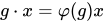
If G is a group acting on a set X, the action amounts to a group homomorphism from G to the automorphism group of X and conversely. Indeed, each left G-action on a set X determines , and, conversely, each homomorphism defines an action by . This extends to the case when the set X has more structure than just a set. For example, if X is a vector space, then a group action of G on X is a group representation of the group G, representing G as a group of linear transformations (automorphisms) of X; these representations are the main object of study in the field of representation theory.


Here are some other facts about automorphism groups:

  • Let be two finite sets of the same cardinality and the set of all bijections . Then , which is a symmetric group (see above), acts on from the left freely and transitively; that is to say, is a torsor for (cf. #In category theory).
  • Let P be a finitely generated projective module over a ring R. Then there is an embedding , unique up to inner automorphisms.[5]

In category theory

[edit]

Automorphism groups appear very naturally in category theory.

If X is an object in a category, then the automorphism group of X is the group consisting of all the invertible morphisms from X to itself. It is the unit group of the endomorphism monoid of X. (For some examples, see PROP.)

If are objects in some category, then the set of all is a left -torsor. In practical terms, this says that a different choice of a base point of differs unambiguously by an element of , or that each choice of a base point is precisely a choice of a trivialization of the torsor.

If and are objects in categories and , and if is a functor mapping to , then induces a group homomorphism , as it maps invertible morphisms to invertible morphisms.

In particular, if G is a group viewed as a category with a single object * or, more generally, if G is a groupoid, then each functor , C a category, is called an action or a representation of G on the object , or the objects . Those objects are then said to be -objects (as they are acted by ); cf. -object. If is a module category like the category of finite-dimensional vector spaces, then -objects are also called -modules.

Automorphism group functor

[edit]

Let be a finite-dimensional vector space over a field k that is equipped with some algebraic structure (that is, M is a finite-dimensional algebra over k). It can be, for example, an associative algebra or a Lie algebra.

Now, consider k-linear maps that preserve the algebraic structure: they form a vector subspace of . The unit group of is the automorphism group . When a basis on M is chosen, is the space of square matrices and is the zero set of some polynomial equations, and the invertibility is again described by polynomials. Hence, is a linear algebraic group over k.

Now base extensions applied to the above discussion determines a functor:[6] namely, for each commutative ring R over k, consider the R-linear maps preserving the algebraic structure: denote it by . Then the unit group of the matrix ring over R is the automorphism group and is a group functor: a functor from the category of commutative rings over k to the category of groups. Even better, it is represented by a scheme (since the automorphism groups are defined by polynomials): this scheme is called the automorphism group scheme and is denoted by .

In general, however, an automorphism group functor may not be represented by a scheme.

See also

[edit]

Notes

[edit]

Citations

[edit]
  1. ^ Hartshorne 1977, Ch. II, Example 7.1.1.
  2. ^ Dummit & Foote 2004, § 2.3. Exercise 26.
  3. ^ Hochschild, G. (1952). "The Automorphism Group of a Lie Group". Transactions of the American Mathematical Society. 72 (2): 209–216. doi:10.2307/1990752. JSTOR 1990752.
  4. ^ Fulton & Harris 1991, Exercise 8.28.
  5. ^ Milnor 1971, Lemma 3.2.
  6. ^ Waterhouse 2012, § 7.6.

References

[edit]
[edit]
Revisions and contributorsEdit on WikipediaRead on Wikipedia
from Grokipedia
In mathematics, particularly in and , the automorphism group of a —such as a group, ring, , or graph—is the set of all isomorphisms from the object to itself, forming a group under the operation of . These automorphisms capture the intrinsic symmetries of the structure, preserving its operations and relations while potentially rearranging elements. For a group GG, the automorphism group Aut(G)\operatorname{Aut}(G) consists precisely of the group isomorphisms ϕ:GG\phi: G \to G, and it plays a central role in understanding the group's structure and classifications. A key distinction within Aut(G)\operatorname{Aut}(G) is between inner automorphisms, which are conjugations by elements of GG (i.e., ϕg(h)=ghg1\phi_g(h) = ghg^{-1} for fixed gGg \in G), forming the inner automorphism group Inn(G)\operatorname{Inn}(G) isomorphic to G/Z(G)G/Z(G) where Z(G)Z(G) is the center of GG, and outer automorphisms, which are the coset representatives in the quotient Out(G)=Aut(G)/Inn(G)\operatorname{Out}(G) = \operatorname{Aut}(G)/\operatorname{Inn}(G). Inner automorphisms always exist and reflect the group's own action on itself, while outer ones, if nontrivial, reveal additional symmetries beyond conjugation. Notable examples illustrate the diversity of automorphism groups. For the infinite cyclic group Z\mathbb{Z}, Aut(Z)C2\operatorname{Aut}(\mathbb{Z}) \cong C_2, generated by the inversion map nnn \mapsto -n. For finite cyclic groups Zn\mathbb{Z}_n, Aut(Zn)\operatorname{Aut}(\mathbb{Z}_n) is isomorphic to the of units U(n)U(n) modulo nn, with order ϕ(n)\phi(n) where ϕ\phi is ; for instance, Aut(Z5)C4\operatorname{Aut}(\mathbb{Z}_5) \cong C_4. In contrast, nonabelian groups like the D3D_3 (symmetries of an ) have Aut(D3)D3\operatorname{Aut}(D_3) \cong D_3 itself, with six elements. These structures highlight how Aut(G)\operatorname{Aut}(G) encodes information about generators and relations in GG, often determined by where automorphisms send generating sets. Beyond groups, automorphism groups extend to other algebraic objects; for example, in Lie algebras, Aut(L)\operatorname{Aut}(L) comprises Lie algebra isomorphisms from LL to itself, with applications in representation theory and geometry. The study of automorphism groups is fundamental in classification problems, such as determining when two groups are isomorphic or computing rigidity in geometric contexts, and it intersects with broader areas like Galois theory, where Aut(K/F)\operatorname{Aut}(K/F) for field extensions describes symmetries of roots.

Fundamentals

Definition

In mathematics, an isomorphism between two mathematical objects is a bijective mapping that preserves the structure of the objects, such as their operations or relations. An automorphism of a mathematical object XX is an isomorphism from XX to itself, representing a symmetry of the object that leaves its essential properties unchanged. The automorphism group of XX, denoted \Aut(X)\Aut(X) (or sometimes Γ(X)\Gamma(X)), is the set of all automorphisms of XX equipped with the group operation of function composition. This forms a group because composition of automorphisms is again an automorphism, ensuring closure; function composition is associative; the identity mapping on XX serves as the identity element; and every automorphism, being a bijective isomorphism, has an inverse that is also an automorphism.

Basic properties

The automorphism group Aut(X)\operatorname{Aut}(X) of an XX (such as a , or ) with underlying set XX embeds naturally as a of the Sym(X)\operatorname{Sym}(X) on XX. This arises from of Aut(X)\operatorname{Aut}(X) on XX by : for ϕAut(X)\phi \in \operatorname{Aut}(X) and xXx \in X, define ϕx=ϕ(x)\phi \cdot x = \phi(x). Since every is a preserving the structure of XX, this induces a of the elements of XX, and the resulting Aut(X)Sym(X)\operatorname{Aut}(X) \to \operatorname{Sym}(X) is injective, making Aut(X)\operatorname{Aut}(X) isomorphic to its image, a of Sym(X)\operatorname{Sym}(X). The center Z(Aut(X))Z(\operatorname{Aut}(X)) consists of those automorphisms in Aut(X)\operatorname{Aut}(X) that commute with every element of Aut(X)\operatorname{Aut}(X) under composition. An element ϕZ(Aut(X))\phi \in Z(\operatorname{Aut}(X)) satisfies ϕψ=ψϕ\phi \circ \psi = \psi \circ \phi for all ψAut(X)\psi \in \operatorname{Aut}(X), meaning ϕ\phi centralizes the entire . In many cases, particularly when of the underlying structure XX is trivial, Z(Aut(X))Z(\operatorname{Aut}(X)) is also trivial, reflecting a lack of non-trivial automorphisms that act compatibly with all symmetries. If the underlying set XX is finite, then Aut(X)\operatorname{Aut}(X) is finite, with order Aut(X)X!|\operatorname{Aut}(X)| \leq |X|!, and more precisely, Aut(X)|\operatorname{Aut}(X)| divides X!|X|! as a consequence of being a of the Sym(X)\operatorname{Sym}(X). For structures with infinite underlying sets, Aut(X)\operatorname{Aut}(X) is typically infinite, though exceptions exist (e.g., the automorphism group of the integers under , which has order 2). The natural action of Aut(X)\operatorname{Aut}(X) on XX by automorphisms is faithful: the kernel of this action, consisting of automorphisms that fix every element of XX , is trivial. This follows directly from the injectivity of the into Sym(X)\operatorname{Sym}(X), as any structure-preserving fixing all elements must be the identity .

Examples

Automorphisms of finite groups

The automorphism group of the cyclic group Z/nZ\mathbb{Z}/n\mathbb{Z} is isomorphic to the of units modulo nn, denoted (Z/nZ)(\mathbb{Z}/n\mathbb{Z})^*, which consists of integers coprime to nn under multiplication modulo nn and has order given by ϕ(n)\phi(n). This isomorphism arises because automorphisms correspond to multiplication by units, preserving the group . For instance, when n=pn = p is prime, Aut(Z/pZ)Z/(p1)Z\operatorname{Aut}(\mathbb{Z}/p\mathbb{Z}) \cong \mathbb{Z}/(p-1)\mathbb{Z}, a of order p1p-1. For non-abelian finite groups, the SnS_n provides key examples. The Aut(Sn)\operatorname{Aut}(S_n) is isomorphic to SnS_n itself for n6n \neq 6, reflecting the highly symmetric nature of where inner automorphisms capture all symmetries. However, S6S_6 is exceptional: Aut(S6)\operatorname{Aut}(S_6) has order 2S62|S_6|, twice that of S6S_6, due to an outer automorphism arising from the transitive action on 6-element sets distinct from the standard permutation representation. The AnA_n, the subgroup of even permutations, also exhibits rigid automorphism structures for larger nn. Specifically, Aut(An)Sn\operatorname{Aut}(A_n) \cong S_n for n7n \geq 7, with the outer automorphisms arising from conjugation by elements of SnAnS_n \setminus A_n. Finite abelian groups offer further illustrations, particularly through their . For a finite abelian pp-group decomposed into cyclic factors via invariant factors, say GZ/pa1Z××Z/pakZG \cong \mathbb{Z}/p^{a_1}\mathbb{Z} \times \cdots \times \mathbb{Z}/p^{a_k}\mathbb{Z} with a1ak1a_1 \geq \cdots \geq a_k \geq 1, the group Aut(G)\operatorname{Aut}(G) can be computed as a matrix group over Z/pZ\mathbb{Z}/p\mathbb{Z} acting on the factors, preserving the exponents. A concrete case is the V4Z/2Z×Z/2ZV_4 \cong \mathbb{Z}/2\mathbb{Z} \times \mathbb{Z}/2\mathbb{Z}, whose automorphism group is isomorphic to S3S_3, the on 3 letters, of order 6; this reflects of permuting the three non-identity elements.

Automorphisms of graphs and geometric objects

In , an automorphism of a simple undirected graph G=(V,E)G = (V, E) is a bijective mapping ϕ:VV\phi: V \to V such that for any distinct vertices u,vVu, v \in V, the pair {u,v}\{u, v\} is an edge in EE {ϕ(u),ϕ(v)}\{\phi(u), \phi(v)\} is an edge in EE. The set of all such automorphisms forms the automorphism group Aut(G)\operatorname{Aut}(G), which acts faithfully as a on the vertex set VV. The order of this group, Aut(G)|\operatorname{Aut}(G)|, quantifies the graph's symmetries and relates to the size of its class through the , where the number of distinct labelings of isomorphic graphs is n!/Aut(G)n! / |\operatorname{Aut}(G)| for n=Vn = |V|. Representative examples illustrate these symmetries. The complete graph KnK_n on nn vertices has Aut(Kn)Sn\operatorname{Aut}(K_n) \cong S_n, the on nn elements, since any of vertices preserves all possible edges. In contrast, the CnC_n for n3n \geq 3 has Aut(Cn)D2n\operatorname{Aut}(C_n) \cong D_{2n}, the of order 2n2n, generated by rotations and reflections that preserve the cyclic structure. Automorphism groups also describe symmetries of geometric objects modeled as graphs. For polyhedra, the automorphism group includes transformations like rotations and reflections that preserve the edge structure. The , with 8 vertices and 12 edges, has full symmetry group Aut([cube](/page/Cube))S4×Z/2Z\operatorname{Aut}(\text{[cube](/page/Cube)}) \cong S_4 \times \mathbb{Z}/2\mathbb{Z} of order 48, where S4S_4 accounts for rotational symmetries permuting the 4 space diagonals, and the Z/2Z\mathbb{Z}/2\mathbb{Z} factor incorporates reflections. A key result connecting and graph symmetries is Frucht's theorem, which asserts that every is isomorphic to Aut(G)\operatorname{Aut}(G) for some finite simple undirected graph GG. This theorem, proved in 1939, highlights the expressive power of graph automorphisms in realizing arbitrary finite group structures. To compute Aut(G)\operatorname{Aut}(G), one approach uses the AA of GG, an n×nn \times n with Aij=1A_{ij} = 1 if {i,j}E\{i, j\} \in E and 0 otherwise. A π\pi of the vertices induces a PP such that π\pi is an if and only if [PAPT=A[P A P^T = A](/page/If_and_only_if), meaning PP conjugates AA to itself. This matrix formulation facilitates algorithmic enumeration of automorphisms by testing permutations that preserve the matrix structure.

Inner and outer automorphisms

Inner automorphisms

In group theory, an of a group GG is an ϕ:GG\phi: G \to G of the form ϕ(g)=h1gh\phi(g) = h^{-1} g h for all gGg \in G, where hh is a fixed element of GG. This conjugation action defines a map from GG to the automorphism group \Aut(G)\Aut(G), and the image of this map forms the \Inn(G)\Inn(G) consisting of all inner automorphisms. The concept extends to other algebraic structures, such as rings or algebras, where conjugation by an invertible element is similarly defined and yields an automorphism. The subgroup \Inn(G)\Inn(G) is isomorphic to the quotient group G/Z(G)G / Z(G), where Z(G)Z(G) denotes of GG, the set of elements that commute with every element of GG. To see this, consider the map ϕ:G\Inn(G)\phi: G \to \Inn(G) defined by ϕ(a)=ia\phi(a) = i_a, where ia(g)=aga1i_a(g) = a g a^{-1} for all gGg \in G. This ϕ\phi is a because iab(g)=abg(ab)1=a(bgb1)a1=iaib(g)i_{ab}(g) = ab g (ab)^{-1} = a (b g b^{-1}) a^{-1} = i_a \circ i_b(g). The kernel of ϕ\phi is precisely Z(G)Z(G), since ia=iei_a = i_e (the identity automorphism) aga1=ga g a^{-1} = g for all gGg \in G, meaning aZ(G)a \in Z(G). Moreover, ϕ\phi is surjective onto \Inn(G)\Inn(G) by construction. By the first theorem, G/ker(ϕ)\im(ϕ)G / \ker(\phi) \cong \im(\phi), so G/Z(G)\Inn(G)G / Z(G) \cong \Inn(G). The subgroup \Inn(G)\Inn(G) is always normal in \Aut(G)\Aut(G), as for any π\Aut(G)\pi \in \Aut(G) and inner automorphism ϕx(g)=xgx1\phi_x(g) = x g x^{-1} with xGx \in G, the conjugate πϕxπ1=ϕπ(x)\pi \circ \phi_x \circ \pi^{-1} = \phi_{\pi(x)} is again inner. A concrete example occurs with the S3S_3 of order 6, which has trivial Z(S3)={e}Z(S_3) = \{e\} since no non-identity element commutes with all permutations. Thus, \Inn(S3)S3/Z(S3)S3\Inn(S_3) \cong S_3 / Z(S_3) \cong S_3, implying \Inn(S3)\Inn(S_3) has order 6. In fact, every of S3S_3 is inner, as the natural conjugation map S3\Aut(S3)S_3 \to \Aut(S_3) is an , confirmed by noting that automorphisms permute the three transpositions (which generate S3S_3) in a way that matches the action of S3S_3 itself. The inner automorphisms arise naturally from the of GG, which embeds GG into \Aut(G)\Aut(G) via the conjugation action: the map \Ad:G\Aut(G)\Ad: G \to \Aut(G) sends g\Adgg \mapsto \Ad_g, where \Adg(h)=ghg1\Ad_g(h) = g h g^{-1}. The image of \Ad\Ad is precisely \Inn(G)\Inn(G), providing a linear perspective in the case of Lie groups, where the differential of \Ad\Ad yields the on the .

Outer automorphisms

The outer automorphism group of a group GG, denoted \Out(G)\Out(G), is defined as the \Aut(G)/\Inn(G)\Aut(G) / \Inn(G), where \Aut(G)\Aut(G) is the full automorphism group and \Inn(G)\Inn(G) is the normal of . Elements of \Out(G)\Out(G) are thus cosets of \Inn(G)\Inn(G) in \Aut(G)\Aut(G), representing equivalence classes of automorphisms where two automorphisms are equivalent if one is obtained from the other by composition with an inner automorphism (i.e., conjugation by an element of GG). This structure captures the "non-internal" symmetries of GG, distinguishing automorphisms that cannot be realized by conjugation within the group itself. The group \Out(G)\Out(G) quantifies symmetries beyond those induced by the group's own elements, and it is often trivial, meaning every of GG is inner. For instance, in many finite groups, including most s, all automorphisms arise from conjugations. However, non-trivial outer automorphisms exist in specific cases, highlighting exceptional symmetries. For abelian groups, where Z(G)=GZ(G) = G and thus \Inn(G)\Inn(G) is trivial, \Out(G)\Aut(G)\Out(G) \cong \Aut(G), so outer automorphisms coincide with all automorphisms. A representative example is the V4Z/2Z×Z/2ZV_4 \cong \mathbb{Z}/2\mathbb{Z} \times \mathbb{Z}/2\mathbb{Z}, for which \Aut(V4)S3\Aut(V_4) \cong S_3 ( on three letters), yielding \Out(V4)S3\Out(V_4) \cong S_3. This isomorphism reflects the action of automorphisms permuting the three non-identity elements of order 2. A classic non-abelian example occurs with the S6S_6, where \Out(S6)Z/2Z\Out(S_6) \cong \mathbb{Z}/2\mathbb{Z}, while \Out(Sn)\Out(S_n) is trivial for all n6n \neq 6. This exceptional outer interchanges the conjugacy classes of transpositions (order 2 elements of cycle type (2)) and double transpositions (products of three disjoint transpositions, also order 2 but of cycle type (2,2,2)), which have the same size in S6S_6 unlike in other SnS_n. Constructions of this include actions on sets of pentads (subsets of five elements) or via embeddings into larger groups, confirming its uniqueness up to composition with inner automorphisms. For finite simple groups, outer automorphism groups are typically small, often trivial, reflecting their rigid structure. By the , \Out(G)=1\Out(G) = 1 for most such GG, but non-trivial cases arise, such as \Out(\PSL(2,7))Z/2Z\Out(\PSL(2,7)) \cong \mathbb{Z}/2\mathbb{Z}, generated by a field automorphism or duality in the projective special linear group. Among sporadic simple groups, 14 of the 26 have trivial \Out(G)\Out(G), while the remaining 12 have \Out(G)Z/2Z\Out(G) \cong \mathbb{Z}/2\mathbb{Z}, as in the M12M_{12} or the Harada-Norton group. These non-trivial outer automorphisms often stem from graph automorphisms or field extensions in the underlying Lie type structures.

Applications in algebra

Automorphism groups of rings and fields

In , an of a ring RR is a bijective from RR to itself, which preserves both the and operations. For commutative rings that are algebras over a base field, such automorphisms typically fix the elements of the base field, as they must map the multiplicative identity to itself and preserve . The automorphism group Aut(K)\operatorname{Aut}(K) of a field KK consists of all field automorphisms of KK, which are bijective maps preserving addition, multiplication, and the multiplicative identity. For finite fields Fpn\mathbb{F}_{p^n}, where pp is prime and n1n \geq 1, this group is cyclic of order nn and isomorphic to Z/nZ\mathbb{Z}/n\mathbb{Z}. It is generated by the Frobenius automorphism ϕ:FpnFpn\phi: \mathbb{F}_{p^n} \to \mathbb{F}_{p^n} defined by ϕ(x)=xp\phi(x) = x^p, which satisfies ϕ(ab)=ϕ(a)ϕ(b)\phi(ab) = \phi(a)\phi(b) and ϕ(a+b)=ϕ(a)+ϕ(b)\phi(a + b) = \phi(a) + \phi(b) due to the freshman's dream identity (a+b)p=ap+bp(a + b)^p = a^p + b^p in characteristic pp. More generally, for Fq\mathbb{F}_q with q=pnq = p^n, Aut(Fq)={ϕk0k<n}\operatorname{Aut}(\mathbb{F}_q) = \{\phi^k \mid 0 \leq k < n\}, where ϕk(x)=xpk\phi^k(x) = x^{p^k}. For infinite fields, the automorphism groups can be trivial or vastly larger depending on the field and any imposed conditions. The group Aut(Q)\operatorname{Aut}(\mathbb{Q}) of the rational numbers is trivial, consisting only of the identity map, since any automorphism fixes 1 and hence all integers by induction, and thus all rationals of the form a/ba/b. Similarly, Aut(R)\operatorname{Aut}(\mathbb{R}) of the real numbers is trivial without assuming continuity: automorphisms fix Q\mathbb{Q}, preserve positivity (as squares map to squares), and thus fix all reals by density of . In contrast, Aut(C)\operatorname{Aut}(\mathbb{C}) of the complex numbers, without continuity assumptions, is enormous, with exceeding that of the continuum, arising from the transcendence degree of C\mathbb{C} over Q\mathbb{Q}, which allows arbitrary permutations of transcendence bases. In , the automorphism group Aut(K/F)\operatorname{Aut}(K/F) of a K/FK/F—fixing the base field FF pointwise—coincides with the when the extension is Galois (normal and separable). The absolute case, where FF is the prime subfield of KK, recovers Aut(K)\operatorname{Aut}(K) as the full group of automorphisms.

Automorphism groups of vector spaces

In a VV over a field FF, an is an invertible T:VVT: V \to V that preserves the vector space structure, and the set of all such automorphisms forms the automorphism group Aut(V)\operatorname{Aut}(V) under composition. This group is isomorphic to the general linear group GL(V)\operatorname{GL}(V), consisting of all invertible linear operators on VV. For a finite-dimensional vector space VV of dimension nn over FF, Aut(V)GL(n,F)\operatorname{Aut}(V) \cong \operatorname{GL}(n, F), the group of n×nn \times n invertible matrices over FF. When FF is the finite field Fq\mathbb{F}_q of order qq, the order of this group is GL(n,q)=k=0n1(qnqk)|\operatorname{GL}(n, q)| = \prod_{k=0}^{n-1} (q^n - q^k), which counts the number of ordered bases for VV. In the infinite-dimensional case, Aut(V)\operatorname{Aut}(V) comprises all invertible linear operators on VV, but studies often restrict to those preserving a chosen Hamel basis or satisfying additional conditions like continuity in topological settings. The choice of a basis for VV identifies Aut(V)\operatorname{Aut}(V) with GL(n,F)\operatorname{GL}(n, F) in the finite-dimensional case, where automorphisms act as matrix multiplications relative to that basis; changing the basis corresponds to conjugation by the change-of-basis matrix. For the standard space FnF^n, elements of Aut(Fn)\operatorname{Aut}(F^n) act by permuting coordinates via matrix multiplication. Special subgroups include the orthogonal group O(n,F)\operatorname{O}(n, F), which stabilizes a non-degenerate symmetric bilinear form, and the symplectic group Sp(n,F)\operatorname{Sp}(n, F), which stabilizes a non-degenerate alternating bilinear form.

Category-theoretic aspects

Automorphisms in categories

In , an automorphism of an object XX in a category C\mathcal{C} is defined as an f:XXf: X \to X, which is equivalently an that admits an inverse within C\mathcal{C}. The collection of all such automorphisms, denoted AutC(X)\mathrm{Aut}_\mathcal{C}(X), forms a group under the composition of morphisms, with the identity morphism serving as the neutral element and inverses provided by the isomorphism property; this group is a subgroup of the monoid HomC(X,X)\mathrm{Hom}_\mathcal{C}(X, X) consisting of all endomorphisms. Automorphisms exhibit naturality in the sense that they are compatible with the morphisms of the category. This compatibility ensures that automorphisms act as symmetries internal to the categorical framework. Illustrative examples appear in concrete categories: in the category Set\mathbf{Set} of sets, Aut(X)\mathrm{Aut}(X) consists of all bijections from XX to itself, yielding the symmetric group Sym(X)\mathrm{Sym}(X); in the category Grp\mathbf{Grp} of groups, it comprises group isomorphisms from a group to itself; and in the category Top\mathbf{Top} of topological spaces, automorphisms are homeomorphisms of the space. These instances highlight how AutC(X)\mathrm{Aut}_\mathcal{C}(X) captures the invertible symmetries specific to each category's notion of isomorphism. In general, AutC(X)\mathrm{Aut}_\mathcal{C}(X) functions as an automorphism group in the sense of ordinary 0-categories, where composition yields the group operation. Regarding monoidal structures, when C\mathcal{C} is monoidal, automorphisms may interact with the tensor product, for instance preserving it up to natural isomorphism in contexts like sheaf toposes, where they relate to automorphism sheaves. Extending to 2-categories, the notion of generalizes to auto-equivalences, which are equivalences F:CCF: \mathcal{C} \to \mathcal{C} (functors invertible up to natural isomorphism), contrasting with strict automorphisms that are strictly invertible functors without needing weak inverses. Strictification theorems allow many 2-categories to be equivalent to strict ones, wherein strict 2-groups emerge, comprising strict equivalences and invertible 2-morphisms under horizontal composition. For example, in the strict 2-category of groups Grp2\mathbf{Grp}_2, the 2-group of a group HH corresponds to the crossed module (HAut(H))(H \to \mathrm{Aut}(H)).

Automorphism group functor

In , the automorphism group functor Aut is defined as a contravariant from a category C\mathcal{C} to the category of groups Grp\mathbf{Grp}, typically restricted to the wide subcategory of C\mathcal{C} consisting of all objects and only the isomorphisms as morphisms (known as the core of C\mathcal{C}, or equivalently via the opposite category Cop\mathcal{C}^{\mathrm{op}} since inverting all isomorphisms yields an equivalent structure). For an object XOb(C)X \in \mathrm{Ob}(\mathcal{C}), Aut(X)\mathrm{Aut}(X) is the group of all isomorphisms XXX \to X under composition. For an isomorphism f:XYf: X \to Y in C\mathcal{C}, the induced group homomorphism Aut(f):Aut(Y)Aut(X)\mathrm{Aut}(f): \mathrm{Aut}(Y) \to \mathrm{Aut}(X) is given by conjugation: Aut(f)(g)=f1gf\mathrm{Aut}(f)(g) = f^{-1} \circ g \circ f for gAut(Y)g \in \mathrm{Aut}(Y). This assignment preserves composition and identities, making Aut functorial on this subcategory, though it does not extend to arbitrary morphisms in general categories like Grp\mathbf{Grp}. This contravariant nature arises because a f:XYf: X \to Y in C\mathcal{C} "pulls back" automorphisms from YY to XX, reversing the direction; viewing it covariantly on Cop\mathcal{C}^{\mathrm{op}} aligns the maps with the reversed arrows. In algebraic categories, such as those of modules or varieties, often admits additional structure, being representable as a (isomorphic to a Hom-functor into a group object), which provides a for automorphism groups via the to the underlying category. For instance, the End()\mathrm{End}(-) is representable, and extracts the group of units therein. A concrete example occurs in the category Grp\mathbf{Grp} of groups. The Aut sends a group GG to its group Aut(G)\mathrm{Aut}(G), the group of group isomorphisms GGG \to G. For an ϕ:GH\phi: G \to H, Aut(ϕ):Aut(H)Aut(G)\mathrm{Aut}(\phi): \mathrm{Aut}(H) \to \mathrm{Aut}(G) is βϕ1βϕ\beta \mapsto \phi^{-1} \circ \beta \circ \phi for βAut(H)\beta \in \mathrm{Aut}(H), preserving the group operation. This induced map reflects how isomorphisms between groups conjugate their respective groups, highlighting the 's role in preserving across isomorphic objects.

References

Add your contribution
Related Hubs
User Avatar
No comments yet.